Natuna Tourism Application Design To Learn
Foreign Language With Mnemonic Method
Yi Ying, Tirta Nugraha Mursitama, Bahtiar Saleh Abbas
Abstract : Tourism is the main driving force of the Indonesian economy. So far, Indonesia's maritime economic potential has not been optimally developed, especially in Natuna. The area of Natuna Sea is 99.25%, so it is very potential to develop marine tourism. Natuna is also included in the planning of the Global Maritime Fulcrum and is given the authority to manage tourism. Natuna Geopark has also been inaugurated by UNESCO in 2019. The presence of a geopark in Natuna will have an impact on the movement of foreign tourists. Thus, it is necessary to prepare human resources for tour guides to welcome foreign tourists. This study describes the design of Natuna Tourism application with an emphasis on mobile-assisted language learning (MALL) to introduce Natuna tourism in Indonesian, English and Mandarin. Through this application, students can learn independently. This application also features pictures and sounds with a quiz that helps learners to memorize vocabulary. Before designing this application, researchers first conducted interviews with the Natuna tourism service and religious high schools. From the interviews, the application was designed using the Mnemonic method. Researchers hope that with applications on smartphones that can be used offline, the Natuna tourism agency will develop and can contribute to improving the maritime economyfishermen, fish processing technology and illegal fishing. Whereas the obstacle in the field of goods distribution is the Sea Toll Program which is of little help due to the trip schedules of ships which are only twice a month. The fishermen's catch has become no longer fresh and cannot be sold at high prices. There should be special treatment for Natuna by developing a model of economic integration of Maritime and tourism.
Index Terms : MALL, Mnemonic Method, Natuna, Natuna Tourism Application, Global Maritime Fulcrum —————————— ——————————
1.
INTRODUCTION
Based on the presentation of Indonesia's Global Maritime Fulcrum (GMF) discourse by the Coordinating Ministry of Maritime Affairs in Jakarta on October 18, 2017, tourism is the main driving force of the Indonesian economy. So far, Indonesia's maritime economic potential has not developed optimally. Marine tourism only contributes 4%, it should be more than that because 75% of Indonesia's territory consists of the sea so the potential for marine tourism is very large. The Natuna waters are considered a potential point for the GMF. Natuna's strategic location across four oceans in the world makes it very important. Natuna is also included in the planning of the GMF with the Sea Toll Program, which provides a Logistics Center that synergizes with SOEs at the Natuna Port. The Ministry of Maritime Affairs and Fisheries since 2014 has prioritized the development of 15 outermost islands and border areas as Integrated Maritime and Fisheries Centers (SKPT). Ten of the locations are being carried out to be completed this year, including in Natuna Regency. In addition, in early 2019, Natuna was designated as a National Geopark area by UNESCO. Thus, this will promote Natuna as a tourism destination. The area of Natuna Sea is 99.25%, this is very potential to develop marine tourism. Natuna is also a potential point for Indonesia to become the GMF because it is located in a very favorable border region that makes Natuna far from the central government. In addition, there are no direct flights to Natuna from major cities in Indonesia, only from Batam. Natuna also does not have many colleges, only one religious-based college. Natuna was declared as one of the GMF regions and was given the authority to develop its tourism. In terms of human resources, especially those who can speak foreign
languages, a solution for independent learning is needed. One of them is through Mobile Learning. M-Learning is the right solution for language learning in Natuna along with increasing applications, shifting communication devices and social networks. In addition, Smartphones and computer tabs are present in the daily lives of Natuna residents. With Mobile technology, learners can access their subject content at the most appropriate time and place. In order to support M-Learning in Natuna by using a mobile phone and by considering the results of the Focus Group Discussion with Natuna officials at the Natuna Regency Regional Development Planning Agency (BP3D) office on October 2, 2018, which said that the signal mobile phone was in Natuna still not stable, the researchers designed an application that can be used offline. This offlline application can help students in learning because the colleges in Natuna still do not have internet facilities, so the learning cannot be online.
The designed application also emphasizes the mastery of two foreign languages namely English and Mandarin. Mandarin is also considered important - besides English - to support the tourism business. Along with the increasing number of tourists from China to Indonesia significantly, so it is necessary to increase the number of tourism guides who can speak Mandarin. In addition, the Chinese Ambassador to Indonesia expects that tourism destinations will also provide the most complete tourism facilities and services including cultural and culinary arts and provide information in Mandarin. Therefore, in order to support the Indonesian government's plans and the development of tourism, especially tourism in Natuna, researchers also designed a Mandarin learning application that also introduces cultural and culinary arts in Natuna in Mandarin. This application is expected to help the Natuna government in preparing human resources who can speak Mandarin to welcome foreign tourists to Natuna, especially tourists from China. This study aims to describe the mobile application developed in order to help prepare human resources, especially tour guides in English and Mandarin. This developed application is called "Natuna Tourism" Application. This application is an update from the previous application which had been demonstrated in 2018 during a research meeting with government officials in ————————————————
Yi Ying, Chinese Department, Faculty of Humanities, Bina Nusantara University, Jakarta, Indonesia 11480. Email: [email protected]
Corresponding author: Tirta Nugraha Mursitama, International Relations Department, Faculty of Humanities, Bina Nusantara University, Jakarta, Indonesia 11480. Email: [email protected]
Natuna. On the Focus Group Discussion which was attended by more than 20 government officials from various levels and fields, researchers received input for the development of material from this application. In addition to this, the development of this application material was assisted by the Natuna Tourism and Culture Office. The application, which contains four foreign language skills (listening, speaking, reading and writing), is planned to be tested on Tourism Vocational High School (SMK) students by the end of 2019. Before being tested on vocational students, researchers first tried it out on students studying Mandarin in Jakarta. From the students' input, the researchers got a picture of the role of the application in learning Mandarin. From these conditions the researchers drew conclusions from the role of M-Learning in learning foreign languages, especially Mandarin.
2.
LITERATURE
REVIEW
2.1. Mobile-Assisted Language Learning (MALL)
Using mobile technology in M-Learning has also become a trend in learning today and this attracts the attention of educators and society (1) (2). Mobile learning is information and communication technology that is used to create new ways in the process of learning foreign languages (3). Mobile technology is also used to support language learning, especially vocabulary (4). Mobile-Assisted Language Learning (MALL) develops effective methods and materials with specialization in mobile learning (mLearning). The main characteristics of mobile learning are such as permanence, accessibility, closeness, interactivity, placement of learning activities (5). Mobile technology provides many advantages that are flexible, low cost, small size, and user friendly (6). MALL is considered a potential tool for language learning and an easy, practical way to help learners of English to learn independently and interactively outside the classroom (7). From the results of the learning of mobile-based language applications, the MALL application has advantages in reading, listening and speaking learning that prove the superiority of the application of MALL (8). MALL is an adaptive process that includes the level of language learner proficiency, perceptual learning style and learning behavior. Researchers use a mobile application to teach vocabulary (9). MALL and Vocabulary Learning (VL) design by focusing on a combination of images & text and sound & text. The results revealed that audio representation can improve memory of the words learned (10). This is also confirmed by Agca and Ozdemir who say MALL has a big influence in Vocabulary Learning by integrating multimedia into learning materials (11). The use of Smart Phones such as the iPhone, Android, Kindle Fire, and iPad in education has proven to arouse the interest of educators in using mobile media for education (12).
2.2. Mnemonic Method in Language Learning
Mnemonic is the art of improving memory with three commonly used techniques, namely Peg Word Method, The Keyword Method and Method of Loci (13). Peg Word Method
Chinese shows that games can increase the interest and assessment of Mandarin language learning for elementary students (18). Research on Sino-Japanese characters and their meaning with static pictures or animated morphs as visual encoding mnemonics shows that the character's visual form is a strong predictor of learning (19). The use of the "Mnemonic Keyword Method" ("MKM") for elementary level English students shows that students who study with the MKM method are better at memorizing vocabulary, both in the short and long term. (20). Eric conducted research with the Method of Loci (MOL) to train participants' memory of their environment. You do this by "placing" items that must be remembered in certain locations with the help of navigation. Participants must take the item and imagine running through the environment again, and "search" for the items in sequence. With the MOL method, participants use a virtual environment that is briefly studied as a basis for MOL. Through MOL, the ability to remember is as effective as considering conditions in the real environment (21).
Thus the need for multilingual staff also increases, especially in the tourism industry. The availability of multilingual staff is a function of the world of education (26). The survey that investigates the attitudes of British entrepreneurs towards the needs and skills of foreign languages was conducted on various tourism companies, which are representatives from all over the UK reveal that overall, there is a demand for foreign language skills and there are gaps in employment (27). For example, available language skills and difficulties in recruiting. In addition, employers generally feel reluctant to promote and support the development of foreign language skills in the workplace. (27). A survey of the needs, functions and problems of using English by 40 tourism employees reveal that speaking ability is the most important ability (28). For the same survey, then the next ability is listening, reading, and writing. The three most relevant functions in using English are providing information, followed by providing services, and offering help. Thus four foreign language skills need to be studied simultaneously. A study of the abilities of students majoring in tourism who held internships in the tourism industry to recreational and tourism industry entrepreneurs about the requirements of foreign languages to work (29). According to a research (30) communication skills are an important element of the hospitality industry and understanding performance expectations is the key to achieving tourist satisfaction. Good oral and written communication skills are the top skills that are important for hospitality practitioners at various position levels. In the tourism industry, the ability to offer and serve demand must be carried out with perfect communication skills to ensure the required quality and performance standards. From the results of research, communication skills (speaking, reading, listening and writing) in English are important for hospitality employees and students who study business and tourism (30).
3.
METHODOLOGY
This research is a qualitative research by conducting interviews with 20 officials of the Natuna Regency Regional Development Planning Agency (BP3D) on October 2, 2018. Interviews were conducted for 1 day. Before the interview was held, the researcher presented an application design that had been previously designed to get input from the relevant journalists. From the results of the Focus Group Discussion, the researchers then develop applications that have been designed to suit the needs of users. The use of Mnemonic Method such as peg word, loci, and picture method is applied in existing vocabulary in each tourism destination to be studied. In addition, a combination of visual and verbal will make it easier for learners to learn. After the application was developed, researchers tested it on 20 students who had studied Mandarin for 6 months. This test is conducted in May-June 2019. The students then download the application on their smart phone. The purpose of the trial is to find out the opinions of students after using this application to learn
Mandarin. From the opinion of these students, the researchers then drew conclusions about the function of the application in helping foreign language learning, especially Mandarin.
4.
R
ESULT ANDD
ISCUSSIONTourism acts as an agent of development on the small island, therefore tourism development in Natuna is very appropriate because it can encourage the economy of the local community. Small islands present significant challenges in terms of sustainable tourism development (31). Tourism can also be a major source of employment and foreign exchange earnings (32). Tourism is also one of the largest and fastest growing industries in the world, and is an increasingly important source of income, employment and wealth in many countries (33). Because of its remote location, the facilities on the small island are also inadequate. Human attractions can replace facilities that do not exist (34). Therefore, to attract tourists, Natuna also promotes tourism that features attractions that involve visitors, such as international scale competitions, such as rowing, swimming and kite flying competitions and so on. Natuna tourism development also needs to be balanced with the provision of tour guide resources that are capable of foreign languages, especially English and Mandarin. Therefore the solution offered by researchers is learning with Mobile Learning with tourism application design. This application can be used to learn four language skills independently (7) (8) and help vocabulary learning (9) (10) with a relatively low cost and can be reached by all levels of society.
4.1. Natuna Tourism Application
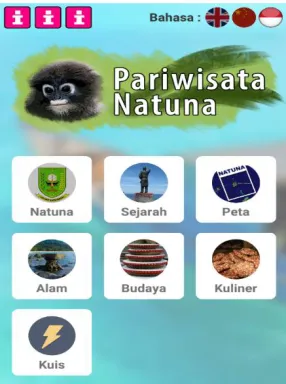
Fig. 1 Application. Frontend
The picture of the 3-state flag and the word "Language" on the right-hand screen shows the application in 3 languages, namely English, Mandarin and Indonesian (Figure 2). If the user wants to change the language according to his wishes, then it can be by tapping the flag image of each country in the
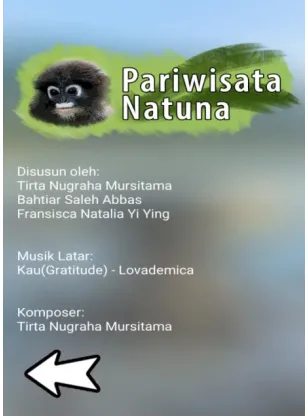
application so that the language on the application screen will change as desired (Figures 3 and 4). Information about application designers, funding agencies and collaborative partners can be seen on the "i" mark on the left-hand corner of the application (Figure 5).
Fig. 2. Three Languages Application
Fig 3. English Application Fig. 4. Mandarin Application
Fig. 6. Information of Application Designers Fig. 7. Information of Funding Agency
This application is used when users need information about Natuna, such as geographical location, history, natural, cultural, and culinary tourism, so users simply tap the display on the screen according to the desired information. For example, a map image (Figure 8). When the user taps the "Map" image above, the Natuna Location will appear in the South China Sea (Figure 9).
When the user taps the sign a hand drawing clue will appear immediately showing the Natuna location (Figure 10). When the user taps the location indicated by the hand image, the Natuna Map image will appear as a whole as Figure 11. A small round gray circle shows Natuna tourist attractions.
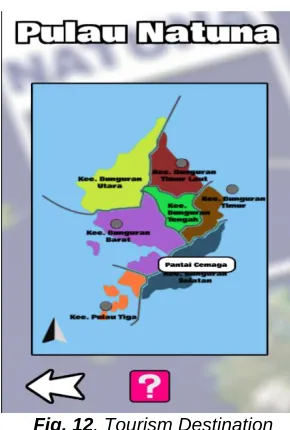
Fig. 11. Natuna Map Fig. 12. Tourism Destination
When the user taps the image of the question mark in the
middle the name of the Natuna tourism location will appear as shown in Figure 12.
When the user taps the name of the Cemaga Beach tourist spot (Figure 12), the tourism location information will appear in Indonesian, Mandarin and English (Figure 13).
When the user taps the arrow image
the user will return to the front screen or the previous
explanation. Users can search for other information that is provided in accordance with their wishes.
When the user taps in Figure 13, a signature will appear indicating the explanation in Chinese. This explanation in Chinese if it is taped will sound in Chinese, so users can learn to hear and read in Chinese (Figure 14).
If the user wants to learn Indonesian and Mandarin vocabulary,
the user can tap the image . When the image is taped, the screen will appear as follows (Figure 15).
Fig. 16. Vocabulary Writing Screen Fig. 17. Vocabulary Writing Sequence Fig. 18. Finger Writing
If the user wants to hear how to read vocabulary in
Chinese, the user can tap the image . Users can imitate the desired vocabulary reading repeatedly by pressing the speaker sign.
If the user wants to learn how to write a word, then simply tap the desired vocabulary, so the white screen will come out. This white screen is used to write vocabulary (Figure 16). To find out how to write based on the sequence, the user can press the desired letter or word (Figure 17). After the user
knows how to write letters, the user can directly write on the desired letter image. (Figure 18).
If there is an error in writing, the user taps the image
so that it will return to the blank screen (Figure 16). If the user wants to know his ability to remember all the meanings of vocabulary contained in the application, then the user can do the exercises in the application (Figure 19).
Fig. 19. Quiz Fig. 20. Meaning and Vocabulary Fig. 21. Wrong and Right Answer
On the quiz, the user pairs the meaning of the vocabulary with the Han letter. If the answer is correct, the letter would turn green and there would be a reading sound (Figure 20). If the answer is wrong, the wrong answer will be orange and the correct answer will appear in green (Figure 21). This application, which uses Mnemonic - which emphasizes memory enhancing techniques - has implemented the technique in every design and material in it. Through the Peg Word Method, students are expected to be able to learn unknown content (14). For example, the content of this application that connects words about known tourist attractions, culture and food names in Natuna, then groups them. The goal is that students learn a series of words that function as "hangers" to "hang" memorized items. One way to do this is to display an interaction between the word used with the peg word and the word that must be remembered. For example, the name of a tourism destination is a Batu Catur. So, the word hanging is chess (catur) so that students can imagine a stone (batu) that looks like chess. Then, the students can test their ability to remember content learned by working on quizzes that are already in the application.
become a tourism guide, students only need to have an android smart phone.
4.2. Feedback of Chinese Literature Student to the Application
Of the 20 respondents who used this application, all answered that the Natuna Tourism application can help in learning vocabulary, especially in terms of helping in learning and remembering the meaning of vocabulary. In addition, 20 respondents also thought that the Natuna Tourism application helped in learning the Han strokes and learning Mandarin tones. This application, which is equipped with text, images and sounds, also helps learning Mandarin. Besides being easy to use, this application can also encourage students to learn independently. According to respondents the advantage of this application is that it can be used anywhere and anytime. The weakness of this application is the absence of complete sentence exercises, there are only vocabulary exercises. So, it is suggested that for the next development there is an exercise in completing sentences so that students are more helped in composing sentences.
5.
CONCLUSION
The limitation of this research is that the application of "Natuna Tourism" has never been widely tested in Natuna so that the likelihood of success of this application cannot be measured yet in helping foreign language learning, especially English and Mandarin in Natuna. It is hoped that for the next research, it can be conducted a trial of the use of applications for students in Natuna who have never learned Mandarin, to find out how this application can help learn English and Mandarin independently and how the results are achieved through learning with the help of this application. From the values and abilities of students in learning foreign languages with the help of this application, the weaknesses of this application will be known to be developed further in the future. In addition, the culture of learning to use smart phones has not been introduced in Natuna so it is necessary to socialize the importance of learning with modern technology. With the cooperation of government officials, education providers and technology-based curriculum developers, students are expected to be able to take advantage of technological advances to improve their competitiveness, especially foreign language skills.
ACKNOWLEDGEMENT
This work is part of Research Grant awarded to corresponding author as principal investigator by the Directorate General of Strengthening for Research and Development, Ministry of Research, Technology, and Higher Education, Republic of Indonesia entitled ―Strategi Pengembangan Perbatasan di Kepulauan Riau dalam Rangka Implementasi Indonesia sebagai Poros Maritim Dunia‖ (Border Development Strategy in Riau Islands as Implementation of Indonesia’s Global Maritime Fulcrum) number 23/AKM/MONOPNT/2019.
empirical studies.‖ Computers Human Behavior, vol. 23, pp 490-501, 2016.
[3] A. A Mustafa et al , ―Effect of the Verbal Mnemonics on Students’ Achievements and their Attitudes.― Procedia - Social and Behavioral Sciences, vol. 47, pp. 1506-1510, 2012.
[4] Q. Wu, ―Learning ESL vocabulary with
smartphones.― Procedia-Social and Behavioral Sciences, vol. 143, pp. 302-307, 2014.
[5] H. Ogata et al, ―Computer supported ubiquitous learning environment for vocabulary learning.‖ International Journal of Learning Technology, vol. 5, no. 1, pp. 5-24, 2010.
[6] Y.M. Huang et al, ―A ubiquitous English vocabulary learning system: Evidence of active/passive attitudes vs. usefulness/ease-of-use.‖ Computers and Education, vol. 58, pp. 273-282, 2012.
[7] M. Rosniah, ―The Acceptance of Mobile Assisted Language Learning (MALL) among Post Graduate ESL Students in UKM.‖ Procedia - Social and Behavioral Sciences, vol. 118, pp. 457-462, 2014.
[8] B. Jack, ―Twenty years of MALL project implementation: A meta-analysis of learning outcomes,‖ vol. 27, no. 1, pp. 4-20, 2015.
[9] F.C. Ou-Yang, and W.C.V. Wu, ―Using Mixed-Modality vocabulary learning on Mobile Devices Design and Evaluation.‖ Journal of Educational Computing Research, vol. 54, no. 8, pp. 1043-1069, 2017.
[10]C. C. Lin, and Y. C. Yu, ―Effects of presentation modes on mobile-assisted vocabulary learning and cognitive load‖ Interactive Learning Environments, pp.1-15, 2016. [11]R. K. Agca, and S. Özdemir, ―Foreign language
vocabulary learning with mobile technologies,‖ Procedia-Social and Behavioral Sciences, vol. 83, pp. 781-785, 2013.
[12]K. Squire, and S. Dikkers, ―Amplifications of learning: Use of mobile media devices among youth,‖ Convergence: The International Journal of Research into New Media Technologies, vol. 18, pp. 445-464, 2012. [13]J. A. McCabe, Integrating Mnemonics into Psychology
Instruction. Office of Teaching Resources in Psychology. 2010.
[14]R. N. Carney, and J. R. Levin, ―Delayed Mnemonic Benefits for a Combined Pegword Keyword Strategy, Time After Time, Rhyme After Rhymey,‖ Applied Cognitive Psychology, vol. 25, pp. 204-211, 2011. [15]T. Ahour, and S. Berenji, ―A Comparative Study of
Rehearsal and Loci Methods in Learning Vocabulary in EFL Context.,‖ Theory and Practice in Language Studies, vol. 5, no. 7, pp. 1451-1457, 2015.
[16]W. Mireel et al. ―The mnemonic keyword method: The effects of bidirectional retrieval training and of ability to image on foreign language vocabulary recall,‖ Learning and Instruction, vol. 17, no. 3, pp. 360-371, 2007.
[19]S. Vanlee, ―The Mnemonic Keyword Method: Effects on the Vocabulary Acquisition and Retention,‖ English Language Teaching, 2013, Vol. 6, No. 10, pp. 1-10. [20] Y. Ying et al, ―Innovation of human resources
development by m-learning to support cross-border tourism event in Natuna,‖ ACM International Conference Proceeding Series, 2018, pp. 16-21. [21]L. G. L Eric et al, ―Building a memory palace in
minutes: Equivalent memory performance using virtual versus conventional environments with the Method of Loci,‖ Acta Psychologica, 2012, Vol. 141, No. 3, pp.380-390.
[22]J. Keirstead, S. Mehta, S. Webb, L. Silveira, H. Khikhol, English at Work:global analysis of language skills in the workplace. 2016, Full report. November Cambridge English Language Assesment. Retrieved from
https://www.cambridgeenglish.org/images/english-at-work-full-report.pdf
[23]L. Zhenfang, and R. Shabbir, ―Mandarin: Conquering the Language Classrooms around the World,‖ American International Journal of Contemporary Research, Vol. 4, No. 3, pp. 48-54
[24]H. P. Wei, and B. J. Li, Duiwai Hanyu Jiaoxue Kecheng Shezhi Ji Jiocai Shiyong Xianzhuang Yanjiu,
2013 (对外汉语教学课程及教材使用现状研究). 四川大
学出版社.
[25]D. Leslie, and H. Russell, ―The importance of foreign language skills in the tourism sector: A comparative study of student perceptions in the UK and continental Europe,‖ Tourism Management, vol. 27, no. 6, pp. 1397-1407. 2006.
[26]D. Leslie et al, ―Needs Analysis on English Language Use in Tourism Industry‖. Procedia - Social and Behavioral Sciences, vol. 66, pp. 117-125, 2012.
[27]D. Leslie et al, ―Foreign Language Skills and the Needs of the UK,‖ Tourism Sector, vol. 18, no. 4, pp. 255-266, 2004.
[28]N. Prachanant, ―Needs Analysis on English Language Use in Tourism Industry,‖ Procedia - Social and Behavioral Sciences, vol. 66, pp. 117–125, 2012. [29]J. Davies, ―Languages for Applied Purposes: A study
of language skills in the leisure and tourism industry,‖ The Language Learning Journal, vol. 21, no. 1, pp. 66-71, 2000.
[30]K-B, Moira, and G. Jasmina, ―The importance of English language skills in the tourism sector: A comparative study of students/employees perceptions in Croatia,‖ Almatourisam-Journal of Tourism, Culture and Territorial Development, vol. 1, pp. 10-23, 2011. [31]W. Butler et al, ―Implementing STD on a Small Island:
Development and Use of Sustainable Tourism Development Indicators in Samoa‖, vol. 10, no. 5, pp. 363-387, 2002.
[32]R. Sharpley, ―Tourism, Modernisation and Development on the Island of Cyprus: Challenges and Policy Responses,‖ Journal of sustainable tourism, vol. 11, no. 23, pp. 246-265, 2003.
[33]F. Neto, ―A new approach to sustainable tourism development: Moving beyond environmental protection,‖ A Unites Nations Sustainable Development Journal, pp. 1-11, 2003.
[34]J. L. Mcelroy, ―Tourism development in small islands across the world,‖ Geografiska Annaler: Series B, Human Geography , vol. 85, no. 4, pp. 231-242, 2016.
[35]Y. Ying et al, ―Suitability of textbook for the improvement of linguistic competence in Chinese by international relations students in Indonesia,‖ Pertanika Journal of Social Sciences and Humanities, vol. 26, no.3, pp. 1241-1252, 2018.
2018,