Load Sharing as a Power Management Strategy for
Mobile Computers
Mazliza Othman
A dissertation submitted in partial fulfilment o f the requirements for the degree of
Doctor of Philosophy
o f the
University of London
Department of Computer Science
University College London
ProQ uest Number: U 6 4 2 8 3 8
All rights reserved
INFORMATION TO ALL U SE R S
The quality of this reproduction is d ep en d en t upon the quality of the copy subm itted. In the unlikely even t that the author did not sen d a com plete manuscript and there are m issing p a g e s, th e se will be noted. Also, if material had to be rem oved,
a note will indicate the deletion.
uest.
ProQ uest U 6 4 2 8 3 8
Published by ProQ uest LLC(2016). Copyright of the Dissertation is held by the Author. All rights reserved.
This work is protected against unauthorized copying under Title 17, United S ta tes C ode. Microform Edition © ProQ uest LLC.
ProQ uest LLC
789 East E isenhow er Parkway P.O. Box 1346
Abstract
Load sharing has traditionally been used to improve system performance in distributed
networks by transferring jobs from heavily loaded hosts to idle or lightly loaded hosts.
Performance is improved by distributing workload more evenly among hosts, thus better
utilising system resources.
This thesis investigates the use of load sharing for a different purpose^ that is as a power
management strategy for mobile computers. Since mobile computers operate on limited battery
power, which is a scarce resource, and there is unlikely to be a vast improvement in battery
capacity in the near future, it is vital that power utilisation is managed efficiently and
economically.
The power management strategy proposed in this thesis is based on the concept of load sharing.
The strategy attempts to reduce power consumption by the CPU, which is one of the
components consuming a substantial amount of power, by off-loading computations from a
mobile computer to a fixed host. A load sharing algorithm which selects suitable Jobs for
remote execution is proposed. When designing the algorithm, the inherent limitation of
wireless networks must be taken into account. For example, low bandwidth means that
communications delays are no longer negligible; sending and receiving messages must also be
considered carefully as transmitting and receiving also consume a substantial amount of power.
Consequently, when performing load sharing on wireless networks, more constraints have to be
dealt with compared to when performing load sharing on fixed networks. In addition to
reducing power consumption, transferring jobs for remote execution also gives users access to
faster machines, thus improving response time.
This study identifies the conditions and factors which make job transfer a viable option. The
results obtained show that under suitable conditions, load sharing can extend battery lifetime
significantly. Since stability is an important concern when designing load sharing algorithms,
Acknowledgement
I would like to express my gratitude to people who have supported me throughout my
postgraduate study;
• first of all, my parents, for their love and support. Where would I be without them!;
• my supervisor. Dr. Stephen Hailes, for his invaluable guidance and advice, and for being
such a wonderful mentor;
• Dr Hale Cuss from the Language Centre who taught the Thesis Writing Course';
• Mr John Wilkes, from Hewlett Packard, for providing the hard disk trace data used in part of
this study;
• fellow sufferers in room 208, Paul, Minseok and Cedric;
• Jungwon, Nadia and Kanta for 'depression outings', and for recommending good books to
read;
• Faez, Gie, Anis and Nor ley, for putting up with my emails, moaning about my predicament;
• Raeis, for making sure I do not forget my mother tongue;
• and finally, Ronnie, for keeping me company while I was tapping away at the keyboard.
"And in the alternation o f night and day,
and the provision (rain) that God sends down from the sky, and revives therewith the earth after its death,
and in the turning about o f the winds, are signs fo r a people who understands. "
Table of Contents
1. Introduction... 7
1.1 Hypotheses... 8
1.2 Contributions...8
1.3 Thesis O utline...9
2. Wireless Networks and Mobile Computing Issues... 11
2.1 Mobile Computing Applications and Services...12
2.2 Limitations and Challenges o f Wireless N etw orks... 16
2.3 Power Management Strategies...20
2.3.1 Power Management Strategies for Hard D isks... 22
2.3.2 Power Efficient Communications...30
2.3.3 Power Management Strategies for C P U s... 33
2.4 Conclusion...38
3. Load Distribution in Distributed System s... 40
3.1 Load Sharing P olicies...42
3.1.1 Information and Location P olicies...43
3.1.2 Transfer P olicy... 47
3.1.3 Job Selection P olicy... 48
3.2 Effect of Communication Delays on Load Distribution...53
3.3 Stability and Scalability...53
3.4 Conclusion... 55
4. Load Sharing in Wireless N etw orks... 57
4.1 An Approach to Load Sharing in Wireless N etw orks...57
4.2 The Load Sharing A lgorithm ... 59
4.3 Trace D ata... .62
4.4 Power Consumption... 63
4.5 Assumptions... 64
4.6 The Simulation Environment ... 65
4.6.1 E ntities...65
4.6.2 System Param eters... 68
4.6.3 Experimental D esign... 70
4.6.4 Performance M etrics... 73
4.6.5 Data A nalysis... 73
4.7 Summary... . 74
5. Factors Influencing Load Sharing in Wireless N etw orks... 75
5.1 Bandwidth... ... ... 75
5.2 Processor Power o f Mobile Com puters... 79
5.3 CPU Utilisation... 82
5.4 History and A L S ... 83
5.5 Combining Load Sharing with a Disk Spin-Down Strategy... 85
6. Stability and Scalability of the Load Sharing Algorithm... 90
6.1 Backoff Algorithm ... 92
6.2 Slotted LS A lgorithm ... 95
6.3 Delegating Job Transfer R equests... 103
6.4 Conclusion... 107
7. Emulation of Load Sharing on a Wireless L A N ...108
7.1 Results of Emulation and Sim ulation... 109
7.2 Conclusion... 114
8. Future W ork... 115
8.1. Future System s... 115
8.2. Applicability of this W o rk... 117
8.3. Future w o rk ... 118
9. Conclusion... 120
T a b l e o f F i g u r e s
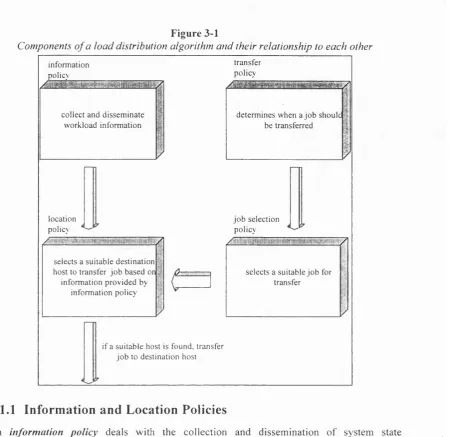
3-1 Components o f a load sharing algorithm ... 43
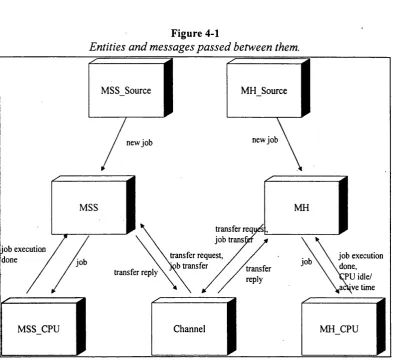
4-1 Entities and messages passed between them ... 66
5-1 Battery lifetime improvement vs. available bandw idth... 77
5-2 Percentage o f jobs transferred vs. available bandw idth ...77
5-3 Communication delays vs. available bandw idth...78
5-4 Battery lifetime improvement vs. processor p o w er...80
5-5 Response time improvement vs. processor p o w er...81
5-6 Battery lifetime improvement vs. CPU utilisation... 83
5-7 Performance o f History and ALS compared to L S ...85
5-8 Battery lifetime improvement combining load sharing with a disk spin-down strategy... 87
6-1 Performance o f LS vs. total u sers... 91
6-2 Performance o f load sharing degrades beyond no load sharing... 91
6-3 Percentage o f jobs transferred vs. total u sers...91
6-4 Percentage o f rejected requests vs. total u s e rs...92
6-5 Battery lifetime improvement of LS and Backoff... 93
6-6 Percentage o f rejected requests o f LS and B ack o ff... 94
6-7 Response time improvement of LS and B ack o ff... 94
6-8 Battery lifetime improvement for Slotted LS, Backoff and L S 99 6-9 Response time improvement of Slotted LS, Backoff and L S ... 100
6-10 . Performance o f LS with probes... 104
6-11 Percentage o f rejected requests of Probes and L S ... 104
6-12 Percentage o f rejected requests of LS, P=2 and Slotted P r o b e 105 6-13 Battery lifetime improvement for LS, P=2 and Slotted P r o b e ...105
6-14 Percentage o f jobs transferred for LS, P=2 and Slotted P r o b e ...105
6-15 Response time improvement for LS, P=2 and Slotted P r o b e ...106
7-1 Battery lifetime improvement for emulation and simulation... 110
7-2 Percentage o f jobs transferred for emulation and simulation... 111
7-3 Response time improvement for emulation and simulation... I l l 7-4 Emulation: battery lifetime improvement vs. CPU utilisation... 112
In loving memory, bapa.
1. Introduction
In recent years, the basic technology has become available to make wireless computing a
reality. In addition, changing work patterns and an understanding of what technology might
be able to provide have become business drivers pushing towards environments in which
tetherless computing has a significant role to play. It is not, therefore, surprising that the
research community have become increasingly interested in this area, driving it forward from
the lower levels.
The technologists' goal is to produce systems which are practicable. There are several key
characteristics of mobile systems which must be addressed in order to allow this to happen.
Wireless links are relatively slow and unreliable; wireless hosts are resource poor relative to
their fixed counterparts; mobile users may roam the globe, disconnecting from and
reconnecting to the network arbitrarily; and mobile hosts must rely on battery power for
significant periods of time. It is this latter problem that this dissertation seeks to address.
Under continuous use, a typical laptop battery lasts for approximately two to three hours.
There has been relatively little in the way of innovation in battery technology over the past
decade. In 1992, Sheng et al projected a 20% increase in battery capacity over a ten-year
period [Shen92]. More recently, Cox stated that there is unlikely to be a lOx improvement in
battery capacity [Cox95]. Since the power supply problem cannot easily be solved, the only
practical solution to providing greater system availability is to reduce power consumption.
There are several existing approaches to this problem already in use within laptops, generally
based on powering down hardware components when they are not in use. However, studies
based on such approaches have failed to consider how best to exploit the potential for power
saving which can be derived from the existence of a communication link.
In this study, we adopt an approach based around the concept of load sharing, which has
traditionally been used to improve job response time in distributed systems. It is sometimes
forgotten that the question of load distribution is simply an instance of a more general class of
resource allocation problems, with the objective of optimising Job response time. Here, the
problem is similarly to do with making the most of a resource, that resource being battery
power and the optimisation constraints being to minimise the amount o f power used. As in
load distribution, the problem is non-trivial; there is a need to invest power in transmitting a
job to the fixed network in order to receive benefit by allowing the CPU to be placed in doze
mode. Again, as in load distribution, the benefit cannot be known precisely at the point of
1.1 Hypotheses
Since the load sharing algorithm now operates in ah environment which is much different
from the environment previously studied, factors influencing the benefit gained from load
sharing are also expected to be different. In this study, it is expected that:
• low bandwidth impedes load sharing as long delays might result in increased response
time,
• mobile hosts with low processor power benefit from load sharing as that gives them access
to faster machines on the fixed network,
• it is jobs with long execution time that brings significant benefit from transfers as they
considerably reduce power consumption by the CPU,
• combining load sharing with another power management strategy will further extend
battery lifetime,
• delegating transfer requests among fixed hosts will further improve performance as users
are given access to other fixed hosts' spare capacity.
Experiments were carried out to verify these hypotheses, and determine if load sharing brings
significant improvement in battery lifetime.
1.2 Contributions
The contributions of this thesis is listed below:
1. This study has successfully adopted a well-known concept in distributed systems to
address a problem in mobile computing. It is possible to adopt load sharing for use in a
mobile computing environment as a power management strategy, and load sharing was
found to be a potentially effective power management strategy. On average, battery
lifetime was extended by about 20% when load sharing was performed. In an experiment
which combined load sharing with another power management strategy, battery lifetime
was extended by an average of 33%.
2. This study identified the necessary modifications required in order to implement load
sharing in a mobile computing environment, taking into considerations the constraints of
wireless networks and the objective to be achieved.
3. In addition to establishing that load sharing does extend battery lifetime significantly, the
findings also identify factors which are favourable, and which may impede load sharing.
Among the finding of this study is that low bandwidth does not always impede load
sharing was also found to be useful in giving mobile hosts access to faster machines on the
fixed network.
4. This study identified the type of applications which are most likely to benefit from load
sharing. Previous studies on load sharing have found that it is CPU-intensive jobs that
have most to benefit from load sharing. The findings o f this study show that this is also
the case in a mobile computing environment. Off-loading CPU-intensive jobs to fixed
hosts extends the duration the CPU operates in doze mode considerably, thus reducing
power consumption. A power management technique which reduces power consumption
by the CPU is especially important when a user is using his mobile device to perform
CPU-intensive jobs, in which case it is critical that battery power is not suddenly depleted,
resulting in a considerable amount of frustration on the part o f the user. It is imperative
that the power management strategy should be able to prolong battery lifetime in order to
allow the user to finish his tasks. It is on the basis o f these considerations that we argue
the merits and importance o f our proposed approach.
5. This study shows that it is possible to make use o f unutilised resources on fixed hosts to
conserve battery power on mobile computers.
1.3 Thesis Outline
The thesis outline is as follows. The wireless networks and mobile computing issues are
discussed in Chapter 2. This starts with an overview o f the diversity o f mobile applications,
followed by a discussion of the challenges which must be met in order to support mobile
users due to the inherent limitations of wireless communications. The power management
strategies proposed thus far are examined.
Previous studies on load distribution in distributed systems and the extent to which they are
relevant to this study are discussed in Chapter 3. This is followed by a discussion on load
distribution policies and the effect o f communication delays on the performance of load
distribution algorithms. Finally, the importance o f addressing stability and scalability issues
are discussed.
In Chapter 4, the approach taken in designing a load sharing algorithm for wireless networks
is described. The reasoning behind the design decisions and the factors which were taken
into account in developing the algorithm are explained, and the extent to which previous work
on load distribution is relevant is discussed. This is followed by a discussion on the trace
data collected for use in the simulations, the assumptions made, the simulation environment,
In Chapter 5, experiments carried out to determine factors influencing load sharing in
wireless networks are discussed. In addition, the benefit o f combining load sharing with
another power management strategy is also examined.
In Chapter 6, the issue of stability and scalability of the load sharing algorithm are addressed.
The modifications carried out on the proposed load sharing algorithm to prevent instability
are discussed. The way in which the algorithm is modified to disable itself when load sharing
is no longer feasible and the parameters influencing that decision are explained.
In Chapter 7, the emulation carried out to verify and validate the simulation results is
discussed. The emulation results are compared to the simulation results in order to determine
the extent to which the simulation represents a real environment.
In Chapter 8, a vision for the future wireless and mobile applications is discussed, followed
by a discussion on the applicability of this work. Possible future work is also explored.
2. Wireless Networks and Mobile Computing Issues
Advancing technology in wireless communication offers users anytime, anywhere access to
information and network resources without restricting them to the fixed network
infrastructure. Mobility introduces new challenges as several assumptions made regarding
distributed networks are no longer valid. Many of the research issues regarding wireless
networks and mobile computing are not new, for they have been discussed in the context of
distributed systems. However, the fact that users are no longer restricted to fixed hosts, that
users are free to roam the globe and can connect to a network from various locations, and that
addresses no longer give the location o f a machine, have made the research problems harder
and more interesting.
Wireless networks are also associated with various constraints - bandwidth is scarce, the
quality of connection varies, communication delays are high and users may disconnect
frequently from the network. In addition, mobile devices usually have lower computing
power and storage capacity compared to a host on a fixed network. Mobile devices and
applications have to address these limitations in order to deliver services which are of
acceptable quality to the users. As users roam, they will encounter heterogeneous network
environments and computing resources may become lost or new resources may become
available. Mobile applications need to be smart enough to be able to make full use of
resources as they become available.
Katz [Katz94] saw the progress in wireless communications as the next logical step in the
evolution o f computers, where computing resources can be used more flexibly as users are
freed from being physically connected to the underlying network. He defined wireless
information systems as computing systems that provide the ability to compute, communicate
and collaborate anywhere at any time. In his paper, Katz gave the following definitions,
though it should be noted that there is no general consensus in this matter;
• Wireless computing refers to computing systems that are connected to their environment
via wireless links, such as radio frequency (RF) or infrared (IR), and usually apply to
computing devices participating in a wireless LAN, with gateways to wired networks.
Users are able to participate in work groups via a collection o f computing devices and
servers in order to share data and information, implying relatively symmetric bandwidth
between the wireless node and the network, and relatively high bandwidth.
• Nomadic computing refers to the ability to compute as users relocate from one computing
environment to another. In this scenario, individual organisations with their own wireless
will make it possible for a user to use his own device within a foreign organisation's
wireless infrastructure. The issues of trust, security and privacy must be addressed to
enable users to roam in foreign environments while protecting their privacy, and the
foreign networks against malicious users.
• Decoupled computing refers to the ability to compute when disconnected from the
network. If mobile devices are full-function computers such as notebook computers,
decoupled computing makes operations such as file access transparent across
disconnections by using techniques such as prefetching and caching.
Katz also predicted that the distinction between communications and computing will continue
to blur, leading to a new field of telecomputing.
In addition to the definitions above, Weiser [Weis93] presented the interesting idea of
ubiquitous computing where computers are made 'invisible' to users by integrating them into
users' environment. He pointed out that anthropological studies of work life showed that
people primarily work in a world of shared situations and unexamined technological skill.
The computer technology today does not conform to this description because it remains the
focus of attention instead o f being a tool which disappears from users' awareness. Ubiquitous
computing aims to make computers widely available throughout user environments and
effortless to use. In other words, users should be able to use computing devices without
having to acquire technological skills to use them.
The definitions above indicate different classes of applications and, in the following sections,
the diversity of mobile/wireless applications will be described, followed by a discussion on
the constraints and limitations imposed by wireless networks which must be addressed in
order to provide services which are of acceptable quality to the users. Later, how this thesis
addresses one o f the constraints of mobile computing, that of power management, is
discussed.
2.1 Mobile Computing Applications and Services
There is a wide range of applications (either under study or readily available) to support users
on the move. The applications and services range from personal guides and electronic news
services to collaborative applications for emergency services.
Mobile context-aware applications can be used as personal guides in museums and galleries
which will allow users to take personalised tours [Long96]. Information about an exhibit is
downloaded as a user moves towards it and he could then download more detailed
information about it. Personal guides are different from human guides in that a user can
using active beacons or identified using computer vision recognition. The hand-held devices
might use position measurement systems such as indoor beacons or The Global Positioning
System (GPS) to locate users, and an electronic compass or inertial navigation system to find
user orientation.
Context-aware devices can also be used as a measurement tool and to assist field studies.
Simple hand-held sonar devices can be adapted to videotape and map a room along with
user's comments. An ecological field study may be assisted by a device that automatically
records the context of a particular species, assists the user in recognising plants, and also
notes the surrounding objects. Another application is as an enhanced reality tool where a
head-up display provides "x-ray vision" for a user surveying a building for renovation, to
indicate the location of hidden plumbing or electrical conduits to the user based on
information from sensors and/or building plans.
Another class of application is electronic news services discussed by Imielinski and Badrinath
[Imie94b]. The electronic news services deliver and filter information according to
individual user profiles. For example, traffic information or weather reports are filtered
based on users' locality, while stock information is filtered according to users' portfolios.
This class of application is further illustrated by Shekar and Lin [Shek94] who described an
application known as Advanced Traveller Information System (ATIS), which provides up-to-
date information on weather and road conditions. It also provides travel information such as
diversions, construction zones, bus schedules and parking etc.
Imielinski et al [Imie95] predicted that the massive market for mobile computing which will
emerge by the end of the decade will be based on mail-enabled and information services
oriented applications. These applications differ from traditional applications in that they are
not computationally intensive applications and will not need to run on powerful computing
devices.
Duchamp [Duch92] predicted that mobile applications will metamorphosise low-skill and/or
labour-intensive jobs into more information-based tasks which will affect people whose job
involves movement over a wide area in order to deliver things or to visit immovable people or
things, e.g. repair personnel, nurses and inspectors. Katz [Katz94] gave examples of how the
metamorphosis envisioned by Duchamp will change the way people in various fields work.
Wireless information systems will make possible collaborative applications that require
untethered real-time access to multimedia information sources to provide support for
personnel in the field, emergency services, law enforcement, mapping and location finding
Katz illustrated the diversity of wireless communications in a crisis management application
using a multimedia terminal for fire-fighters. The application can be used to provide maps
and architectural blueprints to assist in planning fire-fighting strategy. A locator system may
be incorporated to track team members as they move through the building. It should also
provide voice and data communications among the team and other emergency and civil
defence teams. The dynamic nature of this combined data makes it impossible to pre-store all
information on the mobile device; instead, communication with a wide range o f data rates
must be supported, some of it unidirectional, some bidirectional and interactive. For
example, symmetric communication is required to communicate with other members of the
team, while downloading maps and location and tracking systems can be supported by
asymmetric communication.
Mobile computing technology can also be used to support field work and increase
collaboration among field workers by providing on-line access to information and interactive
communication facilities. The MOST project (Mobile Open Systems Technologies for the
Utilities Industries) was established to examine the impact o f mobility on working practices
and on the repercussions for computer systems support [Davi93, Chev94, Frid96]. It focused
on the IT requirements o f field engineers within the power distribution industry.
Engineers working in the field were traditionally coordinated by a single control centre which
approved all switching in the power distribution network and maintained an overall picture of
the current state. The centralised approach ensured that conflicting requirements were
resolved safely, but the centre became a bottleneck. The main disadvantages of this approach
were the global network state was not available to engineers in the field and efficiency was
reduced due to the bottleneck. The second point was particularly crucial when faults
occurred requiring multiple unscheduled items o f work to be carried out.
In order to help field engineers work more efficiently, they were given access to information
previously held only at the control centre and were allowed to collaborate by exploiting the
GSM network. Information which rarely changed was provided on a CD-ROM or stored on
hard disk, while dynamic information was provided via a communication link to the centre.
The new system also allowed them to update the current state to reflect the operations they
carried out. Engineers not physically located together were able to view and manipulate
shared diagrams and information. They were also provided facilities so that they could
communicate with each other to ensure that conflicting switching requirements were resolved
safely. The application had real-time aspects and was based on a peer-to-peer architecture
Another example o f collaborative application in the field is W ireless C oyote [Gran93], which is an experiment conducted by Apple Classrooms o f Tomorrow (ACOT) in
cooperation with Orange Grove Middle School o f Tucson, Arizona. An experiment was
conducted to investigate how teachers and students could use technology in education.
Mobile computers were connected by a wireless local area network (WLAN) and a wide area
network (WAN) and a spreadsheet program was designed to provide real-time data sharing,
immediate data display and real-time graph plotting. Students were provided with voice-
activated walkie-talkies to support collaboration so that they could discuss their findings.
This experiment involved 5 groups of students, four teachers, a naturalist and personnel from
Apple Computer. The students made a field trip to learn about Sabino Canyon in Tuscon.
Four of the five groups were placed at different locations in the canyon, where three groups in
the canyon used traditional scientific methods to measure soil and water temperature, wind
speed and soil pH in their assigned locations, and the fourth group served as a base station
and provided coordination among the other three groups by walkie-talkie, delivered additional
supplies and coordinated requests for two digital cameras among the three groups. The base
station was not involved in data collection, but was responsible for monitoring data collection
activities of the field groups and transferred those data by cellular modem to the fifth group,
located at the school which was 15 miles away. The school group built a database about the
canyon based on the data collected by the field groups and used print and video resources at
the school to add images and other content to their database. The naturalist provided them
with expert opinion to help them to understand their findings.
The LAN made each group's data instantly available to all; consequently, they were analysing
environmental data of the whole canyon. The walkie-talkie helped students and teachers to
discuss their findings and to decide on the next step to take. The interactive nature of the
application made the learning process more interesting and fun for the students.
Other collaborative applications proposed are Bayou [Deme94] and W ebE xp ress [Hous96]. Bayou is an architecture which provides users with facilities to share appointment calendars, documents, bibliographic databases etc. in spite o f intermittent network connectivity.
W ebE xpress was designed for repetitive commercial applications and targeted for visiting medical personnel, salespersons, service workers who carry out repair at remote locations etc.
It was designed to reduce data volume and latency of wireless communication.
This section illustrates the diversity o f mobile applications and how the applications might
change the way people work. Naturally, prediction o f future trends is highly speculative and
often subject to over-optimism by those in the field. However, it is undoubtedly the case that
now large commercial concerns whose existence derives from mobile telephony who have a
vested interest in seeing (and selling) the expansion of the sort of services they offer.
Consequently, the claims made for wireless computing are probably not far wide off the
mark, although timescales may differ and commercial pressures are likely to play the major
role in determining how far and how fast we can go. In the next section, the limitations of
wireless networks and the challenges which must be met in order to deliver mobile
applications at a quality of service which is acceptable to the users is discussed.
2.2 Limitations and Challenges of Wireless Networks
Several issues must be addressed in order to deliver the sort of applications and services
described in the previous section. The problems encountered are not only due to the inherent
limitations of wireless communications, but also due to the fact that the locations of mobile
users/devices are constantly changing as users move. The configuration of a wireless
network changes dynamically because users are no longer attached to a fixed point during the
duration of a connection. The problem is further compounded by heterogeneous
environments encountered by users as they move between various points o f attachment.
The amount o f bandwidth available to users as they move between networks varies greatly.
While connected to a wireless LAN, a user may have available bandwidth o f up to 2 Mbps, or
10 Mbps in the near future while when venturing outdoors, the available bandwidth may drop
to only 9.6 kbps. Considering the amount of bandwidth currently available on fixed networks
and the bandwidth-consuming applications available in the market, the low bandwidth, high
latency communication medium offered by wireless networks must be considered primitive.
Satellite-based systems which provide wide area coverage are also used to provide the
wireless communication infrastructure, albeit at a very high cost. Among well known
satellite services are Odyssey, Globalstar and Iridium. There are three types o f satellite
services:
1. Geostationary/Geosynchronous O rb it System (GEO), which is positioned 36,000 km
above the earth, requires expensive satellites and large antennas, but with only three
required to cover the earth. GEO may provide hundreds of high bit-rate data links using
multiplexing, but involves a transmission delay of 0.5 second due to its high altitude. Its
large regional coverage makes it difficult to provide the small-cell coverage necessary for
frequency reuse to provide higher overall system capacity.
2. Low E arth O rbit System (LEO), which is positioned 1000 km above the earth is the
least expensive of the three types of satellite systems, but more is required to cover the
within a given spectrum allocation. The transmission delay is also significantly less than
GEO.
3. Medium Height E arth Systems (MEG) is between the two extremes.
A much less expensive alternative to satellite systems is offered by the Stratospheric
Telecommunications Services, which uses air platforms that remain geo-stationary above
metropolitan cities to provide T l/E l access to users in the service area’. The air platforms,
which are positioned 22 km above the earth, incur very low communication delays and low
infrastructure costs.
Apart from the variability of available bandwidth, users may also experience rapid and
massive fluctuation in the quality of service provided by the wireless infrastructure
[Davi94b]. Bagrodia et al [Bagr95] stated a fundamental way in which mobile computing
differs from conventional operation is the huge variability in connectivity to users' computing
environments. Even though there will be improvements as these limitations are addressed in
future technologies, the discrepancy between wired and wireless networks are likely to
remain [Wats94]. Badrinath and Welling [Badr95] claimed that although the constraints of
mobile computing will become less noticeable, the mobility o f devices will always induce
constraints compared to non-mobile devices. Ebling et al [Ebli94] stated that even as global
wireless connectivity becomes available in the near future, much o f it will be intermittent
with low bandwidth and high latency and will be limited to a few oases in a vast desert of
poor connectivity. Watson [Wats94] argued that the limitation imposed calls for a software
architecture which reduces the demands placed on the wireless link and supports
disconnected operation.
It is very unwise to make any assumptions about the underlying support provided by the
network infrastructure because, as users encounter heterogeneous environments while
moving, resources and services not previously available may now be offered by the new
network, or a critical service needed to run an application may be lost [Davi94a, Davi94b].
Mobile applications must deal with this heterogeneity and try to deal with failure gracefully
while minimising inconvenience to users. Davies et al [Davi94b] termed the class of service
which is designed to operate in a dynamic environment, and is able to adapt itself to the
heterogeneity of the network as adaptive service, while Katz [Katz94] termed this type of
communication adaptive communication. Katz regarded making applications aware of their
limited and dynamically changing bandwidth as a critical challenge. Applications designed
for mobile users must take into consideration the resource constraints they may face and be
able to make the best possible use of available resources [Badr95], and they may need to
present different views o f functionality and quality depending on the location o f the mobile
device.
Duchamp et al [Duch91, Duch92] listed the challenges in designing system software to
insulate applications from hardware and networking changes imposed by mobility:
1. Support fo r mobile operation: most current software for distributed computing assumes
that computing devices do not move and packets are routed based on network number.
This is especially true for routing protocols like the Internet Protocol (IP). This
shortcoming, however, has been addressed by protocols such as Mobile IP [John97,
Perk97a, Perk97b].
2. User interface design fo r very small computers: the user interface has to be modified to
accommodate the shrinking size of portable computer's display.
3. Adjustments to new hardware trade-off: the hardware employed by portable devices will
inevitably be different from hardware devices on fixed networks. For example, since
portable devices might have reduced disk storage, new storage management algorithms
will have to be designed.
4. Emerging new technologies: applications should be able to adjust and take advantage of
any unique characteristics o f new technologies that might be used in future portable
workstations.
5. Security: providing authentication, accounting and management over a wide area and
across organisations is not a new problem, but is aggravated and made more urgent by the
advent of mobile computers.
6. Compatibility: the requirements above should be provided while retaining a reasonable
level of compatibility, i.e. applications should provide interfaces and performance so that
a user’s desktop computing environment is available in his/her hand without the need to
rewrite applications.
Davies et al [Davi93] classified the challenges of mobile computing technology as being
either communications, distributed systems or cooperative working, which are explained
below:
1. Communication issues: most existing wireless protocols are tailored for voice whereas
mobile computing technology needs media access protocols for the radio channel which
exploit the characteristics of the media and are suitable for transmitting a wide range of
2. Distributed system issues: the low bandwidth and error-prone wireless communication
medium calls for object replication and message batching techniques to overcome the
problems associated with poor communication channels.
3. Implications fo r collaborative working: collaborative applications in high-bandwidth
networks often use multimedia to enhance interaction among users. The wireless
communication medium restricts the range o f services which can be offered by
collaborative applications and the impact of this restriction on users' ability to collaborate
has to be studied.
Davies et al's study o f currently available technology and the user requirements of mobile
computing systems led them to conclude that there is a significant mismatch between the two.
Katz [Katz94] stressed that in spite o f the discrepancies between wired and wireless
networks, mobile users should have access to the services they see in wired networks, albeit
at potentially lower resolutions and possibly longer latencies. A crucial challenge is to make
applications aware of their limited and dynamic environment so that they can adapt to what is
available as appropriate.
Other constraints faced by mobile devices are that they have significantly lower memory
capacity and computing power compared to a fixed host. For this reason, Badrinath et al
[Badr93] proposed that the computation and communication load should be borne by the
static network as much as possible. Doing so will reduce the burden o f computation on
mobile hosts and also helps conserve battery power.
The limited battery power on mobile devices is an issue which has to be addressed as users on
the move will want their battery to last for as long as possible. Cox [Cox95] pointed out that
the possibility o f a ten-fold improvement in battery capacity in the short to medium term is
essentially nil. Cox stated that, ''Frequently, the suggestion is made that battery technology
will improve so that high-power handsets will be able to provide the desired five or six hours
o f talk time in addition o f 10 or 12 hours o f standby time, and still weigh less that half o f
today's smallest cellular handset batteries. This "hope" does not take into account the
maturity o f battery technology, and the long history (many decades) o f concerted attempts to
improve it. Increases in battery capacity have come in small increments, a few percent, and
very slowly over many years, and the shortfall is well over a factor o f 10. In contrast,
integrated electronics and radio frequency devices needed fo r low-power low-tier PCS
continue to improve and to decrease in cost by factors o f greater than 2 in time spans on the
order o f a year or so. It also should be noted that, as the energy density o f a battery is
increased, the energy release rate per volume must also increase in order to supply the same
difference between a battery and a bomb become indistinguishable! The likelihood o f a xlO
improvement in battery capacity appears to be essentially zero. "
Since there is unlikely to be much improvement in battery capacity, it is important that power
utilisation is managed efficiently and economically. Without this, the potential of mobile
system, and the commercial realisation of projects such as described above will be difficult to
realise. It is hard to overstate its importance in the future development o f mobile systems.
This is the issue addressed by this thesis. The following section discusses the importance of
power management and various power management strategies proposed to date.
2.3 Power Management Strategies
Power management strategies deal with techniques to reduce power consumption by power-
hungry components, which often involve powering down the components during idle period
in order to reduce power consumption. Imielinski et al [Imie94a] gave three reasons for the
importance of power management. Firstly, it makes possible the use of smaller and less
powerful batteries to run the same applications for the same duration, which is important
from the portability point of view. Secondly, extending battery life allows a unit to run
longer without the trouble o f recharging which also results in monetary savings. The third
advantage is from an environmental perspective, where disposal of batteries is an
environmental hazard.
In this section, the studies which have identified the power-hungry components and the
strategies proposed to reduce power consumption are described. Marsh and Zenel [Mars94]
discussed the results of measuring power consumption of three components of portable
computers which consumed a significant amount of power. They measured power
consumption of the CPU, hard disk and display o f four notebook computers, Toshiba
2200SX, the Toshiba 3300SL, the Dell 320SL1 and the Zenith MasterSport SLe. The results
o f their measurements are as follows.
CPU: Each machine was measured at fast and slow clock speeds. The amount of possible
saving varied from 11 - 31% of total system power. In the best case, slowing down the CPU
clock speed extended battery life for over an hour for Dell 320. Since consumption varies
linearly with CPU clock speed, Marsh and Zenel extrapolated power consumption of the CPU
of each notebook by a simple calculation:
A C lockX = AWatts
and solving for X. The calculations showed that all CPUs consume approximately the same
amount of power, where the total power consumed by the CPU is 16 - 35% o f total power.
machines which use 3.3V components reduce this figure significantly, because power
consumption varies quadratically with voltage.
Hard disk: Measurements taken for hard disk power consumption showed that it consumes 8
-22% of total power. Not spinning the disk extends battery lifetime for 20 - 30 minutes.
Results showed that a bigger drive consumes even more power. The trend in the marketplace
however, is to increase density which does not help towards shrinking the disk size,
indicating that disks will consume increasingly more power. Results also showed that a
decrease in power due to lower-voltage CMOS logic does not reduce the power consumption
of disk drives.
Display: The measurements were made with the backlight on and off. Turning the backlight
off saved over 4 Watts on the Zenith and 2 Watts on Toshiba, but saved less than 1 Watt on
Dell.
In summary, the measurements showed that slowing the CPU clock rate saved between 11%-
31%, spinning down the disk saved between 20% - 54% and turning the display off saved
between 44% - 61% power. The CPU, disk and display were found to account for 44 - 60%
o f total system power.
Marsh and Zenel used three different strategies in powering down by the CPU, which are
described below, in increasing order o f complexity;
1. Halt is a technique for reducing CPU power by executing the halt instruction. Once
halted, most of the transistors do not change state, reducing power significantly. The halt
instruction is simple and consists of only 6-10 assembly instructions. The CPU still runs
at full speed because the clock rate is not altered. When halted, no instructions are fetched
and nothing happens until an interrupt, which may be generated by the real-time clock or
any peripheral devices, is sent.
2. Clock relies on hardware and its iS2360 power management chip. When the idle thread
finds no other threads in the ready queue, it asks the iS2360 to reduce the clock speed.
The ready queue is continually inspected at the lower speed until a new thread appears.
The clock is then reset to full speed and control is transferred to the new thread. The
clock speed is also increased if an asynchronous software trap (AST) is received.
3. Clock/Halt first reduces the clock speed and then calls the halt instruction. Unlike the
first approach, some logic may change state when halted. This approach reduces the
CPU's power consumption while waiting for an interrupt. The idle thread checks the ready
queue and reduces the clock speed and calls the halt instruction if there is no ready thread.
When an interrupt is received, the chaining code turns the clock back to full speed. When
Results showed that Halt reduces total system power consumption by about 22%. Clock reduces power consumption by an additional 8% for Dell, and saved 11% less than Halt for Toshiba, Halt/Clock gave the best performance, reducing power consumption by 35%. Marsh and Zenel demonstrated that using suitable techniques, power consumption by power-
hungry components can be reduced significantly. Forman and Zahorjan [Form94] suggested
that power is conserved by careful design and efficient operation, while applications can
conserve power by reducing their appetite for computation, communication and memory.
There have been several studies which address the power management issue, by attempting to
reduce power consumption by the CPU, hard disk and also by using the communication
medium economically. In the following sub-sections, the proposed strategies are discussed.
2.3.1 Power Management Strategies for Hard Disks
Power management strategies for hard disks involve techniques for spinning down the disk
during an idle period. The concerns which have to be addressed are summarised as follows:
• an appropriate threshold for the idle period so that the disk can be spun down safely,
• keeping access latency to a minimum, because once a disk is spun down, a delay is
introduced when spinning up the disk, thus delaying access to data,
• spinning down the disk to reduce power consumption should not adversely affect the disk
life span,
• spinning down the disk should not result in higher power consumption compared to when
it is not spun down.
In the following paragraphs, the way in which these concerns are addressed by various studies
is discussed.
Greenwalt [Gree94] pointed out that recent efforts to achieve low-power operating conditions
have primarily targeted the hardware, where low-power subsystems are given controllable
power and clocks to allow them to operate in multiple power states. Advanced Power
Management provides a mechanism whereby system software can control the transitions
between power states.
Greenwalt established that hard disk drives consume between 15-30% power depending on
the amount of memory and disk usage. The amount of power consumed by the disk can be
reduced by spinning down the disk during idle period, when there is no request to access it.
The disk is spun up again on the next access request, and spinning it up consumes a
considerable amount of power and introduces access latency. As a result, spinning down the
hard disk vigorously can actually increase power consumption, in addition to increasing
additional power consumed when spinning it up again and to justify the increased response
time.
Greenwalt defined a disk critical rate, Ren as the rate where the average power consumed for
a single access if the disk continually spins and the power needed to spin the disk up after
spinning it down are equal. A timeout value, which is the minimum period of time a disk has
to be idle before being spun down, is selected based on Rcr- His experimental results showed
that:
• Since spinning up the disk after spinning it down consumes a considerable amount of
power, spinning it down too quickly, might result in an increase in power consumption
instead of decreasing it. On the other hand, if the timeout value is too high, the
probability of spinning down the disk is almost zero.
• The power consumed by a disk is equal to the power consumed for the on/off cycle plus
the extra power needed to keep the disk spinning until the timeout occurs.
• The on/off cycle is costly. Low timeout values reduce the reliability of a disk because
rapid on/off cycles reduces the life span o f a disk whereas large timeout values minimise
power consumption and lengthen its life span. A common practice is to use a timeout
value o f several minutes in order to balance disk life span and reduce power
consumption.
• As there is a delay incurred when spinning up the disk, performance improves as timeout
values becomes longer. However, users may tolerate the increased delay if it happens
infrequently.
Greenwalt also pointed out that power, performance and reliability are not always compatible
goals and a compromise must be reached in choosing an appropriate timeout value.
Although Greenwalt proposed that a spin down policy should strike a balance between
reducing power consumption and latency. Doughs et al [Doug94a] proposed an adaptive
threshold policy which aggressively spins down the disk at the expense of higher latency.
Doughs et al claimed that the high fixed threshold values used by manufacturers, which vary
from 3 seconds to several minutes, was too high, and that spinning the disk for a few seconds
without accessing it can consume more power than spinning it up again upon the next access.
To examine the trade-off, they ran trace-driven simulations to evaluate different disk spin-
down policies. They evaluated two algorithms: an off-line algorithm^, which is optimal in
terms o f power consumption; an online threshold algorithm^; and a predictive online
algorithm which uses past history to predict the next access. They found that threshold
policies which spin down the disk after 1-10 seconds perform almost as well as the optimal
off-line algorithm. Whilst this approach reduces the timeout value recommended by
manufacturers by approximately half, in some cases, the threshold significantly increased
access latency. They claimed that the delays can be avoided if access time could be predicted
accurately, but admitted that predictive strategies that narrow the gap between optimal off
line and threshold-based algorithms are difficult to formulate.
A later work by Doughs et al [Doug95] proposed an adaptive disk spin-down policy which
tries to balance between reducing power consumption and reducing access latency. They
developed a method for distinguishing between undesirable and acceptable spin-up delays.
Undesirable delays are referred to as bumps and the timeout value was varied based on users'
tolerance of bumps. The adaptive policy is aimed either:
• to reduce the number of bumps without adversely affecting energy consumption compared
to a fixed-threshold policy, or
• to reduce energy consumption without adversely affecting the number o f bumps.
A fixed threshold policy spins down the disk if it has not been accessed for T seconds. As a
spin-down policy has two contradicting goals, which is to reduce energy consumption while
minimising access latency, using a low timeout value may reduce power consumption, but
increases the number of bumps. Moreover, as mentioned earlier, a short timeout may
increase instead of reducing power consumption due to the cost o f spinning up. A fixed
threshold policy usually uses a large timeout value to minimise bumps.
Doughs et al used a break-even point, 7^, which is the critical value Rcr discussed earlier, as
the minimum period a disk remains idle before spinning it down. The adaptive spin-down
policy monitors the spin-down threshold and updates the threshold to balance between energy
consumption and bumps. They defined the measure o f acceptability as /? = S/I, where <5 is the
spin up delay and / is the idle time of the disk prior to spin-up. A spin-up delay is a bump if 5
> pi, all spin-up delays are bumps if p=0.
The threshold value is adjusted using either an additive or multiplicative approach. Using an
additive approach, a value % or Pa is added to T, depending on whether an undesirable or
acceptable spin-up occurs respectively, where Œa> 0, Pa < 0 and % > \Pa\. The values are
chosen so that when a bump occurs, T is increased to avoid the possibility o f future bumps
^ A threshold algorithm uses a fixed timeout value, T, where the disk is spun down if it has been idle for
and when an acceptable spin-up occurs, T is decreased, but more gradually. Using a
multiplicative approach, T is multiplied by or p„ where a„> 1 and 1 > P„> l/a^.
Simulations were carried out using traces from a Macintosh Power Book, Windows 3.1 and
HP-UX. The results obtained, which are summarised in Table 2-1, showed different levels of
Table 2-1
Table summarising simulation results of [Doug95]
p=0.05 Windows Macintosh HP
Fixed threshold T=2, 5, 10, 30 and 300 seconds
A fixed threshold o f 2s consumed the least energy, but caused over 50 bumps in a 1.5 hour period. Increasing the fixed threshold or using an adaptive policy reduced the number of bumps at the expense of higher energy
consumption. E.g. T=30s resulted in no bump, but increased energy
consumption by 48%. A fixed threshold of 1 Os decreased bumps by 66% and increased energy consumption by 15%.
Results showed no significant improvement of adaptive policy over a fixed threshold policy.
A fixed threshold o f T=30s reduced bumps by about 50% with an energy increase o f 18%.
Adaptive policy (adaptive approach)
T was varied between 5 and 30 seconds, tta=2s, Pa=ls.
Energy consumption increased by 8% compared to fixed threshold of 2s and the number of bumps decreased by 65%.
Varying T between 10-70 seconds with tta=2s, Pa=0-2s reduced bumps by 50% with an energy increase o f 3%.
Adaptive policy (multiplicative approach)
T was varied between 5 and 30s, a„,=1.5s, pm=0.5s
Consumed only 0.5% more energy than a fixed threshold o f 5s and reduced bumps by 33%.
A threshold between 2-20s using a multiplicative approach consumed 1% more energy and reduced bumps by 22%.
Not discussed.
The algorithm offers a method o f varying the threshold dynamically to reduce bumps at the
expense of power consumption. Users can make the trade-off by varying the threshold
parameter manually, or the value may be varied dynamically by the algorithm based on recent
history, which is preferable as user work patterns may change with time.
Li et al [Li94] reduced power consumption and avoided latency by using a disk cache to
extend the duration a disk operates in sleep mode. Disk caches have been traditionally used
to reduce disk access response time. From the perspective of power management, disk caches
will not only reduce access response time, but also incur less energy cost compared to a
system without a cache by filtering read accesses. Using a disk cache also reduces the overall
impact o f spinning down the disk and the number of spin ups required to service write
requests. The cache used for the study was LRU (least recently used) with a block size o f 4
kilobytes.
Li et al divided the hard disk operation into 4 modes. O ff mode consumes no power and
cannot perform any function except power up. Sleep mode is when the disk is powered up,
but the disk platter is not spinning. In idle mode, the disk is spinning, but there is no disk
activity. In active mode, the disk platter is spinning, and the disk head is either seeking,
reading or writing and consumes the most power; this occurs only for short periods o f time.
Li et al also studied the effect o f a write-back policy which reduces the frequency of write
accesses to a disk by delaying write operations to a disk for a specified period of time. The
policy proved to be especially useful in cases where files are quickly over-written. Trace data
for the study was collected from Microsoft DOS and Sprite file systems. The simulation
results showed that a minimum amount o f energy was consumed using a timeout value of 2
seconds, where it saved nearly 90% of energy consumed. A timeout value o f zero increased
power consumption due to frequent disk spin ups, as expected.
The performance of disk cache policy with a timeout value of 6 seconds was compared to an
optimal spin down algorithm with the same timeout value. This value was chosen based on a
critical value, Rcr, which was identified as 6.2 seconds. Results showed that the 6-second
timeout policy saved 30% less energy compared to disk spin down with caching.
Li et al established that two factors which determine how much energy saving is achieved are,
how frequently a disk sleeps and for how long it sleeps. The timeout value should be chosen
so that it is small enough that it includes a cluster o f disk activities, but large enough that the
energy saved by sleeping is significantly larger than the energy consumed when spinning up.
Decreasing the timeout value also increases the sleep time, which reduces energy
An analysis of the trade off between energy consumption and delays showed that a large
saving can be achieved by tolerating a small amount of user delay. User delay was defined as
the sum of all the spin up delays which are synchronous with user activities. Asynchronous
spin ups from delayed writes were not considered because they were transparent to users.
Results showed that a 2 second timeout did not carry a heavy performance penalty.
The disk cache was found not to have a profound impact on energy savings, even though it
did reduce energy consumption by filtering disk traffic. The choice o f timeout value was
found to play a more prominent role in energy consumption. A disk cache of 1 megabyte
reduced power consumption by half, and a larger cache did not further reduce energy
consumption. The effect of varying write delays was found to be similar to the effect of
varying the disk cache size, A write delay o f 30 seconds reduced energy consumption by
half, and a write delay greater than 60 seconds did not yield further improvement.
Krishnan et al [Kris95] took a different approach of spinning down the disk by using a
sequential rent-to-buy problem, which is described as follows. If a resource is required for an
unknown amount of time, and there is an option of renting it for £1 per unit time, or buying it
for £c, for how long should the resource be rented before it is bought? An offline algorithm
with a priori knowledge of resource requirement will immediately buy the resource if it is
needed for at least c time units, and rent it otherwise. An online algorithm with no a priori
knowledge will rent the resource for c time units before buying it, incurring a cost of at most
twice o f an offline algorithm. In the context o f the spin down algorithm, keeping the disk
spinning is a rent, while spinning it down is a buy, because spinning it down and then up
again consumes a fixed amount o f energy which is independent o f the amount of time before
the next access.
The disk spin-down algorithm is modelled as a sequence o f single rent-to-buy problems,
where the time between any two disk accesses is termed a round. For each round t, the
algorithm uses information from the previous (t-1) rounds to decide if it should continue
spinning the disk (renting) or spin down the disk (buying).
Krishnan et al proposed the "L" algorithm which sets a cut-off on the cost it is willing to
accrue before buying, where the cut-off value is the critical value, R c : r . Tworequirements for
the algorithm are that it should produce good cut-offs, and do so using minimum space and
time. The L algorithm assumes that a spinning disk consumes f , power and a spun down disk
consumes P,j> 0 power, where P.j is much smaller than P,. T is the net idle time of a disk,
which means the disk consumes at least T.Psd energy independent o f the disk spin-down
![Table 2-1Table summarising simulation results of [Doug95]](https://thumb-us.123doks.com/thumbv2/123dok_us/8614779.1404487/28.844.47.766.109.489/table-table-summarising-simulation-results-of-doug.webp)
![Table 2-2Summary o f results obtained by Rudenko et al [Rudn98]](https://thumb-us.123doks.com/thumbv2/123dok_us/8614779.1404487/40.595.50.515.80.586/table-summary-results-obtained-rudenko-et-al-rudn.webp)