249
Detection Dynamics Of Nitrogen Based
Explosive Quantities In Selected Cylindrical
Containers
Ngusha Tavershima Almighty, Amah Alexander Nwabueze
Abstract: An experimental set up for examining the variation of detection intensity with explosive quantity has been studied. Containers made from ceramic, carbon steel, wood and HDPE were filled with explosive masses ranging from 10 kg to 500 kg and irradiated by a 14.1 MeV point isotropic neutron source. The resulting gamma photons were analyzed for their C, N and O composition and the sum computed to yield a quantity known as the material quotient (MQ). Examination of MQ values indicates an initial increase in detection intensity with increasing explosive quantity. Saturation is however reached at an explosive quantity of about 25kg where detection intensity reduces with further increase in explosive quantity. Effects of variation in explosive quantity appeared to be more pronounced for explosives contained in HDPE and wooden containers and least pronounced for those in steel containers. Source-detector configuration was identified as a major factor affecting effective detection of large masses of explosives.
Index Terms: Ammonium nitrate, Detection, Explosive Containers, Explosive masses, Neutron interrogation, MCNP
————————————————————
1
INTRODUCTION
Terrorism is increasingly assuming disturbing dimensions world over. The Global Terrorism Index (GTI) identifies over 162 nations of the world grappling with terrorism related security concerns [1]. In perpetrating acts of terrorism, it has been indicated that explosives, bombs and dynamite constitute 60 per cent of global terrorist weapons [1]. Studies indicate that nitrogen based explosives are terrorist most commonly used composition [2]. The ammonium nitrate explosive leads in this category as its precursor is readily available in the form of agricultural fertilizer. Terrorist explosive attacks inflict varying degrees of damage depending majorly on the type of explosive used and the quantity deployed. Varying quantities of explosives may be deployed conveyed in containers having commensurate volumes. Such containers can theoretically be made from any material as long as it is chemically stable and strong enough to support the weight of its content [3]. Current best practice in the detection of ‗explosive – in container‘ targets involves non-invasive interrogation using penetrating particles such as neutrons. The effectiveness of these technologies is not without its challenges. Packing an explosive in a container of any kind or thickness greatly attenuates detection intensity [4]. Also, the detection dynamics should predictably vary as the quantity of interrogated explosive varies. This study thus sought to investigate the detection dynamics of the nitrogen based ammonium nitrate explosive as explosive quantities vary.
2 Materials and Method
2.1 Materials
The study was undertaken using Monte Carlo N-Particle simulation code (MCNP 4c). MCNP is a general purpose particle transport code that finds application in simulating neutron interaction with matter [5]. The materials simulated in this study are listed below followed by a brief description.
i. Irradiation source: The source employed is point isotropic producing 14.1 MeV of mono-energetic neutrons at flux strength of 1011 ns-1
ii. Gamma-ray detector: Rectangular sodium iodide (NaI) scintillation detectors having width of 10 cm were utilized.
iii. Explosive charge: The nitrogen based ammonium nitrate explosive composition (AN) with the chemical formula NH4NO3 and density of 1.72g/cm3 were used.
iv. Explosive containers: Four containers drawn from the four classes of engineering materials were selected. These are;
a. Ceramic (fired clay) with density of 2.403g/cm3 b. Carbon steel with density of 7.82g/cm3
c. Oak wood with density of 0.67g/cm3
d. High density polyethylene (HDPE) with density of 0.93g/cm3.
2.2 Method
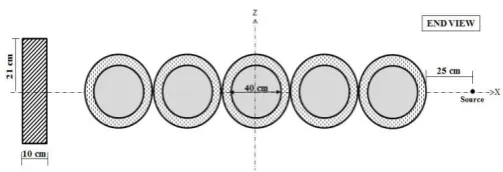
Two experimental setups were employed in the study. Figures 1 and 2 give the top and end view of the first setup called ‗stream 1‘ while figs. 3 and 4 illustrates the views of the second setup referred to as ‗stream 2‘. In each setup, a given quantity of the explosive charge is enclosed in a cylindrical shaped container having uniform material thickness of 1 cm. The container is placed between the neutron source and the sodium Iodide detector. The source irradiates this explosive target activating it in the process with the consequent release of characteristic gamma rays. The detector captures the emitted rays and computation is carried out for two hundred million neutron particle histories. The experiment is repeated for various explosive quantities and similarly repeated with each of the four container materials (ceramic, HDPE, carbon steel and wood) in turn. Stream 1 set up consists of one cylinder with an internal
__________________________
Ngusha Tavershima Almighty is currently pursuing a PhD in Engineering Physics at the University of Agriculture, Makurdi, Nigeria, PH: +2348150738358.
E-mail: [email protected]
radius (r) of 10 cm. The ends of the cylinder are left open such that the length can be varied to accommodate various explosive quantities. Values of explosive masses (M)
considered in stream 1 were 10 kg, 20 kg, 30 kg 40 kg and 50 kg.
Fig. 1. Top view of the experimental setup employed in stream 1
Stream 2 features between one to five cylinders all having the same dimensions. With an internal radius of 20 cm and a length (L) of 46.5 cm, each cylinder had a volume accommodating 100 kg of explosive. Masses of explosives irradiated in stream 2 were thus 100 kg, 200 kg, 300 kg, 400 kg and 500 kg. Additional cylinders when introduced were placed beside the previous one with no intervening space between.
Fig. 2. End view of the experimental set up employed in stream 1
The sodium iodide detector is placed 2 cm behind the cylindrical container (s). Its length is varied such that it extends 2 cm beyond the left and right ends and 1 cm above and below the explosive cylinders in every case. The irradiation source is centrally positioned at a distance (d) of 35 cm in front of the cylindrical target for stream 1 setup and 25 cm from the front surface of the closest cylindrical container for stream 2 setups.
Fig. 3. Top view of the Experimental setup employed in stream 2 for an explosive volume of 500 kg
Fig. 4. End view of the experimental set up employed in stream 2 for an explosive volume of 500 kg
3 Results and Discussion
251
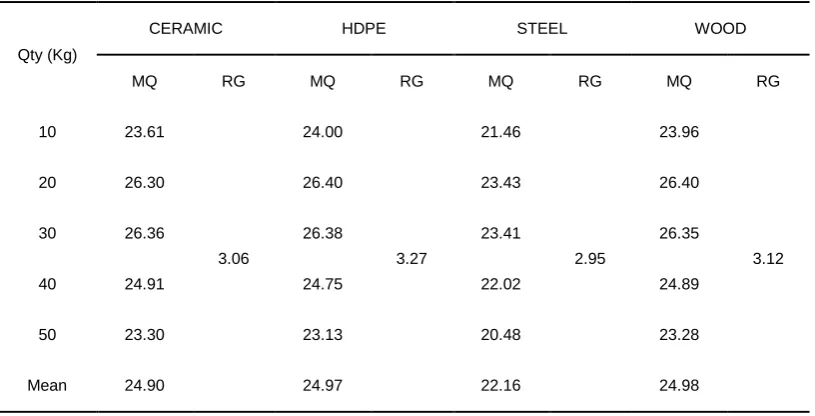
work, the sum of magnitudes of C, N and O present in the explosive target as seen by the detector, is computed to yield a quantity referred to as material quotient (MQ). The MQ value is a measure of detectability. It indicates the strength or intensity of detection. The arithmetic range (RG) which is the difference between the highest and lowest MQ values for each container set is also computed. Table 1 presents the result obtained for interrogation of stream 1 setups. Actual MQ values are x10-8 of the tabulated values.
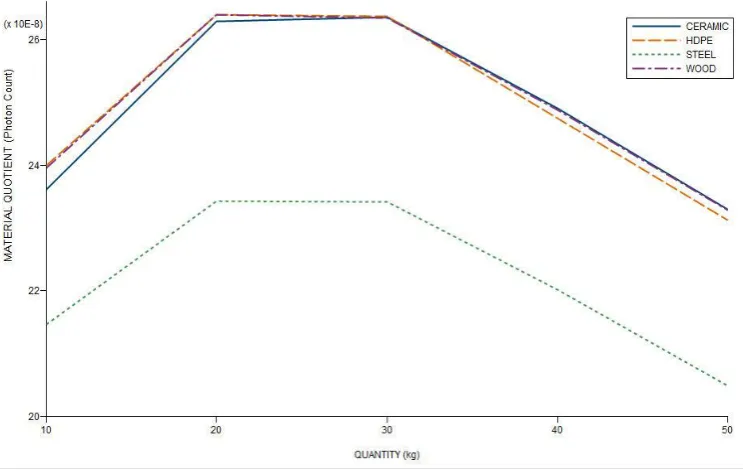
A consistent MQ trend is observed for each of the explosive–in-container sets investigated in stream 1. The MQ trend indicates an initial increase in values followed by
the attainment of saturation and a subsequent steady decrease. The increase in values indicates stronger detection as explosive quantity increases. Self-attenuation and thermalization effects however, gradually build up with increasing explosive quantity. These effects equalize the gamma photon intensity at about 25 kg resulting in the observed saturation. As explosive quantity continues to increase beyond the saturation point, a corresponding decrease in detection intensity is observed. Fig. 5 aptly captures this trend.
Table 1: Computed Values for Explosive Quantities in Stream 1
Qty (Kg)
CERAMIC HDPE STEEL WOOD
MQ RG MQ RG MQ RG MQ RG
10 23.61
3.06
24.00
3.27
21.46
2.95
23.96
3.12
20 26.30 26.40 23.43 26.40
30 26.36 26.38 23.41 26.35
40 24.91 24.75 22.02 24.89
50 23.30 23.13 20.48 23.28
Mean 24.90 24.97 22.16 24.98
A consistent MQ trend is observed for each of the explosive–in-container sets investigated in stream 1. The MQ trend indicates an initial increase in values followed by the attainment of saturation and a subsequent steady decrease. The increase in values indicates stronger detection as explosive quantity increases. Self-attenuation and thermalization effects however, gradually build up with
Fig. 5. Material Quotient variation with explosive quantity for stream 1 setup
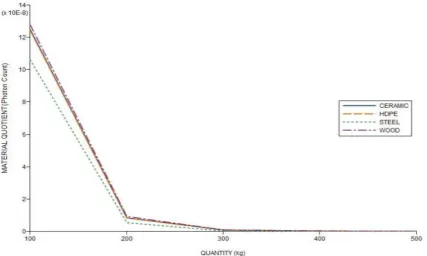
Table 2: Computed Values for Explosive Quantities in Stream 2
Quantity
(Kg) Ceramic HDPE Steel Wood
100 12.51 12.45 10.64 12.79
200 0.83 0.84 0.55 0.92
300 0.08 0.09 0.03 0.09
400 0.01 0.02 0.00 0.02
500 0.00 0.00 0.00 0.01
MEAN 2.69 2.68 2.24 2.77
At the smallest investigated quantity of 10 kg, explosives contained in HDPE and Wood showed the strongest detection values of approximately 24.00 MQ points. Ceramic lagged behind with 0.39 points while steel fell far behind by 2.54 points. It is thus deduced that for small explosive quantities, the intensity with which detection is recorded will be least for steel and highest for HDPE and wood. Mean MQ values agree with the stated deduction indicating a decreasing ease of detection with Wood, HDPE, ceramics and steel. At an explosive volume of 50 kg, MQ values drop below those of 10 kg. A target containing 50 kg of explosive will thus be detected weakly in comparison to a 10 kg explosive charge. The detection geometry no doubt plays an important factor in this
253
Fig. 6. Material Quotient variation with explosive quantity for stream 2 setup
Explosive detection is practically ineffective for MQ levels below 1 as background noise impedes effective detection. This inability of detectors to positively register the presence of explosive substances when two explosive containers are placed side by side re-emphasizes strongly the issue of detection geometry mentioned above. At 300 kg of explosives, values drop to barely perceptible levels. Values obtained are most likely stray elements captured by the detector. Below 300 kg, the detector readings are approximately 0.00. The explosive target arrangement is essentially a radiation shield at this point as neutrons entering in at the front surface do not make it to the detector at the back.
4 CONCLUSION
Investigation into the detection dynamics of nitrogen based explosives has been undertaken. The research featured 1 cm thick explosive containers made of ceramic, HDPE, carbon steel and wood. Explosive masses investigated ranged from 10 kg to 500 kg
REFERENCES
[1] GTI. ―Global Terrorism Index 2015,‖
http://economicsandpeace.org/wp-content/uploads/2015/11/Global-Terrorism-Index-2015 [2] J. Binnie and J. Wright, ―Infernal Machines: Improvised
Explosive Devices,‖ Small Arms Survey, Geneva: Small arms survey, pp. 218 – 249, 2013.
[3] A. Kuznetsov, ―Overview of Bulk Explosives Detection Techniques,‖ Detection of Bulk Explosives; Advanced Techniques against Terrorism, H. Schubert and A. Kuznetsov, eds., Kluwer Academic Publishers, pp. 7-30, 2004.
[4] T.A. Ngusha, A.N. Amah and A.D. Onoja, ―Effect of Encapsulating Materials on Detection of Ammonium
Nitrate Explosives,‖ Journal of the Nigerian Association of Mathematical Physics, Vol. 36, no. 2, pp. 311-318, July 2016.
[5] X-5 Monte Carlo Team, ―MCNP – A General Monte Carlo N-Particle Transport Code‖Version 5, Vol.1, Los Alamos National Laboratory, Los Alamos, New Mexico, April 2003.
[6] S.A. Heider and W.L. Dunn ―A simulation Study of Fast Neutron Interrogation for Standoff Detection of