4 From holistic to discrete speech sounds:
the blind snow
X
ake-maker hypothesis
P
i e r r e
-Y
v e s
O
u d e y e r
4.1 The speech code
Sound is a medium used by humans to carry information when they speak to each other. The existence of this kind of medium is a prerequisite for language. It is organized into a code, called speech, which provides a repertoire of forms that is shared in each language community and that allows its users to encode content information. This code is mainly conventional, and thus intuitively requires coordinated interaction and communication to be established. How, then, might a speech code be formed prior to the existence of communication and of language-like interaction patterns?
Moreover, the human speech code is characterized by several properties which we have to explain. Here are some of them:
Property 1: Discreteness and systematic re-use. Speech sounds are pho-nemically coded as opposed to holistically coded. This implies two aspects: (i) in each language, the continuum of possible sounds is broken into discrete units; (ii) these units are systematically re-used to build higher-level structures of sounds, like syllables.
though each language uses only a few places to perform gestures. This is what we call discreteness.1Furthermore, gestures and their combinations, which may be called ‘phonemes’, are systematically re-used in the gestural scores that specify the syllables of each language. Some researchers call this ‘phonemic coding’.
Property 2: Universal tendencies. Reoccurring units of vocalization sys-tems are characterized by universal tendencies. For example, our vocal tract makes it possible to produce hundreds of diVerent vowels. However, each particular vowel system typically uses only three, four, Wve, or six vowels, and extremely rarely more than twelve (Schwartz et al. 1997a). Moreover, some vowels appear much more often than others. For example, most languages contain the vowels [a], [i] and [u] (87 per cent of languages) while other vowels are very rare, such as [y], [œ] and [] (5 per cent of languages). Also, there are structural regularities: for example, if a language contains a front unrounded vowel at a certain height, for example the /e/ in bet, it will also usually contain the back rounded vowel at the same height, which would be the /O/ inhawkin this case.
Property 3: Sharing. The speakers of a particular language use the same phonemes and they categorize speech sounds in the same manner. How-ever, they do not necessarily pronounce each of them exactly the same way.
Property 4: Diversity. At the same time, each language categorizes speech sounds in its own way, and sometimes does this very diVerently from other languages. For example, Japanese speakers categorize the <l>oflead
and the <r>ofreadas identical.
This chapter addresses the question of how a speech code with these properties might have formed from non-speech prior to the ability to have linguistic interactions. The mechanism I present is based on a low-level model of sensory-motor interactions. I show that the integration of certain very simple and non-language-speciWc neural devices allows a population of agents to build a speech code that has the properties
1 The fact that the audible speech stream is continuous and produced by a mixture of
outlined above. The original aspect is that this presupposes neither a functional pressure for communication, nor the ability to have coordin-ated social interactions (agents do not play language or imitation games). It relies on the self-organizing properties of a generic coupling between perception and production both within agents and in the interactions between agents.
4.2 Existing approaches
4.2.1 The reductionist approach
One approach is ‘reductionist’: it tries to reduce properties of the speech system to properties of some of its parts. In other words, this approach hopes to Wnd a physiological or neural structure, the characteristics of which are suYcient to deduce the properties of speech.
For example, cognitive innatism (Chomsky and Halle 1968; Pinker and Bloom 1990) defends the idea that the brain features a neural device speciWc to language (the Language Acquisition Device) which ‘knows’ at birth the properties of speech sounds. This ‘knowledge’ is supposed to be pre-programmed in the genome. A limit of this approach is that its defenders have remained rather imprecise on what it means for a brain to know innately the properties of language. In other words, this hypoth-esis is not naturalized. Also, no precise account of the origins of these innate devices has ever been provided.
Another example of this approach is that of Studdert-Kennedy and Goldstein (2003); see also Studdert-Kennedy (Chapter 3) for the origins of discreteness, or ‘particulate speech’ in his terms. Studdert-Kennedy and Goldstein remark that the vocal apparatus is physiologically composed of discrete independent articulators, such as the jaw, the tongue, the lips, the velum, etc. This implies that there is some discrete re-use in complex utterances due to the independent articulators that move. I completely agree with this remark. However, other aspects of discreteness are not accounted for. Indeed, as Studdert-Kennedy and Goldstein (2003) note, once you have chosen to use a given set of articulators, there remains the problems of how the continuous space of possible constrictions or timings between gestures is discretized. Goldstein (2003) proposes a solution to this question that I will review later in the chapter (since it is not reductionist but is a mixture of self-organization and functionalism).
One has to note that this ‘reductionist’ approach proposes answers concerning the presence of properties (1) and (2) of the speech code, but addresses neither the diversity of speech sounds nor the fact that they are shared across communities of agents. This approach also does not provide answers to the chicken-and-egg problem of the formation of a code, although this was, of course, not its goal.
4.2.2 The functionalist approach
The functionalist approach attempts to explain the properties of speech sounds by relating them to their function. Basically, it answers the ‘why’ question by saying ‘the system has property N because it helps to achieve function F’. It answers the ‘how’ question by saying ‘systems with property N were formed through Darwinian evolution (genetic or cultural) under the pressure to achieve function F’. This approach could also be called ‘adaptationist’:2 systems with property N were designed for (‘ad’) their current utility (‘apt’). Note that typically, functionalist explanations take into account constraints due to brain structure, perceptual, and vocal systems.
Typically, in the case of the four properties of speech sounds we are interested in, this function is ‘communication’. This means that the sounds
2 I use the term adaptationism in its general form: the adaptation may be achieved
of a speech code should be perceptually distinct enough so that they are not confused and communication can take place. The constraints which are involved typically include a cost of production, which evaluates how much energy is to be spent to produce the sounds. So, under this view, speech sounds are a reservoir of forms which are quasi-optimal in terms of perceptual distinctiveness and economy of energy.
For example, Lindblom (1992) shows that if we search for vowel systems which are a good compromise between perceptual distinctiveness and energy cost of articulation, then we Wnd the most frequent vowel systems in human languages. Lindblom also showed similar results con-cerning the re-use of units to form syllables.
Operational scenarios describing how Darwinian cultural evolution formed these systems have also been described. For example, de Boer (2001a) builds a computer simulation showing how cultural evolution might have worked, through processes of imitation among agents. In this simulation, the same mechanism explains both the acquisition of vowels and its formation; this mechanism is imitation. As a consequence, he also proposes an answer to the question: ‘How are vowel systems acquired by speakers?’
Note that de Boer’s model does not deal with questions concerning discreteness (which is built in) and systematic re-use (indeed, his agents produce only simple static vowel sounds, and systematic re-use is a property of complex dynamic sounds). However, this model is very interesting since it shows a process of formation of a convention, i.e. a vowel system, within a population of agents. This really adds value to the work of Lindblom, for example, since it provides a mechanism for (im-plicit) optimization which Lindblom merely assumed.
imitations and prune the others. In the case of bad imitations, depending on the scores of the prototype used by the hearer, either this prototype is modiWed so as to better match the sound of the speaker, or a new prototype is created, as close as possible to the sound of the speaker.
So to perform this kind of imitation game, a lot of computational/ cognitive power is needed. First, agents need to be able to play a game, involving successive turn-taking and asymmetric role-changing. Second, they must voluntarily attempt to copy the sound production of others, and evaluate this copy. Finally, when they are speakers, they need to recognize that they are being imitated intentionally, and give feedback/ reinforcement to the hearer about the (lack of) success. The hearer must understand the feedback, which says that from the point of view of the other, he did or did not manage to imitate successfully.
The level of complexity needed to form speech-sound systems in this model is characteristic of a society of agents which already possesses some complex ways of interacting socially, including a system of communica-tion (which allows them for example to know who is the speaker and who is the hearer, and which signal means ‘good’ and which signal means ‘bad’). The imitation game is itself a system of conventions (the rules of the game), and agents communicate while playing it. It requires the transfer of information from one agent to another, and so requires that this information be carried by shared ‘forms’. So it presupposes that there is already a shared system of forms. The vowel systems that appear do not really appear ‘from scratch’. This does not mean that de Boer’s model is Xawed, but rather that it deals with the subsequent evolution of language (or more precisely, with the evolution of speech sounds) rather than with language origins (in other words it deals with the formation of lan-guages—les langues in French—rather than with the formation of lan-guage—le langage). Indeed, de Boer presents interesting results about sound change, provoked by stochasticity and learning by successive gen-erations of agents. But the model does not address the bootstrapping question: how did theWrst shared repertoire of forms appear, in a society with no communication and language-like interaction patterns? In par-ticular, the question of why agents imitate each other in the context of de Boer’s model (this is programmed in) remains open.
present chapter, which tries to approach the question of the origins of the discretization of the continuum of gestures (they call this ‘emergence of discrete gestures’).3 It involves a simulation in which two agents could produce two gestures, each parametrized by a constriction parameter taken in a continuous one-dimensional space (this space is typically the space of possible places of constrictions, or the continuous temporal interval between two gestures). Agents interacted following the rules of the ‘attunement game’. In one round of the game, both agents produced their two gestures, using for each of them a parameter taken in the continuum with a certain probability. This probability was uniform for both gestures at the beginning of the simulation: this meant that a whole continuum of parameters was used. Next, agents recovered the parameter of the other agent’sWrst gesture, and compared it to the parameter they used themselves. If this matched, then two things occurred: the probability of using this parameter for the Wrst gesture was increased, and the probability of using the same value for the second gesture is decreased. This simulated the idea that agents are attempting to produce both of their gestures diVerently (so that they are contrasted and can be diVerentiated), and the idea that they try to produce each gesture in a similar fashion to the corresponding gesture of the other agent (so that a convention is established). At the end of the simulations, agents converged to a state in which they used only one value for each gesture, so the space was discretized, and these pairs of values were the same for the two agents in the same simulation and diVerent in diVerent simulations. Goldstein utilized simulations both using and not using non-linearities of the articulatory to acoustic mapping. Not employing it led to the uniform use of all parameters across all simulations, while employing it led to statistical preference for parameters falling in the stable zones of the mapping.
Like de Boer’s simulation, in this model agents have coordinated inter-actions: they follow the rules of a game. Indeed, they both need to produce their gestures together in one round of the game. Secondly, as in the ‘imitation game’, a pressure for diVerentiating sounds is programmed in,
3 There is also the work of Studdert-Kennedy (Chapter 3), but as explained earlier, this
as well as a pressure to copy the parameters of the other agent. This means that it is again presupposed that agents already live in a community in which complex communication exists. However, this was certainly not a concern in that simulation, in the context of research in phonology, whilst the primary concern in the present chapter is the bootstrapping of lan-guage. Thus, it remains to be seen how discrete speech, which has been argued to be crucial for the rise of language (Studdert-Kennedy and Goldstein 2003), might have come to exist without presupposing that complex communication had already arisen. More precisely, how might discrete speech appear without a pressure to contrast sounds? This is one of the issues we propose to solve later in the present chapter.
4.3 The ‘blind snowXake-maker’ approach
Functionalist models have their strengths and weaknesses, which we are not going to detail in this chapter (for a discussion, see Oudeyer 2003). Instead, I propose another line of research, which I believe is almost unexplored in theWeld of the origins of language. This is what we might call the blind snowXake maker approach (by analogy with the ‘blind watchmaker’ of Dawkins 1986, which illustrates the functionalist approach).
There are, indeed, mechanisms in nature which shape the world, such as that governing the formation of snowXakes, which are quite diVerent from Darwinism (Ball 2001). They are characterized by the property of self-organization, like Darwinism, but do not include any concept ofWtness or adaptation. Self-organization is here deWned as the following property of a system: the local properties which characterize the system are qualitatively diVerent from the global properties of the system.4
The formation of snow crystals is illustrated in Figure 4.1. The local mechanism at play involves the physical and chemical interactions be-tween water molecules. If one looks at these physical and chemical
prop-4 Note that this de
Wnition of self-organization is ‘non-magical’ and diVers from a deWnition stating that this is a property of systems in which the operations of the higher level cannot be accounted for solely by the laws governing the lower-order level, i.e. cannot be predicted from, nor is reducible to, its constituents. I do not include any dimension of surprise in the concept of self-organization; when I say that the system described in the chapter self-organizes, this does not mean that its behaviour is surprising or unpredictable from its components, but that its global behaviour has qualitative properties diVerent from the properties of its constituents.
erties, one never Wnds anything that looks like the structure of snow crystals. However, if one lets these molecules interact at the right tem-perature and pressure, marvellous symmetrical structures, with a great diversity in exact shapes, form (Kobayashi and Kuroda 1987). This is an example of a mechanism that shows self-organization, and builds very complex shapes which are not adaptive or functional (it would be hard to claim that it helps the water to survive). There is no reason why this kind of ‘free’ formation of structures would not appear in the biological world too. This idea has been defended by Thompson (1932), Gould and Vrba (1982), and KauVman (1995).
Thompson (1932) gives the example of the formation of the hexagonal honeycomb of the honeybee. Honeybees build walls of wax made by regular hexagonal cells which tile the whole plane. This is remarkable because (a) there are only three ways to tile the plane with regular shapes (squares, triangles and hexagons), and (b) hexagons are optimal since it takes less material to cover the same area with hexagons than with triangles or squares. There are two possible ways to account for this. First, one might think that honeycomb was designed as an adaptation by the honeybees to minimize their metabolic cost: this is the Darwinist functionalist approach. The honeybees would have tried out many pos-sible shapes until they stumbled on hexagons, which they would have found to be less energy-consuming. This would imply that honeybees would have acquired sophisticated instincts that allow them to build perfect hexagons without compasses and set-squares. This explanation is plausible but elaborate, and requires a time-consuming search in the space of forms by the honeybees.
hard-wired neural structure which allows them to build precisely hex-agonal shapes; a proposal for such an innate capacity was suggested by von Frisch (1974). Rather, Thompson’s proposal is that long ago in evolution-ary history, the honeybees might simply have relied on the self-organiza-tion of heated packed wax cells, which would have led them toWnd the hexagon, but later on in their evolutionary history, they might have incorporated into their genome schemata for building those hexagons directly, in a process similar to the Baldwin eVect (Baldwin 1896; see Briscoe, Chapter 14).
The goal of this chapter is to present an approach to the formation of speech codes which is very similar in spirit to the approach of D’Arcy Thompson to the formation of honeycomb. We will propose that the formation of sound systems with the properties of discreteness, systematic re-use, universal tendencies, diversity and sharing, may be a result of self-organization occurring in the interactions of modules which were not necessarily selected for communication. The mechanism is not based on the manipulation of the genetic material, but results from the interaction of agents and from a number of generic neural and physical modules (which may have a function on their own, not related to speech commu-nication) during the lifetime of agents. Note that the scenario I propose explains how sound systems with the four properties above could have formed before being related to communication, but says nothing about how it could have been recruited later to be used as an information carrier in communication. If we take the example of the origins of bird feathers used by Gould and Vrba (1982), it is like explaining how the feathers came up with the thermoregulation pressure, but not saying how the feathers were recruited toXy.
4.4 The mechanism
The model is a generalization of that of Oudeyer (2001a), which was used to model a particular phenomenon of acoustic illusion, called the percep-tual magnet eVect. This model was itself a generalization and uniWcation of the earlier models of Damper and Harnad (2000) and Guenther and Gjaja (1996).
It is based on the building of an artiWcial system, composed of robots/ agents endowed with working models of the vocal tract, the cochlea, and some parts of the brain. The complexity and degree of reality of these models can be varied to investigate which aspects of the results are due to which aspects of the model. I stress that while some parts of the model are inspired by knowledge from neuroscience, we are not trying to reproduce faithfully what is in the human brain. Rather, I attempt to build an artiWcial world in which we can study the phenomenon described at the beginning of the chapter (i.e. the speech code). Because we know exactly what is happening in this artiWcial world, in particular what the assump-tions are, I hope this will enhance our understanding of speech. The model does this by allowing us to give suYcient conditions for the appearance of a speech code, and it can also tell us what is not necessary (e.g. we will show that imitation or feedback are not necessary). Because the mechan-isms that formed speech involve the interaction of many components and complex dynamics, artiWcial systems are a crucial tool for studying them, and it helps to obtain intuitive understanding of them. Our artiWcial system aims at proving the self-coherence and logical plausibility of the concept of the ‘blind snowXake maker’, applied to the origins of discrete speech sounds. For more details on this methodology of the artiWcial, see Steels (2001) and Oudeyer (2003).
4.4.1 The architecture of the artiWcial system
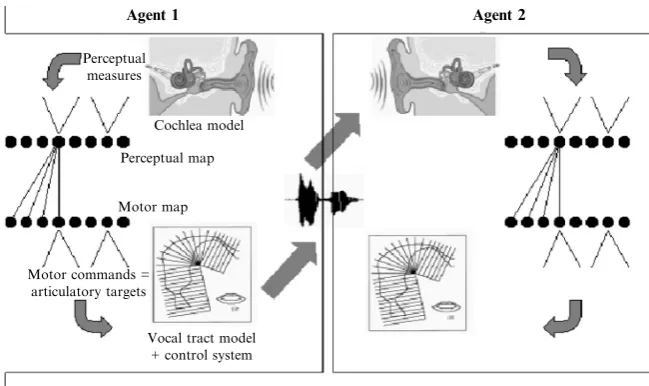
which is basically a set of interconnected neurons. There are two sets of neurons. One is called the ‘perceptual map’, which gets input from the measurements taken by the ear. Then the neurons of the perceptual map send their output to the second set of neurons, the ‘motor map’ (this could also be called an ‘articulatory map’). These motor neurons send signals to a controller which drives the vocal tract. These signals should be viewed as commands specifying articulatory targets to be reached in time. The articulatory targets are typically relations between the organs of the vocal tract (like the distance between the lips or the place of constriction). They correspond to what is called a ‘gesture’ in the articulatory phonology literature (Browman and Goldstein 2000; Studdert-Kennedy, Chapter 3). Figure 4.3 gives an overview of this architecture. In this chapter, the space of organ relations will be two-dimensional (place and manner of constric-tion) or three-dimensional (place, manner of articulation, and rounding). What we here call a neuron is a box which receives several inputs/ measurements, and integrates them to compute its activation, which is propagated through output connections. Typically, the integration is made by Wrst weighting each input measurement (i.e. multiplying the measurement by a weight), then summing these numbers, and applying to
Agent 1 Agent 2
Perceptual measures
Cochlea model
Perceptual map
Motor map
Motor commands = articulatory targets
Vocal tract model + control system
the sum a function called the ‘tuning function’. The tuning function is in this case a Gaussian curve, whose width is a parameter of the simula-tion. A weight is attached to every connection between neurons. In the model, all weights are initially random.
Also, the neurons in each neural map are all interconnected. This means that they receive inputs from all other neurons in the map. When a stimulus is perceived, this prompts an initial activation of all the neurons in the two maps. Next, the activation of each neuron, after the update of all the weights, is updated according to the new activation of the neurons to which it is connected. This is repeated until the activations stabilize. This is what is called an attractor in dynamical systems language. This attractor, i.e. a set of neuron activations which is stabilized, is the same for a number of diVerent stimuli, called its basin of attraction. This models categorization behaviour. There are as many categories as there are at-tractors.
The production of a vocalization consists of choosing a set of articula-tory targets. To choose these targets, one activates neurons in the motor map of agents sequentially and randomly. This activation is a command which we take as the deWnition of a gesture in this chapter. A target is speciWed by the weights of the output connections of the activated motor neurons. Then there is a control system which executes these commands by pulling the organs towards the targets continuously and sequentially.5 Here, the control system simply amounts to generating a continuous trajectory in the organ relation space which passes through the targets. This is achieved through simple spline interpolation, which is basically a polynomial interpolation. Because initially the weights of the connections
5 It is important to note that this way of producing complex articulation already
are random, agents produce vocalizations with articulatory targets that are spread uniformly across the space of possible targets. This implies that their vocalizations are initially holistic as far as the commands are con-cerned (the whole continuum of physically possible commands is used). They are not phonemically coded.
Agents produce vocalizations not by a static conWguration of the vocal tract, but rather by continuous movement of the vocal tract. This implies that agents receive a continuous trajectory (in the acoustic space) from the vocalizations of other agents. Next I explain how this trajectory is pro-cessed, and how it is used to change the weights of the connections between the neurons.
First of all, agents are not able to detect high-level events in the continuous trajectory, which would allow them, for example, to Wgure out which points were the targets that the other agents used to produce that trajectory. Instead, they segment the trajectory into very small parts, corresponding to the time resolution of perception (this models the time resolution of the cochlea). Then all these small parts are integrated, giving a value in the acoustic space, which is sent to the perceptual neurons. Each perceptual neuron is then activated.
specify an organ relation, are used as a reference to update the other weights: they are changed so that the organ relation they specify looks a little more like that of the reference neuron, and this change is weighted by the current activation of each motor neuron.
A crucial point is the coupling between the production process and the perception process. Let us term the weights of the input connections of the perceptual neurons the preferred vectors of these neurons. This term comes from the fact that the set of weights of a neuron forms a vector, and the stimulus that has the same values as the weights will activate the neuron maximally. We also call the output weights of the motor neurons their preferred vector. The set-up and the dynamics of the two neural maps ensure that the distribution of preferred vectors in the motor map corresponds to the distribution of preferred vectors in the perceptual map: if one activates all the neurons in the motor map randomly, many times, to produce sounds, this then gives a distribution of sounds that is the same as the one coded by the neurons of the perceptual map. The distribution of the preferred vectors of the neurons in the perceptual map changes when sounds are perceived, which in turn changes the distribution of preferred vectors in the motor map, which then implies that if an agent hears certain sounds more often than others, he will also tend to produce them more often (here, a ‘sound’ refers to one small subpart of a vocalization, generated by the time-resolution Wlter described earlier). It is important to see that this process of attunement is not realized through imitation, but is a side eVect of an increase in sensitivity of neurons, which is a very generic, local, low-level neural mechanism (Kandel et al. 2001).
Finally, these clusters are the same for all agents: the code is shared and speciWc to each agent community, because in each simulation run, the set of clusters that appears is diVerent (so there is diversity).
I use two kinds of model for mapping from motor conWgurations to sounds and then perception. TheWrst kind is abstract and trivial: this is a random linear mapping from one space to the other. This allows us to see what we can get without any special mapping properties, in particular without non-linearities. In fact, I show that we get quite far without these, obtaining discreteness, systematic re-use, sharing, and diversity. The sec-ond kind is a more realistic model of the mapping, using three motor parameters: tongue height, tongue front–back position, and lip rounding. The formants corresponding to any conWgurations are then calculated using de Boer’s (2001a) model, which is based on human data. This model allows us to predict the vowel systems that appear in human languages, thus allowing us to account for some universal tendencies in human vowel systems.
4.4.2 Non-assumptions
Agents do not play a language game in the sense used in the literature (Hurford et al. 1998), and in particular do not play the ‘imitation game’ which is, for example, used in de Boer (2001a). Their interactions are not structured, there are no roles and no coordination. In fact, they have no social skills at all. They do not distinguish between their own vocalizations and those of others. They do not communicate. Here, ‘communication’ refers to the emission of a signal by an individual with the intention of conveying information which will modify the state of at least one other agent, which does not happen here. Indeed, agents do not even know that there are other agents around them, so it would be diYcult to say that they communicate.
4.5 The dynamics
4.5.1 Using the abstract linear articulatory/perceptual mapping
simulations, 500 neurons were used per neural map, ands¼0:05 (width of their tuning function). The acoustic space and the articulatory space are both two-dimensional, with values in each dimension between zero and one. These two dimensions can be thought of as the place and the manner of articulation.
Initially, as the preferred vectors of neurons are randomly and uni-formly distributed across the space, the diVerent targets that specify the productions of the agents are also randomly and uniformly distributed. Figure 4.4 shows the preferred vectors of the neurons in the perceptual map of two agents. We see that these cover the whole space uniformly, and are not organized. Figure 4.5 shows the dynamic process of relaxation associated with these neural maps, and due to their recurrent connections. This is a representation of their categorizing behaviour. Each small arrow represents the overall change of activation pattern after one iteration of the relaxation (see the Appendix to this chapter). The beginning of an arrow represents a pattern of activations at timet(generated by presenting a stimulus whose coordinates correspond to the coordinates of this point;
this is possible because the population vector is also a decoding scheme which computes the stimulus which activated a neural map). The end of the arrow represents the pattern of activations of the neural map after one iteration of the relaxation. The set of all arrows allows one to visualize several iterations: start somewhere on theWgure, and follow the arrows. At some point, for every initial point, you get to aWxed point. This corres-ponds to one attractor of the network dynamic, and theWxed point to the category of the stimulus that gave rise to the initial activation. The zones deWning stimuli that fall into the same category are visible on theWgure, and are called basins of attractions. With initial preferred vectors uni-formly spread across the space, the number of attractors as well as the boundaries of their basins of attractions are random.
agents produce. All the agents share the same speech code in any one simulation. However, in each simulation, the exact set of modes at the end is diVerent. The number of modes also varies with exactly the same set of parameters. This is due to the inherent stochasticity of the process. I illustrate this later in the chapter.
It is very important to note that this result of crystallization holds for any number of agents (experimentally), and in particular with only one agent, which adapts to its own vocalizations. This means that interaction with other agents—i.e. the social component—is not necessary for discreteness and systematic re-use to arise. But what is interesting is that when agents do interact, then they crystallize in the same state, with the same categories. To summarize, there are, so far, two results:Wrst, discreteness and systematic re-use arise because of the coupling between perception and production within agents; second, shared systems of phonemic categories arise because of the coupling between perception and production across agents.
tually quite distinct. In terms of Lindblom’s framework, the energy of these systems is high. However, there was no functional pressure to avoid close prototypes. They are distributed in that way because of the intrinsic dynamics of the recurrent networks and their rather large tuning func-tions: indeed, if two neuron clusters get too close, then the summation of tuning functions in the iterative process of relaxation smooths their distribution locally and only one attractor appears.
4.5.2 Using the realistic articulatory/acoustic mapping
In the previous subsection, we assumed that the mapping from articula-tions to perceparticula-tions was linear. In other words, constraints from the vocal apparatus due to non-linearities were not taken into account. This is interesting because it shows that no initial asymmetry in the system was necessary to get discreteness (which is very asymmetrical). So there is no need to have sharp natural discontinuities in the mapping from the articulations to the acoustic signals and to the perceptions in order to explain the existence of discreteness in speech sounds (I am not saying that non-linearities of the mapping do not help, just that they are not necessary).
the perceptual maps will ensure that the distributions of the preferred vectors of these neurons will also be biased.
The articulatory synthesizer used is from de Boer (2001a). This models only the production of vowels. The fact that agents produce only vocal-izations composed of vowel sounds does not imply that the model does not hold for consonants. I chose this articulatory synthesizer because it is the only one both fast enough and realistic enough for my computer simulations. The articulatory space (or organ relation space) is three-dimensional here: tongue height (i.e. manner of articulation), tongue front–back position (i.e. place of articulation), and lip rounding. Each set of values of these variables is then transformed into the Wrst four formants, which are the poles of the vocal tract shaped by the position of the articulators. Then the eVective second formant is computed, which is a non-linear combination of the second, third, and fourth formants. TheWrst and eVective second formants are known to be good models of our perception of vowels (de Boer 2001a). To get an idea of this, Figure 4.8 shows the state of the acoustic neural maps of one agent after a few interactions between the agents (200 interactions). This repre-sents the bias in the distribution of preferred vectors due to the non-linearities.
Fig. 4.9 Neural map and attractor Weld of the agent from Fig. 4.8 after 2000 interactions with the other twenty agents. The correspondingWgures for other agents are nearly identical, as in Fig. 4.6 and 4.7. The vowel system produced corresponds to the most frequentWve-vowel system in human languages.
50
45
40
35
30
25
frequency
20
15
10
5
0
3 4 5 6
sizes of vowel systems
emergent systems
human systems
7 8 9
coding, is not due to this mapping but to the sensory-motor coupling dynamics.
4.6 Discussion
A crucial assumption of the artiWcial system presented in this chapter is the fact that there are connections between the motor vocal neural map and the perceptual acoustic map which allow the agents to learn the mapping between the two spaces. How might these connections have appeared?
First, it is possible that they appeared through Darwinian genetic evolution under a pressure for language. But the simplicity and non-speciWcity of the neural architecture allows other ways of explaining
Most frequent vowel systems in human languages and emergent systems
3 vowels
0.6% u
i a
0.1%
1.9% 1.9% 3.1% 1.6%
1.9% 6.3%
0.9%
28%
0% 0%
0%
6.4% 3.7%
3.2%
0.3% 1.7%
1.2% 1.9%
1.6% 25%
15%
9.1% 3%
6%
19% : frequency in emergent systems 12% : frequency in human languages
2% 9% 0%
0% 4 vowels 5 vowels 6 vowels 7 vowels 8 vowels
their origins which do not necessitate a pressure for language. These scenarios truly illustrate the ‘blind snowXake maker’ approach.
One alternative scenario is that these connections evolved for imitation. Imitation may have appeared for purposes very diVerent from language: for example, it might have evolved to maintain social cohesion. Copying of types of behaviour might have been used to mark friendship, for example, as in some species of birds. Interestingly, this kind of imitation does not require a system of sounds made of discrete units that can be re-used to produce inWnite combinations. Also, in this kind of imitation, agents do try to copy behaviours or sounds, but do not try to discriminate sounds. This means that there is no pressure to develop a system of sounds that are diVerent from each other and categorized as such. There is no need to have a system of categories as a whole if all that is useful is just evaluating the similarity of the sound you yourself produce to one pro-duced by another individual at a given moment. But discreteness, re-use, and a system of diVerences and categories are necessary for speech. The artiWcial system of this chapter shows precisely that with just a simple neural system which may very well have evolved for ‘imitation for social cohesion’ (it would be diYcult to make a simpler system), we obtain freely, through self-organization, a system of sounds that is shared by a population and that is discrete, with systematically re-used units and a system of categorization. In other words, we obtain exactly what speech needs without the need for speech.
So, even if the neural devices that are assumed in this chapter evolved for imitation, they produce speech-sound systems without a functional pressure for speech (as used in the context of language). The simulations of de Boer and of Browman and Goldstein do assume this pressure for speech, since their agents do try to produce the sounds of their repertoire diVerently (and in the case of de Boer, they try to make the repertoire as big as possible). But the agents here do not try to distinguish sounds. The fact that they reach a system of categories that allows them to distinguish sounds is a self-organized result. Furthermore, the notion of repertoire is not pre-programmed, but appears as a result.
Then it needs the random connections between these two sets of neurons to adapt by following a very general dynamic: Hebbian learning. Next, activating the motor neurons randomly and uniformly leads to a move-ment of the vocal tract which produces sounds, which in turn activates the perceptual neurons, and then the connections between the two maps self-organize so that after a while the mapping is eVectively learnt. This is what we call babbling.
Crucially, this architecture does not require precise pre-wiring during ontogeny which is pre-programmed by the genes. The neurons in the perceptual map and in the motor map certainly existed well before speech. In fact they have existed since ears and mouths have existed. So the question, of course, is how did they come to be connected? It is quite possible that these connections are a side-eVect of general architectural design constraints of the brain; Gould and Vrba (1982) give many ex-amples of other features of the bodies and brains of animals which appeared in a similar manner. Indeed, it is obvious that the connections between certain modalities (for example, vision and the motor control of arms) are necessary and thus existed very early in mammalian evolution. It might very well be that the most eYcient strategy to produce these connections is to connect all modalities rather than just to connect particular modalities with other particular modalities. This might be more eYcient because it requires fewer speciWcations for the growth process, and thus might be more robust, and the advantage of this robustness might be superior to the cost of having a prioriunnecessary connections. In fact, this method of shaping the brain by initial generation of many random neural structures, followed by a pruning phase, is accepted by a large part of the neuroscience community (see Changeux 1983). But then all mammals should have these connections between neurons that perceive sounds and neurons that control the movements of the mouth. So, why are we the only mammal to have such a system of speech sounds? And in particular, why do monkeys or chimps not have speech sounds like ours? It is probable that they do have at birth the connections between the neurons that perceive sounds and those that control the mouth, but that they lose them because the key is somewhere else. The key might lie inbabbling.
means that they spontaneously try out many articulatory conWgurations and repeat these trials. In other words, they practise. Monkeys or chimps do practise certain speciWc motor activities when they play, but these are very limited and they do not try to practise all the motor activities that their bodies allow, while human children do. For example, once monkeys have thrown a stone towards an objective, they will not try to do it again repeatedly. And it seems that a major evolutionary event which gave rise to primitive humans with increased skills as compared to their ancestors is the ability to practise any new motor activity that they encounter, in particular vocal babbling. Indeed, a general drive to explore all motor activities available to the body may have been very beneWcial for the learning of many skills useful for primitive humans, who lived in a dynamic, quickly changing environment (for example, coping with changes in habitat, or living in complex dynamic social structures). This may have pushed them, in particular, to use their vocal apparatus for babbling. And then we come to the beginning of the simulation presented in this chapter, which shows that self-organization takes place and generates ‘for free’ a system of sounds shared by the agents who live in the same area and which is phonemically coded/discrete. Monkeys or chimps may have the connections, but because they do not practise, the neural structures connecting the two modalities certainly die (through the pruning process of activity-dependent neural epigenesis; Changeux 1983). But humans do practise, which not only allows the neural system to be kept alive, but also allows the generation of a shared speech code.
4.7 Conclusion
conventional code shared by a population, may appear without linguistic features being already there.
Furthermore, this same mechanism allows us to account for properties of the speech code like discreteness, systematic re-use, universal tenden-cies, sharing, and diversity. I believe that this account is original because (a) only one mechanism is used to account for all these properties and (b) we need neither a pressure for eYcient communication nor innate neural devices speciWc to speech (the same neural devices used in the chapter can be used to learn hand-eye coordination, for example).
Models like that of de Boer (2001a) are to be seen as describing phenomena occurring later in the evolutionary history of language. More precisely, de Boer’s model, as well as, for example, that of Oudeyer (2001b) for the formation of syllable systems, deals with the recruitment of speech codes like those that appear in this chapter, and studies how they are further shaped and developed under functional pressure for communication. Indeed, whilst we have shown here that one can go a long waywithoutsuch pressure, some properties of speech can only be accounted forwithit. An example is the phenomenon of chain shifts, in which the prototypes of sounds of a language are all moved around the space.
However, in de Boer (2001a) and Oudeyer (2001b), the recruitment of the speech code is pre-programmed. How this could have happened in the origins of language is a problem which remains to be solved. A particular instantiation of the problem is: how do agents come to have the idea of using a speech code to name objects? In fact, the problem of the recruitment of features not initially designed for a certain linguistic function is present at all levels of language, ranging from sounds to grammar. The question of how recruitment comes about is a major challenge for research on the origins of language. In this chapter, we have shown one example of recruitment: individual discrete sounds were systematically re-used in the building of complex vocalizations, and this was not pre-programmed.
ACKNOWLEDGEMENTS
FURTHER READINGS
For a comprehensive overview of research on the origins of speech sounds, Lindblom (1992), de Boer (2001), and Studdert-Kennedy and Goldstein (2003) are key references.
For the role of self-organization in the origins of patterns in the biological world, and in particular for the relationship between self-organization and neo-Darwinian natural selection, KauVman (1995) is a good start, presenting the general arguments in an accessible way, and could be followed up by Ball (2001) and Thompson (1932), which present a great many biological examples, with more technical and empirical detail.
Appendix 4.1: Technical Details of the Mechanism
The neurons have a Gaussian tuning function. If we note tunei,t the tuning
function ofniat timet,sone stimulus vector,vithe preferred vector (the weights)
ofni, then the form of the function is:
tunei,t(s)¼
1
ffiffiffiffiffiffiffiffiffi
2ps
p e-12vis2=s2
The notationv1v2denotes the scalar product between vectorv1and vectorv2. The parametersdetermines the width of the Gaussian, and so if it is large the neurons are broadly tuned (a value of 0.05 means that a neuron responds substantially to10 per cent of the input space).
When a neuron in the perceptual map is activated because of an inputs, then its preferred vector is changed. The mathematical formula of the new tuning function is:
tunei,tþ1(s)¼ 1
ffiffiffiffiffiffiffiffiffi
2ps
p evi,tþ1s2=s2
wheresis the input, andvi,tþ1the preferred vector ofniafter the processing ofs:
vi,tþ1¼ vi,tþ0:001tunei,t(s)(svi,t)
change. A Hebbian learning rule is used. Ifiis a neuron of the perceptual map connected to a neuronjof the motor neural map, then the weightwi,jchanges:
dwi,j¼c2(tunei,si<tunei,si >)(tunej,sj<tunej,sj>)(correlation rule)
wheresiandsjare the input of neuronsiandj,<tunei,si>the mean activation of neuron i over a certain time interval, andc2a small constant. All neurons between the two maps are connected.
Both the perceptual and the motor neural map are recurrent. Their neurons are also connected to each other. The weights are symmetric. This gives them the status of a dynamical system: they have a HopWeld-like dynamics with point attractors, which are used to model the behaviour of categorization. The weights are supposed to represent the correlation of activity between neurons, and are learnt with the same Hebbian learning rule:
dwi,j¼c2(tunei,si<tunei,si>)(tunej,sj<tunej,sj>)(correlation rule)
These connections are used to relax each neural map after the activations have been propagated and used to change the connections weights. The relaxation is an update of each neuron’s activation according to the formula:
act(i,tþ1)¼ P
jact(i,t)wi,j
P
iact(i,t)
whereact(i) is the activation of neuroni. This is the mechanism of competitive distribution, together with its associated dynamical properties.
To visualize the evolution of the activations of all neurons during relaxation, we use the ‘population vector’. The activation of all the neurons in a neural map can be summarized by the ‘population vector’ (see Georgopoulos et al. 1988): it is the sum of all preferred vectors of the neurons weighted by their activity (nor-malized as here we are interested in both direction and amplitude of the stimulus vector):
pop(v)¼ P
iact(ni)vi
P
iact(ni)