Licensed under Creative Common Page 380
http://ijecm.co.uk/
ISSN 2348 0386
PRACTICES OF SOCIAL RESPONSIBILITY AMONG THE
STUDENTS OF BAU AND TRENDS OF IMPROVEMENT
FIELD STUDY ON BAU STUDENTS, JORDAN
Atef Saleh Aladwan
Business administration department, BAU, Jordan [email protected]
Shatha Alzoubi
Researcher Albalqaa Applied University, Jordan
Tareq Ghaleb Abu Orabi
Business Administration Department, BAU, Jordan
Abood Saleh Ahmad
Business Administration Department, International Islamic University, Jordan
Abstract
The study aims to find out the practices of social responsibility among the student at the BAU
and trends of improvements. Study use different variables as college, gender and academic
yea. A descriptive approach is used for data collection. The researchers developed a tool to
measure the levels of social responsibility designed based on the Likert scale were confirmed
validity and reliability of the scale. The study population is 27,384 BAU students for the
academic year 2015/2016, and total sample size of student 606 were selected by random
sampling. The study found that there were no statistically significant differences at the level of
(0.05 = α), The total score of the reality of social responsibility depending on the gender variable
and variable college, and the presence of significant differences in favor of the first year. The
study concluded many of the valuable recommendations to be implement by decision makers in
universities and other educational institutions and other organisations in general.
Licensed under Creative Common Page 381 INTRODUCTION
The scientific and technological progress witnessed by the world in all areas and link the areas of human life with each other consequent overlapping roles and boundaries and it was necessary to emphasize on the social responsibility in various forms and in various fields.
The youth education on the topic of the social responsibility is a leading priorities for the developed societies because it involves developments of the times and the Renaissance ability to meet the challenges of the technological revolution and the Nations measured degree of awareness of social responsibility (al-Shammari, 2015), is the category of young people of great importance within the community in building a civilization and the development and progress and it an important and vital role in social responsibility, such as the maintenance of organizing and community cohesion, sense of national belonging and social behavior and self-reliance and to preserve the unity of the community cohesion and a sense of feeling of responsibilities towards other members of the community (Kharashi, 2004) Therefore, the need arises for a combination of all social institutions, starting with the family, the school and the mosque and universities in order to strengthen and deepen the development of social responsibility in word and deed among members of society (Musharraf, 2009). As universities and scientific centers of civilization aimed at education, scientific research and community service, they must ensure that the youth of intellectual openness, development and self-reliance and the development of social responsibility (al-Dossari, 2011).
They are interested in providing the best services and programs and the preparation of young people from the academic, scientific, technical and social terms and transmitted the spirit of responsibility and development in the hearts of young people so that they are able to assume responsibilities in all areas of life and the ability to lead and do the work required. Students at the university are integrated in the activities and events available to them and reacts with other people and thus learn the types of behavior and gain positive experiences of others through that interaction, activities and trying to develop the same sense of responsibility and self-reliance through these processes and activities it does so by participating with others from other groups, And so it was necessary to do a search for how to develop students' abilities and skills necessary to find and develop the social responsibility inside and outside the university ( Kharashi , 2004).
The problem of the study:
Licensed under Creative Common Page 382 develop of their capabilities and directing their energies, and there will be a number of ethical , social and value issues that will affect the future and the future of the community positively if its practicing by student.
The goal of the study and research questions
The study aims to find out the practicing of social responsibility at the BAU students for the academic year 2015/2016 and ways of its development, the study comes to answer the key question: What is the reality of social responsibility at the BAU students?
- Are there significant differences at the level of significance (α = 05, 0) in the social responsibility of BAU students according to the following variables: (specialty, sex, school year)?
- What is the proposed ways and mechanisms to strengthen and deepen the social responsibility of BAU students?
The importance of study
The importance of the study come out from importance of the subject as the social responsibility topic is important issues in this era as well as to the importance of the target group, which represents BAU students.
It is hoped that this study will enrich the theoretical side in the area of social responsibility as well as to provide data to help in the development and enhance the capabilities of university students in general. It is hoped that this study will open the way for researchers to further research on corporate social responsibility at the Jordanian university students in general and benefit from the results in directing the energies of youth, development and promotion.
THEORETICAL LITERATURE
Licensed under Creative Common Page 383 of the family through the implantation of the system values and punctuality, cleanliness and participation in school activities and this has an important role in the development of social responsibility and strengthen their self-confidence and cooperation and work with the group (Musharraf, 2009).
Levels of social responsibility
Al-Harthy (2001) several levels of social responsibility, namely:
1. The individual's responsibility towards himself, such as eating and sleeping and innate motives.
2. Responsibility toward his family: A- Mother, father and brothers. B- The wife and children. C - The rest of the relatives.
3. The individual's responsibility towards neighbors
4. Responsibility towards the tribe and the neighborhood and the city 5. Responsibility towards colleagues and friends
6. Responsibility towards the nation
7. Responsibility toward the world and the universe (Earth Building) and ecosystem
The social responsibility requirements, as described by (al-Shammari, 2015) are: freedom and safety of mental power , control and stability of identity and social responsibility requires freedom because there cannot be a social responsibility under oppression conditions , they also require the safety and mental powers to choose the act , the official bear as a result of do and require monitoring by conscience and divine power and administrative power and so must be fulfilled for a person 's identity and specific knowledge of when to use the act and take responsibility for the act , where that responsibility increases with knowledge.
The role of universities in the development of social responsibility
Educational institutions a fundamental and active centers that achieve an important role in the formation and construction of social responsibility among students of various humanitarian, national, personal and social kinds, so it falls on the universities a lot of duties to maintain social responsibility and development of young people so as to ensure direct their energies positively about themselves and their community (Kharashi, 2004). This is reflected through a number of components, namely:
Licensed under Creative Common Page 384 2. University contributes essential and fundamental skills in the labor market and the ethics of the profession.
3. Teach students on the types of scientific thinking, problem solving and decision making. 4. Provide future potential of individuals and communities.
5. University contains the necessary competencies and expertise for the development of social responsibility among students.
Mahmoud (2012) aimed to identify the relationship between psychological security and social responsibility to the university education students in Jordan, according to the number of variables (sex and specialization ) amounted to sample size ( 630 ) students were selected through random sampling Among the most prominent results of the study and no statistically significant in psychological and social responsibility security differences according to gender and no differences in the psychological security and social responsibility variable depending on the specialty.
Shammari study (2015) aimed to recognize the relationship between social responsibility and a culture of tolerance among the Naif Arab University for Security Sciences students study population km of all university students and the total sample size of 481 students for the academic year 2014/2015 and the study found a number of the most important results and the differences statistically significant social responsibility due to the variable age.
Kennemer (2002) aimed to identify the factors that predict social responsibility among university students and reached the study sample (100 students ) were the results of the study indicated a statistically significant differences in favor of students in the scale of global responsibility also it revealed a lack of significant differences statistically in the scale of social responsibility towards people according to gender .
METHODOLOGY
Licensed under Creative Common Page 385 which have been developed for the purpose of achieving the objectives of the study, were tested by appropriate statistical means
The study population and sample
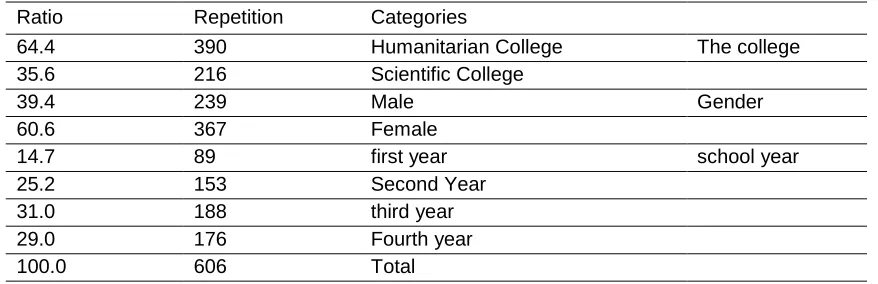
The study population consisted of the BAU students for the academic year 2015/2016 and numbered (27 384) male and female students were selected randomly sample the simple total sample size of 606 students. The following table shows the distribution of the study sample:
Table 1. The distribution of the study sample according to the college, Gender and year of study variables
Categories Repetition
Ratio
The college Humanitarian College
390 64.4
Scientific College 216
35.6
Gender Male
239 39.4
Female 367
60.6
school year first year
89 14.7
Second Year 153
25.2
third year 188
31.0
Fourth year 176
29.0
Total 606
100.0
Research Instrument
The researcher prepares a likert scale to measure social responsibility on the depending on the theoretical literature and previous studies to include paragraphs:
1. The student responsible for his / her towards himself. 2. The student responsible for his / her toward home.
3. The student's responsibility to his / her individual societies. 4. The student responsible for his / her about the ecosystem.
As the tool consisted final form of (49) items, and Supplement No. 1 illustrates the study tool finalized. The researcher grading standard answer for each paragraph in accordance with the Likert scale Pentagram identified in five grades ( Strongly agree - agree - neutral - disagree - Strongly Disagree) were used for government measure on the reality of social responsibility according to the equation the following :
The upper limit of the scale - the minimum scale / number of categories 5-1 = 4/3 = 1.33 Thus it becomes categories as follows:
Licensed under Creative Common Page 386 (3.68 - 5) the degree of reality high.
This kind of creditability looking to verify that the questionnaire, which the researcher designed to measure really is designed to be measured by viewing the resolution on a group of experts in the field to which they belong This tool is known as creditability arbitrators, where the researcher introduced a resolution in the initial image on the a group of arbitrators with experience and competence in the field of educational administration and educational planning did by making their views and comments on the following aspects:
1. Clarity resolution and suitability for the goal, which was prepared for him. 2. Appropriate degree paragraphs for the domain that fall under it.
3. The safety of ferries in terms of the wording of the language.
4. Add, delete or modify paragraphs contained tool at their convenience.
In the light of the observations of the arbitrators , the researcher make adjustments in accordance with the arbitrators' notes, it was adopted paragraph if the ratio of the agreement between the arbitrators of not less than (80%) on the validity and relevance of the study and reformatted finalized and consisted of ( 49 ) items .
Instrument Reliability
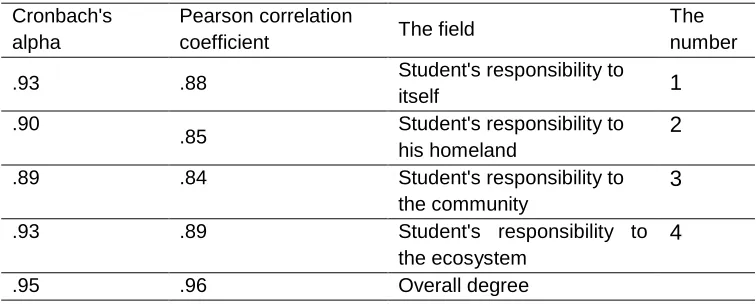
To make sure the reliability of study tool researcher used the test method and retest Test, as the researcher apply the resolution on the exploratory sample, has been the sample selection method stratified random composed of 30 students from outside the study sample and the same society , and within a time interval (14) days between Marty application, then was awarded a Pearson correlation coefficient between the scores of Marty application also used the method of internal consistency (Cronbach alpha), paragraphs questionnaire with a total score of the axis to which it belongs , and table 2 shows the resolution firming as the following transactions :
Table 2. Stability study tool using the Pearson correlation coefficient and Cronbach's alpha coefficients
The number The field
Pearson correlation coefficient
Cronbach's alpha
1 Student's responsibility to itself
.88 .93
2 Student's responsibility to his homeland
.85 .90
3 Student's responsibility to the community
.84 .89
4 Student's responsibility to the ecosystem
.89 .93
Overall degree .96
Licensed under Creative Common Page 387 Notes from the above table that the stability of the dimensions of the questionnaire coefficients ranged between (.84 - .89) transactions Pearson correlation, and ranged between (.90-.93) for transactions Cronbach's alpha, which means that the resolution enjoys a factor of the stability (stability) is acceptable for the purposes of the present study.
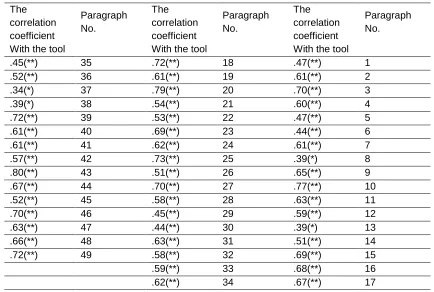
As paragraphs scale correlation with the total score in the exploratory sample from outside the study sample coefficients calculated consisted of (20) students from Albaqaa Applied University students, as the correlation coefficient here is a sign of sincerity for each paragraph in the image correlation coefficient between each paragraph and the total score, link with the tool as a whole between the coefficients ranged (0.34-0.80), the following table shows that.
Table 3. Correlation coefficients
Paragraph No. The
correlation coefficient With the tool Paragraph
No. The
correlation coefficient With the tool Paragraph
No. The
correlation coefficient With the tool
1 .47(**) 18 .72(**) 35 .45(**) 2 .61(**) 19 .61(**) 36 .52(**) 3 .70(**) 20 .79(**) 37 .34(*) 4 .60(**) 21 .54(**) 38 .39(*) 5 .47(**) 22 .53(**) 39 .72(**) 6 .44(**) 23 .69(**) 40 .61(**) 7 .61(**) 24 .62(**) 41 .61(**) 8 .39(*) 25 .73(**) 42 .57(**) 9 .65(**) 26 .51(**) 43 .80(**) 10 .77(**) 27 .70(**) 44 .67(**) 11 .63(**) 28 .58(**) 45 .52(**) 12 .59(**) 29 .45(**) 46 .70(**) 13 .39(*) 30 .44(**) 47 .63(**) 14 .51(**) 31 .63(**) 48 .66(**) 15 .69(**) 32 .58(**) 49 .72(**) 16 .68(**) 33 .59(**) 17 .67(**) 34 .62(**)
* Statistically significant at the significance level (0.05). ** Statistically significant at the significance level (0.01).
It is worth mentioning that all correlation coefficients were of acceptable and statistically significant degree, so it is not deleted any of these paragraphs.
Licensed under Creative Common Page 388 University student's members. Then the questionnaires were collected and discharged and entered into a computer to get the results.
Statistical treatment
To achieve the objectives of the study was the use of statistical packages for Social Sciences ((SPSS to answer her questions, and as follows:
To answer the first two questions, the use of averages and standard deviations.
To answer your second question, it has been the use of t-test for two independent samples, and analysis of variance (One Way Anova).
The answer to the third question: is the use of one-way analysis of variance One way Anova,, and test Hevah comparisons posteriori .
Model of the study
Independent variables:
Gender: male, female.
Academic year: It has four categories: first year, second year , third year , fourth year .
The dependent variable:
The reality of social responsibility at the BAU students and ways of development
FINDINGS
First question: What is the reality of social responsibility at the BAU students ?
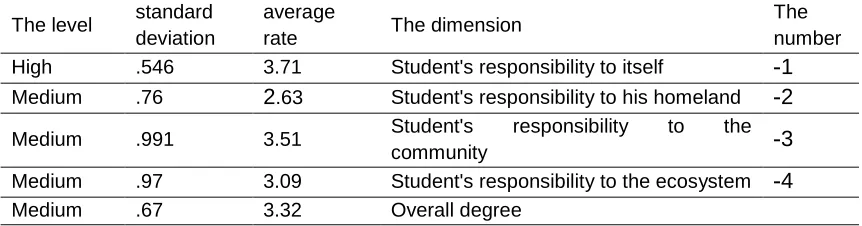
To answer this question was extracted arithmetic means and standard deviations of the responses of the study sample to the reality of social responsibility at the BAU students and to determine the degree of social responsibility; it has been using the standard described in previous chapter on each dimension of the scale dimensions:
Table 4. Arithmetic means and standard deviations for answers sample members of the study on the reality of social responsibility at the BAU students measure the dimensions
The number The dimension
average rate standard
deviation The level
1 - Student's responsibility to itself
3.71 .546
High
2 - Student's responsibility to his homeland 2.63
.76 Medium
3 - Student's responsibility to the community
3.51 .991
Medium
4 - Student's responsibility to the ecosystem 3.09
.97 Medium
Overall degree 3.32
Licensed under Creative Common Page 389 The table (4) indicates that the first place was the first after the student's responsibility to itself with a mean (3.71) and a standard deviation (546.) By the study sample responses and moderately, followed in second place, third dimension student's responsibility to the community in a mean (3.51) and deviation standard (54) and moderately , while the third place was fourth after the student's responsibility to the ecosystem with a mean (3.09 ) and a standard deviation (76) and moderately, while the fourth place fourth after the responsibility of the student to his homeland with a mean (2.63) And a standard deviation (0.76) and got the total score of the reality of social responsibility on the arithmetic average (3.32) and a standard deviation (0.67) and moderately .
Table 5. Means and standard deviations for answers sample members of the study on the first dimension student's responsibility to itself
the number The dimension
average rate standard
deviation Degree
1 Do my best to carry out any action by the need to take
3.76 .928
High
2 Help my family in solving problems
3.75 .946
High
3 Committed to the system when you line up in the queue
3.73 .967
High
4 Be sure to provide assistance to those in need
3.72 1.011
High
5 Increase the voice of the radio always
3.71 .913
High
6 Devote some time to read
3.71 .955
High
7 I join my colleagues talk about community issues 3.71
.937 High
8 Do not be late for an appointment lecture
3.70 1.025
High
9 I like to work with the group to work on my own
3.69 .951
High
10 Completed my duties on time
3.67 1.027
Medium
Overall degree 3.71
.546 High
Licensed under Creative Common Page 390 Table 6. Means and standard deviations for answers sample members of the study on the
second dimension of student responsibility towards their homeland
the number The dimension average rate standard deviation the level 1 I join in the volunteer work
2.68 .771
Medium
2 I do not care the way that is going to work within the National Assembly
3.14 .620
Medium
3 Violation of traffic rules an attack on the system 3.80
.330 High
4 Be sure to show the bright side of my country. 3.01
.80 Medium
5 I like to work with the group to work on my own 2.95
.788 Medium
6 Join Students Council elections
2.95 .788
Medium
7 Drug responsibility of the security men only.
2.87 1.284 Medium Overall degree 3.05 .76 Medium
The table (6) indicates that ranked first came to paragraph (3) " for violation of traffic rules an attack on the system, with a mean ( 3.80 ) and a standard deviation ( 33 ) and highly , either paragraph ( 1)" I join in the volunteer work came in ranked last by study participants responses to a student's responsibility towards his homeland moderately Account ( 2.68 ) and a standard deviation ( 52 ) and moderately , while the total score for after the responsibility of the student to his homeland was moderately came as the study sample responses with a mean ( 3.05 ) standard deviation ( 76 ).
Table 7. Means and standard deviations for Answers study sample members of the Third Dimension student responsibility towards society
the number The dimension average rate standard deviation degree 1 Committed to the university systems
3.62 .515
Medium
2 Re books that I have borrowed from the university library in the allotted time
3.35 .614
Medium
3 The complexity of life affects participation in social events
3.50 .53
Medium
4 Resort to cheating in exams
3.43 1.037
Medium
5 Read about the history of my country
3.39 .991
High
6 Listen to the news bulletins
3.38 1.117
Medium
7 We follow world events
Licensed under Creative Common Page 391 The table (7) indicates to the first rank came with paragraph (5) J Read about the history of my country, " with a mean ( 3.39 ) and a standard deviation ( 0.99 ) according to the study sample responses and highly, either paragraph (7) " I follow world events " came in ranked last by the study sample responses on the social responsibility of the student to the community in a mean (3.33) and a standard deviation ( 1.117 ) and moderately, while the total score of social responsibility of the student to the community came highly according to the study sample responses with a mean ( 3.51 ) and a standard deviation ( .991).
Table 8. Means and standard deviations for answers sample members study the fourth dimension (student responsibility to the ecosystem)
the number The dimension
average rate standard
deviation degree
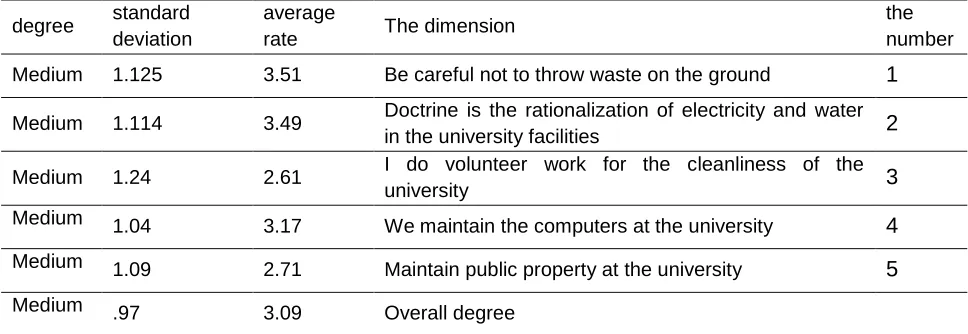
1 Be careful not to throw waste on the ground
3.51 1.125
Medium
2 Doctrine is the rationalization of electricity and water in the university facilities
3.49 1.114
Medium
3 I do volunteer work for the cleanliness of the university
2.61 1.24
Medium
4 We maintain the computers at the university
3.17 1.04
Medium
5 Maintain public property at the university
2.71 1.09
Medium
Overall degree 3.09
.97 Medium
The table indicates (8) to the first rank came with paragraph (1) "Be careful not to throw waste on the ground," according to the study sample responses after the student's responsibility to the ecosystem with a mean (3.48) and a standard deviation (1.411) and moderately while I got a paragraph ( 3) "I do volunteer work for the cleanliness of the university," with a mean (2.61) and a standard deviation (1.24) at the lowest arithmetic average, according to the study sample responses after the student's responsibility to the ecosystem and moderately, while the total score after came moderately within the responsibility student toward ecosystem according to the study sample responses with a mean (3.09) and a standard deviation (97).
Second question: Are there significant differences (α = 0.05) in the degree of social responsibility and the reality of the BAU students due to the variable) Gender, college(
Licensed under Creative Common Page 392 Table 9. Averages, standard deviations, and the results of the test (t-test) of the significance of
differences to the point where the reality of social responsibility at the students due to the variable (gender)
Gender the number average rate standard deviation Values "T" Degrees of freedom Statistical significance Male 239 3.32 .588 -.206 604 .837 Female 367 3.33 .584
As points in the table (9) that there is no statistically significant differences at the level of significance (0.05 = α) on the total score of the reality of social responsibility depending on the
variable gender.
Table 10. Averages, standard deviations, and the results of the test (t-test) of the significance of differences to the point where the reality of social responsibility at
the BAU students due to the variable (total)
College averag e rate standard deviation Values "T" Degrees of freedom Statistical significance Humanitarian College 3.32 .573 -.236 604 .814 Scientific College 3.34 .608
The results indicate in the table (10) that there is no statistically significant differences at the level of significance (0.05 = α) on the total score of the reality of social responsibility depending
on the total variable.
Third question: Are there significant differences (α = 0.05) in the degree of social responsibility
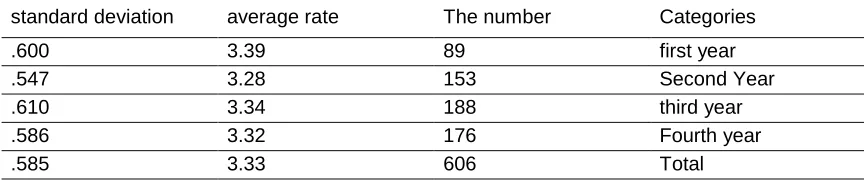
and the reality of the BAU students attributed the college, sex and academic year for a variable? To answer this question was extracted averages, standard deviations , to the extent the reality of social responsibility as the academic year variable , and the table below illustrates this:
Table 11. Averages, standard deviations, to the extent the reality of social responsibility as the academic year variable
Licensed under Creative Common Page 393 Table (11) shows differences in the averages , standard deviations, to the extent the reality of the social responsibility of the academic year by a variable , but a statement denote statistical differences between the averages have been used by one-way analysis of variance table (12) .
Table 12. Variance of the impact of differences in the degree of social responsibility attributed to the academic year analysis
the source Sum of
squares Degrees of
freedom Average
squares The value
of " F " Statistical
significance
Between groups .669
3 .223
.649 .584
Within groups 206.670
602 .343
Overall 207.339
605
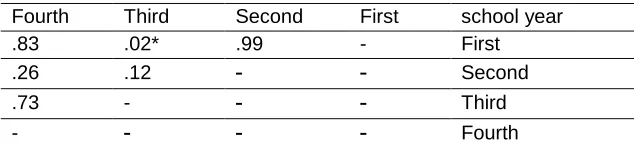
Seen from the table (12) no statistically significant differences at (α = 0.05) attributed at all - and in the tool as a whole except for , but a statement of marital differences statistically function between the averages were used posteriori comparisons manner as shown in the table (13) :
Table 13. Test results posteriori comparisons between the averages on the degree of the degree of social responsibility attributed to the academic year
school year First
Second Third
Fourth
First -
.99 .02*
.83
Second -
- .12
.26
Third -
- -
.73
Fourth -
- -
-
* Statistically significant at the significance level (α = 0.05)
DISCUSSIONS
Discuss the first question
Licensed under Creative Common Page 394 Discuss the second question
The results showed that there were no statistically significant differences at the level of significance (0.05 = α) on the total score of the reality of social responsibility according to gender, attributes the researcher this result that there is no statistically significant differences between males degrees and female, BAU students may be attributed to both equality has received the same opportunities of education and upbringing, care and training,. The social role of distinctive expected of college students, regardless of gender or specialization may raise the level of sense of responsibility to the highest levels, where high rates came on the scale when males and females agreed outcome with the customer study (2012), Knumeir (Kennemer, 2002), and varied with the study of Bani Yaseen (2012).
The study pointed out that there were no statistically significant differences at the level of significance (0.05 = α) on the total score of the reality of social responsibility depending on the college for a variable, concludes the researcher that the level of social responsibility at the humanitarian and scientific disciplines students of the same level nature courses in humanitarian disciplines, especially specialized social service, which informative materials and process emphasizes the importance and practice of social responsibility, and scientific disciplines seeking to find a clean scientific community, the nature of the students in colleges Informed are characterized by seriousness and interest in various fields including, it agreed outcome with the customer study (2012) and the study of Bani Yaseen (2012).
Discussion of the third question
There are statistically significant differences at the level of significance (α = 0.05) to the variable of the school year and for the first year. And enhance researcher result is that there is a range of undergraduate courses compulsory, distributed all disciplines In the first school year, it emphasizes in its entirety on the importance of a college student's commitment to social responsibility, approved by the Islamic religion, as it comes on top of these courses a course of Islamic culture, and lectured the Muslim world and Child Education in Islam, and social service from an Islamic perspective, and other courses taught by university student, starting from the first year, and the result differed with the customer study (2012).
RECOMMENDATIONS
Licensed under Creative Common Page 395 2. Attention to the development of social skills that are related to social responsibility for university students and private developmental manner, preventive, and therapeutic.
3. Conduct studies to determine the relationship between social responsibility when a university professor and his tender within the university and social responsibility when his students.
4. Focus on social aspects, like other cognitive and emotional aspects for university students. 5. Increase the interest in programs specialized in the development of social responsibility in the media.
6. Interest in activities that educates and develops a sense of social responsibility of the students.
7. Carry out studies similar to the current study with a broader sample.
8. Interest in the promotion and development of the spirit of social responsibility, and create social awareness among university students.
9. Motivate students to join social and charitable associations that aim to help others in order to develop students' responsibilities toward others and their issues.
10. Activating the role of supervisor's academics in guiding students to do social roles.
REFERENCES
Aaronson S.A. (2002) ‘How the Europeans Got a Head Start on Politics to Promote Global Corporate Responsibility’, pp. 356–367, International Journal Corporate Sustainability. Corporate Environmental Strategy, 9(4). Elsevier Science Inc. Ruth Hillary, Editor-in-Chief, Scott Wilson Kirkpatrick & Co Ltd. London, UK.
ADB (2003) ‘Country Strategy and Program 2003–2006’, Asian Development Bank, India.
British Council, UNDP, CII and Pricewaterhouse Coopers (2002) Corporate Social Responsibility Survey, 2002 – India, India: British Council.
Chaudhuri S. (2001) ‘Production and Employment Growth and Decline in Organized Manufacturing in India Since 1991’, Paper presented at the International Conference, Beyond the Washington Consensus – Governance and the Public Domain in Contrasting Economies: The cases of India and Canada, 12–14 February 2001, India.
CREM (2004) Corporate Social Responsibility in India, Policy and Practices of Dutch Companies, Amsterdam: CREM.
CSM (2001) Corporate Social Responsibility: Perceptions of Indian business, Kolkata, India: Centre for Social Markets.
Ghosh J. (2003) ‘Strategy for Development’, Frontline Vol. 20, No, 18, India.
Goyal S.K. (1996) ‘Political Economy of India’s Economic Reforms’, Working Paper of the Institute for Studies in Industrial Development (ISID), New Delhi, India.
Hopkins M. (2003) The Planetary Bargain: Corporate social responsibility comes of age, London: Macmillan Press.Google Scholar
IIC (1966) Social Responsibilities of Business, New Delhi, India: India International Centre.
Licensed under Creative Common Page 396 Mohan A. (2001) ‘Corporate Citizenship: Perspectives from India’, Journal of Corporate Citizenship, Sheffield: Greenleaf Publishing.Google Scholar
Partners in Change (2004) Third Report on Corporate Involvement in Social Development in India, Partners in Change, India.
Prakash-Mani K. (2002) Corporate Social Responsibility in the Indian Context, Sustainability, UK: Sustainability Radar.Google Scholar
Purie A. (2003) ‘BT The New Paradigm: Letter from the Editor-in-Chief’, Business Today, Collector's Edition, Volume IV., Publisher: Ashish Bagga, Living Media India Ltd. Delhi, India.
Seminar (2004) ‘Development Journal from India’, No. 537, May 2004 (www.india-seminar.comaccessed 09 May 2004), India.
Shourie A. (2004) ‘Required: A new form of governance for a new economy’, Indian Express Newspaper Article Series – Our Brave New Industry, Part III 04 April 2004, India.
Shrivastava H. and S. Venkateswaran (2000) Business of Social Responsibility – The Why, What and How of Corporate Social Responsibility in India, Bangalore: Books for Change.Google Scholar
Srinivasan T.N. and S.D. Tendulkar (2003) ‘Reintegrating India with the World Economy’. Washington, D.C.: Institute for International Economics.
Utting P. (2003) ‘Promoting Development through Corporate Social Responsibility – Does it Work?’, Global Future, Third Quarter 2003, Profit and Loss? Corporations and Development. W orld Vision International, London.