R E S E A R C H A R T I C L E
Open Access
Capturing domain knowledge from multiple
sources: the rare bone disorders use case
Tudor Groza
1*, Tania Tudorache
2, Peter N Robinson
3and Andreas Zankl
4Abstract
Background: Lately, ontologies have become a fundamental building block in the process of formalising and storing complex biomedical information. The community-driven ontology curation process, however, ignores the possibility of multiple communities building, in parallel, conceptualisations of the same domain, and thus providing slightly different perspectives on the same knowledge. The individual nature of this effort leads to the need of a mechanism to enable us to create an overarching and comprehensive overview of the different perspectives on the domain knowledge.
Results: We introduce an approach that enables the loose integration of knowledge emerging from diverse sources under a single coherent interoperable resource. To accurately track the original knowledge statements, we record the provenance at very granular levels. We exemplify the approach in the rare bone disorders domain by proposing the Rare Bone Disorders Ontology (RBDO). Using RBDO, researchers are able to answer queries, such as: “What phenotypes describe a particular disorder and are common to all sources?” or to understand similarities between disorders based on divergent groupings (classifications) provided by the underlying sources.
Availability: RBDO is available at http://purl.org/skeletome/rbdo. In order to support lightweight query and integration, the knowledge captured by RBDO has also been made available as a SPARQL Endpoint at http://bio-lark. org/se_skeldys.html.
Multiple perspectives over the same domain Ontologies represent a formalised description of the con-cepts and relationships in a domain. For example, they can be used to model and capture knowledge around a par-ticular set of hereditary disorders (e.g., bone dysplasias), in addition to their underlying genetic mechanisms (relat-ing disorders to genes) and their observable traits (relat(relat-ing disorders to phenotypes). Over the course of the past decade, they have become one of the main mechanisms used in building intelligent systems and algorithms to sup-port, among others, the study of cross-species phenotype networks [1-3], gene screening, prediction and prioritiza-tion [1,4] or disorder predicprioritiza-tion [5,6]. This rising adop-tion, in particular by the biomedical community, has led to the proliferation of the number of ontologies published openly via repositories such as the NCBO BioPortal [7] or the Open Biological and Biomedical Ontology (OBO)
*Correspondence: [email protected]
1School of ITEE, The University of Queensland, St Lucia, Australia Full list of author information is available at the end of the article
Foundry [8]. An effect of this uptake has been the need for a community-driven process [9], which requires a shared understanding of the rules and primitives that govern the domain under scrutiny. More concretely, experts required appropriate mechanisms to update and evolve ontologies and the domain knowledge, in order to ensure an accurate knowledge transfer. A relevant example of such collab-orative knowledge curation is the development of the International Classification of Disorders (ICD-11) [10], or efforts like the Gene Ontology [11], the Human Pheno-type Ontology [12] or the International Classification for Nursing Practice (ICNP) [13].
Recognising the need for community-oriented knowl-edge curation does not, however, take into account that multiple communities may target, in parallel, the concep-tualisation of the same domain. This, in turn, leads to ontologies that provide slightly different perspectives on the same knowledge. These perspectives differ in:
1. focus – the particular aspects of the domain – e.g., given a particular set of disorders, a community may
focus more on the genetic mechanisms, while another one on the clinical presentation, 2. granularity – the level of detail considered in the
knowledge modelling process – e.g., given the same context, the knowledge captured by a community may include the prevalence of the disorders or the age of onset, while in other cases this knowledge may be omitted, or
3. in the underlying interests or priorities of those creating them – for example, a community may just be interested in the clinical presentation of the disorders because of its focus on clinical diagnosis.
We are currently missing a key mechanism to allow us to create a comprehensive overview of the different perspectives on the domain knowledge.
Ontology integration is a field that has been extensively studied in the past. Although several definitions of “ontol-ogy integration” exist in the literature [14], it is usually referred (as is in our case) to the process of combining two or more ontologies about the same subject into a single unified ontology. One step in the integration process is to find the correspondences (a.k.a., mappings) between the semantically-related entities, which can be done manu-ally or (semi-automaticmanu-ally). The ontology-matching topic that has seen an enormous amount of research, as shown by several comprehensive and thorough surveys that are available in the literature [15-18]. All these approaches are focused on trying to identify in a (semi-)automatic manner the correspondences between entities in differ-ent ontologies. This is not the focus of our work, as the mappings between the two resources were identified in a manual fashion by a domain expert. Even more, existing work on ontology integration does not keep track of the provenance of the integrated entities. This novel aspect of our work brings several benefits, which are discussed later in the paper.
In the biomedical domain, many ontologies create cross-references to other vocabularies, as a means to keeping track of both the mapping between terms, and, sometimes, provenance of a term. The UMLS Metathe-saurus [19] provides the Concept Unique Identifiers (CUI) that represent the unique meaning of a concept and is used to map between terms from different source vocabu-laries. The Disease Ontology (DO) [20] reuses terms from different biomedical ontologies (MeSH, ICD, OMIM and NCI Thesaurus), either by inclusion or cross-mapping, and keeps track of their provenance by recording their source id as a property associated to the class. As such, the Disease Ontology provides a rich resource for seman-tically connecting phenotypic, gene and genetic informa-tion related to human disease. Even though, the Disease Ontology approach is somewhat related to ours, there are two significant differences: (i) The domains covered by the
DO and our RBDO are different (general disease vs. rare bone disorders); (ii) Our focus is on storing the prove-nance at very granular level, including at the relationship level (as opposed to only at entity level), in a manner that is computable.
In this paper we present a model, and its associated implementation, aimed at integrating classifications of disorders developed by multiple entities, with a focus on the rare bone disorder domain. More concretely, we showcase the integration of the ORPHANET rare bone disorders classification [21] with the International Skele-tal Dysplasia Society Nosology [22]. The resulting ontol-ogy – the Rare Bone Disorders Ontolontol-ogy – structures knowledge via the Simple Knowledge Organisation Sys-tem (SKOS) vocabulary [23] and documents provenance via the Provenance Ontology [24]. From a conceptual per-spective, the atomic elements of the classification integra-tion resemble nano-publicaintegra-tions [25], while RBDO acts as a coherent aggregation of such nano-publications. Finally, we describe a simple SPARQL query interface that enables the interaction with the knowledge, directly via SPARQL queries or via pre-built query templates.
Current status in the rare bone disorders domain Rare bone diseases knowledge resources
The rare bone disorders domain is an example where the above-mentioned integration challenge can be observed and where developing a consolidated solution would ben-efit the all communities working on the topic. In this section, we discuss the existing domain knowledge repre-sentations together with their advantages and shortcom-ings.
The International Skeletal Dysplasia Society(ISDS) publishes every 4 years the Nosology of bone dys-plasias [22] – based on the recommendation provided by a panel of experts. The Nosology classifies each dis-order into a single group, based either on its clinical radiographic appearance or on its underlying molecu-lar genetic mechanism. In some cases, this classification scheme proves to be too rigid, since disorders may easily be associated with multiple groups – due also to the lack of a complete overview of the knowledge surrounding them. Furthermore, the actual Nosology incorporates only the genotype of the domain, with no relationships to the char-acteristic phenotypes (which are implicitly present in the taxonomy).
More concretely, the authors annotate the clinical syn-opses with Human Phenotype Ontology (HPO) [12] con-cepts and link the resulting annotations to skeletal dys-plasias in BDO. Overall, the Bone Dysplasia ontology acts as a consolidating agent between the ISDS Nosology and the OMIM phenotype description of the disorders.
TheOrphanet Consortium, on the other hand, has also developed over the years a taxonomy of rare bone disor-ders that lists skeletal dysplasias as central elements. This taxonomy, more elaborated than the ISDS Nosology, is enriched with manually curated genotype and phenotype knowledge, the latter including an additional level of detail and mappings to HPO concepts (i.e., the degree of occurrence of the phenotype in the context of the disorder -e.g.,Achondroplasiais associated “very frequently” to Macrocephaly).
Differences in the representation of the current resources There are several major differences between the BDO/ISDS and Orphanet that are worth noting. As a side note, we need to remark that the Orphanet classifi-cation is by default more generic and includes disorders that are not bone dysplasias. Our analysis, however, focuses strictly on those components of Orphanet that are common to both classifications.
1. Orphanet introduces a more fine-grained pheno-typic annotation by specifying the frequency of occur-rence of a phenotype in the context of a given disorder.
Orphanet:
<Disorder id="17601">
<OrphaNumber>166024</OrphaNumber> <Name lang="en">Multiple epiphyseal
dysplasia, Al-Gazali type</Name> <DisorderSignList count="18"> <DisorderSign>
<ClinicalSign id="2040">
<Name lang="en">Hypertelorism</Name> </ClinicalSign>
<SignFreq id="640">
<Name lang="en">Very frequent</Name> </SignFreq>
</DisorderSign> ...
</DisorderSignList> </Disorder>
BDO/ISDS:
Class: Multiple epiphyseal dysplasia, Al-Gazali type
Annotations:
rdfs:label ’’Multiple epiphyseal dysplasia, Al-Gazali type’’,
SubClassOf:
Bone Dysplasia,
associated_phenotype some hp:HP_0000316
2. The Orphanet taxonomy is more complex, nesting disorders up to 7 levels deep, as opposed to the 3 levels defined by BDO/ISDS.
Orphanet:
<Disorder id="12333">
<OrphaNumber>93419</OrphaNumber>
<Name lang="en">Rare bone disease</Name> <ClassificationNodeList count="1"> <ClassificationNode>
<ClassificationNodeChildList count="53"> <ClassificationNode>
<Disorder id="858">
<OrphaNumber>2764</OrphaNumber>
<Name lang="en">Osteochondritis dissecans </Name>
</Disorder>
<ClassificationNodeChildList count="10"> <ClassificationNode>
<Disorder id="746">
<OrphaNumber>2054</OrphaNumber>
<Name lang="en">Osteochondritis of tarsal/ metatarsal bone</Name>
</Disorder> ...
</ClassificationNode> ...
</ClassificationNodeChildList> ...
<ClassificationNode> ...
<ClassificationNodeChildList> ...
<ClassificationNode> ...
<ClassificationNodeList> ...
</Disorder>
BDO/ISDS:
Class: Bone Dysplasia
Class: Abnormal mineralization group SubClassOf: Bone Dysplasia
Class: Hypophosphatasia adult form
SubClassOf: Abnormal mineralization group
e.g., Mesomelic dysplasia, Korean type is (conceptually) a type ofMesomelic dysplasia. Such groupings may occur as siblings in the hierarchy.
Orphanet:
<Disorder id="12333">
<OrphaNumber>93419</OrphaNumber>
<Name lang="en">Rare bone disease</Name> <ClassificationNodeList count="1"> <ClassificationNode>
<ClassificationNodeChildList count="53"> <ClassificationNode>
<Disorder id="858">
<OrphaNumber>2764</OrphaNumber>
<Name lang="en">Osteochondritis dissecans </Name>
</Disorder>
<ClassificationNodeChildList count="10"> ...
</ClassificationNodeChildList> ...
<ClassificationNode> <ClassificationNode> <Disorder id="10552">
<OrphaNumber>68411</OrphaNumber>
<Name lang="en">Rare bone tumour</Name> </Disorder>
<ClassificationNodeChildList count="10"> ...
</ClassificationNodeChildList> ...
<ClassificationNode> ...
<ClassificationNodeChildList> ...
<ClassificationNode> ...
<ClassificationNodeList> ...
</Disorder>
BDO/ISDS:
Class: Bone Dysplasia
Class: Abnormal mineralization group SubClassOf: Bone Dysplasia
Class: Perlecan group SubClassOf: Bone Dysplasia
Class: TRPV4 group
SubClassOf: Bone Dysplasia
... Class: Hypophosphatasia adult form SubClassOf: Abnormal mineralization group
Class: Schwartz-Jampel syndrome SubClassOf: Perlecan group ...
4. The number of bone dysplasias and their pheno-type associations covered by the two sources differs significantly: (i) there are 202 bone dysplasias present in BDO but not in Orphanet (i.e., 38.5% of the total of 524 disorders listed in BDO); (ii) BDO reuses 2,183 HPO concepts to describe phenotypic characteristics, while Orphanet reuses only 1,133 HPO concepts.
5. The actual disorder – phenotype associations are different between BDO and Orphanet. For example,
Adams-Oliver syndromehas 40 HPO concepts
asso-ciated in BDO and 66 in Orphanet, only 14 of which are in common.
Both classification systems have been developed by domain experts and the apparent differences might reflect true differences in opinion between the expert groups. We do not suggest that this divergence is due to errors and that a ground truth should exist, as there is no easy way to reconcile them to arrive at such a ground truth. We do, however, advocate for building a model that is able to represent both classifications by recording the appropri-ate provenance and that enables researchers to use both sources in an integrated or comparative manner.
In the remainder of the paper we discuss the benefits of integrating diverse domain knowledge views and then propose a new ontology, named the Rare Bone Disorders Ontology (RBDO), which shows how to achieve this inte-gration from a pragmatic perspective. The goal of RBDO is to provide a comprehensive overview of the rare bone disorders domain and to enable researchers and clinicians to analyse in a comparative manner the different perspec-tives on their genetic and phenotypic descriptions. RBDO is at the border between a domain ontology and an appli-cation ontology. On one hand, it can be used for reasoning tasks, similar to a domain ontology. On the other hand, it can also be used to serve specific integration purposes, subject to the underlying application. The current state of RBDO integrates BDO/ISDS 2010 (the latest to date) and Orphanet data May 2014.
be used for automated consistency checking and reason-ing (e.g., classifyreason-ing disorders based on their phenotype description). Conceptually, the model used by RBDO can be applied in any biomedical domain that may take advan-tage from the integration of various sources of knowledge, however, our current focus is only on bone disorders.
Benefits of loosely integrated domain knowledge views
The previous section has noted various differences between the BDO/ISDS and Orphanet, including: (i) dif-ferent taxonomical groupings; (ii) difdif-ferent ways of sub-typing disorders; or (iii) different phenotypic descriptions. Here we discuss the benefits of using a light and flexi-ble taxonomic representation to incorporate the different views on the domain knowledge, by maintaining both the granularity, as well as provenance.
• Aggregated analysis:Traditionally, ontologies externalise knowledge statements defined by an underlying community. On the other hand, an ontology that integrates the viewpoints of multiple communities creating and publishing knowledge in the same domain enables an aggregated analysis over this domain knowledge. For example, a researcher is able to understand and analyse the differences in phenotype descriptions between BDO/ISDS and Orphanet (in agreement or disagreement) or complement missing descriptions in one source with those defined by the other. Similarly, automated classification or reasoning mechanisms can take advantage of the multiple viewpoints definition of the knowledge and give a higher weight or impact to those statements that have been defined by both (or several) sources as opposed to those defined by a single source.
• Extensibility:Incorporating additional sources in a model that targets integration implies the analysis of the common and distinctive knowledge statements. This is then followed by an enrichment of the ontology with those statements that have not been defined yet, or by adding the new source as provenance to already existing statements. As an example, we intend in the near future to incorporate in RBDO also the classification and description of bone dysplasias according to Spranger et al. [28]. This differs, again, in various aspects, including the grouping strategy or association with different phenotypes and thus will provide yet another perspective on the bone dysplasia knowledge. • Backwards compatibility:By keeping track of the
provenance of all elementary knowledge statements, one is able to re-create the original model – as initially developed by a group / organisation – simply
by building a view over the ontology from the perspective of the corresponding entity. For example, the original BDO/ISDS classification can be
re-created by retaining from the current Rare Bone Disorder Ontology only those concepts and relations that were attributed to ISDS and OMIM. Such an operation may be desirable if classification according to a particular group / organisation is sought.
Integrating multiple classifications and recording the associated provenance
A typical ontology consists of a hierarchy and a set of additional relations between its concepts. The hierar-chy denotes, for example, the taxonomy of disorders, e.g., Acrodysostosis is a sub-class of Acromelic Dysplasias. On the other hand, the additional relation-ships may be used to related these concepts to other con-cepts introduced by the ontology, or to concon-cepts defined by other ontologies. For example, in the Bone Dysplasia Ontology (BDO) we findAchondroplasiato be char-acterised_byMacrocephaly(HP:0000256) and to have associated_geneFGFR3.
The conceptual model we propose follows to a large extent the same direction, but introduces two modelling distinctions. First, we propose the use of the Simple Knowledge Organisation System (SKOS) [23] to capture the hierarchy of disorders published by different enti-ties (e.g., BDO/ISDS and Orphanet) SKOS is a W3C recommendation and has been widely used for build-ing lightweight classifications. It provides an alternative mechanism to rigid logical classifications and it enables a straightforward publishing of the same knowledge as Linked Data. Finally, it is conceptually easy to understand also by non-experts. Second, we impose the documenta-tion of the provenance of all concepts and reladocumenta-tionships in the ontology – in order to keep track of the originating source. We shall discuss and exemplify these two aspects in the remainder of this section.
The knowledge engineering process
In order to build RBDO, we first had to gain a deep understanding of the similarities and differences between BDO/ISDS and Orphanet. Consequently, with the help of a bone dysplasia expert, we performed a manual com-parative analysis of the two sources, which included: 1. a manual alignment of the disorders and groups of disorders (using a spreadsheet); 2. a manual inspection, followed by an intersection of the genotype knowledge associated with each disorder; and 3. a repetition of the previous step for phenotype knowledge.
Bone Disorder
Bone Disorder Group
SKOS: Concept
SKOS: Collection
skos:member
associated_phenotype
HP:0000118
Phenotypic Abnormality
Gene
associated_gene
skos:member skos:broaderTransitive /
skos:narrowerTrasitive
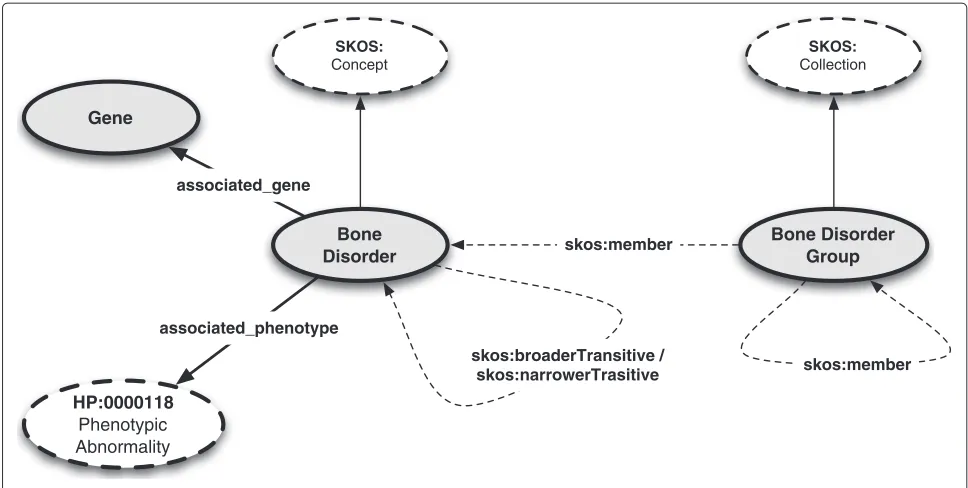
Figure 1The upper-level structure of the Rare Bone Disorder Ontology.
Group,Bone DisorderandGene– in addition to re-using the knowledge captured by the Human Phenotype Ontology via its top level concept HP:0000118 (Phe-notypic abnormality). The relations between Bone
Disorder and Gene and Bone Disorder and
HP:0000118, respectively, are conceptually the same as in BDO, i.e., aBone Disorderhasassociated_geneany
Gene and Bone Disorder has associated_phenotype
any HP:0000118. A major difference to BDO is, how-ever, the clear semantic distinction between group membership and disorder sub-typing via the SKOS vocabulary - discussed in detail later in the paper. Finally, provenance is recorded using the Provenance Ontology (PROV-O) [24], a World Wide Web Consortium recom-mendation, at all levels, for example, when defining bone disorders or associating a bone disorder with a gene.
It is important to note that our effort does not propose a novel ontology mapping approach. The literature contains a wealth of such solutions and we would refer the reader to [29] for a comprehensive overview. We, instead, focus on devising a conceptual mapping model for domain-specific taxonomies, with the added value of provenance, while the actual mapping process has been performed manually by a domain expert. This model is comple-mentary to the existing automatic mapping approaches and provides an upper level scheme that can be used to integrate the mapping results.
Modelling the taxonomy of bone disorders
In a typical ontology, the classification of disorders is modelled using the class – sub class relationship. The
semantics of the sub-class relationship is one of specializa-tion - for example, Mesomelic dysplasia Korean
type or Mesomelic dysplasia Savarirayan
type are subtypes of Mesomelic dysplasia. And while most ontologies use it appropriately, some use it with a different semantics, i.e., as apart-Of relationship, to show the membership of a particular disorder to a group – e.g.,Acrodysostosis is asub-class of – i.e., member of –Acromelic Dysplasias. Consequently, the same relationship is used with two different connota-tions, which does not capture accurately the semantics of the domain knowledge.
A second aspect that requires consideration is the fact that the same disorder can be classified into multiple groups, which may occur either due to the ambiguity introduced by the way in which the groups were formed, or by taking into account the knowledge provided by multiple sources. As an example in the first category,
the FGFR3 Chondrodysplasia Group, defined by
BDO/ISDS, collates bone disorders caused by a mutation inFGFR3– hence the grouping is performed on a genetic
basis. The Lacrimo-Auriculo-Dento-Digital
syndrome(LADD), a disorder known to be caused also by a mutation in FGFR3, has however been placed in
the Polydactyly-Syndactyly-Triphalangism
Group in BDO/ISDS because of its clinical character-istics. Similarly, an example in the second category is
the Holt-Oram syndrome: in BDO/ISDS the
under Dysostosis with limb anomaly as a major feature.
An elegant solution to address both above men-tioned aspects is adopting the Simple Knowledge Orga-nization System (SKOS). As mentioned above, SKOS enables the realisation of lightweight classifications via concepts that are easily understandable also by non-experts. For the purpose of our solution, two SKOS entities are of interest: SKOS Collection and SKOS Concept.
SKOS Concepts are the fundamental units of the
SKOS vocabulary and they denote units of thought, i.e., ideas, meanings, objects, events, which underpin most of existing knowledge organizations systems. In our case,
Bone Disorders, Genes and Phenotypes act as
fundamental units of the ontology and of the domain (as per Figure 1). SKOS Collections provide a natural method to define meaningful groupings of concepts, such
as Bone Disorder Groups. The actual grouping is
realised by connecting aCollectionto aConceptvia theskos:memberrelationship (see Figure 1). Hence, from a general perspective Bone Disorder Groups are
SKOS Collections, Bone Disorders are SKOS
Concepts and Bone Disorder Groups have
mul-tiple Bone Disorder members. Moreover, in order to build multi-level hierarchies, SKOS Collections can, subsequently, be members of other SKOS Collections, via the sameskos:member relationship. This is, for example, not possible if instead of usingSKOS
Collections we would have used SKOS Concept
Schemes.
The advantage of using this modelling approach is that it enables us to place bone disorders into multiple groups, as well as to assign a clear semantics to group membership, and to aggregating groups of bone dis-orders and bone disdis-orders, respectively, into the same group. The example above has already exhibited the multi-group membership within a taxonomy or across taxonomies. An example of multi-group membership with a mixture of both groups and disorders is the case of the Orphanet Dysostosis group (Orphanet:364559).
Dysostosis has as members Dysostosis with
predominant craniofacial involvement (Orphanet:93453) andPatellar dysostosis (Orp-hanet:93455), which are groups on their own, but also Congenital pseudoarthrosis of clavicle (Orphanet:66630), which is a disorder.
So far, we have addressed the issue of modelling groups of bone disorders. The second aspect relevant for the hierarchy is the disorder sub-typing, as per the previous example about Mesomelic dysplasia: Korean type, Kantaputra type, Savarirayan type. Sim-ilar to the grouping of disorders, SKOS provides a way to model this aspect using a clear semantics via the skos:broaderTransitive and skos:narrowerTransitive relationships – i.e., a Bone Disorder can be skos:broaderTransitive or skos:narrowerTransitive with respect to another Bone Disorder (see Figure 1). In practice, both relationships denote two elements: the broader / narrower association between Bone
Disorders, e.g.,Mesomelic dysplasiais broader
conceptually thanMesomelic dysplasia, Korean type, as well as the transitivity aspect which ensures a natural hierarchy of disorders. An example of this order is presented in Figure 2: Polydactyly(Orphanet:2913) is broader than Preaxial polydactyly of fin-gers (Orphanet:294939), which in turn is broader
than Polydactyly of a triphalangeal thumb
(Orphanet:93336). Transitivity hence enforces
Poly-dactyly (Orphanet:2913) to be, due to the
existing broader relationships, also broader than Polydactyly of a triphalangeal thumb (Orphanet: 93336).
In addition to the hierarchical structure, the Rare Bone Disorders Ontology defines the relationships required to describe disorders by means of their under-lying genetic and phenotypic characteristics. These relationships are associated_gene that connects a
Bone Disorder to a Gene (e.g., Achondroplasia
associated_gene FGFR3) and associated_phenotype that connects a Bone Disorder to Phenotypic
abnormality(HP:0000118) – e.g.,Achondroplasia
associated_phenotype Macrocephaly (HP:0000256). Finally, additional relations are introduced to capture
ORPHA: 2913
Polydactyly
ORPHA: 294939
Preaxial polydactyly of
ORPHA: 93336
Polydactyly of a triphalangeal thumb
skos:broaderTransitive skos:broaderTransitive skos:broaderTransitive
extra knowledge about Bone Disorders, such as the mode_of_inheritance relation, which relates a Bone
DisordertoMode of Inheritance(HP:0000005).
All associations between Bone Disorders and their related concepts are modelled as OWL restrictions.
In conclusion, using the grouping and broader/narrower capabilities provided by SKOS, we are able to capture the entire knowledge encoded by both the ISDS Nosology (and hence BDO), as well as the Orphanet classification. A complete overview of the definitions and axioms defined by this new ontology are provided later in the paper.
Recording provenance
Our approach records provenance at all granularity lev-els in the ontology – i.e., both when defining concepts, as well as when associating them via relationships. We believe that tracking provenance is currently a key aspect in domain-specific knowledge engineering and in particu-lar in domains where the knowledge is not fully matured. Provenance offers a clear perspective on the origins of the diverse knowledge units, in addition to enabling a com-parative view over those knowledge units that have been modelled by multiple sources. By embedding it within the definition of the ontological concepts, we can, by default, capture the entity that defines both the ontological con-cepts, as well as the diverse relationships that characterise
them. We will discuss a concrete example further down in this section.
In order to capture provenance in RBOD, we adopted another well-known W3C recommendation – the Prove-nance Ontology (PROV-O). PROV-O provides the set of classes, properties and restrictions required to rep-resent and share provenance. It consists of ten classes describing entities, agents and activities and a wide range of properties that cover aspects such as provenience, authorship, temporality, influence or roles – all in the context of provenance. For example, using PROV-O, one is able to specify the primary source of an information (prov:hadPrimarySource), to whom is the information attributed (prov:wasAttributedTo) or where was it derived from (prov:wasDerivedFrom).
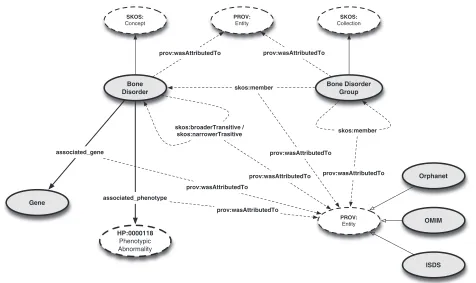
Figure 3 depicts our ontology enriched with provenance. Using this model, one can add provenance to both entities defined in the ontology, as well as relationships created between these entities. More concretely, provenance is captured for:
• Bone Disorder Groups – e.g.,FGFR3 Chondrodysplasia Group prov:wasAttributedToISDS
• a particular Bone Disorder as part of its classification – e.g.,Achondroplasiais aBone Disorder,
Bone Disorder
Bone Disorder Group SKOS:
Concept
SKOS:
Collection
skos:member PROV:
Entity
prov:wasAttributedTo
associated_phenotype Gene
associated_gene
skos:member prov:wasAttributedTo
skos:broaderTransitive / skos:narrowerTrasitive
PROV:
Entity
prov:wasAttributedTo
prov:wasAttributedTo prov:wasAttributedTo
prov:wasAttributedTo prov:wasAttributedTo
ISDS OMIM Orphanet
HP:0000118 Phenotypic Abnormality
Achondroplasiaprov:wasAttributedToISDS, Orphanet
• group membership – e.g.,FGFR3
Chondrodysplasia Groupskos:member
Achondroplasia; statement prov:wasAttributedToISDS
• broader / narrower relationships – e.g.,
Rubinstein-Taybi syndrome(Orphanet:783)
skos:narrowerTransitiveRubinstein-Taybi syndrome due to 16p13.3
microdeletion(Orphanet:353281); statement prov:wasAttributedToOrphanet
• the association between a Bone Disorder and a phenotype – e.g.,Achondroplasia associated_phenotypeMacrocephaly (HP:0000256); statementprov:wasAttributedTo ISDS
• the association between a Bone Disorder and a gene – e.g.,Achondroplasiaassociated_geneFGFR3; statement prov:wasAttributedToISDS,Orphanet
All these aspects are depicted in an example in Figure 4,
usingSpondyloepimetaphyseal dysplasia
Ma-roteaux type, its placement in BDO/ISDS and Orphanet and some of its associated knowledge.
Implementation & availability
The Rare Bone Disorder Ontology (RBDO) aims to capture the domain knowledge in a computer-processable way and thus we opted for using a logical formalism to encode the relationships between the concepts. The resulting ontology
class axioms not only encode the conceptual real-world knowledge (e.g., Achondoplasia hasassociated_gene
FGFR3 and associated_phenotype Hydrocephalus
(HP:0000238) or Lumbar hyperlordosis (HP:000 2938)), but also enable users (and applications) to perform reasoning on patient instance data. The actual formal-ism we have used is the RL profile of the Web Ontology Language (OWL) 2 [30].
OWL 2 RL enables applications to perform scalable reasoning while at the same time maintaining most of the language’s expressiveness. The profile has been designed to cater for applications that allow a trade-off between the full expressivity of OWL 2 and efficient inference, since OWL 2 RL reasoning systems can be implemented using typical rule-based reasoning engines. Finally, this profile enables the use cases targeted by our ontology, i.e., consistency checking, class expression sub-sumption or conjunctive query answering, in a scalable and reliable way. We will use the Manchester syntax, a user-friendly syntax for OWL 2, to present the formal representation of the RBDO examples throughout this section.
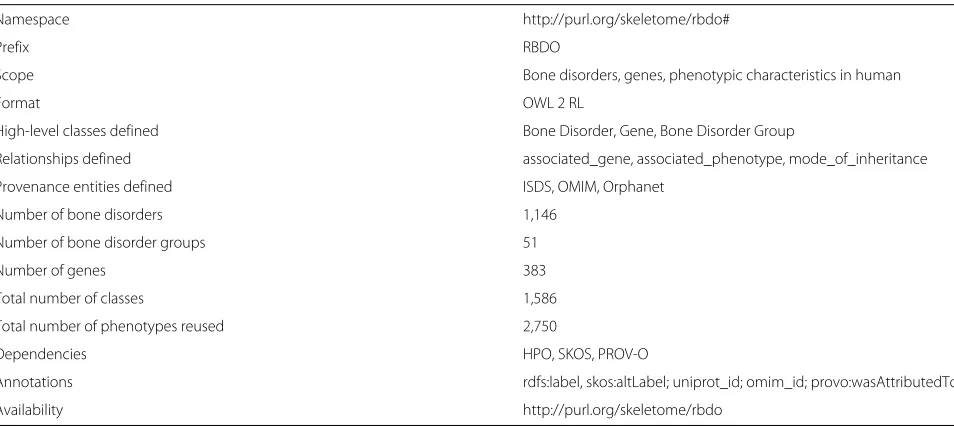
Table 1 denotes the fact sheet of RBDO. The ontol-ogy defines two relationships and three own classes, the rest being re-used from Human Phenotype Ontol-ogy, SKOS and PROV-0. The two relationships (associ-ated_geneandassociated_phenotype, both defined using the Manchester syntax, in the listing below) enable us to relate bone disorders to genes and to phe-notypes, respectively – the latter defined by HPO concepts.
Table 1 The rare bone disorder ontology fact sheet
Namespace http://purl.org/skeletome/rbdo#
Prefix RBDO
Scope Bone disorders, genes, phenotypic characteristics in human
Format OWL 2 RL
High-level classes defined Bone Disorder, Gene, Bone Disorder Group
Relationships defined associated_gene, associated_phenotype, mode_of_inheritance
Provenance entities defined ISDS, OMIM, Orphanet
Number of bone disorders 1,146
Number of bone disorder groups 51
Number of genes 383
Total number of classes 1,586
Total number of phenotypes reused 2,750
Dependencies HPO, SKOS, PROV-O
Annotations rdfs:label, skos:altLabel; uniprot_id; omim_id; provo:wasAttributedTo
Availability http://purl.org/skeletome/rbdo
ObjectProperty: associated_phenotype Domain: DisjointUnionOf: Bone_Disorder, Bone_Disorder_Group
Range: HP:HP_0000118
ObjectProperty: associated_gene
Domain: DisjointUnionOf: Bone_Disorder, Bone_Disorder_Group
Range: Gene
The central concept of the ontology is the Bone Disorder class (see Figure 1 and listing below), which is defined as an entity characterised by a mode of inheri-tance (re-used from HPO) and by a series of associations with specific genes and phenotypes.Bone Disorders can be grouped into Bone Disorder Groups using theskos:memberrelation as shown in the previous section and can be associated with genes and phenotypes as per the above corresponding relation definitions. It is worth noting that the ontology definesBone Disordersvia a novel artefact introduced in OWL 2 – namely, punning – which allows an entity to be defined both as a class of concepts and as an instance of a particular concept at the same time. This was required in order to be able to accom-modate the SKOS taxonomical structure, since a SKOS Conceptis a class on its own, while bone disorders rep-resent instances of SKOS Concepts. More details are shown in the example presented later in the section.
Class: Bone_Disorder Types: SKOS:Concept
SubClassOf: mode_of_inheritance some HP:HP_ 0000005
SubClassOf: associated_gene some Gene SubClassOf: associated_phenotype some HP: HP_0000118
A key aspect of RBDO is the presence of provenance embedded within the logical definitions of the concepts. This is, in principle, possible due to another technical artefact introduced by OWL 2, which enables the defini-tion of annotadefini-tion asserdefini-tions on class axioms and property restrictions. More concretely, as we will see in the next example, every class definition (and hence association with genes and phenotypes) or group membership defi-nition is annotated with a provenance statement, which enables us, at any time, to track its original creator and eventually to create a specific provenance-driven view over the knowledge in the ontology.
In order to have a better understanding of the logi-cal descriptions introduced in RBDO we detail below the example provided in Figure 4.
Class: BDG0000035 Types: SKOS:Collection Annotations:
rdfs:label ’’Spondylo-epi(-meta)physeal dysplasias’’,
prov:wasAttributedTo Orphanet, prov:wasAttributedTo ISDS ...
skos:member BD0000917 skos:member
Annotations: prov:wasAttributedTo Orphanet BD0000189
Class: BDG0000038 Types: SKOS:Collection Annotations:
rdfs:label ’’TRPV4 Group’’, prov:wasAttributedTo ISDS ...
skos:member
Annotations: prov:wasAttributedTo ISDS BD0000189
Firstly, let us note the definition of theSpondylo-epi
(-meta)physeal dysplasias (BDG0000035) and
TRPV4 Group (BDG0000038) bone disorder groups,
as shown in the listings above. We can observe that the former has been defined by both ISDS and Orphanet, while the second is present only inISDS.
Fur-thermore, Spondyloepimetaphyseal dysplasia
Maroteaux type (BD0000189) is listed as a
mem-ber of both groups (see skos:member BD0000189 in the definition of each group). Theprov:wasAttributedTo statements in the listings denote the use of annota-tion asserannota-tions to assign specific provenance to each group membership. The first statement captures the provenance of the group membership relation with
Spondylo-epi(-meta)physeal dysplasiasand
assigns it toOrphanet, while the second has the same goal but in the context of theTRPV4 GroupandISDS.
Class: BD0000189 Annotations:
rdfs:label ’’Spondyloepimetaphyseal dysplasia Maroteaux type’’,
skos:altLabel ’’Pseudo-Morquio syndrome type 2’’,
skos:altLabel ’’Spondyloepiphyseal dysplasia, Maroteaux type’’, omim_id ’’184095’’,
prov:wasAttributeTo ISDS, prov:wasAttributeTo Orphanet Types: skos:Concept
SubClassOf: Bone_Disorder SubClassOf:
Annotations: prov:wasAttributeTo OMIM associated_phenotype some hp:HP_0002857 SubClassOf:
Annotations: prov:wasAttributeTo Orphanet, ISDS
associated_gene some GENE0000100
The actual definition of the disorder is presented in the listing above. As a remark, for brevity, some of the axioms have been left out from this listing. Here,
Spondyloe-pimetaphyseal dysplasia Maroteaux type is
defined as a bone disorder belonging to bothISDSand
Orphanet and which may be associated with Genu
Valgum (HP:0002857) and with the TRPV4 gene
(GENE0000100) – the definition of GENE0000100 is provided below.
Class: GENE0000100 Annotations:
rdfs:label ’’TRPV4’’,
skos:altLabel ’’OTRPC4’’, skos:altLabel ’’TRP12’’, skos:altLabel ’’VR-OAC’’, skos:altLabel ’’VRL-2’’, skos:altLabel ’’VROAC’’, uniprot_id "Q96Q92’’ Types: skos:Concept SubClassOf: Gene
Finally, the same mechanism for annotating the group membership provenance is used to annotate the class axioms and enforces the bone disorder to be defined in the context of the association with some phenotypes and genes. Theprov:wasAttributeTostatements using in the listings above capture the provenance of the associ-ation with Genu Valgum(HP:0002857) and assigns it to OMIM, as well as the provenance of the underlying genetic mechanism – i.e., the association with theTRPV4 gene(GENE0000100) and assigns it to both ISDSand Orphanet.
Publishing bone dysplasia Linked Data
As shown and discussed in the previous section, the Rare Bone Disorders Ontology has been made available in OWL 2 RL format in order to support a smooth transition to a specific entity-oriented view (i.e., BDO or Orphanet). This would then enable direct consistency checking and classification based on the current ontology axioms. The same knowledge, however, can also be published in a lighter format – a format focused on easy integration and query. Consequently, we have also transformed the ontol-ogy into a query and integration endpoint using a Linked Data approach.
The Linked Data initiative [31] has initially emerged from the need of making data trapped within legacy sys-tems openly available on the Web for reuse and integration purposes. The proposed publishing process relies on four simple principles:
• Use unique identifiers (URIs) to denote entities/concepts/etc
• Use retrievable Web identifiers to enable both humans and machines to look up and access the entities corresponding to these identifiers
• Use structured formats (i.e., machine processable) to represent the data – or more precisely RDF – Resource Description Framework [CITE] • Include links to other entities
Protocol and RDF Query Language) [34], which provides a set of specifications for querying their underlying graph structure.
The literature consists of several good examples of using integrated data to achieve particular goals in specific contexts. For example, Taboada et al. [35] have inte-grated SNOMED CT, OMIM and HPO and a patient clinical dataset in order to bridge the gap between domain specific phenotype descriptions and clinical data in the context of Cerebrotendinous Xanthomatosis. Con-sequently, they were able to successfully infer bidirec-tional phenotype-genotype relations in their domain of interest – e.g., “What are the genetic variants that have been associated with a combination of traits?”. Simi-larly Zhu et al. used Linked Data to perform drug data normalisation in the Pharmacogenomics Knowledge Base (PharmGKB) [36], while Kiefer et al. [37] mined
genotype-phenotype associations in Gene Wiki Plus and OMIM, with a focus on commonly occurring chronic diseases.
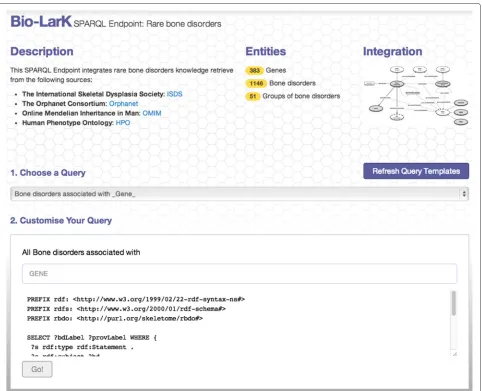
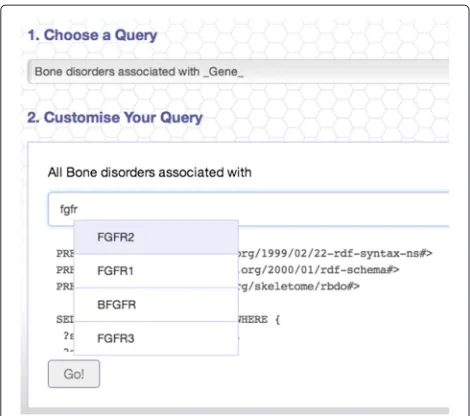
In order to support this initiative and enable future integration of the bone disorders knowledge, we have pub-lished RBDO as a SPARQL Endpoint – available at: http:// bio-lark.org/se_skeldys.html. Furthermore, we have also built a simple query interface to provide researchers and clinicians with the opportunity of exploring it – as shown in Figure 5. The interface uses a set of customisable templates that guide the user in building the desired queries. Currently, it offers a direct access to answer-ing questions, such as “Bone Disorders associated with a given GENE” or “Bone Disorders associated with a given PHENOTYPE”. For example, given the first type of query, a researcher needs only to select from the exist-ing gene list the desired one (as depicted in Figure 6).
Figure 6Example of query via autocompletion: “All bone disorders associated with a chosen GENE”.
The interface then translates it into SPARQL and exe-cutes the query. The results are provided in a tabu-lated form (see Figure 7) and include the provenance of the disorder - gene association and a rapid filtering functionality, in the case in which a particular disorder is sought.
The Bone Disorders SPARQL Endpoint is the first ini-tiative of this kind in the rare bone disorder domain and represents only the first step in our integration plan. Next steps include the integration of this knowledge with other datasets of direct interest, like KEGG Pathway (defining pathway – gene – disorder associations), Cell Cycle Ontol-ogy [38] (describing the cell cycle process inclusive of GO
annotations) and Gene Ontology (defining among others biological and molecular functions). Consequently, the list of query templates will be enriched with new elements to enable an exploration of phenotype - pathway associations or disorder - phenotype - biological functions associa-tions. Finally, to provide an even more comprehensive view over the domain, we intend to integrate bone dys-plasia mouse genotype and phenotype knowledge from KEGG, Mouse Genome Informatics, the Mammalian Phe-notype ontology [39] and the MP – HPO alignments, which will enable the unique opportunity of executing cross-species genotype and phenotype queries.
Discussion
In this section, we discuss some of the challenges encoun-tered in building RBDO, as well as some of its current limitations.
RBDO, as any other domain ontology, relies on the inter-pretation of the domain knowledge, interinter-pretation which is then captured into the ontological definitions. In our case, this raised challenges when performing the manual mapping process, and especially when deciding the nature of some of the concepts in Orphanet – i.e., groups vs. non-groups. Here, the decision has been taken subject to the children of the concept under scrutiny. If the children represented particular types of the same disorder (see the Mesomelic dysplasiaexamples earlier in the paper), the concept has been defined as aBone Disorder, and its children were sub-typed usingskos:broaderTransitive relations. If, however, the children were a mixture of possible groups and disorders well-defined (using also BDO/ISDS as background knowledge), then the concept was defined as aBone Disorder Group.
The goal of RBDO is to provide the scaffolding required to capture knowledge defined by several sources. Since
this knowledge is not necessarily aligned (as in our use case), we may encounter logical conflicts when trying to consolidate it. For example, one source may define a bone disorder to be associated with a particular phenotype, which on its own, may be disjoint with another phenotype that is associated to the same disorder by another source. Currently, RBDO does not contain such conflicts because of the lack of a finergrained definition of the disorder -phenotype associations and of the underlying phenotypic concepts. However, one of the major advantages of RBDO is that it is able to deal with this aspect, simply by allowing conflicting information to exist and recording its prove-nance. We believe that such information is valuable and should be maintained because it allows researchers to get a better understanding of the rationale behind the current classification of disorders. If logical consistency is sought, this can be achieved either by filtering the RBDO knowl-edge according to a single source, or by manually resolving existing conflicts when integrating multiple sources.
A final remark is worth mentioning about the sustain-ability and evolution of RBDO. The initial Bone Dyspla-sia Ontology has been published and used to generate the SKELETOME knowledge base – a community-driven platform for knowledge curation in the skeletal dyspla-sia domain. This platform implements an editorial pro-cess to describe and enrich knowledge around bone dys-plasias and enables a continuous expert-based evolution of the underlying ontology. We plan in the near future to expand the SKELETOME knowledge based to incorporate RBDO, including the functionality required to add addi-tional sources and to discuss conflicting knowledge. All interested researchers and clinicians will have access to SKELETOME and will be able to contribute to the cura-tion and evolucura-tion of this rare bone disorders source of knowledge.
Conclusions
In this paper, we have presented our effort in building and publishing an innovative model for capturing domain spe-cific knowledge from multiple information sources using the rare bone disorders domain as our use case. We have shown how multiple, diverging taxonomies can be ele-gantly integrated using SKOS structures, as well as how to record provenance at all ontology definition levels – rang-ing from group membership, disorder sub-typrang-ing or dis-order characterisation. The model has been implemented as a OWL2 RL ontology, to enable logical formalisation of the knowledge. Furthermore, the same knowledge has also been published in a lightweight format using Linked Data, to support immediate integration and querying.
A major limitation of our current work is the restricted range of queries that can be executed on the published SPARQL endpoint – in principle, this supports only basic interrogations on the association of bone disorders to
phenotype and genotype. Our future efforts will, however, focus on continuously curating and expanding the knowl-edge in the rare bone disorders domain by integrating additional information sources including both human and cross-species data. This will enrich significantly the types of possible queries and will enable us to develop targeted knowledge discovery and exploration tools.
Competing interests
The authors declare that they have no competing interests.
Authors’ contributions
TG and AZ formulated the idea. TG, TT, PR and AZ designed the model. TG and TT developed the ontology. AZ populated the ontology. TG developed the SPARQL Endpoint. TG and TT wrote the manuscript. PR and AZ edited the manuscript. The authors gracefully acknowledge the feed-back received from the anonymous reviewers. All authors read and approved the final manuscript.
Acknowledgements
This research is funded by the Australian Research Council (ARC) under the Discovery Early Career Researcher Award (DECRA) – DE120100508.
Author details
1School of ITEE, The University of Queensland, St Lucia, Australia.2Stanford
Center for Biomedical Informatics Research, Stanford University, Stanford, USA.
3Institut für Medizinische Genetik und Humangenetik, Charité
-Universitätsmedizin Berlin, Berlin, Germany.4Children’s Hospital, Westmead,
The University of Sydney, Sydney, New South Wales, Australia.
Received: 2 April 2014 Accepted: 2 March 2015
References
1. Hoehndorf R, Schofield PN, Gkoutos GV. PhenomeNET: A
whole-phenome approach to disease gene discovery. Nucleic Acids Res. 2011;39(18):e119.
2. Washington NL, Haendel MA, Mungall CJ, Ashburner M, Westerfield M, Lewis SE. Linking human diseases to animal models using
ontology-based phenotype annotation. PLoS Biol. 2009;7(11):e1000247. 3. Doelken SC, Koehler S, Mungall CJ, Gkoutos GV, Ruef BJ, Smith C, et al.
Phenotypic overlap in the contribution of individual genes to CNV pathogenicity revealed by cross-species computational analysis of single-gene mutations in humans, mice and zebrafish. Dis Models Mech. 2013;6(2):358–72.
4. Chen CK, Mungall CJ, Gkoutos GV, Doelken S C, Koehler S, Ruef BJ, et al. MouseFinder: candidate disease genes from mouse phenotype data. Human mutation. 2012;33(5):858–866.
5. Kohler S, Schulz MH, Krawitz P, Bauer S, Dolken S, Ott CE, et al. Clinical diagnostics in human genetics with semantic similarity searches in ontologies. Am J Hum Genet. 2009;85(4):457–64.
6. Paul R, Groza T, Zankl A, Hunter J. Semantic similarity-driven decision support in the skeletal dysplasia domain. In: Proc. of the 11th International Semantic Web Conference. Boston, Massachusetts, USA: Springer Verlag; 2012. p. 164–79.
7. Noy NF, Shah NH, Whetzel PL, Dai B, Dorf M, Griffith N, et al. BioPortal: Ontologies and integrated data resources at the click of a mouse. Nucleic Acids Res. 2009;37(DB): W170–3.
8. Smith B, Ashburner M, Rosse C, Bard J, Bug W, Ceusters W, et al. The OBO Foundry: coordinated evolution of ontologies to support biomedical data integration. Nat Biotechnol. 2007;25:1251–5.
9. Groza T, Tudorache T, Dumontier M. State of the art and open challenges in community-driven knowledge curation. J Biomed Inf. 2013;46:1–4. 10. Tudorache T, Falconer S, Nyulas C, Noy N, Musen M. Will Semantic Web
technologies work for the development of ICD-11? In: Proc. of the 9th International Semantic Web Conference. Shanghai, China: Springer Verlag; 2010. p. 257–72.
12. Robinson PN, Kohler S, Bauer S, Seelow D, Horn D, Mundlos S. The human phenotype ontology: a tool for annotating and analyzing human hereditary disease. Am J Hum Genet. 2008;83(5):610–5.
13. Hardiker N, Kim TY, Bartz CC, Coenen A, Jansen K. Collaborative development and maintenance of health terminologies. In: Proc. of the AMIA Annual Symposium. Washington, DC, USA: American Medical Informatics Association; 2013. p. 572–7.
14. Pinto HS, Gómez-Pérez A, Martins JP. Some issues on ontology integration. In: IJCAI and the Scandinavian AI Societies. CEUR Workshop Proceedings. CEUR-WS.org; 1999.
15. Shvaiko P, Euzenat J. Ontology matching: state of the art and future challenges. Knowl Data Eng IEEE Trans. 2013;25:158–76.
16. Kalfoglou Y, Schorlemmer M. Ontology mapping: the state of the art. Knowl Eng Rev. 2003;18(01):1–31.
17. Noy NF. Semantic integration: a survey of ontology-based approaches. ACM Sigmod Rec. 2004;33(4):65–70.
18. Choi N, Song IY, Han H. A survey on ontology mapping. ACM Sigmod Rec. 2006;35(3):34–41.
19. Bodenreider O. The unified medical language system (UMLS): integrating biomedical terminology. Nucleic Acids Res. 2004;32(suppl 1):D267–70. 20. Schriml LM, Arze C, Nadendla S, Chang YWW, Mazaitis M, Felix V, et al.
Disease Ontology: a backbone for disease semantic integration. Nucleic Acids Res. 2012;40(D1):D940–6.
21. Rath A, Olry A, Dhombres F, Brandt MM, Urbero B, Ayme S. Representation of rare diseases in health information systems: the orphanet approach to serve a wide range of end users. Hum Mutation. 2012;33(5):803–8.
22. Warman ML, Cormier-Daire V, Hall C, Krakow D, Lachman R, LeMerrer M. Nosology and classification of genetic skeletal disorders: 2010 revision. Am J Med Genet Part A. 2011;155(5):943–68.
23. Miles A, Bechhofer S. SKOS Simple Knowledge Organization System Reference. 2009. http://www.w3.org/TR/2009/REC-skos-reference-20090818/.
24. Lebo T, Sahoo S, McGuinness D. PROV-O: The PROV Ontology. 2013. http://www.w3.org/TR/prov-o/.
25. Groth P, Gibson A, Velterop J. The anatomy of a nanopublication. Inf Serv Use. 2010;30(1-2):51–6.
26. Groza T, Hunter J, Zankl A. The bone dysplasia ontology: integrating genotype and phenotype information in the skeletal dysplasia domain. BMC Bioinformatics. 2012;13(50):.
27. Amberger J, Bocchini C, Hamosh A. A new face and new challenges for online endelian inheritance in man (OMIM). Hum Mutation. 2011;32(5): 564–7.
28. Spranger JW, Brill P, Superti-Furga A, Unger S, Nishimura G. Bone dysplasias: An Atlas of genetic isorders of skeletal development. Oxford, UK: Oxford University Press; 2012.
29. Shvaiko P, Euzenat J. Ontology matching: state of the art and future challenges. IEEE Trans Knowl Data Eng. 2013;25:158–176. 30. Motik B, Grau B C, Horrocks I, Wu Z, Fokoue A, Lutz C. OWL 2 Web
Ontology Language Profiles (Second Edition). 2012. http://www.w3.org/ TR/owl2-profiles/.
31. Heath T, Bizer C. Linked data: evolving the web into a global data space. Princeton, New Jersey, US: Morgan & Claypool; 2011.
32. Bairoch A, Apweiler R, Wu CH, Barker WC, Boeckmann B, Ferro S. The Universal Protein Resource (UniProt). Nucleic Acids Res. 2005;33:154–9. 33. Croft D, Mundo AF, Haw R, Milacic M, Weiser J, Wu G. The Reactome pathway knowledgebase. Nucleic Acids Res. 2014;42(Database issue): D472–7.
34. Group TWSW. SPARQL 1.1 Overview. 2013. http://www.w3.org/TR/ sparql11-overview/.
35. Taboada M, Martinez D, Pilo B, Jimenez-Escrig A, Robinson PN, Sobrido MJ. Querying phenotype-genotype relationships on patient datasets using semantic web technology: the example of cerebrotendinous xanthomatosis. BMC Med Inf Decis Making. 2012;12:78.
36. Zhu Q, Freimuth RR, Pathak J, Chute CG. Drug Data Normalization with NDF-RT. In: Proc. of the AMIA Joint Summits on Translational Science, eCollection 2013. Bethesda, Maryland: American Medical Informatics Association; 2013. p. 180.
37. Kiefer R, Freimuth RR, Chute CG, Pathak J. Mining Genotype-Phenotype Associations from Public Knowledge Sources via Semantic Web Querying. In: Proc. of the AMIA Joint Summits on Translational Science,
eCollection 2013. Bethesda, Maryland: American Medical Informatics Association; 2013. p. 118–22.
38. Antezana E, Egana M, Blonde W, Illarramendi A, Bilbao I, Baets BD, et al. The cell cycle ontology: an application ontology for the representation and integrated analysis of the cell cycle process. Genome Biol. 2009;10: R58.
39. Smith C, Goldsmith C, Eppig J. The mammalian phenotype ontology as a tool for annotating, analyzing and comparing phenotypic information. Genome Biol. 2005;6:R7.
Submit your next manuscript to BioMed Central and take full advantage of:
• Convenient online submission
• Thorough peer review
• No space constraints or color figure charges
• Immediate publication on acceptance
• Inclusion in PubMed, CAS, Scopus and Google Scholar
• Research which is freely available for redistribution