1461
Artificial Neural Network Approach for Software
Product Line Testing
Ashish Saini, Rajkumar, Satendra KumarAbstract: Software Product Line Testing (SPLT) is an immensely important task because it confirms the validity of a product while it is a time consuming and costly process. To minimize the time and check the validity confirmation of a product, an efficient method is required to decide whether a product of an SPL is faulty or not. A tester can decrease the actual cost of testing and its maintenance cost as well as time by using such efficient method. In this paper, we concentrate on an idea, where we use an Artificial Neural Network (ANN) technique, which works to test a software product line. In this technique, the backpropagation algorithm is used to train a Neural Network (NN) based on the set of test cases of the product’s actual version. The trained network treats as a black-box testing approach, in which two parts are presented for an algorithm. SPL product’s validity is measured by the distance between actual and faulty outputs.
Index Terms: Testing, Software Product Line, Artificial Neural Network, Test Cases, Feature Model, Product Line, Configurations. —————————— ——————————
1 INTRODUCTION
Software Product Line (SPL) is a very optimistic approach to software product advancement that allows organizations to develop number of comparative products in similar application space. SPL decreases the products development and maintenance cost, moreover increases the productivity which occur by artifacts reuse, and also reduce the market time. SPL artifacts like as architectures, test cases, components, models, documents and requirement specifications are the metamorphic artifacts of core assets. These artifacts are sufficient to develop non identical products from a particular set of core assets by utilizing and recognizing commonality between the products in a product line. According to Software Engineering Institute, “An SPL is a software-intensive system that share common, managed features to satisfy the certain needs of a specific segment of the market and developed in a prescribed manner using a common set of core assets"[1][2]. Companies like Toshiba, Bosch, General motors etc. already applied SPL engineering approaches effectively, in developing intensive system. Industries (small or large scale) want to expand their business and also capture the market in very less time. To grow their business, companies want to create different and unique products according to the requirement of customer or market needs. Now a days, industries are moving to adopt the SPL concept. But an issue that always persists with SPL approach that, the combinations of features of licit and unique artifacts are work properly or not. So, testing is a better way to check the product and their artifact’s combinations. Testing is an expensive, time consuming and a tedious process but, it control the quality of a product. Testing of an SPL is a challenging and significant practice for any
organization’s goals. These goals are to improve the quality, reduce the time and cost of implementation of products. An SPL testing should follow some characteristics like [3] [4]:
In development process, testing should be done instantly as possible for each artifacts.
Must follow the property of reusability regarding assets of product line.
The test method should manage a large number of test cases, because SPL will produce a test case exponent as the features increases.
If probably changes occur in an SPL, there should be no effect on test artifacts.
An approach should test the artifacts combinations and final product too.
Testing methods should be structured whereby, it could achieve the aim of traceability.
Number of researchers are articulated numerous testing methods to test product line and improve testing costs [4][5] discuss these later sections, but no any researcher uses the neural network to test the Software product line and its artifacts.
2 ARTIFICIAL NEURAL NETWORK
BACKGROUND
The arrangement of Artificial Neural Networks (ANNs) is similar to the organization and information processing capabilities of the brain. An ANN composed by a huge number of massive interrelated processing elements called neurons, which works in parallel fashion to solve a specific task. In a neural network neuron consists one or more layers and connections between neurons have related synaptic weight. The synaptic weight on the connections of neurons encodes the knowledge of the network. Every neuron used in the network, used for calculations occurring in the network, which contributes to the training or whole learning process of neural network. Each neuron has its own memory and the output of every neuron depend, on its value in memory and the signals attain at that neuron [6]. Intelligence power of a neural network depends on the collective behavior of neurons, where limited operations performed by each neuron. Thus, the neural network is a large-scale parallel information system, which uses a distributed system to learn and store the information of its environment. There are two components which affect, the ability of neural network computation. First One is designing of
____________________________
• Ashish Saini is currently pursuing Ph.D. at Department of Computer Science in Gurukula Kangri Vishwavidyalaya, Haridwar, India, PH-8791158699. E-mail: [email protected]
• Rajkumar is an Assistant Professor at Department of Computer Science in Gurukula Kangri Vishwavidyalaya, Haridwar, India. E-mail: [email protected].
parallel distribution and another one is the ability to expand the learn information which comes from the output for those inputs that are not present during the training. Thus, with these characteristics, a neural network can solve complicated tasks. Some complex tasks like, Data classification, function approximation and data mining that can be solved with the help of the neural network. Our approach works in that manner, where a trained network produces different outputs when representing a network with input signals. In phase of training, for the training algorithm, the weight of the network can be upgraded with a set of training examples. Every instance occurs in the organization of two components, for the first input and the second output. When the complete set of training example present to the network then one pass (forward or backward) or epoch is concluded. Thus, a neural network works as an input-output mapping system. Each computational neuron of neural network made up of three features: set of synaptic weights, each for interconnections; summation unit which is used to sum, the multiplication of input signal and corresponding weight; an activation or squashing function that keep bound the output in a range, referred by user. Demonstration of a neuron depicts in Fig.1 [18]. Where, for neuron i the input signal is xj; wij, weight
associated between neuron and input signal. Now linearly combine the Multiplication of weights with input signals. The obtained resultant value is used for output of the activation function.
Figure 1. Model of a neuron
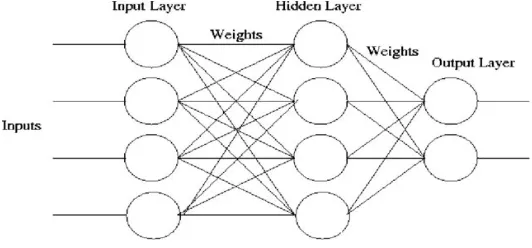
A multi-layer feed forward neural network contains non-computational units for input layer and an output layer for computational units, it also contains hidden layers that may be one or more. A multilayer neural network is shown in Fig. 2 [19].
The standard training approach backpropagation which works for multi-layer feed forward neural networks. In an algorithm input signal passes forward and the erroneous signal passes backward with the help of network. A multilayer neural network works efficiently, feedforward resolves complex and general tasks while backpropagation is a systematic method for training [7][8]. Objective behind this idea to propose an automated testing method to test the combination of artifacts as well as the end product of a product line. Further this paper structured as follows: section 2 discuss some research work published by researchers in concerning subject of research. Outline of propose idea is defined in section 3. Description about the testing methodology discuss in section 4. In section 5, we conclude the paper with future work.
3 RELATED WORK
1463
Prakash [15] presented an improved combinatorial testing approach, testing with a combinatorial approach considers a promising method. They enhance the combinatorial testing with approach IPOG (In-Permanent-Order-General) which is a test case generating method. To perform combinatorial coverage, they incorporate that method with a neural network which provides the most appropriate test case scenario. New approach suitable to find that how much combinatorial previously performed and how many fresh test cases are required in existing test cases, through which suitable coverage of testing could be achieved. There are many more papers that discussed the testing of the product line. But, after survey those papers it came to our notice that, no author has shown any method in which the neural network has been used for testing of product line.
4 METHOD’S OUTLINE
In the above section, we have seen that no author has discussed any such methods of using the neural network approach for software product line testing. In this section, we will introduce a method for testing a product line with the help of a neural network.
The proposed method is summarized as follows:
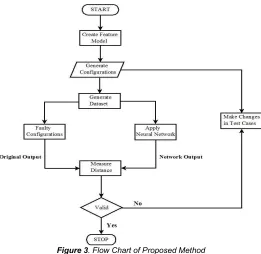
1. Design/Select the feature model of SPL. 2. Generate configurations of an SPL product. 3. Use the configuration to generate a dataset. 4. Apply a neural network approach.
5. Lead to errors or the correct form.
An overview of the proposed method presented in the form of a flowchart in Fig.3.
Figure 3. Flow Chart of Proposed Method
The basic part of a product line is the feature model or feature tree, as well as a dense demonstration of the model, which
based on the features and dependencies between them. The approach presented in this section begins with designing a product model that is created using the necessary and common features or characteristics of the product. For this approach, the model is designed with the help of the model design tool FeatureIDE [16].
It is not feasible to test all the products at once in a software product line. For this purpose, we generate test cases or configurations of that product. These configurations are generated by using the features and constraints of the SPL. For example, an SPL with seven features and the generated configurations are five, now if the first configuration has 5 features, then the second configuration might have 3 or 4 features, which means the number of features in a configuration may vary and also not in its place as shown in Fig.4. There may be a special case, if any configuration from all five of them may contain all the seven features, only if, all features are mandatory for this configuration. In this approach, we use the FAMA (FeAture Model Analyzer) tool to generate test cases or configuration [17]. We create a dataset using the SPL configurations where in the dataset, if a feature is available in the configuration then, its corresponding value is represented by one otherwise zero. After the dataset is created, the neural network is applied to the data set and the actual dataset is trained to obtain the output of the network. This trained neural network seems to be a simulation model of SPL.
Figure 4. Product Configurations with Features
On the other hand, creating a new version (faulty dataset) of the actual dataset and output generated using this new version of the dataset. Then, using the comparison tool to measure the distance between both outputs, representing the distance, we can determine the effectiveness of the product. If the product is valid, the process will end and the existing configuration is valid, but if the product is not valid, we make changes in the existing test case or configuration.
5 PROPOSED SPL TESTING METHODOLOGY
Figure 5. Training Phase of Configuration Dataset
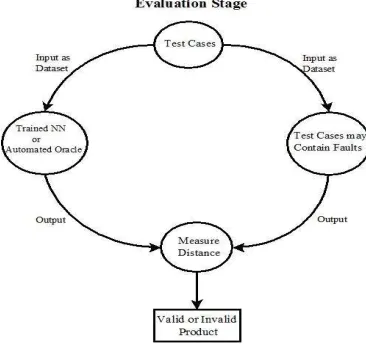
contain defects and create a dataset for corresponding configurations. The actual dataset is created and trained by the neural network, from which a trained network is obtained, and this trained network can act as an automated tool for testing the upcoming versions of the product, and this process known as regression testing. The second phase is the evaluation phase, as shown in Fig. 6, where the actual dataset is used as input to the trained neural network and misconfiguration dataset for testing. For each input, the distance between the output of the ANN and the value corresponding to the faulty configuration is measured. The validity of a product depends on the distance calculated, and if the calculated distance coincides with the test case output, then our product is valid. Furthermore, if the output of the test case does not coincide with the calculated distance, then the network reports of an invalid product. The validity of any product depends on the distance calculated by the network which can be measured by any comparison or distance rule, which compares the result given by ANN to the results of faulty test cases. With the help of an automated method, we can ensure that outside factors have not affected the results. Apart from this, the condition of biasness may occur if a tester already aware about the original product or output.
To test an SPL, there are the following steps:
1. Create/Select a feature model. 2. Generate test configuration.
3. Generate datasets based on feature availability in configurations
If, feature availability = yes Then, set 1
Else, set 0
4. Apply Artificial Neural Network, Trained actual dataset and get output, also trained faulty configuration’s dataset.
5. Apply comparison method and get difference between network and actual outputs.
If test case is valid, Then, stop the program
Else, go to step 3 and make changes in test configurations.
6. Stop the program.
6 CONCLUSION AND FUTURE WORK
Testing of an SPL is a complex task, either testing the product's effectiveness or verifying the functional combination for that product. Performing this manually can be time-consuming and much costly. To decrease the time and cost of SPL testing, we propose a method in which an artificial neural network acts as an automatic predictor for SPL testing. In the proposed method, a dataset is generated from a test case and then used as input to the training, and a dataset is generated for the wrong configuration. The neural network is applied to the dataset and calculate the difference between the outputs is found. After the difference is obtained and compare with the faulty configuration, it can be said that the product is valid or not. The neural network approach might be suited to product line testing, and implementing this approach in real-time examples or as a result experiment will be our future work.
REFERENCES
[1] A. Saini, Rajkumar, and S. Kumar, “A Systematic Literature Survey on Software Product Line Testing,” Int. J. Res. Anal. Rev., Vol. 6, No. 1, Pp. 253–262, 2019.
[2] S. Kumar and Rajkumar, “Test Case Prioritization Techniques for Software Product Line : A Survey,” Int. Conf. Comput. Commun. Autom., pp. 884–889, 2016. [3] Z. Akbari, S. Khoshnevis, and M. Mohsenzadeh, “A
Method For Prioritizing Integration Testing in Software Product Lines Based on Feature Model,” Int. J. Softw. Eng. Knowl. Eng., Vol. 27, No. 4, Pp. 575–600, 2017. [4] E. Engström and P. Runeson, “Software Product Line
Testing - A Systematic Mapping Study,” Inf. Softw. Technol., Vol. 53, No. 1, Pp. 2–13, 2011.
[5] I. D. C. Machado, J. D. Mcgregor, Y. C. Cavalcanti, and E. S. De Almeida, “On Strategies For Testing Software Product Lines: A Systematic Literature Review,” Inf. Softw. Technol., Vol. 56, No. 10, Pp. 1183–1199, 2014. [6] E. Parveen Kumar and E. Pooja Sharma, “Artificial Neural
Networks-A Study,” Int. J. Emerg. Eng. Res. Technol., Vol. 2, No. 2, Pp. 143–148, 2014.
1465
[9] J. C. Dueñas, J. Mellado, R. Cerón, J. L. Arciniegas, J. L. Ruiz, and R. Capilla, “Model Driven Testing in Product Family Context,” 2004.
[10] L. Jin-Hua, L. Qiong, and L. Jing, “The W-Model For Testing Software Product Lines,” Int. Symp. Comput. Sci. Comput. Technol., 2008.
[11] J. D. Mcgregor, “Testing A Software Product Line,” Tech. Report, Clemson University, USA, 2001.
[12] J. M. Ferreira, S. R. Vergilio, and M. Quinaia, “Software Product Line Testing Based on Feature Model Mutation,” Int. J. Soft. Eng. Knowl. Eng., Vol. 27, No. 5, Pp. 817–839, 2017.
[13] A. Bertolino and S. Gnesi, “Pluto : A Test Methodology For Product Families,” Lecture Notes In Computer Science, Pp. 181–197, 2004.
[14] M. A. M and R. Moawad, “An Approach For Requirements Based Software Product Line Testing,” In International Conference On Informatics and Systems (Infos), 2010. [15] R. Patil and V. C. Prakash, “Neural Network Based
Approach For Improving Combinatorial Coverage in Combinatorial Testing Approach,” vol. 96, no. 20, pp. 6677–6687, 2018.
[16] C. K̈astner, T. Thum, et al., “FeatureIDE: A Tool Framework for Feature-Oriented Software Development,” Proc. - Int. Conf. Softw. Eng., no. May 2014, pp. 611–614, 2009.
[17] A. Saini, Rajkumar, and S. Kumar, “Software Product Line Configurations Generation using Different Types of Tools – A Comparison,” Int. J. Comput. Sci. Eng., vol. 6, no. 4, pp. 105–109, 2018.
[18] https://becominghuman.ai/artificial-neuron-networks-basics-introduction-to-neural-networks-3082f1dcca8c [19] O. M. Abbas, “Neural Networks in Business Forecasting “,