51
Identifying The Most Applicable Renewable
Energy Systems Of Iran
Nasibeh Mousavi, Mitra Mohebbi, Mohammad Teimouri
Abstract: These years because of energy crisis all of country try to find a new way to reduce energy consumptions and obtain maximum use of renewable energy. Iran also is not an exception of this progress. Renewable energy is energy that is provided by renewable sources, such as the sun or wind. In general renewable energies are not adaptable to every single community. Because of location and special climate conditions of Iran, most applicable renewable energy systems in Iran are solar and wind energy. Main purpose of this paper is to review and identify most applicable renewable energy systems of Iran and also review on traditional and current methods that utilized to obtain maximum use of these renewable energies.
Index Terms: Sustainable building, Renewable energy, Wind energy, Passive solar energy, Active solar energy, Wind catcher, Photovoltaic system, solar thermal system, Iran
————————————————————
1
I
NTRODUCTIONEnergy has become a critical factor in national and global economic development. Whether or not there is true energy crisis at this time may be debated, but it is certain that era of plentiful and cheap fossil fuel is ending. Iran is rich in oil, gas and other fossil energy resources. For many years people of Iran used gasoline and oil fuel power generators to meet their electricity need. It need fuel plus maintenance, which is too expensive and costly and also cause pollution. Iran has opted to turn to use renewable energy. Renewable energy is energy that is provided by renewable sources, such as the sun or wind. Renewable energy is contrasted with energy generated by fuels that are subject to depletion, such as oil, natural gas, and coal, which were formed over millions of years and which society is consuming at a rate faster than the rate at which the fuels were formed. Renewable energy is also contrasted with the energy generated by fuels that create pollution that will have a lasting effect, such as nuclear energy. [1] In general renewable energies are not adaptable to every single community because of two main factors, the distribution of the natural resources that has dependency on the geographical locations and energy-use with its dependency on the culture of individual community. [2] Because of location and special climate conditions of Iran, most applicable renewable energy systems in Iran are solar and wind energy.
1.1 Climate conditions of Iran
Iran is located in western Asia, a region that is better known as the Middle East. Iran is a large country with the Caspian Sea and the Persian Gulf making up much of the northern and southern borders respectively. Iran covers such a large area of land (approximately 636,372 square miles, in fact) that the country contains a vast variety of landscapes and terrains.
Much of Iran is made up of the Iranian Plateau, which the exception of the Caspian Sea and Persian Gulf coastlines where the only large plains are found. Iran is also one of the most mountainous countries in the world. Iran has what is considered a variable climate which ranges from semi-arid to subtropical. In the northwest, winters are cold with heavy snowfall and subfreezing temperatures during December and January. Spring and fall are relatively mild, while summers are dry and hot. In the south, however, winters are mild and the summers are very hot, with average daily temperatures in July exceeding 38°C (or 100°F). On the Khuzestan plain, the extreme summer heat is accompanied by high humidity. But in general, Iran has an arid climate in which most of the relatively scant annual precipitation falls from October through April. [3]
1.2 Most applicable renewable energy systems of Iran There are many different kinds of renewable energy sources like geothermal, bio fuel, tidal and so on, but wind and solar energies are more available and accessible than other types in Middle Eastern countries and also in Iran. [4] Iran’s location shows that solar energy in all parts of Iran is easily accessible. As well, the great number of sunny days in Iran during the year indicates that it is possible to use solar energy in most of the days in all seasons. Fig.1 Solar energy (active and passive forms) has the highest priority, best advantage, and most useful application to be used in urban areas and buildings of Iran. The most important advantages for active solar energy are the fossil fuel consumption reduction and added the reduction in maintenance and operation costs. The major advantages of passive solar energy are the applicability in urban areas and buildings of Iran and the low initial construction costs. [5] Iran according to its excellent geographical position, can use enormously from wind energy as a renewable energy. Iran has some high-wind locations, for example in the mountainous regions north of Tehran. Fig.2 shows that wind energy potential in Iran is more than 40000 MW. The energy potential of the wind is an important source of clean and renewable energy which is available in many parts of the Iran. Iran enjoys high wind energy potential, but exploitation and investigation of this clean renewable source is still below the desired level. [6]
_____________________
52 Fig. 1. Annual average of solar radiation in Iran, 1999-2011
Fig. 2. Wind energy potential of Iran
2
O
VERVIEW OF MOST APPLICABLE RENEWABLE ENERGY SYSTEMS OFI
RANThe necessity use of renewable energy systems in Iran can be categorized in two main issues: 1) Environmental pollution and 2) More oil and gas export. Most applicable renewable energy systems of Iran are wind and energy.
2.1 Wind energy
Wind is one of the renewable energy forms associated with the lowest embodied energy, which is typically saved within three to five months of operation. The UK has excellent potential for generating energy from wind, being the windiest country in Europe. As an island it also has many possibilities of developing off-shore wind farms. [7] Wind power is plentiful, renewable, widely distributed, clean, produces no greenhouse gas emissions during operation and uses little land. Tapping wind energy would help Iran cut use of fossil fuels because most of the country’s power generation plants are operated by
gas and oil products. An advantage of wind turbines is the potential to generate power during both day and night. Disadvantages include high cost, dependence on steady winds, and noise pollution. [1] Wind energy is provided by turbines and the larger the turbine, the more electricity can be produced. It is also possible to install small generators on a particular building; but often their efficiency is compromised by the local wind environment and there is evidence that such small turbines are not generating anything like their potential. The most efficient way of using wind energy is to use a large turbine located away from the building. These turbines often produce more energy than is required by the building and therefore provide the opportunity of exporting electricity to the grid. [8] Iran joined the Wind Energy Producers' Global Club in 1994 by installing 2X500 KW turbines. The first experience in installing and using modern wind turbines dates back to 1994. Two sets of 500 kW NORDTANK wind turbines were installed in MANJIL and ROODBAR. They produced more than 1.8 million kWh per year. These two sites are in the north of Iran, 250 km from Tehran, the capital of Iran. The average wind speed is 15 m/s for 3700 hours per year in ROODBAR, and 13 m/s for 3400 hours per year in MANJIL. After this successful experience, in 1996 the contract for 27 wind turbines was signed and they were installed by 1999 in MANJIL, ROODBAR and HARZEVIL. HARZEVIL is the third wind farm site near to MANJIL. [9] Fig.3. Nowadays Iran`s government try to installing wind turbines in many wind farm of country.
Fig. 3. Manjil wind turbines area
2.1.1 Wind Catcher/Tower
53 tower’s shaft and heated the thermal mass of the wind tower,
the hot inside air rose due to lower density and escaped through the exhaust partitions. In some buildings, wind coming in the tower would pass over a water pond, offering evaporative cooling. In general, wind towers applied convection and evaporation to decrease the temperature of internal spaces to below outdoor temperatures. [11] Baud-Geers designed depend on wind directions and height in southern and centeral cities of Iran such as Bandar-abbas, Bushehr, Kerman, Yazd, Esfahan, Semnan,… Most of them located in south part of building. There are many different shape of baud-geer which designed in traditional building of Iran.
Fig. 4. Wind catchers served as a cooling system (Seyed Aliagha house-Abarkouh)
2.2 Passive solar energy
Passive solar energy refers to the harvesting of solar heat without the use of mechanical or electrical systems, such as pumps or fans. The passive solar energy field in many ways laid the groundwork for much of our current knowledge both in building efficiency and in solar energy. Passive-heated buildings need the three elements of a solar energy system, including collection, storage, and control. Collection is performed by south-facing windows. Storage is typically performed by thermal mass. Control is performed by such devices as movable insulation for windows at night. [1] Fig.5 Passive solar design is a very effective and simple way to save money and minimize our biggest impact on the environment, buildings. To save most of the energy a building uses, apply passive solar design to heat it, as well as to cool, light, and ventilate it. By not requiring energy from fossil fuels and nuclear reactors, passive solar homes will save money, ensure your family’s comfort, and be less of a burden on the planet. There are three key types of passive solar systems: direct gain, thermal storage walls, and sunspaces. Each of these systems has its own advantages. With direct gain systems, the house’s windows act as solar collectors and the
walls and floors act as solar absorbers; this is why direct gain is the simplest and least expensive passive solar system. Thermal storage wall systems are good for rooms where you do not want as much light or where you want more privacy. Sunspace systems are great for additions to historic homes because you do not have to modify the home too much. These three systems can, and often should, be used on the same house. The most important passive solar design strategy is to get proper building orientation, especially making sure your site has good southern solar access and laying out the house so that its long side faces south. Another important strategy is to design solar shades so that they allow in the winter’s solar radiation and block the summers. The other essential strategies are getting proper thermal mass, glazing, ventilation, room arrangement, and daylighting. Insulation and air sealing are critical in any building. Use light-colored roofs, do not build more than you need, locate the home near where the occupants need to go, chose efficient appliances and lighting, and select local and green materials. [12]
Fig. 5. Passive solar energy system, including collection, storage, and control
Iran has a good potentials of using solar energy, it is obvious most of traditional architects knew about this potentials and used different methods to access this renewable energy. Most of used methods in traditional architecture of Iran for receiving and using the sun energy include passive ways. Iran consists of various climatic regions and in each region native architects have used different methods to adapt to the environment. Types of these methods included the following:
2.2.1 Glazing
54 method can provide both nature lights and suitable views for
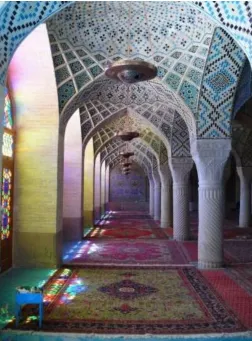
the inhabitants but receiving more sun light spoils the interior devices and also can cause visual problems. But Iran`s traditional architects solve this problem by using colorful and small windows in many different shapes. These kind of windows not only can provide light and heat but also it is beautiful and kind of interior design.
Fig. 6. Colorful and small windows in many different shapes
2.2.2 Thermal mass wall
In this system there is a wall, which is made using masonry materials around the building, especially the solar side of the building for saving the heat of the sun and reducing the heat fluctuation. [13] Fig.7 In summers, adobe structures provided high thermal mass which functioned through a time lag effect. In fact, the outside hot air penetrates the adobe surface through radiation, convection and conduction mechanisms and it is stored in the wall’s thermal mass. The stored heat is then released into the space with a delay – time lag – at night. Using this time lag effect, adobe building materials balanced high diurnal temperature swings between interior and exterior spaces in hot and cold regions. [11] Most of these walls have a thickness about one meter.
2.2.3 Orientation
Selection of building orientation depend on factors such as nature of territory amount of need to private spaces, control and decrease of sound and two factor of wind and radiation. Therefore, the most important role of architect will be that with due attention to require thermal, sanitary and moral condition,
locate building toward orientation which obtain maximum use of light. There are three types of orientation that architects use them in building of Iran: 1) Northeast-Southwest which use in some cities such as Yazd, Tehran, Tabriz. This kind of orientation is according to Qibla direction. 2) Northwest-Southeast which use in some cities such as Esfahan and Takhte-E-Jamshid. 3) East-West use in Kerman, Hamedan, Azarbaijan-Gharbi. [14] Fig.8 Depend on different climates of Iran, architects used different methods of orientation to obtain maximum use of light.
Fig. 7. Thermal mass wall around the building
Fig. 8. Building orientation of Iran in different climatic zone
2.2.4 Insulation
The huge walls have approximately thickness of about one meter. These walls lose the heat through transferring and radiation during night and its temperature remains in low and average degree during the day, this, it provides enough comfort for residents. The common materials for constructing these huge walls includes mud, mudbrick, stone, brick, mortar, lime and wood. The thermo-physical specifications of these materials are the important factors in hot and dry regions. These materials have thermal resistance, high heat capacity and they absorb the sun radiation by their external surfaces. These microscopic and many pores of the mentioned materials, which are filled with air, change them to a material similar to thermal insulator. [15]
2.2.5 Introversion and Courtyard
55 in winter and heating building. Use of courtyard and some
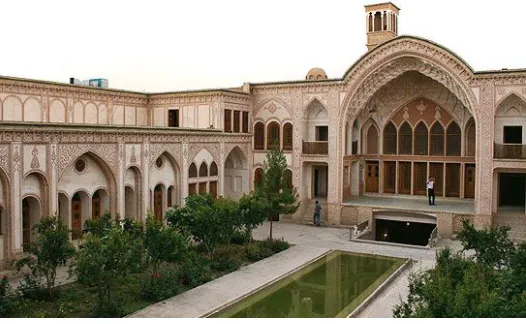
element such as tree, pool, plant inside it not only is useful in winter and summer but also it makes a good scenery for resident. In some big traditional building we can see two or three courtyards that use in different side of building. Fig.9. Rooms usually were arranged around a central courtyard. In the winter, people moved to the northeast side of the house, facing southwest to receive more sunlight, keeping the room warm naturally. In the summer, they migrated to the southwest side where there was less exposure to the sun and more introduction of the fresh breeze of the desirable wind. [16]
Fig. 9. Courtyard and some elements such as tree, pool,plants (Broujerdi house-Kashan)
2.2.6 Using pool
In the past, traditional architects used pools in the central courtyard or interior space of the buildings, like Romans impluviums, for ventilating the spaces or keeping heat. Water can act as a thermal reservoir. Which can save heat during the day and release it at night, when needed. Nowadays, by progressive construction technologies we can use these pools on the roofs of buildings for controlling the interior temperature of the space. In this method thermal mass is located in the roof of the building and is used for heating and cooling the interior space. [13]
2.2.7 Synthetic method
It is the best way of heating and cooling. Most of ancient buildings have combined mentioned methods and used them behind each other. [13]
2.3 Active solar energy
Unlike passive solar system, in active solar system use different mechanical or electrical systems. Active solar systems use external sources of energy to power blowers, pumps and other types of equipment to collect, store and convert solar energy. Solar energy can be used directly via solar thermal collectors for heat or electricity generation through solar photovoltaic (PV). Thermal solar collectors, in essence, consist of an absorber and a heat insulated shell, the front of which is transparent. [17] As mentioned before Iran is among the countries which enjoy a high solar potential, thus the government of Iran same as another country try to start use of active solar energy in some regions of country. Nowadays in Iran solar photovoltaic system and solar thermal system use in different region of country. But against all of the measures that government did, people didn’t get use to this
system yet. More difficult than installing solar panels in Iran, is changing the habits of people who have got accustomed to cheap non-solar energy such as fossil fuels.
2.3.1 Solar photovoltaic system
Solar photovoltaic panels are commonly referred to as modules. Photovoltaic systems have no moving parts. Electric power is generated in the modules in the form of direct current (DC) power. A control device called an inverter takes this DC power and converts it into the alternating current (AC) power required in buildings. The energy generated by solar photovoltaic systems can alternately be fed back to the electric grid if more power is generated than is needed in the building. A photovoltaic system can either be connected to the electric grid (grid-tied) or use batteries to serve as a stand-alone system, or both, to allow the system to both connect to the grid but to operate on its own in case of a power outage. [1] PV generation has many other advantages over other forms of power generation. It is freely and conveniently available everywhere needing no mains supply, it is silent in operation and can be visually unobtrusive, it can be planned and installed in a matter of months rather than taking the ten or more years needed to build a conventional power plant, the technology is non-polluting (any toxic materials used in manufacture can be controlled using existing industrial methods) and it is modular, such that the generation capacity can be expanded easily and any breakages easily replaced. [18] For converted sunlight to electricity, silicon is used on mono and poly crystalline and also in amorphous form. Mainly, it is the mono and poly crystalline forms that are being used for solar cells. [17] These cells of silicon materials that convert solar radiation into direct current electricity. The cost of a crystalline silicon wafer is very high, but new light - absorbent materials have significantly reduced the cost. [19] feasibility of these systems in Iran refer to availability of rich silicone mines in 90% of the lands as the raw material for production of photovoltaic cells, availability of vast unused lands for installation of solar systems, possibility of gradual replacement of fossil fuel power plants with solar systems in order to use fossil fuels for added value applications, increasing energy security, positively affecting the employment issue especially for educated work force, being harmless to the environment and capability of sustained development, profitability for national economy, capability of distributed generation and less dependency on nationwide grid. [9] Activities and achievements in the field of photovoltaic energy:
Supplying photovoltaic electricity to rural areas (358 rural households) totaling 368 KW.
Design, installation and putting into operation of 30 KW Taleghan photovoltaic power plant connected to the grid. Design, installation and putting into operation of a
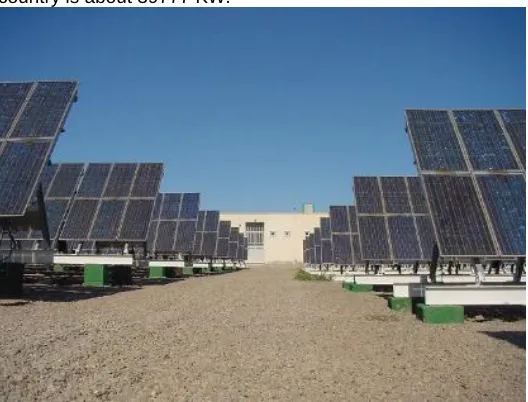
photovoltaic power plant with the nominal capacity of 97 Kw in Sarkavir region in Semnan. Fig.10
Installation 12 kW PV in Yazd.
Transferring management of the photovoltaic systems to distribution companies for electrification of rural areas. Implementation of photovoltaic systems in mosques,
schools and distribution companies throughout the country.
Construction of Solar Park in Taleghan renewable energies site. Fig.24
56 country is about 39777 KW.
Fig. 10. PV panels-Semnan
2.3.2 Solar thermal system
Solar thermal systems can either be used to heat a liquid or to heat air. Solar thermal panels are commonly referred to as collectors. Common liquid collector types include flat-plate collectors and evacuated tube collectors. Flat-plate collectors are lower in cost but are also generally lower in efficiency. Evacuated tube collectors are higher in cost but higher in efficiency and can be easier to install on a roof because the collector is field-assembled from modular tubes. Air-based systems can either heat outdoor air that is being drawn in for ventilation or heat indoor air. The ventilation application is common in a type of collector known as a transpired solar collector, where the air is drawn in through holes in the collector. Systems that heat air can be considered active, using a fan to circulate air, or passive, operating without a fan. Whether active or passive, solar thermal systems typically have three components:
Collection, to receive the sun’s energy.
Storage, to store heat from periods when the sun is available and deliver it when the sun is not available. Controls, to initiate collection and storage of solar energy
when it is available and to prevent losses when the sun is not shining. [1]
A solar collector, mounted on a south, southeast or southwest-facing roof (in the northern hemisphere) and a heat store. [7] This type of power plant is very practical for dry regions such as Iran, because they don’t need water for their performance while fossil fuel power plants consume lots of water for their cooling towers and treatment centers. Moreover, solar power plants do not need fuel and use only solar power for generating electricity and can also work at nights by storing of energy. Unlike fossil fuel power plants where the price of the generated electricity is dependent on oil prices and permanently fluctuating, in solar power plants there is no fluctuation and the price of electricity can be maintained unchanged for long periods. [9] Activities and achievements in the field of solar thermal energy:
Construction of Shiraz 250 KV Parabolic Trough solar thermal power plant. Fig.11
Study of potentials and preparing national solar atlas and
paving the ground for preparation of sun radiation potentials map of Iran with cooperation of German Aerospace Center (DLR)
Conceptual design of Shiraz Hybrid Solar power plant with the objective of 500 KW capacity increment, utilizing advanced Parabolic Trough Collectors.
Design and construction of 5 MT Solar refrigerating system with Solar Solid Desiccant method.
Design, construction and installation of 7500 solar water heaters (3 types) in Boushehr, Tabas, Yazd, Bojnourd, Zahedan and Esfahan cities.
Fig. 11. Shiraz 250 KV Parabolic Trough solar thermal power plant
3
O
VERVIEW OF STUDIES ON RENEWABLE ENERGY SYSTEMS INI
RAN57 system in urban areas and buildings in Iran. Afsharian,
Tabatabaei [23] Firstly, the way of using sustainable desert energy in buildings and how to use solar energy and the way of decreasing infiltration inflow weather from outdoor and absorption of the heat of solar energy; Secondly, how to use air condition and make cold weather with using solar power to have comfortable place in desert buildings. Finally, using traditional wind catcher illustrated and suggested similar system for new tall tower and buildings that can be used in other hot climates. Vaghefpour, zabeh [24] Discuss role of cooperation in creating opportunities for using rich renewable energy sources and also their potential role for entrepreneurship and employment in Iran. The presence of constant, sustainable and economical energy is an essential basis for any economical and social development while it can upgrade life qualities. Iran has a considerable amount of natural resources for modernizing its energy supply and being transited to a sustainable energy system as it has countless opportunities for using rich renewable energy sources. On the other hand, cooperation have been considered as a strategic way to create job opportunities as they are strong organizations which can encounter economical and social side-affects caused by quick moderating procedures in structural programs. Results show convergence between renewable sources development and Iran's economical development through taking a frugal approach in expenses, creating new job opportunities and entrepreneurship in renewable energies. Zahedi [25] Present the results of a study conducted to examine the potential role and potential benefits of energy storage integrated into intermittent sources. Using energy storage will provide an opportunity to create a sustainable power supply, and to make the electricity grid more reliable especially with large proportion of grid-connected renewable sources. Soleymanpour, Parsaee [26] Comparison of vernacular and contemporary houses of Iran revealed that vernacular houses could provide a higher level of climate comfort by using building design strategies that influenced by the outdoor environmental conditions and climatic zones. The vernacular architecture approach is coordinating between human beings, buildings, and physical environment in order to achieve comfort in Energy efficient buildings. While these factors are not significant in contemporary houses of Iran and using similar design patterns based on technology can't provide human comfort. To enhance the level of comfort, especially climate comfort in today's housing of Iran, it is recommended using the climate-responsive design strategies retrieved from Givoni’s Psychometric chart, identified for each region, with using technology in a proper way. Keshtkaran [27] Describes the principals and methods of vernacular architectural designs in Yazd, Iran, which is located in a dry and hot area that is one of the unique geographical and cultural regions of Iran. Design and technological considerations, such as sustainable performance of natural materials, optimum usage of available materials, and the use of wind and solar power, were studied in order to provide effective eco-architectural designs for this region. Eiraji, Akbari-Namdar [28] Concentrates on sustainable systems used in Iranian traditional architecture which traditional architects designed and presented to have the solutions of human comfort and save natural energies. The result shows Sustainable systems in Iranian traditional architecture are cheap, simple and logical and by using the natural resources of energies such as wind, water and
sunshine can provide the comfortable situation of life for human. Mohammadabadi, Ghoreshi [29] through descriptive methods and based on the findings of field research and academic studies they inspect and analyze the Iranian architecture in hot and dry climates specifically Kashan city. In the end while understanding and scrutinizing the principles of green architecture in clinical centers, a suitable design for green architecture in these buildings based on Iranian vernacular architecture using modern technologies will be concluded. Studying green clinical centers architecture and considering the knowledge of the architects and designers show that different methods exist in applying these principles. What needs to be noted is that these methods are for creating principles that help preserve energy, be compatible with the climate, reduce pollution and realize the needs of the users. Since the circle of life in adjoined, to achieve these out sets we need to follow the general architecture where all the green architecture principles are concentrated. This is what has happened in Iranian vernacular architecture. Iranian architecture is formed by considering the different sites and climates and cultural and social elements. Using non-fossilized fuels, clean and renewable energy and organic growth are all for the respect to the environment. Iranian architecture can today be an example for architects. Roodgar, Mahmoudi [30] Generates a detailed comparison between modern and traditional housings by considering sustainability in energy and resource consumptions, architectural topology and green building evaluations in Kashan as a hot-arid region of Iran. The investigation shows results in several design-related methods which are suitable to contribute as efficient use of energy and domestic resources.
3.1 Overview of studies on wind energy
58 ventilation system relies heavily upon the design and
performance of the facade openings that allow outdoor air to flow in and stale air to flow out through wall ventilators. Dehghani, soltani [34] Propose a new design for wind towers. The proposed wind towers are installed on top of the buildings, in the direction of the maximum wind speed in the region. If the desired wind speed is accessible in several directions, additional wind towers can be installed in several positions. The proposed wind tower can also rotate and set itself in the direction of the maximum wind speed. In the regions where the wind speed is low, to improve the efficiency of the system a solar chimney or a one-sided wind tower can be installed in another part of the building in the opposite direction. Using transparent materials in the manufacturing of the proposed wind towers improves the use of natural light inside the building. These wind towers can be used in most countries, especially in the developing countries. The use of these wind towers reduces greenhouse gas emission and air pollution.
3.2 Overview of studies on solar energy
Enjavi, Hirbodi [35] The first step of pre-feasibility study for the establishment of a parabolic trough power plant is implemented in this study. By using the measured GHI data for 21 cities of Iran, 6 city areas with higher solar potential are selected. Simulation is done for a 100 MW parabolic trough power plant with 6 hour thermal storage by SAM software. Outputs show that the site of Shiraz area has the highest potential to generate electricity and Bandar-e Abbas (at Persian Gulf) has the lowest potential. From the sites analyzed; Shiraz, Yazd and Kerman have area with higher solar radiation as illustrated in the solar GIS map. All these areas suffer from water shortage and therefore dry cooling tower are the best condensing system for these locations. Both Iran and Algeria are in the sun-belt region of the world, and computations indicate that there is good opportunity to harness solar energy for electricity generation in both countries. Gorjian, Ghobadian [36] Studies show that Iran can become the major supplier of the Mediterranean solar power generation chain in 2050 to provide the electrical power demand of Europe. However, some obstacles such as lack of required financial supports, contractors and competent observers, highly time consuming for develop of technical and scientific potentials, lessen the process of starting new projects. Besides, the Iranian government should support the private sectors to invest in solar installations. Apart from private investments, the Iranian government should also invest in extension of solar energy by launching an expert agency or contracting firms. A ―Quality Control Manager‖ should be defined to monitor all the factors and processes as well.
4
C
ONCLUSIONThese years because of energy crisis all of country try to find a new way to reduce energy consumptions and obtain maximum use of renewable energy. Iran also is not an exception of this progress. As mentioned before Iran due to special climate and located on solar belt, most applicable renewable energy in Iran are solar and wind energy, thus Iran has a high potential of using renewable energy such as wind and solar. Through identifying traditional methods of using solar and wind energy in vernacular building of Iran, it is obvious traditional architects and people knew about these potential and tried to find different ways of using these valuable and renewable energies. Nowadays some of architects also use these
traditional methods but generally we become too far from these methods. The best ways to access a maximum use of these renewable energies is using traditional and current methods besides each other.
R
EFERENCES[1] Ching, F.D.K. and I.M. Shapiro, Green building illustrated. viii, 279 pages.
[2] Mohtasham, J., Review Article-Renewable Energies. Energy Procedia, 2015. 74: p. 1289-1297.
[3] American University (Washington D.C.) Foreign Area Studies., R.F. Nyrop, and H.H. Smith, Iran, a country study. 3d ed. Area handbook series. 1978, Washington: For sale by the Supt. of Docs., U.S. Govt. Print. Off. xxviii, 492 p. (p. 491-492 publisher's list).
[4] Mostafaeipour, A. and N. Mostafaeipour, Renewable energy issues and electricity production in Middle East compared with Iran. Renewable and Sustainable Energy Reviews, 2009. 13(6–7): p. 1641-1645.
[5] Heravi, G. and M. Qaemi, Energy performance of buildings: The evaluation of design and construction measures concerning building energy efficiency in Iran. Energy and Buildings, 2014. 75: p. 456-464.
[6] Mostafaeipour, A., et al., Wind energy feasibility study for city of Shahrbabak in Iran. Renewable and Sustainable Energy Reviews, 2011. 15(6): p. 2545-2556.
[7] Sassi, P., Strategies for sustainable architecture. 2006, London ; New York: Taylor & Francis. 306 p.
[8] Mumovic, D. and M. Santamouris, A handbook of sustainable building design and engineering : an integrated approach to energy, health and operational performance. 2009, London ; Sterling, VA: Earthscan. xxxvii, 435 p.
[9] Renewable energy Organization of Iran. Available from: http://www.suna.org.ir/en.
[10] Saadatian, O., et al., Review of windcatcher technologies. Renewable and Sustainable Energy Reviews, 2012. 16(3): p. 1477-1495.
[11] Azari, R. and M. Singery, Chapter 14 - Sustainable Buildings and their Relationship with Humans and Nature: Lessons from the Past, in Sustainability, Energy and Architecture, A. Sayigh, Editor. 2013, Academic Press: Boston. p. 387-399.
[12] Doerr, T.P., Passive Solar Simplified: Easily design a truly green home for Colorado and the West. 2012. p. 115.
59 Architecture, 2011. 5: p. 163-174.
[14] Pirnia, M.K. and G.H. Memarian, Iranian Architecture. second ed. 2000, Iran: Soroush Danesh. 600 pages.
[15] Ahmadkhani Maleki, B., Traditional Sustainable Solutions in Iranian Desert Architecture to Solve the Energy Problems. Technical and Physical Problems of Engineering, 2011. 3(6): p. 84-91.
[16] Baboli, F.B.M., N. Ibrahim, and D.M. Sharif, Design Characteristics and Adaptive Role of the Traditional Courtyard Houses in the Moderate Climate of Iran. Procedia - Social and Behavioral Sciences, 2015. 201: p. 213-223.
[17] Bauer, M., P. Mösle, and M. Schwarz, Green building : guidebook for sustainable architecture. 2010, Heidelberg ; New York: Springer. 208 p.
[18] Reddy, P.J., Solar power generation : technology, new concepts & policy. 2012, Boca Raton FL: CRC Press. xii, 249 p.
[19] Keyhani, A., Design of smart power grid renewable energy systems. 2011, Hoboken, N.J.: Wiley. xix, 565 p.
[20] Hosseini, S.E., et al., A review on green energy potentials in Iran. Renewable and Sustainable Energy Reviews, 2013. 27: p. 533-545.
[21] Mohammadnejad, M., et al., A review on energy scenario and sustainable energy in Iran. Renewable and Sustainable Energy Reviews, 2011. 15(9): p. 4652-4658.
[22] Bahrami, M. and P. Abbaszadeh, An overview of renewable energies in Iran. Renewable and Sustainable Energy Reviews, 2013. 24: p. 198-208.
[23] Ashrafian, T., j. Mahdavi Tabatabaei, and N. Moazzen Ferdos, SUSTAINABLE ENERGIES IN DESERT CLIMATE BUILDINGS. Technical and Physical Problems of Engineering, 2011. 3(6): p. 69-75.
[24] Vaghefpour, H. and K. Zabeh, Renewable Energy: Role of Cooperation in Entrepreneurship Development. Energy Procedia, 2012. 18: p. 659-665.
[25] Zahedi, A., Sustainable Power Supply Using Solar Energy and Wind Power Combined with Energy Storage. Energy Procedia, 2014. 52: p. 642-650.
[26] Soleymanpour, R., N. Parsaee, and M. Banaei, Climate Comfort Comparison of Vernacular and Contemporary Houses of Iran. Procedia - Social and Behavioral Sciences, 2015. 201: p. 49-61.
[27] Keshtkaran, P., Harmonization Between Climate and Architecture in Vernacular Heritage: A Case Study in Yazd, Iran. Procedia Engineering, 2011. 21: p. 428-438.
[28] Eiraji, J. and S.A. Namdar, Sustainable systems in Iranian traditional architecture. Procedia Engineering, 2011. 21: p. 553-559.
[29] Mohammadabadi, M.A. and S. Ghoreshi, Green Architecture in clinical centres with an approach to Iranian sustainable vernacular architecture (Kashan City). Procedia Engineering, 2011. 21: p. 580-590.
[30] Roodgar, M., et al., Sustainability, Architectural Topology and Green Building Evaluations of Kashan-Iran as a Hot-Arid Region. Procedia Engineering, 2011. 21: p. 811-819.
[31] Mostafaeipour, A., et al., Evaluation of wind energy potential as a power generation source for electricity production in Binalood, Iran. Renewable Energy, 2013. 52: p. 222-229.
[32] Saeidi, D., et al., Feasibility study of wind energy potential in two provinces of Iran: North and South Khorasan. Renewable and Sustainable Energy Reviews, 2011. 15(8): p. 3558-3569.
[33] Moghaddam, E.H., S. Amindeldar, and A. Besharatizadeh, New Approach to Natural Ventilation in Public Buildings Inspired by Iranian's Traditional Windcatcher. Procedia Engineering, 2011. 21: p. 42-52.
[34] Dehghani-sanij, A.R., M. Soltani, and K. Raahemifar, A new design of wind tower for passive ventilation in buildings to reduce energy consumption in windy regions. Renewable and Sustainable Energy Reviews, 2015. 42: p. 182-195.
[35] Enjavi-Arsanjani, M., K. Hirbodi, and M. Yaghoubi, Solar Energy Potential and Performance Assessment of CSP Plants in Different Areas of Iran. Energy Procedia, 2015. 69: p. 2039-2048.