United Kingdom Vol. VI, Issue 9, September 2018
Licensed under Creative Common Page 109
http://ijecm.co.uk/
ISSN 2348 0386
ESTIMATING RISK TO THE EFFICIENT FUNCTIONING OF A COMPANY
Katarzyna Piskrzyńska
University of Bielsko-Biała, Coordinator for Management Control System, Poland [email protected]
Justyna Kronstedt
Certified auditor, experienced consultant, trainer and lecturer, Poland [email protected]
Abstract
In the current economic conditions, the risk management process plays a very important role,
both in units of the public finance sector and in the private sector. Efficient identification and
analysis of risk, allows you to take appropriate steps in a timely manner and introduce control
mechanisms to protect your company from financial losses. In this process, the highest
management and its involvement play a very important role. All employees of a given company
should be involved in the process of risk estimation, as they have an insight into what is being
done in the company on a daily basis. They should report any threats on a regular basis. They
should have confidence in their subordinates that they will not be punished for indicating
irregularities. Efficient risk management means that top management can decide on risk
acceptance, risk avoidance, risk mitigation or risk transfer. The study was aimed at identifying
potential risks in the project, which assumed the start of business in the area of consulting and
training. The risks identified helped to estimate the residual risk value and design control
mechanisms that adjusted this risk to an acceptable level of risk. The level of acceptable risk
was the starting point to decide whether to implement or withdraw from the project. The level of
residual risk coincided with the risk acceptable to the future owner. In view of the above, a
decision was made to register the company and start operations.
Licensed under Creative Common Page 110 INTRODUCTION
The risk, i.e. the possibility of an event that will affect the implementation of the assumed venture, is inscribed in every area of human life. It constitutes its inseparable element. It is important to manage it properly. Risk management is a process that focuses on managing current projects that will influence the future events. It is an indispensable process to achieve the set goals. It assumes taking appropriate remedial mechanisms, thanks to which the effectiveness of the enterprise increases. Proper risk management requires adjusting it to the existing situation in the unit, taking into account its size, structure, property and personnel resources as well as the experience of top management in the field of business management (Kowalczyk, 2011: 27). In efficient risk management, the procedures that often constitute the process of the process are helpful (Pieśniak, 2017: 105).Running your own business is directly related to risk taking and estimation. The natural reaction of most people is protection against threats. This approach has good and bad sides. The advantage of avoiding the risk is predictability, while the downside - limiting the possibilities, because whoever does not risk does not drink champagne. In public sector units, we are obliged to minimize, or even reduce, the risk. The situation is completely different in the private sector, where the level of risk is determined by risk appetite. The risk can be managed through a process or an audit. Taking into account many factors, you may be tempted to say that process management can be a better solution. The article presents the research carried out in the Training and Advisory Firm called "JAK", for which a risk analysis was carried out. The risk analysis was created before the start of operations and was of assurance nature. The company "JAK" performs orders for higher education institutions, among others University of Economics, institutes and enterprises (which can be confirmed by concluded contracts). The services are provided on the territory of the whole country, in the fourth quarter of 2018, talks will be made to provide services in Germany. All processes occurring in the company were examined and all identified risks were estimated.
REVIEW OF THE LITERATURE
Licensed under Creative Common Page 111 understood risk management, that is all actions undertaken in the field of risk identification, risk analysis and risk response, in order to eliminate or reduce the level of risk, there are many publications both Polish and foreign. Among the most important publications that present a comprehensive approach to the risk-related research problem, one should include the publication of I. Staniec, Determinants of the effectiveness of risk management in organizations, or R. Walczak, Selected methods of risk analysis and assessment. Numerous articles dealing with risk analysis can be found in the Research Papers of Wroclaw University of Economics, University of Szczecin Scientific Papers, Scientific Notebooks of the Silesian University of
Technology, Scientific Notebooks of the Częstochowa University of Technology, University of
Szczecin Scientific Notebooks, Cracow Review of Economics and Management. Similar issues can be found in the Monthly Issues in Quality or Organization Overview.
METHOD
During the risk analysis for the Training and Advisory Company, a process-based approach was chosen, divided into the following stages:
1. Identification. 2. Risk analysis.
3. Planning the risk response. 4. Risk monitoring and control.
Licensed under Creative Common Page 112 dimension. The qualitative method is based on an individual risk assessment based on experience and good practices. This method uses subjective measures and evaluations such as descriptive values of levels (low, medium, high). The benefits of the quality methods are:
- no need to quantify the effects and likelihood of occurrence of hazards, - an indication of the general risk areas for which attention is needed, - applicable in the absence of specific information and quantitative data or resources. The risk analysis was made by estimating the probability and the effect without time, as it is of little importance in this industry. If the analysis was an exercise for the military or agriculture, it would be difficult to omit the timeline. A table with a three-point odd scale was used to calculate the probability.
Table 1: Probability table
Number of points
Probability of occurrence of risk
Description Probability
3 Large (virtually certain event during the year / quarter) 70-100%
2 Average (an event occurring in the period of 2 - 4 years) 31-69%
1 Small (event occurring no more than once every 5 years) 0-30%
Source: Authors
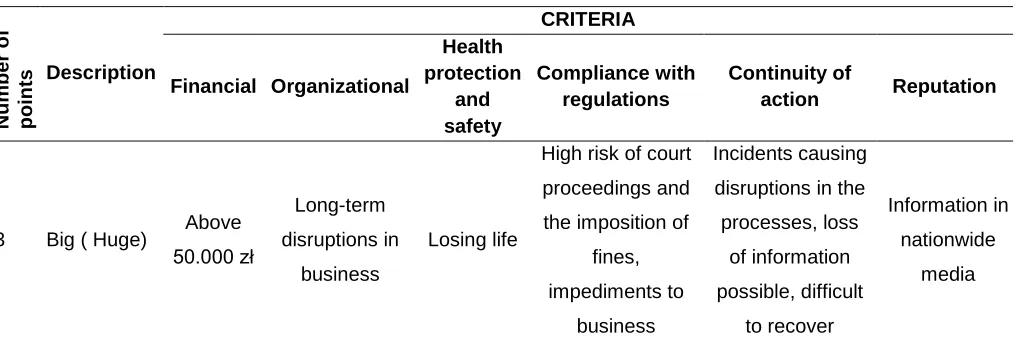
The effect is also estimated on the basis of tables with a three-point odd scale as below.
Table 2: Impact table
Nu mb er of p o int s Description CRITERIA
Financial Organizational
Health protection and safety Compliance with regulations Continuity of
action Reputation
3 Big ( Huge) Above 50.000 zł
Long-term disruptions in
business
Losing life
High risk of court proceedings and the imposition of
fines, impediments to
business
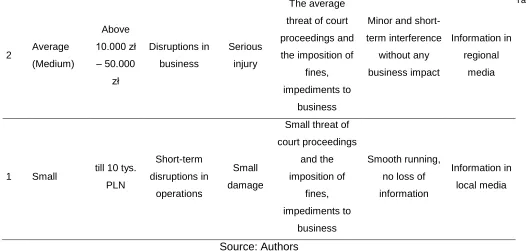
Licensed under Creative Common Page 113 2 Average
(Medium) Above 10.000 zł – 50.000 zł Disruptions in business Serious injury The average threat of court proceedings and the imposition of
fines, impediments to
business
Minor and short-term interference without any business impact Information in regional media
1 Small till 10 tys. PLN Short-term disruptions in operations Small damage
Small threat of court proceedings and the imposition of fines, impediments to business Smooth running, no loss of information
Information in local media
Source: Authors
It is here to explain why the decision was made on a three-point scale, what are its disadvantages, what are its advantages. On such a small scale it was decided due to the fact that the analysis was carried out for the company's project, namely, the analysis was of the nature ensuring that the start-up was justified and the financial and time resources invested would allow the company to continue its operations, achieve the intended profits and take the appropriate market position. The advantage of this scale is undoubtedly the simplicity of implementation, and the results are easy to analyze. The disadvantage, however, is the small spread, which significantly limits the determination of the level of risk and the so-called center. This drawback is most evident on the five-point scale, where, in the absence of certainty in the assessment, we have a tendency to choose the middle mark. It was assumed that after the start of operations and the end of the 12-month period of the company's operation, the risk analysis will be carried out again, the scale will be odd, six-point. The advantage of this scale is the lack of a measure and a reference to the school assessment system. The assurance analysis was performed based on the residual risk assessment. At this point, it was also assumed that the next analysis will be based on inherent and residual risks in order to demonstrate the strength of the control mechanisms. In the view of the above, it is reasonable to clarify the definition of individual risks at this point: Primary and inherent risk is a risk occurring in the absence of management actions to influence the probability of risk occurrence and its effects. Inherent risk is a risk occurring before applying control mechanisms. In contrast, residual risk is the risk that remains after management takes actions to minimize the likelihood of adverse events occurring
Licensed under Creative Common Page 114 and to minimize the consequences if a given risk materializes. Residual risk - the risk that remains after the introduction of control mechanisms. The risk (unreliability) of control is the risk that the existing control mechanisms will not work in the intended manner.
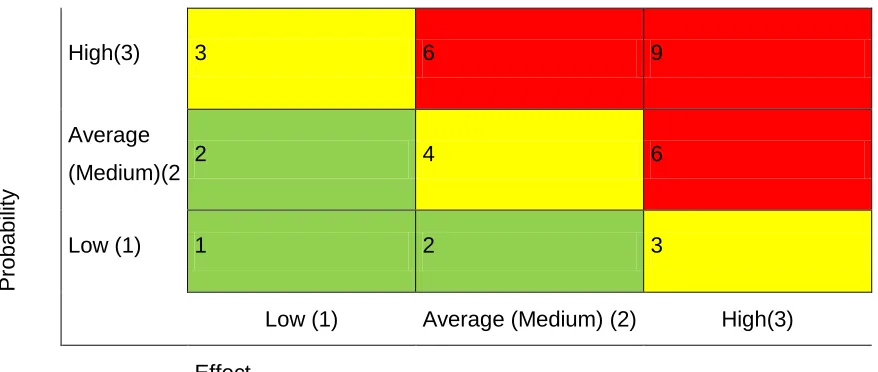
The audit risk is connected with the possibility of drawing wrong conclusions by the auditor (Mazurek, Knedler, 2010: 111). The hazard matrix was used to perform the analysis (figure 1).
P
rob
ab
ili
ty
High(3) 3 6 9
Average
(Medium)(2 2 4 6
Low (1) 1 2 3
Low (1) Average (Medium) (2) High(3)
Effect
Figure 1: Threat Matrix
The risk analysis showed what risks occur in individual processes and what is the value of individual risks. The analysis carried out in this way allows for planning the reaction to risk. There are four basic reactions:
1. Avoidance - the strategy consists in modifying the project plan so as to eliminate a specific risk or try to protect the project from the effects of the threat.
2. Transfer - the reaction strategy does not eliminate the risk, because its aim is to transfer the responsibility to another entity.
3. Mitigation - this solution is based on minimizing to an acceptable level of probability and consequence of occurrence of risk. The most important step is to take action early so as not to repair the damage after the loss. The strategy is useful when the risk cannot be fully predicted. 4. Acceptance - this is a method where there is no way to reduce or eliminate the risk (Sławińska-Tomtała 2010: 26).
Licensed under Creative Common Page 115 negative effects, and even attempt to turn threats to opportunities. However, one should remember about the economic aspect, so the costs of minimizing or eliminating the risk cannot be higher than the cost of materializing the risk. The exceptions are processes such as the health and safety process or the fire safety, where we are dealing with human health and life and in these processes there is no question of excessive investing in control mechanisms, because the well-being of employees and third parties is invaluable.
RESULTS
As a result of the analysis, the identified risks were assigned tothe individual processes. In the Training and Advisory Firm, there will be implemented, among others such processes as: 1. The market research process.
2. The process of acquiring contractors. 3. The shopping process.
4. The sale process.
5. The process of implementing the consulting service. 6. The process of educational service implementation. 7. The process of performing the sporting activity service. 8. Financial and accounting process.
9. Health and safety process, fire protection and Environmental Protection.
For the purposes of this article, three selected processes will be presented. Presentation of the results consists in presenting for each selected process such documents as: a card of risks in a given process, a table of values of residual risks in a given process and a matrix for a given process.
Market research process
In process 1 - Market research, the following risks were identified: R 1.1. The risk of incorrect tests.
R 1.2. The risk of incorrect analysis.
R 1.3. The risk of underestimating the service. R 1.4. Risk of overestimation of the service. R 1.5. The risk of competition.
R 1.6. Risk of changes in the external environment. R 1.7. The risk of data leakage.
Licensed under Creative Common Page 116
Lp. Process / Risk P S P*S
P1 MARKET RESEARCH
R 1.1. Erroneous research 3 2 6
R 1.2. Erroneous analysis 2 3 6
R 1.3. Service underestimation 2 1 2
R 1.4. Service revaluation 2 1 2
R 1.5. Competition 2 2 4
R 1.6. Changes of the external environment 2 2 4
R 1.7. Data leak 2 3 6
R 1.8. Accident 1 1 1
R 1.9. Abuses 1 1 1
32
P
rob
ab
ili
ty
High(3) R 1.2.
R 1.7.
Average (Medium)(2)
R 1.5.
R 1.6. R 1.1.
Low(1) R 1.8. R 1.9.
R 1.3.
R 1.4.
Low (1) Average (Medium) (2) High (3)
Effect
The process of educational service delivery
In the process No. 6 - Implementation of the educational service identified the following risks: R 6.1. The risk of selling an educational service inconsistent with the order.
R 6.2. The risk of inability to conduct classes in accordance with the offer. R 6.3. Risk of diversity of the level of knowledge of service recipients. R 6.4. The risk of absence of the recipient.
R 6.5. Risk of absence of a trainer.
Licensed under Creative Common Page 117 R 6.8. Risk of failure.
R 6.9. The risk of abuse.
Lp. Process / Risk P S P*S
P1 RESERVATION OF EDUCATIONAL SERVICE
R 6.1. Sale of an educational service not in line with the order 1 3 3 R 6.2. Impossibility of conducting classes according to the offer 2 2 4 R 6.3. Diversity of the level of knowledge of service recipients 3 3 9
R 6.4. Absence of the service recipient 1 1 1
R 6.5. Absence of the trainer 1 3 3
R 6.6. Lack of housing resources 1 2 2
R 6.7. No hardware resources 1 2 2
R 6.8. Accident 2 3 6
R 6.9. Abuses 1 1 1
31
P
rob
ab
ili
ty
High(3) R 6.1.
R 6.5. R 6.8. R 6.3.
Average (Medium)( (2)
R 6.6.
R 6.7. R 6.2.
Low (1) R 6.4.
R 6.9.
Low (1) Average (Medium) (2) High(3)
Effect
Financial and accounting process
In process 9 - Financial and accounting, the following risks were identified: R 9.1. The risk of not invoicing the provided service.
R 9.2. The risk of not receiving payment for the service provided.
R 9.3. The risk of incorrect recognition of revenues and expenses in accounting books. R 9.4. The risk of financial losses.
Licensed under Creative Common Page 118 R 9.6. The risk of lack of financial liquidity.
R 9.7. The risk of penal and fiscal sanctions. R 9.8. Risk of failure.
R 9.9. The risk of abuse.
Lp. Process / Risk P S P*S
P1 FINANCIAL - ACCOUNTANT
R 9.1. Not billing the service 1 1 1
R 9.2. Not receiving payment for the service provided 2 2 4 R 9.3. Incorrect recognition of revenues and costs in the KR 1 2 2
R 9.4. Financial losses 2 2 4
R 9.5. Contractual penalties 1 3 3
R 9.6. Lack of financial liquidity 2 3 6
R 9.7. Penal and fiscal sanctions 2 3 6
R 9.8. Accident 1 1 1
R 9.9. Abuses 1 2 2
29
P
rob
ab
ili
ty
High(3) R 9.5. R 9.6.
R 9.7.
Average (Medium)( (2)
R 9.3. R 9.9.
R 9.2
R 9.4.
Low (1) R 9.1.
R 9.8.
Low(1) Average (Medium) (2) High (3)
Effect
CONCLUSIONS
Licensed under Creative Common Page 119 In the presented processes, most of the risks were low and medium, which was desirable information for the future owner, because the analysis confirming the legitimacy of starting the activities of the Training and Advisory Company. As a result of this analysis, the company has been operating since 25 April this year. The company provides services throughout the country. Revenues and costs for the first quarter of operations are at a predictable level. If there are no threats that have not been identified and are not managed, the company has a good chance of making, developing and increasing market share. The Training and Advisory Company, like all entities in the world, faces threats, plans reactions to risks, monitors and controls. The company manages risks that may adversely affect the achievement of goals, as well as being prepared to take advantage of emerging opportunities.
The risk analysis will be repeated after the end of the balance sheet year to verify the risks in terms of their monitoring and to review processes for identifying potential risks that were not identified in the initial analysis and thus not being checked in the Risk Register. In addition, the residual value will be verified based on the experience gained and the incidents recorded. Ultimately, the company intends to update the risk analysis every twelve months, thus ensuring that the mapped risks in individual processes have a current value in relation to changes occurring both in the internal environment and in the external environment of the company.
SCOPE FOR FURTHER STUDIES
Related research in the field of risk identification and estimation as well as risk mapping were performed, among others in one of the PGNiG Group companies, where risk maps were updated. The risk analysis covered all areas, the value of inherent and residual risk was estimated, the results were plotted on the map, which was the basic tool in risk management. Similar activities towards risk analysis will be undertaken in the future based on other enterprises.
REFERENCES
A. Mazurek, K. Knedler, Management control, Practical approach, Warsaw 2010
E. Kowalczyk, Procedures of management control in units of the public finance sector, Wrocław 2011 E. Kuklińska, A. Dornfeld, Risk Management, Opole 2009
E. Skrzypek, Conditions and consequences of risk management in the organization - risk in projects, Quality problems, Sigma Publishing House, 2011.
E. Sławińska-Tomtała, Management control in the public sector, Warsaw 2010
H. R. Kerzner, Project Management, A System Approach to Planning, Scheduling, and Controlling, Wiley, Hoboken 2013.
Licensed under Creative Common Page 120 I. Zdonek, B. Hysa. D. Zdonek,Review publications in management sciences - essence and tendencies, Scientific Papers of the Gliwice University of Technology, Organization and management, z. 96, Gliwice 2016.
J. Bijańska, K. Wodarski,Risk in investment decisions, Scientific Papers of the Gliwice University of Technology,Organization and management, , z. 70, Gliwice 2014.
J. E. Saunders, Z. Paszka, Methods and tools of internal control in practice, Krakow-Poznań 2014 M. F. Dallas, Value and Risk Management, A Guide to Best Practce, Chichester, GBR: Wiley, 2008.
M. Pieśniak,Risk as a determinant of innovation in the company, Scientific Papers of the Częstochowa University of Technology, Management, No. 25 t. 2 (2017)
R. J. Mockler, Readings in Management Control, Appleton- Century- Crofts, New York 1970. R. Walczak, Selected methods of risk analysis and assessment, Płock 2015
S. K. H. Pickett, Enterprise Risk Management: A Manager’s Journey, John Wiley& Sons, San Francisco 2006 T. K. Das, B. S. Teng, Risk Types and Inter-firm Alliance Structures, „ Journal of Management Studies”, Vol. 33, No. 6, 2004.
Katarzyna Piskrzyńska (PhD): University of Bielsko-Biała, Coordinator for Management Control System. Research interests focus mainly on current problems of quality of services, risk management, internal control, management and organization, organizational culture, time management and motivation. Author more than 30 publications including chapters in monographs and articles.