
Future plans at COMPASS
J. Pretz,aon behalf of the COMPASS collaboration
Physikalisches Institut, Universit¨at Bonn, Nußallee 12, 53115 Bonn, Germany
Abstract. After successfully running since several years with polarized muon and hadron beams to study the spin structure of the nucleon and spectroscopy of hadrons, the COMPASS (Common Muon and Proton Apparatus for Structure and Spectroscopy) experiment enters a second phase with a new extended physics program to obtain deeper insight in the partonic structure of matter. These future plans include a measurement of deep virtual Compton scattering in order to determine generalized parton distributions and the study of the polarized Drell-Yan process giving access to transverse momentum dependent (TMD) parton distributions. Recent results and these future plans will be presented in this document.
1 Motivation
1.1 Partonic structure of the nucleon
Most of our knowledge about the internal structure of the nucleon comes from lepton-nucleon scattering experiment. Starting with Hofstadter’s experiment[1] in 1955 proving that the proton has a finite radius, culminating in the mani-festation of pointlike particles identified as quarks by Fried-man, Kendall and Taylor in deep inelastic scattering [2].
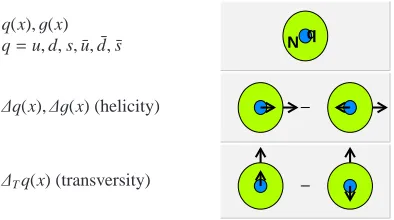
At high momentum transfers from the lepton to the nu-cleon the nunu-cleon can be described in terms of parton dis-tribution functions. At leading twist and after integration over the transverse momentum of the quarks inside the nu-cleon the nunu-cleon is fully described by three parton distri-butions, the unpolarized parton distributions q(x) andg(x), the helicity distributions∆q(x) and∆g(x) and the transver-sity distribution∆Tq(x). Note that there is no
correspond-ing gluon transversity distribution∆Tg(x) in a spin 1/2
par-ticle. Figure 1 shows these distributions in a pictorial way. They have simple probabilistic interpretations. The unpo-larized distributions q(x)dx equals the number of quarks of type q carrying a longitudinal momentum fraction in the interval [x,x+dx] inside the nucleon. The helicity distri-bution gives the difference of the number of quarks having their spin aligned with the nucleon spin and the number of quarks with spin anti-aligned in a longitudinally polarized nucleon. A similar interpretation holds for the transversity distribution in a transversally polarized nucleon.
Helicity distributions can be measured by analyz-ing double spin asymmetries of longitudinally polarized lepton beams and longitudinally polarized targets. The transversity distribution is related to a single spin Collins-asymmetry on a transversally polarized target.
The simple partonic interpretation can be extended if one does not integrate over the transverse momentum of
a e-mail:[email protected]
q(x), g(x)
q=u,d,s,¯u,d¯,¯s N q
∆q(x), ∆g(x) (helicity)
∆Tq(x) (transversity)
Fig. 1. The three twist three parton distributions appearing in the cross section for lepton-nucleon scattering after integration over transverse momentum.
Table 1. All eight leading twist parton distributions. Distributions in parentheses denote alternative notations found in the literature.
X X
X X
X X
X XX quark
nucleon
unpol. long. trans.
unpol. f1(q) f1T⊥(qT)
long. g1(∆q) g1T
trans. h⊥
1 h1L h1(∆Tq),h⊥1T
the quarks. In this case five more parton distributions ap-pear in the cross section at leading twist. These are re-ferred to as transverse momentum dependent (TMD) dis-tributions in the literature. Table 1 gives an overview [15]. The TMD distributions can be accessed in deep inelastic scattering studying the azimuthal distribution of the pro-duced hadrons or in Drell-Yan processes.
Another extension of the simple collinear quark par-ton model is to consider the transverse position of a quark inside the nucleon. This effect is described by generalized parton distributions accessible in deep virtual Compton scat-tering. These distributions describe the probability that a parton carries a certain longitudinal momentum fraction at
DOI:10.1051/epjconf/201007019
a given transverse position in the nucleon as indicated by Fig. 2.
Investigation of generalized parton distributions (GPDs) and transverse momentum distributions (TMDs) is part of the future COMPASS programme.
1.2 Theoretical Background
All the distributions discussed are related to the following matrix element of nucleon states:
<P′|Ψ¯(η) ˆOΨ(0)|P> (1)
The following cases are of interest
– P=P′are related to the quark distributions. Depend-ing on the operator ˆO chosen, one has access to the various distributions in Tab. 1
– η=0 is related to form factors
– the most general case P,P′andη ,0 are related to generalized parton distributions
Here are two explicit examples [3]: 1
2
Z dη⊥dη− (2π)3 e
k+·ξ−+k
⊥·η⊥ <P|Ψ¯(0)γ+Ψ(η−, η⊥)|P>
=q(x,k⊥)+qT(x,k⊥)(ˆk×SˆT)·Pˆ
This matrix element contains information on the ordinary unpolarized parton distribution q(x,k⊥) and the Sivers func-tion qT(x,k⊥). STdenotes the transverse polarization of the
nucleon.
The matrix element
Z dx− 4π e
ip+x− D
P′|Ψ¯(−η−/2)γ+Ψ(η−/2)|PE
=Hq(x, ξ,t)
1 2p+ ¯u(P
′) γ+u(P)
+Eq(x, ξ,t)
1 2p+ ¯u(P
′ )iσ
+ν(P−P′)ν
2M u(P)
is parameterized by two GPDs, Hqand Eq.ξ≈x/(2−x) is
the skewness and t =(P−P′)2the momentum transfer to
the nucleon.
From the definitions above one can read offthe relation between GPDs and from factors (F1(t)) and parton
distri-butions:
H(x,0,0)=q(x)
Z
H(x, ξ,t)dx=F1(t) ∀ξ
2 Results from the COMPASS Experiment
COMPASS is a fixed target experiment at CERN using hadron and muon beams to study the structure of the nu-cleon and spectroscopy of hadrons. In this section the COM-PASS experiment will be described and recent selected re-sults on longitudinal and transverse spin structure will be presented.
2.1 The COMPASS Experiment
The main experimental requirements to perform the mea-surements discussed above are
– a high energetic polarized lepton beam – a polarized target
– good particle identification
The COMPASS experiments meets these requirements. A 160 GeV naturally polarized positively charged muon beam is used. Its polarization is−0.80±0.04.6LiD (containing
polarizable deuterons) or NH3(polarized protons) serve as
target material. The target material is placed in a supercon-ducting solenoid and is polarized via dynamic nuclear po-larization.6Li can be considered as a helium nucleus plus
a deuteron. Thus 4 out of the 8 nucleons in6LiD are
po-larizable. This would lead to a so called dilution factor of 4/8 = 0.5. The corresponding dilution factor for NH3 is
3/17≈0.18. Talking into account additional non polariz-able material in the target leads to a dilution factor of ap-proximately 0.4 (0.15) for the6LiD (NH
3) target. The exact
value depends on the kinematics and is calculated event by event. Its relative uncertainty is 5%. The target polariza-tion reached is 50% (85%) with a relative error of 5% for the deuteron (proton) target. For the years 2002-2004 two target cells oppositely polarized were in use. In 2006 and 2007, 3 target cells were employed, the outer two had op-posite polarization compared to the central cell. The proton target was only in in operation in the year 2007. The use of 2 (or 3) target cells oppositely polarized and simulta-neously exposed to the muon beam is mandatory for the extraction of asymmetries. Combining data sets with two different polarizations with respect to the muon polariza-tion, allows, to a large extend, a cancellation of possible acceptance variations during the data taking.
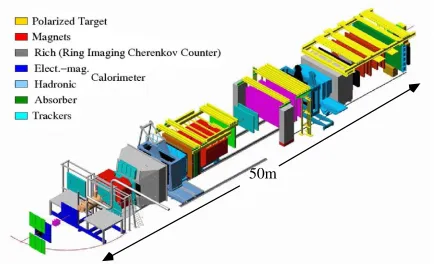
The scattered muon and the produced hadrons are de-tected and identified in a two stage magnetic spectrometer. Electromagnetic and hadron calorimeters and a Ring Imag-ing Cherenkov (RICH) Detector are used for particle iden-tification. The RICH allows a pion-kaon separation from threshold (9 GeV) up to momenta of 40 GeV at a 2.5 σ level. For a more detailed description of the experimen-tal setup see [4]. A schematic view of the spectrometer is shown in Fig. 3.
2.2 Recent Results
During the periods of data taking with a muon beam, ap-proximately 80% of the time was dedicated to run with a longitudinally polarized target, the remaining 20% with transversally polarized target.
The main goal of the measurement with a longitudi-nally polarized target is the determination of the gluon po-larization ∆g/g. The gluon polarization is accessible via double spin asymmetries selecting specific hadronic final states which enhance the number of partonic processes where a gluon participated (s. Fig. 4).
Fig. 2. Interpretation of generalized parton distributions as correlated longitudinal momentum and transverse space distributions.
50m
Fig. 3. The Compass spectrometer.
p u u d
q q
g
hadrons
hadrons
q
q
*
γ
’
µ
µ
Fig. 4. Deep Inelastic events with the photon-gluon fusion pro-cess as underlying partonic subpropro-cess.
recent measurements of∆g/gfrom COMPASS and other experiments. All the results are consistent with a vanish-ing gluon polarization at a gluon momentum fraction of xg≈0.1, although the first moment∆G=
R1
0 dxg∆g(xg) is
still consistent with a value of 0.5 which would mean that the gluon helicity accounts for 100% of the nucleon spin.
−2
10 10−1
−1 −0.8 −0.6 −0.4 −0.2 0 0.2 0.4 0.6 0.8 1 g x g/g ∆
COMPASS, open charm, prel., 02−06 , prel., 02−04
2
>1 (GeV/c)
2
, Q
T
COMPASS, high p
, prel., 02−04
2
<1 (GeV/c)
2
, Q
T
COMPASS, high p
2
, all Q
T
HERMES, high p
, prel.
2
hadrons, all Q
T
HERMES, single high p
2
>1 (GeV/c)
2
, Q
T
SMC, high p
2 =3 GeV 2 µ GRSV at G = ∆ 2.5 0.6 0.2
COMPASS, open charm, prel., 02−06 , prel., 02−04
2
>1 (GeV/c)
2
, Q
T
COMPASS, high p
, prel., 02−04
2
<1 (GeV/c)
2
, Q
T
COMPASS, high p
2
, all Q
T
HERMES, high p
, prel.
2
hadrons, all Q
T
HERMES, single high p
2
>1 (GeV/c)
2
, Q
T
SMC, high p
2
=3 GeV
2
µ
GRSV at
Fig. 5. Results from direct measurements of∆g/g.
u ∆ x -0.1 0 0.1 0.2 0.3 0.4 COMPASS preliminary DNS parametrization d ∆ x -0.25 -0.2 -0.15 -0.1 -0.05 0 0.05 -2 -1 u ∆ x -0.1 -0.05 0 0.05 0.1 d ∆ x -0.1 -0.05 0 0.05 0.1 x -2
10 10-1
s ∆ x -0.05 -0.04 -0.03 -0.02 -0.01 0 0.01 0.02
Fig. 6. Helicity distributions ∆q obtained from semi-inclusive
asymmetries.
Figures. 7 and 8 show results obtained on a transver-sally polarized proton target. Figure 7 shows the Collins asymmetry which gives access to the transversity distribu-tion. Figure 8 shows the Sivers asymmetry. Using this data together with corresponding asymmetries measured on the deuteron target allows an extraction of the transversity dis-tribution,∆Tq(x) and the Sivers function, qT [14, 13].
Fig. 7. Collins asymmetry from the proton target for positively and negatively charged hadrons.
x
-210
10
-1Sivers
A
-0.2
-0.1
0
0.1
0.2
preliminary
COMPASS 2007 PROTON DATA (part)
positive hadrons negative hadrons
Fig. 8. Sivers asymmetry from the proton target for positively and negatively charged hadrons.
3 Future plans at COMPASS
We now turn to future plans of the COMPASS collabo-ration. The years 2010 and 2011 will be dedicated to run with longitudinal and transversely polarized proton target to improve the statistics of the measurements presented above. From 2012 on, we plan measurements of deep vir-tual Compton scattering and Drell-Yan processes.
3.1 Deep Virtual Compton Scattering (DVCS)
In deep virtual Compton scattering the following scattering process is studied
µ+p→µ′+γ+p′.
*
γ
γ
q
ξ
x+
x-
ξ
p
p’
t
l
l’
Fig. 9. The DVCS on the partonic level.
+
DVCS BH
=
σ
d
2
Fig. 10. Contribution to the processµ+p→µ′+γ+p′
virtuality (Q2 > 1 GeV2)) and the other hand a the
spa-tial distribution as described by form factors measured in elastic scattering because the proton stays intact. Thus it is not surprising that DVCS is described by generalized parton distributions which are hybrids between parton dis-tributions and from factors. These GPD depend on three variables (ignoring an additional dependence on a renor-malization scale), the longitudinal momentum fraction x, the skewnessξand the momentum transfer squared to the nucleon t.
Unfortunately the DVCS process is not the only pro-cess contributing to the cross section; the Bethe Heitler (BH) process has the same final state and thus interferes with the DVCS process as shown in Fig. 10.
The cross section can be expressed schematically as
dσ=(dσBH+dσDVCSunpol +eµaBHRe(ADVCS))×cos(nΦ)
+(PµdσDVCSpol +eµPµaBHIm(ADVCS))×sin(nΦ) (2) where eµ(Pµ) denotes the muon charge (polarization).Φ denotes the angle between the lepton and theγ-proton plane. The amplitudes appearing in eq. 2 are related to the GPDs via relations like
ADVCS = Z 1
−1
dx H(x, ξ,t) x−ξ+iǫ
Compass has at its disposal a negatively polarized pos-itively charged muon beam or a pospos-itively polarized neg-atively charged muon beam. The cross section difference and sum of these two measurements project out various contributions in eq. 2:
difference : dσµ+↓−dσµ−↑∝ Re(ADVCS)
sum : dσµ+↓+dσµ−↑ ∝ Im(ADVCS).
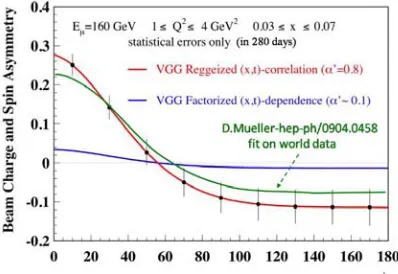
Figure 11 shows the statistical precision reachable in 140 days of data taking for the beam charge spin asym-metry defined by A = (dσµ+↓−dσµ−↑)/(dσµ+↓+dσµ−↑). The curves are two models [10], the blue line assumes that H factorizes in a quark distribution times a form factor and the red one assumes a strong correlation between the trans-verse position and longitudinal momentum fraction carried by the quark. Our measurement would clearly be able to distinguish the two models.
Concerning the kinematic range covered, COMPASS will be able to contribute in the the range form x ≈ 0.01 and x≈0.1) not covered by any previous (H1, Zeus, HER-MES) or future (JLAB12) experiment.
Fig. 11. Statistical precision reachable in 140 days for the beam charge spin asymmetry. The curves are two models [10–12] once assuming that H factorizes in a quark distribution times a form factor and once assuming a strong correlation between the trans-verse position and longitudinal momentum fraction.
Figure 12 shows results from a first test measurement performed in 2008. The expected φ dependence (mostly originating from the Bethe-Heitler process) is clearly ob-served. The running conditions were: 160 GeV muon beam on a 40cm Liquid hydrogen target and one day of data tak-ing.
In a first phase COMPASS plans to upgrade the spec-trometer by installing a 2.5m long liquid hydrogen target and a 4m long recoil detector surrounding the target to de-tect the slow recoil proton in the DVCS reaction. In ad-dition the calorimetry will be upgraded for a better detec-tion of the photon. In a second phase, measurements with a polarized target giving access to the generalized parton distribution ˜H and ˜E are planed.
3.2 Drell-Yan physics
The Drell-Yan process
Table 2. The Drell-Yan cross section in terms of various parton distribution functions.
Unpolarized target:
dσDY∝ ...+¯h⊥
1(x1,kT2,1) × h ⊥
1(x2,kT2,2) cos(2Φ) Boer-Mulders × Boer-Mulders
transversally polarized target:
dσDY∝ f¯
1(x1,k2T,1) × f ⊥
1T(x2,kT,2) sin(Φ−ΦS 2)+
¯q × Sivers
¯h⊥
1(x1,k2T,1) × h1(x2,kT,2) sin(Φ+ΦS 2)+ Boer-Mulders × Transversity
¯h⊥ 1(x1,k
2
T,1) × h ⊥
1,T(x2,kT,2) sin(3Φ−ΦS 2) Boer-Mulders × Pretzelosity
(deg)
φ
-150 -100 -50 0 50 100 150
events
0 2 4 6 8 10 12 14 16 18
Monte-Carlo Data
COMPASS 2008 DVCS TEST RUN PRELIMINARY
-Fig. 12. Results from test run for theΦdistribution.
π
p
γ
µ
+
-µ
X
X
q
q
Fig. 13. The Drell-Yan process.
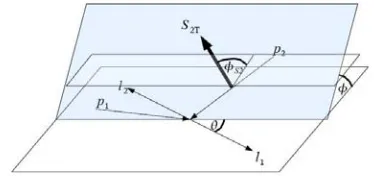
studied by COMPASS is depicted in Fig. 13. In leading twist the cross section can be written in terms of parton distribution functions as shown in Tab. 2. The anglesΦand ΦS 2appearing in the cross section are defined in Figure 14.
Note that in contrast to DIS, no fragmentation function ap-pear in the cross section.
Of particular interest here is a relation between the Sivers and Boer-Mulders parton distributions measured in deep inelastic scattering and Drell-Yan. Both are naively
Fig. 14. Kinematics of the Drell-Yan process in the Collins-Soper frame. S2T denotes the transverse polarization of the target pro-ton.
time reversal odd and require an initial state interaction in the Drell-Yan process and a final state interaction in semi-inclusive deep inelastic scattering (SIDIS) as first realized by Collins [17]. This leads to the following relations:
Sivers: f⊥
1T(DY)=−f
⊥
1T(S IDIS )
Boer-Mulders: h⊥1(DY)=−h⊥1(S IDIS )
The verification of these relations would be an impor-tant test of our understanding of TMD distributions.
Exploiting the angular dependence of the cross section by measuring the following asymmetry gives for example access to the Sivers function
AUT = R2π
0
dσ↑−dσ↓sin(ΦS 2−Φ)dΦ R2π
0 dσ
↑+dσ↓dΦ
.
Figure 15 shows the statistical precision reachable on AUT
assuming 2 years of data taking.
Fig. 15. Statistical precision on AUTreachable in 2 years of data taking. The curves and boxes are parameterizations by [17, 16, 19, 18, 20].
)
2
(GeV/c
µ µ
M
2 2.2 2.4 2.6 2.8 3 3.2 3.4 3.6 3.8 4
2
Events/50 MeV/c
1 10
COMPASS
2007 DY beam test
Dimuon trigger
Preliminary
5
±
= 14
ψ
#J/
Fig. 16. Reconstructed muon pairs from a 2007 test run. The number of measured J/Ψs agrees with the expected number of 20±8.
References
1. R. Hofstadter and R. W. McAllister, Phys. Rev. 98 (1955) 217.
2. M. Breidenbach et al., Phys. Rev. Lett. 23 (1969) 935. 3. X. Ji, Ann. Rev. Nucl. Part. Sci. 54 (2004) 413. 4. P. Abbon et al. [COMPASS Collaboration], Nucl.
Instrum. Meth. A 577 (2007) 455 [arXiv:hep-ex/0703049].
5. M. Alekseev et al. [COMPASS Collaboration], arXiv:0904.3209 [hep-ex]. Phys. Lett. B 676 (2009) 31
6. J. Collins PLB536, 43 (2002)
7. D. Boer and P. J. Mulders, Phys. Rev. D 57 (1998) 5780 [arXiv:hep-ph/9711485].
8. A. Bacchetta, M. Diehl, K. Goeke, A. Metz, P. J. Mul-ders and M. Schlegel, JHEP 0702 (2007) 093 [arXiv:hep-ph/0611265].
9. M. Alekseev et al. [COMPASS Collaboration], Phys. Lett. B 680 (2009) 217 [arXiv:0905.2828 [hep-ex]]. 10. M. Vanderhaeghen, P. A. M. Guichon and M. Guidal,
Phys. Rev. Lett. 80 (1998) 5064.
11. M. Vanderhaeghen, P. A. M. Guichon and M. Guidal, Phys. Rev. D 60 (1999) 094017 [arXiv:hep-ph/9905372].
12. K. Goeke, M. V. Polyakov and M. Vanderhaeghen, Prog. Part. Nucl. Phys. 47 (2001) 401 [arXiv:hep-ph/0106012].
13. M. Anselmino et al., arXiv:0807.0166 [hep-ph]. 14. M. Anselmino, M. Boglione, U. D’Alesio,
A. Kotzinian, F. Murgia, A. Prokudin and S. Melis, Nucl. Phys. Proc. Suppl. 191 (2009) 98 [arXiv:0812.4366 [hep-ph]].
15. A. Bacchetta, AIP Conf. Proc. 1149 (2009) 447 [arXiv:0902.2712 [hep-ph]].
16. A. V. Efremov, K. Goeke, S. Menzel, A. Metz and P. Schweitzer, Phys. Lett. B 612 (2005) 233 [arXiv:hep-ph/0412353].
17. J. C. Collins, A. V. Efremov, K. Goeke, S. Menzel, A. Metz and P. Schweitzer, Phys. Rev. D 73 (2006) 014021 [arXiv:hep-ph/0509076].
18. M. Anselmino, M. Boglione, U. D’Alesio, S. Melis, F. Murgia and A. Prokudin, Phys. Rev. D 79 (2009) 054010 [arXiv:0901.3078 [hep-ph]].
19. A. Bianconi and M. Radici, Phys. Rev. D 73 (2006) 114002 [arXiv:hep-ph/0602103].

![Fig. 15. Statistical precision ontaking. The curves and boxes are parameterizations by [17,16,19, AUT reachable in 2 years of data18,20].](https://thumb-us.123doks.com/thumbv2/123dok_us/9045819.1440657/7.595.75.294.298.530/statistical-precision-ontaking-curves-boxes-parameterizations-reachable-years.webp)
