1167
Enterprise Architecture Planning Information
System Based On Cloud Computing Using Togaf
(Case Study: Pandi. Id Registry)
David Kwek, Dimaz Maulana, Emil Robert Kaburuan, Nilo LegowoAbstract: Indonesian Internet Domain Name Managers or PANDI is an association engaged in the registry operator domain name .id. To improve the quality of service both internally and society, it is necessary to have an information system that is able to connect and help process the operational performance of PANDI. This study uses the TOGAF ADM methodology which has the main stages, namely Preliminary, Architecture Vision, Business Architecture, Information System Architecture, Technology Architecture, Opportunity and Solution, Migration Planning, Implementation Governance, and Architecture Change Management. The results of this study are in the form of a blueprint for information systems based on cloud computing based on the TOGAF ADM framework up to phase G to produce an integrated system
Index Terms: Cloud Computing, Country Code Top Level Domain, Domain Registry, Enterprise Architecture, Information System, PANDI, TOGAF, Value Chain.
————————————————————
1
I
NTRODUCTIONIn recent years, the use of information technology (IT) and IT applications have potentially increased dramatically [1]. This development provides convenience for organizations to develop in the field of information technology. Many organizations today invest in various forms of information technology and information systems by having various benefits. One of the driving factors for better utilization of information systems in an organization is the increasing need for business functions and business processes that are being run [2]. In addition, the cloud computing trend is predicted by experts to continue to move up, digital transformation in various business and industry sectors becomes an accelerator [3]. The main tasks of the Indonesian Internet Domain Name Manager (PANDI) are managing the operational registration system, extending the active period and accessing .id domain names. At present, PANDI still does not use information technology and information systems optimally in daily operational management. Although the business process of managing domain names .id already uses Information Technology and Information Systems which are used internationally in managing domain names. But there is no application that manages the operational PANDI as an
organization, which is mutually integrated and mostly separated from each other. According to the data obtained, PANDI currently consists of 25 PANDI Members, 10 Executive Boards, 3 Directors, and 23 Staffs.
Based on the above, it requires information technology and information system that runs using cloud computing that can be used to manage the organization's operations to achieve PANDI's vision and mission. To build a technology and information system, an Enterprise Architecture plan is needed that fits the current needs and conditions of PANDI. Enterprise architecture planning is intended to build a
blueprint and proposal for cloud computing-based
information systems to PANDI so that it can provide good changes from the internal side of PANDI because of its ease of adaptation to the workers who will use it [4] so that it can provide better service in the community side of the user .id domain name. In addition, it is hoped that this plan can accelerate the adoption of the use of information technology and information systems in stages, minimizing and simplifying the entire process carried out [5], [6].
2
L
ITERATURER
EVIEW 2.1 Information TechnologyInformation technology (IT) is not only limited to computer technology but also includes telecommunications technology. In other words, IT is the result of the convergence between computer technology and telecommunications technology [7]. Computer technology is a technology related to computing devices such as printers, fingerprint readers, CD-ROMs, processors, disks, and others. A computer is a versatile machine that can be used for the purposes of processing any data into useful information. This is possible because the computer can be controlled by a program consisting of a series of instructions. The computer will act according to the instructions received from the program. In other words, the computer will act according to the wishes of the program
————————————————
David Kwek , Information System Management Department, BINUS Graduated
Program – Master Information System Management, Bina Nusantara University, Jakarta 11480 Indonesia Email: [email protected]
Dimaz Maulana , Information System Management Department, BINUS
Graduated Program – Master Information System Management, Bina Nusantara University, Jakarta 11480 Indonesia Email:
Emil Robert Kaburuan , Information System Management Department, BINUS
Graduated Program – Master Information System Management, Bina Nusantara University, Jakarta 11480 Indonesia Email:
Nilo Legowo, Information System Management Department, BINUS Graduated
1168
maker. Utilization of IT according to Thomson [8] is a benefit expected by users of information systems in carrying out their duties or behavior in using technology when doing work. The measurement is based on the intensity of utilization, the frequency of use, and the number of applications or software used. The proper use of IT and supported by the expertise of the personnel who operate it can improve company performance and the performance of the individual concerned [7].
2.2 Information Technology
Information System is a combination of IT with the activities of people who run the technology. In organizations, an information system is used as a form of communication using hardware, stages, and information processing instructions (software), networks (networks), and stored data [9], [10]. Information system (SI) is the arrangement of people, data, processes, and information technology that interact with each other to collect, process, store and provide information output needed to support an organization [11]. An information system can be defined technically as a set of interrelated components that collect (or take), process, store, and distribute information to support decision-making and control in an organization. In addition to supporting decision-making, coordination, and control, information systems can also help managers and workers analyze problems, visualize complex subjects, and create new products [12]. Based on some of the opinions above, it can be concluded that information systems are a set of components consisting of people, data, information and communication technology, and interacting procedures to collect, process, store, and produce information needed by an organization to support decision-making process [5].
2.3 Cloud Computing
Fig. 1. Cloud Computing Architecture [13]
Cloud Computing is a computing service that has 5 characteristics [14], namely:
a. Resource Pooling: Computational resources (storage,
CPU, memory, network bandwidth, etc.) collected by service providers to meet the needs of many customers (service consumers) with multi-tenant models. This computing resource can be either physical or virtual resources and can also be used dynamically by customers to meet their needs.
b. Broad Network Access: Capability of services from
cloud providers is available over the network and can be accessed by various types of devices, such as smartphones, tablets, laptops, workstations, etc.
c. Measured Service: A service is available to optimize
and monitor services that are used automatically. By monitoring this system, we can see how many computing resources have been used, such as bandwidth, storage, processing, number of active users, etc. This monitoring service is a form of transparency between the cloud provider and the consumer cloud.
d. Rapid Elasticity: The capability of cloud provider
services can be used by the consumer cloud dynamically based on needs. Cloud consumers can increase or decrease service capacity. The capacity of services provided is usually unlimited, and consumer services can freely and easily choose the desired capacity at any time.
e. Self Service: Cloud Consumer can independently
configure services that want to be used through a system, without the need for human interaction with
the cloud provider. This selected service
configuration must be available immediately and immediately at that time automatically.
1169 Fig. 2. Cloud Computing Reference Model [17]
2.4 Enterprise Architecture
An enterprise is a group of organizations that have a number of objectives. For example, an enterprise is a government, an entire corporation, a division of a corporation, a department, or a series of geographical organizations that are interconnected in ownership [18]. ISO / IEC 42010: 2007 defines architecture as the fundamental organization of a system, which is embodied in its components, their relationships with each other and the environment, and the principles that govern the design and evolution [18]. Based on these definitions it can be concluded that enterprise architecture is an illustration of the model of an operational system in the enterprise starting from the planning, design to implementation stages. Enterprise architecture has four main components, namely: business architecture, information
architecture, technology architecture and application
architecture. In connection with these four components, enterprise architecture products will be in the form of graphics, models, and/or narratives that explain the environment and enterprise design [2], [5], [19]–[21].
2.5 The Open Group Architecture Framework (TOGAF)
Fig. 3. Architecture Development Method [18].
TOGAF is an architectural framework that is used as a tool to assist in the receipt, production, use, and maintenance of corporate architecture. This is based on a repetitive process model supported by best practices and a set of existing and reusable architectural assets [18]. TOGAF 9 was first published in January 2009. TOGAF 9 can be used to develop various types of companies with different architectures. TOGAF complements and can be used in conjunction with other frameworks that are more focused on specific shipments for
certain vertical sectors such as government,
telecommunications, manufacturing, defense, and finance. The key to TOGAF is the Architecture Development Method (ADM) that is used to develop enterprise architecture that can meet business needs. TOGAF ADM as shown in Figure 3 is also a flexible method that can authenticate various types of modelling techniques used in design because this method can be adjusted to changes and needs during the design carried out [22], [23]. The stages of TOGAF ADM can be briefly explained as follows [5]:
Preliminary: Describes the preparation and initial activities needed to achieve business objectives for the new enterprise architecture, including the determination of architectural frameworks and principles.
Phase A. Architecture Vision: Creating uniformity of views regarding the importance of enterprise architecture to achieve organizational goals formulated in the form of strategies and determine the scope of the architecture to be developed. Phase B. Business Architecture: Defines the initial conditions of business architecture, determines the business model or desired business activity based on a business scenario.
Phase C. Information System Architecture: At this stage, more emphasis on activities is how information system architecture is developed. Defining information system architecture in this stage includes the data architecture and application architecture that will be used by the organization.
Phase D. Technology Architecture: Build the desired technology architecture, starting from determining the type of candidate technology needed which includes software and hardware.
Phase E. Opportunities and Solution: At this stage more emphasis on the benefits obtained from enterprise architecture which includes business architecture, data architecture, application architecture and technology architecture, so that it becomes the basis for stakeholders to choose and determine the architecture to be implemented.
Phase F. Migration Planning: At this stage, an assessment will be carried out in determining the migration plan of an information system.
Phase G. Implementation Governance: Arranging
recommendations for implementing implementation
1170
Phase H. Architecture Change Management: Establish an architectural management plan from the new system by supervising technological developments and changes in the organization's environment, both internal and external and determining whether the next enterprise architecture development cycle will be carried out.
2.6 Related Research
Barovih and Salimin (2018) in his research entitled "Architectural Model of Drug Monitoring through the TOGAF Adm and Cloud Database Approach" conducted research using TOGAF ADM stages A, B, C and D and the Cloud Database displayed in the ERD table [24]. Ekawati (2017) in her research entitled "Information Technology Infrastructure Planning in Banks with TOGAF Framework" uses TOGAF ADM stages A, B, C, D, and E in their research and architecture designed using the cloud computing principle [8]. Febrian, Sinaga, and Wisnubadhra (2015) in their research entitled "Designing Business Architecture of Universities with TOGAF (Case Study: Palangka Raya Ministry of Health Polytechnic)" using TOGAF ADM stages A, B, C, D, and E and using the porter's value chain to draw a value chain diagram [25]. Irmayanti and Permana (2018) use TOGAF ADM but are limited to F in their research but attachments to detailed
research describe Business Process and Technology
Architecture, This research is poured into research with the title "Purwakarta Disnakersostrans Information System Architecture Planning Using TOGAF" [5]. Kustiyahningsih (2013) in his research entitled "Enterprise Architecture Planning Using the TOGAF Adm Method (Case Study: Rsud Dr. Soegiri Lamongan)" using TOGAF ADM all stages but merged into one result and displayed a matrix of relations between applications and functions [26]. In a study entitled "Enterprise Architecture Design Using TOGAF at ABC University", Retnawati (2018) presented a reference table for previous research, the phase in TOGAF ADM used only to phase D, displaying value chains, data entity matrix, revised diagram of business solution concepts, Gap analysis and network architecture [10]. Yunis and Surendro (2009) conducted research using the TOGAF framework to phase G but phases F and G merged in the design with the RUP (Rational Unified Process) method. This research is entitled "Designing an Enterprise Architecture Model with the TOGAF Architecture Development Method [27]. Susanti, Saeduddin, and Sadat (2018) in their research entitled "Designing Enterprise Architecture in the Finance Function at PT Albasia Nusa Karya Garut Regency Using the TOGAF ADM Framework" using TOGAF ADM to phase D, showing solution concept diagram, functional decomposition diagram and business footprint diagram. The design results are in the
form of a Data entity/data component catalogue,
application/function matrix and environment and location diagram [28]. Helmiawan and Sofiyan (2018) use the TOGAF ADM framework to phase F, display value chains, network
architecture, and planning migration [29]. This research is entitled "Development of Campus Information System Planning Model with TOGAF Architecture Development Method". Supriyana, (2010) in a study entitled "Planning of
Business Architecture Model, Information System
Architecture and Technology Architecture Using TOGAF: Bakosurtanal Case Study" using TOGAF ADM stages of Business Architecture, Information System Architecture, and technology architecture, this research displays TOGAF validation and validated with current EA with architectural targets [30].
3
R
ESEARCHM
ETHODThe method used in this research in the initial stage is to conduct data collection either by conducting a literature study of textbooks, articles, or previous research that discusses enterprise architecture planning using TOGAF ADM and then making observations and interviews directly with employees in PANDI office environment. The next step is to design an Enterprise Architecture information system using the ADM method in accordance with the framework that is used in the enterprise architecture information system planning process, namely TOGAF ADM. But this research is limited only to the Phase G (Implementation Governance). The research model can be seen as shown in Figure 4 below.
Fig. 4, Research Model
The research methodology mentioned above is the result of the preliminary in the TOGAF.
4
R
ESULT4.1 Architecture Vision
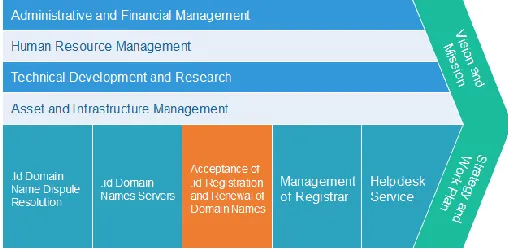
Fig. 5. PANDI’s Value chain analysis
PANDI business function as shown in Figure 5 has the main business functions, namely the acceptance of registration and extension of .id domain names, access to .id domain names,
Data Collection (Literature Study,
Observation, Interview)
Designing Enterprise Information
System Architecture using TOGAF
ADM
Results of Enterprise Architecture
Design and Recommendation
1171
settlement of .id domain name disputes (PPND), registrar management and one-door helpdesk services. While supporting business functions are administrative and financial management, human resource management, technical development, and research as well as asset and infrastructure management.
4.2 Business Architecture
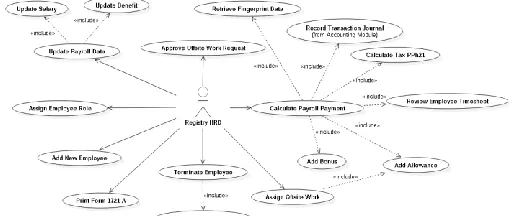
Business architecture can be seen in the image of business processes, where this image explains the actor's access rights to applications that will later access the system or application system.
Fig. 6. Main Business Process of Human Resource
• Add New Employee
Use Case "Add New Employee" gives the HRD Registry the ability to register new employees into the system database. Information that can be given when adding new employees, including:
a. Employee Name b. Place of birth c. Date of birth d. Gender e. Marital status f. ID card number g. Employee ID number h. Address
i. Telephone Number j. Mobile phone number k. Personal Email l. Office Email
• Payroll Data Update
The Use Case "Payroll Data Update" provides the HRD Registry with the ability to update information regarding Employee Payrolls. Every time the data update process occurs, the system will make a history of changes to payroll data to simplify the audit process. Information that can be given during the process of updating payroll data, among others: a. Employee Name
b. Employee Identification Number c. Name of Payroll Bank
d. Employee Account Number e. Basic salary
f. Benefits Data g. Supporting Facilities
• Assign Employee Role
The "Assign Employee Role" Use Case gives the HRD Registry the ability to determine the role of New Employees in PANDI Organizational Structure and provide access rights in accordance with the roles in the System. Information that can be given when determining the role of new employees, including:
a. Name of new employee
b. New Employee Identity Number c. Role in Organizations
d. Active Date e. Information
• Assign Offsite Work
The "Assign Offsite Work" Use Case gives the HRD Registry the ability to assign assignments to the employee concerned to work outside the office. Information that can be given when giving work outside the office, including:
a. Employee Name
b. Employee Identification Number c. Assignment Subject
d. Start Assignment Date e. Assignment End Date f. Description of Assignment g. Assignment Fees / Benefits
• Approve Offsite Work Request
"Approve Offsite Work Request" Use Case gives the HRD Registry the ability to give permission to employees who submit applications to work outside the office (example: Data Center Installation). Information that can be given when giving the approval to do work outside the office, including: a. Employee Name
b. Employee Identification Number c. Assignment Subject
d. Start Assignment Date e. Assignment End Date f. Description of Assignment g. Assignment Permit Decision h. Assignment Fees / Benefits
• Revoke System Access
Use Case "Revoke System Access" gives the HRD Registry the ability to revoke all access owned by the Employee concerned. Employee access that must be revoked includes:
a. Fingerprint access to enter the office
b. Access your username and password to use the Domain Management System
c. Access username and password to use e-mail
d. Access username and password to manage the server.
• Terminate Employee
1172
"Terminate Employee" Use Case works in tandem with the "Revoke System Access" use case to block the employee's access to the system or Fingerprint system. Information that can be given when giving approval to "Terminate Employee", including:
a. Employee Name
b. Employee Identification Number c. Dismissal Subject
d. Effective Date of Dismissal e. Dismissal Information f. Termination
• Retrieve Fingerprint Data
The "Retrieve Fingerprint Data" Use Case gives the HRD Registry the ability to calculate attendance based on employee access to the office through a fingerprinting tool. Information obtained when accessing the Fingerprint database includes: a. Employee Name
b. Date of Attendance c. Enter Time
d. Exit time
• Add Allowance
Use Case "Add Allowance" provides the HRD Registry with the ability to make additional allowances when the employee is engaged in a work trip or position allowance. Use Case "Add Allowance" will collaborate with the use case "Calculate Payroll Payment" when calculating salary payments every month. Information that must be given when conducting data collection on benefits, including:
a. Employee Number
b. Allowance / Allowance Type
c. Allowance Period (every month, incidental) d. Date of allowance
e. Information
f. Amount of allowance
• Add Bonus
Use Case "Add Bonus" gives the HRD Registry the ability to add bonus money if the employee has a performance that satisfies management. Use Case "Add Bonus" will collaborate with the use case "Calculate Payroll Payment" when calculating salary payments every month. Information that must be given when conducting data collection on benefits, including:
a. Employee Number b. Bonus type
c. Bonus period (every month, incidentally)
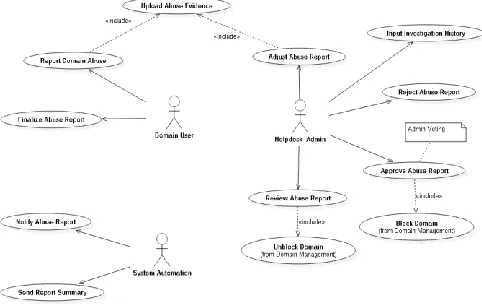
Fig. 7. Business Process of Domain Abuse Report
• Upload Abuse Evidence
Use Case "Upload Abuse Evidence" gives the User Domain the ability to attach evidence indicating that the reported domain violates PANDI and ITE Laws. The types of documents that can be attached to the Abuse report include:
a. Image document (JPG, PNG, TIFF) b. PDF document
c. Microsoft Word document d. Text document
• Report Domain Abuse
The "Report Domain Abuse" Use Case gives the Domain User the ability to report the abuse of the domain to the Registry. The information that must be given to facilitate the Registry in analyzing and following up on abuse reports is as follows: a. Reported Domain Names
b. Name of Reporter (based on username) c. Reporting Email (based on username) d. Telephone Reporter
e. Reporting Categories (Pornography, Gambling, IPR) f. Reporting Remarks
g. List of URLs that contain problematic content h. Reporting IP Address (based on login session)
i. Reporting Time (Date, Time, Minute, Seconds based on login session)
j. Checklist to confirm or monitor the domain abuse reporting process
k. Checklist to confirm that the data provided is actually based on legal sentences.
• Adjust Abuse Report
Use Case "Adjust Abuse Report" gives the Admin Helpdesk the ability to make modifications and changes to abuse reporting. Information that can be added include:
a. Content URL that violates the law b. Information related to content c. Time of addition
d. IP address e. User Name
1173
Use Case "Input Investigation History" provides the ability to the Admin Helpdesk to document investigative activities conducted on Abuse domain reporting. Information provided when conducting investigations includes:
a. Title of Investigation b. Explanation of Investigation c. Time of Investigation
d. Name of Investigator (based on username) e. Proof of investigation
• Finalize Abuse Report
The Use Case "Finalize Abuse Report" provides the ability for the Domain User to finalize requests for reporting domain abuse. If all information needed by the Admin Helpdesk to conduct an investigation is complete, then the Domain User can finalize.
• Reject Abuse Report
The Use Case "Reject Abuse Report" provides the Admin Helpdesk with the ability to reject requests for reporting abuse. Each decision of rejection carried out by the Admin Helpdesk will be counted as a voting vote and if it has fulfilled the quorum and the total value of "rejection" wins the vote then the domain will not experience a blocking process.
• Approve Abuse Report
The "Approve Abuse Report" Use Case provides the ability of the approval to the Admin Helpdesk to vote based on the results of an investigation of abuse reports. Every approval carried out by the Admin Helpdesk will be counted as a vote, and if it has fulfilled the quorum, the reported Domain will experience a blocking process.
• Review of Abuse Report
The Use Case "Review Abuse Report" provides the Helpdesk Admin with the ability to review the reported domain, if the content that violates the law has been removed, the Admin Helpdesk can reactivate the domain. The review process must collaborate with the use case "Input Investigation History" so that every decision to revoke the block has a basis and can be accounted for.
• Notify Abuse Report
The Use Case "Notify Abuse Report" provides the ability to System Automation to send information to the Admin Helpdesk regarding reporting to domains that indicate the violation of terms by placing content contrary to the Law. The purpose of these notifications is to improve performance by
shortening response time when receiving reporting
information.
• Send Report Summary
Use Case "Send Report Summary" gives the ability to System Automation to send information related to the progress of the
investigation and action against the domain that has been reported. This information will be sent to the Registry, the relevant Registrar and the Reporter so that it can be used as an archive of evidence if there is a dispute in the future.
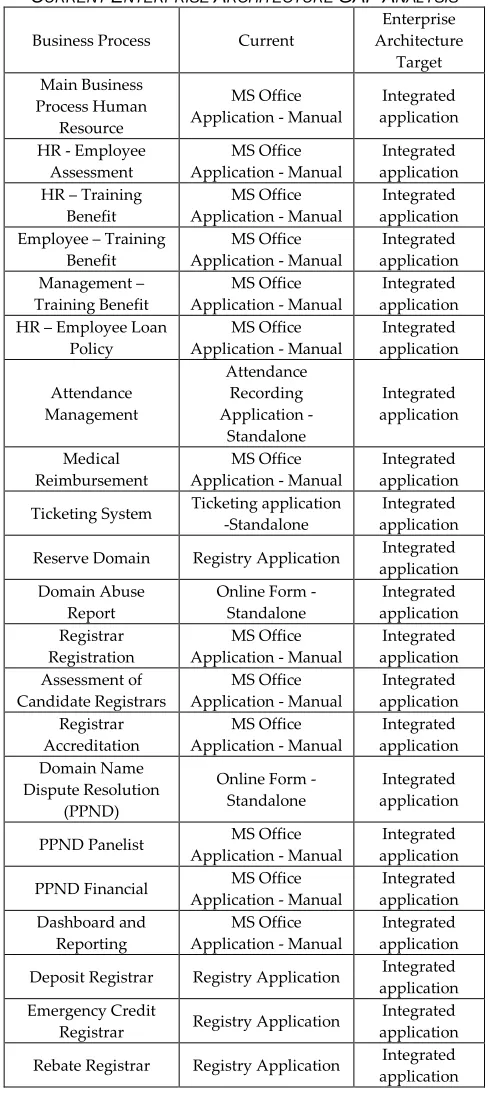
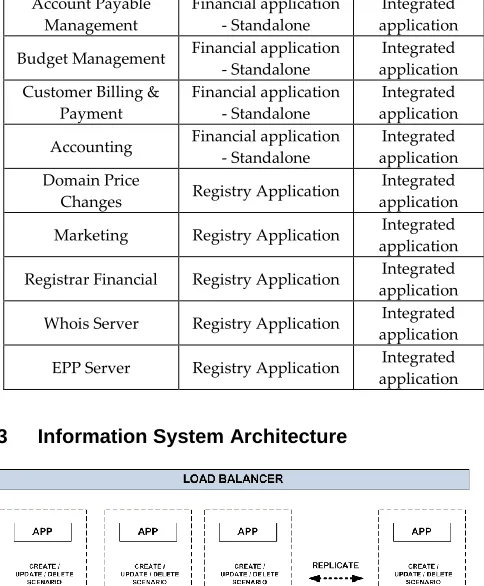
The current GAP Enterprise Architecture analysis shows the condition of the current application in fulfilling business processes to run and how the target enterprise architecture will be designed in this study.
TABLE 1
CURRENT ENTERPRISE ARCHITECTURE GAP ANALYSIS
Business Process Current
Enterprise Architecture Target Main Business Process Human Resource MS Office Application - Manual
Integrated application
HR - Employee Assessment
MS Office Application - Manual
Integrated application HR – Training
Benefit
MS Office Application - Manual
Integrated application Employee – Training
Benefit
MS Office Application - Manual
Integrated application Management –
Training Benefit
MS Office Application - Manual
Integrated application HR – Employee Loan
Policy
MS Office Application - Manual
Integrated application Attendance Management Attendance Recording Application - Standalone Integrated application Medical Reimbursement MS Office Application - Manual
Integrated application
Ticketing System Ticketing application -Standalone
Integrated application
Reserve Domain Registry Application Integrated application Domain Abuse
Report
Online Form - Standalone Integrated application Registrar Registration MS Office Application - Manual
Integrated application Assessment of
Candidate Registrars
MS Office Application - Manual
Integrated application Registrar
Accreditation
MS Office Application - Manual
Integrated application Domain Name
Dispute Resolution (PPND)
Online Form - Standalone
Integrated application
PPND Panelist MS Office Application - Manual
Integrated application
PPND Financial MS Office Application - Manual
Integrated application Dashboard and
Reporting
MS Office Application - Manual
Integrated application
Deposit Registrar Registry Application Integrated application Emergency Credit
Registrar Registry Application
Integrated application
1174 Account Payable
Management
Financial application - Standalone
Integrated application
Budget Management Financial application - Standalone
Integrated application Customer Billing &
Payment
Financial application - Standalone
Integrated application
Accounting Financial application - Standalone
Integrated application Domain Price
Changes Registry Application
Integrated application
Marketing Registry Application Integrated application
Registrar Financial Registry Application Integrated application
Whois Server Registry Application Integrated application
EPP Server Registry Application Integrated application
4.3 Information System Architecture
Fig. 8. Design of PANDI Operational Information System Architecture
Fig. 9. Design of System Architecture 3 (Three) Layers
• Data Layer
o Master - Master Database Clustering
The Relational Database Management System that will be used is MariaDB
o Master-Slave Replication
The Relational Database Management System that will be used is MariaDB
o NoSQL Database
The NoSQL Database that will be used in the Information System architecture is Apache Cassandra.
• Business Service Layer o Business Logic Service
The technology that will be used as a Business Logic Service in the Information System Architecture is Enterprise Java Bean (EJB) 3.2.
o Asynchronous Messaging Service
The JMS technology that will be used in the Information System is ActiveMQ which has been discussed in the technology consideration section above.
o Java Persistence API (JPA)
The JPA technology that will be used in the System Registry architecture is Hibernate Object Relational Mapper (ORM) and Hibernate Object Graph Mapper (OGM).
o Cache Manager
The Cache Manager technology that will be used in the Information System Architecture is Infinispan.
o Third Party Connector
Embedded Systems / Appliances that have been used by PANDI in supporting domain management activities include:
i. Fingerprint Devices that function for the process of
collecting employee attendance and access control for operational buildings.
ii. HSM (Hardware Security Module) which functions to
make top grade security keys to be used in the DNSSEC subsystem.
iii. Email Server that serves to store e-mails that contain
reporting complaints and questions sent by .id domain users.
• Presentation Layer o Front-End Web
This implementation on the web front-End layer can use various technologies such as PHP Zend Framework, PHP Laravel, Spring MVC Framework. Front-End Web can interact with the layer below it (Business Logic) directly with Local Method Invocation or remotely by using Web Service (JSON, XML).
o JSON Web Service
Data interaction using JSON (JavaScript Object Notation) format.
o XML Web Service
Data interaction using XML (Extensible Markup Language) format.
o XML Service (EPP Parser)
1175 Fig. 10. System Building Block Application Landscape Design
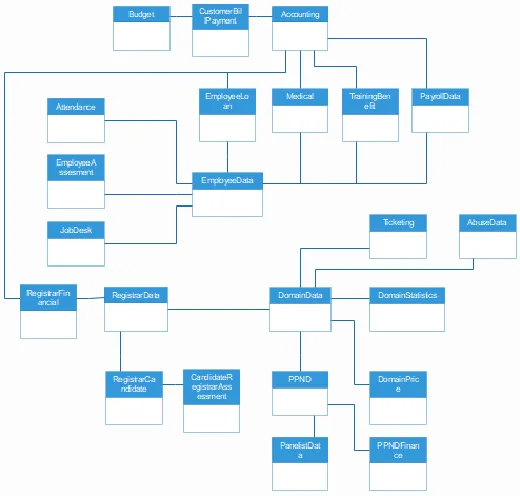
Information System to be built by PANDI is formed with the Micro Service architecture, based on figure 10. So that each service can be deployed separately but can still interact with one another according to the level of dependency. The stored database can also be used between services, such as the design of the entity-relation database shown in figure 11.
Figure 11: Application Database Design
4.4 Technology Architecture
Cloud computing architecture consists of many cloud components that are loosely coupled. This architecture mainly divides cloud architecture into two parts, Front End and Back End. Each end is connected to another person through a network, generally to the Internet.
Front End is the computer user or client side. This involves the interfaces and applications needed to access the Cloud Computing system.
Back End is the cloud part of the system. This involves all the resources needed to provide Cloud computing services. This
includes very large data storage, virtual machines, security mechanisms, services, deployment models, servers and others.
To provide a built-in security mechanism, traffic control and protocol are the responsibility of the back end [13].
Router Server
Server Server
Server
Internet
Router Office
Firewall
Mainframe
Cloud Service Provider
Cloud Vendor s Infrastructure
User WAP
Fig 12: Cloud Computing Network Topology
4.5 Opportunities and Solution
At this stage, it is looking for opportunities and solutions that can be utilized or carried out in the development of this enterprise architecture. Opportunities and solutions proposed at this stage are planning and developing applications both new development or integration with existing information and data systems.
TABLE 2
OPPORTUNITIES AND APPLICATION DEVELOPMENT SOLUTION
Business Process Opportunities and Solutions Main Business
Process Human Resource
Integrated application development
HR - Employee Assessment
Integrated application development
HR – Training Benefit
Integrated application development
Employee – Training Benefit
Integrated application development
Management – Training Benefit
Integrated application development
HR – Employee Loan Policy
1176 Management Recording
Application - Integration with developed applications Medical Reimbursement Integrated application development Ticketing System Ticketing application - Integration with
developed applications
Reserve Domain
Registry Application - Integration with
developed applications Domain Abuse Report Integrated application development Registrar Registration Integrated application development Assessment of Candidate Registrars Integrated application development Registrar Accreditation Integrated application development Domain Name Dispute Resolution (PPND) Integrated application development PPND Panelist Integrated application development PPND Financial Integrated application development Dashboard and Reporting Integrated application development Deposit Registrar Registry Application - Integration with
developed applications
Emergency Credit Registrar
Registry Application - Integration with
developed applications
Rebate Registrar
Registry Application - Integration with
developed applications Account Payable Management Integration with developed applications Budget Management Integration with developed applications
Customer Billing & Payment
Integration with developed applications
Accounting Integration with developed
applications
Domain Price Changes
Registry Application - Integration with
developed applications
Marketing
Registry Application - Integration with
developed applications
Registrar Financial
Registry Application - Integration with
developed applications
Whois Server
Registry Application - Integration with
developed applications
EPP Server
Registry Application - Integration with
developed applications
4.6 Migration Planning
The steps taken in this phase are to arrange the order/priority of system implementation based on the previous stages, so that the enterprise architecture to be implemented is based on the application architecture that has been designed, by first
implementing planning initiation, business models,
information systems and data architecture, which have existed.
TABLE3
THE SEQUENCE OF APPLICATION DEVELOPMENT IMPLEMENTATION Sequence
Number Application Name Explanation 1 Main Business
Process Human Resource
New development
2 Attendance Management
Integration with developed applications 3 Registrar
Registration
New development
4 Assessment of Candidate Registrars
New development
5 Registrar Accreditation
New development
6 EPP Server Integration with developed applications 7 Whois Server Integration with
developed applications 8 Reserve Domain Integration with
developed applications 9 Domain Price
Changes
Integration with developed applications 10 Marketing Integration with
1177 developed
applications 12 Deposit Registrar Integration with
developed applications 13 Emergency Credit
Registrar
Integration with developed applications 14 Rebate Registrar Integration with
developed applications 15 Dashboard and
Reporting
New development
16 Ticketing System Integration with developed applications 17 Domain Abuse
Report
New development
18 Domain Name Dispute Resolution
(PPND)
New development
19 PPND Panelist New development 20 PPND Financial New development 21 Account Payable
Management
Integration with developed applications 22 Budget Management Integration with
developed applications 23 Customer Billing &
Payment
Integration with developed applications 24 Accounting Integration with
developed applications 25 HRD Employee
Assessment
New development
26 HR – Training Benefit
New development
27 Employee – Training Benefit
New development
28 Management – Training Benefit
New development
29 HR – Employee Loan Policy
New development
30 Medical Reimbursement
New development
4.7 Implementation Governance
In this phase application development can use ISO / IEC 27001: 2013 [31] for information security and ISO / IEC 27002: 2013 [32] for information security control, risk management using ISO / IEC 27005: 2018 [33] to mitigate risks that possible occurrence, SMART Requirements for resource perspective provides an effective method for addressing cloud software security requirements [34], [35] , and OWASP [36] for security of website-based application development.
5
C
ONCLUSIONThe conclusions that can be conveyed from the results of this study are:
This research produced a blueprint of an enterprise
architecture operational information system that could be used and developed later as a standard PANDI operational information system and could be connected to all applications in the future.
With the design of this information system, it is expected
to facilitate business processes related to operational management that can be carried out directly, whenever and wherever and make it easy for PANDI employees in managing the organization's operations.
The development of enterprise architecture-based cloud
computing information system uses the TOGAF ADM approach which only refers to the stages up to the G phase, but even so, it can produce architectural model designs that are generally in accordance with the needs of the business processes set by PANDI.
By utilizing cloud computing, it makes it easy for system
managers to run an information management system for operational PANDI with guaranteed infrastructure, information security and access speeds that service providers have and the confidentiality of data to be an important guarantee in the infrastructure built.
REFERENCES:
[1] H. Chen, R. H. L. Chiang, and V. C. Storey, “Business
intelligence and analytics: from big data to big impact,” MIS Q., pp. 1165–1188, 2012.
[2] K. Surendro, “Pengembangan Rencana Induk Sistem
Informasi,” Inform. Bandung, 2009.
[3] “Diprediksi Tumbuh Pesat, Inilah Tren Cloud
Computing Tahun 2019 - Semua Halaman -
Infokomputer.Grid.ID.” *Online+. Available:
https://infokomputer.grid.id/read/121328634/diprediks i-tumbuh-pesat-inilah-tren-cloud-computing-tahun-2019?page=all. [Accessed: 16-Feb-2019].
[4] “Mengapa Cloud Computing Diperlukan di Masa
Sekarang? – CRMS Indonesia.” *Online+. Available: http://crmsindonesia.org/publications/mengapa-cloud-computing-diperlukan-di-masa-sekarang/. [Accessed: 16-Feb-2019].
[5] D. Irmayanti and B. Permana, “Perencanaan Arsitektur
Enterprise Sistem Informasi Disnakersostrans
Kabupaten Purwakarta Menggunakan TOGAF,” J. Teknol. Rekayasa, vol. 3, no. 1, p. 17, 2018.
[6] B. Rianto, L. Lidya, and G. W. Nurcahyo, “Pemodelan
Arsitektur Enterprise Menggunakan Metode Togaf ADM Studi Kasus Dinas Kesehatan Kabupaten Indragiri Hilir,” J. Komput. Terap., vol. 2, no. 1, pp. 55– 68, 2016.
[7] R. K. Ekawati and A. N. Hidayanto, “The Influence of
1178
Organizational Performance-A Case Study of IAIN Raden Fatah Palembang,” WSEAS Trans. Comput., vol. 10, no. 3, pp. 81–92, 2011.
[8] R. K. Ekawati, “Perencanaan Infrastruktur Teknologi
Informasi pada Bank dengan Framework TOGAF,” J. Sist. Inf. Bisnis, vol. 7, no. 2, p. 154, 2017.
[9] J. A. O’brien and G. M. Marakas, Introduction to
information systems, vol. 13. McGraw-Hill/Irwin New York City, USA, 2005.
[10] L. Retnawati, “Perancangan Enterprise Architecture
Menggunakan TOGAF di Universitas ABC,” J. IPTEK MEDIA Komun. Teknol., vol. 22, no. Mei 2018, pp. 13– 20, 2018.
[11] V. M. Barlow, L. D. Bentley, and J. L. Whitten, “System
Analysis and Design Method,” Penerbit Von Hoffmann Press. USA, 1989.
[12] K. C. Laudon and J. P. Laudon, Management
Information Systems: Managing the Digital Firm Plus MyMISLab with Pearson eText--Access Card Package. Prentice Hall Press, 2015.
[13] “Cloud Computing Architecture.” *Online+. Available:
https://www.tutorialride.com/cloud-computing/cloud-computing-architecture.htm. [Accessed: 06-Mar-2019].
[14] P. M. Mell and T. Grance, “Sp 800-145. the nist
definition of cloud computing,” 2011.
[15] A. Budiyanto, “Pengantar Cloud Computing,”
Komunitas Cloud Comput. Indones., 2012.
[16] B. Furht and A. Escalante, Handbook of cloud
computing, vol. 3. Springer, 2010.
[17] R. Buyya, C. Vecchiola, and S. T. Selvi, Mastering
cloud computing: foundations and applications programming. Newnes, 2013.
[18] R. Harrison, TOGAF®9 Foundation Study Guide. Van
Haren, 2016.
[19] S. A. Bernard, An introduction to enterprise
architecture. AuthorHouse, 2012.
[20] J. Schekkerman, How to survive in the jungle of
enterprise architecture frameworks: Creating or choosing an enterprise architecture framework. Trafford Publishing, 2004.
[21] J. Schekkerman, “Enterprise Architecture Good
Practices Guide: How to Manage the Enterprise Architecture Practice, Trafford,” Victoria, 2008.
[22] P. Desfray and G. Raymond, Modeling enterprise
architecture with TOGAF: A practical guide using UML and BPMN. Morgan Kaufmann, 2014.
[23] B. Raynard, TOGAF The Open Group Architecture
framework 100 success secrets-100 most asked questions: the missing TOGAF guide on how to achieve and then sustain superior enterprise architecture execution. Emereo Pty Ltd, 2008.
[24] G. Barovih and Salimin, “Model Arsitektur Monitoring
Obat melalui Pendekatan Togaf Adm dan Cloud Database,” J. SISFOKOM, vol. 07, no. September, pp.
155–162, 2018.
[25] B. Febrian, B. L. Sinaga, and I. Wisnubadhra,
“Perancangan Arsitektur Bisnis Perguruan Tinggi
Dengan TOGAF (Studi Kasus : Politekes Kemenkes
Palangka Raya),” Pros. Semin. Nas. Multi Disiplin Ilmu Call Pap. Unisbank, pp. 1–6, 2015.
[26] Y. Kustiyahningsih, “Perencanaan Arsitektur
Enterprise Menggunakan Metode TOGAF ADM (Studi
Kasus : RSUD Dr.Soegiri Lamongan),” Pros. Semin.
Nas. Manaj. Teknol. XVIII, pp. 1–8, 2013.
[27] R. Yunis and K. Surendro, “Perancangan Model
Enterprise Architecture Dengan Togaf Architecture Development Method,” Semin. Nas. Apl. Teknol. Inf., vol. 2009, no. Snati, pp. 25–31, 2009.
[28] N. A. Susanti, R. R. Saeduddin, and A. Sadat,
“Perancangan Enterprise Architecture Pada Fungsi Finance Di PT Albasia Nusa Karya Kabupaten Garut Menggunakan Framework TOGAF ADM,” INSIGHT, vol. 1, no. Agustus, pp. 228–233, 2018.
[29] M. A. Helmiawan and Y. Y. Sofiyan, “Pengembangan
Model Perencanaan Sistem Informasi Kampus Dengan TOGAF Architecture Development Method,” J. Ilmu-ilmu Inform. dan Manaj. STMIK, vol. 12, no. Mei, 2018.
[30] I. Supriyana, “Perencanaan Model Arsitektur Bisnis,
Arsitektur Sistem Informasi dan Arsitektur Teknologi
Dengan Menggunakan TOGAF: Studi Kasus
Bakosurtanal,” J. Generic, vol. 5, no. 1, p. 9, 2010.
[31] “ISO/IEC 27001:2013(en), Information technology —
Security techniques — Information security
management systems — Requirements.” *Online+.
Available:
https://www.iso.org/obp/ui/#iso:std:iso-iec:27001:ed-2:v1:en. [Accessed: 17-Feb-2019].
[32] “ISO/IEC 27002:2013(en), Information technology —
Security techniques — Code of practice for information
security controls.” *Online+. Available:
https://www.iso.org/obp/ui/#iso:std:iso-iec:27002:ed-2:v1:en. [Accessed: 17-Feb-2019].
[33] “ISO/IEC 27005:2018(en), Information technology —
Security techniques — Information security risk
management.” *Online+. Available:
https://www.iso.org/obp/ui/#iso:std:iso-iec:27005:ed-3:v1:en. [Accessed: 17-Feb-2019].
[34] M. Mannion and B. Keepence, “SMART requirements,” ACM SIGSOFT Softw. Eng. Notes, vol. 20, no. 2, pp. 42–47, 1995.
[35] R. L. Krutz and R. D. Vines, Cloud security: A
comprehensive guide to secure cloud computing. Wiley Publishing, 2010.
[36] “Web Application Security Guidance - OWASP.”
[Online]. Available:
![Fig. 1. Cloud Computing Architecture [13]](https://thumb-us.123doks.com/thumbv2/123dok_us/8629479.1419187/2.612.83.267.480.710/fig-cloud-computing-architecture.webp)