Licensed under Creative Common Page 647
http://ijecm.co.uk/
ISSN 2348 0386
STATE OF PROCUREMENT TRAINING AND ECONOMIC
STIMULUS PROJECTS’ PERFORMANCE
A SURVEY OF PUBLIC SECONDARY SCHOOLS IN MBEERE NORTH DISTRICT,
EMBU COUNTY, KENYA
Eunice Njagi
Tutorial Fellow, School of Business and Economics,
South Eastern Kenya University, Kenya
Jackson Ndolo
School of Business and Economics, Mount Kenya University, Kenya
Abstract
The human aspect in the success of any projects cannot be over emphasized for it is the glue
that holds all the other players together. Training plays a key role in equipping the people with
the necessary skills and knowledge in performance of their tasks hence the project success.
The study therefore aimed at examining the role of procurement training in the performance of
economic stimulus programmes in public sector in Kenya. The particular objectives that were
analyzed included; to establish the state of procurement professionalism in the economic
stimulus projects, to determine the extent to which staff training on procurement affects
economic stimulus projects’ performance and to identify challenges facing procurement
professionals on economic stimulus projects. The researcher used descriptive research design
in carrying out the survey. The researcher used census method since the respondents were
drawn from the entire population of thirty seven respondents since it is small and known. Data
was collected using open-ended and semi-structured questionnaires. Data collected was
analyzed through qualitative and content analysis. The study established that most of the
members involved in procurement of ESP projects have no training in procurement and also
Licensed under Creative Common Page 648 influence on what transpires during the procurement exercise. The researchers recommend
establishment of an independent procurement department in secondary schools involving well
trained staff conversant with procurement procedures. The study is of great importance to the
management of ESP especially the heads of public secondary schools and Board of Governors.
To Kenyan government and donors it will assist in identifying areas of improvement in
procurement procedure of such projects. To researchers the study will form basis for future
research.
Keywords: Professionalism, Training, Performance, Procurement, Economic Stimulus Projects
INTRODUCTION
ESPs being multi-billion projects requires high level of monitoring, transparency and
accountability hence in secondary schools the projects are managed by head teachers and
board of governors most of who are expected to be well versed with knowledge on public
procurement procedures and guidelines as stipulated in PPDA (2005) and the PPDR ( 2006).
The people concerned in implementation of the ESPs have other key responsibilities in other
areas like the head teacher whose key responsibility is to run the school and ensure academic
excellence, members of the board of governors only visit the school occasionally and more so to
address specific issues as requested by the head teacher, other members include teachers
whose key role is to teach. In such circumstances monitoring of such time framework and
procedural activities may pose a big challenge. The schools have no procurement professionals
hence procurement activities are carried out by people with minimal or no procurement
knowledge. Does this affect the performance of the ESPs? The study therefore sought to
answer this question through assessing role of procurement training on economic stimulus projects’ Performance by establishing the state of procurement professionalism and the extent to which staff training on procurement affects Economic Stimulus Projects’ performance.
LITERATURE REVIEW
Procurement Procedure
The public procurement procedure is the process followed in acquiring of goods, works and
services by the government procuring entities which includes purchasing, hiring, leasing or any
other contractual means of engaging suppliers in the provision of services to the public (lent,
2002). Public procurement is controlled by government and is financed from taxation, grants,
Licensed under Creative Common Page 649 provision of public service. It is aimed at satisfaction of customers in terms of cost, quality, and
timeliness of the delivered product or service, minimizing administrative operating costs,
conducting business with integrity, fairness and openness so as to fulfill public policy objectives
(GoK, 2005).
ESP Procurement
All works and services are sourced using existing government procurement regulations [Public
Procurement and Disposal Act, 2006 and its attendant Regulations, 2006 and subsequent
Amendments, 2009].The CDF Account Manager shall ensure that the constituency establishes
CPTC. A Tender Evaluation Committee shall also be established and membership appointed by
the CDF Account Manager, whose task will be to prepare a report on the analysis of the tenders
received, and final ratings assigned to each tender and submit the report to the CPTC, with
exceptions of projects under the Ministry of Education, the CPTC will be responsible for
adjudication and award of all the project contracts in the Economic Stimulus Programme.
Project Performance Measurement
Projects are often implemented as a means of achieving an organization’s Strategic plan.
Operations and projects differ primarily in that operations are ongoing and repetitive while
projects are temporary and unique. A project is a temporary endeavor undertaken to create a
unique product or service. Temporary means that every project has a definite beginning and a
definite end. Unique means that the product or service is different in some distinguishing way
from all other products or services. For many organizations, projects are a means to respond to those requests that cannot be addressed within the organization’s normal operational limits
(Gary, 2002).
Project procurement management is governed by the four project management
objectives as identified by James (1995); performance, cost, time and scope of the project.
Performance is the quality of the work being done, cost is the cost of project work, directly
related to the human and physical resources applied, time is the schedule that must be met and
scope is the magnitude of the work to be performed. The four project objectives are related to
each other by cost as a function of performance, time and scope. What the equation says is
that cost is a function (f) of performance (P), time (T), and scope (S). As P and S increase, cost
generally increases. The relationship between time and cost, however, is not linear. As a rule,
cost increases as the time to do the project decreases below a certain optimum time. That is,
there exists a project duration that results in the best performance of all resources. If the
Licensed under Creative Common Page 650 Further, worker errors often increase, resulting in costs for corrections, and productivity often
declines. In addition, if project work extends beyond an optimum time, costs increase because
people are not working efficiently.
Training of Staff on Procurement
Professional supply managers with assistance of top management and their colleagues in other
functional areas must ensure that appropriate personnel receive periodic training or education
with respect to organizations ethical and professional standards (David et al, 2003). All
members of the supply management system must respect their roles as agents of their
employer and must represent the best interest of their organization. According to Chopra
(2002), secretary of the purchasing and supply lead body, traditionally the UK only required
small highly educated elite-our engines of government and civil service; and management of UK
industry only required that proportion of workforce to be educated to high levels. Today we need
a large work a better education system for a larger proportion of the work force and in view of increasing competitive world’s environment; we need to ensure workforce is trained to highest
levels in competence.
The Chopra (2002) report indicated that vocational education, training qualification were
fragmented. There were too many awarding bodies and much of provision was not delivered
against recognizable or employer led statement of occupational competence. Kenneth (2006)
explained why continuing professional development in the shape of the things to come and
examine some of the other professional education and training initiatives in which the institute is
involved. Many employers now recognize that it is no longer enough and services on for their
staff to gain a professional or relevant academic qualification at one particular point in their
career. It is essential that they keep themselves up to date with the best practice in their
function. Employers must also accept that qualifications gained earlier in their careers quickly
become oudated as a result many professional institutions have developed schemes that assist
and guide their members.
According to David et al (2003), many firms have learnt the benefits of providing training
to their suppliers in approaches such as World class supplies Management (WCSM), statistical
process control (SPC), Just - In – Time (JIT) manufacturing. Progressive firms recognize that
their ability to procure quality products and services on time requires suppliers with competence
Licensed under Creative Common Page 651 RESEARCH METHODOLOGY
The research involved a survey of public secondary schools in Mbeere North District, Kenya.
The respondents were drawn from the entire population of 37 committee members involved in
procurement of ESP in public secondary since it is small and known. The target population was
distributed as shown in table 1.
Table 1: Target Population
Cadre of staff Target population Percent
BOG ESP Representative 6 16.2
Heads of schools 3 8.1
DEOs office staff 3 8.1
School Tender Committee 21 56.8
Public Works Staff 4 10.8
Total 37 100.0
Data was collected using a self-designed questionnaire with both closed and open questions.
The study mostly utilized descriptive statistics. As such, frequency tables were generated to
highlight the percentage scores and cumulative percentages for the variables of interests. Items
in the questionnaires which required the respondents to give an essay response were first put in
groups of similar response and then analyzed.
EMPIRICAL FINDINGS AND DISCUSSION
Response rate
Thirty seven respondents were targeted by the research study from the schools implementing
economic stimulus programme. Thirty five (35) questionnaires were filled accordingly and
returned this represented an overwhelming 95 percent of the targeted population.
Background Information
It is important for the readers to know the particulars for the participants in order to be able to
have an objective assessment of the findings. Hence, the underlying information concerning the
respondents who furnished the details, which formed part of the research findings, was obtained
in terms of age, gender, length of service in secondary schools procurement, designation and
their duties, professional background, highest level of educational attainment and their
Licensed under Creative Common Page 652 Gender
Table 2: Gender Distribution
Gender Frequency Percent Cumulative Percent
Male 25 71.4 71.4
Female 10 28.6 100
Total 35 100.0
The study findings indicate that 71.4 percent of the respondents were male while 28.6 percent
of the respondents were female. From the censured population, it is clear that the proportion of
the male was higher than their female counterparts. This is almost the recommended
government 30 percent of women representation percentage in decision making processes.
Age
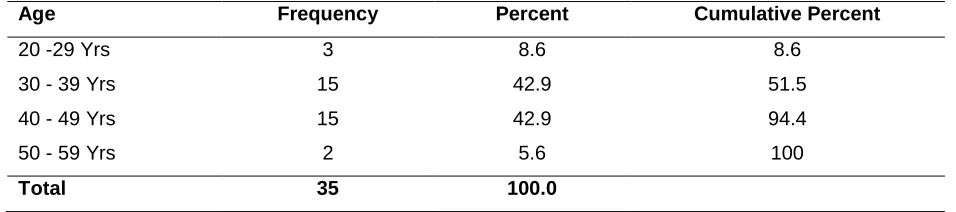
The study sought to determine the ages of the staff in order to identify the distribution of the staff
age. Age was disaggregated by 10 years interval and hence grouped into age groups ranging
from 20-29 years to 50-59 years. The responses are presented in table
Table 3: Age Bracket
Age Frequency Percent Cumulative Percent
20 -29 Yrs 3 8.6 8.6
30 - 39 Yrs 15 42.9 51.5
40 - 49 Yrs 15 42.9 94.4
50 - 59 Yrs 2 5.6 100
Total 35 100.0
From table 3, 8.6 percent of the staff fell between the age of 20 and 29 years. While 42.9
percent and 42.9 percent composed of staff age between 30 – 39 years and 40 – 49 years
respectively, 8.6 percent of staff members were aged between 50 and 59 years. The mean age
of the respondents was 34 years. This shows that the participants in the research were young
people. This is the group which has little experience but may have been exposed to knowledge
of procurement through formal training.
Level of Education
Education attainment was asked in order to determine distribution of respondents by level of
Licensed under Creative Common Page 653 Table 4: Education Level
Level of Education Frequency Percent Cumulative Percent
Secondary School Certificate 0 0.0 0
College Diploma 8 22.9 22.9
Bachelor’s Degree 24 68.6 91.5
Post graduate - Masters 3 8.5 100.0
Post graduate -Doctoral 0 0 100.0
Total 35 100.0
From the table, none of the SIC members have secondary school certificate as their highest
level of education, 30% percent of the respondents are diploma holders, 67% are degree holders and 9% percent having master’s degree. Although none of the respondents have
doctoral qualification this indicates that the SIC members have capacity to understand their
duties and for the sake of this study be able to understand the research questionnaire items and
are in a position to give relevant information as required.
Length of Service
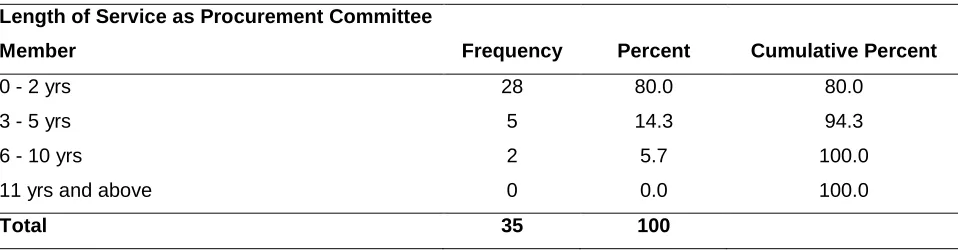
The study sought to determine the length of service as part of procurement committee member
so as to identify whether the respondents are experienced therefore acquainted with
procurement process. Further, information on length of service would form basis not only to
determine the correlation between length of service and other demographic information such as;
age and gender but also to validate content of the responses. The results are shown in table 5.
Table 5: Length of Service
Length of Service as Procurement Committee
Member Frequency Percent Cumulative Percent
0 - 2 yrs 28 80.0 80.0
3 - 5 yrs 5 14.3 94.3
6 - 10 yrs 2 5.7 100.0
11 yrs and above 0 0.0 100.0
Total 35 100
Familiarity with Procurement Procedure
The researcher also wanted to know the familiarity of the respondents to the schools
procurement procedure. When respondents were asked whether they were familiar with the
Licensed under Creative Common Page 654 Table 6: Familiarity with the term Procurement Procedure
Option Frequency Percent Cumulative Percent
Yes 14 40 40
No 21 60 100
Total 35 100
Table 5 responses indicate that only 40 percent of the respondents agreed to be familiar with
the term procurement process while 60 percent seemed not to be familiar with the term. This
indicates that most of the SIC members were not directly involved in the procurement process
and may be lacking relevant training and skills on procurement.
Respondents’ Rating of schools’ Procurement Procedure
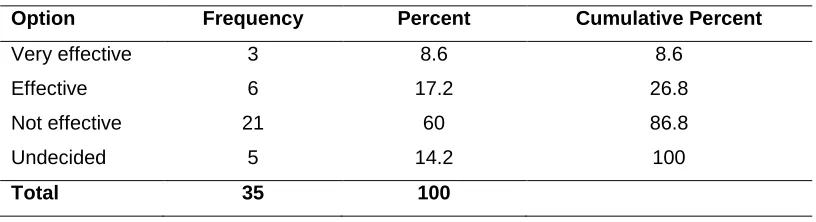
The study sought to know how the staff would rate school procurement procedure in terms of
whether as being very effective, effective, and not effective or not being decided on its
effectiveness. The responses are shown in table 7.
Table 7: Rating of school’s Procurement Procedure
When asked to rate the school’s procurement process, 60 percent of the respondents rated the school’s procurement process as being not effective, 17.2 percent rated it as effective while 8.6
percent rated it as being very effective. 14.2 percent of the respondents were undecided. These
findings indicate there were factors that were affecting the effectiveness of the procurement
process and hence leading to it being ineffective as noted by the 60 percent of the respondents.
Effects of Staff Training on the Procurement Procedure
Information concerning staff training on the procurement process gave a blue print on how the
procurement process was being conducted. The responses were based on the objective of the
effects of training on economic stimulus procurement process, training policy, timeliness, quality
of purchase and suggestions on improving training.
Option Frequency Percent Cumulative Percent
Very effective 3 8.6 8.6
Effective 6 17.2 26.8
Not effective 21 60 86.8
Undecided 5 14.2 100
Licensed under Creative Common Page 655 When asked whether staff training affects the cost, quality and timeliness of the procurement
process, 99 percent of the respondents were convinced that staff training affects directly the
procurement process either in cost, time and quality of purchase as indicated in table 6.
Table 8: Effects of staff training on procurement procedure
STATEMENT Strongly
disagree
Disagree Undecided Agree Strongly Agree The school has a staff training policy on all
staff involved in procurement process
94.2 2.9 0.0 2.9 0.0
The staff training on procurement process
affects the quality of purchased 0.0 0.0 0.0 2.9 97.1
The staff training on the process leads to
competence hence saves time 0.0 0.0 2.9 2.9 94.2
According to the respondent’s schools had no staff training policy for the staff involved in
procurement process as indicated by 94.2 percent of the respondents who strongly disagreed
that the school had a staff training policy. The schools had no procurement specialist and
majority of the staff relied on one day seminar training knowledge on procurement to carry out
their procurement duties, however, 94.2 percent of the respondents strongly agreed that staff
training on the process may lead to competence hence improve project performance.
Table 9: Recommendations to improve Procurement in schools
Recommendations Frequencies Percent
Diversify scope of supplier selection 19 54.3
Adequate training 27 77.1
Clear and Proper policies 23 65.7
Independent procurement department 17 48.6
From the basis of the findings in the table 9 we can establish that 54.3 percent feels selection
suppliers should be diversified to wider region and 77.1 percent indicate need to have those
involved in procurement be properly trained on procurement . Proper and clear policies and
separate procurement department registered 65.7 percent and 48.6 percent respectively. This
Licensed under Creative Common Page 656 problems that may not be common in other public entities. Procurement training is
recommended as the leading solution to ESPs performance.
CONCLUSION
Lack of procurement professionalism by SIC members was evidenced since majority of these members don’t poses procurement skill as their core competence. They just rely on seminar
training on procurement with some not even attending such seminars. In relation to work
experience 80 percent of the staff has worked as procurement committee for less than 2 years.
This shows the school procurement committee not only lack training but also experience. Deficit
in higher level qualifications has a bearing on the appreciation of procurement process and thus
affecting ESPs performance.
RECOMMENDATIONS
For effective role of procurement to be achieved the government through the ministry of
education needs to lay more emphasis on training and using procurement professionals to carry
out procurement in the school. This will be possible if the department of procurement is
established in the secondary schools and filled with procurement professionals. This would help
remove the head teachers from the procurement process since it would eliminate the problem of
diversion of funds to other unplanned activities, conflict of interest and ensuring independence
of the process.
REFERENCES
Jason C. (2003). Project Management Methodologies. AEW services. Vancouver.
Kenneth L & Michael G. (2006). Purchasing and Supply Chain Management: 6th edition. Pearson Education Limited, Harlow.
Mugenda, O. M. (2003). Research Methods: Quantitative and Qualitative Approaches: African Center for Technology Studies Press, Nairobi
Parsons W. (2002). Improving Purchasing Performance. Gower Publishing Co, Ltd. London.
Mark etal. (2009). Research methods for business students: 5th edition. Rotolito lombarda, Italy
Republic of Kenya. (2005). The Public Procurement and Disposal Act 2005: Government Printer, Nairobi
Republic of Kenya. (2006). The Public Procurement Regulations. Government Printer, Nairobi.