Introduction
The regional development became a frequent topic in the Czech Republic mainly after the country entered the EU. Logically, this has led to a growing demand for new theoretical and methodological approaches of regional research, also as a reaction to the unilateral approaches existing at the time defining regional policy in terms of a mix of practical tasks in Central and Eastern European countries [1]. This development represents a new challenge for regional sciences, which include especially regional economy, economic geography and spatial planning [15]. It is necessary to note that as far as direct links of the theory of regional development to general economic theory are concerned, this is a rather complicated matter. The main reason is the fact that the mainstream economic theory ignores the spatial aspect (to say nothing of the degree of information capacity of economic theories which use a gnoseological framework of closed physical systems although they relate to open social systems). The solution of this problem can be considered as a significant methodological contribution of the theory of regional development.
The above mentioned developments led to the creation of the presented model aiming for business oriented interpretation of the principles of developmental and hierarchical differentiation of social systems [11]. Their effect is in agreement with the general theory of systems connected with numerous feedbacks which provide self-control of social systems in real conditions of imperfect competition. The developmental differentiation of social systems
determines the socioeconomic organisation of the society, and its main demonstration is natural selection based on competition, which in combination with purposeful cooperation of economic entities ensures optimum use of limited sources. This differentiation is closely related to hierarchical differentiation of social systems resulting in socio-geographical orga-nisation of the society. However, this relation-ship is modified by strong inertia of hierarchical structures therefore the effect of both principles is not always straightforward. In this context the following principles have been applied when creating the model:
evaluate development potentials of regions in an integrative way – from factual (integration of economic, social and environmental factors) as well as spatial (integration of territorial structures) perspectives;
preference for the bottom-up approach following the line microregion – mesoregion – macroregion with an emphasis on the specification of the main integration processes;
evaluate the information capacity of the model by means of testing relevant hypotheses with positive impacts on usage in a regional policy and the business sector.
1. The Theoretical Background
Location theories are the most inspiring out of supply-oriented neoclassical theories of economic growth as regards the links of the presented model to theories of regional development. Their basic premise is that a limited spatial mobility of production sources determines theINTEGRATIVE MODEL FOR EVALUATION OF
DEVELOPMENT POTENTIALS OF REGIONS
AND ITS APPLICATION ON AN EXAMPLE OF
THE CZECH REPUBLIC
creation of territory-specific economic structures (including the creation of external savings), and the aim of these theories is to find the main factors determining the location of economic activities. According to Massey [20] one can distinguish four basic directions: location decision process of companies, mutual interdepen-dencies of location decisions, behavioural concept of location and a synthesis of economy spatial distribution, which was dealt with from the perspective of the central-place theory [14]. Further inspiration was obtained from endogenous growth theories responding to the fact that original neoclassical theories cannot explain a long-term production growth. Endogenous theories emphasise the internalisation of the significant factors of economic growth, which were within the widely known Solow’s neoclassical growth model considered as the exogenous factor “technology” – it is a non-measurable residual factor to which the differences between the real GDP growth and the corresponding contribution of basic production factors are allotted [28]. Correspondingly, they are characterised by a spill-over of economic effects connected with the creation of positive externalities (capital returns then have, ceteris paribus, growing character). Most often, two examples of endogenous models are mentioned: models oriented towards an accumulation of human capital [18] and models oriented towards an accumulation of knowledge capital [27]. In this context, we also have to mention the new trade theory [17] and the micro-economic theory of competitiveness with the well-known diamond model [26]. The other main group of regional theories contains demand-oriented theories emphasizing the determining effect of demand on economic growth, which is in contrast to neoclassical theories generally considered uneven. Out of these “core-periphery theories” the most inspirational are especially the growth pole theory [24], the theory of cumulative causation [22] and the theory of uneven development [13]. The first theory points out the key role of development poles for economic growth. The other two theories significantly contributed to the clarification of the cumulative mechanism of origination of disparities in the regional development, including the diffusion of positive and negative effects. According to Myrdal, this process has
three basic stages: selection of successful regions, polarization, and integration. Other significant groups of inspirational theories are institution-oriented theories, mainly the theory of learning regions [19] and time-geography [10].
2. Model Description and the
Results of Its Application to
the Czech Republic
Based on the theory and accepted principles, the main components of the model are business environment quality (BEQ), innovation potential of companies (IPC) and use of human resources (UHR). The essence of the model can be described as follows. An improvement of BEQ stimulates the development of business activities with positive impacts on IPC and UHR. Thus, the synergic effects that are generated enhance territorial integration and increase development potential and regional competitiveness, which creates the basic prerequisites for sustainable regional development. The developmental tendencies of regions then depend on whether the region gains or loses competitive advantages compared with other regions (these tendencies can also be influenced by random factors, i.e. the model is non-deterministic). The competitive-ness of companies plays a crucial role in this; however, its relationship to the competitiveness of regions is not completely straightforward (e.g. reduction of staff in companies reduces the level of the UHR). We chose the microregional level as the level to be used for the primary evaluation of development potentials. In the Czech Republic this level is represented by administrative districts MEC – municipalities with extended competence of the 3rd degree. These are 205 territorial units in total with an average number of 45 thousand of inhabitants (this level does not include Prague). The following mesoregional (hereinafter regional) level is represented by 14 regions of NUTS 3 level including Prague, with the current average number of about 750 thousand of inhabitants.
The central position of the BEQ is based on the fact that it represents an aggregate result of a long-term accumulation of various influences generated by activities of entrepreneurial and non-entrepreneurial entities. The own methodology of BEQ assessment is based on territorially bound factors reflecting investment or development preferences of the companies operating in the processing industry and higher market services (information and communi-cation; financial and insurance activities; real estate activities, professional, scientific and technical activities; administrative and support service activities), which are considered the
“engines” of economic development. Both of these sectors have similar positions in the Czech economy (the not included industries provide material conditions for the society to operate and their reproduction, distribution and exchange of products and lower market services and public services; location of the remaining industries is determined by specific nature-conditioned factors – the proportion of these industries in the total production of developed economies is substantially lower than that of the development-bearing industries). This approach has been chosen for its good usability for regional comparisons of the corresponding supply. It is necessary to note that besides the field classification an individual location is influenced by many factors which are hard to quantify (companies assess the existing offer using a mixture of general factors and their own criteria).
information and communication technology (6) and proximity to international airport (3); the group of local factors contains factors of entrepreneurial and knowledge base (24) and assistance of public administration (11); the group of price factors contains factors of real estate price (5) and price of labour (3); the group of environmental factors contains factors of urban and natural attractiveness (9) and environmental quality (8). The essential issue is then the search for suitable indicators enabling us to confront the companies’ preferences with regions’ supply – within our research 20 thousand records were collected and analysed from the perspective of their information value and statistical distribution. The system for BEQ evaluation is based on five generalised classification degrees (from the excellent – 1st degree to the unfavourable 5th degree). The initial microregional evaluation is based on weighted sums of individual values of the factors respecting the results of analyses of primary indicators and interpreted by means of the created system of classification. Regional values of the BEQ were obtained by aggregating microregional values weighted by the number of inhabitants. In agreement with the main strategic objective of economic development of the Czech Republic, which is generally considered to be the transfer to knowledge economy, we used weights B for the evaluation of the significance of the factors as these correspond to an intensive type of economic development driven by innovation (see Tab. 1, which also shows weights A corresponding to the existing type of development driven by investments). When establishing weights B the preferences of economic entities active in high-tech and medium-high-tech industries and preferences of economic entities active in other industries considered equal (this ratio corresponds to the current situation in one of the most technolo-gically advanced countries i.e. Germany). The corresponding changes in the regional values which appeared due to the fact we used weights B did not exceed 2%, which points to an initial stage of the development of knowledge economy in the Czech Republic. Generally, the approach used thus increases the timeless significance of BEQ assessment. The used procedure can be expressed by the following formula:
n
T = ∑ Fv×Fw (1)
i=1
Where:
T = total value of BEQ Fv= values of partial factors Fw= weights of partial factors.
Tab. 1: BEQ factors and their importance
a Basic content specification of factors (the auxiliary criteria are not included):
Proximity to markets – availability of foreign and Czech regions weighted by size of GDP/PPS, expressed by gravity model within limits of effective distance in truck transport determined by labour regulations and quality of roads. Concentration of significant companies – location of large companies.
Supporting services – proportion of economic entities classified as L, M and N by NACE. Presence of foreign companies – proportion of companies in foreign ownership.
Availability of labour forces – aggregated data about the number of economically active inhabitants.
Quality of labour forces – aggregated data about the degree of education of workers in industry (manual and non-manual components) and higher market services (non-non-manual component).
Flexibility of labour forces – expressed based on the highest level of flexibility (degree of entrepreneurship). Road and railway quality – weighted assessment of the level of connection of regions to motorways and roads of 1st class and significant railways.
Information and communication technology – perception of computer literacy of inhabitants based on data about the rate of PC availability and the dynamics of its development.
Proximity of international airport – location of airports and their accessibility within the limits of distance. Entrepreneurial and knowledge base – the number of industrial zones, science parks, business incubators, universities and research institutions within a region (including assessment of quality).
Assistance of public administration – assessment of quality of territorial administration from the perspective of the support for development of business activities.
Real estate price – aggregated data about average prices of lands in industrial zones and average prices of net annual rent for offices.
Price of labour – aggregated data about average gross wages in industry and market services. Urban and natural attractiveness – aggregated expression of attractiveness within the context of a region’s significance for tourism.
Environmental quality – aggregated expression based on data about air quality mainly. b Ratio B/A – ▲higher weight of B, ●●balanced weights, ▼ lower weight of B.
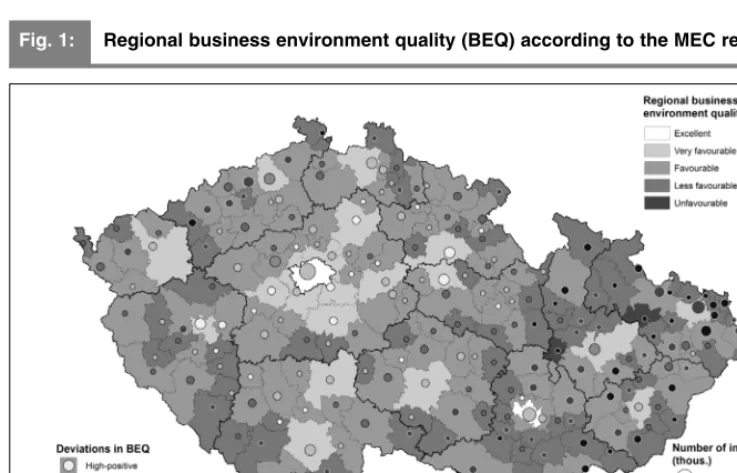
As regards the regional level, except for the specific Prague region, the differences among regions are not very considerable – the BEQ values range from +11 to -10% from the weighted average of these regions. Therefore, we have reached a strategically important conclusion that the issue of disparities pre-dominantly concerns the relation between Prague, or Prague together with the Stfiedo-ãesk˘ region (in the case of this “natural” region, the combined BEQ value would be around 1.90), and remaining regions. That is why the differences between development poles seem to be more important (gateway effect). It should also be added that the BEQ value changes assessed using weights A between the examined periods 2001/2002 and 2006/2008 ranged only within +5% for Prague and -6% for the Olomouck˘ region. The spatial distribution of BEQ values displays the following regu-larities or basic tendencies:
macroregional level – deterioration of regional BEQ values in the direction from the west to the east (this corresponds to a similar tendency of GDP per capita, which is observed in all countries of the Visegrád Group: Czech Republic, Slovakia, Poland, Hungary);
regional level – deterioration of microregional BEQ values in the direction to regional boundaries in the sense of core-periphery theories (selectively modified by the historical development of urbanization); macroregional and regional levels – creation of a system of development axes of national and regional significance with comparatively higher BEQ in relation to the diffusion of positive effects (including the stimulation of business clusters creation), induced by development poles.
The listed regularities reflect general principles of spatial organization of social Tab. 2: Aggregate BEQ values
a Values for 2007.
b Prague is seat of the regional office. c The value is related to M. Boleslav.
systems, which have a logical consequence in the form of disparities in regional development. Reduction of these disparities is the main aim of a traditional regional policy. It is necessary to have a verified methodology for a correct iden-tification of disparities (in the practice intuitive or unilaterally oriented methods prevail). The results obtained allow us to accept the following conclusion: territorial disparities in regional development can be divided into the “inherited”
ones, that is disparities determined by the hierar-chical position of regions – their regulation would be contrary to the strong inertia of hierarchical structures and therefore inefficient – and “created” ones, that is disparities determined by the character of economic development of regions – their regulation is considered a socially justifiable application of the solidarity principle [29].
Fig. 1: Regional business environment quality (BEQ) according to the MEC regions
The common explanation framework of the following model components i.e. IPC and UHR is formed by processes of regions’ adaptation to global and regional tendencies in the development of economy, whose key factors are the ability to create innovation and maintain employment. Both the components are characterized by strong linear and nonlinear links to the development of the entrepreneurial sector in the system context of its structural adaptation. Due to certain troubles with availability of regional data, the methodological approach based on selected indicators of ex-plored processes was chosen for the interpre-tation of these components. The regional
evaluation of IPC component is based on eight representative indicators (mainly related to the share of innovation companies and types of innovation activities, further to expenditures and employment rate in the field of R&D, and also the space distribution of the most significant innovation companies) and UHR component on five representative indicators (mainly microregional series of unemployment and vacancy indicators and economic sensitivity indicators). However, it is necessary to note that a number of external factors affecting the development of both of these components are already comprised within BEQ factors.
The essential significance of the IPC component follows from the fact that the creation, adoption and transfer of innovation are generally considered, together with the development of science and research, the main processes affecting the existent and mainly the future competitiveness of regions and the corresponding indicators provide basic infor-mation on the development of knowledge economy. From a theoretical perspective, we have to note that the creation of innovation disrupts the process of automatic balancing of the market which is one of basic postulates of the neoclassical theory. To evaluate the component we used the following information sources: survey of the Czech Statistical Office on innovations in the entrepreneurial sector in 2004–2006 – about 8,500 companies included [5], survey on science and research in 2004–2006 [4] – all companies performing R&D included, and our own survey based on the database of the Association for Innovative Entrepreneurship and annual reports of companies, with data
harmonized as of the end of 2007 – about 1,500 companies included. The advantage of surveys on innovations is their standardization within the entire EU by means of the harmonized CIS questionnaire. The disadvantages include a degree of subjectivity, and in the case of the Czech Republic also the fact that the survey from 2004–2006 is the last one by now which provides information up to the level of NUTS 3 regions. A strategically important finding is the fact that in contrast to non-innovative companies, technically innovative ones penetrate interna-tional markets much more easily (the correspon-ding ratio at international, national and regional markets was 0.5 : 1 : 0.6 for the former in contrast to 0.3 : 0.8 : 1 for the latter), and innovation capabilities increase with the size of companies and their internationalization. It follows the dominating orientation of Czech companies towards innovations of lower levels, as proved by the fact that only a third of expenditures on technical innovations go to R&D (the proportion of technologically demanding
Tab. 3: Selected indicators of IPC
a TNE – total number of employees. Source: Czech Statistical Office.
20.3 23.4
17.9 20.7
18.3 20.8
18.9 22.2
14.0 17.1
16.6 20.5
17.1 24.3
17.2 21.3
20.0 19.2
13.7 19.3
21.9 23.3
17.4 23.7
21.1 25.3
15.2 20.0
industry and services in the Czech Republic is about 20%). This is also connected to a relatively low level of the exertion of intellectual property rights – however, using the indicator of the number of patents per capita for a regional comparison of Visegrád countries is disputable as most transnational corporations (TNC) file patents in the place of their headquarters, not in the place where the invention was made.
According to the evaluation results (see Tab. 3), the highest degree of the component is reached by Prague, followed by the Stfiedo-ãesk˘ region and the Jihomoravsk˘ region – this is also reflected by their high migration attractiveness for college graduates. At the other end of the scale, there are the Karlo-varsk˘, Ústeck˘ and Vysoãina regions. Further analyses prove that the most significant innovation centres with more than five thousand employees in localised innovative companies are agglomerations of regional capitals (except for â. Budûjovice, Ústí n. L., H. Králové and K. Vary, which belongs to the second group). The analyses have also identified innovation zones organized in bands; two out of the four most significant zones are located in regions with a worse BEQ. It is also a fact verified in practice that in small microregions industrial innovative companies are the more important bearers of knowledge capital. Although an above-average level of BEQ is associated with a higher competition forcing companies to implement technical and nontechnical innovations with positive effects on competitiveness, its relations to the IPC components at the regional level are not completely straightforward – a strong correlation of IPC with BEQ (and also GDP) was found especially for the indicator of proportion of employees in R&D in the total number of employees. However, at microregional level we confirmed an obvious dependence between the BEQ and the presence of larger innovative companies.
The significance of the UHR component mainly follows from the socially sensitive issue of unemployment, whose solution is considered an important part of the solidarity principle application. Therefore, the selected UHR indicators can be understood as indicators of social impacts of regional economic adaptation processes. The most accurate expression of this adaptation is the development of unemployment rate, which in relation to creation of new jobs
knowledge economy, it is necessary to maintain the dynamic balance between the supply of vacancies and the quality of workforce as one of the key prerequisites of the regional efficiency of education system.
The final stage of the model application focuses on the general evaluation of development potentials of regions based on the synthesis of BEQ (key component with a double level of significance), UHR and IPC. The obtained results allowed us to identify regions with an excellent position – type A, regions with a good position – type B and regions with a less favourable position – type C (see Tab. 4). As expected, the highest development potentials have Prague and the Stfiedoãesk˘ region. This also corresponds to the results of the latest
ranking of knowledge regions according to which Prague was in the 37th to 40th position within NUTS 2 EU regions in 2005–2007 – the best position from V4 countries [3]. The weaker position of the six regions of C type indicates significant future risks for the regional development. In this context it is interesting that the number of inhabitants in these regions fell by 0.5% between the censuses of 2001 and 2011 (from +1.9% in the Karlovarsk˘ region to -2.3% in the Moravskoslezsk˘ region). On the other hand, regions of B type manifested increase by 2.5% (from 0.9% in the Králové-hradeck˘ region to 4.4% in the PlzeÀsk˘ region) and regions of A type a significant increase by 11% (from 8.9% in Prague to 13.6% in the Stfiedoãesk˘ region).
Tab. 4: Total evaluation of development potentials
The information capacity of the model was primarily verified based on the hypothesis that the BEQ level is strongly related to the GDP as the main indicator of developmental differen-tiation. The validity of this hypothesis was confirmed for the NUTS 3 level for which GDP data is available. The mean correlation coefficient for the explored period of 2006–2008 was, despite the limited selection used for BEQ evaluation, 0.95 (0.90 when the Prague region and the Stfiedoãesk˘ region are combined), and the logical link between conditions for business and results of business was thus confirmed. The development of regional GDP per capita in PPS has shown long-term slightly divergent tendencies with an indication of the west-east gradient reduction during the economic boom, i.e. 2001 to 2007. Based on the power regression function (individual types of regression functions were assessed with respect to the optimum progress of curve) of the dependence between BEQ and the population size of microregions the second hypothesis that the BEQ values strongly correspond to their sizes as the basic measures of their hierarchical position has been confirmed as well. The average values of BEQ according to size groups of microregions with 180 and more, 90–179, 45–89, 18–44 and less than 8 thousand inhabitants are 1.68, 2.51, 2.97, 3.51 and 3.84. It has to be noted that the power regression function best captures the regularities in the size distribution of towns referred to as rank-size rule [21]. This fact has also been proved by our analysis, in The overall consistency of the model is confirmed by statistical relations of microregional values of BEQ with the other two components – location of innovation companies (correlation coefficient 0.62) and unemployment rate (correlation coefficient -0.63). Inclusion of the model into the general framework of economic growth theories based on the production function can be demonstrated using the following expression:
Yr= A [A1, A2] . f (I, L, K) (2)
Where:
Yr– level of regional output
A – general variable with components A1, the macroeconomic (territorially free) and A2, the regional (territorially bound) factors of economic development
I – knowledge (innovations) L – labour
K – capital.
In this context, the BEQ component is a part of the general variable A (factor A2) and the remaining two components IPC and UHR represent a sum regional reflection of endo-genous factors I and L (factor K is in agreement with economic theory considered as a result of the production process).This approach corresponds to the idea that besides natural resources, capital deepening, increases in human capital and technological progress, agglomeration economies can be considered a specific source of economic growth.
4. Generalization and
sources and expands limits of production capabilities of companies with adequate impacts on IPC and UHR. The complex synthesis allows us to create the first spatial
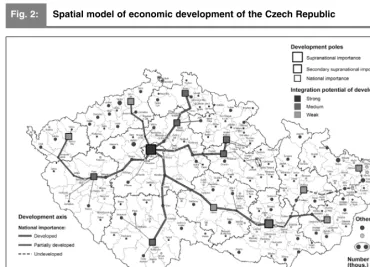
model of the economic development of the Czech Republic (see Fig. 3), whose foundation stones are 14 poles and 8 developed axes of national significance.
Fig. 2: Spatial model of economic development of the Czech Republic
Although the origination and dynamics of the development poles are mainly results of the historical development and influence of market mechanisms (attempts at an initiation of new development poles were usually unsuccessful), creation of development axes represents an excellent opportunity for an effective orientation of regional policy as the spread of positive effects from development poles contributes to both decreasing regional disparities and increasing regional competitiveness. The most important integration processes are further specified using the bottom-up approach (see Tab. 5).
Microregional level is represented by nodal regions (which can be identified with MEC regions) with the polarity of centre – hinterland, integrated by nodal processes. The most
significant of these processes is commuting to work; therefore, the integration process is closely associated with creating regional labour markets. Most of commuting takes place at this hierarchical level – correspondingly, this process can be seen as integration on the basis of labour interactions. An uneven economic development leads to the subordination of weaker nodal centres to their stronger competitors; therefore, we can divide these centres to the authentic and the subordinate ones. At the regional level, there is the polarity of the regional centre (development pole) – subordinate microre-gions. The economic subordination depends on the dynamics of growth in development poles, overall subordination increases with a higher political and administrative function of centres.
Note: Integration potential of development poles reflects their position in system of development axes and also the results of socio-geographical regionalisation [12].
In contrast to the prevailing opinion, in most countries local economy represented by SMEs maintains about 2/3 share in the creation of added value, therefore, we can assume that most production interactions of companies are performed at regional and national level. The most important integration process is the spread of positive effects from development poles along development axes of national significance, involving supplier-customer relation-ships forming a natural basis of business clusters (spread of negative effects on the contrary supports disintegration of regions) – integration on the basis of production interactions. We also have to add that the development of territorial distribution of labour in the conditions of global economy leads to an overlapping of horizontal and vertical production interactions, induced mainly by the application of specific schemes of value chains within TNC. The macroregional level differs from the previous one by a concentration of central political and administrative functions into the macroregional centre, which transforms the polarity into the
usual form of the capital city (the most significant development pole) – subordinate mesoregions. Concentration of political power also stimulates the concentration of managerial functions in entrepreneurial sectors, which consequently strengthens processes of economic integration – integration on the basis of the highest managerial interactions. The highest level of economic integration is global integration with the polarity of development poles of global significance (e.g. London) versus subordinate macroregions. These main global development poles are further supplemented by auxiliary development poles of partial global significance (e.g. Frankfurt a. M.). Here, the integration process is carried out on the basis of commercial relationships and its essential geopolitical manifestation is the creation of supranational economic organisations – integration on the basis of commercial interactions. Both the above-mentioned hierarchical levels play a determining role in the creation of an institutional environment of particular countries.
Tab. 5: Basic determinants of space organisation of economy
Source: Authors’ research.
The results provide potential users with information about the effect of relevant factors and processes determining the development of regions which allow them to evaluate the development potential of regions and to diagnose their strengths, weaknesses, opportu-nities and threats. From the perspective of the private sector, the principal use is for investment decisions (see website eCBA http:// online.ecba.cz/podnikatelskeprostredi/default.aspx,
a long-term concept of a regional policy of the Czech Republic.
Due to the unpredictability of economic development we chose the method of flexible development scenarios as the primary tool for regional policy conceptualization. These scenarios are based on the evaluation of development potential and perception of their demanded development and relate to the NUTS 3 level as the basic spatial framework of regional policy application. Altogether three development scenarios were designed: a progressive scenario, a growth scenario and an adaptation scenario. The main objective of the first scenario (regions A) is enhancement of quality of regional development with an emphasis on the development of knowledge economy. In agreement with the high potential of response to global stimuli, the implementation of this scenario is based on an effective use of strengths and opportunities by entrepreneurial entities. The growth scenario is suitable for less developed regions with favourable development potentials (regions B) and its main objective is improvement of quality of economic growth. A typical feature is orientation towards the use of opportunities in combination with the activation of strengths and elimination of weaknesses (the role of public interventions is significant). The main objective of the adaptation scenario (regions C) is strengthening of the competitive position, with an emphasis on diversification and reduction of the unem-ployment rate. Its typical feature is suppressing of threats in combination with eliminating weaknesses and activating strengths and using opportunities (role of public interventions is highly significant).
Application of the scenarios makes use of a flexible set of tools and their synchronization with appropriate programs of EU. The flexible approach means that the allocation of particular tools reflects different priorities of created scenarios (matter-of-fact correspondence) and the related system of selecting measures reflects the basic territorial framework of their potential development impacts (territorial correspon-dence). For regions A the main priority is enhancement of IPC and a secondary priority is improvement of BEQ (with an emphasis on quality of life); for regions B the main priorities are improvement of BEQ and enhancement of IPC and a secondary priority is improvement of
UHR; for regions C the main priority is improvement of BEQ and UHR and a secon-dary priority is enhancement of IPC. Each of these proposed priorities can be matched with adequate measures, regarding e.g. the improvement of entrepreneurial or knowledge base in the case of BEQ (e.g. industrial zones projects) and in the case of IPC and UHR mainly support for education and creation of innovations or creation of new labour positions and workforce requalification. In harmony with the results application those measures which contribute to the development of integration processes should be preferred – especially support for the development axes of national/ /supranational and regional significance including business clusters, which are understood as a dynamic part of this processes. An identifi-cation of the function of the particular hierarchic levels allows for defining the optimum territorial framework for an assessment of potential impacts of specific measures or projects. For measures related to the UHR component, this framework is the microregional level; for measures related to the BEQ component, it is the regional level; and for measures related to the IPC component it is the macroregional level. The definitive form of the regional policy can only be elaborated after a consensus among the main stakeholders. In this context, we have to emphasise that efficiency of its implementation is, besides creativity and entrepreneurial spirit of support receivers, considerably determined by the quality of institutional environment. It is also necessary to mention the indisputable fact that a significant condition for the permanent enhancement of regional policy efficiency is removal of relevant information deficits. In this respect we reach a positive conclusion that the elaborated model is transferrable, especially to be applied in more developed countries with polycentric settlement structure and a relevant tradition of regional policy.
References
[3] COLOMBELLI, A., FODDI, M., PACI, R. The
knowledge regions in the enlarged Europe. Working Paper. Cagliari: CRENoS, University of
Cagliari and Sassari, 2011.
[4] âSÚ. Vûda a v˘zkum v regionálním pohledu. Praha: âesk˘ statistick˘ úfiad, 2007.
[5] âSÚ. Inovaãní aktivity podnikÛ v âeské
republice v letech 2004-2006. Praha: âesk˘
statistick˘ úfiad, 2008.
[6] EUROPEAN COMMISSION REGIONAL DEVELOPMENT STUDIES. The Impact of the
Development of the Countries of Central and Eastern Europe on the Community Territory.
Luxembourg: European Communities, 1996. ISBN 92-826-8802-X.
[7] EUROPEAN COMMISSION, CAMBRIDGE ECONOMETRICS. Aggregate and Regional Impact – Regional Growth and Convergence.
Luxembourg: European Communities, 1997. ISBN 92-827-8806-7.
[8] EUROPEAN COMMISSION. Sixth Periodic
Report on the Social and Economic Situation and Development of Regions in the European Union.
Brussels: European Communities, 1999. [9] EUROPEAN COMMISSION. European Union
Foreign Direct Investment Yearbook. Luxembourg:
European Communities, 2001. ISBN 92-894-0644-5. [10] HÄGERSTRAND, T. Space, time and human conditions. In: KARLQVIST, A., LUNDQVIST, L. and SNIKARS, F. (eds.). Dynamic allocation of
urban space. Farnborough: Saxon House, 1975.
ISBN 978-0347010528.
[11] HAMPL, M. Teorie strukturální a v˘vojové organizace geografick˘ch systémÛ: principy a problémy. Studia geographica. 1988, Iss. 93, pp. 1-78. ISSN 0587-1247.
[12] HAMPL, M. Geografická organizace spoleãnosti
v âeské republice: transformaãní procesy a jejich obecn˘ kontext. Praha: Karlova univerzita, 2005.
ISBN 80-86746-02-X.
[13] HIRSCHMAN, A. The Strategy of Economic
Development. New Haven: Yale University Press,
1958. ISBN 0813374197.
[14] CHRISTALLER, W. Die zentralen Orte in
Süddeutschland. Jena: Gustaf Fischer, 1933.
[15] ISARD, W. Introduction to Regional Science. New York: Prentice-Hall, 1975. ISBN 0134938410. [16] KLAASSEN, l. Exercises in Spatial Thinking:
Case Studies of Regional Development Issues.
Aldershot: Avebury Grower Company, 1988. ISBN 0566057107.
[17] KRUGMAN, P. Geography and Trade. Cambridge: MIT Press, 1991. ISBN 02620111594. [18] LUCAS, R. On the mechanics of economic development. Journal of Monetary Economics. 1988, Vol. 22, Iss. 1, pp. 3-42. ISSN 0304-3932. [19] LUNDVALL, B. National systems of innovation:
towards a theory of innovation and interactive learning. London: Pinter, 1992. ISBN 1843318660.
[20] MASSEY, D. A Critical Evaluation of Industrial--Location Theory. In: HAMILTON, F., LINGE, G. (eds.). Spatial Analysis, Industry and the Industry
Environment. New York: Wiley, 1979. ISBN
0471997382.
[21] MCCANN, P. Urban and Regional Economics. Oxford: Oxford University Press, 2001. ISBN 978-0-19-877645-1.
[22] MYRDAL, G. Economic Theory and
Under-developed Regions. London: Duckworth, 1957.
[23] NETHERLANDS ECONOMIC INSTITUTE in co-operation with Ernst & Young. New Location
Factors for Mobile Investment in Europe.
Brussels--Luxembourg: Office for Official Publications of European Communities, 1993. ISBN 9282658597. [24] PERROUX, F. Note sur la notion de pole de croissance. Economique Applique. 1955, Iss. 1-2, pp. 307-320.
[25] POMERY, Ch. Zpráva o zahraniãních investicích ve v˘robním sektoru âeské republiky.
Praha: CzechInvest, 1998.
[26] PORTER, M. Competitive Advantage, Agglomeration Economies and Regional Policy.
International Regional Science Review. 1996, ã. 1,
s. 85-94. ISSN 0160-0176.
[27] ROMER, P. Increasing Returns and Long-Run Growth. Journal of Political Economy. 1986, Vol. 94, Iss. 5, pp. 1002-1037. ISSN 0022-3808. [28] SOLOW, R. A contribution to the theory of economic growth. Quarterly Journal of Economics. 1956, Vol. 70, Iss. 1, pp. 65-94. ISSN 0033-5533. [29] VITURKA, M. Regionální disparity a jejich hodnocení v kontextu regionální politiky.
Geografie. 2012, Vol. 115, Iss. 2, pp. 131-143.
ISSN 1212-0014.
doc. RNDr. Milan Viturka, CSc.
Masaryk University Faculty of Economics and Administration Department of Regional Economics
Abstract
INTEGRATIVE MODEL FOR EVALUATION OF DEVELOPMENT POTENTIALS
OF REGIONS AND ITS APPLICATION ON AN EXAMPLE OF THE CZECH
REPUBLIC
Milan Viturka
The aim of this paper is to introduce a new model for the evaluation of development potentials of regions, including methodology, application and conceptualization of the obtained information. The main components of this model are the business environment quality, innovation potential of companies and use of human resources, interpreted using relevant factors or indicators. The model has been applied to the evaluation of Czech regions – 205 administrative districts (microregional level) and 14 NUTS 3 regions (mesoregional level). Information capacity of the model has been proved by the confirmation of the hypotheses assuming strong relationships among business environment quality and regional GDP and population size of regions. A synthesis allowed us to define the main regularities, evaluate the competitive positions of regions and create the spatial model of the economic development of the Czech Republic. Special attention has been given to the unique method for the identification of territorial systems of poles and axes of development and further to the hierarchy of integration processes (using the profile interaction method). Subsequently, we conceptualized the results from the perspective of regional policy creation using the method of development scenarios. This allows for a flexible optimization of the main priorities and tools of a regional policy (regions are defined and territorially specified by means of flexible sets of relevant measures). From a theoretical perspective, we extend the knowledge about the processes of polarization and integration as key manifestations of the principles of developmental and hierarchical differentiation of society in the conditions of increasing globalisation.
Key Words: Regional development, business environment, innovation potential, human
resources, competitiveness.
JEL Classification: R12, R15, R58.