THE IMPORTANCE OF FORECASTING IN THE PROCESS OF
DEVELOPING A NEW POSTAL SERVICE
Jelena Milutinović1, Valentina Radojičić2 1ICT College of Vocational Studies, Belgrade, Serbia
2University of Belgrade, Faculty of Transport and Traffic Engineering, Belgrade, Serbia
Received 6 September 2016; accepted 17 October 2016
Abstract: This paper presents a modification to the standard Bass Diffusion Model applied to new services along with an analysis of different aspects which influence the parameters essential for defining a product’s life cycle. An analysis of the potential application of the modified model – a model with gradual market potential growth in which the successive introduction of service alters both territorial coverage and new service availability – has been conducted on a sample of two financial services offered by the PE Post of Serbia (a new service – international postal money order, and an existing service – Western Union money order). Due to confidentiality of the data owned by the operator, a quantitative parameter which estimates market potential for the new service is not available. However, a detailed analysis of various influential factors (infrastructure, social environment, migrations, and demographical and psychographic population characteristics) is provided, while the parameters which define the rapidity of the acceptance of the new service and its later growth have been calculated using comparison with the existing service. Various forecast models have been gaining significance concerning business decision making and gaining competitive advantage. For this reason, the authors tried to provide directions for diffusion model implementation in postal traffic and to emphasize its applicability and significance, for both the abovementioned financial services and other types of services offered by postal operators.
Keywords: forecast, Bass Diffusion Model, postal financial services.
1 Corresponding author: [email protected]
1. Introduction
The postal sector is of general social and economic importance. The future of the development of this sector should be marked by interconnection and cooperation between operators, investment into IT and physical infrastructure and improvement of coordination between post offices, carriers, and other interested parties. By implementing new technological solutions a
certain level of adjustability to the changing number of services and new demands and requests from clients is achieved.
planning, the organization chooses goals and manners of achieving them. As a part of planning, forecast has a key role, because through this process, organizations are offered the possibility to adjust to changes before they actually happen, instead of facing the changes unready. Forecasting is a process of predicting future needs by using mathematical methods and expert assessment. Most forecast methods are based on the assumption that the future will be a reproduction of the past (Radojicic et al., 2013).
When forecasting new services, the main problem is a lack of historical data, which makes all methods useless, with the exception of the diffusion model which is used for presenting the rapidity of implementing innovative services to a market in phases, and is graphically presented with an S-curve. The diffusion, through certain channels, realizes communication between members of the social system. The Bass Diffusion Model was the first diffusion model to be applied in marketing and it describes the process of accepting a new service through interaction
between existing and potential clients. This paper will describe the process of implementing new services of Post of Serbia – an international postal money order and possible implications to the existing service – Western Union money order. Through successive implementation of the new service in different countries, the forecast of the new service has been analysed by a modification of the basic Bass Model – with changeable market potential where, depending on the infrastructure use, bilateral agreements made, social surrounding, demographical and psychographic characteristic of the societies in new territories, the territorial coverage and representation of the new service are changeable as well.
2. Financial Postal Services
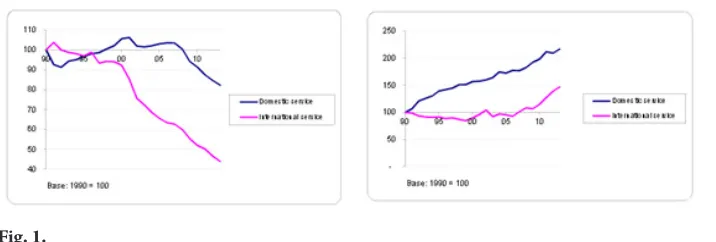
According to UPU (Universal Postal Union) statistics from 2013, it is clear that there had been a decrease in the letter transport, as well as an increase in parcel transport in domestic and international service, as presented in Figure 1.
Fig. 1.
Letters and Parcel Movement Trend
Source: http://www.upu.int/en/resources/postalstatistics/2013results.html
The postal operators’ management concept
organization and has led to a development of new offers – a combination of physical and e-services. At the same time, e-commerce has become a unique platform for financial and social inclusion, providing visibility and value to manufacturers and products which could not stand the competition on the traditional market. The postal sector, with its infrastructure – postal network, based on the principles of universality and availability, as well as traditional confidence appears as the bearer of the integration process of marginalized and discriminated groups into social and legal financial flows – women, young adults, the unemployed, the deprived, individuals with no steady income, individuals with low income, the elder, undereducated, migrants, individuals with special needs, the blind, and on the other hand legal entities – small and medium-sized enterprises for which it is not rational to develop their own logistic support. A supply chain which is organized through postal flows connects the place of manufacture with the place of consumption with a simultaneous information flow and money flow.
The postal sector can be competitive either as an independent financial institution or as an agent in cooperation with existing financial service providers, since the conditions of opening an account are less rigorous than in banks. Postal models vary2 – from pay
centres which enable their clients to take money orders to the ability to supplement e-wallets via mobile phones. Increased competition in this segment can only increase client satisfaction by lowering service prices, introducing innovations and increasing quality.
2 In some countries, post offices offer all financial services that banks do ( Japan); in Brazil the postal sector develops partnerships with financial institutions, and in Malawi posts rent their offices to commercial banks.
In USA, more than ¼ of households does not have a current or savings account; those households have an annual income of less than 25,500USD, so the banking sector does not view them as profitable clients. From 2008, as many as 93 per cent of shut-down branches used to be located in areas where annual incomes are lower than average. Thus, the traditional public operator’s duty to provide a universal service on the whole national territory under equal conditions for all clients could become a competitive advantage (USPS, 2014).
2.1. New Service of Post of Serbia –
International Postal Money Order
E l e c t r o n i c p o s t a l s e r v i c e s a r e communicational services offered to clients through informational communicational technologies. The new service of Post of Serbia is an international postal money order which enables a quick, simple, and safe money transfer with France, Belarus, Russia, Ukraine, Montenegro, Bosnia and Herzegovina and the Republic of Srpska, Croatia, and as of lately, Portugal. The gradual introduction of groups of countries (October 2014, June 2015, October 2015) results in better segmentation, and leaves plenty of time to analyse previous data and rationally and effectively define access points – post offices which provide this service. Until recently, electronic money transfers in international postal transport could be conducted only via Western Union money orders with over two hundred countries worldwide, with the fact that this service is provided by several commercial banks in Serbia as well, while only Post of Serbia (1670 locations) offers the option of delivering the money to a client’s home address.
The project was launched in 2011 with the implementation of the software solution
International Financial System –IFS, developed by UPU, used for electronic data transfer with other postal administration offices – users of the system. Aside from allocating money between individuals, this service has gained importance in the development of e-commerce, as a good way of paying through a secure channel. In accordance with current acts and regulations, it is cheap and should be implemented to the remotest areas of the world. The IFS offers not only the ability to manage all phases of international money
transfer, but it also offers advanced functions which make international accounting easier. However, many postal administration offices are already equipped with an electronic system for processing money orders, so they are not interested in implementing a new electronic service (Berthaud, 2014). For now, 53 countries use IFS, and more than 30 are on the waiting list. The IFS includes mostly underdeveloped African and Asian countries; thus this platform is a way for them to connect with some of the more developed countries with whom they share a significant money flow due to migrations, through the process of social and financial inclusion, with the goal of connecting migrants to their families and legalizing the money flow. The set priorities of the UPU in simplifying the commerce procedures for micro, small, and medium-sized enterprises have defined certain standards and legal and financial frames which enable an undisturbed flow of parcels. This makes it possible to solve the problem of COD parcels and international e-commerce.
3. Developing the New Service
historical data, which makes all methods useless, with the exception of the diffusion model which is used for presenting the rapidity of implementing innovative services to a market in phases, and is graphically presented with an S-curve. The Bass Diffusion Model was the first diffusion model to be applied in marketing and it describes the process of accepting a new service through interaction between existing and potential clients (Lilien et al., 2007). The mathematical formula of the Bass Model is presented in the following equation (1):
(1) where:
N(t) – cumulative number of new users of a service, technology, or new product for the time t,
m – overall market size
p – parameter which represents the level of acceptance of a service or a product by innovators within a certain time frame,
q – parameter which represents the level of acceptance of a service or a product by imitators within a certain time frame. Bass describes the diffusion process as a result of two independent influences –
mass-media and Word-of-Mouth effect. The first effect refers to clients who are innovative, while the second one is based on the directed transfer of experience and is very influential because clients in general believe one another more than they believe advertisements and marketing messages from companies. However, negative WoM is more influential than the positive one (Velickovic et al., 2012).
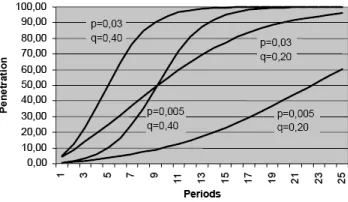
According to this model, the possibility of accepting a new service is a linear function of previous sales, and thus key coefficients are related to the characteristics of innovation (external inf luence) and imitation (internal inf luence). The innovation parameter represents the possibility of initial acceptance of a new technology, while the imitation parameter is the possibility of later acceptance of an innovation in society, which means that both innovators and imitators participate in accepting a new ser vice. Specific parameters crucial for modelling are p – which shows how quickly the service begins to be accepted and q – which shows how quickly the further growth takes place; thus, depending on the characteristics of the new product, parameters can change, and with them the shape of the curve (Figure 2).
Fig. 2.
The parameter m represents market potential and, depending on the service, it should be adequately estimated (overall population, number of households, market structure, level of competition, habits and attitudes of clients).
4. Modifications to the Basic Bass Model
The specificity of the postal transport service can best be shown in the fact that the future development of an altered service influences significantly the development of the current one – depending on the characteristics, it can, to some extent, upstage the current service or survive on the common market for some time or become a competitor. The new service takes up a part of the existing market, but it also brings new clients.
4.1. Substitution Models
The first significant paper concerning models which explain the connection between diffusion and substitution is that of Norton and Bass (1987), where emphasis is put on the mutual influence of generations and a potential market growth as a consequence of technological advancements, with the presumption that innovation and imitation parameters remain unchanged through generations. Norton and Bass (1987) claim that in all generations coefficients
p and q are constant for two reasons – in the context of the given technology, it could not be expected that the processes of adopting consecutive generations of a same technology will change drastically; the other reason is empirical – if the model fits well with this presumption, then it means that the presumption is justified. The model represents a simplification of reality, but parameters such as these do not make the forecast result much worse, so this
simplification is acceptable and applicable. According to this model, it is possible for clients of one generation to upgrade to a newer generation or to become clients of a service of the new generation without having previously used the service.
Speece and MacLachlan (1995) have applied the Norton and Bass model to an example of diffusion technology of three generations of milk containers with prices as model variables. It is important to note that the model puts emphasis on the fact that the technological substitution takes place by changing one generation in a moment in time, i.e. clients cannot skip the second generation and upgrade to the third one. An upgrade to the basic Norton and Bass model was given in the paper by Mahajan and Muller (1996). The model was applied through a unique methodology into a process of diffusion and substitution of four consecutive generations of IBM mainframe computers where there is an emphasis put on the importance of the time when the new technology is introduced as a key factor in the strategy of developing the new service. The model allows clients of any of the previous generations to “fast-forward” to the latest generation.
Bass and Bass (2001) offer a specific sales model according to which clients accept and exchange products of an older generation for the newer ones. Repeated purchases are motivated by better functionality and are related mostly to long-lived products. Another phenomenon, first mentioned by Goldenberg and Oreg (2007) is the fact that old technology can possess certain characteristics which are better than those in the newer technology (for a client who has a vinyl or audio-tape collection and does not want to start using CDs because, although he would get a more high-quality sound and compact supporting technology, he would have to renew his whole collection on a new sound carrier; same goes for photographers who have an adequate equipment which can be replaced by a digital camera, or taxi drivers when buying electronic automobiles). Knowing potential clients’ habits and characteristics and matching their requests to real characteristics of a new service helps service providers to efficiently plan their promotion strategy, so the limiting factor is not how well the product is known, as how well it matches clients’ needs.
4.2 The Bass Model Modification for
Competitive Market
W hen a competitive service/product appears on the market, it can lead to an expansion of the overall market potential for the given service, or it can slow down the diffusion because of the re-ordering of clients. According to the diffusion theory, an increase in the number of clients of a new service depends on experiences of previous clients, so an impression of an older service has a significant influence on how the new
one will be accepted. In a paper by Lilien and Yoon, (1990), the authors consider the optimal time to release a product on the market. As for the tactics, it is important to risk premature release, or possibly missing out on a business opportunity because of a late release.
In the paper by Krishnan et al. (2000), the authors test the existence of three products on the market, where the third product appeared on the market later. In general, if the release happens after some time, it can increase the overall market potential, increase the q parameter – make the diffusion process faster, or cause the combination of these two scenarios. A parameter k is introduced into the model. It determines whether the market potential will increase or decrease after the release of the third product and innovation and imitation parameters’ values are considered before and after the release, so by using this model, the service diffusion speed of each individual brand can be modelled and future changes can be foreseen.
4.3. Diffusion Model with Changeable
Market Potential
In the basic Bass model, parameter m
represents market potential, i.e. the number of potential clients. The model is based on the supposition that this value is constant,
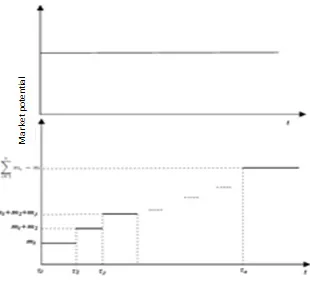
and it is determined for particular services by use of case studies and it can represent the overall number of people, number of households, or number of legal entities on a certain territory into which the service is to be released. However, it is sometimes impossible, for various reasons (legal aspect, physical limitations, financial limitations, infrastructure availability), to implement a service to the whole territory, and thus, the process of implementation takes place in phases or stages (Velickovic et al., 2012). Also, the number of potential clients can change due to significant migrations, change in service price, as well as the correlation with other services. The pace in which a territory becomes technically able to provide the service has a direct influence on the number of potential clients, so the parameter m should be viewed as a time-related variable, where each part of the territory has separate parameters, and the process of diffusion of the new communicational service should be viewed as an aggregate of successive diffusional processes in stages. Market potential is a time-dependent function as follows:
m(t)=
where τi are moments of successive implementation of the new service in certain countries. With each new country, new clients join the others according to the principle which is the same as with the original Bass model – innovators and imitators. Each joining of a new market should be viewed separately and it can have different innovation and imitation
Fig. 3.
Market Potential in the Bass Model and the Model with Changeable Potential Source: Velickovic and Radojicic, 2012
5. The Sociological Aspect
The acceptance of the new service can be viewed on a sociological level – group or individual level. Potential clients are exposed to information and they react by filtrating it through their personal perception, comparison to prev ious attitudes, experience, and thus the decision an individual makes is rational if it is in accordance with their attitudes and beliefs, i.e. if it is logical and consistent with previous behavior. They gather certain knowledge about the innovation, form an opinion on the information gathered and reach a decision – for or against.
From the service providers’ point of view, this decision-making process results in significant suspense, statistical errors, potentially wrong conclusions, so they focus on several key characteristics, specific attributes, which represent the basics for market segmentation, i.e. suitable marketing campaign.
Attitude towards the risk brought about by innovation, determines the decision-maker’s
attitude whether to accept the innovation or not, and it is connected with socio-economic characteristics, personal characteristics and attitudes. It has been empirically determined that there are different groups of clients according to this criteria, and Rogers (1976) divided them in the following groups: • I n n o v a t o r s – t h e y t a k e i n t o
consideration competitor’s advantages to their new technology in relation to existing alternatives and are ready to experiment; they assess the innovation and can demonstrate that the new technology works, i.e. satisfies clients’ needs adequately
• Early accepters – they have the ability to understand and appreciate potential advantages of new technologies • Early majority – “pragmatists” –
much of innovations until they are convinced by other people’s positive experiences
• Late majority – they often do not know about the new technology; they accept the service when it has already been on the market for some time, when the price is low, with little risk, and thus they prevent product expiration • Followers or skeptics – they emphasize
that the new technology does not live up to expectations; they point out the differences between the advertised product and the actual product, and are generally considered to be indifferent to technological enthusiasts and that they do not take into consideration experiences of pragmatists. They are also considered to be the majority which spreads the negative WoM.
In The Bass Model, the communication between individuals is constant for the whole population, but in social networks, interaction takes place through individuals who have various social roles. Mass media are important in the knowledge phase, and interpersonal channels are of key importance in persuasion during the decision-making process. Followers are mostly oriented towards direct inf luence, because it is believed that efficient communication is most likely to take place between two individuals who share the same attitudes, beliefs, which leads to mutual understanding, while communication between conflicting individuals can lead to disharmony, because messages received are not in harmony with personal values. Given these interpersonal communication patterns, it is evident that a few highly influential individuals who accept the innovation can represent a much more powerful critical mass than an equal
or higher number of individual with little influence (Datte et al., 2007.).
Financial experts believed that new financial services would be accepted as soon as they become available, but in reality, clients stuck to paper transactions for a long time – clients who have difficulties in accepting changes when an innovation is introduced before they are ready to accept it. Also, when the number of innovative alternatives is quickly multiplied, some clients can suffer from “innovation overload” and refuse to accept new technologies.
e-banking service diffusion is in finding an adequate way convince clients to accept different financial innovations.
By observing various technologies on different levels of complexity and various levels of clients’ sophistication, a study showed that new service providers should identify a certain level of knowledge for each service and develop their diffusion strategy accordingly. Clients’ age has a negative impact on accepting new services except when it requires less activity – a single signup as opposed to other services which require more engagement.
The clients’ decision-making process about using sew services and technologies can be impacted by marketing tools and influence every client experiences in their social
circles where the diffusion speed changes with the level of coincidences – the more heterogeneous a network is, the higher the diffusion speed (Watts and Strogatz, 1998). In a regular network, when one client has new information, it takes a long time to transfer it to other clients, while in completely random networks, clients are not grouped and information can reach ever yone quick ly. In middle-ground (small-world network) the network is still well-connected and information spreads quickly, so the penetration of new ideas in these networks is rapid – a client doesn’t feel social pressure if only a few people around him act a certain way, but when the number of these people rises, he suddenly decides to change his attitudes and behavior (Fig. 4.) (Granovetter, 1978).
Fig.4.
Network Evaluation – from Completely Regular to Random
Innovations appear more often and spread more rapidly in heterogeneous networks and on markets with diffusion in highly socially sensitive contexts, such as groups of young friends who carefully observe other peers (Delre et al., 2007.). Milgrim’s experiment called “six degrees of separation”3 has had a significant impact
3 Randomly chosen individuals from Omaha, NE were given identical letters without an address and they were all asked to send the letter to a certain stock market mediator in Boston, identified only by name, occupation and a roughly described position. This experiment showed that, on average, the number of required steps is six.
in scientific circles around the end of the 20th century. Scientists’ interest in the small-world phenomenon rose in 1998, when Duncan Watts and Steven Strogatz published their paper on social networks, where they reached a conclusion that any community, as well as human society, is in fact a social network. Watts and Strogatz (1998) also proved how important random acquaintances are for mutual connection in a community – if a target person is a loner with few acquaintances, they are much harder to reach, and that is a completely new result for the social network theory, because it introduces psychology into a purely mathematical area.
6. Forecasting the Development of a New
Service
Parameters needed for the Bass model are in the following relation:
(2) where stis the number of new clients in a
discrete moment t, and the cumulative number of clients Nt-l in the moment t-l is
(3)
while p, q, and m parameters are calculated by regression parameters a, b, and c and based on the system of equations:
(4)
and thus follows:
The suitable goal function is as follows: (5) so that the parameters are calculated through minimization conditions of the goal function; this results in a system of linear equations with three unknowns:
(6)
By solving these, we can calculate parameters
a, b, and c, and then also the Bass model parameters. To forecast the use of a new service – international money order, we can use the available data for the number of the existing service – WU money order, but in forecasting, it is important to make a difference between the number of sent and received money orders, i.e. users who received money and users who sent money to other countries.
Table 1
The Number of Received Western Union Money Orders by Years (Post of Serbia)
Year 2009 2010 2011 2012 2013
Number of clients 79924 144440 201810 251223 333380
By solving the system of equations we can determine regression parameters: a=0.0922727;
b=0,501291; c=-0.02242, which we can use to
determine diffusion parameters p=0,03834 and
q=0,539631, where the m parameter – market potential, is determined separately.
Table 2
The number of Sent Western Union Money Orders by Years (Post of Serbia)
Year 2009 2010 2011 2012 2013
Number of clients 5422 63883 89452 110467 126817
Source: Postal statistics, UPU, 2013
By solving the system of equations, we can determine diffusion parameters p=0,053 and
q=0,514, where the m parameter – market potential, is determined separately. In conclusion, for this type of Post of Serbia financial service there are around 4-5% innovators and around 50-55% imitators, so the results can be used for determining these parameters in a new service using analogy. In countries where the suitable infrastructure exists, given the quality of the new service which is similar to the quality of the previous one, but for a lower price, the new service can be viewed as a competitor. Given the currently low implementation of the IFS infrastructure, we can only talk about the WU market shrinkage to some extent. In order to exactly determine the new
m parameter, it is necessary to receive information from the operator about the number of money orders per country, which is not public information, but protected as a business secret. Also, the plan for further implementation of the new service is unavailable, which makes it difficult to observe the diffusion curve through time. For the abovementioned reasons, the authors did not determine the quantitative parameter m. instead, they provide a detailed analysis of the factors important to this parameter, in both the segment of received orders and the
segment of sent orders. The authors believe that the provided analysis can serve as a good basis to postal operators for forecasting development of new financial services, as well as other services.
The first step in a row towards a successful implementation of the new service is market research. In this case, there was no research, so the road to establishing the initial interest, need, and requirement of the new service is more difficult. It is important to divide the market in foreign countries according to the plan for new service implementation; for each country with which cooperation is planned or established, the level of marketing activity should be determined, and the territories should be segmented according to different parameters with various preferences to the new service (socio-economic, exploitation-technical etc.).
promotional campaign for this new service. The Post, as the provider of direct marketing services, has a grand opportunity to influence the rise of the innovation parameter through direct marketing by segmenting clients with the highest potential (e.g. areas with a large number of migrants – emigrants and immigrants).
When defining the influence of the new service on the old one, it is important to take significant changes into consideration, such as exchange services and providing WU services in certified exchange offices, kiosks, gas stations, supermarkets, which will have a significant influence on the shrinkage of the potential market.
According to the previous theory about interactions and social networks, an innovation should be accepted by a person of trust in the social network, thus creating a desire for further accepting of the innovation. The innovation should be implemented to the group of individuals who are ready to accept it and who will create a positive atmosphere for the next category of potential clients.
The successive method of implementing a service can be highly useful when observing weakness of the segments while exploiting on an applied territory, and thus, through correction, errors can be avoided on wider territories. So, in order to be able to establish market potential, we should, on one hand, be aware of migrations, and on the other, follow e-commerce flows. Countries with highest money order rates with Serbia are ex-SFRY countries, while, according to experiences with WU money orders, the amounts of money on those orders were
relatively low (for larger amounts of money banking systems are used), but the number of transactions is significant.
The number of potential clients on the
m(t) market has various constant values in certain time intervals (according to the successive introduction plan), where there is an assumption that the number of potential clients in each i area can be viewed as a constant mi value, where each territory is
characterized by pi, qi, mi parameters which
are determined independently.
Determining market potential depends on the overall population number, but due to the specificity of the new service it should be noted that not all households or household members have the same need for the new service.
The service should be divided into two segments – the forecast of the number of sent and received money orders because of the obvious difference in market potentials. The market potential for clients who wish to send their money can be determined as the number of households in Serbia, and not the number of people or adults, because usually only one person sends money from one household. According to data from the Statistical Office of the Republic of Serbia from the last census in 2011, the number is 2,487,886. Clients, usually immigrants, who are paying for certain services (e.g. accommodation in Montenegro) need to send money abroad.
are China (21.07%), Russian Federation (12.29%), Romania (9.37%), FYR Macedonia (6.90%), Libya (4.20%), and Ukraine (4.30%).
By the end of 2012, 8,095 foreigners had received permission for temporary residence based on work. Among them, most were citizens of China (41.65%), then Russian Federation, Italy, FYR Macedonia, Romania, Greece, Bulgaria, Turkey and ex-SFRY countries.
According to data from NBS in 2013, the overall number of transactions for paying for goods and services on foreign websites was 1,454,790, with the overall value of 62 million Euros, i.e. 42.7EUR per transaction. According to data from the Statistical Office of the Republic of
Serbia, in 2013 55.8% of all households had internet access, while more than 2,500,000 people used internet every or almost every day, and 35.5% of all internet users used services of e-commerce.
When analyzing this data, the transactions with countries which signed the bilateral agreement of IFS transactions should be singled out, and the existing data could be a good basis for future market expansion planning for this service.
In order to determine the number of clients who would send money from abroad using the new service, it is important to be aware of emigration flows, as well as the number of people attending schools in Serbia. When determining the market, imprecise data could pose a large problem, as seen in Table 3.
Table 3
Differences in Data in the Parent Country and the Receiving Country in Which Emigrants Live
Data source Italy Hungary Germany The Netherlands Switzerland SwedenReceiving country
Serbian census 20428 5343 102799 6280 65751 14049
Receiving country statistics 61146 8389 591492 6645 212505 20741
Source: Special data processing from Census of Serbia in 2002, and Council of Europe (2006)
According to results from the last census, 313,411 citizens of the Republic of Serbia work/live abroad (4.20% of the overall population).They are located in Austria (70488 – 22,5%), Germany (55999 – 17,9%), Switzerland (41008 – 13,1%), Italy (23340 – 7,4), France (20231 – 6.5%), USA (13504 – 4.3%), Sweden (10925 – 3,5%), Canada (6226 – 2,0%), Russia (5983 – 1,9%), Hungary (5375 – 1,7%), The Netherlands (4189 – 1,3%), Australia (3760 – 1,2%), Greece (2048 – 0.7%), UK (3516 – 1,1%), former Yugoslav republics (19624 – 6,3%), other countries (19538 – 6,2%) and unknown (7657 – 2,4%).
(120,000 each). Around 207,000 individuals with Serbian origin live in Australia and New Zealand, and a significant number lives in Turkey, Croatia, Sweden, and Italy. There is unofficial information that 88% of Diaspora sends money to Serbia, 81% of them has real estate in Serbia, 63% return to Serbia when they retire, and over the last few years, Serbia received more than 12 billion Euros from Diaspora, which makes about 14% of the overall gross domestic income. In order to precisely determine the market potential in this service segment, it is important to determine the number of such transactions per country, and then conduct a wider market research about the motives for sending money and existing connections which is a good basis for planning the activation of other countries which could sign a significant IFS agreement.
According to available data a relatively low number of foreigners attend universities in Serbia. As many as 96.4% of the students are citizens of the Republic of Serbia. Most foreign students come from Bosnia and Herzegovina (4,797) and Montenegro (2,622). At the end of 2012, 1,041 foreigners
were temporarily staying in the Republic of Serbia for education. Most of these individuals were from Libya (34.77%), Algeria, Russia, FYR Macedonia, Croatia, Ukraine, Iraq, Greece, China, as well as non-aligned countries through the “World in Serbia” program.
The pace of the activation of the new service does not point to substitution, because the concept of sending money abroad based on the international money order has come to life between very few countries. It is expected that the new service will be a competition to the existing one and take up a part of the market (Fig. 5), and in order to determine the quantitative market potential m2, it is
required to know the market potential m1,
i.e. the part of the market which represents the changing of the number of clients of the existing service towards the countries where the new service has been developed. The market potential of the existing and the new service will be influenced by the new National Payment System Act, since it is expected that a part of the market should be taken up by other legal subjects (kiosks, exchange offices, shops etc.).
Fig. 5.
In order to reach the peak in the shortest time possible, certain factors should be present – advertising and marketing activity aimed towards clients who accept the service independently, without the influence of other clients. As was said before, the number of innovators could be influenced by the increase of the accessibility of the service which, thus, becomes available to a larger
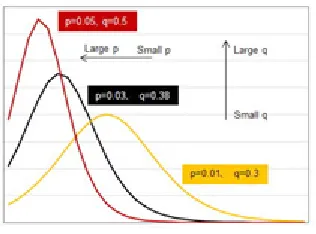
number of clients ready to accept it. Potential clients share their experiences with potential clients and receive information about the characteristics of the service and experiences about using it, which is most common on the Internet, through different social groups and social networks. This effect is presented by the q parameter, and the higher the q, the sharper the curve (fig. 6).
Fig. 6.
The S Curve Depending on the Value of p and q
Statistics show that the p parameter is always between 0.01 and 0.03, while the q
parameter is always between 0.3 and 0.5, with the average value being 0.38. According to the analogy with the existing service, it was found that p=0.03834 and q=0.539631 for received money orders and p=0.053 and q=0.514 for sent money orders. This data can be used for modeling, but with expert opinion, existing statistics analysis and implementation process management of the new service through management activity influencing vital factors, they can be corrected. If planning is detailed and the process segmented into phases with precise market analysis, one of the three forecasting scenarios can be expected. Other papers mostly offer the optimistic and pessimistic scenarios, as well as a realistic, most probable one, which is moderate and represents the movement of the curve
somewhere between the two extremes. In the optimistic scenario, for developing the new service with high parameters p (additional marketing activity – direct mail, flyers, advertisement, information given to clients while they utilize existing services) and q
should be aimed at a marketing campaign for countries which are to be a part of further service implementation, in order to avoid perceived weaknesses and missed business opportunities over the past period. By analyzing the market, countries with highest potential for bilateral cooperation should be determined by following migration flows, and
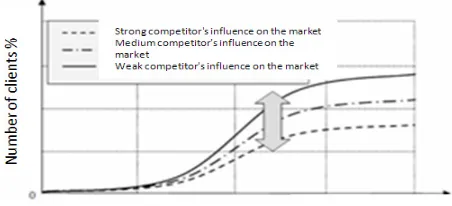
afterwards, the number of potential clients should be risen by aiming suitable marketing strategy at certain market segments. Realization of any of the three options will have an impact on the competitive service – WU by changing the market potential according to the planned implementation flow of the new service (Fig. 7).
Fig. 7.
Potential Number of Clients Depending on Competitive Service Influence
7. Business Data Analysis and New
Business Opportunities
The data gained is a good basis for planning work, capacity, and engagement of the workforce and resources. The new service of the Post of Serbia, ranked 461 in the public operator’s list, provides a good basis for developing e-commerce, as well as the concept of social and financial inclusion. Problems obser ved i n ot her posta l administrations – money misuse and laundering, can be an obstacle to monetary services development. USPS has been using GIS (Geographic Informational System) for following money flows since 2006, so each transaction is written down. Through different transactions, including money orders4, billions of dollars get allocated, so
4 In the USA money orders can be used to allocate up to 3000USD without identifying the client, and those funds can be collected anywhere in the country.
this is potentially a fertile ground for criminal groups to use it for laundering their illegal funds. In GIS, there is a way to mark post offices with a large number of suspicious transactions according to two criteria – frequency and amount, as well as transactions where a certain individual receives money from different parts of the country.
be observed which could not be discovered otherwise – instead of transaction lists, payment codes, address data, there are maps with graphical data presented in a clear and unambiguous way. Because of the good results in this segment, there are options for expanding the GIS field for following foreign currency cash flows, as well as for detection of frauds using debit cards in post offices (Office of Inspector General, USPS, 2014). The data base available to the postal system can be of vital importance for discovering data legalities using the data mining concept. This technique is used to discover significant hidden structures by means of various algorithms which can be used to find and single out unexpected information (relations between data, behavior patterns, correlations, trends), which are becoming the basis for market segmentation and creation of goal marketing strategy.
8. Conclusion
A revision of the universal service concept, service diversification, market segmentation with the goal of finding a pattern for defining new services which satisfy clients’ needs, utilizing new technologies through decision-making support systems are all parts of the planning process which, together with using data gained through forecasting, create a basis for reaching business-related decisions. Providing financial services to households with low and medium income, enabling commerce benefits to small and medium-sized enterprises and special services for individuals outside traditional banking flows represent a significant improvement for social and financial inclusion, i.e. cooperation and interconnection of postal networks in creating mutual standards and raising efficiency and efficacy.
The diffusion model can be very useful when estimating how a new product or service assimilates into the social system over time. The Bass Model provides answers to the question of how many clients will accept the new service, as well as when they would do it, which is a significant piece of information in the process of service implementation. Of course, when choosing parameters and creating analogies with previous products, it would be wise to take into consideration expert assessment about the possibility of creating parallels between the two processes – is it, and to what extent is it, better to apply analogy to similar markets or similar products. Sometimes, if the opportunity arises, multiple analogies can be drawn, and then the average value applicable to the new service should be estimated, or another methodology should be enforced (artificial intelligence) and compared to the results.
To sum up, forecasting is a significant phase in the development of new communicational services and the process of planning sustainability, i.e. validity of the offer. The development of the new service should be based on the market analysis which makes it possible to define activation plan order by certain areas. Aside from needs which are a vital condition, but not a sufficient one, it is important to define in which time period certain countries are interested in accepting and utilizing this service. Based on this, the plan should be revised and an emphasis should be put on areas with largest potential. The overall market potential of the new service, a competitor to the existing one by quality offered for a lower price, can significantly be affected by the National Payment System Act. Thus, all these factors, with exact data, have to be taken into consideration when analyzing service development and forecasting overall number of clients by areas.
References
Bass P. I.; Bass F. M. 2001. Diffusion of Technology Generations: A Model of Adoption and Repeat Sales Working Paper, In Proceedings of the Marketing Science Conference, Mainz, Germany. 29 p.
Berthaud, A. 2014. UPU, The impact of access to financial services, including by highlighting the impact on remittances on development: economic empowerment of women and youth, Panel session – Innovative business models and financial services, UNCTAD 2014, 20 p.
Comber, А.; Brunsdon, С.; Hardy, Ј.; Radburn, R.2009. Using a GIS-Based Network Analyses and Optimisation Routines to Evaluate Service Provision: A Case Study of the UK Post Office, Appl. Spatial Analysis and Policy
2(1): 47–64.
Dattée, B.; Weil, H. B. 2007. Dynamics of social factors in technological substitutions, Technological Forecasting & Social Change 74(5): 579–607.
Delre, S. A.; Jager, W.; Janssen, M. A. 2007. Diffusion dynamics in small-world networks with heterogeneous consumers, Computational and Mathematical Organization Theory 13(2): 185-202.
Erdős P.; Rényi A. 1959. On random graphs, I. Publicationes Mathematicae (Debrecen), 6: 290-297.
Goldenberg, J.; Oreg, S. 2007. Laggards in Disguise: Resistance to Adopt and the Leapfrogging Effect,
Technological Forecasting and Social Change 74(8): 1272-1281.
Granovetter, M. 1978. Threshold Models of Collective Behavior, American Journal of Sociology 83(6): 1420-1443.
Guseo, R.; Mortarino, C. 2012. Sequential market entries and competition modelling in multi-innovation diffusions, European Journal of Operational Research 216(3): 658-667.
Guseo, R.; Mortarino, C. 2014. Within-brand and cross-brand word-of-mouth for sequential multi-innovation diffusions, IMA Journal of Management Mathematics 25(3): 287-311.
Islam, T.; Meade, N. 1997. The Diffusion of Successive Generations of a Technology - A More General Model,
Technological Forecasting and Social Change: 56(1): 49-60.
Kalish, S.; Mahajan, V.; Muller, E. 1995. Waterfall and sprinkler new-product strategies in competitive global markets, International Journal of Research in Marketing, 12(2): 105-119.
Krishnan, T.; Bass, F.; Kumar, V. 2000. Impact of a Late Entrant on the Diffusion of a New Product/Service,
Lee, E.; Lee, J. 2000. Haven’t Adopted Electronic Financial Services Yet?, The Acceptance And Diffusion Of Electronic Banking Technologies, Financial Counseling and Planning 2(1): 49-60.
Lilien, G. L.; Yoon, E. 1990. The Timing of Competitive Market Entry: An Exploratory Study of New Industrial Products, Management Science 36(5):568-585.
Lilien, G. L.; Rangaswamy, A.; Bruyn, de B. 2007. The Bass Model: Marketing Engineering, Technical Note of the materials in Chapters 1, 2, and 7 of Principles of Marketing Engineering. Available from internet http://faculty.washington.edu/sundar/NPM/ BASS-Forecasting%20Model/Bass%20Model%20 Technical%20Note.pdf
Mahajan, V.; Sharma S.; Buzzell R. D. 1993. Assessing the impact of competitive entry on market expansion and incumbent sales, Journal of Marketing 57(3): 39-52.
Mahajan, V.; Muller, E. 1996. Timing, diffusional and substitution of successive generations of technological innovations: The IBM mainframe case, Technological Forecasting and Social Change 51(2): 109-132.
Norton, J. A.; Bass, F. M. 1987. A Diffusion Theory Model of Adoption and Substitution for Successive Generations of High-Technology Products, Management Science 33(9): 1069-1086.
Office of Inspector General, USPS, Providing Non ‐ Bank Financial Services for the Underserved, January 27, 2014. Available from internet: https://www.uspsoig. gov/sites/default/files/document-library-files/2015/ rarc-wp-14-007_0.pdf
Parker, P.; Gatignon H. 1994. Specifying Competitive Effects in Diffusion Models: An Empirical Analysis,
International Journal of Research in Marketing 11(1): 17–39.
Peterson, R.; Mahajan, V. 1978, Multi-Product Growth Models, Research in Marketing 1(20): 201-231.
Radojicic, V.; Bakmaz, B.; Velickovic, S. 2013. Forecasting new telecommunication services, University of Belgrade, Faculty of Transport and Traffic Engineering, Belgrade, 160 p.
Savin, S.; Terwiesch, C. 2005. Optimal product launch times in a duopoly: balancing life-cycle revenues with product cost, Operational Research 53 (1): 26-47.
Speece, M. W.; Maclachlan, D. L. 1995. Application of a multi-generation diffusion model to milk container technology, Technological Forecasting and Social Change
49 (3): 281-295.
Velickovic, S.; Radojicic, V. 2012. A new modification of the Bass model with gradual communicational network infrastructure development, The Thirtieth Symposium On Novel Technologies In Postal And Telecommunication Traffic 2012, Belgrade, 357-366 p.