Simulation Investigations of Structural, Electronic,
Optical and Elastic Properties of the Cu
x
Ti
1-x
O
2
Yasaman Abed1, Fatemeh Mostaghni2,*
1Physic Department, Payam Noor University, Iran 2Chemistry Department, Payam Noor University, Iran
Abstract
In this study, the electronic, optical and elastic properties of Cu-dopped TiO2 were theoretically investigated.The calculations have been performed using castep code in the framework of density functional theory with LDA and GGA approximations. Comparison between the experimental and the theoretical results indicates that the simulational method is able to provide satisfactory results for predicting the properties of the considered compounds. The best results were achieved by GGA+PBE approximation. It served as an additional proof of reliability of these theoretical findings and gave confidence in the results of the following calculations of the electronic, optical and elastic properties of Cu doped TiO2
semiconductor.
Keywords
Simulation, Electronic properties, Elastic constants, Semiconductor1. Introduction
Among the inorganic oxide semiconductors, titanium dioxide is highly noteworthy due to its chemical stability, non-toxicity and low cost [1-5]. It is used in a wide range of fields, including pigments, solar energy transfer, photocatalyst and so on. Titanium dioxide exists in three crystalline phases includes rutile (cubic), anatase (tetragonal) and brookite (orthorhombic). Rutile, is the most stable phase of titanium dioxide in bulk and environmental conditions.
It should be noted that the production of titanium dioxide, affects the final phase of production [6-10]. The mechanism of all its characteristics includes lighting the surface of titanium dioxide with energies greater than its band gap and exciting electrons from valance band to conducting band [11]. However, the use of titanium dioxide has been limited by two reasons [12]:
1- The band gap of titanium dioxide is in the ultraviolet (UV), while less than 10% of sunlight is in the ultraviolet region of the spectrum.
2- Rapid pairing of electron-hole which results in the loss of photo-catalytic activity.
In recent years, the number of ways to modify titanium dioxide with metals and non-metals and sensitization of titanium dioxide have been used [13-15].
Different investigations show that doping of TiO2 by low
amounts of metals and nonmetals elements, sometimes leads
* Corresponding author:
[email protected] (Fatemeh Mostaghni) Published online at http://journal.sapub.org/nn
Copyright © 2016 Scientific & Academic Publishing. All Rights Reserved
to enhanced photocatalytic activity and to an increase of visible light absorption [16, 17].
Producing solar cells based on titanium dioxide is the new generation of photo-volta cells that regarding its low cost have been proposed as an alternative to the solar cells [18]. In the area of solar energy, doping with Cu element significantly extends the light absorbtion of TiO2 into the
visible region, which further enhance the photoelectro chemical properties of the TiO2 [19].
The understanding of detailed electronic structure of semiconductors has been a challenging problem in electronics. Unfortunately, measurements of structure and electronic properties of crystals require a specified laboratory, as well as excellent quality materials, which is generally expensive. In contrast to experimental investigations, a theoretical analysis by computer simulations could overcome the effects of complex experimental factors and clarify the ion doping effects on crystal and electronic structure.
Quantum chemistry calculations of modifying the band gap of TiO2 have been reported, including studies of
transition metals co-doping of TiO2 photocatalysts [20-23].
Yalc et al. performed calculations based on density functional theory (DFT) to characterize the influence of Fe3+
doping on the electronic and structural properties of TiO2
[24]. Recently, first-principles calculations were conducted for Fe-doped TiO2 [25-28].
In our previous study we have performed a careful and systematic analysis of the cobalt impurity states in different concentrations as well as their influence on the TiO2 band
In this paper the electronic band structure, density of state, optical and elastic properties of Cupper doped TiO2
nanocomposite simulated using castep code. Castep employs the first-principles density functional theory that explore the properties of crystals and surfaces in materials, such as, semiconductors, ceramics, metals, minerals and zeolites.
2. Materials and Methods
All presented calculations were performed using a first principle plane wave pseudo-potential technique based on density functional theory with CASTEP module [30] of Materials Studio. Calculations are performed with either generalized gradient (GGA) or the local density approximation (LDA) to treat the exchange–correlation effects. [31]. To obtain the desired accuracy, we selected 973 points in 6 × 6 × 7 K_point. Computations for TiO2 crystal
are done in anatase phase (141/amd space group) with lattice constant a = b = 3.7834 and c = 9.4841. The structural data from ref. [32] were taken as an initial input for all calculations.
3. Results and Discussion
3.1. Electeronic PropertiesIn this study Cu dopant is substituted into anatase structure in Ti lattice site in various concentrations (0, 1 and 2%). Then the electronic structures and band parameters of three samples are obtained using either generalized gradient (GGA) or the local density approximation (LDA). From the above simulations, it is found that the band structure and density of states of three samples are nearly same from the LDA and GGA. The band gap values for all samples is determined from the band structures and density of state, by two methods. The results are summarized in table 1.
Table 1. The band gap (eV) values calculated by LDA and GGA methods
sample method
GGA LDA exp
TiO2 2.14 2.09 3.04
Cu/TiO2 (1%) 1.81 1.74 2.80
Cu/TiO2 (2%) 1.94 1.92 2.83
It can be observed that the values of bond gap complement the experimental findings and reported results. The best fittings between calculated and measured band gap were achieved by GGA aproximation. With this level, the deviations between calculated and experimental values are smaller than LDA methods. It serves as an additional proof of reliability of these theoretical findings and gives confidence in the results of the following calculations of the electronic, optical and elastic properties which presented in the next sections.
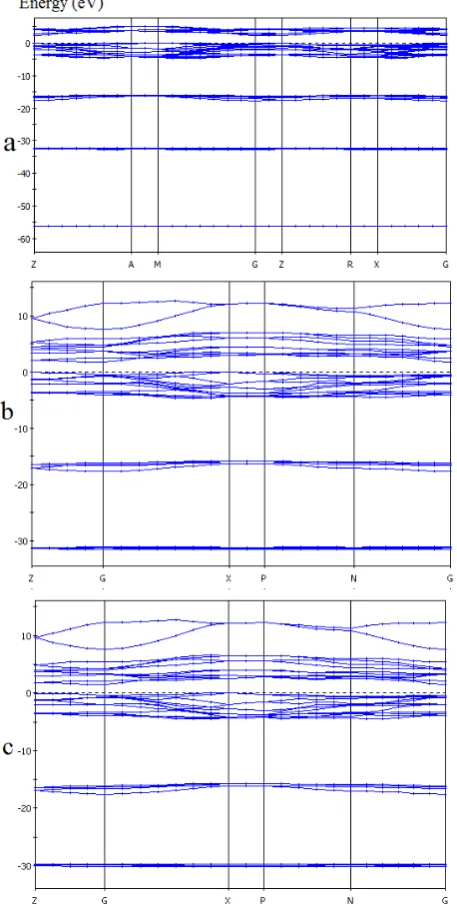
The calculated band structures of pure and Cu doped TiO2
are shown in figure 1. The fermi level is chosen to be zero of the energy scale. As we can see, the band structure of pure anatase TiO2 shows semiconducting behavior, because in
this case indirect energy band gap is 2.14 eV. It is less than the experimental value Eg = 3.04 eV. This underestimation is
an intrinsic feature of the density functional theory.
Figure 1a shows that the top of valence bands (VBs) appears to be relatively flat and the bottom of conduction bands (CBs) have small dispersion. Figure 1b and 1c shows the substitution of Cu dopant created impurity states in electronic band structure of anatase. The Cu introduced two lone pair states just above to the valence band maximum thus reduced the band gap of TiO2 with an optimal doping
concentration of 1 %.
Figure 1. Band structure and of CuxTi1-xO2 for (a) x= 0%, (b) 1% and (c) 2%
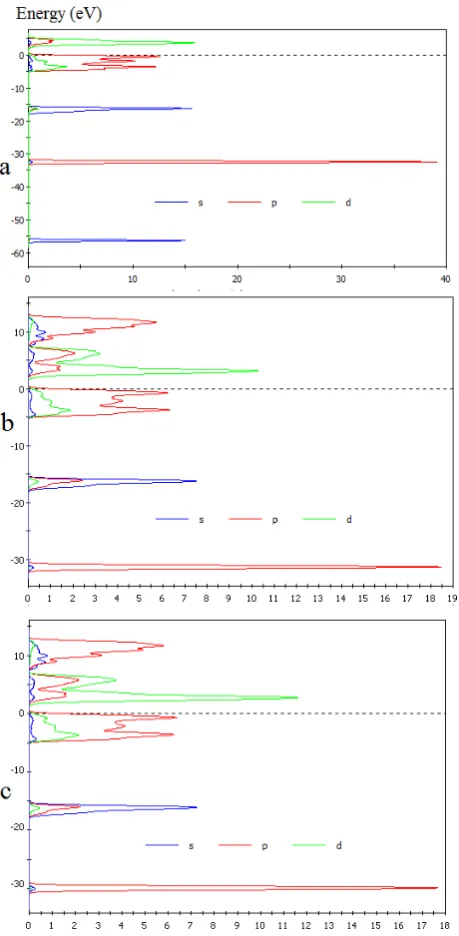
The DOS of pure and Cu doped TiO2 are also shown in
figure 2. In figure 2a, we can also clearly see the conduction bands, are mostly formed by Ti-4d state, with a contribution of the O-3p states. While the valance bands are mainly consist of the hybridizations of Ti-3d states and O-2p states. In figure 2b and 2c it can be observed that the source of energy is also located in the maximum capacity band with conductive bands on top where overlap exists in 3d titanium and 4d cupper in an area that represents the overlap of 3d titanium and 4d cupper orbitals.
Figure 2. Density of state of CuxTi1-xO2 for (a) x= 0%, (b) 1% and (c) 2%
in GGA method
3.2. Optical Properties
The optical properties of matter can be described through
the complex dielectric function ε(ω) as following [33]:
ε(ω) = ε1(ω) + iε2(ω)
Figure 3. The imaginary part of dielectric function for CuxTi1-xO2 for (a)
x= 0% , (b) 1% and (c) 2%
The imaginary part of the dielectric function ε2(ω) is
associated with the dissipation and as a consequence, it is responsible for the absorption. It is well known that the interaction of a photon with the electrons in the system can be defined in terms of time-dependent perturbations of the ground-state electronic states. If an incoming photon can couple a filled state to an empty state, there will be absorption. If there are a lot of photons which can couple these two states, there will be a big peak in the imaginary part of the dielectric function, because there will be more absorption.
elements between the occupied and the unoccupied electronic states and calculated directly by [34]:
Imϵαβ(ω) =m4π2eω22� � 〈Ck|Pα|ϑ
K〉
∞
0 cy
〈ϑk�Pβ�CK〉δ
(εck −εϑk−ω)dK
Where e is the electronic charge, Ck and υk are the
conduction and valance band wave function at k respectively, and ω is the light frequency.
The imaginary part calculations of the dielectric function for CuxTi1-xO2 for x = 0, 1 and 2% are shown in Figure 3.
We observe that the values of ε2(ω) for all the binary and
ternary alloys are naturally shifted towards lower energies with the amplitude increasing as increases Cu concentration. This confirm our results that the increase in Cu concentration causes a decrease in indirect band gap.
The real part of the dielectric function can be calculated by the Kramer-Kronig relation as bellow [35]:
Reϵαβ(ω) =δαβ+2πP� ωImεαβ(ώ) ́
ώ2−ω2
∞
0 dώ
where P is the Kooshy integral section.
The present results of calculated ε1(ω) are shown in Figure 3. An important quantity of ε1(ω) is the zero frequency limit ε1(0). It represents the dielectric response to the static electric
field, which is the electronic part of the static dielectric constant and strongly depends on the band gap.
In CuxTi1-xO2, value of ε1(0) increases from 6.14 to 10.37
and the direct band gap decreases With increasing the Cu concentration.
3.3. Elastic Properties
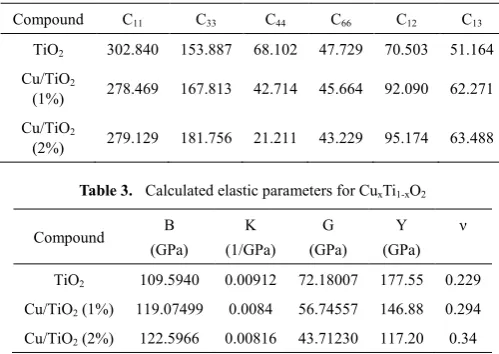
The elastic constants of solids provide a link between the mechanical and dynamical behaviours of crystals. In the present work, we performed systematic first-principles calculations of the elastic constants Cij (Table 2), bulk
moduli B, compressibility K, shear moduli G, Young’s moduli Y and the Poisson ratio v for CuxTi1-xO2 (Table 3).
Table 2. Calculated elastic Cij
Compound C11 C33 C44 C66 C12 C13
TiO2 302.840 153.887 68.102 47.729 70.503 51.164
Cu/TiO2
(1%) 278.469 167.813 42.714 45.664 92.090 62.271 Cu/TiO2
(2%) 279.129 181.756 21.211 43.229 95.174 63.488
Table 3. Calculated elastic parameters for CuxTi1-xO2
Compound B
(GPa) K (1/GPa) G (GPa) Y (GPa) ν
TiO2 109.5940 0.00912 72.18007 177.55 0.229
Cu/TiO2 (1%) 119.07499 0.0084 56.74557 146.88 0.294
Cu/TiO2 (2%) 122.5966 0.00816 43.71230 117.20 0.34
Values of E and σ are computed using the following relationships [36].
E =3B + G and 9BG σ=2(3B + G)3B−2G
The calculated six independent elastic coefficients for each doping level were found to be positive and satisfy the known born criterion for a mechanically stable system: (C11+
C33- 2C13) > 0 C11> 0, C33> 0, C44> 0, C66 > 0, [2(C11+ C12) +
C33+ 4C13] > 0 and (C11– C12) > 0). To define true
polycrystalline constants, the values for their upper and lower limits were given by Hill. He showed polycrystalline moduli in terms of voigt and reuss approximation, and are given by [37].
Hill’s shear modulus:
GH ≡G = 1/2(GR+ GV)
Hill’s bulk modulus:
BH ≡B = 1/2(BR+ BV)
Where BR and Bv are the reuss’s and voigt’s bulk modulus
and GR and Gv are the reuss’s and voigt’s shear modulus,
respectively.
From our calculations, it is found that the CuxTi1-xO2 is
stiffer than the pure anatase TiO2, because the balk modul of
Cu/TiO2 was bigger than pure TiO2. The Poisson's ratio (σ) takes the value: 0 < σ < ½. The lower limit and upper limit for central forces in solids are σ = 0.25 and σ = 0.5
respectively. The present calculated result showed that
poisson's ratio (σ) of TiO2 and CuxTi1-xO2 was larger than the lower limit value (σ = 0.25), which indicates that the
interatomic forces of CuxTi1-xO2 are central forces.
4. Conclusions
Calculations based on density functional theory have been carried out. The calculated values are in good agreement with experimental results and few conflicts are due to density function failure. The results show that by increasing Cu, the energy gap decreases and finally dielectric constant will increase which satisfy the corresponding experimental data result.
The Cu introduced two lone pair states just above to the valence band maximum. Therefore charge transfer (CT) processes from the TiO2 valence band to Cu(II) and from
Cu(II) to the conduction band Occur upon visible light. In other word Cu doping reduced the band gap of TiO2 with an
optimal doping concentration of 1 %. The best results were achieved by GGA+PBE approximation. In addition, it is found that the CuxTi1-xO2 is stiffer than the pure anatase TiO2,
because the balk modul of Cu/TiO2 was bigger than pure
TiO2. In the area of solar energy, doping with Cu element
that significantly extends the light absorbtion of TiO2 into
ACKNOWLEDGEMENTS
We would like to thank Fars Payam Noor University for their support and encouragements.
REFERENCES
[1] Colmenares, J. C., Aramendia, M. A., Marinas, A., Marinas, J. M., Urbano, F. J., 2006, Synthesis, Characterization and Photocatalytic Activity of Different Metal-Doped Titania Systems, Applied Catalysis A, 306, 120-127.
[2] Crisan, M., Braileanu, A., Raileanu, M., Zaharescu, M., Crisan, D., Dragan, N., Anastasescu, M., Ianculescu, A., Nitoi, I., Marinescu, V. E., Hodorogea, S. M., 2008, Sol-gel S-doped TiO2 materials for environmental protection, Journal
of Non-Crystalline Solids, 354, 705-711.
[3] Ding, X., An, T., Li, G., Zhang, S., Chen, J., Yuan, J., Zhao, H., Chen, H., Sheng, G., Fu, J., 2008, Preparation and characterization of hydrophobic TiO2 pillared clay: the effect
of acid hydrolysis catalyst and doped Pt amount on photocatalytic activity, Journal of Colloid and Interface Science, 320 (2), 501-507.
[4] Chen, S.L., Wang, A.J., Dai, C., Benziger, J.B., Liu, X.C. 2014, The Effect of Photonic Band Gap on the Photocatalytic Activity of nc-TiO2/SnO2 Photonic Crystal Composite
Membranes, Chemical Engineering Journal, 249(1), 48-53. [5] Kato, H, Kudo, A, 2002, Visible-Light-Response and
Photocatalytic Activities of TiO2 and SrTiO3 Photocatalysts
Codoped with Antimony and Chromium. Journal of Physical Chemistry B, 106(19), 5029-5034.
[6] Mali, S.S., Betty, C.A., Bhosale, P.N., Patil, P.S., Hong, C.K. 2014, From Nanocorals to Nanorods to Nanoflowers Nanoarchitecture for Efficient Dye-sensitized Solar Cells at Relatively Low Film Thickness: All Hydrothermal Process, Scientific Reports, 4,1-8.
[7] Gao, Y., Masuda, Y., Seo, W.S., Ohta, H., Koumoto, K., 2004, TiO2 nanoparticles prepared using an aqueous peroxotitanate
solution, Ceramics International, 30, 1365-1368.
[8] Wu, M.C. Sápi, A., Avila, A., Szabó, M., Hiltunen, J., Huuhtanen, M., Tóth, G., Kukovecz, A., Kónya, A., Keiski, R., Su, W.F., Jantunen, H., Kordás, K., 2011, Enhanced photocatalytic activity of TiO2 nanofibers and their flexible
composite films: Decomposition of organic dyes and efficient H2 generation from ethanol-water mixtures, Nano Research, 4(4), 360-369.
[9] Yang, J., Mei, S., Ferreira, J.M.F., 2001, Hydrothermal synthesis of TiO2 nanopowders from tetraalkylammonium
hydroxide peptized sols, Materials Science and Engineering C, 15, 183-185.
[10] Yang, S., Liu, Y., Guo, Y., 2002, Preparation of rutile titania nanocrystals by liquid method at room temperature, Materials Chemistry and Physics, 77, 501-506.
[11] Bak, T., Li, W., Nowotny, J., Atanacio, A.J., Davis, J., 2015, Photocatalytic Properties of TiO2: Evidence of the Key Role
of Surface Active Sites in Water Oxidation, Journal of Physical Chemistry A, 119(36), 9465–9473.
[12] Pelaez, M., Nolan, N., Pillai, S., Seery, M., Falaras, P., Kontos, A., Dunlop, P., Hamilton, J., Byrne, J., Oshea, K., 2012, A review on the visible light active titanium dioxide photocatalysts for environmental applications, Applied Catalysis B, 125, 331–349.
[13] Mostaghni, F., Abed, Y., 2016, Structural, Optical and Photocatalytic Properties of Co-Tio2 Prepared by Sol-Gel
Technique, Materials Research, 19(4), 741-745.
[14] Komai, Y., Okitsu, K., Nishimura, R., Ohtsu, N., Miyamoto, G., Furuhara, T., Semboshi, S., Mizukoshi, Y., Masahashi, N., 2011, Visible Light Response of Nitrogen and Sulfur Co-Doped TiO2 Photocatalysts Fabricated by Anodic
Oxidation, Catalysis Today, 164, 399-403.
[15] Jia, X., Fan, H., Afzaal, M., Wu, X., Brien, P.O., 2011, Solid State Synthesis of Tin-Doped ZnO at Room Temperature: Characterization and Its Enhanced Gas Sensing and Photocatalytic Properties, Journal of Hazardous materials, 193, 194-199.
[16] Zhou, S., Lv, J., Guo, L.K., Xu, G.Q., Wang, D.M., Zheng, Z.X., Wu, Y.C., 2012, Preparation and Photocatalytic Properties of N-Doped NanoTiO2/Muscovite Composites,
Applied Surface Science, 258, 6136-6141.
[17] Collazzo, G.C., Foletto, E.L., Jahn, S. L., Villetti, M.A., Degradation of Direct Black 38 Dye under Visible Light and Sunlight Irradiation by N-Doped Anatase TiO2 as
Photocatalyst, Journal of Environmental Management, 98, 107-111.
[18] Bianco-Prevot, A., Baiocchi, C., Brussino, M.C., Pramauro, E., Savarino, P., Augugliaro, V., Marci, G., Palmisano, L. 2001, Photocatalytic degradation of Acid Blue 80 in aqueous solutions containing TiO2 suspensions. Environmental
Science and Technology, 35, 971-976.
[19] Liu, Y., Zhou, H., Li, J., Chen, H., Li, D., Zhou, B., Cai, W. 2010, Enhanced photoelectrochemical properties of Cu2O-loaded short TiO2 nanotube array electrode prepared by
sonoelectrochemical deposition. Nano-Micro Letters, 2(4), 277-284.
[20] Zheng, L., Cheng, H., Liang, F., Shu, S., Tsang, C.K., Li, H., Lee, S., Li, Y., 2012, Porous TiO2 Photonic Band Gap
Materials by Anodization, Journal of Physical Chemistry C, 116(9), 5509–5515.
[21] Zheng S., Guohao, W., Zhang, G., Suoling, Z., Jie, S., Leil, L., Fang, W., Rui, Z., Xiaobing, Y., Material Science Poland, 32, 93.
[22] Karthik, K., Kesava, P., Pandian, S., Suresh, K., 2010, Influence of dopant level on structural, optical and magnetic properties of Co-doped anatase TiO2 nanoparticles, Journal of
Applied Surface Science, 256, 4757-4760.
[23] Li, H., Chen, L., Liu, S., Li, C., Meng, J., Wang, Z., Yoon, J., Shim, E., Joo, H., 2009, First-principles study of atomic structure and electronic properties of Si and F doped anatase TiO2, Journal of Chemical Engineering, 26, 1296.
[24] Li, H., Chen, L., Liu, S., Li, C., Meng, J., Wang, Z., 2015, First-principles study of atomic structure and electronic properties of Si and F doped anatase TiO2, Materials
Science-Poland, 33(3), 549–554.
2014, Probing the Optical Property and Electronic Structure of TiO2 Nanomaterials for Renewable Energy Applications,
Chemical Reviews, 114(19), 9662-9707.
[26] Hou, X.G., Huang, M.D., Wu, X.L., Liu, A., 2009, First-principles calculations on implanted TiO2 by 3d
transition metal ions, Science China Physics, Mechanics & Astronomy, 52, 838-842.
[27] Su, Y., Xiao, Y., Li, Y., Du, Y., Zhang, Y., 2011, Preparation, photocatalytic performance and electronic structures of visible-light-driven Fe–N-codoped TiO2 nanoparticles,
Materials Chemistry and Physics, 126 (3), 761-768.
[28] Jia, l., Wu, C., Han, S., Yao, N., Li, Y., Li, Z., Chi, B., Pu, J., Jian, L., 2011, Theoretical study on the electronic and optical properties of (N, Fe)-codoped anatase TiO2 photocatalyst,
Journal of Alloys and Compounds, 509(20), 6067-6071. [29] Mostaghni, F., Abed, Y., 2015, First-Principles Study on
Anatase Co/TiO2: Effect of Co Concentration, Physical
Chemistry, 5(2), 34-38
[30] Clerk, S.J., Segall, M.D., Pickard, C.J., Hasnip, P.J., Probert, M.I.J., Refson, K., Payne, M.C. Z. 2005, First principles methods using CASTEP. Z. Kristallogr. 220, 567-570. [31] Cottenier, S. 2002, Density Functional Theory and the family
of (L) APW-methods: a step-by-step introduction. Belgium, Instituut voor Kernen Stralingsfysica, K.U. Leuven.
[32] Langreth, D.C., Perdew, J.P. 1980, Theory of nonuniform electronic systems. I. Analysis of the gradient approximation and a generalization that works. Physical Review B: Condensed Matter, 21, 5469-5493.
[33] Amrosch-Draxl, C., Sofo, J.O. 2006, Linear optical properties of solids within the full-potential linearized augmented planewave method. Computer Physics Communications, 175(1), 1-14.
[34] Ivanovskii, A.L. 2009, New superconductors based on (Ca, Sr, Ba) Fe2As2 ternary arsenides: Synthesis, properties, and
simulation. Computer Physics Communications, 50(3), 539-551.
[35] Boucetta, S. 2014, Theoretical study of elastic, mechanical and thermodynamic properties of MgRh intermetallic compound. Journal of Magnetic and Alloys. 2(1), 59–63. [36] Martin, R.M. 2008, Electronic Structure Basic Theory and
Practical Methods. New York, Cambridge university Press. [37] Qia, L., Jina, Y., Zhaoa, Y., Yanga, X., Zhaoa, H., Han, P.
2015, The structural, elastic, electronic properties and Debye temperature of Ni3Mo under pressure from first-principles.