4634
Validity And Reliability Of Multicultural
Competency Instruments For Islamic Education
Teachers
Husni, Iwan Setiawan, Abdul Azis, Tanto Al Jauharie Tantowie, Soni Samsu Rizal
Abstract: Multiculturalism is increasingly seen as important in education. The significance of multiculturalism then require education practitioners who have multicultural competence. Multicultural competence can only be determined by measurements using a valid and reliable instrument. This article reports a study to test the validity and reliability of the instrument of multicultural competence. The results of this study proved that the instrument is tested proven valid and reliable.
Keywords: multicultural competency instruments, validity, reliability, religious teacher
_____________________________________________
1. INTRODUCTION
Since the beginning of the 21st century, multiculturalism has become one of the most important issues in the world of education in Indonesia. The emergence of this issue cannot be separated from a number of incidents of social violence based on ethnicity, religion, race, and class. Various racial violence in the country-starting from the Sambas riots (1999), Poso (2000), Sampit conflict (2001), and other religious nuances that still haunt the Indonesian people, become a valid argument about the importance of multiculturalism. A report about freedom of religion/belief and tolerance was released in 2013 by The Wahid Institute mentions a tendency to increase acts of violence and religious intolerance in the country from year to year. In 2009 there were 121 acts of violence. In 2010, it increased to 184 cases of violence. In 2011, it increased again to 267 actions and in 2012 there was a sharp increase to 363 actions. Religious violence and persecution continue to increase from 2016 to 2019, when religious issues turn into political issues or conversely political issues turn into religious issues (Husni, 2019; The Wahid Foundation, 2017). The various cases of SARA (ethnicity, religion, race-based violence) are valid evidence of the need to develop multicultural education that is not only able to encourage everyone to recognize the diversity of ethnicities, races, religions and cultures; but also able to initiate the development of multicultural knowledge, skills and awareness (Vavrus, 2002, p. 1). Through multicultural education, educational institutions and communities can play a role themselves as agents of multicultural awareness that is inclusive, and free from all discriminatory policies, acts of violence, cultural-religious-ethnic biases, and various stereotypes. Multicultural education will only be effective if the parties involved in the education process: teachers, leaders, education personnel, and education policy makers have multicultural competence.
A person’s multicultural competence can be known through measurement using valid and reliable instruments. This study examines the validity and reliability of multicultural competency measurement instruments, especially with the subject of educator measurements.
2. THEORIES
The Concept of Multicultural Competence
Competence is generally interpreted as qualifications, abilities, and the ability to understand and carry out things in the most appropriate and effective way (Rodolfa et al., 2005). Competence is also often seen as a complex and dynamic concept that contains a number of dimensions. Rubin et al, for example, interpret competence as something that is complex, dynamic, and interacts with each other which includes knowledge, skills, attitudes, beliefs, and values (Rubin et al., 2007). However, in the practice of competency measurement, as used in this study, the concept is operationalized into three criteria: awareness, knowledge, and skills (Pope & Reynold, 1997). Multicultural or multiculturalism is not easy to define and a number of literature exists on multicultural competence without multicultural definitions. According to Pedersen (Pedersen, 1991), multiculturalism refers to broad groups without any hierarchy, comparison and ranking of them, either because of a better or worse perspective, and without denying or rejecting different or contradictory elements from each that group. Through the study of some of the literature, it seems that multiculturalism includes an understanding, appreciation and assessment of one’s culture and a respect and curiosity about the ethnic cultures of others. It includes evaluating other people’s cultures, not in the sense of agreeing to all aspects of these cultures, but trying to see how certain cultures can express value for their own members. Multiculturalism also emphasizes the process of knowledge and experience transactions that are used by community members to interpret their different world views in the direction of cultural renewal. Thus, in a multicultural culture each individual has the ability to interact and transact even though their cultural backgrounds are different. By using the terms of competence and multiculturalism, multicultural competence refers to awareness and skills to deal with pressures caused by cultural differences. Arredondo (Arredondo et al., 1996), Constantine (Constantine, Hage, Kindaichi, & ___________________________________
• Husni, Departement of Islamic Education, Postgraduate Program, Institut Agama Islam Darussalam (IAID) Ciamis, West-Java, Indonesia. Email: [email protected]
• Iwan Setiawan, Departement of Quran and Interpretation Program, Ushuluddin Faculty, Institut Agama Islam Darussalam (IAID) Ciamis, West-Java, Indonesia.
• Abdul Azis, Departement of Islamic Education, Tarbiyah Faculty, Institut Agama Islam Darussalam (IAID) Ciamis, West-Java, Indonesia.
• Tanto Al Jauharie Tantowie, PGMI Study Program, Tarbiyah Faculty, Institut Agama Islam Darussalam (IAID) Ciamis, West-Java, Indonesia.
4635 Bryant, 2007), Sue, Arredondo, and McDavis (Sue,
Arredondo, & McDavis, 1992) interpret multicultural competence as the level at which a person is actively involved in the process of self-awareness, knowledge acquisition and implementation of skills in working with different individuals. Knowledge as one of the domains of multicultural competence includes the acquisition of knowledge about various worldview orientations, the history of oppression borne by marginal populations, and specific cultural values that affect the subjective experiences of marginal groups (Sue & Sue, 2007). The development and implementation of skills which is the next domain of multicultural competence is the ability of a person drawn from his knowledge to design certain actions that are appropriate and needed by marginal groups. Meanwhile, the awareness domain includes awareness related to attitudes, beliefs, and values regarding race, ethnicity, and culture together with one’s socio-political awareness in accordance with the membership of cultural groups in relation to issues of privilege, discrimination and oppression (Sue & Sue, 2007). The attitudes, beliefs, and values of multicultural competencies by Pope and Reynolds are then combined into awareness, so that multicultural competencies have three domains: awareness, knowledge, and skills (Sue & Sue, 2007). The multicultural competence referred to in this study is the multicultural competency of educators. Thus, educators’ multicultural competencies are knowledge, awareness and skills that teachers need to work effectively in diverse groups and work with a diversity of complex issues (Pope & Reynold, 1997). In the view of Farid Elashmawi and Philip P. Harris, (Elashmawi & Harris, 1994) also James A. Bank (Banks, 2009), educators’ multicultural competencies have a number of domains, namely (a) openness and flexibility in managing student diversity, (b) ability to understand differences in student learning styles; (c) readiness to accept differences in scientific disciplines, backgrounds, races, and gender; (d) respect for students from minorities; (e) willingness to cooperate with various parties; (f) program and future oriented; (g) sensitive to the ethnic behavior of students, and (h) sensitive to the possibility of controversy about teaching material.
Development of Multicultural Competency Measurement Instruments
Multicultural competency measurement instruments have not been widely used, let alone used for measuring multicultural competencies of educators. Except in psychology and counseling, instruments of multicultural competence almost never get the attention of experts. The development of the use of multicultural competency instruments in the field of psychology and counseling had begun when D’Andrea, Daniels and Heck (D’Andrea, Daniels, & Heck, 1991) introduced the Multicultural Awareness Knowledge and Skills Survey (MAKSS) in 1991. The instrument, which consisted of three factors: knowledge, communication skills, and self-awareness was developed to instructional objectives and training activities. Testing the validity of this instrument is done by comparing the results of the pre-test and post-test between the experimental group and the control group. The test results showed a significant difference between the results of the pre-test and post-test in the experimental group, while the
4636 for others with different racial backgrounds and ethnicities
(Wang et al., 2003). Empathy is the ability to understand other people’s perspectives even when they are different from their own perspective. Specifically, to analyze the concept of empathy four factors are used: empathic feelings and expressions, empathic perspective taking, acceptance of cultural differences, and empathic awareness. After being repeatedly tested, this instrument was proven to have internal consistency and high reliability. From a number of instruments that have been developed, three instruments that are quite popular are the Multicultural Awareness Knowledge and Skills Survey (MAKSS) developed by D’Andrea et al, Multicultural Counseling Knowledge and Awareness Scale (MCKAS) by Ponterotto, and the Survey of Graduate Students’ Experience with Diversity (GSEDS) by Talbot. However, according to Kocarek, Talbot, Batka, and Anderson (Shearer & Ann King, 2004), there are very few valid and reliable instruments that can be used to assess multicultural competence.
3. METHODS
The respondents of this research were 21 Islamic Education teachers in Elementary Schools, 14 people in Junior High Schools, 10 people in Senior High Schools and 6 people in Vocational Schools. All participants reside in Ciamis Regency, West Java. From the aspect of educational background, The respondents graduated from several Islamic institute in Java. The distribution of instruments was carried out by going directly to the participants. The measurement instrument is a trial instrument for assessing multicultural competencies that have three dimensions. They are multicultural awareness, knowledge, and skills. The multicultural awareness dimension contains 55 score items; 20 items for the dimension of knowledge; and 15 score items for the skill dimension. Thus the total score items are 85. The measurement of multicultural awareness dimensions uses a semantic-different scale with 5 alternative choices. As for the dimensions of knowledge and skills using Likert scale also with 5 choices. This instrument was developed after modifying a number of concepts and ideas from similar instruments that already existed, specifically the Multicultural Awareness Knowledge and Skills Survey (MAKSS) from D’Andrea et al and the Multicultural Counseling Knowledge and Awareness Scale (MCKAS) from Ponterotto. Testing of the validity and reliability of this trial instrument uses statistics processed with IBM-SPSS for Windows version 20. The validity test of each score item uses Pearson Product Moment Correlation as was done in the instrument validity tests. While the instrument reliability test uses the Cronbach alpha-test.
4. RESULT
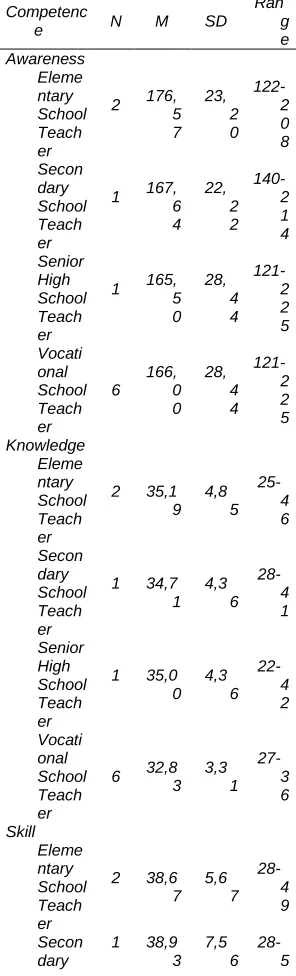
Descriptive statistics covering the mean, standard deviation, and the difference in the minimum-maximum score (range) of multicultural competencies for each group are shown in Table 1. The average scores for all groups of religious education teachers Islam shows their high multicultural competence. It appears that Islamic education teachers at elementary school have an average multicultural awareness that is higher than the average multicultural awareness of Islamic education teachers in junior high, high school, and vocational school. From Table
1, one can see that the average multicultural awareness of Islamic religious education teachers for all levels of elementary, junior high, high school and vocational education is categorized as high, namely 176.57 (elementary), 167.64 (junior high), 165.5 (high school) ), and 166 (vocational school). All of the average scores on the subscale of awareness were in the range of 124-177. However, the domains or subscales of the teacher’s multicultural knowledge and skills are relatively low. The average score of multicultural knowledge of teachers for all levels of education is 34.7 while the domain of skills is 38.98. The two averages are in the range of 34-48. The frequency table also shows that 39.2% of Islamic religious education teachers with low multicultural knowledge, and 21.6% have low multicultural skills.
Table 1. Average Descriptive Statistics (Mean), Standard Deviation, and Difference in Minimum-Maximum Scores
(Range) of Multicultural Competencies
Competenc
e N M SD
Ran g e Awareness Eleme ntary School Teach er 2 1 176, 5 7 23, 2 0 122-2 0 8 Secon dary School Teach er 1 4 167, 6 4 22, 2 2 140-2 1 4 Senior High School Teach er 1 0 165, 5 0 28, 4 4 121-2 2 5 Vocati onal School Teach er 6 166, 0 0 28, 4 4 121-2 2 5 Knowledge Eleme ntary School Teach er 2 1 35,1 9 4,8 5 25-4 6 Secon dary School Teach er 1 4 34,7 1 4,3 6 28-4 1 Senior High School Teach er 1 0 35,0 0 4,3 6 22-4 2 Vocati onal School Teach er
6 32,8
4637 School
Teach er
1
Senior High School Teach er
1 0
39,5 0
6,8 7
26-4 8
Vocati onal School Teach er
6 39,3
3 5,5
4
31-4 7
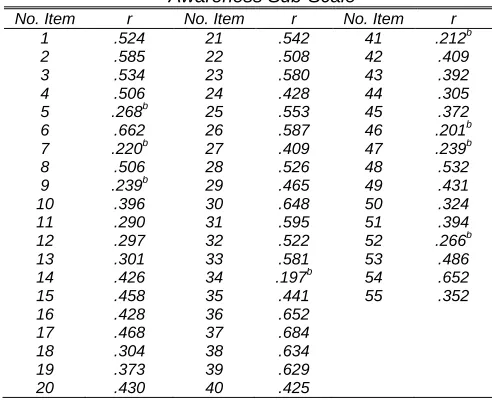
The validity of each sub-scale score or multicultural awareness domain totaling 55 questions is presented in Table 2. The positive and significant correlation coefficient between each item’s score and the total score of the awareness sub-scale becomes evidence of the internal validity of the sub-instrument awareness scale. In contrast, correlation coefficients that are not significant at the 0.05 level indicate questions on these items have low internal validity. Of the 55 items on the sub-scale score of consciousness, there are 47 valid item scores with the strongest correlation coefficient in a row of 0.684 (item number 37); 0.662 (6); 0.652 (36 and 54); 0.648 (30); 0.634 (38); and 0.629 (39). Meanwhile, the invalid item numbers are 8, namely item number 34 (0,197), 46 (0,201), 41 (0,212), 7 (0,22), 47 (0,239), 9 (0,239), 52 ( 0.266) and 5 (0.268).
Table 2. Correlation Coefficient Scores for Each Item with Awareness Sub-Scale
No. Item r No. Item r No. Item r
1 .524 21 .542 41 .212b
2 .585 22 .508 42 .409
3 .534 23 .580 43 .392
4 .506 24 .428 44 .305
5 .268b 25 .553 45 .372
6 .662 26 .587 46 .201b
7 .220b 27 .409 47 .239b
8 .506 28 .526 48 .532
9 .239b 29 .465 49 .431
10 .396 30 .648 50 .324
11 .290 31 .595 51 .394
12 .297 32 .522 52 .266b
13 .301 33 .581 53 .486
14 .426 34 .197b 54 .652
15 .458 35 .441 55 .352
16 .428 36 .652
17 .468 37 .684
18 .304 38 .634
19 .373 39 .629
20 .430 40 .425
b
The question items were not significant at the 0.05 level
The second domain or subscale of multicultural competence is knowledge. There are 15 items of knowledge subscale questions. The positive and significant correlation coefficient between the scores of each item and the total score of the knowledge subscale prove the internal validity of this subscale. Of the 15 knowledge score sub-scale scores, there are only two invalid item numbers, namely item numbers 65 (0.098) and 63 (0.191), as shown in Table 3.
Table 3. Correlation Coefficient Scores for Each Item with Knowledge Sub-Scale (Knowledge)
No. Item r
56 .500
57 .405
58 .429
59 .356
60 .600
61 .611
62 .371
63 .191b
64 .364
65 .098b
66 .286
67 .428
68 .544
69 .542
70 .517
b The question items were not significant at the 0.05 level
All domain item numbers or skill subscales used to measure the ability of Islamic religious education teachers to implement education and learning with a variety of students proved to be valid, as shown in Table 4. Even the correlation of each item score with the total score of the subscales skills have a strong coefficient. This proves that the instrument domain sub-scale instrument has high internal validity.
Table 4. Correla
tion Coefficient Scores for each Item with Skill Sub-Scale (Skill)
No. Item r
71 .659
72 .631
73 .579
74 .564
75 .677
76 .515
77 .487
78 .522
79 .555
80 .429
81 .669
82 .478
83 .637
84 .383
85 .440
The alpha reliability coefficient of the instrument is shown in Table 5. The alpha reliability coefficient for the awareness domain is 0.922, 0.662 for knowledge, 0.828 for skills, and 0.864 for the whole scale.
Table 5. Instrument Alpha Reliability Coefficients for Each Domain/Sub-Scale and Overall Score Items
Domain/Sub-Scale N
Alpha Cronbac
h
Awareness 55 0,922
Knowledge 15 0,662
Skill 15 0,828
All item score 85 0,864
4638 overall scale of the multicultural competency measurement
instrument proved to be reliable.
5. DISCUSSION
Descriptive statistical data show that the multicultural awareness of Islamic education teachers at various levels of education is in the high category, while their multicultural knowledge and skills are in the moderate category. This shows that their multicultural knowledge which tends to be low does not correlate with their multicultural awareness. Even the correlation analysis between the knowledge domain and multicultural awareness is only -0.26 (p = 0.06), which means that the negative correlation is very low and not significant. So, by using this instrument, one’s multicultural awareness is not determined by one’s multicultural knowledge. On the other hand, due to the multicultural knowledge of teachers who tend to be low, their skills to implement multicultural education and learning also tend to be low. This is evidenced by the correlation coefficient of the two domains of 0.46 (p = 0.001). The results of this study show that there are 8 out of 55 invalid domain item numbers or awareness sub-scale, namely item numbers 5, 7, 9, 34, 41, 46, 47, 52. Items 5, 7, and 9 are in one group statement ―Someone of different ethnicity or followers of other religions move and live near your house‖. Item number 5 contains a choice of words that are semantically contradictory namely ―friendly vs. unfriendly‖; item number 7 ―annoying vs not disturbing‖; and item number 9 ―need to be suspected vs not need to be suspected‖. It seems that these semantically contradictory words are irrelevant as an answer choice when someone is asked for their opinion if someone who is a different ethnicity or followers of other religions moves and lives near his house. Item number 34 is the answer choice between ―feeling usual vs. feeling unusual/ nervous‖ for the statement ―you are in a meeting room/hall in which most are people from races or religions that are different from you‖. The choice of answers is also not meaningful to be used as an alternative. Meanwhile, item number 41 was initially thought to have high relevance to measure one’s multicultural awareness, but later it was not proven. Item number 41 is a choice between ―accept vs. reject‖ for the statement ―your relatives have an affair with races or followers of other religions and they plan to proceed to the level of engagement and marriage‖. Two item numbers 46 and 47 each contain ―accept vs. reject‖ and ―happy vs. unhappy‖ answers to the statement ―people of other races or adherents invite you to be friends with them on online social media‖. The two choices also proved to be irrelevant as choices for the statement. Item number 51 is the choice between ―accepting vs. rejecting‖ the statement ― the arrival of a new leader or labor coming from a race or adherent of another religion to the place or institution you are working for‖. While the scale to measure the domain or subscale of knowledge consisting of 15 item numbers there are only 2 items that are invalid numbers, namely numbers 63 and 65. Number 63 contains the statement ―Every religious adherent has the same right in building and establishing places of worship ―with a choice of strongly disagree (score 1), disagree (score 2), do not know (score 3), agree (score 4), and strongly agree (score 5). It seems that the question which has almost become common knowledge does not need to be asked to measure one’s multicultural
knowledge. The item number 65 contains the statement ―Some evidence shows that children from ethnic minorities (e.g. Chinese) have superior achievements compared to children from ethnic majority‖. This question also proved to be irrelevant to measure one’s multicultural knowledge, because it tends to be tendentious. In contrast to the scale of the two domains of awareness and knowledge, the scale to measure the domain of the skill which contains 15 items of questions all proved valid. Thus, this scale can be used fully to measure the ability of teachers to implement multicultural education and learning. The instrument reliability test results using Cronbach’s alpha also showed that the two domain scales of awareness and skills had high reliability, even though the domain scale of knowledge reliability was low. A number of multicultural competence measurement instruments actually also have low reliability. When the Multicultural Awareness Knowledge and Skills Survey (MAKSS) was tested for validity and reliability by Kocarek, Talbot, Batka, and Anderson (Kocarek et al., 2001), it was found that one of its domains, namely awareness, was proven to have an alpha reliability coefficient of 0.49. A study conducted to measure the multicultural competence of 500 professional counselors as reported by Holcomb-McCoy and Myer (Holcomb-McCoy & Myer, 1999) by using the 61-item Multicultural Counseling Competence and Training Survey (MCCTS) instrument also proved one of the 5 factors to have an alpha reliability coefficient low, which is 0.66. This proves that the alpha reliability coefficient is low, the scale can be used if the score items are internally valid.
6. CONCLUSION
This multicultural competency measurement instrument is designed to assess self-assessment related to awareness, knowledge, and multicultural skills. High assessment results show high multicultural competence as well. The score items on the instruments tested were mostly proven to be valid and reliable. Although in this instrument there is one domain of multicultural competence, namely the knowledge domain, which has a low alpha coefficient of reliability, overall this instrument has proven to be reliable and can be used to measure multicultural competencies, especially with the subject of educator measurements.
7. REFERENCES
[1] Arredondo, P., Toporek, R., Brown, S., Jones, J., Locke, D. C., & Sanchez, J. (1996). Operationalization of the Multicultural Counseling Competencies. Journal of Multicultural Counseling and Development, 24, 42–78.
[2] Banks, J. A. (2009). Multicultural Education: Characteristics and Goals. In J. A. Banks & C. A. McGee (Eds.), Multicultural Education: Issues and Perspectives. New York: John Wiley and Sons. [3] Constantine, M. G., Hage, S. M., Kindaichi, M. M.,
& Bryant, R. M. (2007). Social Justice and Multicultural Issues: Implications for the Practice and Training of Counselors and Counseling Psychologists. Journal of Counseling & Development, 85, 24–29.
4639 70, 143–150.
[5] Elashmawi, F., & Harris, P. R. (1994). Multicultural Management: New Skills for Global Success. Kualalumpur: S. Abdul Majeed & Co.
[6] Graham, M., & Miller, D. (1995). Cross Cultural Interactive Preference Profile. In J. W. Pfeiffer (Ed.), The 1995 Annual: Volume I Training. San Diego, CA: Pfeiffer & Company.
[7] Holcomb-McCoy, C. C., & Myer, J. E. (1999). Multicultural Competence and Counselor Training: A National Survey. Journal of Counseling & Development, 77.
[8] Husni. (2019). Moderate Muslims’ Views on Multicultural Education, Freedom of Expression, and Social Media Hate Speech: An Empirical Study in West Java Indonesia. Jurnal Penelitian Pendidikan Islam, 7(2), 199–224. https://doi.org/10.36667/jppi.v7i2.370
[9] Kocarek, C. E., Talbot, D. M., Batka, J. C., & Anderson, M. Z. (2001). Reliability and Validity of Three Measures of Multicultural Competency. Journal of Counseling and Development, 79(4), 486–496.
[10] Neville, H. A., Lilly, R. L., Duran, G., Lee, R. M., & Browne, L. (2000). Construction and initial validation of the color-blind racial attitudes scale (CoBRAS). Journal of Counseling Psychology, 47, 6–12.
[11] Pedersen, P. B. (1991). Multiculturalism as a Fourth Force in Counseling. Journal of Counseling and Development, 70, 6–12.
[12] Ponterotto, J. G., & Potere, J. C. (2003). The Multicultural Counseling Knowledge and Awareness Scale (MCKAS): Validity, Reliability, and User Guidelines. In D. B. Pope-Davis, H. L. K. Coleman, W. M. Liu, & R. L. Toporek (Eds.), Handbook of multicultural competencies: In counseling & psychology (pp. 137–153). New York. [13] Pope, R. L., & Reynold, A. L. (1997). Student Affair Core Competencies: Integrating Multicultural Awareness, Knowledge, and Skills. Journal of College Student Development, 38(3), 266–277. [14] Rodolfa, E., Bent, R., Eisman, E., Nelson, P.,
Rehm, L., & Ritchie, P. L. (2005). A Cube Model for Competency Development: Implications for Psychology Educators and Regulators. Professional Psychology: Research and Practice, 36(4), 347–354.
[15] Rubin, N. J., Bebeau, M., Leigh, I. W., Lichtenberg, J. W., Nelson, P. D., & Portnoy, S. (2007). The Competency Movement within Psychology: An Historical Perspective. Professional Psychology: Research and Practice, 38, 452–462.
[16] Shearer, R. A., & Ann King, P. (2004). Multicultural Competencies in Probation—Issues and Challenges. Federal Probation, 68, 1–11.
[17] Sue, D. W., Arredondo, P., & McDavis, R. J. (1992). Multicultural Counseling Competencies and Standards: A Call to the Profession. Journal of Counseling and Development, 70, 477–483. [18] Sue, D. W., & Sue, D. M. (2007). Foundations of
Counseling and Psychotherapy: Evidence-based Practices for a Diverse Society. Hoboken, NJ:
Wiley.
[19] Talbot, D. M. (1992). A Multicultural Study of the Diversity Emphasis in Maters’s Degree Programs in College Student Affairs. University of Maryland, College Park.
[20] The Wahid Foundation. (2017). Laporan Tahunan Kebebasan Beragama/Berkeyakinan di Indonesia 2017. Jakarta: The Wahid Institute.
[21] Tulin, D. (1995). Diversity Awareness Assessment. In J. W. Pfeiffer (Ed.), The 1995 Annual: Volume I Training. San Diego, CA: Pfeiffer & Company. [22] Vavrus, M. (2002). Transforming the Multicultural
Education of Teachers: Theory, Research, and Practice. New York: Teachers College Columbia University.