United Kingdom
Vol. II, Issue 6, 2014
Licensed under Creative Common Page 1
http://ijecm.co.uk/
ISSN 2348 0386
ASSESSING THE CHALLENGES TO THE IMPLEMENTATION OF TOTAL QUALITY
MANAGEMENT IN THE DEVELOPMENT OF TERTIARY EDUCATION IN GHANA
CASE STUDY OF TAMALE POLYTECHNIC
Mohammed, Abdul-Basit Fuseini
Department of Marketing, Tamale Polytechnic, Northern Region, Ghana [email protected]
Osman,Ibrahim
Department of Marketing, Tamale Polytechnic, Northern Region, Ghana [email protected]
Abdul-Razak, Abubakari
Department of Accountancy,Tamale Polytechnic, Northern Region, Ghana [email protected]
Abstract
This study was conducted to assess the challenges to the implementation of Total Quality
management in tertiary Institutions in Ghana with Tamale Polytechnic as case study. Total
quality management practices and the challenges to the implementation in Tamale polytechnic
were examined. Purposive sampling technique was used to select certain key respondents from
the Polytechnic for the collection of data. Data was collected using questionnaires and
interviews. This study revealed the absence of total quality management practices even though
a quality assurance unit was part of the administrative body of the polytechnic. The challenges
to its implementation emanated from the attitude of staff among of the polytechnic. Furthermore,
the polytechnic lacked a policy plan to manage quality related issues. More so, management
was not committed to the implementation of quality management practices in the Polytechnic.
The study recommended the introduction of a policy plan to introduce, monitor and control
quality related issues in the polytechnic. The quality assurance unit should be empowered to
execute their task effectively and efficiently. Finally, a more inclusive approach and appropriate
education should be adopted to address some of the problems associated with the practice of
Total quality management in Tamale Polytechnic.
Licensed under Creative Common Page 2
INTRODUCTION
Higher educational institutions have been strategically seeking quality education, with external measurement such as achievement levels of graduating students and later graduate success as evidence of that quality. In some countries, external monitoring of final examination has provided a measuring rod for institutional success. In others, other performance indicators have been used (Newton, 2002).In more recent years, however significant focus have shifted internationally not just to evidence of institutional outcomes but the internal process by which quality is assured. Coupled with this has been an increased emphasis on the more formative elements of achieving quality not just in the academic areas but in all aspects of campus operations. Quality management in higher education emphasizes issues such as, institutional structures and environment conclusive to making quality procedures and processes effective. Quality demands also reflect on emphasis on education that focuses on the whole person (physical, mental, spiritual and emotional). This invites administrators to use quality management structures and improvement processes to enrich education and delight its customers in the academic as well as social, physical and emotional spheres. Quality assurance agency for higher education (QAAHE, 2001).
Quality assurance in higher educational institution has become an issue of major concern among higher institutions. In the postmodernism era, quality driven initiatives continue to remain high on the agenda of many educational institutions. This is associated with the rise in public accountability and demand for transparency in the way in which higher educational institutions are managed. A number of higher institutions have implemented several quality initiatives. The traditional academic approach to control and maintain quality in higher educational institutions appears to be less effective in the present era. The public demand for greater accountability in the utilization of public funds would require a more explicit assurance of quality in the delivery and management of higher education. The focus remains on quality assurance and quality enhancement. These issues have become a major cause of concern for most nations. They have been accrued priority as strategies have been a planned agenda for higher education to re-examine during the past decades (Elaine, 1998).
Licensed under Creative Common Page 3 education quality; what it takes to implement these initiatives, what has been the impact, and what are the priorities for capacity building? Numerous concerns have been raised regarding the quality of products turned out from most of the tertiary institutions in Ghana. This research therefore sought to unveil the challenges to the implementation of total quality management in the Tamale Polytechnic and its effects on the quality of products for growth. It is against these reasons this study sought to address the following objectives:
1. To assess total quality management practices in Tamale Polytechnic.
2. To examine the challenges to implementation of total quality management in Tamale Polytechnic
The following questions were addressed in a bid to uncover the challenges to the implementation of total quality management in Tamale Polytechnic:
1. What total quality management practices exist in Tamale Polytechnic? 2. What are the challenges of total quality management in Tamale Polytechnic?
Scope of the Study
The study was conducted in the Tamale Polytechnic. And its focus was on the challenges of the implementation of total quality management and the effects on successful human resource development in Tamale Polytechnic. The choice of Tamale Polytechnic is informed by the fact that its core responsibility is to train human resource for the middle manpower of the nation. There is therefore the need to assess how quality management is ensured in delivering that responsibility.
Delimitation
It is worthy to note that total quality management functions cut across several areas. But this study will not include quality control, effects of the role of management to implementing Total Quality Management and the general perception of quality in Tamale Polytechnic.
Limitations of the Study
Licensed under Creative Common Page 4
LITERATURE REVIEW
A Conceptual Analysis of Total Quality Management
Total quality management (TQM) is defined as a management philosophy that seeks to integrate all organizational functions (marketing, finance, design, engineering, and production, customer service,) to focus on meeting customer needs and organizational objectives Terry (2010). Accordingly, Terry views an organization as a collection of processes. It maintains that organizations must strive to continuously improve these processes by incorporating the knowledge and experiences of workers. He further, reiterates that the simple objective of TQM is “Do the right things, right the first time, every time”. TQM is infinitely variable and adaptable. Although originally applied to manufacturing operations, and for a number of years only used in that area, TQM is now becoming recognized as a generic management tool, just as applicable in service and public sector organizations.
There are a number of evolutionary strands, with different sectors creating their own versions from the common ancestor. TQM is the foundation for activities, which include commitment by senior management and all employees, meeting customer requirements, reducing development cycle times, Just- in- time or demand flow manufacturing, improvement teams, reducing product and service costs among others, Dale (2003).
The need for quality as a fundamental component in the formulation of strategies for institutions to implement Total Quality Management (TQM) is clearly outlined by Neto (2000) who state that quality, as a macro function of institutions, must be present in the day-to-day running of an institution, in aspects such as establishment of policies, the decision process, selection of personnel, allocation of resources, definition of priorities and service delivery to satisfy customer requirements. Neto (2000) further stated that, the quality approach, as a strategic element, has brought to institutions a new manner of conceiving quality, as it engages the top decision-makers of the institution in the effort for better performance in service delivery.
Licensed under Creative Common Page 5 services but includes quality of time, place, equipment and tools, processes, people, the environment and safety, information and measurement. Quality is an ongoing process that has to be so persuasive throughout the institution, that it becomes the philosophy and culture of the whole institution. All institutions and each department within the institution need to adopt the same strategy, to serve the customer with even better quality, lower cost, quicker response and greater flexibility (Schonberger, 1990).
Total Quality Management is one of the most durable management innovations of the past two decades. Total Quality Management has been globally recognized by the Japanese approach toward quality improvement (Mani, Murugan & Rajendran 2003). Yet, in spite of thousands of articles in the business and trade press from 1984 to 2002, Total Quality Management remains a hazy, ambiguous concept. Total Quality Management is arguably the most significant concept that has swept across institutions over the last few years. Total Quality Management encompasses a vast spectrum of topics and perspectives. While Total Quality Management is widely practiced, there is little agreement on what it actually means, despite assertions that “clear definitions are important.In addition, it has been argued by Douglas and Judge (2001) that for an institution to realize the value of a Total Quality Management implementation, it must have an internal conceptual understanding of Total Quality Management in order to be capable of fully supporting Total Quality Management implementation.
According to Douglas and Judge (2001), the emphasis placed on various aspects of TQM varies among the authorities. Some of the emphasis includes the following:
Competence: This implies possession of the required skills and knowledge to perform the required service such as qualifications and training of service.
Communication: This involves keeping customers informed in a language that they can understand and listening to customers. Language should not be too technical for the customer to understand and sufficiently technical for those customers who have the required knowledge.
Credibility: This includes trustworthiness and honesty. Contributing factors are the name and reputation of the service enterprise.
Licensed under Creative Common Page 6
Factors that Influence Total Quality Management in Institutions
The transformation to a Total Quality Management programme depends on the extent to which institutions successfully implement certain quality management practices. Fewer defects, reduced lead times, higher flexibility and increased employee satisfaction are reportedly among the benefits of a successful Total Quality Management programme (Sirota, 1994).
Barriers to Quality Transformation
There is ample evidence that quality management systems improve institutional performance if properly implemented. Why institutions fail in their endeavours to implement a quality management system. However, two common problems appear to be a lack of strategic planning and a lack of an appropriate culture supportive of Total Quality Management programme. In order to analyze Total Quality Management, it is important to understand the reasons why Total Quality Management programme fail which may provide insight into the importance to understand the meaning of Total Quality Management. Institutions and authors have identified a variety of reasons why Total Quality Management programmes fail and many surveys have been done on this subject (Greb, 1993). The following is a list of obstacles, barriers, reasons and pitfalls institutions have reported when implementing Total Quality Management (Claus 1991). Even though this is not an exhaustive list, it does include the obstacles that are frequently cited in today‟s literature, namely: lack of management commitment, communication thereof and participation; lack of established guiding framework for TQM; Inadequate knowledge or understanding of TQM; lack of an institution-wide definition of quality; quick fix approach, emphasis on short-term results; lack of a formalized strategic plan for change; inability to change institutional culture; lack of customer focuses (internal and external customers); poor inter-institutional communication; lack of real employee empowerment and teamwork; lack of employee trust in senior management; drive for short-term financial results and the traditional belief that TQM costs money (Djerdjour& Patel 2000).
Customer Expectations in Implementing Total Quality Management
Satisfying customers and creating customer enthusiasm through understanding their needs and future requirements is to crux of TQM and all institutions are dependent on having satisfied customers (Dale, 2003). According to the latter, research has shown that institutions that do not meet their customers‟ expectations, have lost market shares to competitors who are customer-orientated. Stamatas (1996) developed a generic model for the implementation of customer service, for the very reason of complying with the expectations of the customer. The generic model of six Sigma follows a six-step approach:
Licensed under Creative Common Page 7 Step 3: Identity the institution‟s critical needs that are required for customer satisfaction. Step 4: Define the process required to perform the work in order to ensure quality
customer service.
Step 5: Zero-defect the process and eliminate wasted efforts.
Step 6: Ensure continuous improvement by obtaining continuous feedback from the customer, in order to produce continuous total quality results as output. Stamatis (1996:56)
Principles of Total Quality Management in Practice
Despite diverse views on what constitutes Total Quality Management, there are a number of principles that will now be summarized. According to Dean and Bowen (1994:394), Total Quality Management as a philosophy or an approach to management can be characterized by its principles. They continued and indicated that Total Quality Management implementation can only be accomplished through a set of principles that supports the Total Quality Management philosophy. What differentiates Total Quality Management from other management processes is the emphasis on continuous improvement. Total Quality Management is about continuous improvement of individuals, of groups and of institutions. To improve performance, people need to know what to do, how to do it, have the right tools to do it, to be able to measure performance and to receive feedback on current levels of achievement. (Dean & Bowen 1994). The following key principles underpin the Total Quality Management concept, which are common to all manifestations.
Total Quality Management Starts at Top Management
Top management should demonstrate understanding, commitment and be involved in the total quality improvement process from day one in order to improve quality in all areas of the institution.(Hoyer & Hoyer (2001)
Total Quality Management Requires Total Employee Involvement
People at all levels are the essence of an institution and their full involvement enables their abilities to be used to the benefit of the institution. The involvement of every individual in an institution is necessary for successful Total Quality Management implementation (Burr, 1993).
Total Quality Management Needs Strategic Planning
Licensed under Creative Common Page 8
Total Quality Management Focus on Teamwork
Institutions should understand that employees need to participate in vertical, horizontal and cross-functional teams to be most effective. Teams should be used through collaboration/participation, to provide an opportunity for employees to work together in their pursuit of total quality in ways that they have not worked together before (Dale et al., 2001).
Total Quality Management focus on continuous improvement
Continuous improvement should be a permanent objective of the institution. Continuous improvement means a commitment to constant examination of technical and administrative processes in search of better methods. Underlying this principle are the concept of institutions as systems of interlinked processes and the belied that by improving these processes, institutions can continue to meet the increasingly stringent expectations of their customers (Ghobadian et al., 1996).
RESEARCH METHODOLOGY
Research Design
The cross-sectional research design was adopted for the study. This method was adopted because there was the need for the examination of definite units with specific characteristics within a particular time frame. This was to give a general picture of the challenges to the implementation of total quality management to the development of tertiary education in Ghana.
Targeted Population and Sample Size
The polytechnic community comprises the target population of the study. They include administrative staff, academic staff, the support staff and the students. A purposive sampling was used to draw the sample elements from the target population. The sample size for this study was one hundred and twenty (120) respondents which was made up of 30 teaching staff, 30 administrative staff and 60 students. The sample size was determined by considering the total number of each unit of the target population by a percentage. That is:
Teaching staff = 14/100× 215= 30 Administrative staff = 26/100 ×115 = 30 Students = 1.7/100× 3500 = 60
Licensed under Creative Common Page 9 Table.1 Sample Size
Composition Frequency Percentage%
Administrative Staff 30 25
Teaching Staff 30 25
Students 60 50
Total 120 100
Data collection
Out of the 120 questionnaires administered, all the questionnaires were retrieved and analysed in this presentation for discussion.
Socio biographic profile of respondents
Out of the 120 respondents studied, 76% of respondents were males. The female respondents were 24%. The male respondents dominated among the staff of the Polytechnic. The ages of the respondents indicated that, those within the ages of 18-23 years were 19%, 24-29 years were 34%, the ages of 30-35 years were 35% and the ages of 36 years were 12%. This indicates that, the modal age range of the respondents were between the ages 30 to 35 years.
FINDINGS & DISCUSSION
Practice of TQM in Tamale Polytechnic
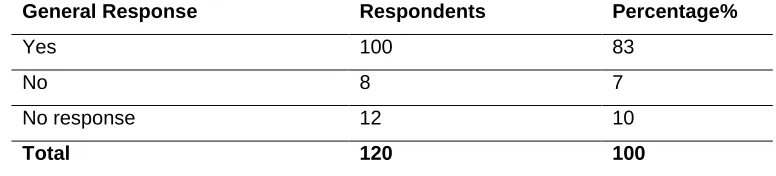
Table.2 shows that of the 120 respondents, 83% of the respondents said the Polytechnic practiced total quality management. This means that Tamale Polytechnic having recognized the role of TQM has made it a strategic competitive tool.
Table 2: Practice of Total Quality Management in Tamale Polytechnic
General Response Respondents Percentage%
Yes 100 83
No 8 7
No response 12 10
Total 120 100
Areas of Practicing TQM in Tamale Polytechnic
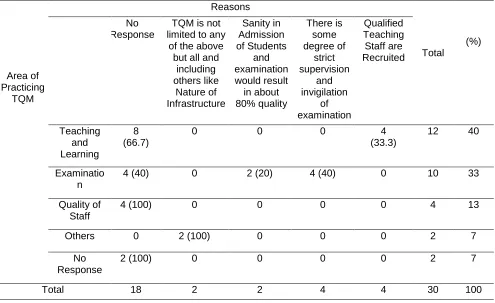
Licensed under Creative Common Page 10 examination. Also, 2 respondents representing 100% responded that Total Quality Management is not limited to any of the above but all and including others like nature of infrastructure. Data on this is illustrated on Table 3.
Table 3: Cross Tabulation of Area of Practicing TQM in Tamale Polytechnic with Reasons
Area of Practicing TQM Reasons Total (%) No Response
TQM is not limited to any
of the above but all and
including others like Nature of Infrastructure Sanity in Admission of Students and examination would result in about 80% quality There is some degree of strict supervision and invigilation of examination Qualified Teaching Staff are Recruited Teaching and Learning 8 (66.7)
0 0 0 4
(33.3)
12 40
Examinatio n
4 (40) 0 2 (20) 4 (40) 0 10 33
Quality of Staff
4 (100) 0 0 0 0 4 13
Others 0 2 (100) 0 0 0 2 7
No Response
2 (100) 0 0 0 0 2 7
Total 18 2 2 4 4 30 100
Presence of Quality Assurance Unit
Licensed under Creative Common Page 11 Figure 1: Presence of Quality Assurance Unit
The issue of how Total Quality Management operates in Tamale Polytechnic, 39% of the respondents indicated that supervision of students work was an area where TQM was practiced, 46% indicated that, total quality management was practiced under the management of the quality assurance unit, 8% indicated that teaching and learning was the area where TQM was practiced and 7% did not know where it was practiced. Even though majority of the respondents indicated management through the quality assurance unit as an area where TQM was practiced, they explained that there was no laid down guide for the operation of TQM in the Polytechnic and that, the head of the unit did not communicate any issue of TQM to staff, but took it as “one man‟s show”.Even though the respondents had the view that TQM was in operation, their explanations contradicted with the actual principles of TQM. This could account for serious challenges to the success of its operation. This is illustrated in Table 4.
Table 4: Areas where TQM Operate in Tamale Polytechnic
RESPONSE FREQUENCY PERCENTAGES
Supervision of work 47 39
Management (Q.A) 55 46
Teaching/ learning 9 8
Don‟t know 8 7
Total 120 100
Challenges to Total Quality Management in Tamale Polytechnic
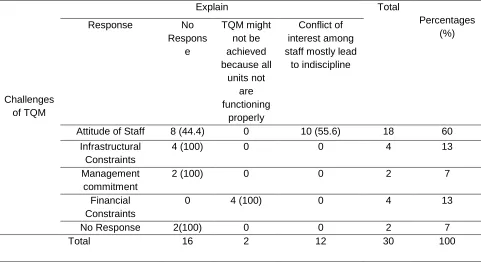
From Table 5, of the 30 respondents, 60% from management indicated that the attitude of staff was a serious challenge to managing total quality management with 13% explaining that conflict
yes
Licensed under Creative Common Page 12 of interest among staff mostly led to indiscipline leading to difficulties associated with the implementation of total quality management, 13% stated that infrastructure was a constraint to total quality management, 7%said that management was not committed to managing total quality. Financial Constraints recorded 7% of the respondents with an explanation that Total Quality Management might not be achieved because all units were not functioning properly in the polytechnic.
Table 5: Cross Tabulation of Challenges to TQM in T. Poly with respondents‟ reasons.
Challenges of TQM
Explain Total
Percentages (%)
Response No
Respons e
TQM might not be achieved because all
units not are functioning
properly
Conflict of interest among staff mostly lead
to indiscipline
Attitude of Staff 8 (44.4) 0 10 (55.6) 18 60
Infrastructural Constraints
4 (100) 0 0 4 13
Management commitment
2 (100) 0 0 2 7
Financial Constraints
0 4 (100) 0 4 13
No Response 2(100) 0 0 2 7
Total 16 2 12 30 100
Majority of the teaching staff represented by 60% also indicated that the attitude of staff was a big challenge to managing TQM. This implies that the basic challenge to managing total quality in Tamale Polytechnic is attitude of staff. This poses a serious threat to the achievement of TQM because staff commitment is critical to the success of TQM implementation.
Relationship between Participatory management and TQM
Licensed under Creative Common Page 13 Figure 2: Relationship between Participatory Management and TQM
Relationship between Centralized Management and TQM
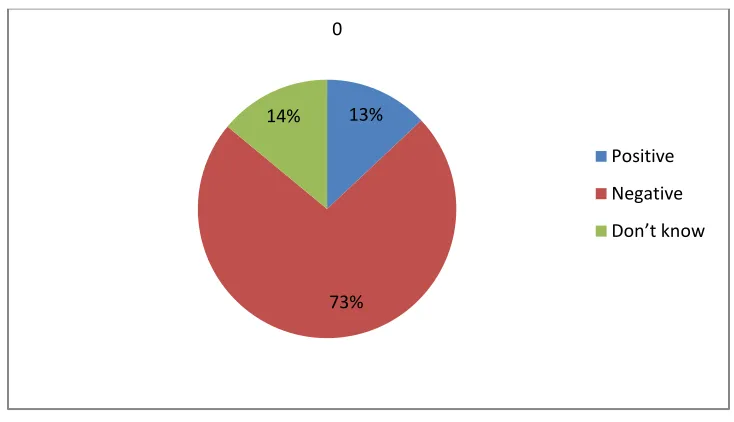
On the issue of centralized management, a cumulative percentage of 73% indicated that it would have negative consequence on the management of total quality. They explained that decision making at that level would be too rigid and would lack the flexibility to manage quality at all levels of management in the polytechnic. This is very critical especially in areas where decision making is expected to be decentralized for the smooth flow of activities in the Institution. This is manifested in Figure 3:
Figure 3: Relationship between Centralized Management and TQM
An Assessment of the Performance of the Teaching staff to the success of TQM
To effectively gather accurate data on the issue above, interview was conducted across the administrative and the teaching staff. The academic registry indicated that the Q.A unit has been in contact with them regarding issues bothering on academic performance of the students.
61% 12%
27% 0
Positive Negative Don’t know
13%
73% 14%
0
Positive
Negative
Licensed under Creative Common Page 14 In terms of the general performance of lecturers; the unit indicated that they were putting up their best even though a lot of challenges usually stand their way. Some of these challenges were: the teaching staff handling large classes without public address system and the difficulty in supervising students‟ works due to lack of offices and other logistical constraints.
The performance of the students was the biggest problem. The unit lamented that in recent past, they were bedeviled with a lot of faked and unqualified results being used by students to secure admission. This trend has affected the total number of graduating students from 85% five years ago to 45% two years ago. Most of such students find it difficult to cope resulting in very poor performance which invariably affect the total number of graduating students.
The academic unit indicated that the Unit through the central admission board is now bringing sanity into the admission process. This means that, the collective efforts of all staff to ensure sanity and improvement in quality must not only rely on the offices responsible for a particular task but the collective efforts of all.
Response from Teaching Staff
Through the discussion the researcher had with the teaching staff, the revelation was that the human resource component to managing quality in the Polytechnic had been neglected even though the backbone of the success to TQM was the human resource. This could account for the behavior of staff towards achieving quality. The issue of staff development according to the teaching staff seems to be the biggest challenge for the Polytechnic since the Polytechnic did not have any policy on developing staff .This has corroborated the initial revelation. This could be a serious threat to the success of TQM in any institution that seek to adopt TQM as a concept.
Licensed under Creative Common Page 15
CONCLUSION
In spite of widespread interest and massive investment in Polytechnic education, there are reports of only isolated successes. By and large, quality is not yet integral to almost all department or most activities in the tertiary Institutions in Ghana. The progress is only in terms of how many people are trained rather than how many inherent quality problems have been recognized and resolved. The concepts of Total Quality Management have been widely discussed, but the challenges of implementation have received little attention especially within the service sector in Ghana. This Philosophy must facilitate a long term change for tertiary institutions; top management commitment as well as the substantial inflow of resources; adequate training and workforce participation is very essential to the success of Total Quality Management.
RECOMMENDATIONS
Total Quality Management in the Polytechnic should be an all-inclusive strategy that must be taken seriously at all level. This can be done through vigorous training and education on specific performance targets guided by strategic plans. When this is done total quality management will not be seen as any strange concept in the polytechnic.
Furthermore, Skill training through workshops and seminars should also be organized for all units and departments about the revolution in management of quality and the role of all. This when introduced and carefully managed will enhance smooth and effective practiced of Total Quality Management in the polytechnic. The polytechnic should develop its own policy on managing total quality. This policy should have inputs from all units and departments in the polytechnic which must be related to quality improvement, quality assurance and general improvements in process and practices. This policy must be integrated into the entire policy plan of the polytechnic.
Licensed under Creative Common Page 16 broader scope of quality commitment must be understood by all staff. This is very important to the collective gains associated with the success of the practice of TQM. This can be achieved by setting targets for staff and giving them the opportunity to assess their performance.
REFERENCES
Adinolfi, P. (2003). Total Quality Management in public health care: a study of Italian and Irish hospitals. Total Quality Management & Business Excellence, 14(2): 141 – 150.
Burr .T. (1993).A new name for a not so-new concept. Quality progress, 26(3); 87-88
Billich. F,F. and Neto, A.A (2000). TQM quality Macro function model for banks.TQM11 (1); 5-15
Dale, B.G (2003). Managing quality, fourth Edition.
Dean, J.W. and Bowen, D.E. (1994). Management theory and total quality: improving research and practice through development: Academy of management Review, 19(3): 392 – 418.
Dean, J.W. and Evans, J. (1994). Total Quality Management, organization, and Strategy St. Paul, MN: West.
Djerdjour, M. and Patel, R (2000). Implementation of quality programmes in developing countries a Fiji Islands case study – T.Q.M, 11 (1): 25 – 44
Douglas T.J. and Judge, W.Q. (2001). Total Quality Management and struneturalcontEncyclopedia Britannica (K led) “personnel management – industrial management‟.
Evans, J.R. and Dean, J.W. (2003). Total Quality management, organization and strategy. United States. Thomson learning.
Ghobadian, A and Gallear, D. (1996).Total Quality in SME‟s; International Journal of management science 24(1); 2, 83-106
Ghobadian,A.Gallear, D,Woo, H. Andliu,J, (1998).TQM Impact introduction and integration strategies. London; The chartered institute of management Accounts
Hoyer and Hoyer (2001). Total Quality Management as culture 201; 54
Mani.T. P, Murugan. andRajendran (2003a). TQM is a must for success, but not sufficient for survival; a conceptual framework as contemplated in ancient Tamil literature in India. TQM and Business Excellence, 14(4); 395-465.
Newton, J (2002). Views from below: academics coping with quality: quality in Higher Education 8 (pp 39-62).
Quality Assurance Agency for Higher Education(QAAHE, 2002). Handbook for institutional Audit; England QAA 021(Gloucester, AAHE)
Sirota, D. (1994). Breaking through the culture wall; Journal for Quality and participation, March1994; 61-63
Schonberger, R, J.and Knood.E, M, M.(1997).Operations management customer focused principles. Boston Irwin.
Stamatis, D.H (2003).Six Sigma and beyond; Foundation of excellence performance. New York;Stlucie press.