IJEDR1702184
International Journal of Engineering Development and Research (www.ijedr.org)1101
A Review on Energy Efficient Data Aggregation
Routing Algorithm in WSN
Gitanja li1, Research ScholarSarpreet Singh2, Assistant Professor Depart ment of Co mputer Science and Engineering Sri Gu ru Granth Sahib World University, Fatehgarh Sahib1,2
Abstract—Wireless sensor networks (WSNs) have significant potential in many application domains such as agriculture, health, environmental monitoring, battlefield surveillance, and wild fire detection. They, however cannot be u sed in large geographical areas due to the short communication range of sensors. In addition, sensor networks have been the lack of available network management and control tools, such as for determining the degree of data aggregation prior to transforming it into useful information. Designing different network management tools such for routing, localization, and data aggregation are, therefore, required in large scale WSNs. Only a few of the existing data aggregation methods have been developed for a large scale WSN. In this paper, review of some literature and techniques for data aggregation has been done in large scale WSN.
Keywords— WSN, Data Aggregation, Data Clustering
I. INTRODUCTION
Wireless sensor networks (WSN) square measure spatially distributed autonomous sensors to monitor physical or environmental conditions, such as temperature, sound, pressure, etc. and to cooperatively pass their knowledge through the network to a main location. The more fashionable networks square measure bi-directional, a lso sanctionative manage ment of sensing element activity[1]. The develop ment of wire less sensor networks was driven by military applications like battleground surveillance; nowadays such networks square measure utilized in several industrial and client applications, such as process monitoring and manage ment, machine health monitoring, and so on. With advancement in technology, sensor network compo sed of tiny and value effective sensing devices equipped with wire less radio transceiver for surroundings observance became possible. The key advantage of using these tiny devices to monitor the surroundings is that it doesn't need infrastructure like electrica l mains for power offer and wired lines for web connections to gather knowledge, nor need human interaction whereas deploying[2]. These sensor nodes will mon itor the surroundings by collection info fro m their surroundings, and work cooperatively to send the knowledge to a base station, or sink, for analysis.
Clustering in WSN: The method of grouping the sensing ele ment rnodes in a very densely deployed la rge-scale sensing ele ment network is understood as clump.
Data Aggregation: The intelligent manner to mix and compress {the knowledge|the in fo|the info rmation} happiness
to one cluster is understood as data aggregation in cluster based mostly surroundings.
Fizzy Fingerprint: To win the privacy goal, data owner generates a special sort of digests that we have a tendency to decision fuzzy fingerprints. Intuitively , the purpose of fuzzy finger prints is to cover actuality sensitive data in a very crowd. It denies the DLD (Data Leakage Detection) to access the actual price. In finger-printing, each shingle is treated as a polynomia l q(x). Each constant of q(x), i.e., c i (0 < i < k), is one bit in the shingle. q(x) is mod by a selected irreducible polyno mia l p(x).
II. RELATED WORK
IJEDR1702184
International Journal of Engineering Development and Research (www.ijedr.org)1102
stop aggregating the packets and additionally instructneighbors to do therefore. In Directed Diffusion (DD), interest messages flow fro m the sink to the source mistreat ment high -priced flooding (Interest propagation), then data messages flow fro m the supply to the sink at the start on multip le ways towards the sink (data propagation). As time progresses, the sink re inforces only a on knowledge quality) and variety of ways (depending thus the total variety of nodes in transmission is reduced. To a llev iate e xpensive flooding for interest propagation in doctorate, clustering approaches area unit used, where interest messages area unit solely sent to cluster head (CH) and gateways. Chatterjea S. and Hav inga P.propose Clustered Diffusion with Dyna mic Data Aggregation (CLUDDA) that imp roves energy and network potency by integration cluster into Directed Diffusion (DD) and permitting nodes to collect and comb ination knowledge by as well as entire question definition with in terest message[4]. The format of interest packet is significant in interest transformation, dynamic aggregation, and point formation. It also permits nodes to deal with unacquainted with queries. Interest packets contain not only the question however additionally the entire defin ition of the question. They allo w nodes to interrupt down {a question|a question |a question} into its ele mentary parts and gather knowledge for these individual parts and method them mistreatment the query definitions, wh ich in flip ends up in knowledge reduction. Ying Liang ANd Hongwei Gao propose an best cluster algorith mic rule based mostly on Target Recognition (OCA BTR) that collects knowledge sporadically and thus, reduces transmission overload and energy consumptions of sensor nodes. When clusters area unit fashioned, sensors reside in different clusters would possibly represent the samegeo graphical space in terms of events to sense that will increase knowledge redundancy. It is also troublesome to combination similar knowledge in several c lusters[5]. Hence, OCABTR uses genetic algorith m to partit ion nearby/adjacent nodes (to kind cluster) that sense similar events into a cluster that improves the rate of information aggregation. Data aggregation {based|based mostly|primarily based mostly} on dynamic routing (DA BDR) is another cluster based aggregation routing protocol. DABDR creates tree structure where oldsters wait a bound time for kid knowledge. Data packets have a depth field that
ensures the direction of knowledge flowing fro m a sa mpling node to sink and a queue length field that produces knowledge packets flow to nodes with an e xtended knowledge aggregation queue in order that data packets area unit focused a lot of to create the aggregation a lot of energy economica l. Tiny Aggregation Approach (TAG) is additionally a dynamic knowledge aggregation technique wherever, each epoch or time length is divided into timeslots. Different leve ls of tree area unit associated with completely diffe rent timeslots and nodes of every level will solely send knowledge in their specific timeslots. Hence, synchronization is achieved for sending and receiving knowledge that reduces energy consumptions. However, in this approach if ANode doesn't receive info} for {a kid|a toddler|a baby} at its s pecified timeslot the unused information of the entire sub -tree
stock-still at that child can result an final inaccurate data[6]. Bidirect ional knowledge Aggregation (BDA ) adds a label to every question additionally to the fundamental regulation of TAG.
III. DATAAGGREGATIONAPPROCHESINWS N
Data aggregation process is performed by specific routing protocol. Our a im is aggregating data to min imize the energy consumption. So sensor nodes should route packets based on the data packet content and choose the next hop in order to promote in network aggregation. Basically routing protocol is divided by the network structure, that’s why routing protocols is based on the considered approaches[7].
Tree-B ased Appr oac h: The tree based approach is defining
aggregation from constructing an aggregation tree. The form of tree is minimu m spanning tree, sink node consider as a root and source node consider as a leaves. Information flowing of data start fro m leaves node up to root means sink(base station).Disadvantage of this approach, as we know like wireless sensor network are not free fro m failure .in case of data packet loss at any level of tree, the data will be lost not only for single leve l but for whole re lated sub tree as well. This approach is suitable for designing optimal aggregation techniques’.
Fig 1: Tree based data aggregation
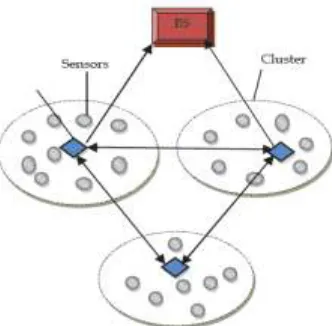
Cluster-Base d Approach: In energy-constrained sensor
IJEDR1702184
International Journal of Engineering Development and Research (www.ijedr.org)1103
Fig 2: Cluster based data aggregation
Multi-path Appr oac h: The drawback of tree based approach
is the limited robustness of the system. To overco me this drawback, a new approach was proposed by many researchers .in wh ich sending partially aggregated data to single parent node in aggregation tree, a node could send data over mult iple paths. In which each and every node can send data packets to its possibly mult iple ne ighbors[9]. Hence data packet flow fro m source node to the sink node along mu ltip le path, lot of intermediate node between source node to sink node so aggregation done in every intermed iate node. Using this approach we will ma ke the system robust but some e xtra overhead.
Hybri d Appr oac h: Hybrid approach followed between tree,
cluster based and mult ipath scheme. In wh ich the data aggregation structure can adjusted according to specific network situation and to some performance statistics.
IV. LITERATURES URVEY
Gu rbinder Singh Bra r et al. [17] propose directional transmission-based energy aware routing protocol named PDORP. The proposed protocol PDORP has the characteristics of each power economical gathering device data system and DSR routing protocols. In addition, hybridizat ion of genetic algorith mic rule and mic roorganism hunt improvement is applied to projected routing protocol to establish energy economical best methods. The performance analysis, comparison through a hybridization approach of the projected routing protocol, gives higher result comprising less bit erro r rate, less delay, less energy consumption, and better output, which leads to higher QoS and prolong the period of the network. Moreover, the co mputation model is adopted to evaluate and compare the performance o f the each routing protocols exploitation soft computing techniques.
Jin Qi et a l. [18] proposed a hybrid security and compressive sensing-based theme for mult imed ia system device information gathering is bestowed. It has light security mechanis m and so decreases the comple xness and energy consumption of system. The use of cryptographic techniques like secret writing and hashing mostly will increase the energy consumption of sensors, which aggravates the original crucia l energy constraint downside of wireless device networks (WSNs). To reduce the burden of sensors, compression can be
utilised. Since the tradit ional chaos -based schemes aren't directly applicable for WSNs, we gift a hybrid security answer. The hybrid security consists of 8-bit integer chaotic block secret writing and a chaos -based message authentication codes.
Muhammad Us man et al. [19] proposed a class -conscious D2D co mmun ication design wherever a centralized software-defined network (SDN) controlle r co mmun icates with the cloud head to scale back the quantity of requested long-run evolution (LTE) co mmunicat ion lin ks, thereby imp roving energy consumption. The concept of native and central controller permits our design to work just in case of infrastructure harm and hotspot traffic scenario. The architecture helps to maintain the commun ication between disaster victims and initia l responders by putting in mult i-hop routing path with the support of the SDN controller.
Li Sun et al. [20] proposed a fountain -coding motor-assisted relaying the me to deal with challenge to ensure the secrecy of cooperative transmissions underneath eavesdropping attacks. Using projected approach all the supply packets area unit initia l encoded with fountain codes (FCs) and then transmitted over the channels. Based on th e essential characteristic o f FC trans missions, a suffic ient variety of coded packets have to be with success received to recover the in itia l informat ion. There fore, transmission secrecy is guaranteed if the legit imate rece iver will accumulate the needed variety of FC packets before the auditor will. To satisfy this condition, a cooperative ja mming methodology is utilised to worsen the rece ived signal quality at the auditor. By apply ing the constellation rotation approach, the information-bearing signal and the electronic countermeasures signal area unit designed rigorously to cut back the negative result of the ja mming procedure on the legitimate rece iver.
Jun Wu et al. [21] proposed a hierarchical fra me work based mostly on probability discovery and usage manage ment (UCON) technologies to boost the protection of WSNs whereas still taking the low-comp le xity and high security necessities of WSNs under consideration. The features of continuous call and dynamic attributes in UCON will address in progress attacks e xploitation advanced persistent threat detection. In addition, technique used a dynamic adaptive probability discovery mechanism to find unknown attacks. To design and imple ment a system e xp loitation the mechanism represented higher than, a unified fra me work is proposed in that low-level attack detection with easy rules is performed in sensors, and high-level attack detection with co mple x ru les is performed in sinks and at the base station.
IJEDR1702184
International Journal of Engineering Development and Research (www.ijedr.org)1104
sparsity constraint is obligatory on the nonlinear estimat ion byCKF. In order to develop a distributed reconstruction algorith m to fuse the random linear measurements fro m the nodes in WSNs, the PM e mbedded CKF is typeulated into the data form, and then the derived informat ion filter is comb ined with the agreement filter, wh ile the square-root version is more developed to imp rove the performance and strengthen power saving capability.
Ahmed Al-Riya mi et a l. [23] proposed a novel theme, called Associate in Nursing adjustive early node compro mise detection theme, to fac ilitate node co mpro mise attack detection in a cluster-based WSN. The scheme is designed to attain a coffee false positive magnitude relation within the presence of assorted levels of message loss ratios. To achieve this feature, t wo ideas area unit used in the p lanning. The first is to use cluster-based collective higher cognitive process to find node co mpro mises. The second is to dynamica lly adjust the rate of notification message transmissions in response to the message ratio within the sender's neighborhood. The performance of the scheme, in terms of fa lse positive ratio, false negative rat io, and transmission overheads, is evaluated using simulation.
Haip ing Huang et al. [24] proposed a novel Privacy -Preserving inner p roduct Protocol (PPSPP) for wireles s device networks. Based on PPSPP, then propose a Homo morphic-Encryption-based Euclidean Distance Protocol (HEEDP) while not third parties. This protocol can succeed secure distance computation between 2 device nodes. Correctness proofs of PPSPP and HEEDP are provided, followed by security validation and analysis. Perfo rmance evaluations via comparisons among simila r protocols demonstrate that HEEDP is superior; it is best in terms of both communicat ion and computation on a large vary of information variet ies, especially in wire less device networks.
V. PDORPALGO RITHM
PDORP is one of the heuristic optimization methodology and a set topic of swa rm intelligence. PDORP is supported replicat ing the concept of however water drops mix to make rivers and rivers successively mix to h itch the ocean by choosing the shortest path based mostly on altitudes of the land through that they flow[17]. In PDORP, the source (drop generating) positions generate water drops and these water drops square measure interested to satisfy the destination or ocean. Similarly, in WSN data assortment method, the sensor nodes generate the knowledge and this knowledge is interested to achieve the bottom station. Each such sensing ele ment network node has many parts: a radio t ransceiver with associate externa l associatetenna or association to an internal antenna, associate electronic circuit for interfac ing with the sensors and an energy supply, a mic rocontroller, usually a battery or associate embedded sort of energy harvest. In river formation stage, the river is c reated between drop generating positions and ocean explo itation the repetitive method having the functions select−Forward −Position(), move−Drops(), erode−Path(), and add−Sediments()[17]. The iterative method is recurrent t ill e ither a ll drops follow the sa me path or
satisfying the opposite ending conditions like restricted variety of iterations, limited e xecution time. There is similarity a between PDORP and data assortment processes in WSN. In PDORP, the source (drop generating) positions generate water drops and these water drops square measure interested to satisfy the destination or ocean. Hence, the sensor knowledge act like water drops, the source positions like sensing element nodes, and base station as Sea. In the proposal an approach is outlined for energy potency and reduction in knowledge born within the WSN network. In PDORP algorith m a set is outlined, in which if one node therein set is died out then the fu ll set ought to be replaced[1]. A modification in the PDORP a lgorith m is created to attain the objectives of the analysis during which associate energy threshold set for every node. In case of the proposed approach with the lo w energy within the set of network the neighbour nodes of the set will co wl the rea lm of the died node. The proposed approach is outlined on the basis of hymeno pteran Colony improve ment e xplo itation that the rule beco me a lot of energy economica l. In this way the information born attributable to the replace ment of the set is also reduced therefore there's a discount within the energy dissipation[17.]
VI. LIMITATION OF PDORP
In WSN, mu lti-hop routing is an effective mechanism for knowledge assortment. In mu lti-hop routing, the selection of forwa rd node for re laying knowledge plays a significant ro le. In the WSN the most important proble m is to conserve energy and improve the network period. In this research the higher than outlined drawback are taken ca re of[17.
The proble m of the way to transfer knowledge to the sink as quick as potential whereas maintain ing energy potency is difficult. Although there have been varied studies regarding the way to choose associate optimized re lay node to attain the minimu m delay, to our knowledge, a theoretical study of end -to-end delay and energy efficiency has not until now been performed as a result of these goals square measure connected to a plurality of network para meters[17].
• One of the biggest disadvantages of enormous scale wireless sensor networks lies on the quality of supply involving selective replace ment of sensors that have ran out of energy.
• More comp le x to tack than wired network. • Gets distracted by various parts like Blue-tooth. • It does not enable USA to try to to over are often fin ished a wired system
Using this approach the data dropped and other Quality parameters are also improved like, de lay, load and throughput etc as defined in results and discussion.
VI. LIMITA TIO N O F PDORP
In WSN, mu lt i-hop routing is an effective mechanis m for data collection. In mult i-hop routing, the selection of forwa rd node for re laying data plays a vital role. In the WSN the ma jor problem is to conserve energy and improve the network lifetime . In this research the above defined proble m will be taken care of[17.
IJEDR1702184
International Journal of Engineering Development and Research (www.ijedr.org)1105
to select an optimized re lay node to achieve the min imu mdelay, to our knowledge, a theoretical study of end -to-end delay and energy effic iency has not hitherto been performed because these goals are re lated to a plura lity of network parameters[17].
One of the b iggest disadvantages of large scale wireless sensor networks lies on the comple xity of logistics involving selective rep lace ment of sensors that have ran out of energy.
More comp le x to configure than wired network. Gets distracted by various elements like Blue-tooth. It does not allo w us to do more than can be done with
a wired system
I. CONCLUS ION
This paper presents wire less sensor network is consist a large number of sensor node. And these nodes are resource constraint. That’s why lifetime of the network is limited so the various approaches or protocol has been proposed for increasing the lifet ime of the wireless sensor network. The paper discusses, the data aggregation is one of the important technique for enhancing the life t ime of the network and security issues like data integrity. W ith the help of integrity we reduce the comp ro mised sensor source nodes or aggregator nodes from significantly altering the final aggregation value.
VII.REFER ENC ES
[1]. Kiran Mara iya, Ka ma l Kant, Nitin Gupta, “W ire less Sensor Network: A Revie w on Data Aggregation”, International Journal of Sc ientific & Engineering Research Volu me 2, Issue 4, April -2011
[2]. Lutful Karim, Nidal Nasser, Hanady Abdulsalam, ImadMou kadem, “An Effic ient Data Aggregation Approach for Large Sca le Wireless Sensor Networks.”
[3]. Sanjay Eknath Gawali, Prof. D. S.Mantri, “Lifetime Energy Efficient Optimization for WSN”
[4]. PrakashgoudPatil, Umakant P Kulkarn i, “ENERGY EFFICIENT A GGREGATION WITH DIVERGENT SINK PLA CEM ENT FOR WIRELESS SENSOR NETWORKS”, International Journal of Ad hoc, Sensor & Ubiquitous Co mputing (IJASUC) Vo l.4, No.2, April 2013
[5]. Neera j Ku mar Mishra, Vikra m Ja in, Sandeep Sahu , “Survey on Recent Clustering Algorith ms in Wireless Sensor Networks ”, International Journal of Scientific and Research Publications, Volu me 3, Issue 4, April 2013
[6]. KarimSeada, Marco Zuniga, Ahmed He lmy, Bhaskar Krishnamachari, “Energy Efficient Forward ing Strategies for Geographic Routing in Lossy Wireless Sensor Networks”
[7]. Xun Li, Geoff V Merrett, Neil M White, “Energy-efficient data acquisition for accurate signal estimation in wireless sensor networks”, Journal onWireless Commun ications and Networking 2013 [8]. Gyanendra Prasad Joshi, SeungYeob Na m and Sung
Won Kim, “Cognitive Radio Wireless Sensor
Networks: Applications, Cha llenges and Research Trends.”
[9]. Stefanos A. Nikolidakis, DionisisKandris, Dimitrios D. Vergados, Christos Douligeris, “Energy Efficient Routing in Wire less Sensor Networks Through Balanced Clustering”
[10]. Wei Ye, John He ide mann, Deborah Estrin, “An Energy-Efficient MA C Protocol for W ire less Sensor Networks”
[11]. Mohit Saini, Ra kesh Kuma r Sa ini, “Solution of Energy-Efficiency of sensor nodes in Wire less sensor Networks ”, International Journal of Advanced Research in Co mputer Sc ience and Software Engineering, Vo lu me 3, Issue 5, May 2013
[12]. Mark Adam Perillo, “Role Assignment in W ireless Sensor Networks: Energy-Effic ient Strategies and Algorith ms”
[13]. Shashidhar Rao Gandham, M ilind Da wande, Ravi Prakash, S. Venkatesan, “Energy Efficient Schemes for W ire less Sensor Networks with Multip le Mobile Base Stations.”
[14]. Eugene Shih, SeongHwan Cho, Nathan Ickes, Re x Min, A mitSinha, A lice Wang, Anantha Chandrakasan, “Physical Layer Driven Protocol and Algorith m Design for EnergyEfficient W ire less Sensor Networks”
[15]. N. Akilandeswari, B. Santhi and B. Baranidharan, “A SURVEY ON ENERGY CONSERVATION
TECHNIQUES IN WIRELESS SENSOR
NETWORKS”, A RPN Journal of Engineering and Applied Sciences, VOL. 8, NO. 4, APRIL 2013 [16]. Neeraj Ku mar, Manoj Ku mar, and R. B. Patel, “A
Secure and Energy Effic ient Data Dissemination Protocol for Wireless Sensor Networks”, International Journal of Network Security, Vo l.15, No.6, PP.490-500, Nov. 2012
[17]. Gu rbinder Singh Bra r, Shalli Rani, Vinay Chopra, Rahul Ma lhotra, Houbing Song, Syed Hassan Ahmed, “Energy Efficient Direction-Based PDORP Routing Protocol for WSN”, Special Section On Green Co mmunicat ions And Networking For 5g Wireless, IEEE Access, ISSN: 2169-3536, Vo lu me 4, 2016, pp: 3182-3194
[18]. Jin Qi, Xiao xuan Hu, Yun Ma, Yanfei Sun, “A Hybrid Security and Co mpressive Sensing -Based Sensor Data Gathering Scheme”, Special Section On Industrial Sensor Networks With Advanced data manage ment: design and security, IEEE Access, ISSN: 2169-3536, Volu me : 3, 2015, pp: 718-724 [19]. Muhammad Usman, Anteneh A. Gebre ma ria m,
IJEDR1702184
International Journal of Engineering Development and Research (www.ijedr.org)1106
[20]. Li Sun, Pinyi Ren, Qinghe Du, Yichen Wang,“Fountain-Coding Aided Strategy for Secure Cooperative Transmission in Industrial W ire less Sensor Networks”, IEEE Transactions on Industrial Informatics, ISSN: 1551-3203, Vo lu me : 12, No: 1, 2016, pp: 291-300
[21]. Jun Wu, Kaoru Ota, M ian xiong Dong, Chun xiao Li, “A Hierarch ical Security Framework for Defending Against Sophisticated Attacks on Wireless Sensor Netwo rks in Smart Cities”, IEEE Access, ISSN: 2169-3536, Vo lu me : 4, 2016, pp: 416-424
[22]. Zhi Zhao, Jiuchao Feng, Bao Peng, “A Green Distributed Signal Reconstruction Algorithm in Wireless Sensor Networks”, Special Section On Green Co mmunications And Networking For 5g Wireless, IEEE Access, ISSN: 2169-3536, Volu me : 4, 2016, pp: 5908-5917
[23]. Ahmed Al-Riya mi, Ning Zhang, John Keane, “An Adaptive Early Node Co mpro mise Detection Sche me for Hierarch ical WSNs”, IEEE Access, ISSN: 2169-3536, Volu me : 4, 2016, pp: 4183-4206