Original Research Article
Evaluation of research skills of medical interns by focus group
discussion: a qualitative study in Chennai, India
Ganesh Shanmugasundaram Anusuya*, Balaji Arumugam, Sree T. Sucharitha,
Karthik R. C., Radhakrishnan A., K. R. S. Sivapriya, Ezhilvanan M.
INTRODUCTION
Health research is an important component of post graduate medical education in India. But the level of importance of research in undergraduate medical education has always been a major concern. Many undergraduate medical students do not know the various steps involved in a research process. The problem is that even in countries with a renowned calling for science, such as the USA, it is increasingly less common for doctors to decide to focus their careers on scientific
activity.1,2 The main solution for this problem can be introducing the medical professionals to research training at an early part of their academic training.2
Even though the research skills can be imparted by training and by giving an experience of doing a research project. The level of research skills acquired by an undergraduate medical intern after completion of a research project has not been studied so far in Tamil Nadu, India.
ABSTRACT
Background: Health research has become an important component of undergraduate medical curriculum. Hence we assessed the research skills of interns who have recently completed the community medicine internship postings.
Methods: It is a qualitative cross sectional study of 32 interns who have completed community medicine internship postings and also have completed a research project during the postings in a private medical college in Chennai. The method of assessment is by focus group discussion. Duration of the study was 10th August to 23rd August 2018. The research skills were graded on a 0 to 9 point ordinal scale. The mean difference in research skills before and after the postings were analysed using paired t test.
Results: 43.8% were males. The mean age was 22 years. 15.6% felt they had research skills even before entering the internship postings. 100% felt they have acquired some kind of research skills after postings. The research skills acquired by the interns were in doing review of literature (50%), sample size calculations (53.1%), methodology (43.8%), questionnaire development (75%), data collection (75%), data entry (53.1%), data analysis under guidance (21.9%), report writing (34.4%), and presentation skills (65.6%). The overall mean increase in research skills before and after the postings was nearly 4.03 (p=0.000). Suggestions given by interns to improve the research activity were giving individual topics (19%), more time (47%) and more guidance (9%).
Conclusions: Our study has shown that a research project done during the community medicine internship postings has helped interns to gain research skills.
Keywords: Research skills, Medical Interns, Focus group discussion, Qualitative study
Department ofCommunity Medicine, Tagore Medical College and Hospital (TMCH), Chennai, Tamil Nadu, India
Received: 01 September 2018
Revised: 15 September 2018
Accepted: 18 September 2018
*Correspondence:
Dr. Ganesh Shanmugasundaram Anusuya, E-mail: [email protected]
Copyright: © the author(s), publisher and licensee Medip Academy. This is an open-access article distributed under the terms of the Creative Commons Attribution Non-Commercial License, which permits unrestricted non-commercial use, distribution, and reproduction in any medium, provided the original work is properly cited.
Hence we wanted to assess the level of research skills of medical interns who have completed the community medicine postings in a private medical college in Chennai, India and also who have completed a research project under guidance during their two months of postings in community medicine department.
METHODS
This is a cross sectional qualitative study of 32 medical interns who have completed a research project in community medicine postings in Tagore medical college and hospital, Chennai. Ethical clearance was obtained from Institutional Ethical Committee of Tagore Medical College and Hospital, Chennai. Informed consent was also obtained from study participants. Duration of the study: August 10th to 23rd 2018.
As a part of routine activity during the internship postings in community medicine department in Tagore medical college, the interns were exposed to do a research project. The research project was a group activity and done under the guidance from faculties of the community medicine department.
Focus group discussion
The research skills of the interns who have completed the research project were obtained using a focus group discussion (FGD). The FGD was conducted after getting informed consent from the medical interns. We opted for FGD because, a FGD is a good way to gather together people from similar backgrounds or experiences to discuss a specific topic of interest. The group of participants is guided by a moderator (or group facilitator) who introduces topics for discussion and helps the group to participate in a lively and natural discussion amongst themselves.3
FGD should be used when you need to understand an issue at a deeper level than you can access with a survey4. The basic rules of FGD like the facilitation, ensuring even participation, careful wording of the key questions, maintaining a neutral attitude and appearance, and summarising the session to reflect the opinions evenly and fairly were followed by session moderator.3-7
The total of 32 interns were divided into 3 FGD groups. The number of participants in each FGD group were 12, 12 and 8. The average time taken for each FGD was 45 minutes. All the FGD were moderated by a single associate professor to avoid bias. The questions asked during the FGD were
Have you been involved in any research activities prior to community medicine postings? If yes explain in what way you were involved. Kindly specify in which activity you were involved?- Review of literature, sample size calculations, methodology,
questionnaire development, data collection, data entry, data analysis, report writing and presentation skills
Do you think the research activity done in postings helped you to gain research skills? If yes explain how much skills you gained?
What are all the skills you have acquired from doing
the research project in posting? Kindly choose the activities you were involved and also you feel competent enough to handle now - Review of literature, sample size calculations, methodology, questionnaire development, data collection, data entry, data analysis, report writing and presentation skills
What are the suggestions for improving research skills for interns?
In future are you confident of undertaking research projects?
All the FGD were video recorded and the answers were translated into quantitative data.
Scoring system
An working definition was given for the scoring of the individual research skill acquired. A score of 0 was given if a particular skill was not present. A score of 1 was given for each individual skills acquired. The research skills that were taken into consideration were review of literature, sample size calculations, methodology, questionnaire development, data collection, data entry, data analysis, report writing and presentation skills. Based on their responses the scoring was done on a ordinal scale of 0-9. The scores obtained were analysed before and after completion of research project and the mean difference in the score before and after completion of research project was analysed using paired t test. The descriptive statistics were also done.
Data analysis
The FGD was video recorded and the answers collected were translated into quantitative data and entered into excel and analysed by SPSS version 20.
RESULTS
The total number of study participants was 32 medical interns. The mean age of the study participants was 22 years (range 21–24). Nearly 27 (85%) said they have never been involved in any kind of research activity prior to community medicine internship postings. The level of research skill acquired by them after the postings is shown in Figure 1.
Figure 1: Level of competency acquired by medical interns.
Figure 2: Type of research skills acquired.
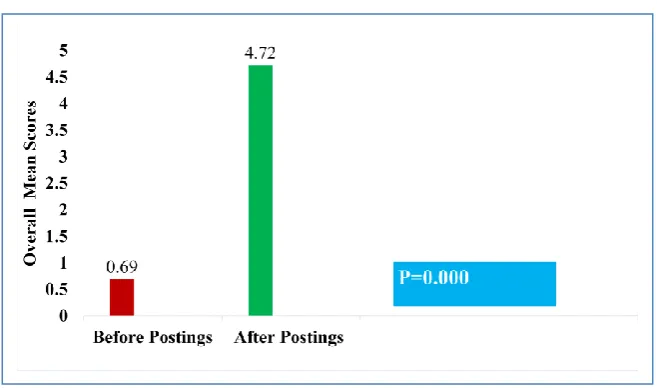
Figure 3: Mean score difference in research skills acquired by interns.
You can see from Figure 2, the interns stated nearly 75% of them were confident of the research activity of questionnaire development and data collection followed
Suggestions given by interns to improve the research activity were, giving individual research topics (19%), more time to do research (47%), more guidance (9%), more field exposure (6%) and 25% said nil suggestions. 78.1% felt they are now confident enough to undertake a research project in the future.
Comparison of mean scores
We compared the overall mean scores before and after completion of the postings. The mean score before the postings was 0.69 and after the postings were 4.72. The mean difference in the score of 4.03 was statistically significant (p=0.000) (Figure 3).
DISCUSSION
Our study showed that there was an improvement in perception of research skills acquired after completion of the research project. Similar findings were also reported by a study done by Devi et al in Melaka Manipal Medical College, India.8
Devi et alstudy findings also reflected our study findings of requirement of more time in terms of time management.8 Nearly 85% said they have never been exposed to any kind of research activity before to community medicine postings. This was comparable with a bibliometric analytic study done by Sachdeva et al.9 The study done by Sachdeva et al showed the published articles of undergraduate medical students as co-author had 35% community medicine department faculties as corresponding author.9 In a way this shows most of the undergraduate research activity were done in community medicine postings or under the guidance of community medicine faculties.
Our study showed the overall mean score of perception of acquired research skills improved from 0.69 to 4.72 on a ordinal scale of 0 to 9. The study done by Devi et al also showed that their mentored student research project has improved their research skills of medical students.8
CONCLUSION
Our study showed because of a research project done by medical interns during the two months period of community medicine internship postings significantly improved their research skills. Evidence based medicine has become an important component of health care decision making.8,10
It is essential to inculcate critical thinking and reasoning skills, and to develop a positive attitude among medical students towards scientific research from the beginning of their medical career.8,11 Research projects helps to develop analytical thinking and self directed learning skills and also helps to improve presentation skills and other communication skills. Furthermore, these projects play a role in producing physicians who are better
equipped to evaluate and apply new knowledge to their profession.8,12-16
Community medicine and community medicine faculties can play a vital role in creating the ―Indian Medical Graduates‖ with the necessary competencies (knowledge, skills, and attitudes) including research skills to become a better doctor of the future.17
Hence we strongly recommend, in future the Medical Council of India should make it mandatory that every medical intern should complete an individual research project under guidance as a part of one year internship programme to receive the medical degree.
ACKNOWLEDGEMENTS
We acknowledge all the medical interns who co-operated for the focus group discussion.
Funding: No funding sources Conflict of interest: None declared
Ethical approval: The study was approved by the Institutional Ethics Committee
REFERENCES
1. Solomon SS, Tom SC, Pichert J, Wasserman D,
Powers AC. Impact of medical student research in the development of physician-scientists. J Investig Med. 2003;51(3):149-56.
2. William MD, JotzMaitê, Roberto MW, Sabrina
MM, Steffi V, Christ M, et al. Interest in research among medical students: Challenges for the undergraduate education. Rev Assoc Med Bras. 2016;62(7):652-8.
3. Research tools: Focus group discussion. Toolkits.
2009. Available at: https://www.odi.org/
publications/5695-focus-group-discussion. Accessed 10 August 2018.
4. How to Conduct a Successful Focus Group
Discussion. 2017. Available at: https://blog.
socialcops.com/academy/resources/conduct-successful-focus-group-discussion/. Accessed 10 August 2018.
5. Krueger RA. Focus Groups: A practical guide for applied research. Sage, UK; 1988.
6. Morgan DL. Focus Group as qualitative research. Sage, UK; 1988.
7. Stewart DW, Shamdasani PN. Focus Groups:
Theory and Practices. Sage, UK; 1990.
8. Devi V, Abraham RR, Adiga A, Ramnarayan K,
Kamath A. Fostering research skills in
undergraduate medical students through Mentored Student Projects: Example from an Indian medical school. Kathmandu Univ Med J. 2010;8(31):294-8.
9. Sachdeva S, Sachdev TR, Sachdeva R, Dwivedi N,
Bibliometric Analysis. Indian J Comm Health. 2017;29(3):287-91.
10. Bornstein BH, Emler AC. Rationality in medical decision making: a review of the literature on doctors’ decisionmaking biases. J Eval Clin Pract 2001;7:97-107.
11. Ghali WA, Saitz R, Eskew AH, Gupta M, Quan H,
Hershman WY. Successful teaching in evidence-based medicine. Med Educ. 2000;34:18–22.
12. Kanter SL, Wimmers PF, Levine AS. In-depth
learning: One school’s initiatives to foster integration of ethics, values, and the human dimensions of medicine. Acad Med. 2007;82:405–9. 13. Schor NF, Troen P, Kanter SL, Levine AS. The
Scholarly Project Initiative: Introducing scholarship in medicine through a longitudinal, mentored curricular programme. Acad Med. 2005;80:824–31.
14. Parsonnet J, Gruppuso PA, Kanter SL, Boninger M.
Required vs. elective research and in-depth scholarship programmes in the medical student curriculum. Acad Med. 2010;85:405–8.
15. Green EP, Borkan JM, Pross SH, Adler SR,
Nothnagle M, Parsonnet J, et al. Encouraging scholarship: Medical school programmes to promote student inquiry beyond the traditional medical curriculum. Acad Med. 2010;85:409–18.
16. Bierer SB, Chen HC. How to measure success: The
impact of scholarly concentrations on students—A literature review. Acad Med. 2010;85:438–52.
17. Sowmiya KR, Arumugam B. Summative to
Formative Assessment: The Road to Competency Based Education. Ann Int Med Den Res. 2016;2(6):1-4.
Cite this article as: Anusuya GS, Arumugam B, Sucharitha ST, Karthik RC, Radhakrishnan A, Sivapriya KRS, et al.Evaluation of research skills of medical interns by focus group discussion: a