RBF network based motion trajectory optimization for
robot used in agricultural activities
Yanan Sun*, Zhongqiang Pan
Network Management Center, Pingdingshan University, Pingdingshan, 467000, China
*Corresponding author:
Yanan Sun, Network Management Center, Pingdingshan University, Pingdingshan, 467000, China. E-mail: [email protected]
Revised: 31 December 2017; Accepted: 10 April 2018
INTRODUCTION
At present, the mobile robot has been widely used in the
field of agricultural production. The fruit and vegetable
picking robot has become an Indispensable equipment
to improve the yield of fruit and vegetable. Due to
the non-linearity and non-completeness of fruit and vegetable picking robot, to efficiently track and forecast
motion trajectory of fruit and vegetable robot has been a
challenging research (Maddi et al., 2018; Yadav et al., 2018). In order to realize the tracking and prediction of motion
trajectory of fruit and vegetable robot, the relevant scholars
and experts track and predict the overall moving trajectory of robot manipulator. The results can improve the working efficiency. But the tracking process is complex and the calculation time of tracking prediction is too long, which cannot meet the real-time tracking of motion trajectory
of fruit and vegetable robot and high efficient prediction
(Zheng & Wang 2017, Cui & Tian 2016). In order to solve this problem, some scholars and experts have got some achievements (Huang et al., 2016).
In achievement one, a method to track and predict flux linkage trajectory based on model prediction is proposed. This method uses the optimized pulse-width modulation model (PWM) to predict the trajectory of magnetic chain (Karim et al., 2017; Nyemb et al., 2018; Rahman et al., 2018). It does not need to estimate the fundamental components of stator flux linkage and voltage in real time, and realizes the high performance closed-loop control of optimized PWM. The effective set method is used to solve the numerical value. The optimal PWM switch angle is corrected as little as possible and the deviation of tracking magnetic chain is eliminated. Thus, the tracking prediction of flux linkage trajectory based on optimized PWM is realized. But this method has a large error in tracking prediction (M.M. 2017).
In achievement two, a method to design trajectory tracking model predictor is proposed. A nonlinear space model with only two control inputs and interference is built (Borogayary et al., 2018; Khan et al., 2017; Kylili et al., 2018; Sanchez Camacho and Martinez Morales, 2017; Wu et al., 2018). But,
At present, the efficiency of the method to track and predict motion trajectory of fruit and vegetable picking robot was low and the realization process was complex. Therefore, a research on motion trajectory optimization of fruit and vegetable picking robot based on RBF network was proposed. After analyzing the reason for data class imbalance of fruit and vegetable picking robot, this paper introduced the processing technology MWMO in RBF network. Then, the MWMO technology was embedded in the tracking and prediction research of motion trajectory optimization of fruit and vegetable picking robot. Moreover, the semi-supervised learning algorithm was used as the framework and integrated the processing technology of data class imbalance of motion trajectory to improve the efficiency of tracking and prediction of fruit and vegetable picking robot. According to the integration result, combined with the idea about the calculation of spatial function and the tracking and prediction of motion trajectory in RBF network, we designed the matching principle of trajectory similarity of time and space and realized the matching between the predicted position and the actual position, so that the tracking and prediction of fruit and vegetable picking robot could be completed. Experimental results show that the average calculation time of proposed method is 2.0S, which is only half of average time of traditional tracking and prediction method. It fully proves that the proposed optimization method can accurately track and predict the motion trajectory of fruit and vegetable picking robot. The prediction efficiency is higher and the time consumptionis shorter.
Keywords: RBF network; Fruit and vegetable picking robot; Trajectory; Tracking prediction; Optimization
A B S T R A C T
http://www.ejfa.me/
this method has a large amount of computation, leading to the complex process of tracking and forecasting(Wang et al., 2017). In achievement three, a method to track and predict trajectory based on support vector machine is proposed. The input and output data of network system are collected and designed. The generalized inverse system is obtained by support vector machine, which is decoupled from the original system (Litwin et al., 2017; Liu, 2018; Mo et al., 2018; Peng et al., 2017). For the decoupled system, the identification prediction model based on support vector machine and the predictive function control method based on PSO optimized control sequence are used to realize the tracking and prediction of motion trajectory. But, this method does not consider noise interference in social network, resulting in low accuracy of trajectory prediction (Zheng & Wang 2017). In achievement four, a method to track and predict motion trajectory of fruit and vegetable picking robot based on dynamic characteristic is proposed. This method has high accuracy for the tracking and prediction, but it costs a lot of prediction time due to calculation error, leading to low efficiency of tracking and prediction (Xue et al., 2016). In achievement five, a method to track and predict motion trajectory of robot based on reinforcement learning and self-organizing topology control algorithm of neural network is proposed. According to the reinforcement learning, we can intelligently probe the environment and accumulate the probe result into experience. Combined with the neural network topology control algorithm, we can realize the accurate tracking and prediction of motion trajectory of robot. This method achieves intelligent tracking and prediction, but the efficiency is low (Jiang J et al., 2017). In achievement six, a research on path planning of mobile picking robot based on visual path planning is proposed. This method has high accuracy in path control, but it can only play an auxiliary role in tracking and forecasting, and it cannot achieve accurate and high-efficient tracking and monitoring.
For above problems, a method on the motion trajectory
optimization of fruit and vegetable picking robot based on
RBF network was proposed. Experimental results show that the proposed optimization method can accurately track
and predict the motion trajectory of fruit and vegetable
picking robot, and the realization process is simple, which provides a theory basis for development of this subject in the application field. The overall implementation framework of proposed method is as follows:
Analyze the reasons for imbalance of trajectory data of
fruit and vegetable picking robot. MWMO processing
technology for imbalance of motion trajectory data class in RBF network is applied to the research of tracking and
predicting the motion trajectory of fruit and vegetable
picking robot.
Take the semi supervised learning algorithm as the framework to integrate the imbalance of motion trajectory data class.
According to the integration result of motion trajectory data class, the idea about the calculation of space function and the prediction of trajectory track in RBF network is fused to design the matching principle which comprehensively considers trajectory similarity between time and space.
The tracking prediction optimization method is verified by experiment and analysis.
Discussion.
Summarize the whole article and pointing out the way of future development.
METHODS AND MATERIALS
Research on imbalance of motion trajectory data classes for fruit and vegetable picking robot
For the data class imbalance of motion trajectory of
fruit and vegetable picking robot, this paper uses
semi-supervised learning method. The semi semi-supervised learning method is a method of probabilistic trajectory tracking based on classifier. It transforms the trajectory tracking problem into the problem of binary classification(Yang et al., 2016). The essence of semi-supervised learning: a learning algorithm between unsupervised learning (training data without any marks) and supervised learning (training data which is completely marked). The unprocessed data set of motion trajectory tracking prediction of fruit and vegetable picking robot isX =( ) 1,2, ,x ii = N, which
can be divided into two parts: the part Xl =( , , )x1 xl
is the marked motion trajectory data, the corresponding
mark isYl =( , , )y1 yl , and the unmarked motion
trajectory data isXu =(xl+1, , xl u+ ). The main idea of
algorithm: first, the initial classifier is obtained from the
data set ( , )X Yl l of motion trajectory. In each step, the
unlabeled data Xuis classified based the decision function, and its pseudo labels and weights are obtained, which are added in the training set. In view of the characteristic of semi-supervised learning method, the semi-supervised learning method is better than the full-supervised learning method and unsupervised learning method, which can improve the accuracy of learning algorithm and tracking performance. The Semi-Boosting learning method is an important method of semi supervised learning. The data set in Semi-Boosting training not only contains the unmarked
data set XU of motion trajectory but also contains the
marked data set XL of motion trajectory. To classify the
the training process is the key of Semi-Boosting tracking algorithm (Atikuzzamman, M et al., 2018).
1
1 1
2 ( )
( ) ( )
1
( ) ( , )
1 ( , )
n
i
n n i U
i H x
n L i
x X
H x H x i
U x X
q x e S x x
X
S x x e X − − − − ∈ − ∈ = +
∑
∑
(1) − + − − − ∈ − ∈ = +∑
∑
1 1 12 ( )
( ) ( )
1
( ) ( , )
1 ( , )
n
i
n i n U
i H x
n L i
x X
H x H x i
U x X
p x e S x x
X
S x x e X
(2)
Where, S x x( , )i denotes the similarity measure of
tracking and prediction sample of motion trajectory of
fruit and vegetable picking robot. Respectively, X+ and
X −denote the positive sample set and negative sample
set. eHn−1( )x denotes the similarity coefficient of tracking
prediction sample. Hn−1( )xi denotes the index function
of unprocessed data set. Hn−1( )x denotes the index
function of unmarked training samplex . p xn( ) denotes
the reliability degree that unmarked training sample
x belongs to normal sample. q xn( ) indicates that the
reliability degree that unlabeled training samplex belongs
to negative sample. p xn( )and q xn( ) can be calculated
directly. The key problem is to estimate the value in the online case and introduce the boosting method: firstly, to
train H P (a priori classifier), which will be rough, and
then to calculate the approximate value of p xn( ) and
( )
n
q x by the estimation method, as shown in formula (3) and formula (4).
1( ) ( ) ( ) ( )
( )
P n
P P
H x H x
n eH x e H x
p x e e − − − = + (3)
1( ) ( ) ( ) ( )
( )
P n
P P
H x H x
n H xe e H x
q x e e − − − = + (4)
According to above formulas, the pseudo label and weight of unmarked motion trajectory data are calculated in the
trajectory tracking prediction of fruit and vegetable picking
robot. After getting the pseudo label and weight, we add them in the training set, and then they can participate in the updating of classifier (S.N. and Hanafiah 2017.)
The semi-supervised online learning method shows the good adaptability in the tracking process. The positive sample which is adjacent to the current target location and the negative sample which is far away from the current target location are used to update the tracker and model.
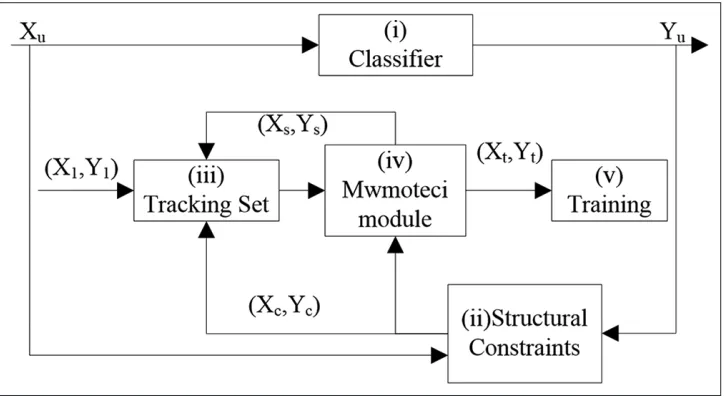
Generally, it has good adaptability to new apparent change and new background change. The classifier training only has only a marked sample and unlabeled samples of all subsequent frames. In the framework of semi-supervised algorithm, the focus of class imbalance is the class imbalance processing (CI) module in Fig. 1 (the framework of P-N tracking algorithm). The meaning of each module: (i) classifier marks unlabeled samples, (ii) correct the sample that violates the constraint condition, (iii) training set after joining a new sample, (iv) use the class imbalance technique to balance the training set, (v) retrain the classifier.
The class imbalance method has two aspects of purposes: improve the sample selection mechanism of motion trajectory tracking prediction and improve the mechanism of minority class sample synthesized by artificial interpolation in over-sampling(Artaud et al., 2016). The class imbalance process method has three steps: firstly, in
the minority classSminof previous training set, the majority
class weighting and minority class over-sampling technique
are used to recognize minority classSminthat is difficult
to learn; secondly, based on its importance in data set, a
weight Swis given for each Simin; thirdly, the class imbalance
processing technology MWMO is used to combine weight
w
S fromSiminto generate synthetic sample trajectory data
and add it in Sminto form an output setSomin. The principle of equalization technique of majority class weight and minority sample oversampling is as follows:
Supposing thatNN x( )denotes the nearest neighbor set
of sample points of user location, andNmaj( )x denotes
the nearest set of minority class, and Nmin( )x denotes the
nearest set of majority class, and their respective elements
arek k k1, 2, 3. When k1=k2=k3 5= , N Amaj of minority
classAis( , , , , )P Q R S T . For the sample of majority class
P , N Pmin is ( , , , , )A B C D E .
The detailed process to constructSiminis described as
follows:
MWMO firstly filters the minority classSminin initial data
set of motion trajectory tracking prediction, and the set
minority class is labeled asSminf : in implement process, we
calculate its NN x( )for each xi ∈Sminelement. If NN x( )
only contains the majority class, the corresponding xi
should be filtered out.
For each xi ∈Smin, the correspondingNmaj( )xi is
in Nmaj( )xi will be the majority class sampleSbmajon the
edge. They are at the decision boundary. Sb m a j is obtained
by adding all Nmaj( )xi .
For each y Si ∈ bmaj, MWMO calculatesNmin( )yi and
combines the calculation results to getSimin.
The big weight value denotes the important minority class. Correspondingly, composite value should be generated around it. The process of using MWMO to calculate
weight value is as follows: each majority class of y Si ∈ bmaj
sample gives each minority sample a weight (information
weight). I y xw( , )i i is defined as the product of adjacent
factor C y xf( , )i i and density factorD y xf( , )i i of fruit
and vegetable picking robot.
( , ) ( , ) ( , )
w i i f i i f i i
I y x =C y x ×D y x (5)
Where, the calculation for adjacent factor C y xf( , )i i of
motion trajectory of fruit and vegetable picking robot
needs two steps. ( , )
( , ) i i
n i i dist y x
d y x
l
= (6)
(1/ ( , )) ( , )
( )
n i i f i i
f
f d y x
C y x CMAX
C th
= ∗
(7) The formula (6) denotes the normalized Euclidean distance
i
y from to xi. l is the dimension of feature space. In
formula (7), C thf( )and CMAXare parameters defined by
( )
f •
the high value and limit the maximum value asC thf( ).
Therefore, the range of C y xf( , )i i value is [0,CMAX].
Then, f ( )• is defined as follows:
( )
( )
( )
f
f
x x C t h
f
C t h o t h e r w i s e
≤
• =
(8)
Because the distance from the decision boundary to the
two ethnic groups is equal, the density factor D y xf( , )i i
should have such function: when the sample is synthesized again, the sparse group and the dense group should be distinguished. Meanwhile, more and more synthetic samples should be formed around the sparse ethnic group.
( , )
f i i
D y x can be defined as:
min
( , ) ( , )
( , )
i f i i f i i
f i q S
C y x D y x
C y q
∈
=
∑
(9)MWMO uses the improved multilevel clustering algorithm
to find minority classSminand initializes the output set
min
o
S asSmin. Finally, based on above two steps, a linear
interpolation method is used to form the synthetic sample,
which is added in Sominto synthesize the sample of motion
trajectory tracking prediction of fruit and vegetable picking
robot.
The above discussion discusses the influence of motion trajectory data imbalance on the motion trajectory tracking
prediction of fruit and vegetable picking robot. Due to the
problem of sample training, the reason of imbalance of motion trajectory data class, which is still caused by the concept drift. After introducing the processing technology MWMO in RBF network, we embeds it in the tracking prediction method, and then use the semi-supervised
processing technology to realize the synthesis of motion
trajectory tracking prediction sample of fruit and vegetable
picking robot.
Optimization of prediction for motion trajectory track of fruit and vegetable picking robot based on RBF network
Based on the synthesis of tracking prediction samples of
motion trajectory of fruit and vegetable picking robot, the
motion trajectory of fruit and vegetable picking robot is
tracked and predicted. Because the original motion trajectory
of fruit and vegetable picking robot is a series of discrete
points(< p t1 1, >, , < p ti, i >, , < p tn, n >), in order to get further information, RBF network mapping and matching must be carried out, so as to obtain the specific motion trajectory information
1 1 1
( p e t, , , , p e ti, ,i i , , p e tn, ,n n )
′ < ′ > < ′ > < ′ > .
For each motion trajectory point < p ti, i >, the candidate
edge set is acquired. The candidate edge is defined as the
edge eiwhich is intersected with the circle that the center
of circle is< p ti, i >and the radius is r. The candidate
point is defined as follows: if the projection point of
motion trajectory point< p ti, i >at the edge is between
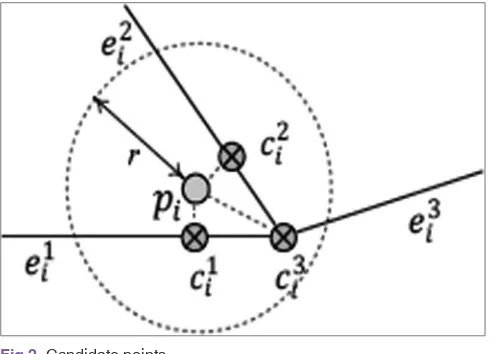
the two ends of the edge, the projection point is the candidate point. Otherwise, the end point which is close to the trajectory point < p ti, i >is the candidate point. In the following Fig. 2, the candidate edges of piare e e ei1, ,i2 i3.
Respectively, candidate points are 1, ,2 3
i i i
c c c . The number of candidate points of pi is ai.
Then, a candidate map including a series of trajectory points is obtained by time-space analysis. Because the difference between the coordinate of measured user location point and the actual position conforms to Gauss
distribution N( , ) 2 , the probability that a candidate
point j i
c is really the projection point of point pi is:
2 2 ( )
2
1 ( )
2
j i x u j
i
N c e
− −
= (10)
In the above formula, j
i
x denotes the Euler distance
between j i
c and pi . e denotes the coefficient of
Gaussian function. The spatial weight from the candidate
point c tj−1to the candidate point c sj is defined as follows:
1 1
( t s) ( )j ( t s),2
S j j i j j
F c − →c =N c ×V c − →c ≤ ≤i n (11)
In the above formula, ( t 1 s)
j j
V c − →c denotes the transfer
probability of t 1 s
j j
c − →c :
1. 1
( 1 , ) ( , )
( t s) i i
j j
i t i s
d
V c c
w
− −
− →
→ = (12)
In the above formula, di−1.idenotes the Euler distance from
1 i
p− to pi.w( 1, ) ( , )i− t →i s denotes the shortest path from the
candidate pointctj−1to csj. There is a hypothesis that the
fruit and vegetable picking robot often chooses the nearest
path between two points, and it is restricted by the space of network, thusdi−1.i ≤w( 1, ) ( , )i− t →i s . Then if the closer to
( 1, ) ( , )i t i s
w − → the value of di−1.i , the greater the probability
that ctj−1transfers to csj.
According to the candidate points obtained before, a matrix
M can be established:
( 2) (3) ( )
( , , , n )
M diag M= M M (13)
In the above formula, ( )
( )
( )1
( )
i i t s
ts S j j
M = m =F c − →c .
The matrix M only reflects the local influence of adjacent
two points. Due to the measured error, if we only consider adjacent two points, it is easy to fall into the local error (Zhang 2017, Lengyel et al., 2017). Meanwhile, this cannot
reflect the whole relationship among n trajectory points.
Therefore, a distance weight matrix Wiis established:
−
= { , ,1 i 1, , , }i n
i i i i i
W diag w w w w (14)
Where, j = ( ( , ))
i i j
w f dist p p , f( )⋅ is a distance weight function, which is used to denote the influence of point
j
p on point pi.
−
= ( , )
( ( , )) 2 dist p pi j i j
f dist p p (15)
A weighted scoring matrix for each tracking prediction
trajectory point can be obtained by W and M.
Φ =i W M diagi = { , , }Φ2i Φni (16)
Where, j
i
Φ denotes the weight score matrix of each
prediction point.
After getting the weight score matrix Φiof each prediction
pointpi , the best motion trajectory for pican be obtained,
which satisfies.
1
2 m i n n j
i j
Z −
=
=
∑
Φ (17)Finally, we vote for each candidate point in the best motion
trajectory obtained by pi. The candidate points should be
selected from each best motion trajectory, and then vote is
increased by 1. Corresponding to pi, the candidate point
k i
c with the largest number of votes is chosen as the final
mapping point. They are linked to get the required motion trajectory.
As mentioned above, to find the similar motion trajectory is a key to track and forecast the trajectory of fruit and vegetable picking robot. In order to find similar motion trajectories, we must quantify the specific definition of trajectory similarity. Considering that the trajectory mainly contains the factor of time and space, we use the two factors to define the similarity of trajectory.
At first, the spatial similarity of motion trajectory is considered. Because the motion trajectory of fruit and vegetable picking robot is actually composed of a series of edges, and each side can be regarded as a number, then the trajectory can be regarded as a character string. In character string processing algorithm, Levenshtein distance is a popular method to measure the similarity between two character strings. Based on the idea of Levenshtein distance, we propose a definition for spatial distance of motion trajectory.
The spatial distance of motion trajectory is the given trajectory 1′ and 2′, and their sub-trajectories τ ′1(1, )i and
2(1, )j
τ ′ and the spatial distance sdτ τ1 2′ ′, ( , )i j are defined as:
′ ′ ′ ′ ′ ′ ′ ′ = =
= >
= >
= − + >
− − + > ′⋅ ≠ ⋅′
− − > ′⋅ = ⋅′
1 2 1 2 1 2 1 2 , ,
, 1 2
, 1 2
0 0
0, 0
0, 0
( , ) ( 1, ) 1 , 0
min ( 1, 1) 1 , 0,
( 1, 1) , 0,
i j i j
i j
i j i
j i j
sd i j sd i j i j
sd i j i j e e
sd i j i j e e
(18) The space distance between two motion trajectories is actually an edge sequence of motion trajectory. After
deletion, insertion, and replacement operation, the minimum distance of another motion trajectory is obtained.
After getting the space distance between two trajectories, the similarity degree of two trajectories is defined. In fact, Levenshtein distance only considers the absolute factor such as those edges with difference of the two trajectories, but does not take into account the relative factor such as length of motion trajectory (Zhou et al., 2016, Wolz et al., 2018). For example, the space distance between two pairs of trajectories is 5, but one pair is 50 and the other pair is 20. Then for the first pair of track, they are very similar, but for the latter pair, they are very different. Thus, the formal definition of similar motion trajectory is given based on the length of motion trajectory.
The motion trajectories with spatial similarity: two
trajectories 1′ and 2′ are considered to be similar. If
they satisfy following conditions:
′ ′ ′ ′ ′ ′ ≥ ≥ ≤ ⋅ ⋅
′1 2 ′1 2 1 2
, ,
1 2 , 2
1 2
, ,
st st
sRatio
len len (19)
W h e r e , 1 2 1 2
, 1 2
,
1 2
( )
st len len
sRatio len len ′ ′ ′ ′ × ′⋅ − ⋅′ = ⋅ × ⋅ ′ ′ ,
1, 2 m a x { 1 , 2 } 1, 2
s t ′ ′ = ′⋅l e n ′ ⋅l e n −s d ′ ′ , 1 and
2
denote the parameters of two trajectories.
Because s d 1′ ′, 2 is the space distance between two motion
trajectories. In other words, it is the minimum operation times, if we use the length of longer motion trajectory sequence to subtract s d 1′ ′, 2 , then we can get s t 1′ ′, 2
. In other words, it is the number that two trajectories pass same edges, namely the same sub trajectories. The motion trajectory is not necessarily continuous. For example, the edge sequence passed by two sub-trajectories
i s 1 11′(e →e23→e28), (2 11′ e →e18→e28→e35) , a n d then theirs d 1′ ′, 2 is 2, and s t 1′ ′, 2 is 2. 1and 2 are the
specified parameters, which are set as 0.7 and 0.3. This definition shows that the two sub-trajectories with the same motion trajectory must be proportional to the length of two motion trajectories. Meanwhile, the difference of proportion cannot be too large.
The similarity degree with the historical motion trajectory:
a motion trajectory c i′ moving in a social network and a
historical motion trajectory hj′ are given. Their similarity
degree is as follows:
When c ei i′. =h e c′j k. , . i′ =h ′j. , ci′ and hj′are the
1 , (1, ) 2 ci h j
ij i j
S w c h k w e
′− ′
= × ′ ′ + × (20)
Otherwise, Sij =0.
Where, w1is the weight of spatial factor. w2is the weight
of time data. The historical trajectory h′j which is similar
to the driving motion trajectory c i′must also pass the
edge ci′.ek in the same time period c i′. .That is the
last side of current user.
After finding all the similar historical trajectories h′jof
running trajectories ci′of fruit and vegetable picking
robot, and their similarity Sij, the probability that ci′
appears on edge ek at some future time t+t can be
obtained:
+ =
∑
∑
, im
k t t m i
ij j
S P
S (21)
Where, Si m are all the trajectories appearing on the edge
k
e after time t which are similar to ci′. The user density
of a certain edge at some future time t +tis:
,
t t k t t
k i i
e ⋅ + =
∑
P +(22) Through the above discussion, the optimization method of tracking and forecasting motion trajectory of fruit
and vegetable picking robot was described in detail. By
matching the trajectory of fruit and vegetable picking
robot with the actual trajectory, the motion trajectory
of fruit and vegetable picking robot could be tracked
and predicted in real time. Therefore, we hoped to use similar historical trajectories for the tracing and prediction. The core was to design a matching principle of motion trajectory similarity that considered the space factor and time factor synthetically. Thus, the tracking and prediction
the trajectory of fruit and vegetable picking robot could
be realized.
RESULTS
In order to prove the effectiveness of research on motion
trajectory optimization of fruit and vegetable picking
robot based on RBF network, the proposed method is used to track and predict the motion trajectory of fruit and vegetable picking robot, and the experimental verification is carried out. This experiment uses the Gowallaregistration data set from famous American LBS website to track and
predict the motion trajectory of fruit and vegetable picking
robot. The experiment extracts the more than 30 thousand active trajectory data. Each motion trajectory data contains
the Id of fruit and vegetable picking robot, the starting
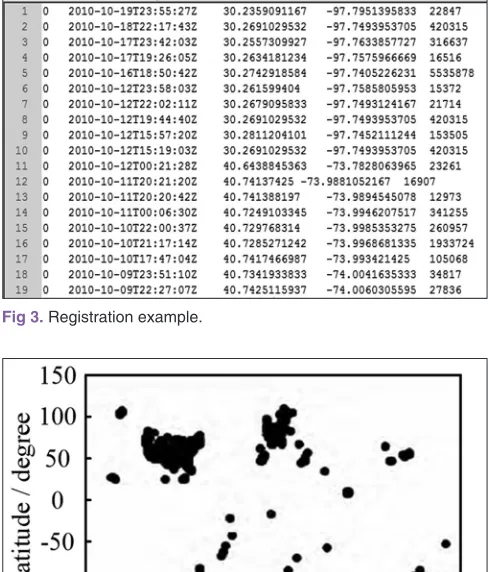
operation time, the latitude of operating trajectory point, the longitude of motion trajectory point and the longitude and latitude of end point of motion trajectory. The example
is shown in Fig. 3 and the distribution of original motion trajectory points is shown in Fig. 4.
The initial clustering radius of motion trajectory is
10 km. The minimum numberMinPtsin neighborhood
is 1000. The initial clustering area of motion trajectory is
shown in Fig. 5.
From Fig. 5, the clustering points of original motion trajectory are divided into five clustering regions (the black part is the noise point, which should be eliminated), and the radius of each region is relatively large, which does not conform to the actual application of motion
trajectory judgment of fruit and vegetable picking robot.
The traditional method is used to repeat the experiment. When the sign-in points are very dense, the smaller and more ideal cluster area cannot be obtained no matter how
to adjust and MinPts. Nevertheless, RBF network can solve the problem well. If the initial cluster radius of a
Fig 3. Registration example.
motion trajectory is too large, it will adjust and MinPts
adaptively, and then divides clustering areaagainuntil it meets the requirement.
Base on the proposed method, the distribution contrast between the motion trajectory of tracking prediction and the actual motion trajectory (the circle denotes the motion trajectory of tracking prediction, and the triangle denotes the actual motion track),which is shown as shown in Fig. 6.
From the above Fig., the proposed method can accurately track and predict the motion trajectory of fruit and vegetable picking robot. Because the proposed method analyzes the unbalance of motion trajectory data class in the process of tracking and prediction, and then reduces the interference of noise, the tracking accuracy is high and the tracking effect is good.
The effectiveness of motion trajectory optimization
method of fruit and vegetable picking robot based on RBF
network is proved through the collected trajectory data of
fruit and vegetable picking robot. Because the model only
tracks and predicts the future motion trajectory of fruit and
vegetable picking robot, it does not consider the retention of robot in the picking operation, we need to filter out the redundant trajectory data collected by robot at a certain point, and then abstract the motion trajectory data of
fruit and vegetable picking robot based on the similarity
of trajectory space. Table 1 shows the total amount of trajectory points collected by the acquisition program, the number of motion trajectory points after the abstraction, and the number of motion trajectory points in active regions after the abstraction.
The total number of trajectories of a fruit and vegetable
robot is processed and the total number of trajectories is active.
From the above table, the total number of motion trajectory
points of fruit and vegetable picking robot processed by
proposed method is obviously reduced. Using the proposed method to determine the similar motion trajectory, we can remove the prediction point with large error and improve the accuracy of tracking prediction. Therefore, the effect of abstraction processing is good and the accuracy of prediction results can be ensured.
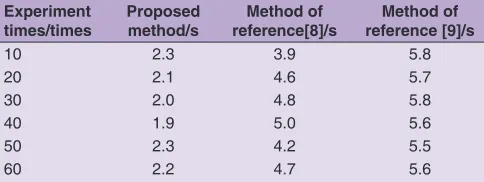
Finally, compared with different methods, the complexity of implementation of proposed optimization method is determined through the analysis of calculation time. In order to ensure the accuracy of analysis results, the method of reference (Yang et al., 2016) and the method of reference (Artaud, et al., 2016) method are introduced. Three methods are compared by the experiment. The contrast results of three methods are shown in Table 2.
From the above table, when method of reference (Artaud,
et al., 2016) is used to track and predict the motion
trajectory of fruit and vegetable picking robot, the average
calculation time is 5.7s. When the number of experiments is ten times, the calculation time is 5.8S. When the experiment reaches 50 times, the calculation time is 5.5s. When method of reference (Yang et al., 2016) is used to track and predict
the motion trajectory of fruit and vegetable picking robot,
the average calculation time is 4.6s. When the number of experiments is 10 times, the calculation time is shortest and it is only 3.9s. When the number of experiments is 40, the calculation time is 5.0s which is the longest. When propose method is used to track and predict the motion
trajectory of fruit and vegetable picking robot, the average
calculation time is 2.0S. When the number of experiments is 10 times and 50 times, the calculation time is the longest, which is 2.3S.The calculation time is the shortest which is 1.9s when the fortieth experiment is carried out. Compared
with the proposed method proposed with the method in
reference (Yang et al., 2016) and (Artaud, et al., 2016), the average calculation time of proposed optimization
Fig 5. Initial clustering area distribution of motion trajectory.
method is far less than that of method in reference (Yang et al., 2016) and (Artaud, et al., 2016), and it is close to the half of average calculation time of method in reference (Artaud, et al., 2016). This fully proved that the proposed optimization method has the shortest calculation time and the calculation time is more uniform. Meanwhile, the proposed method can rack and predict the trajectory of
the fruit and vegetable picking robot smoothly and quickly
(Anuar, M.S., 2018)
DISCUSSIONS
For the tracking and prediction of motion trajectory of robot, this article puts forward a research on motion
trajectory optimization of fruit and vegetable picking robot
based on RBF network, that is to say, an optimization method based on the RBF network. This method has the following contributions:
The proposed method studied has a sufficient analysis on reasons for the imbalance of motion trajectory data class. Based on the imbalance of trajectory data class caused by the concept drift, MWMO technique is used to insert it into the tracking and prediction method, and a semi-supervised learning algorithm is introduced to integrate the motion trajectory data and form the trajectory tracking prediction sample (M.M. 2018).
The way matching the motion trajectory of fruit and vegetable picking robot with the actual trajectory is used to track and predict the motion trajectory, and then we find out the similar historical motion trajectory. Moreover, we design the matching principle of similarity of motion
trajectory of space factor and time factor, so as to complete the tracking and prediction of motion trajectory of fruit
and vegetable picking robot, namely the optimization of
motion trajectory of fruit and vegetable picking robot
based on RBF network is realized.
CONCLUSION
To track and predict the motion trajectory of fruit and vegetable picking robot can improve the accuracy of running and moving and the operation efficiency of fruit
and vegetable picking robot. Due to low tracking prediction
accuracy and long time-consuming prediction, a method to track and predict the motion trajectory of fruit and vegetable picking robot based on RBF network is proposed. Experimental results prove that the proposed method can accurately track and predict the motion trajectory of fruit
and vegetable picking robot. Meanwhile, the prediction
accuracy is higher and the effect is better.
REFERENCES
Artaud, F., S. Sabia and A. Dugravot. 2016. Trajectories of unhealthy behaviors in midlife and risk of disability at older ages in the whitehall II cohort study. J. Gerontol. 71(11): 1500-1506. Atikuzzamman, M., M. A. Islam, M. Moniruzzaman and M. S. Islam.
2018. Vendors and consumers status and microbiological analysis of some common fast food items of different fast food restaurants in Barisal city. Malays. J. Halal Res. 1(1): 17-21. Borogayary, B., A. K. Das and A. J. Nath. 2018. Tree species
composition and population structure of a secondary tropical evergreen forest in Cachar district, Assam. J. Environ. Biol. 39(1): 67-71.
Cui, W. and Ding, L 2016. Research on path planning for mobile picking robot based on visual navigation and RBF. J. Agric. Mechanization Res. (11): 234-238.
Cui, Y. and C. Tian. 2016. RBF adaptive control ctrategy based on sub-block approximation algorithm for binocular vision robot. Int. J. Multimed. Ubiquitous Eng. 11(8): 53-64.
Haruna, S. N. and M. M. Hanafiah. 2017. Consumptive use of water by selected cash crops in Malaysia. Malays. J. Sustain. Agric. 1(2): 6-8.
Hasan, M. M. 2018. Bioaugmentation approach in rhizospheric microbiome research: A lesson from arsenic remediation.
Malays. J. Halal Res. 1(1): 15-16.
Table 1: Motion trajectory data statistics of fruit and vegetable picking robot in experiment Serial number of fruit and
vegetable robot Total of motion trajectory point Total of motion trajectory point after treatment Amount of motion trajectory point in active area
1 341252 86421 152
2 153463 56447 101
3 120452 45122 94
4 245487 64513 164
5 141786 30654 75
6 31785 7941 31
7 124464 43815 158
Table 2: Computing time of trajectory tracking prediction of fruit and vegetable picking robot by different methods Experiment
times/times Proposed method/s reference[8]/sMethod of reference [9]/sMethod of
10 2.3 3.9 5.8
20 2.1 4.6 5.7
30 2.0 4.8 5.8
40 1.9 5.0 5.6
50 2.3 4.2 5.5
Huang, W. M, S. S. Wen and F. U. Yi. 2016. Study on the reliability of white LED using RBF neural network optimization by FOA algorithm. Acta Photonica Sin. 45(4): 30-34.
Karim, F., T. Bora, M. Chaudhari, K. Habib, W. Mohammed and J. Dutta. 2017. Measurement of aluminum oxide film by fabry-perot interferometry and scanning electron microscopy. J. Saudi Chem. Soc. 21(8): 938-942.
Khan, A. M., I. Yusoff, N. K. Abu Bakar, A. F. Abu Bakar, Y. Alias and M. S. Mispan. 2017. Accumulation, uptake and bioavailability of rare earth elements (rees) in soil grown plants from ex-mining area in Perak, Malaysia. Appl. Ecol. Environ. Res. 15(3): 117-133. Kylili, A., P. A. Fokaides, A. Ioannides and S. Kalogirou. 2018.
Environmental assessment of solar thermal systems for the industrial sector. J. Clea. Prod. 176: 99-109.
Lengyel, C. O., D. Jiang and R. B. Tate. 2017. Trajectories of nutritional risk: The Manitoba follow-up study. J. Nutr. Health Aging. 21(6): 604.
Litwin, W., W. Lesniewski and J. Kowalski. 2017. Energy efficient and environmentally friendly hybrid conversion of inland passenger vessel. Pol. Marit Res. 24(4): 77-84.
Liu, Z. 2018. Economic analysis of energy production from coal/ biomass upgrading; Part 1: hydrogen production. Energy Sources Part B Econ. Plann. Policy. 13(2): 132-136.
Maddi, B., S. Viamajala and S. Varanasi. 2018. Pyrolytic fractionation: A promising thermochemical technique for processing oleaginous (algal) biomass. ACS Sustain. Chem. Eng. 6(1): 237-247. Mo, S., Z. Li, K. Gou, L. Qin and B. Shen, 2018. Quantifying the effects
of climate variability and direct human activities on the change in mean annual runoff for the bahe river (Northwest China). J. Coast. Res. 34(1): 81-89.
Nyemb, J. N., L. M. Magnibou, E. Talla, A. T. Tchinda, R. T. Tchuenguem, C. Henoumont, S. Laurent and J. T. Mbafor.
2018. Lipids constituents from Gardenia aqualla stapf and hutch.
Open Chem. 16(1): 371-376.
Peng, W., S. Ge, Z. Liu and Y. Furuta. 2017. Adsorption characteristics of sulfur powder by bamboo charcoal to restrain sulfur allergies. Saudi J. Biol. Sci. 24(1): 103-107.
Rahman, A., D. V. Smith, B. Little, A. B. Ingham, P. L. Greenwood and G. J. Bishop-Hurley. 2018. Cattle behaviour classification
from collar, halter, and ear tag sensors. Inf Process. Agric. 5(1):
124-133.
Camacho, E. A. S. and M. M. Morales. 2017. Estimation of the volume of underground water for a coastal wetland. Rev. Int. Contam. Ambient. 33(SI): 65-76.
Wang, F., Z. Q. Chao and L. B. Huang. 2017. Trajectory tracking control of robot manipulator based on RBF neural network and fuzzy sliding mode. Cluster Compu. (7): 1-11.
Wolz, K. J., B. E. Branham and E. H. Delucia. 2018. Reduced nitrogen losses after conversion of row crop agriculture to alley cropping with mixed fruit and nut trees. Agric. Ecosyst. Environ. 258: 172-181.
Wu, X., M. Song, P. Qiu, F. Li, M. Wang, J. Zheng, Q. Wang, F. Xu and H. Xiao. 2018. A metabolite of nobiletin, 4 ‘-demethylnobiletin and atorvastatin synergistically inhibits human colon cancer cell growth by inducing g0/g1 cell cycle arrest and apoptosis. Food Funct. 9(1): 87-95.
Xue L, W. G. Fan and X. Z. Wang. 2016. Research on motion trajectory control of fruit and vegetable picking robot based on RBF network. J. Agric. Mech. Res. (9): 229-233.
Yadav, H. J. A., B. Eraiah, H. Nagabhushana, B. D. Prasad, R. B. Basavaraj, M. K. Sateesh, J. P. S. Begum, G. P. Darshan and G. R. Vijayakumar, 2018. Broad spectral inhibitory effects of pale green zinc oxide nanophosphor on bacterial and fungal pathogens. Arabian J. Chem. 11(3): 324-342.
Yang, C., X. Wang and Z. Li. 2016. Teleoperation control based on combination of wave variable and neural networks. IEEE Trans Syst. Man Cybern. Syst. (99): 1-12.
Zheng, T. and C. Wang. 2017. Relationship between persistent excitation levels and RBF network structures, with application to performance analysis of deterministic learning. IEEE Trans. Cybern. 47(10): 3380-3392.
Zheng, T. and C. Wang. 2017. Relationship between persistent excitation levels and RBF network structures, with application to performance analysis of deterministic learning. IEEE Trans. Cybern. 47(10): 3380-3392.