Original Research Article
Level of awareness about pregnancy danger signs among pregnant
women attending antenatal care, Chidambaram
John William Felix A., Devi R., Manobharathi M.*
INTRODUCTION
Pregnancy and childbirth is one of the happiest events in all over the world, and it is the period every woman want to cherish throughout her lifetime. While childbirth is a positive experience for most of the women, it can be traumatic for others. Because, though pregnancy is a normal physiological process, it may sometimes be accompanied by serious complications which endanger the life of women contributing to maternal morbidity and mortality.1
Pregnancy related complications are among the greatest killers of women of reproductive age in developing countries. An estimated 3,03,000 maternal deaths occurred globally in 2015 yielding an overall MMR of
216 maternal deaths per 1 lakh live births. The overall MMR in developing region is 239 which is roughly 20 times higher than that of developed regions.2
Maternal morbidity and mortality could be prevented significantly if women and their families recognize obstetric danger signs and promptly seek health care.3 The danger signs are not the actual obstetric complications, but symptoms that are easily identified by non-clinical personnel. The commonest danger signs during pregnancy and labor include severe vaginal bleeding, swollen hands/face, blurred vision, prolonged labor, convulsions, retained placenta, fever, decreased fetal movements, sudden gush of amniotic fluid.4
ABSTRACT
Background: Delay in seeking health care is one of the key factors leading to maternal death, which can be associated with lack of awareness about obstetric danger signs. So, it is essential that pregnant women should be aware about danger signs of obstetric complications so that they can seek timely healthcare. This study aims to assess level of awareness about danger signs of pregnancy among ANC attendant pregnant women and to assess the factors associated with it.
Methods: A descriptive cross-sectional study was done among 170 pregnant women. The level of awareness about
danger signs were assessed by administering pre tested proforma to the participants. The collected data was entered in Microsoft excel 2010 and the data was compiled analysed using SPSS version 21.
Results: Of the total participants, only 29.3% had good awareness and about 69.3% had fair awareness about danger
signs of pregnancy. It was found that increasing maternal age had significant association with awareness about danger signs whereas other factors like type of family, education, residence, order and duration of pregnancy, number of an visits, previous risk pregnancies had no significant association with level of awareness about danger signs.
Conclusions: Level of awareness about danger signs among pregnant women was average. Thus, provision of health
education, empowering women and improving the quality of health services can be the recommended interventions.
Keywords: Pregnancy danger signs, Awareness
Department ofCommunity Medicine, Rajah Muthiah Medical College, Chidambaram, Tamil Nadu, India
Received: 23 March 2018
Accepted: 03 May 2018
*Correspondence:
Dr. Manobharathi M.,
E-mail: [email protected]
Copyright: © the author(s), publisher and licensee Medip Academy. This is an open-access article distributed under
the terms of the Creative Commons Attribution Non-Commercial License, which permits unrestricted non-commercial use, distribution, and reproduction in any medium, provided the original work is properly cited.
Raising awareness of pregnant women on the danger signs would improve early detection of complications and reduces the delay in deciding to seek obstetric care.3 With the assumption that “every pregnancy faces risks”, women should be made aware of danger signs of obstetric complications during pregnancy, delivery and the postpartum. The knowledge will ultimately empower them and their families to make prompt decisions to seek care from skilled birth attendants.5
Moreover, in order for women to reach the place where appropriate care is provided, certain preparations prior to birth are required.6
Lack of awareness on the significance of symptoms of obstetric complications is one of the reasons for failure of women to identify and seek appropriate emergency care.7 Therefore this study aims to assess level of awareness about danger signs of pregnancy among ANC attendant pregnant women and to assess factors associated with it.
METHODS
Study design: Descriptive cross sectional study.
Study period: Five days in the month of November, 2017
Sample size: Convenient sampling method was used to select the study participants. 170 pregnant women who attended antenatal clinics during the study period at Maternity health centre attached to Rajah Muthiah Medical College, Chidambaram and Government Taluk hospital, Chidambaram.
Study area: Maternity health centre attached to Rajah Muthiah Medical College, Chidambaram and Government Taluk hospital, Chidambaram.
Eligibility criteria
Inclusion criteria: All pregnant women available during the data collection period and willing to participate were included in the study.
Exclusion criteria: Pregnant women who cannot give response like critically ill mothers, those unable to hear/ communicate; women with mental health problem were excluded from the study.
Data collection
Data collection was done by administering pre tested proforma to the pregnant women.
The proforma was translated into local language (Tamil) and was given to the participants. They were then asked to fill the proforma by themselves.
Proforma consisted of two parts.
I part: Questions regarding participants' socio - demographic details like name, age, education, occupation, income,etc., and details about obstetric history like no. of pregnancies, no. of live children, duration of present pregnancy, etc.
II part: Questions to assess participants level of awareness about danger signs of pregnancy.
Measurement of awareness of danger signs
In the II part of the proforma, there was a set of 25 signs which were nausea, giddiness, swollen feet disappearing after rest, convulsions, severe vaginal bleeding, leucorrhea, burning micturition, mild back ache, less than 5 kg weight gain throughout pregnancy, severe abdominal pain during early pregnancy, high grade fever, sudden gush of amniotic fluid, increased blood pressure, anaemia, headache with blurred vision, persistent swelling of feet, sudden increase in weight gain, absence of fetal movements, heartburn/regurgitation of food, breast engorgement, mild breathing difficulty in late pregnancy, excess sweating, cold/cough, diarrhea, sleeplessness which may occur during pregnancy. Participants were asked to categorise each of those signs into major or minor or not a danger sign of pregnancy. Each correct response was given 1 mark. According to the scores obtained, participants were considered to have:
Poor awareness: for those scored 0-12,
Fair awareness: for those scored 13-19 and
Good awareness: for those scored 20-25.
For illiterate mothers, interview method was followed.
The collected data was entered in Microsoft excel 2011 and the data was compiled analysed using SPSS version 21. Frequencies and percentages were used to describe the data. One way ANOVA was used to determine association between means of each independent variable and awareness about pregnancy danger signs. P value of ≤0.05 was considered to be statistically significant.
Ethical consideration
Institutional ethical clearance was obtained before commencing the study. The participants were explained about the purpose of the study and their consent for participation was obtained.
RESULTS
Socio-demographic characteristics of respondents
Concerning educational status, 61 (35.9%) mothers were educated up to secondary level and 3 (1.8%) were illiterates. Occupationally, 83.5% were home makers and
the household income for most of the antenatal women was between the range of INR 5000-10000 per month.
Most of them 109 (64.1%) belonged to rural area.
Table 1: Socio-demographic characteristics of the participants.
Variables Number (170) Percent (%)
Age (years)
<20 12 7.1
21-25 84 49.4
26-30 60 35.3
>30 14 8.2
Type of family
Nuclear 67 39.4
Joint 103 60.6
Education
Graduate 51 30
Higher secondary 31 18.2
Secondary 61 35.9
Middle 23 13.5
Primary 1 0.6
Illiterate 3 1.8
Occupation
Unskilled 142 83.5
Semi-skilled 22 12.9
Skilled 6 3.5
Monthly family income (INR)
<5000 37 21.8
5000-10000 74 43.5
>10000 59 34.7
Residence
Urban 61 35.9
Rural 109 64.1
Table 2: Obstetric details of the participants.
Variables Number (170) Percent (%)
Order of pregnancy
1 73 42.9
2 78 45.9
3 16 9.4
4 3 1.8
Duration of present pregnancy (months)
1-3 12 7.1
4-6 47 27.6
7-9 111 65.3
Age at first pregnancy (years)
<20 25 14.7
21-30 134 78.8
>30 11 6.5
Previous risk pregnancy
Yes 48 28.2
No 122 71.8
No. of AN visits
1-5 58 34.1
6-10 85 50
>10 27 15.9
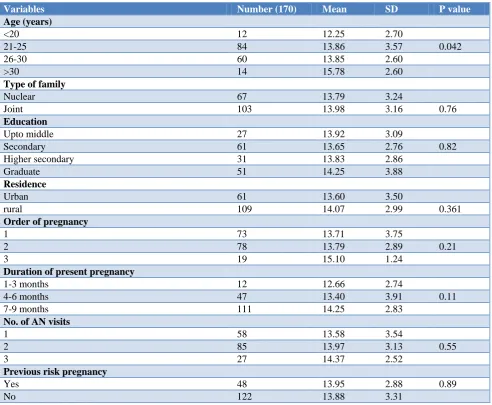
Table 3: Association between awareness about pregnancy danger signs and socio-demographic and obstetric characteristics of participants.
Variables Number (170) Mean SD P value
Age (years)
<20 12 12.25 2.70
21-25 84 13.86 3.57 0.042
26-30 60 13.85 2.60
>30 14 15.78 2.60
Type of family
Nuclear 67 13.79 3.24
Joint 103 13.98 3.16 0.76
Education
Upto middle 27 13.92 3.09
Secondary 61 13.65 2.76 0.82
Higher secondary 31 13.83 2.86
Graduate 51 14.25 3.88
Residence
Urban 61 13.60 3.50
rural 109 14.07 2.99 0.361
Order of pregnancy
1 73 13.71 3.75
2 78 13.79 2.89 0.21
3 19 15.10 1.24
Duration of present pregnancy
1-3 months 12 12.66 2.74
4-6 months 47 13.40 3.91 0.11
7-9 months 111 14.25 2.83
No. of AN visits
1 58 13.58 3.54
2 85 13.97 3.13 0.55
3 27 14.37 2.52
Previous risk pregnancy
Yes 48 13.95 2.88 0.89
No 122 13.88 3.31
Obstetric details of respondents
About 45.9% of the participants were second gravida while about 42.9% were primi and 45.9% had atleast one living children. 111 (65.3%) of the antenatal women were in their 3rd trimester of pregnancy. Most (78.8%) of the mothers were between the age group of 21 to 30 years during their 1st pregnancy. Majority (71.8%) of the women did not have any risk during their last pregnancy. The number of antenatal visits for most of the pregnant women was between 6 to 10 (Table 2).
Awareness about danger signs
Of the participants, 50 (29.3%) of the pregnant women had good awareness about danger signs of pregnancy and
5 (3%) had poor awareness about danger signs (Figure 1). Figure 1: Awareness about danger signs.
29.30%
67.70%
3%
Good awareness
Fair awareness
Poor awareness
Factors associated with awareness about danger signs
In one way ANOVA analysis, it was found that awareness about danger signs was significantly associated with increasing age with p value of 0.042. However, there was no significant association exist between danger signs and other socio-demographic and obstetric characteristics (Table 3).
DISCUSSION
Every pregnancy carries some degree of risk and for every maternal death, between 15 to 30 women who survive childbirth suffer from short- and long-term disabilities such as obstetric fistula, ruptured uterus, or pelvic inflammatory disease. Complications can occur any time from conception to the postpartum period. Fortunately, many obstetric complication can be effectively managed if warning signs are detected early and acted upon promptly.8
In the sample of 170 pregnant women, 29.3% had good awareness about danger signs of pregnancy. There was a statistically significant association found between increasing age and awareness about danger signs.
It has been found that level of knowledge about pregnancy danger signs was 49.2% in a study done in Puducherry which was slightly higher when compared to this study.9 In a study in Maharastra, it was found that only 7% had good knowledge about obstetric danger signs.5
In a study done in Ethiopia, it was found that maternal age, paternal occupation, place of residence were positively associated factors with knowledge of obstetric danger signs.4 Similarly in the present study, increasing maternal age was found to be significantly associated with awareness about pregnancy danger signs. Similar studies conducted in Malayasia and Tanzania also showed significant association between increasing maternal age and knowledge about danger signs.10,11 This can be explained by the fact that increased awareness among older women may be related to their own experiences of pregnancy and delivery which is an important source of their information, especially those who had complications associated with their previous pregnancy.12 Also elderly women are psychologically and physically ready to accept information on danger signs.4 Bililign et al, in their study found that knowledge about danger signs was significantly associated with mother’s education and mother’s occupation. This could be an indication for intervention to encourage access of education for women and it also indicates that women who have their own source of income have better access to health related information.13 However, in this study, there was no statistically significant association found between mother’s education and occupation with awareness about danger signs.
A Tanzanian study reported significant association between knowledge about danger signs and number of antenatal visits, previous institutional deliveries and whether mother informed about risks/complications during antenatal care.10 This implies that those antenatal women who are in touch with health personnel have good knowledge about danger signs. While in this study, there was no such association found.
Considering the limitations of the present study, sample size calculation was not done. And as this study was based on self-report of the participants, the information obtained might had less validity and there might be chance for recall bias.
CONCLUSION
In this study, only 29.3% had good awareness about danger signs of pregnancy and increasing maternal age was found significantly associated with awareness about danger signs.
Therefore, health education and counselling should be focussed on young pregnant women and those who are having their first pregnancy and also to their family members. Improving awareness about danger signs among pregnant women and their families can increase early recognition of danger signs and their timely health seeking behaviour.
Empowering women with education and employment, promoting institutional deliveries and improving the quality of health services are the other recommended intervention.
Funding: No funding sources Conflict of interest: None declared
Ethical approval: The study was approved by the Institutional Ethics Committee
REFERENCES
1. Elmosalami D, El Etreby L, Mohsen A, Saleh R, Hemeda S, Metwally A. Women′s awareness of obstetric danger symptoms: is there a need to promote a preconceptional educational program? J Arab Soc Med Res. 2015;10(1):9.
2. Available at: http://www.who.int/reproductive health/publications/monitoring/maternal-mortality-2015/en/. Accessed on 4 February 2018.
3. Hailu M, Gebremariam A, Alemseged F. Knowledge about obstetric danger signs among pregnant women in Aleta Wondo District, Sidama Zone, Southern Ethiopia. Ethiop J Health Sci. 2011;20(1).
Oromia National Regional State, south-west Ethiopia. Int J Nurs Midwifery. 2017;9(3):22–32. 5. Vijay NR, Kumare B, Yerlekar DS. Awareness of
obstetric danger signs among pregnant women in tertiary care teaching hospital. J SAFOG. 2015;7(3):171–5.
6. Gebrehiwot H, Bahta S, Haile N. Awareness of Danger Signs of Pregnancy and its Associated Factors among Pregnant Women who Visit ANC in Mekelle Public Hospitals. Am J Adv Drug Deliv. 2014;2(2):164-73.
7. UNFPA. Safe Motherhood a review. Safe Motherhood. 2004.
8. Aborigo RA, Moyer CA, Gupta M, Adongo PB, Williams J, Hodgson A, et al. Obstetric danger signs and factors affecting health seeking behavior among the Kassena-Nankani of Northern Ghana: A qualitative study. Afr J Reprod Health. 2014;18(3):78–86.
9. Nithya R, Dorairajan G, Chinnakali P. Do Pregnant Women Know about Danger Signs of Pregnancy and Childbirth ? A Study of the Level of Knowledge and its Associated Factors from a Tertiary Care Hospital in Southern India. Int J Adv Med Health Res. 2017;4:11–7.
10. Pembe AB, Urassa DP, Carlstedt A, Lindmark G, Nyström L, Darj E. Rural Tanzanian women’s awareness of danger signs of obstetric complications. BMC Pregnancy Childbirth. 2009;9:1–8.
11. Teng SP, Zuo TC, Jummaat FB, Keng SL. Knowledge of pregnancy danger signs and associated factors among Malaysian mothers. Br J Midwifery. 2015;23(11):800–6.
12. Hailu D, Berhe H. Knowledge about obstetric danger signs and associated factors among mothers in Tsegedie district, Tigray region, Ethiopia 2013: Community based cross-sectional study. PLoS One. 2014;9(2):1–7.
13. Bililign N, Mulatu T. Knowledge of obstetric danger signs and associated factors among reproductive age women in Raya Kobo district of Ethiopia: A community based cross-sectional study. BMC Pregnancy Childbirth. 2017;17(1):70.
Cite this article as: Felix JWA, Devi R, Manobharathi