Original Research Article
Predictors of low birth weight babies born in tribal tertiary health
care setting: a cross sectional study
Thakre S. B.
1, Thakre S. S.
2*, Kaware A. C.
3, Adikane H.
1INTRODUCTION
A baby‟s weight at birth is a strong indicator of maternal and newborn nutrition. Being undernourished in the womb increases the risk of death in the early months and years of a child‟s life.1 Those who survive tend to have
impaired immune function and increased risk of disease; they are likely to remain undernourished, with reduced muscle strength, cognitive abilities and low intelligence quotient (IQ) throughout their lives.2,3 Babies with a birth
weight of less than 2500 grams, irrespective of the period of their gestation are termed as low birth weight (LBW) babies.4 Evidence showed that in full-term fetuses‟ growth had been limited due to different factors.5
Despite consistent efforts to improve the quality of maternal and child health; more than twenty million LBW babies are born every year throughout the world. Low-income countries account for majority share of LBW. Half of the children with a LBW were born in
ABSTRACT
Background: A baby‟s weight at birth is a strong indicator of maternal and newborn health and nutrition. Strategies to reduce prevalence of LBW are important in order to achieve the third Sustainable Development Goals (SDG 3)-reduce child mortality. With this background the present study was undertaken to estimate proportion of LBW babies born at tribal tertiary health care institution and to find out predictors of the LBW among babies.
Methods: The present cross sectional study was undertaken at tertiary health care setting. We restricted analyses to singleton live births, and following an initial descriptive summary of the deliveries, logistic regression analysis was conducted to investigate the association of various factors.
Results: Our results show proportion of LBW was 17.84% in babies born at tribal tertiary health care setting. There is no significant difference of LBW in different socio-demographics of the mother. However; significant difference was observed in tribal and non-tribal women and women with low literacy lever; wherein significant predictors were related to utilization of antenatal care (ANC), ICDS services, etc. Statistical significance was ascertained based on a p<0.05.
Conclusions: In this study; significant predictors were low maternal education, <4 ANC visits, inadequate consumption iron and folic acid, low hemoglobin percent level, and no additional diet at ICDS during current pregnancy. It has also provided basic information pertinent to quality of ANC care and it influence on LBW. Findings of this study are useful for maternal and child health policy makers, practitioners and those who provide health care during pregnancy
Keywords: Rural, Urban, Naxalite, Low birth weight, ANC, ICDS, SDG-3
Department of Community Medicine, 1Government Medical College, Gondia, 2Indira Gandhi Government Medical College, Nagpur, 3Seth G.S. Medical College, Mumbai, Maharashtra, India
Received: 18 April 2018
Revised: 26 May 2018
Accepted: 28 May 2018
*Correspondence:
Dr. Thakre S. S.,
E-mail: [email protected]
Copyright: © the author(s), publisher and licensee Medip Academy. This is an open-access article distributed under the terms of the Creative Commons Attribution Non-Commercial License, which permits unrestricted non-commercial use, distribution, and reproduction in any medium, provided the original work is properly cited.
South Asia and among these countries India and Bangladesh has the highest prevalence of LBW (30%).4 Since last 10 years institutional delivery have gain momentum in India.6
LBW is a multi-factorial origin. Factors includes maternal and obstetric factors, demographic, uncontrolled fertility, socio-economic status, nutritional status of mother, adequacy of micronutrients and macronutrient and adequate care during pregnancy (ANC).7-17 Majority of these factors are interrelated, influencing each other and predispose a women to give birth to an infant with LBW.
There is a strong association between lack of ANC and adverse pregnancy outcomes.12,17 Antenatal clinics are an essential element of the health services provided during pregnancy. These clinics provide services such as screening, prevention, and treatment of pregnancy-related complications. The World Health Organization (WHO) recommends at least four standard quality antenatal care visits.18 Literature also reveals that more emphasis is given to those factors like socio-demographic and other factors. Either little can be done to modify these factors or may require longer period to modify it. There is a paucity of literature about determinants of LBW in women who deliver at tribal health care settings. Consequently, strategies to reduce prevalence of LBW are important in order to achieve the third Sustainable Development Goals (SDG 3)-reduce child mortality.4 With this background a present cross sectional study was undertaken to estimate proportion of LBW babies born at tribal tertiary health care institution and to find out predictors of the LBW among babies.
METHODS
A hospital based cross-sectional study was undertaken during 1st April to 30th April 2017 in a Government Medical college and General hospital, Gondiya, state of Maharashtra, India. This district is declared as Naxalite affected district in Maharashtra. BGW hospital is a governmental hospital under the Government Medical College, Gondiya district of Maharashtra that provides medical services to a population of nearly 12, 00,000, spread across eight talukas and 952 villages.19
Sample size
A rotational sampling scheme was adopted; year was distributed in four quarters. By random method second quarter of 2017 and its first month (April 2017) was selected for the study. The estimated minimum sample size (n=287) was calculated using a formula to determine sample size for single population proportion, taking the prevalence (p) of LBW 23% in the same hospital and desired precision of 10% at the 95% confidence interval. All together 306 pregnant women were enrolled from obstetric ward. Those women were admitted for delivery. Those babies not suffering from any significant medical
and surgical disorders at the time of enrollment were included. The mother and baby pairs were the study participants.
Ethical Committee of the Government Medical College (GMC), Gondiya, approved the study protocol. A written consent was obtained from each mother. Information on age, religion, years of formal schooling, maternal obstetric, family size and monthly income, etc were obtained using a questionnaire.
Birth weight was recorded for all live births immediately after birth under the direct supervision of a paramedical (nurse). Low birth weight was defined as a weight of a newborn less than 2500 grams. Birth weight was recorded immediately after birth.4 Determination of gestational age was based on menstrual history, clinical examination and ultrasound investigation conducted and recorded by an obstetrician. Other investigation findings documented by obstetrician were also recorded in the present study.
Maternal data included were maternal age (years), parity (number), abortion (number), maternal and husbands education and occupation, education level (illiterate, primary school, secondary school, high school, university), maternity registration with public health system/ Integrated child development services (ICDS)/Private hospital (yes, no), place of living (urban, rural), utilization of Ante natal care (ANC) services, ICDS and other maternal characteristics like, height in centimeter (cm), weight in kilograms (kg), level of hemoglobin in gram per deciliter (g/dl). Assembled neonatal and delivery data collected were gender (female, male) and weight of baby in grams (g), gestational age (week), birth anomalies (yes, no), etc.
Analysis
We restricted analyses to singleton live births, and following an initial descriptive summary of the study participants, association of Socio-demographic factors, maternal factors and numbers/utilization of ANC services, etc. with having a LBW baby was carried out. Logistic regression analysis was conducted to model the relationship between independent variables-predictors and LBW. Results are reported as adjusted odds ratios (OR) with 95% confidence intervals (CI). Statistical significance was ascertained based on a p<0.05. All analyses used the licensed statistical software package SPSS (version 20).
RESULTS
Mean (±SD) birth weight and gestational age by USG were 2738.55 (±470.42) g and 38.24 (±2.34) weeks respectively. Mean (±SD) age of mother was 24.01 (±2.85) years. Mean (±SD) weight and height of mothers were 51.58 (±9.08) kg and 152.91 (±6.81) cm respectively. Mean (±SD) hemoglobin of mother was 9.76 (±1.44) g/dl. A total of 83% women were registered with ICDS and were taking supplementary meals. However; five percent of women were enrolled with private health care providers (doctors).
Figure 1: Enrolment and final analysis.
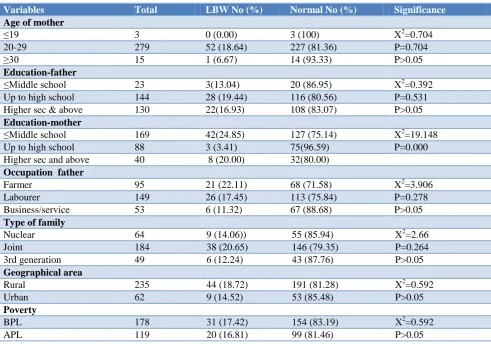
Analysis of maternal factors: Table 1 revealed that there is no significant difference in proportion of LBW in different socio-demographics to mother; like age of mother, education and occupation of father, type of family, geographical location and religion. However, proportion of LBW was significantly more (24.85%) in babies born to mothers whose education was less than middle school. It also reveals that babies born with LBW were significantly more (22.75%) in Tribes class women. There is no significant difference of LBW babies born of primi-para mothers. A higher proportion (18.00%) LBW was seen when inter-pregnancy interval was less than 24 months. LBW percentage was found to be higher among those women who had less than or equal to four antenatal care (ANC) visits (45.24%). Percentage of LBW was significantly more (43.24%) in mothers who had consumed less than 100 iron and folic acid tablets during pregnancy. Low birth weight proportion was significantly more (50.00%) in women who were not consuming additional diet from ICDS. The present study found maximum percentage of LBW babies (66.67%) among those women who had severe anemia. Among the mothers who had height of less than 145 cm, 26.67% had LBW babies. Those mothers who had previous history of abortions and stillbirth were also found to have low percentage of LBW babies (6.67%). Among the mothers who had BMI of less than 18.5 Kg/m2, 25.00% had LBW babies.
Table 1: Association of socio-demographic determinants with birth weight.
Variables Total LBW No (%) Normal No (%) Significance
Age of mother
≤19 3 0 (0.00) 3 (100) X2=0.704
20-29 279 52 (18.64) 227 (81.36) P=0.704
≥30 15 1 (6.67) 14 (93.33) P>0.05
Education-father
≤Middle school 23 3(13.04) 20 (86.95) X2=0.392 Up to high school 144 28 (19.44) 116 (80.56) P=0.531 Higher sec & above 130 22(16.93) 108 (83.07) P>0.05
Education-mother
≤Middle school 169 42(24.85) 127 (75.14) X2=19.148
Up to high school 88 3 (3.41) 75(96.59) P=0.000
Higher sec and above 40 8 (20.00) 32(80.00)
Occupation father
Farmer 95 21 (22.11) 68 (71.58) X2=3.906
Labourer 149 26 (17.45) 113 (75.84) P=0.278
Business/service 53 6 (11.32) 67 (88.68) P>0.05
Type of family
Nuclear 64 9 (14.06)) 55 (85.94) X2=2.66
Joint 184 38 (20.65) 146 (79.35) P=0.264
3rd generation 49 6 (12.24) 43 (87.76) P>0.05
Geographical area
Rural 235 44 (18.72) 191 (81.28) X2=0.592
Urban 62 9 (14.52) 53 (85.48) P>0.05
Poverty
BPL 178 31 (17.42) 154 (83.19) X2=0.592
APL 119 20 (16.81) 99 (81.46) P>0.05
Enrolment ≥28 weeks of gestation (n=306)
Exclusion =9
Twin =03 Anomalies =03
Still births =3
Total Subjects Mothers-newborn
Variables Total LBW No (%) Normal No (%) Significance
Religion
Hindu 243 45 (18.52) 198 (81.48) X2=2.842
Buddhist 45 8 (17.78) 37 (82.22) P>0.05
Islam 9 0 (0.00) 9 (100.00)
Caste
Tribes (ST/NT) 145 33 (22.75) 112 (77.25) X2=5.621 OBC & Others 96 11 (11.45) 85 (88.89) P=0.017
SC 56 9 (16.07) 47 (83.02) P<0.05
Table 2: Association of maternal determinants with birth weight.
Maternal variables Total LBW No (%) Normal No (%) Significance
Parity
1 198 39 (19.70) 159 (80.30) X2=3.21
2 82 10 (12.20) 72 (87.80) P=0.143
≥3 17 4 (23.53) 13 (76.47)
Inter pregnancy interval
≤24 M 50 9 (18.00) 41 (82.00) X2=1.26
>24 M 51 6 (11.76) 43 (88.24) P=0.532
Previous abortions
Yes 30 2 (6.67) 28 (93.33) X2=3.47
No 267 51 (19.10) 216 (80.90) P=0.172
ANC visits
<4 42 19 (45.24) 22 (52.38) X2=26.34
≥4 255 34 (13.33) 222 (87.06) P=0.000
Haematinics
≥100 tab 260 37 (14.23) 223 (85.77) X2=16.57
<100 tab 37 16 (43.24) 21 (56.76) P=0.002
ICDS Diet
Yes 247 28 (11.34) 219 (88.66) X2=39.78
No 50 25 (50.00) 245 (50.00) P=0.000
Additional diet home
Yes (Regular) 230 26 (11.30) 204 (80.70) X2=30.87
No 67 27 (40.30) 40 (59.70) P=0.000
Height in cm
≤145 30 8 (26.67) 22 (73.33) r=0.196
145-155 169 26 (15.38) 143 (84.62) t=3.42
>155 98 19 (19.39) 79 (80.61) P=0.000
Hemoglobin level (gm/dl)
<7 6 4 (66.67) 2 (33.33) r=0.2319
7-9.9 140 28 (20.00) 112 (80.00) t=4.042
10-10.9 125 21 (16.80) 104 (83.20 P=0.000
≥11 26 0 (0.00) 25 (100.00)
BMI (Kg/m2)
<18.5 44 11 (25.00) 33 (75.00) r=0.1242
18.5-24.9 216 34 (15.74) 172 (79.63) t=2.14
25.0-29.9 37 8 (21.62) 29 (78.38) P=0.000
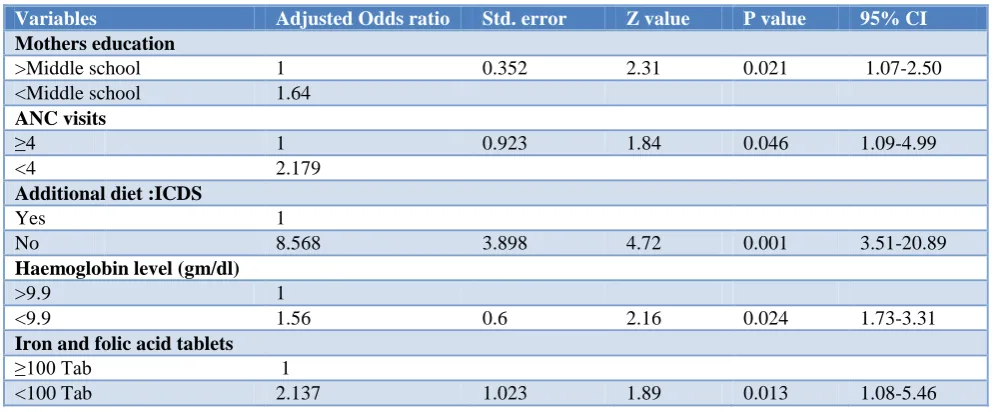
Table 3 reveals that on multiple logistic analysis of determinants of LBW babies, it was found that maternal education ≤middle school (odds ratio (OR) 1.64; CI 1.07-2.50), ANC visits ≤4 (odds ratio (OR) 2.18; CI 1.09-4.99), Not consuming additional diet from ICDS (odds
Table 3: Logistic regression analysis of low birth weight and its predictors.
Variables Adjusted Odds ratio Std. error Z value P value 95% CI
Mothers education
>Middle school 1 0.352 2.31 0.021 1.07-2.50
<Middle school 1.64
ANC visits
≥4 1 0.923 1.84 0.046 1.09-4.99
<4 2.179
Additional diet :ICDS
Yes 1
No 8.568 3.898 4.72 0.001 3.51-20.89
Haemoglobin level (gm/dl)
>9.9 1
<9.9 1.56 0.6 2.16 0.024 1.73-3.31
Iron and folic acid tablets
≥100 Tab 1
<100 Tab 2.137 1.023 1.89 0.013 1.08-5.46
DISCUSSION
The proportion of LBW in the present study was found to be 17.84%, which was slightly less than the national average of rural India (23%).1 However; a study by Borah et al reported 21.8% LBW in institutional births.14 Present study was carried out at tertiary health care institution where women with optimum utilization of health care facilities like ANC, adequate use of iron and folic acid tablets and optimum utilization of ICDS services might have helped in declining LBW. In the present study no significant association was found between the birth weight and teenage pregnancy. It may be due to the fact that teenage mothers in the present study are lesser in number and also higher mean (±SD) age of the study participants is 24.01±2.85 years. No doubt that teen pregnant mothers are both physically and mentally less capable for bearing the burden of pregnancy. Banerjee et al also found that the incidence of LBW was significantly higher among the teenage mothers.20
A significant association was found between mother's education status and birth weight of babies in the present study. Similarly, Borah et al and Kader et al also reported that the percentage of LBW babies among illiterate mothers was high.14,16 Our study found a statistically non significant association between birth weight of babies and the religion. However, Borah et al and, Kaushal et al found higher percentage of LBW babies among Muslim mothers.14,21
In the present study non significant association was observed with types of family, rural and urban difference, economic status of women. However; significantly high proportion of LBW was seen in women belonging to tribe‟s community. Majority of the women utilized social service benefits provided under maternal and child health care promotion like quality ANC care, special and
general nutritional supplementation, etc. Therefore other social and demographic factors have not shown significant association with LBW. Most of the mothers of LBW babies were found to be anemic during the antenatal period. This finding is consistent with. Borah et al and Mumbare et alobserved that maternal anemia is associated with delivery of a LBW infant.14,22 This study also found higher percentage of LBW babies among mothers who did not have adequate ANC checkups. Similar findings were also observed by Kader et al.14,16 This study found that short inter pregnancy interval was not significantly associated with LBW of the baby. However; Borah et al and Metgud et al reported significant association with short inters pregnancy and LBW.14,23 In the present study proportion of LBW was more in the short inter pregnancy interval (≤24 months); significant association could be due to less number of study subjects.
during antenatal period. It will have significant roles to play in reducing LBW in India.
There is a strong association between lack of ANC and adverse pregnancy outcomes.12,17 Antenatal clinics are an essential element of the health services provided during pregnancy. These clinics provide services such as screening, prevention, and treatment of pregnancy-related complications. The World Health Organization (WHO) recommends at least four standard quality antenatal care visits comprising interventions such as tetanus toxoid vaccination, screening and treatment for infections, and identification of warning signs during pregnancy.18 Maternal education, BMI <18.5, short stature (height <145 cm) inadequate consumption of iron and folic acid tablets, non utilizing services provided by ICDS and lack of antenatal visits (<4 visits) are significant predictors of LBW. In agreement with previous studies, maternal education emerged as a strong determinant for LBW. Women with „no education‟ had the greatest odds of giving birth to an infant with LBW followed by women with “primary education”.13,14,16,25 Agreeing with
previous studies, birth weight of the baby is greatly influenced by mother's level of education and having some kind of maternal education (oppose to no education) have a protective effect against LBW.13,16,25 It is likely that women with no or low level of education and/or knowledge may practice poor health habits (e.g. inadequate and poor quality of nutrition, hygiene, rest, and smoking, etc.).
Additionally they may be under utilization of adequate healthcare resources (e.g., antenatal care, iron supplements, nutritional supplement through ICDS, etc.) which consequently may influence fetal growth. Therefore, interventions to improve the utilization of ANC and interventions offered like macro and micronutrient supplement and its optimum use is utmost important. Health education at level of women of reproductive age, very special education during pregnancy and female children are important to reduce prevalence LBW in India. Targeted public health interventions to improve nutrition status of women in childbearing age as well as female children are imperative to reduce prevalence of LBW in India. This study found a strong association between lack of antenatal care and low birth weight and the results are in agreement with previous studies.16,17,25 Antenatal care provide routine monitoring of height and weight gain, identification of medical maternal or fetal problems, counseling against tobacco or substance use, provide psychosocial support, nutritional advice, and early intervention which may reduction adverse pregnancy outcomes including LBW.18 Lack of access to ANC could be influenced by many factors including lower socio-economic status and poor knowledge. Therefore, utilization of ANC should be further investigated to
understand obstacles and opportunities to improve services.
CONCLUSION
Our results shows higher likelihood of LBW babies born at tribal tertiary health care setting: where significant predictors were low maternal education, <4 ANC visits, inadequate consumption Iron and Folic acid, Low Hemoglobin percent level, and No additional diet at ICDS during current pregnancy. Findings of this study are useful for maternal and child health policy makers, practitioners and those who provide health care during pregnancy. It has provided basic information pertinent to quality of ANC care and it influence on LBW.
Strengthsandlimitations
This is the first study that uses data from a rural and urban area of the Naxalite region to investigate social, maternal characteristics and antenatal care components associated with LBW.
Some of the study participants were diagnosed with hypertension, diabetes or other systemic conditions prior or during pregnancy, thereby limiting the influence of these confounders on outcomes i.e. LBW.
ACKNOWLEDGEMENTS
We would like to take this opportunity to express our sincere gratitude to all those who have in some way contributed to bring this study in the final shape. In particular, we would like to thank the mother and newborn who participated in this study. Special gratitude goes to Dean, Government Medical College, Gondia, for their constant support. Similarly, we are very much thankful to all Staff sisters of Bai Gangabai Womens Hospital, Gondia for coordinating and support for data collection. I express my sincere gratitude toward all teaching and non-teaching staff of Community Medicine Department, GMC, Gondia for their untiring efforts in this study. We hope this study will serve the purpose of informing the strategies and actions for any concerned stakeholders in improving the maternal and newborn health. In turn it will add to our knowledge about predictors of LBW.
Funding: No funding sources Conflict of interest: None declared
Ethical approval: The study was approved by the Institutional Ethics Committee
REFERENCES
2. Berkowitz GS, Pqpiernik E. Epidemiology of preterm birth. Epidemiol Rev. 1993;15(2):414-43. 3. Dunin-Wasowicz D, Rowecka-Trzebicka K,
Milewska-Bobula B, Kassur-Siemieńska B, Bauer A, Idzik M, et al. Risk factors for cerebral palsy in very low-birthweight infants in the 1980s and 1990s. J Child Neurol. 2000;15(6):417-20.
4. Low birth weight: Country, regional and global estimates. New York: UNICEF; 2004. United Nations Children's Fund and World Health Organization. Available at: http://apps.who.int/iris/ bitstream/handle. Accessed on 1 January 2017. 5. Biswal RS, Shaarma NN, Kar S. Low birth weight
babies survival predictors in a tertiary care scenario-An experience from middle level city, Bhubaneshwar, Odisha, India. Int J Recent Sci Res. 2017;8(9):2-8.
6. Visualize data.gov Available at: https://visualize.data.gov.in/?inst. Accessed on 2 February 2017.
7. Aliyu MH, Jolly PE, Ehiri JE, Salihu HM. High parity and adverse birth outcomes: Exploring the maze. Birth. 2005;32:45–59.
8. Conde-Agudelo A, Rosas-Bermudez A, Kafury-Goeta AC. Birth spacing and risk of adverse perinatal outcomes: A meta-analysis. JAMA. 2006;295:1809–23.
9. Zhu BP, Rolfs RT, Nangle BE, Horan JM. Effect of the interval between pregnancies on perinatal outcomes. N Engl J Med. 1999;340:589–94. 10. Zhu BP, Haines KM, Le T, McGrath-Miller K,
Boulton ML. Effect of the interval between pregnancies on perinatal outcomes among white and black women. Am J Obstet Gynecol. 2001;185:1403–10.
11. Hosain GM, Chatterjee N, Begum A, Saha SC. Factors associated with low birthweight in rural Bangladesh. J Trop Pediatr. 2006;52:87–91. 12. Valero De Bernabe J, Soriano T, Albaladejo R,
Juarranz M, Calle ME, et al. Risk factors for low birth weight: A review. Eur J Obstet Gynecol Reprod Biol. 2004;116:3-15.
13. Som S, Jr, Pal M, Adak DK, Gharami AK, Bharati S, Bharati P. Effect of socio-economic and biological variables on birth weight in Madhya Pradesh. Malays J Nutr. 2004;10:159–71.
14. Borah M, Agrawala R. Maternal and socio-demographic determinants of low birth weight (LBW): A community-based study in a rural block of Assam. J Postgrad Med. 2016;62(3):178–81.
15. Elshibly EM, Schmalisch G. The effect of maternal anthropometric characteristics and social factors on gestational age and birth weight in Sudanese newborn infants. BMC Public Health. 2008;8:244. 16. Kader M, Perera NK. Socio-economic and
nutritional determinants of low birth weight in India. N Am J Med Sci. 2014;6:302–8.
17. Coria-soto IL, Bobadilla JL, Notzon F. The effectiveness of antenatal care in preventing intrauterine growth retardation and low birth weight due to preterm delivery. Int J Qual Health Care. 1996;8:13–20.
18. World Health Organization [WHO] Geneva: 1994. Technical Working Group on Antenatal Care. 19. Gondia district information. Available at:
https://en.wikipedia.org/wiki/Gondia_district. Last Accessed on 1st April 2017.
20. Baberjee B, Pandy Gk, Dutt D, Sengupta B, Mondal M, Deb S. Teenage pregnancy: Socially inflicted health hazards. IJCM. 2009;34(3):227-31.
21. Kaushal SK, Misra SK, Gupta SC, Singh R. A study of maternal factors and birth weight in a border District of Uttar Pradesh: A hospital based study. Indian J Community Health. 2012;24:86–90. 22. Mumbare SS, Maindarkar G, Darade R, Yenge S,
Tolani MK, Patole K. Maternal risk factors associated with term low birth weight neonates: A matched-pair case control study. Indian Pediatr. 2012;49:25–8.
23. Metgud CS, Naik VA, Mallapur MD. Factors affecting birth weight of a newborn-a community based study in rural Karnataka, India. PLoS One. 2012;7:e40040.
24. Rao PR, Prakash KP, Nair SN. Influence of pre-pregnancy weight, maternal height and weight gain during pregnancy on birth weight. Bahrain Med Bull. 2001;23:22–6.
25. Khatun S, Rahman M. Socio-economic determinants of low birth weight in Bangladesh: A multivariate approach. Bangladesh Med Res Counc Bull. 2008;34:81–6.