Original Research Article
Epidemiological determinants of infant deaths occurring in a teaching
hospital: an observational study
M. N.
Soumyashree
1, R. G. Viveki
2*, Sunanda Halki
2INTRODUCTION
Today’s children are tomorrow’s citizens of the country. Thus the normal health and growth of children plays an important role in the prosperity of the country.1 In India, 39% of total population is contributed by children. Infant mortality is not only an important factor in population growth; it is also an important measure of economic development.2 The infant and child mortality rate is negatively associated with the level of living and reflects
the country’s level of socio-economic development and quality of life.3
Currently IMR is 41 and 28 per 1000 live births (2015-2016) for India and Karnataka respectively.4,5 Despite several interventions implemented for the improvement of infant survival, the pace of decline in IMR has been slow; a lag in achieving millennium development goals (MDG) goal 4 (IMR-27).6 Goal three, target two of sustainable development goal (SDG) states that, by 2030,
ABSTRACT
Background: India has the highest number of infant deaths, contributing about 23% to the global burden of infant deaths. Sustainable development goal states that, by 2030, preventable deaths of new-borns and children under 5 years of age should be ended, with all countries aiming to reduce neonatal mortality to at least as low as 12 per 1000 live births and under-5 mortality to at least as low as 25 per 1000 live births. Aims of the study:(1) to understand the socio-demographic profile of the study cases, (2) to correlate the causes of infant deaths with age, parity and other obstetrics parameters.
Methods: The present study was undertaken for the period of one year from January to December 2016. The study included 120 deceased infants from department of Pediatrics, Belagavi Institute of Medical Sciences (BIMS) Hospital, Belagavi. Information regarding socio-demographic profile, antenatal, intranatal and infant details were collected using a structured questionnaire.
Results: 61.6% of study cases were male and three-fourth of them resided in rural area. 56.2% of the deceased infants were LBW, followed by VLBW (34.9%) and ELBW (8.9%). The common causes of death among the deceased infants were prematurity (45%) followed by birth asphyxia (34.2%), sepsis (12.5%), pneumonia (3.3%) and congenital anomalies and other (2.5%).
Conclusions: Age of the infants, gestational age, place of delivery, delivery assisted and LBW were associated with infant deaths. There is a need for proper implementation of programmes related to mother and child health care.
Keywords: Determinants, Infant deaths, Teaching hospital
Department of Community Medicine, 1East Point College of medical Sciences and research centre, Bengaluru, 2
Belagavi Institute of Medical Sciences, Belagavi, Karnataka, India
Received: 20 December 2018
Revised: 03 February 2019
Accepted: 04 February 2019
*Correspondence:
Dr. R. G. Viveki,
E-mail: [email protected]
Copyright: © the author(s), publisher and licensee Medip Academy. This is an open-access article distributed under the terms of the Creative Commons Attribution Non-Commercial License, which permits unrestricted non-commercial use, distribution, and reproduction in any medium, provided the original work is properly cited.
years of age should be ended, with all countries aiming to reduce neonatal mortality to at least as low as 12 per 1000 live births and under-5 mortality to at least as low as 25 per 1000 live births.7,8 The present study is an attempt to fill the knowledge gaps in understanding the socio-demographic profile of the infants dying in a teaching hospital and to assess the etiological factors responsible for the infant deaths.
METHODS
An observational study was conducted among the expired infants in Department of Pediatrics, BIMS, Belagavi during the period of January to December 2016. Ethical clearance was obtained from Institutional Ethical Committee (IEC). A formal permission to conduct the study was obtained from the authorities of the hospital and consent was taken from mother or the close relatives of study participants. Sample size was estimated by considering the proportion of the most common cause of infant deaths. According to a study in southern India by Upadhyaya et al the proportion of the most common cause of infant deaths was found to be birth asphyxia which contributed 26.2%.9 Considering 10% of allowable error, minimal sample size was calculated to be 75; however, the present study included 120 study participants. All infant deaths occurring in paediatric department (NICU, PICU and ward), BIMS hospital, Belagavi, who fulfilled selection criteria were studied till the required sample size of 120 was reached.
A structured, pre-validated, questionnaire was used to collect relevant data from the informant of the deceased infant i.e., either mother or the close relatives through personal interviewing. The information regarding condition of the infants before the death and cause of death of each deceased infant was collected from the treating doctors. Infants admitted under paediatric department (neonatal intensive care unit (NICU), paediatric intensive care unit (PICU) and ward), BIMS hospital, Belagavi, who expired during their stay in the hospital and all inborn/outborn deceased infants were included. Infant age or date of birth not known, mothers or relatives not willing to give information and mothers seriously ill and relatives not knowing the details of antenatal, intranatal and postnatal period were excluded. Data was entered in Microsoft excel sheet 2007 and analyzed in SPSS version 22. Chi square test was used to test the association between different qualitative variables. At 95% Confidence interval, p≤0.05 was considered as statistically significant.
RESULTS
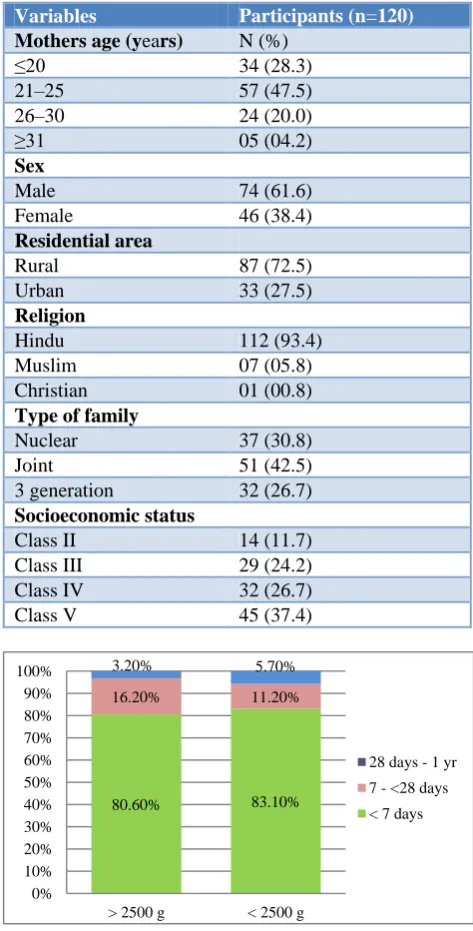
As shown in Table 1, nearly half the of the mothers of deceased infants belonged to the age group of 21–25 years (47.5%), followed by less or equal to 20 years (28.3%). 74 (61.6%) and 46 (38.4%) of them were found to be male and female respectively. 87 (72.5%) of them resided in rural area whereas, 33 (27.5%) resided in urban
area. majority (42.5%) lived in joint family followed by nuclear family (30.8%).
In the present study, majority (52.5%) of deceased infants were found in first birth order of the mother, followed by second birth order (29.2%). 32 (26.7%) of them were born within 1-2 years of birth interval, 12.5% of the study cases were found to have 3-4 years of birth interval. Most (84.2%) of them were born in Government health facilities, followed by private health facility (8.3%), home (5.8%). Surprisingly 2 (1.7%) cases were born in vehicle during travel to the health facility. Three-fourth of study subject were born by full term normal vaginal delivery.
Table 1: Socio-demographic profile of the study cases.
Variables Participants (n=120)
Mothers age (years) N (%)
≤20 34 (28.3)
21–25 57 (47.5)
26–30 24 (20.0)
≥31 05 (04.2)
Sex
Male 74 (61.6)
Female 46 (38.4)
Residential area
Rural 87 (72.5)
Urban 33 (27.5)
Religion
Hindu 112 (93.4)
Muslim 07 (05.8)
Christian 01 (00.8)
Type of family
Nuclear 37 (30.8)
Joint 51 (42.5)
3 generation 32 (26.7)
Socioeconomic status
Class II 14 (11.7) Class III 29 (24.2) Class IV 32 (26.7) Class V 45 (37.4)
Figure 1: Birth weight of study cases.
80.60% 83.10%
16.20% 11.20%
3.20% 5.70%
0% 10% 20% 30% 40% 50% 60% 70% 80% 90% 100%
> 2500 g < 2500 g
28 days - 1 yr
7 - <28 days
Table 2: Distribution of obstetrical parameter of the mothers of deceased infants.
Variables <7 days
n=99 (%)
7–<28 days n=15 (%)
28 days–1 year n=6 (%)
Total n=120 (%) Birth order
1 50 (50.5) 08 (53.3) 05 (83.3) 63 (52.5)
2 32 (32.3) 02 (13.3) 01 (16.7) 35 (29.2)
3 15 (15.2) 04 (26.7) 00 (00.0) 19 (15.8)
≥4 02 (02.0) 01 (06.7) 00 (00.0) 03 (02.5)
Birth interval (years)
1–2 26 (26.3) 05 (33.3) 01 (16.7) 32 (26.7)
3–4 14 (14.1) 01 (06.7) 00 (00.0) 15 (12.5)
5–6 06 (06.1) 00 (00.0) 00 (00.0) 06 (05.0)
>6 03 (03.0) 01 (06.7) 00 (00.0) 04 (03.3)
Not applicable 50 (50.5) 08 (53.3) 05 (83.3) 63 (52.5)
Gestational age
≤30 weeks 20 (20.2) 01 (6.7) 02 (33.3) 23 (19.2)
31–35 weeks 30 (30.3) 05 (33.3) 03 (50.0) 38 (31.7) 36–40 weeks 45 (45.5) 08 (53.3) 01 (16.7) 54 (45.0)
≥41 weeks 04 (04.0) 01 (06.7) 00 (00.0) 05 (04.1)
Place of delivery
Government health facilities 85 (85.9) 12 (79.9) 04 (66.6) 101 (84.2) Private health facility 08 (08.1) 01 (06.7) 01 (16.7) 10 (08.3)
Home 05 (05.0) 01 (6.7) 01 (16.7) 07 (05.8)
Transit 01 (01.0) 01 (6.7) 00 (00.0) 02 (1.7)
Type of delivery
FTND 73 (73.7) 12 (80.0) 05 (83.3) 90 (75.0)
Caesarean section 21 (21.2) 02 (13.3) 00 (00.0) 23 (19.2) Assisted delivery 05 (05.1) 01 (06.7) 01 (06.7) 07 (05.8)
Table no 3: Association of socio-demographic factors with the age of study cases.
Variables <7 days
n=99 (%)
7–<28 days n=15 (%)
28 days–1 year n=6 (%)
Total
n=120 (%) P value
Mother age (years)
>0.05
≤20 31 (31.3) 02 (13.3) 01 (16.7) 34 (28.3)
21 – 25 43 (43.4) 10 (66.7) 04 (66.7) 57 (47.5) 26 – 30 21 (21.2) 02 (13.3) 01 (16.6) 24 (20.0)
≥31 04 (04.0) 01 (06.7) 00 (00.0) 05 (04.2)
Mothers education
<0.01 Illiterate 27 (90.0) 03 (10.0) 00 (00.0) 30 (25.0)
Primary 11 (57.9) 05 (26.3) 03 (15.8) 19 (15.8) Secondary 45 (91.8) 03 (06.1) 01 (02.0) 49 (40.8) >Higher secondary 16 (72.7) 04 (18.1) 02 (9.2) 22 (18.4)
Wash hands
<0.05
Yes 39 (73.6) 11 (20.8) 03 (5.6) 53 (44.2)
No 60 (89.6) 04 (06.0) 03 (04.4) 67 (55.8)
Sex
>0.05
Male 62 (83.8) 08 (10.8) 04 (05.4) 74 (61.6)
Female 37 (80.4) 07 (15.2) 02 (04.4) 46 (38.4)
Sanitary latrine
<0.05 Present 70 (79.5) 13 (14.8) 05 (05.7) 88 (73.4)
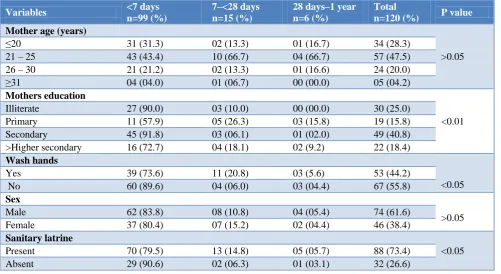
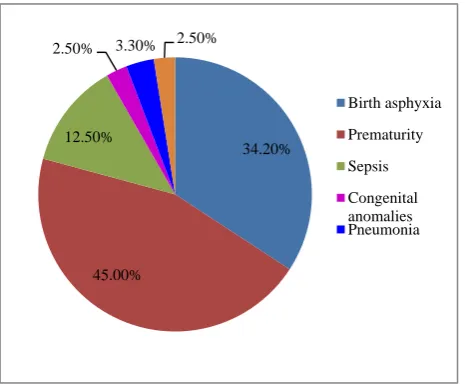
Table 3 shows, age of the deceased infant (early neonates, late neonates and post neonates) was significantly associated with educational status of the mothers (p<0.05) and practice of washing hands with soap water after defecation (p<0.05). No relationship was found with the sex of the study cases (p>0.05). Figure 1 shows, birth weight of study cases. Birth weight less than 2500 g were found to be 83.1%, 11.2% and 5.7% among early neonates, late neonates and post neonates respectively. The common causes of death among the deceased infants were prematurity (45%) followed by, birth asphyxia (34.2%), sepsis (12.5%), pneumonia (3.3%) and congenital anomalies and other (2.5%) (Figure 2).
Figure 2: Cause of deaths of study cases.
DISCUSSION
In this study, 82.5% of the deceased infants were early neonates, 12.5% and 5% of them were late neonates and post neonates respectively. Similar findings were found in studies conducted in Government hospitals in Andhra Pradesh and Maharashtra, majority of the study cases were neonates followed by post neonates.2,10 Similar findings were noted in a study conducted in Iran.11 In the current study majority of the deceased infants were found to be male. Similar findings were found in studies conducted in by Upadhyaya et al, Patil et al, Dube et al, Manandhar R et al, Titaley et al, and Weldearegawi et al.9,12-16 This shows biological vulnerability of males to infection is more than females in their early ages. In the present study, majority (55%) of deceased infants were found in first birth order of the mother, followed by second birth order (26.7%). Similar results were seen in a study done in rural India by Singh et al.17 However in other studies done at Mumbai and Nigeria it was found that, neonates of birth order two were at higher risk of dying.18,19 In few studies infant mortality was high among birth order 5 and above.20-22
Nearly three-fourth 88 (73.3%) of them had sanitary latrine facility at their house and there was significant association between infant deaths and not washing hands with soap and water after defecation. Similar finding was found in study done in Andhra Pradesh by Kunsneniwar et al.20 Access to toilet and hand washing practices with soap and water after defecation reduces the risk of dying through less exposure of neonates to contamination making them less susceptible to diseases and infections, and eventually death. 74.1% of the deceased infants were born with a birth weight less than 2500 g, whereas comparatively lesser number of infants were LBW in other countries, majority of them had normal birth weight.23,18,15 LBW predisposes newborns to increased risk of infections, low blood sugar and low body temperatures, which increase the risk of death compared to normal newborns.
In this study, the common causes of death among the deceased infants were prematurity (45%) followed by, birth asphyxia (34.2%) and sepsis (12.5%). Prematurity was the commonest cause of deaths in studies done by Prasad et aland Patil et al.2,12 However, birth asphyxia was the commonest cause in studies done in southern India, Maharastra, Karnataka (Bagalkot) and Bangladesh.9,10,24,25 As this study was hospital based, the findings cannot be generalized at the community level and a prospective follow up study of all newborns would have been ideal to know the risks associated with infant deaths these were the limitations of the study.
CONCLUSION
Most common cause of deaths was prematurity, followed by birth asphyxia. Promotion of Institutional delivery is on greater need. Mothers and their close relatives should be explained about the warning signs of labor and the need for timely referral to the health care centers for safe delivery. Proper implementation of programmes related to mother and child health care is required.
ACKNOWLEDGEMENTS
Authors are grateful to thank the beloved Director, Dr. S T Kalsad, BIMS, Belagavi for permitting to conduct the present study. We extend sincere thanks to all the participants and staff of the Department of Community Medicine and Department of Pediatrics BIMS, Belagavi for co-operating during the study period.
Funding: No funding sources Conflict of interest: None declared
Ethical approval: The study was approved by the Institutional Ethics Committee
REFERENCES
1. Sumana M, Sreelatha CY, Girija BS, Sundar M, Gowda D. Low birth weight and its determinants in
34.20%
45.00% 12.50%
2.50% 3.30% 2.50%
Birth asphyxia
Prematurity
Sepsis
a teaching hospital of Karnataka, India. Int J Community Med Public Health. 2016;3:610-4. 2. Prasad VK, Thomas V, Padmaleela K. A
retrospective study on the infant deaths in government teaching hospitals in Andhra Pradesh. Nat J Med Dental Res. 2013;1(4):29-33.
3. Shukla S, Das KD, Behera JN. Post Neonatal Under Five Mortality–A Hospital Based Study. J Dental Med Sci. 2015;14(2):42-5.
4. National Family and Health survey, India fact sheet, 2016. Available at http://www.rchiips.org. Accessed on 28 July 2016.
5. NITI Aayog, State statistics, 2016. Available at: http://www.niti.gov.in. Accessed on 28 July 2016. 6. Millennium development goals India country report.
Social Statistics Division Ministry of Statistics and Programme Implementation government of India, 2015. Available at: http://www.mospi.nic.in. Accessed on 12 August 2015.
7. United Nations development Programme. SDGs, 2016. Available at: http:// www.undp.org. Accessed on 28 August 2016.
8. World Health Organization. SDG 3: Ensure healthy lives and promote wellbeing for all at all ages, 2016. Available at: http://www.who.int. Accessed on 28 August 2016.
9. Upadhyaya S, Shetty S, Kumar SS, Dongre A, Deshmukh P. Institutionalizing district level infant death review: an experience from Southern India. WHO South-East Asia J Public Health. 2012;1(4):446-56.
10. Patil SW, Godale LB. Mortality pattern of hospitalized children in a tertiary care hospital in Latur: A record based retrospective analysis. Nati J Med Dental Res. 2013;4(1):96-9.
11. Sharifzadeh GR, Namakin K, Mehrjoofard H. An epidemiological study on infant mortality and factors affecting it in rural areas of Birjand, Iran. Iran J Pediatrics. 2008;18(4):335-42.
12. Patil RB, Koppad R, Shreeshail B. Clinical profile and outcome of babies admitted to Neonatal Intensive Care Unit (NICU), Mc Gann teaching hospital Shivamogga, Karnataka: A Longitudinal Study. J Applied Med Sci. 2014;2(6G):3357-60. 13. Dube L, Taha M, Asefa H. Determinants of infant
mortality in community of Gilgel Gibe Field Research Center, Southwest Ethiopia: a matched case control study. BMC Public Health. 2013;13:401.
14. Manandhar SR, Ojha A, Manandhar DS, Shrestha B, Shrestha D, Saville N, et al. Causes of stillbirths and neonatal deaths in Dhausha district, Nepal: A
verbal autopsy study. Kathmandu University Med J. 2010;8(29):62-72.
15. Titaley CR, Dibley MJ, Agho K, Roberts CL, Hall J. Determinants of neonatal mortality in Indonesia. BMC Public Health. 2008;8(1):232-43.
16. Weldearegawi B, Melaku AY, Abera SM, Ashebir Y , Haile F, Mulugeta A, et al. Infant mortality and causes of infant deaths in rural Ethiopia: a population-based cohort of 3684 births. BMC Public Health. 2015;15:1-7.
17. Singh A, Kumar A, Kumar A. Determinants of neonatal mortality in rural India, 2007-2008. Peer J. 2013;75:1-26.
18. Ezeh KO, Agho KE, Dibley MJ, Hall J, Page AN. Determinants of neonatal mortality in Nigeria: evidence from the 2008 demographic and health survey. BMC Public Health. 2014;14(1):521-31. 19. Schoeps D, Almeida MF, Alencar GP, França Jr I,
Novaes HMD, Siqueira AAF, et al. Risk factors for early neonatal mortality. Rev Saude Publica. 2007;41(6):1013-22.
20. Kusneniwar GN, Mishra AK, Balasubramanian K, Reddy PS. Determinants of infant mortality in a developing region in rural Andhra Pradesh. National Institutes Health Public Access. 2013;4(4):20-6. 21. Nair SD, Singh L, Gulati BK, Pandey A. Levels,
trends & predictors of infant & child mortality among Scheduled Tribes in rural India. Indian J Med Res. 2015;141:709–19.
22. Kananura RM, Tetui M, Mutebi A, Bua JN, Waiswa P, Kiwanuka SN, et al. The neonatal mortality and its determinants in rural communities of Eastern Uganda. J Reproductive Health. 2016;13(1):13-22. 23. Mekonnen Y, Tensou B, Telake DS, Degefie T,
Bekele A. Neonatal mortality in Ethiopia: trends and determinants. BMC Public Health. 2013;13:483-97. 24. Ramadurg UY, Ghattargi CH, Gagan S, Manjula R,
Mayappanavar RY, Bhadja D, et al. A study of causes of neonatal mortality in tertiary care hospital, Bagalkot. Int J Health Information Med Res. 2014;1(2):26-8.
25. Bapat U, Alcock G, More NS, Das S, Joshi W, Osrin D. Stillbirths and newborn deaths in slum settlements in Mumbai, India: a prospective verbal autopsy study. BMC Pregnancy Childbirth. 2012;12:1-10.