National Conference on 'Innovative Research on Robotics, Circuits and Technology' (IRCT 2018) Organized By : CIrcuit Branches of SCSVMV, (EEE, ECE, EIE & Mechatronics) , Kanchipuram, Tamil Nadu, India
In Assotiation with International Journal of Scientific Research in Science, Engineering and Technology © 2018 IJSRSET | Volume 5 | Issue 1 | | Print ISSN: 2395-1990 | Online ISSN : 2394-4099
Mathematical Model for Modulation Detection in Adaptive
Modulation System
S. Selvakumar
1, Dr.J.Vaideeswaran
21Research scholar, ECE Department, SCSVMV University, Kanchipuram, Tamil Nadu, India
2Professor, ECE Department, SCSVMV University, Kanchipuram, Tamil Nadu, India
ABSTRACT
Modulation detection is the one the main process in Adaptive Modulation Systems. In this paper, propose the seven parameters to identify the best modulation. Modulation selection based on Amplitude, Phase, Frequency and Environment. The Seven Parameters are absEnv ( Abstract environment), absPhase, rEnv (Environment), absEnv2 (Environment 2), absFreq, absFreq2, absPhase2. These modulation selections improve the Quality of Services and avoid the Multipath fading, Delay in Transmission/Receiving, Bandwidth limitation.
Keywords: Adaptive Modulation, QOS, Multipath Fading, Delay
I.
INTRODUCTIONThe mathematic distribution is related to the logistic distribution in an identical fashion to how the log-normal and log-normal distributions are related with each other. It is related to work towards Environment, Phase and frequency. A logarithmic transformation on the logistic distribution generates the log-logistic distribution. The probability density function (pdf) of the log-logistic distribution is f (x | α, β). where α > 0 is the scale parameter, and is the median of this distribution; β > 0 is the shape parameter, which controls the shape of the distribution observe that this distribution has radically different shapes, as the distribution can be strictly decreasing, right-skewed, or unimodal. As β increases this distribution becomes more symmetric. Because of its flexible shapes, the log-logistic distribution has been illustrated to provide useful fits to data from many different fields, including engineering, economics, hydrology, and survival analysis. For instance, adopted this distribution in
modeling economic data. Superior performance on fitting precipitation data from various Canadian regions. [3] applied this distribution to maximum annual stream flow data. For further topics related to the log-logistic distribution.
MLEs are quite similar with the various sample sizes, indicating the bias of the Bayesian estimators for small and moderate sample sizes. This motivates a study for obtaining unbiased or nearly unbiased estimators of the unknown parameters for the log-logistic distribution. First consider a certain „corrective‟ approach developed in part by [7], which can correct the bias to the second order of magnitude. The main idea of this „corrective‟ approach is to adjust the bias by subtracting it from the original MLEs, and so the obtained estimators are often referred to as corrected MLEs. It is bias-corrected MLEs of the log-logistic distribution not only have explicit expressions in terms of a convenient matrix notation, but also simultaneously reduce the biases and the root mean square errors (RMSEs) of the parameters. Then consider Efron‟s bootstrap resampling method [8] which can also reduce the bias to the second order. However, this estimator may accomplish this with an expense of increased variance. As a comparison, we also consider the generalized moments (GM) method, a method commonly used in Hydrology. Monte Carlo simulation studies and real-data applications are provided to compare the performances of the various estimators under consideration. Numerical evidence shows that the proposed bias-corrected MLEs should be recommended for use in practical applications, especially when the sample size is small or moderate.
II.
ESTIMATION METHODSAutomatic modulation detection extracts seven parameters (Features based on amplitude, frequency and phase) for identification of different modulation techniques, namely: ASK, FSK, PSK, QAM16 and QAM64. The thresholds of different parameters have been calculated from the classification during training in real time situation. The parameters are carefully chosen based on signal statistics. The parameters selected area The methods are based on the environment, Phase and frequency equations. This equation gives the best modulation identification in real time environments. Maximum Likelihood Estimation Suppose that we have n observations from the log-logistic distribution, denoted by X1 , · · · , Xn . The log-likelihood function of α and β can be written as
Differentiating the above function with respect to α and β, we have
Table 1
Parameter Name Mathematical Model
AbsEnv
AbsPhase
absEnv2
absFreq
absFreq2
absPhase2
The MLEs can be obtained by setting the above two equations to zero. Due to the lack of explicit solutions to the above Equations, numerically estimate the MLEs using the logic MLE function from the R STAR package, created. It is well- known that the MLEs are biased with small sample sizes and the bias of an estimator may lead to misleading interpretations of phenomena in practical applications. This motivates a study for obtaining unbiased or nearly unbiased estimators to reduce the bias of the MLEs of the log-logistic distribution.
The corrective approach Suppose that based on „n‟ randomly selected observations, we are interested in estimating the „p‟ unknown parameters, expressed as θ = (θ1, · · · , θp ) The joint cumulates of the derivatives of the log-likelihood function L(θ) are given by
where i, j, l = 1, 2, · · · , p. The derivatives of the joint cumulates
Here, assume that L(θ) is regular with respect to all derivatives up to the third order, inclusively. Also assume that all expressions in are of order O(n). Then bias can be writer as,
(cdf ) given by F . Let the parameter υ be some function of F , denoted by υ = t(F ). Let υˆ be some estimator of υ. We obtain pseudo-samples x∗ = (x∗, · · ·, x∗ )0 from the original sample x by resampling observations with replacement. We compute the bootstrap replicates of υˆ from these pseudo samples, denoted by υˆ∗ = s(x∗ ). Use the empirical cdf (ecdf ) of υˆ∗ to estimate the cdf of υˆ, Fυˆ . We obtain a parametric estimate for F by using a consistent estimator for Fυˆ , provided F belongs to a parametric family which is known and has a finite dimension, Fυ . The bias of the estimator υˆ = s(x) can be estimated by using BF (υˆ, υ) = EF [υˆ] − υ(F ). Generalized Moments As a comparison, consider another commonly used method, the generalized moments (GM) method, which utilizes moments of the form E[X k ] = Mk , where k can take on a diverse range of values, being positive or negative. In general, the values of k can be chosen to suit the user‟s needs, and the GM method can thus provide differing weights to the data values [4] have implemented the GM method for the log-logistic distribution based on similar techniques as are used for the generalized probability weighted moments (GPWM) method, introduced by [12]. For our problem, we consider probability weighted moments (PWMs) of the form
III.
RESULTS AND DISCUSSIONThe conduct Monte Carlo simulations to evaluate
the performances of the various considered
estimators of the log-logistic distribution. The data
were simulated using the rllogis function in the
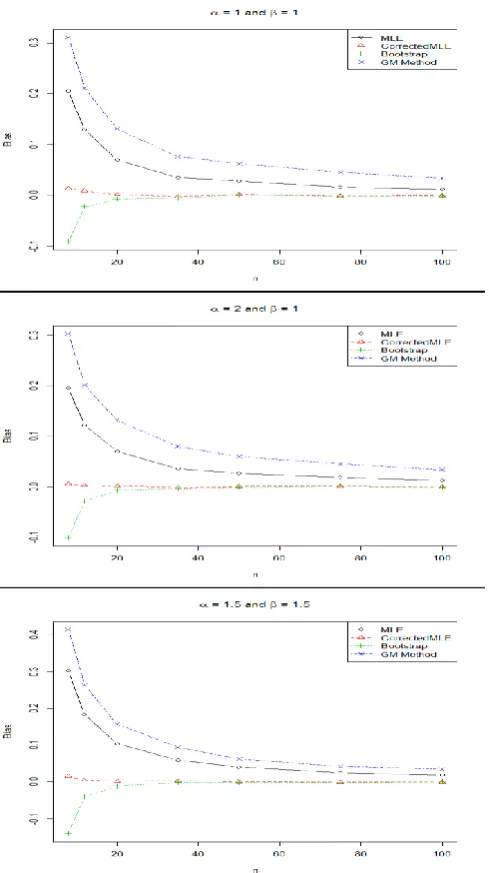
Figure 2.
Comparison of the average biases of the
four different estimation methods for β.
IV.
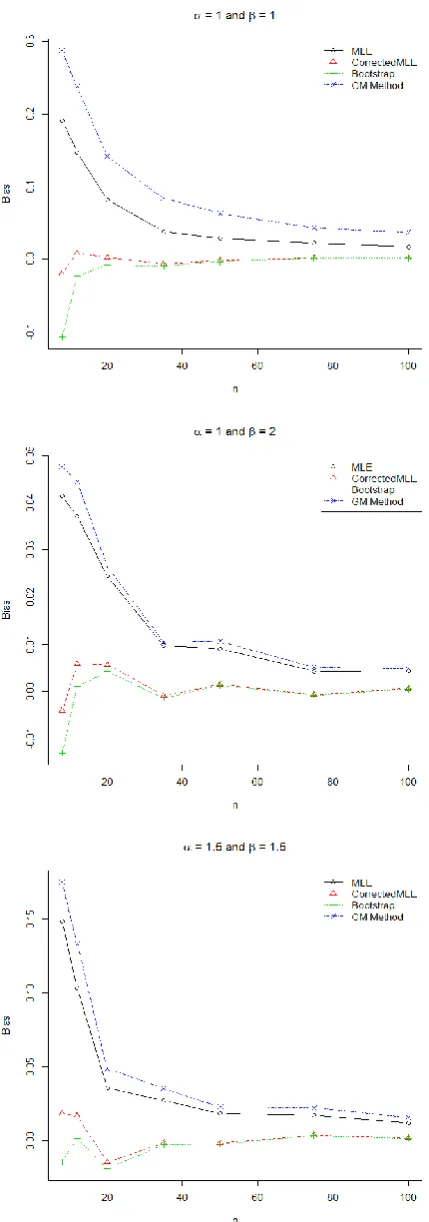
CONCLUSIONThe mathematical analysis can have performed
with several parameters. Those parameters are
analyzed with several conditions. Result show the
best modulation identification based on the value
of the α and β. Calculation are based the values
represent in the graph MLE, Corrected MLE,
Bootstrap and GM method. In future the work
focused on the simply the calculations and
increase the complexity also improve the security
the modulation schemes.
V.
REFERENCES[1]. Zhang, C., Wei, C., Jiang, H., Wang, Z., A Baseband Transceiver for Multi-Mode and Multi-Band SoC, in proceedings of 2012 IEEE 55th International Midwest Symposium on Circuits and Systems, Boise, Idaho, 5-8, pp. 770-773, August 2012.
[2]. Xu,W., Yue, Y., Zhou, T., System Architecture Design of the Internet of Things based on ZigBee, in proceedings of IEEE International
Conference on Cyber Technology in
Automation, Control and Intelligent Systems, Bangkok, Thailand, pp. 826-829, May 2012. [3]. Longbi Lin, Ness B. Shroff, and R. Srikant,
Asymptotically Optimal Energy-Aware Routing for Multihop Wireless Networks with Renewable Energy Sources, IEEE Transactions, 2005.
[4]. B. Danev and S. Capkun. Transient-based identification of wireless sensor nodes. In Proceedings of the ACM/IEEE International Conference on Information Processing in Sensor Networks (IPSN) 2009, 2009.
[5]. S. Selvakumar, Dr.S.Ravi, Adaptive Modulation IN Reconfigurable Platform Journal of
Theoretical and Applied Information
Technology. Vol 68, PP 108-114, Oct 2014. [6]. S. Selvakumar, Dr.S.Ravi, DPSK and QAM
Modulation Detection analyzed with BER Estimation IEEE International Conference on Current Trends in Engineering and Technology, July 2014.
[7]. Navaneethan.C, “Clustering Wireless Nodes
Based On Adaptive Modulation With
Customized Kernel,” J. Theor. Appl. Inf. Technol., Vol. 63, No. 3, Pp. 825-835, 2014. [8]. S.Selvakumar,.J.Vaideeswaran, Adaptive
signatures, in MobiCom „08: Proceedings of the 14th ACM International Conference on Mobile Computing and Networking, ACM, pp. 116-127, New York, USA, 2008.
[10]. Z. Li, W. Xu, R. Miller and W. Trappe, Securing wireless systems via lower layer enforcements, In WiSe '06: Proceedings of the 5th ACM Workshop on Wireless Security, pp. 33-42, ACM Press, 2006.
[11]. Maryam Soltan, Inkwon Hwang, Massoud Pedram, Modulation-Aware Energy Balancing in Hierarchical Wireless Sensor Networks, IEEE Transaction, 2008.
[12]. V. Raghunathan, C. Schurgers, S. Park, and M. Srivastava, Energy-Aware wireless microsensor networks, IEEE Signal Processing Magazine, Vol. 19, pp. 40-50, March 2002. To refer a Book/ Report:
[13]. M. Soltan, M. Maleki, and M. Pedram, Lifetime-aware hierarchical wireless sensor network architecture with mobile overlays, Proceeding of IEEE Radio and Wireless Symposium, pp. 325-328, Jan. 2007.
[14]. Z. Yang, Y. Yuan, J. He, and W. Chen, Adaptive modulation scaling scheme for wireless sensor
networks, IEICE Transactions on