Original Research Article
Social interaction game to promote empathy among first year
medical students: a pilot study
Liaquat R. Johnson
1*, Ramiz Raja
2INTRODUCTION
Empathy has been defined as the ability “to perceive the internal frame of reference of another with accuracy asif one were the other person but without ever losing the “as if” condition” (emphasis added), and is an important attribute desired in a doctor.1,2 Empathic behaviour is required for successful patient care, and is an integral part of professionalism.2 However, studies reveal that medical students lack empathy, and their empathy levels decline as they progress through the course.2-4 This article describes a novel approach to promote empathy- the use of a social interaction game to simulate real-world experiences.
Medical students are expected to interact with members of the community with sensitivity, right from their first semester. We observed that some students were unable to relate to the circumstances of disadvantaged persons during their community visits. This resulted in inappropriate conduct on part of the students, and increased the potential for conflict. To address this problem, we developed a social interaction game that is intended to assist students appreciate that a substantial number of families have socioeconomic circumstances different from their own. Through the experiential element we wanted students to experience many of the problems low socioeconomic status households encounter, and gain a sense of empathy towards this section of society. This is in accordance with ABSTRACT
Background: Empathy is integral to professionalism, but is lacking in medical students. There are few interventions that promote empathy. This pilot study describes the first use of a novel intervention to promote empathy.
Methods: A novel social interaction game was developed and administered to first MBBS students. It provided an experiential simulation of persons belonging to lower socioeconomic strata over 4 simulated „days‟. This cross-sectional study assessed the impact of the intervention on empathy using a 5-point Likert scale to score self-perceptions across several domains. The data were analyzed using repeated measures analysis of variance (RMANOVA).
Results: There was a statistically significant decline in scale scores on all days following Day 1 (p<0.05). This was true across all domains. Cronbach‟s alpha for internal reliability was 0.91 for Day 1; and 0.97 for Day 1 through Day 4. Open ended comments indicated empathic feelings were generated due to the intervention.
Conclusions: A simulation experience like the social interaction game described here, may be used to improve the attitudes and empathy of medical students towards persons from low socioeconomic backgrounds.
Keywords: Empathy, Experiential learning, Medical students
Department of Community Medicine, 1Azeezia Institute of Medical Sciences and Research, Kollam, 2Sree Gokulam Medical College and Research Foundation, Thiruvananthapuram, Kerala, India
Received: 23 April 2018 Revised: 01 June 2018 Accepted: 02 June 2018
*Correspondence: Dr. Liaquat R. Johnson, E-mail: [email protected]
Copyright: © the author(s), publisher and licensee Medip Academy. This is an open-access article distributed under the terms of the Creative Commons Attribution Non-Commercial License, which permits unrestricted non-commercial use, distribution, and reproduction in any medium, provided the original work is properly cited.
recommendations to change how Community Medicine is taught.5 To our knowledge this is the first intervention developed to specifically address this issue.
METHODS
This cross-sectional pilot activity was conducted in a single three hour session among first MBBS students of a private medical college in south India. Total study duration was three months- November 2016 to February 2017.
Permission to pilot the game was obtained from the Department Head, and was implemented during the first semester as part of introductory classes to Community Medicine. During these classes, half the students would go to the community, while the remainder would participate in interactive sessions on a variety of topics- from first aid to communication skills. Verbal consent was obtained from the participating students, and convenience sampling was employed.
The objective of the exercise was to ascertain if the social interaction game described here, could promote feelings of empathy among the participating students.
The social interaction game
The social interaction game takes place over a period of 3 hours with a group of about 50 students and 1-2 faculty. The students are divided into 5 groups (households), each having a predetermined socioeconomic status and material possessions. For uniformity, each household consisted of similar members:
1 Head of the household 1 spouse of the head 1 child 5-6 years of age
1 child 2 months of age who cries for food every 3 minutes, and must be fed something immediately 2 elderly parents of the head who are unemployed
dependents, and require attention every 5 minutes.
In addition, there are several volunteers who essay the following roles:
5 volunteers to document what happens in each group
5 volunteers to document the food consumption in each group
1 Shopkeeper
1 Shopkeeper‟s assistant 1 Doctor
1 Money lender 1 Political leader
5 guests- to be assigned to each group mid-way through the game
While one of the households (number 3) is that of a landlord with considerable savings and assets, the remaining four households represent two pairs of families- one with no savings; and the other with minimal savings. Except for the landlord, all other household heads must work daily to maintain their families. The work consists of carrying students‟ bags from one end of the classroom to another, and is paid for by the landlord at the end of each „day‟.
Households occupy different sections of the classroom, and are constantly observed by the two observers assigned to each family- one to document what and how well they eat; another to document the discussions, actions, etc. of the family members.
A provision shop, a clinic, and the moneylender‟s shop are set up in front of the chalkboards. The provision shop sells meal packets, smokeless tobacco, cigarettes, and breast milk substitute. The clinic is manned by a doctor, who charges fixed fees for consultation in addition to medicines. Additionally, the doctor issues „breastfeeding slips‟ that can be reused any number of times (meal packets, tobacco products and breast milk substitute all come with expiry times and cannot be reused). The moneylender lends money at a very high rate of interest, and charges a surcharge for delayed repayment.
Prior to the activity, „cash‟ was prepared using waste paper (printed on one side and discarded), and marking the appropriate denominational value on each slip. Details of each family‟s circumstances, and the corresponding resources available to them were placed in numbered, opaque paper envelopes. The authors decided on the length of each „day‟ after considering the available time and time required for instructions and feedback.
Each „Day‟ is divided into distinct meal and work times. A typical day begins with breakfast, at which point family members must go to the store and purchase meals for all family members. Thereafter, the heads depart for work, and carry bags till lunchtime is announced. At lunch, the same food pattern repeats itself, and family members purchase meal packets. Post-lunch, work resumes, and continues till the end of the working hours is announced. At this point, the heads receive their wages from the landlord and return home. When dinner is announced, family members purchase meal packets from the store. The end of the day is announced shortly after dinner is announced. The next day commences with the announcement of breakfast time.
Each day is earmarked for one or other event as given below:
Day 1: In the evening, guests arrive unannounced, and are expected to stay for the next few days Day 2: An elderly parent falls down and requires
Day 3: The 2 month old child falls ill and has to be taken to the doctor
Day 4: There is an accident in the fields and all heads working there are injured. They are required to take rest for a few days before resuming work
Day 5: A general strike (hartal/bandh) is called, and there is no work
Day 6: Uneventful
Day 7: Uneventful
The objective of the game was to make it through one week while trying to make the most amount of money.
Participants were asked to rate how they felt about their situation at the end of each „day‟ using a five point Likert scale along multiple domains (Table 1).
Table 1: Details of the domains, and scale of measurement for each domain.a
Scale 5 4 3 2 1 Domain
Hopeful ○ ○ ○ ○ ○ Hopeless Hope
Powerful ○ ○ ○ ○ ○ Powerless Power
Fair ○ ○ ○ ○ ○ Unfair Fairness
Good ○ ○ ○ ○ ○ Bad Niceness
Comfortable ○ ○ ○ ○ ○ Uncomfortable Comfort
Encouraged ○ ○ ○ ○ ○ Frustrated Spirit
Rich ○ ○ ○ ○ ○ Poor Wealth
a
Participants were asked to shade the circle corresponding to their perception/ feelings along each scale.
Movement along the scale as the game progressed would indicate if the activity was successful or not. The scale scores on Day 1 indicated baseline empathy. We had designed the game so that the disadvantaged families would find it increasingly difficult as the „days‟ advanced. Therefore, if those families demonstrated a decline in scale scores across domains (as compared to Day 1), the game would have been successful.
Data entry was performed using Microsoft Office Excel 2013, and analyses were performed using EZR (version 1.36) [R Commander version 2.4-0; R version 3.4.1].6,7 Data were analysed using descriptive statistics and repeated measures ANOVA. Repeated measures ANOVA was used to test the difference in group-wise scale scores over time („days‟) for each domain.8Statistical significance was set at the 5% level.
RESULTS
42 students participated in the activity. Of these, 16 (38.1%) were male, and 26 (61.9%) were female.
There was a statistically significant difference in group-wise scale scores over time when testing the domain „Comfort‟ (F= 33.70, p<0.0001).
Although Group 3 (the landlord‟s family) reported high comfort levels on all days, other groups experienced a significant decline in the same after Day 1.
Post-hoc tests (Bonferroni) revealed that there was a statistically significant difference in scale scores between Day 1 and all succeeding days (Days 2, 3 and 4), p<0.0001.
The domain „Fairness‟ showed a statistically significant difference in group-wise scale scores over time (F= 11.88, p<0.0001).
While Group 3 (the landlord‟s family) felt their situation was fair on all days, members of other groups had a contrasting experience, with all others recording lower scores for fairness after Day 1. As mentioned earlier, this difference in scores was statistically significant.
As in the case of „Comfort‟, Bonferroni post-hoc tests on the „Fairness‟ domain revealed statistically significant differences in scale scores between Day 1 and the succeeding days (Days 2, 3 and 4), (p=0.0005, 0.002, <0.0001 respectively).
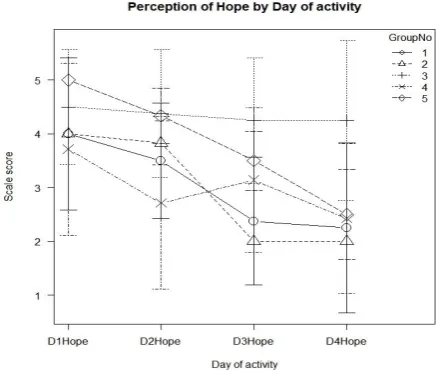
For the domain „Hope‟, Mauchly‟s Test of Sphericity indicated that the assumption of sphericity had been violated, (p<0.0001). Therefore, a Greenhouse-Geisser correction was used. There was a significant effect of time on group-wise scale scores over time (F= 23.32, p< 0.0001) (Figure 1).
Data are presented as scale scores for each Group over the four Days (D1 Hope indicates perception of Hopefulness on Day 1; D2 Hope indicates perception of Hopefulness on Day 2; D3 Hope indicates perception of Hopefulness on Day 3; D4 Hope indicates perception of Hopefulness on Day 4).
Here, too, except for Group 3, all other groups experienced significant decline in hope after Day 1. Although the magnitude and pattern of decline varied between the groups (groups 1, 2, 4 and 5), they all recorded similar levels of hopelessness at the end of Day 4.
Post-hoc tests (Bonferroni) revealed a statistically significant difference in scale scores between Day 1 and the succeeding days (Days 2, 3 and 4), p<0.0001.
For the domain „Niceness‟, Mauchly‟s Test of Sphericity indicated that the assumption of sphericity had been violated, (p=0.02). Therefore, a Greenhouse-Geisser correction was used. There was a significant effect of time on group-wise scale scores over time (F= 10.72, p<0.0001) (Figure 2).
Figure 2: Graph showing the group-wise scale scores for the domain ‘Niceness’ over time.
Data are presented as scale scores for each Group over the four Days (D1 Niceness indicates perception of Niceness on Day 1; D2 Niceness indicates perception of Niceness on Day 2; D3 Niceness indicates perception of Niceness on Day 3; D4 Niceness indicates perception of Niceness on Day 4).
As in previous domains, the values recorded by groups 1, 2, 4 and 5 were clustered together between scores of 2 and 3 at the end of Day 4, while Group 3 consistently recorded values between 4 and 5. Post-hoc tests
(Bonferroni) revealed a statistically significant difference between the scale scores of Day 1 and all succeeding days (Days 2, 3 and 4), (p: <0.0001, 0.001, 0.001 respectively).
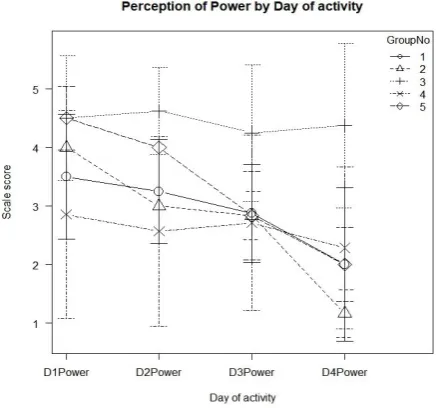
For the domain „Power‟, Mauchly‟s Test of Sphericity indicated that the assumption of sphericity had been violated, (p=0.02). Therefore, a Greenhouse-Geisser correction was used. There was a significant effect of time on group-wise scale scores over time (F= 40.10, p<0.0001) (Figure 3).
Figure 3: Graph showing the group-wise scale scores for the domain ‘Power’ over time.
Data are presented as scale scores for each Group over the four Days (D1 Power indicates perception of Power on Day 1; D2 Power indicates perception of Power on Day 2; D3 Power indicates perception of Power on Day 3; D4 Power indicates perception of Power on Day 4).
This domain recorded the most glaring difference in scores between the groups over time. While Group 3 consistently recorded values between 4 and 5, almost all groups recorded values between 2 and 1 at the end of Day 4. This indicates the extent of powerlessness experienced by them.
As in the case of the previous domains, post-hoc tests (Bonferroni) revealed a statistically significant difference in scale scores between Day 1 and all succeeding days (Days 2, 3 and 4), (p=0.006, 0.0001, <0.0001 respectively).
Unlike the other domains, this domain saw both Group 2 and 3 consistently record scores between 4 and 5, while the other groups manifested a decline in scores at the end of Day 4.
Here, too, post-hoc tests (Bonferroni) revealed that there was a statistically significant difference in scale scores between Day 1 and all succeeding days (Days 2, 3 and 4), (p: 0.007, 0.01, 0.006 respectively).
The tool used to collect responses was evaluated for internal reliability using Cronbach‟s alpha. The value of alpha was 0.91 for Day 1 alone; 0.95 for Day 1 and Day 2; 0.96 for Day 1 through Day 3; and 0.97 for all four days.
Analysis of open-ended comments indicated that participating students valued the experience. A selection of the feedback received is presented in Table 2.
Table 2: Most frequent feedback comments received.
Feedback received Number of students
‘Learned how difficult it is to manage a family’ 12
‘Learned about (financial) problems of poor’ 11
‘Good experience’ 10
‘Learned the importance of each family member’ 10
‘People’s attitude towards each other depends on their situation’ 8 ‘Learned about different circumstances of different levels of people in society’ 8
Some of the students complained about the sale of tobacco products in the store, while others remarked how tobacco products were used as substitutes for food.
DISCUSSION
Medical students‟ exposure to disadvantaged communities is often limited. In a busy secondary or tertiary care setting, the complexities of day-to-day living experienced by persons from low socioeconomic backgrounds are often forgotten. Having an empathic attitude towards such patients may directly correlate with patients‟ satisfaction with care.9-11
The results of this pilot study support the hypothesis that the social interaction game improves the attitudes and empathy of students towards socioeconomically disadvantaged people. Since empathy is an essential part of professionalism, its importance cannot be ignored. We focused only on determining if the intervention had any effect. Therefore, we did not analyse the scores according to age, gender, or socioeconomic background.
As this is a complex study topic, uniform changes across all domains were not expected. However, the trend of decreasing scale scores across all domains indicates that the intervention affected all aspects under study. That said, this intervention accurately captured the difference in subjective experience between members of various groups. Group 3 represented the landlord‟s family, and consistently recorded high scores across domains and time. However, the other groups experienced significant declines in all domains over time (except Group 2 in the Spirit domain). Interestingly, the greatest mismatch in scores between Group 3 and the other groups was seen in the Hope and Power domains at the end of Day 4. This further establishes the effectiveness of the intervention in generating empathy- the students experienced the frustration of having no control over their circumstances
and felt powerless by the end of Day 4 itself. It was as if they were living the lives of those they represented.
To our knowledge, this is the first and only instance of using such an intervention for this specific purpose in medical students. Although others have investigated the utility of other interventions to increase empathy, they focused on other areas- diabetes and aging. Moreover, the interventions were different- one used comics, while another involved an aging game.9,12 Similarly, simulation games have been used in medical education, though not for this purpose.13
The advantages of this game are that it is low-tech, relatively less resource-intensive, scalable, adaptable to a variety of situations, and provides a realistic experience of life in the lower socioeconomic status groups without much manipulation by the faculty.
The disadvantages are that it is relatively low-fidelity in some aspects, requires considerable advance planning, might be considered too complex by some, and is time-consuming- it is difficult to complete the entire week within a single 3 hour session.
Although we originally planned to allow the game till completion of 7 days, time constraints forced us to stop it after the completion of 4 days. We used broad constructs to ascertain if the intervention had any effect. Similarly, students rated their experiences immediately after the intervention. Therefore, it is not known if the effects on attitude and empathy would last for long. As we did not assess students prior to the intervention, it is not known how much of the „effect‟ was attributable to the intervention.
CONCLUSION
attitudes and empathy of medical students towards persons from low socioeconomic backgrounds.
ACKNOWLEDGEMENTS
The authors wish to thank the students who participated in the study, and Mrs. Jeffy Binu for verifying the statistical analysis.
Funding: No funding sources Conflict of interest: None declared
Ethical approval: The study was approved by the Institutional Ethics Committee
REFERENCES
1. Rogers C, Hojat M. In: Empathy in Health Professions Education and Patient Care. Switzerland: Springer International Publishing; 2016: 5,6.
2. Hegazi I, Wilson I. Maintaining empathy in medical school: It is possible. Med Teach. 2013;35(12):1002-8.
3. Ferreira-Valente A, Monteiro JS, Barbosa RM, Salgueira A, Costa P, Costa MJ. Clarifying changes in student empathy throughout medical school: a scoping review. Adv Health Sci Educ Theory Pract. 2017;22(5):1293-313.
4. Chen DCR, Kirshenbaum DS, Yan J, Kirshenbaum E, Aseltine RH. Characterizing changes in student empathy throughout medical school. Med Teach. 2012;34(4):305-11.
5. Bansal R. Has the time come to change the way we teach Community Medicine to undergraduate students? Indian J Community Heal. 2013;25(1):1-5.
6. Kanda Y. Investigation of the freely available easy-to-use software “EZR” for medical statistics. Bone Marrow Transplant. 2013;48(3):452-8.
7. Johnson LR, Karunakaran UD. How to Perform Data Analysis Using the Free Software EZR. Part 1 : Single Continuous Dependent Variable. Ann Community Heal. 2014;2(3):22-5.
8. Johnson LR, Karunakaran UD. How to Choose the Appropriate Statistical Test Using the Free Program “Statistics Open For All” (SOFA). Ann Community Heal. 2014;2(2):54-62.
9. Varkey P, Chutka DS, Lesnick TG. The Aging Game: improving medical students‟ attitudes toward caring for the elderly. J Am Med Dir Assoc. 2006;7(4):224-9.
10. Ren GSG, Min JTY, Ping YS, et al. Complex and novel determinants of empathy change in medical students. Korean J Med Educ. 2016;28(1):67-78. 11. Hur Y, Cho AR, Kim S. Measuring medical
students‟ empathy using direct verbal expressions. Korean J Med Educ. 2016;28(3):305-13.
12. Tsao P, Yu CH. “There‟s no billing code for empathy” - Animated comics remind medical students of empathy: a qualitative study. BMC Med Educ. 2016;16(1):204.
13. Johnson LR. Verisimilitude game to teach infectious disease epidemiology to medical students. Med Educ. 2015;49(11):1140.