Towards a Complete Solution to Mobility
Management for Multiple-Operability Mobile
Systems
Tejashri H. Mohite1Lecturer in Electronics Dept,Dr.J.J.M.C.O.E.,Jaysingpur, Email: [email protected]
S.V.Sankpal2
2 Sr.Lecturer, Electronics Dept, D.Y.P.C.O.E, Kolhapur Mr.Patil A. D.3
,3Sr.Lecturer,Mechanical Dept, D.K.T.E, Ichalkaranji, Dist. Kolhapur., Maharashtra., Email: [email protected]
---ABSTRACT--- In the Multiple-Operability Mobile Systems, mobile users (MUs) will be able to move across various heterogeneous networks while using their mobile terminals (MTs) to communicate. It has been proven that this global roaming freedom signiÞcantly increases the network-signaling traffic. Several schemes have been recently proposed to reduce such a traffic. This paper presents an efficient approach which uses a special gateway called Wireless INterworking Gateway (WING) to facilitate interoperability between heterogeneous subsystems of the NG wireless systems. Results reveal that such an approach signiÞcantly improves the network performance, in terms of generated signaling traffic and response time during the global roaming process.
Keywords: Global Roaming, Multiple-Operability Mobile Systems, heterogeneous networks, Service portability, Location management.
---
Date of Submission: March 31, 2010 Revised: June 22, 2010 Date of Acceptance: June 28, 2010
---
I. INTRODUCTION
T
he Multiple-Operability Mobile systems are envisioned to integrate many heterogeneous existing systems into a seamless radio infrastructure capable of delivering to mobile users (MUs) a wide range of services (fast Internet access, image processing, videoconferencing) [2–9,12,11– 15,14]. Such an infrastructure will implement terminal mobility, personal mobility, and service portability. Terminal mobility refers to the ability to route calls to mobile terminals (MTs) regardless of their point of attachment to the network, while personal mobility is the ability of the MUs to access their personal services independent of their attachment point or terminal. Service portability allows the MUs to move across different network backbones, service providers, and geographical boundaries, and to receive their personalized end-to-end services regardless of their current network. Such a freedom requires the system to interoperate with both wireline and wireless networks, and makes it difficult to locate MUs as they move across various regions and heterogeneousnetworks. In a mobile network, the service area is partitioned into several location areas (LAs), and each LA covers several cells [13].
Mobile terminals are required to update their location information with the network whenever they enter a new LA. This enables the network to know exactly their residing LA at any time [2]. Implementing LA-based methods for mobility management requires the use of several databases. Generally, a home location register (HLR) database and several visitor location register (VLR) databases are included in the network architecture [13,2]. When a user Þrst subscribes to wireless services, a permanent record of his/her proÞle is created in the HLR. Since this user may move from one LA to another, his/her current location is usually maintained in a VLR, and must be identiÞed before the setup of any connection.
Location management is a two-stage process that enables the network to notify the current attachment point of any MT for call delivery. The Þrst stage is location registration (or location update), where the current location of the MT is updated in the appropriate databases (VLR, HLR) [14]. The second stage is call delivery which consists of two major steps: determining the serving VLR of the called MT and locating the visited cell of the called MT. Research in this area generally aims at improving the IS-41 location management scheme while keeping the basic database network unchanged [10,15,2].
Moreover, handoff management is a three-stage process which enables a call in progress to continue as the mobile user (MU) moves between LAs [14]. The Þrst stage involves initiation, where either the user, a network agent, or changing network conditions identify the need for handoff. The second stage refers to generation of a new connection, where the network Þnds new resources for the handoff connection and performs additional routing operations. The Þnal stage involves data ßow control, where data delivery from the old to the new connection path is maintained according to certain quality of service (QoS) requirements.
However, all the schemes presented above only concern intrasystem roaming, i.e. the MUs’ movements are limited within LAs of a particular network. This aspect has been comprehensively investigated for stand-alone wireless net-works over the past decade [10,15,2]. Generally, methods for solving such a problem are classiÞed into two categories [2]. The Þrst category includes all the schemes based on algorithms and network architecture. The second category gathers the methods based on learning process, which requires statistics on user mobility behavior. While the Þrst category uses static algorithms, the second uses dynamic methods [15,2]. However, for the NG wireless systems, we consider intersystem or global roaming, which refers to MUs who move between different backbones, protocols, and service providers
This paper presents an approach which can improve the performance of the NG wireless systems, in terms of generated signaling trafÞc and response time during the global roaming process. It is organized as follows. Section 2 presents background and research related to global mobility management. Section 3 describes the proposed approach for global roaming
management. Section 4 deÞnes the main parameters for performance evaluation. Section 5 presents computational results, whereas Section 6 provides some concluding remarks.
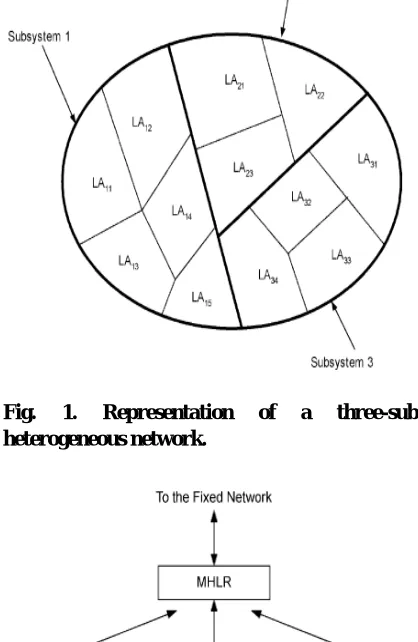
Fig. 1. Representation of a three-subsystem heterogeneous network.
Fig. 2. Architecture with an MHLR for global roaming management.
recently proposed to reduce such a trafÞc and maintain good QoS requirements [3,1,4,9,5,2].
Fig. 1 gives an example of a network which consists of three subsystems. This network allows an MU to travel from any subsystem to another. In this case, subsystem 1 may represent the North American Interim Standard 95 (IS-95) system, while subsystem 2 may represent the European Global System for Mobile Telecommunications (GSM) and subsystem 3 a wireless ATM (WATM) network. In this context, intersystem location update concerns updating the location information of an MT performing intersystem roaming, whereas intersystem paging is aimed at searching for the called terminal roaming between different service areas.
As the subsystems use different registration procedures and protocols, it seems difÞcult to merge HLRs of the individual systems into a single HLR. Thus, a reasonable approach is to build an architecture with a tier manager called Multi-tier HLR (MHLR) which communicates with the heterogeneous HLRs [13,14]. Such an architecture is illustrated in Fig. 2 for a three-subsystem heterogeneous network. With the MHLR, two registration strategies have been proposed: Single Registration (SR) and Multiple Regis-tration (MR) methods [13]. The SR strategy enables the MT to register with the MHLR on only one subsystem at any time to indicate its current location. Ref. [13] illustrates the different registration/deregistration operations executed when an MT moves from subsystem i to subsystem j.As for the MR method, it enables the MT to register with the MHLR on multiple subsystems at any time concurrently, i.e. individual subsystems perform their roaming management as if they are not integrated. Also, Ref. [13] illustrates the operations executed when anMT moves from subsystem i to subsystem j. However, such an architecture may generate a huge amount of signaling trafÞc at the MHLR, which may impact the QoS expected from the network.
2. THE PROPOSED APPROACH:
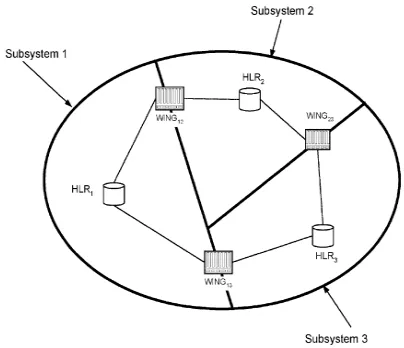
Fig. 3. Interconnection of WINGs with HLRs for a three-subsystem network
The proposed approach uses a special gateway called Wireless INterworking Gateway (WING) between each pair of adjacent networks in order to reduce the signaling trafÞc at the databases (HLRs, VLRs) and facilitate interoper-ability between heterogeneous subsystems in the context of global roaming.More speciÞcally, for each pair of adjoining subsystems i and j, a WING, denoted WINGij, is set up to interconnect directly HLRi to HLRj, while being accessible to both subsystems. Fig. 3 illustrates such an interconnec-tion for a three-subsystem network. The WING contains a number of converter modules which ensure conversion of signaling message formats and perform protocol translation from subsystem i to subsystem j (or vice versa), with respect to syntax and semantics. In particular, different maximum message sizes and different addressing schemes must be converted ßexibly.
messages. As recommended by the UMTS Technical SpeciÞcations, the buffer size may be Þxed at 8192 bytes [1]. In the same vein, the memory used to store packets awaiting processing or currently processed by the forwarding CPU may be Þxed at 16 MB, whereas the maximum rate at which the trafÞc is switched at the WING is 500,000 packets/s. This guarantees that processed packets remain in that memory until sent out on an appropriate interface, or forwarded to the appropriate slot memory. Hence, a WING is an intelligent switch specially designed for the exchange of information needed between adjacent heterogeneous systems. It possesses the following functionalities: Transforming messages and signaling formats from any network to another, Maintaining the roaming information of MUs after any location registration or update, and being able to retrieve such information at any time, Enabling reliable transmission of call delivery and signaling information (i.e. performing error control), Ensuring mobile users’ authentication for secure data delivery.
3.EVALUATION OF QUERY AND UPDATE
RATES:The signaling traffic related to global mobility consists of registration, deregistration, call origination and call delivery. In terms of database activity, such a traffic may be considered as of two kinds: query and update [10]. Evaluation of the query/update rates is based on the mobility model which describes the MU movements, taking into account the speed, direction, and movement history of each MU. Ref. [11] gives a description of several mobility models. However, in the context of this research, we consider a variation of the Fluid Flow Model to characterize movement behavior. According to this model, MUs in subsystem i are assumed to move at an average speed of vi, while having a direction of movement uniformly distributed over [0,2p]. Assuming that these MUs are uniformly distributed throughout subsystem i with a density ri, and the boundary of subsystem i is of length Li, the rate of users moving out of subsystem i to subsystem j is given by:
r i j = Zi vi L i /∏ (1)
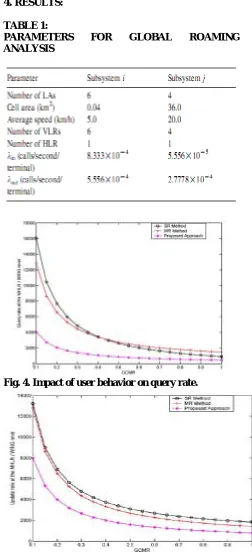
4. RESULTS:
TABLE 1:
PARAMETERS FOR GLOBAL ROAMING ANALYSIS
Fig. 4. Impact of user behavior on query rate.
5. CONCLUSION:
This paper has presented an efficient approach to facilitate interoperability between different subsystems of the NG wireless networks. Numerical results reveal that such an approach significantly improves the results obtained from SR, MR and WING methods, in terms of generated signaling traffic and response time during the global roaming process. From the result analysis, we may deduce the following advantages of the proposed approach: low query/update rates at the database level, rapid user location, simple implementation, and low response time.
REFERENCES:
[1]. G. Fruscio, V. Petrone, Evolving towards universal mobile telecommunication systems: development of a new system based on emerging technologies, IEEE Wireless Communications and Networking Conference (WCNC 1999), September 2006, pp. 403–407.
[2]. V.K. Garg, S. Halpern, K.S. Smolik, Third generation (3G) mobile communications systems, IEEE International Conference on Personal Wireless Communications (ICPWC 99), February 2007 pp. 39–43.
[3]. B. Jabbari, Teletraffic aspects of evolving and next-generation wireless communication networks, IEEE Personal Communications 3 (6) (1996) 4–9.
[4]. R. Jain, Y.-B. Lin, C. Lo, S. Mohan, A caching strategy to reduce network impacts of PCS, IEEE Journal on Selected Areas in Communications 12 (8) (1994) 1434–1444.
[5]. Y.-B. Lin, I. Chlamtac, Heterogeneous personal communications services: integration of PCS systems, IEEE Communications Magazine 34 (9) (1996) 106–113.
[6]. J. McNair, I.F. Akyildiz, M.D. Bender, An inter-system handoff technique for the IMT-2000 inter-system, IEEE Infocom ’00 March 2000; 208–216.
[7]. K.I. Park, Y.-B. Lin, Reducing registration traffic for multitier personal communications services, IEEE Transactions on Vehicular Technology 46 (3) (1997) 597–602.
[8]. N.R. Prasad, GSM evolution towards third generation UMTS/IMT- 2000, IEEE International Conference on Personal Wireless Communications (ICPWC 99), February 1999, pp. 50–54.
[9]. R.R. Ryan, Roaming between heterogeneous 3rd generation wireless networks, IEEE Wireless Communications and Networking Conference (WCNC), 21–24 September 1999, New Orleans, USA, vol. 1, 1999 pp. 321–323.
[10].S. Tabbane, Location management methods for third-generation mobile systems, IEEE Communications Magazine 35 (8) (1997) 72– 84.
[11].Y. Xiao, W. Fang, Y.-B. Lin, Hierarchical implicit deregistrationwith forced registrations for 3G wireless networks, IEEE Transaction on Vehicular Technology 53 (1) (2004) 271–278.
[12]. Y.B. Lin, L.F. Chang, A. Noerpel, K. Park, Performance modeling of multitier PCS system, International Journal of Wireless Information Networks 3 (2) (1996) 67–78. 2000’, Calgary, Canada, July 2000 pp. 295–301.
[13].Y.-B. Lin, I. Chlamtac, Heterogeneous personal communications services: integration of PCS systems, IEEE Communications Magazine 34 (9) (1996) 106–113.
[14].J. McNair, I.F. Akyildiz, M.D. Bender, An inter-system handoff technique for the IMT-2000 inter-system, IEEE Infocom ’00 March 2000; 208–216.