Original Research Article
Knowledge, attitude and practices studies conducted
amongst medical students of India
Sandeep Sachdeva*, Neha Taneja, Nidhi Dwivedi
INTRODUCTION
Research is a critical component in progress and prosperity of institution or nations and inter-alia prevents them from rusting, decay and decline. The research environment in developing countries including India is witnessing a slow but positive rise. In this context,
researchers per million populations were reported in India in 2010, much less than the global average of 1023.1 Similarly, India scored 12th position among the productive countries of the world in medicine during 1999–2008 with a mere 1.6% share in the world research output.2 Another recent study revealed that out of 579 recognized medical institutions, 57% did not produce a
ABSTRACT
Background: Assessment of published original “KAP” based research studies conducted amongst Indian medical undergraduate students.
Methods: A systematic evaluation was undertaken using keywords “KAP” or “knowledge” or “awareness” or “attitude” or “practices” and “MBBS students” or “medical students” or “health students” or “undergraduate student” or “university students” and “India” through search engines, PUBMED and Google scholar under certain criteria.
Results: Highest, “KAP” based articles amongst MBBS students published during one-year period were related to Pharmacovigilance (15.6%) followed by organ/blood donation (11.7%) and self-medication (9.8%), tobacco (5.8%), and basic life support (5.8%) etc; 48 (94.1%) article was one-time cross-sectional descriptive studies while 03 (5.8%) had intervention based research design. Average no. of authors per article was 3.5 (±1.3); Medical student was co-author in 04 (7.8%) research papers. Corresponding co-author was largely dominated by faculties from pre and para -clinical departments with highest from pharmacology (29.4%) and community medicine (27.4%). The studies covered an average sample size of 225.8 MBBS students (45-648, range) per research article. Avg. no. of references used/article was 18.6 (±7.4); Out of all the references used in research articles, only 60.2% were of recent-10 year time frame (2007-2016) origin while the rest were from older time-frame and only 36.1% of all the references were of Indian origin.
Conclusions: Probably, first of its kind systemic synthesis undertaken in the country concludes that diverse topics of “KAP” research have been conducted by the teaching faculties on MBBS students in India and this study provides the over-view of the same.
Keywords: Knowledge, Attitude, Practices, Audit, Communication, Publication, Medical education, MBBS, Undergraduate student, Research design, Cross-sectional study, Teaching faculty
Department ofCommunity Medicine, North Delhi Municipal Corporation Medical College and Hindu Rao Hospital, New Delhi, India
Received: 11 May 2018
Revised: 30 June 2018
Accepted: 16 July 2018
*Correspondence:
Dr. Sandeep Sachdeva, E-mail: [email protected]
Copyright: © the author(s), publisher and licensee Medip Academy. This is an open-access article distributed under the terms of the Creative Commons Attribution Non-Commercial License, which permits unrestricted non-commercial use, distribution, and reproduction in any medium, provided the original work is properly cited.
2005 to 2014.3 However, multiple sustained interjections by government of India especially with the establishment of department of research in the year 2007 have resulted in pan-country catalyzing effect on research.
Medical research is mandatory at post-graduate level and Medical Council of India in its amendments has suggested increasing exposure of theoretical and experiential project based research at undergraduate level. It is widely acknowledged that promoting research aptitude among undergraduate students will help them become more inquisitive and analytical in their approach and in turn lead to adoption of deeper learning capacity.4,5 Education is a powerful tool that can bring a developmental change in the life of individual, group of people and society at large. For this to happen, learning must encompass the cognitive, affective and psychomotor domains. Knowledge refers to understanding of a given topic by a group of people. Attitude refers to their feelings towards the subject as well as any pre-conceived ideas that they may have towards it while practice refers to the ways in which they demonstrate their knowledge and attitude through their actions.
Understanding these background factors enable in tailoring the health and communication program to address the needs of community, students, or other stakeholders more appropriately.6-18 With this insight an evaluation of published original “Knowledge, Attitude and Practices” (KAP) research studies conducted upon Indian medical undergraduate student was undertaken.
METHODS
A systematic evaluation was undertaken using keywords “KAP” or “knowledge” or “awareness” or “attitude” or “practices” and “medical students” or “health students” or “university students” or “MBBS students” and “India” through search engines, PUBMED, and Google scholar. The search engines with selected keywords were reviewed avoiding any duplication of articles between two data source and excluding unrelated items. Inclusion criterion included original “KAP” research studies carried amongst medical (MBBS) undergraduate students of India including medical intern. Considering feasibility, time frame of published original research article was restricted to one-year only i.e. 2017. This analysis did not include manuscripts such as personal view point, editorial, commentaries or case reports etc. The authors were able to identify 60 original research articles using above mentioned search strategy during April 2018. All the listed original research articles were downloaded and reviewed in detail and following characteristics of manuscript was captured using checklist: thematic research domain, research design, methods of data collection, sample size of MBBS students actually
covered, number of authors, department details of corresponding author, medical student as co-author, number of pages per article (pdf), number of tables and graphs depicted in the result section, total number of references, recent (2007-16) references, Indian (authors/studies or website or government) references, and journal references used. However, on detail scrutiny, 09 articles were excluded since they were either carried out on paramedical subject like nurse, pharmacy or dental or non-medical college students or post-graduate resident or clinician; and lastly when only abstract was available without complete research article in public domain. Data management was undertaken using SPSS ver. 20 (IBM, New York, USA) by calculating descriptive statistics. Related research domains were clubbed yet unique titles have been listed separately.
RESULTS
Out of 51 suitable original research articles, 12 (23.5%) were published in PUBMED indexed journals. With regard to thematic research domain, highest, “KAP” articles were related to Pharmacovigilance, 08 (15.6%) followed by those related to organ/blood donation- 06 (11.7%), self-medication (9.8%), tobacco (5.8%), and basic life support (5.8%) etc. The “KAP” research domain of published original articles upon Indian medical undergraduate student is shown in Table 1.
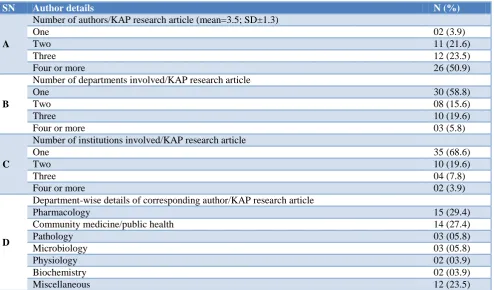
It was observed that 48 (94.1%) article were one-time cross-sectional descriptive studies while 03 (5.8%) had intervention (pre-post) based research design. Average number of authors per article was 3.5 (±1.3) and it was also found out that in 26 (50.9%) research articles there were atleast four co-authors; in majority of articles only one-department (58.8%) and single institution (68.6%) was involved in publication. Medical student was co-author in 04 (7.8%) research papers. Corresponding author in these research publications was largely dominated by faculties from pre and para-clinical departments. Highest was pharmacology (29.4%), and community medicine (27.4%). Details are shown in Table 2.
Table 1: Thematic research domain of knowledge, attitude and practice survey conducted amongst medical students enrolled in medical colleges of India, 2017.
SN Research topic N=51 (%)
1. Pharmacovigilance/ADR/Drug schedule 08 (15.6)
2. Organ/blood donation 06 (11.7)
3. Self medication/rational use of medicine/ antibiotic usage and resistance 05 (09.8)
4. Tobacco/hookah smoking 03 (05.8)
5. Basic life support/ First Aid 03 (05.8)
6. Medical education/teaching 02 (03.9)
7. Bio medical waste management 02 (03.9)
8. Research/clinical trial 02 (03.9)
9. Emergency contraception 02 (03.9)
10. Nutrition and healthy life style/Vitamin D 02 (03.9)
11. Diabetes (metacognition/ ocular complication) 02 (03.9) Miscellaneous (Health communication, Hepatitis-B, HPV vaccine, Hand Hygiene, HIV, Infection
Control, Obstructive Sleep Apnea, Oral Health, Palliative care, Post mortem Examination, Road Safety, Thalassemia, Torture, Tuberculosis)
14 (27.4)
ADR=adverse drug reaction.
Table 2: Author wise details of KAP research (N=51) conducted amongst MBBS students, India, 2017.
SN Author details N (%)
A
Number of authors/KAP research article (mean=3.5; SD±1.3)
One 02 (3.9)
Two 11 (21.6)
Three 12 (23.5)
Four or more 26 (50.9)
B
Number of departments involved/KAP research article
One 30 (58.8)
Two 08 (15.6)
Three 10 (19.6)
Four or more 03 (5.8)
C
Number of institutions involved/KAP research article
One 35 (68.6)
Two 10 (19.6)
Three 04 (7.8)
Four or more 02 (3.9)
D
Department-wise details of corresponding author/KAP research article
Pharmacology 15 (29.4)
Community medicine/public health 14 (27.4)
Pathology 03 (05.8)
Microbiology 03 (05.8)
Physiology 02 (03.9)
Biochemistry 02 (03.9)
Miscellaneous 12 (23.5)
Table 3: Selected document characteristics of original “KAP” research articles (n=51).
Characteristics Mean (SD)
Avg. sample size of MBBS students covered/article 225.8 (±158.9)
Avg. no. of result tables depicted/article 3.2 (±1.5)
Avg. no. of figures (graphs) utilized/article 1.3 (±1.7)
Avg. no. of standard pages (pdf) per research article 5.4 (±1.4)
Avg. no. of references used/article 18.6 (±7.4)
Proportion of recent references used [within 10 years i.e. 2007-2016] to total references/article 60.2%
Proportion of journal references to total references/article 80.3%
DISCUSSION
A systematic evaluation of published original research regarding “Knowledge, Attitude and Practices” conducted upon MBBS undergraduate students enrolled in Indian medical colleges was undertaken, probably first of its kind analysis in country. To the best of our efforts we could not trace any similar studies, at national or international level, conducted at undergraduate level. In this analysis the highest “KAP” research domain upon which original articles were published was related to pharmacovigilance (15.6%) followed by those related to organ/blood donation (11.7%) and self-medication (9.8%) etc. The contour of research topics reflect the attention on the issue being received/debated in the country, newer topics of interest, motivation of faculty and/or subject specific specialty topics.
The present study provides objective analysis of Indian specific “KAP” research undertaken upon MBBS students in the background of socio-cultural scenario at one-end; temporal-distribution; motivation, ease (feasibility), limiting context and scale of technical capacity of faculty at other end. However, it is submitted that „knowledge‟ and „practices‟ were studied in detail but assessment of „attitude‟ is difficult to measure and hence less studied in these articles. From the students perspective, range of publication definitely indicates that sampled students in various medical colleges would have been enriched following the research activities undertaken either in terms of improvement in their “Knowledge, Attitude or Practices”, inter-related communication, sensitization or being exposed to some component of research.
Medical education, teaching, learning dynamics and evaluation process forms the core-activity of student teacher interaction in any institution and motivated faculties are constantly engaged in building, transforming and implementing innovating methods from a large bouquet of training methods.19-21 The development and growth potential of an individual is directly correlated with the depth of knowledge, positive attitude, and diverse skills she/he possesses and demonstrates whether at undergraduate or higher level of functioning.22 It is no surprise that significant proportion of popular physician across the world have roots in India and another substantial global patients are reporting to India to seek care as medical, transplant or reproductive tourist.23,24 The medical education imparted to Indian medical undergraduate student is of highest order, evidence based on global best practices This study provides a snap-shot of the concept (KAP research amongst Indian medical students) under consideration while needless to say there are still larger number of other Indian research published beyond the indexing site, journal and time-limits but were outside the scope of present analysis and hence this study may not be exhaustive in nature.
The research environment and culture in country has definitively evolved for better and the wheels of change have started rolling since the interjection of monetary budget being earmarked by government of India for research, related activities and learning. There are various academic professional bodies and training institutions in the country who are involved in imparting research methodology training to young scholars in collaboration with international partners. Inter-alia, in recent years, there has been boom in quantum of research articles and publishing houses (journals) in India following release of guidelines from Medical Council of India (MCI) towards minimum number of research publication for appointment and promotion as faculty in medical colleges. This is corroborated by a recent study of PUBMED and IndMed database that indicated atleast public health research output has increased by 42% in last decade (n=474 in 2000 to n=817 in 2010) from India.23 Over these years, at one end study rigor has improved and at other end peer-review quality with critical comments on study methodology has been galvanized for better.
With maturing of Indian research environment “KAP” based research domain has come to a stage of „super saturation and fatigue‟ with some of the established Indian journals having policy not to entertain KAP based articles. On a pitfall, this has also led to proliferation of multiple poor quality privately owned journals with inclusion of all varieties of articles on payment basis for publications within-days of submission. This is evident as majority (76.4%) of articles was published in local journals with very low impact factor. Inspite of various challenges there are lot of scope for quality improvement with more efforts and intervention specific studies in future by esteem medical faculties.
international study on summer research program amongst undergraduate reported 30% research articles being co-authored by medical students.28 In another study, authors reviewed 25152 publications in the Medline-indexed journals affiliated to world‟s top 10 universities and found out that 2537 (10.1%) articles contained atleast one undergraduate medical student as co-author.29 A study (n=346) in a Sri Lanka medical university found that 57.6% students had shared their research finding in some scientific conference whereas only 1.73% had published in indexed journal as author.30 While another study (n=515) from British medical college found out that 13.9% student had submitted research article as co-author and 17.0% had submitted their finding for scientific meeting.31 Our study did not cover the entire gamut of publications reflecting the status of medical student as author but evidently increasing trend of medical students as co-author would be witnessed in research articles being generated in India too in near future!
A related study carried out amongst two prominent national public health journals indicated document properties like mean number of pages per article and number of references used as 5.5 (IJCM) and 5.2 (IJPH); and 20.2 (IJCM) and 17.8 (IJPH) references used in original research articles. Nearly 84.42% original research articles in these two-journals were cross-sectional in study design.32 In our analysis, average length of article was found to be 5.4 (±1.4) standard pages (pdf) with 18.6 (±7.4) references/article and 94.1% one-time cross-sectional study design. However, usage of recent references (within 10 years) were found to be lower (60.2%) in present analysis in comparison to 63% (IJPH), 66% in IJCM, and 82% (Bulletin of WHO).32 The lower proportion probably indicates that young faculties are not putting in their best efforts to undertake extensive and updated literature review to buildup and add new dimension to the current knowledge base. However, another possible reason could be the research domain tested in the western literature of more than a decade old is now being validated/explored/tried in Indian setting since the current demand for research publication is very high.
The undergraduate students are the readily available subjects for pre and para-clinical (i.e. predominantly teaching) departments in the medical colleges. In this context, easily approachable and cohesive group like medical student offers an easy option for undertaking “KAP” research studies by distribution of self-administered questionnaire involving minimal resources. Further, it would be prudent on the part of faculties to share research findings with respective undergraduate students keeping an eye on transferring statistical wisdom and skills.
In conclusion, diverse topics of “Knowledge, Attitude and Practice (KAP)” based research studies have been conducted and published amongst Indian medical
various medical colleges and this study provides the over-view of the same. This analysis may aid scholars to explore newer avenues of „KAP” research in future or similar study with longer time-frame along with trend analysis. Each research domain/topic could be further evaluated by undertaking systemic review and synthesized to infer, capture and describe the snap-shot status of research domain amongst MBBS students. A suggestion for young scholars while building article write-up is to undertake review of literature utilizing recent, updated and authentic references.
Funding: No funding sources Conflict of interest: None declared
Ethical approval: The study was approved by the Institutional Ethics Committee
REFERENCES
1. United Nations Educational, Scientific and Cultural Organization. Institute for Statistics. Country profiles: India. Human Resources in Research and Experimental Development. Available at: unesco.org/DataCentre/Pages/countryprofile.aspx? region code=40535andcode=IND. Accessed 22 April 2017.
2. Gupta BM, Bala A. Scientometric analysis of Indian research output in medicine during 1999–2008. J Nat Sci Biol Med. 2011;2:87-100.
3. Ray S, Shah I, Nundy S. The research output from Indian medical institutions between 2005 and 2014. Curr Med Res Pract. 2016;6:49‑58.
4. Alghamdi KM, Moussa NA, Alessa DS, Alothimeen N, Al‑Saud AS. Perceptions, attitudes and practices toward research among senior medical students. Saudi Pharm J. 2014;22:113‑7.
5. Devi V, Abraham RR, Adiga A, Ramnarayan K, Kamath A. Fostering research skills in undergraduate medical students through mentored students projects: Example from an Indian medical school. Kathmandu Univ Med J. 2010;8:294‑8. 6. Sachdeva S, Sachdev TR, Sachdeva R. Bibliometric
evaluation of published Indian research on “Knowledge, Attitude, and Practices”. Indian J Health Sci Biomed Res. 2017;10:208-15.
7. Sachdeva S, Kapilashrami MC, Sachdev TR. Adolescent profile: Hospital record based study. Int J Adolesc Med Health. 2010;22:561-6.
8. Sachdeva S, Malik JS, Sachdeva R, Sachdev TR. HIV/AIDS knowledge among first year MBBS, nursing, pharmacy students of a health university. J Fam Comm Med. 2011;18:155-8.
9. Taneja N, Sachdeva S, Dwivedi N. Assessment of depression, anxiety, and stress among medical students enrolled in a medical college of New Delhi, India. Indian J Soc Psychiatry. 2018.
11. Gupta KB, Mehta D, Sachdeva R, Sachdeva S. Knowledge of doctors, interns, and final year medical students on selected parameters of tuberculosis and RNTCP. JIACM. 2016;17(3):198-200.
12. Sachdeva S, Datta U. Hepatitis B immunization coverage evaluation amongst slum children. Ind J Pub Health Res Devel. 2012;3:210-3.
13. Sachdeva S, Behera BK, Rani B, Sachdeva Ruchi, Bharti, Nagar M, et al. Perception of selected risk factors for cancer and heart attack among visitors of a public hospital. Clin Cancer Investig J. 2015;4:295-301.
14. Sachdeva R, Mehar S, Sachdeva S. Inhalational therapy for airway disease among adult patients: Compliance is a major challenge toward effective management. MAMC J Med Sci. 2015;1:80-4. 15. Sachdeva R, Sachdeva S. Delay in diagnosis
amongst carcinoma lung patients presenting at a tertiary respiratory centre. Clin Cancer Investig J. 2014;3:288-92.
16. Sachdeva S, Malik JS. Assessment of maternal and child health (MCH) practices with a focus on Janani Suraksh Yojana. GJMEDPH. 2012;1(6):1-9. 17. Sachdeva S, Datta U. Level of knowledge regarding
hepatitis-b immunization amongst health personnel in Delhi, India. J Commun Dis. 2010;42(2):147-51. 18. Sulania A, Sachdeva S, Dwivedi N. Risk of internet
addiction among undergraduate medical, nursing, and lab technology students of a health institution from Delhi, India. Digit Med. 2015;1:72-8.
19. Sachdeva S. Training methods. J Postgrad Med Educ Train Res. 2008;3:4-8.
20. Sachdeva R, Sachdeva S. Medical education, training and patient care from the lens of resident. Natl J Comm Med. 2012;3:750-3.
21. Sachdeva S, Dwivedi N. Medical Students‟ Opinion and Perception of the Education Environment in a Medical College of Delhi, India. MAMC J Med Sci. 2018;4:18-25.
22. Sachdeva S, Sachdev TR. Skills and practices for the postgraduate trainees of community medicine, public health, and hospital administration courses in India: Learn to demonstrate and imbibe. J Sci Soc 2016;43:109-11.
23. Kalita A, Shinde S, Patel V. Public health research in India in the new millennium: a bibliometric analysis. Glob Health Action. 2015;8:275-6.
24. Miholic P. Bibliometric analysis: Slovenian Journal of Public health vs. European J Public Health. Biblio Sciento. 2015;5:129-37.
25. Mishra A. Bibliometric analysis of the „Health and Population: Perspective and Issues‟ journal during 2000-10. Lib Philosophy Practice 2014. Available at: http://digitalcommons.unl.edu/libphilprac/1199. Accessed on 10 November 2017.
26. Sachdeva S, Sachdev TR, Sachdeva R, Dwivedi N, Taneja N. Published research studies conducted amongst Indian medical undergraduate students: Bibliometric Analysis. Indian J Comm Health. 2017;29:287-91.
27. Arriola-Quiroz I, Curioso WH, Cruz-Encarnacion M, Gayoso O. Characteristics and publication patterns of theses from a Peruvian medical school. Health Info Libr J. 2010;27:148–54.
28. Toledo P, McLean S, Duce L. Evaluation of the Foundation for Anesthesia Education and Research Medical Student Anesthesia Research Fellowship Program Participants‟ Scholarly Activity and Career Choices. Anesthesiology. 2016;124:1168–73. 29. Gouda MA, Zidan HS, Marey AA, Gameal MG,
Elmahrook RG, Saleh A, et al. Medical undergraduates' contributions to publication output of world's top universities in 2013. QJM. 2016;109:605-11.
30. Atukorala KR, Sumanasekara DRN, Wickramasinghe KH, Ratnayake GM, Jayasena GM, Weeratunga PN, et al. Medical student research output in a developing country: Where has all the research gone? Med Teach. 2012;34:998. 31. Griffin MF, Hindocha S. Publication practices of
medical students at British medical schools: Experience, attitudes and barriers to publish. Med Teacher. 2011;33:11-8.
32. Sachdeva S, Dwivedi N. Comparative analysis of study design and statistical test utilization in Indian Journal of Community Medicine, Indian Journal of Public Health and Bulletin of the World Health Organization. MAMC J Med Sci. 2017;3:73-8.