Original Research Article
Prevalence, severity and characteristics of work-related musculoskeletal
disorders amongst obstetrics and gynaecology professionals
Ashwini P. Jadhav
1, Venu M. Dharmapuri
2*,
Ashok K. Shyam
3, Parag K. Sancheti
3INTRODUCTION
A majority of people from different occupational groups experience common musculoskeletal disorders.1 Most sick leaves taken are due to the cause of musculoskeletal disorders.2 World Health Organisation defines work related disorders as problems “associated with certain exposures at work, including physical and mental work-load, adverse psychosocial factors, workers’ habits and life-style, individual susceptibility, in some instance, combined occupational and environmental exposures”.3
Force in biomechanics is usually exerted either by muscles acting on joints (internal) or by heavy external objects (external) acting on the human body.4 Such different types of forces affect the biomechanical structure of body motion.5 A biomechanical imbalance develops when the internal force required is greater than the capacity of person attempt to it from an ergonomics perspective.6 Injuries are a result of such imbalances. Rather than the person adapting to the workplace, the aim of the application of ergonomics is to design the system, equipment and the working task to fit the person.7
ABSTRACT
Background: Backache is a common cause of morbidity among doctors and 50% of the obstetricians and gynaecologists suffering from this attribute it to working posture. Occupational injuries are poorly analyzed amongst these professionals. Work related injuries have adverse effect on health and work performance due to discomfort caused by pain. Awareness of ergonomics, correct posture and strategical assessment of risk factors is needed for the prevention of work related musculoskeletal injuries amongst obstetricians and gynaecologists.
Methods: A survey based study was performed. Informed consent was taken for participation. The questionnaire included 16 questions categorised into: demographics; injury data; impact of injury; and general mental health. Hard copy of the questionnaire and online forms of the questionnaire were used to complete the data collection.
Results: The response rate for the survey was 85% of the doctors who reported to have experienced pain in the last year. The most common site was back, which was followed by the neck and knees. 71.4% of doctors reported injuries attributed to work.
Conclusions: The result demonstrates the prevalence of work related musculoskeletal injuries and their effects. These injuries are highly underreported. Ergonomics and work related injury prevention in this profession is a suggestion for solution as more data is needed regarding the analysis and risk factor assessment.
Keywords: Work related, Musculoskeletal injuries, Obstetrics, Gynaecologists
1
Department of Physiotherapy, 2Department of Musculoskeletal Sciences, Sancheti Institute College of Physiotherapy, Pune, Maharashtra, India
3
Department of Orthopedics, Sancheti Institute for Orthopedics and Rehabilitation, Pune, Maharashtra, India
Received: 29 March 2019 Revised: 09 May 2019 Accepted: 10 May 2019
*Correspondence: Dr. Venu M. Dharmapuri, E-mail: [email protected]
Copyright: © the author(s), publisher and licensee Medip Academy. This is an open-access article distributed under the terms of the Creative Commons Attribution Non-Commercial License, which permits unrestricted non-commercial use, distribution, and reproduction in any medium, provided the original work is properly cited.
Quality of life and productivity are affected by these kinds of problems. Excessive repetition, awkward postures, and heavy lifting were the most commonly reported biomechanical risk factors with at least reasonable evidence for causing Work related musculoskeletal injury.8
According to researchers, psychological factors like stress at work and job satisfaction are potential causes for development of musculoskeletal injuries.9,10 Anxiety and fear symptoms are also likely reported by people having pain. The reason was argued to be the impact on their life and future due to these symptoms.11 Severe somatic symptoms are predicted by stress according to studies.12 However it is unclear whether these have a casual role on injuries.13
Each health profession group has different working positions and patterns resulting in different injuries. Example: neck and upper back injuries in dentistry14 low back pain in nurses.15 Survey in an international conference amongst 407 professionals using ultrasound devices was conducted with majority of the participants were obstetricians and gynaecologists for work related musculoskeletal injuries (WRMI).16 The most commonly reported complaints were injuries, and neck, back and shoulder pain was experienced by 65.6% of all the professionals.17
Objectives
The survey conducted will determine the work related musculoskeletal injuries in the said population and the impact of injuries due to professional practices.
METHODS
Consent was taken from each participant. The sampling technique used was convenience sampling and the calculated sample size was 69. Hard copy and soft copy (google forms) both were used to complete the data collection. After completion of data collection, Microsoft Excel was used to analyze the data.
Inclusion criteria included 30-50 years of age, years of experience more than five years, were able to comprehend English language and legal practitioners.
Exclusion criteria included any recent fractures.
This one time study was conducted in August 2018 to January 2019 in the 4 major cities of Maharashtra, India.
To determine the prevalence, characteristics and severity of work-related musculoskeletal disorders, a questionnaire was used which included 16 questions categorised into: (1) demographics; (2) injury data; (3) impact of injury; and (4) general mental health. Within the demographics, the participant was asked about the level of training, age and manual handling training. In the
injury data, questions about the presence of MSI during the past 12 months along with an indication of the body part, the severity of the injury, duration of injury and management of injury. The number of days off work due to the injury was asked to understand the impact of injury. General mental health was explored by asking about job satisfaction, anxiety, depression and severity of injury and was recorded on a zero to ten scales. It also included the working hours, type of work setup (private/ government). Average numbers of surgeries/ deliveries performed to understand the working patterns and work level. Data collection and recruitment of subjects was performed who met the inclusion and exclusion criterion.
Statistical method used was Descriptive statistics
Data from the questionnaires was analysed on ExCEL spreadsheet and reported as number (%).
RESULTS
Sixty-nine doctors completed the questionnaires. The results of the survey demonstrated that 85.5% of doctors had at least one experience of pain during the last year. Ten participants who completed the questionnaire did not report any pain or discomfort.
Around 33% of the injuries occurred all the time, while 44% were felt at least once per day. More than half of injuries (71%) were reported to be caused by work-related tasks.
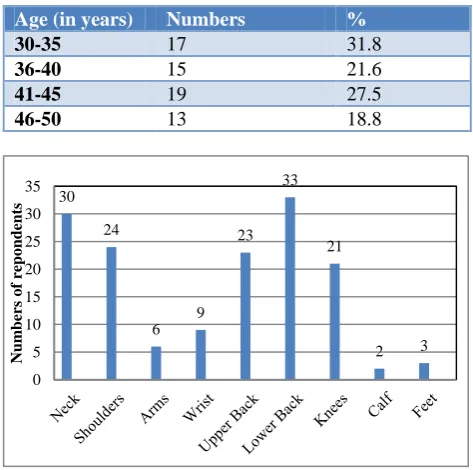
Table 1: Age groups.
Age (in years) Numbers %
30-35 17 31.8
36-40 15 21.6
41-45 19 27.5
46-50 13 18.8
Figure 1: Prevalence of injuries.
Out of 69 doctors, the daily average of 8 working hours 30.4% (n=21) was reported by the majority, followed by 12 hours of daily working by 21.7% (n=15) and 10 hours
30 24
6 9
23 33
21
2 3
0 5 10 15 20 25 30 35
Num
bers
o
f
repo
by 18.8% (n=13). On an average, 44.9% (n=31) of doctors reported performing 11-20 numbers of surgeries per week out of which 6-10 surgeries were reported to be emergency surgeries. Majority of responders about 82% (n=57) performed 0-10 numbers of high risk/ complicated surgeries in a week.
Table 2: Management of the reported injuries.
Management Number
Self-medication 19
Physiotherapy 20
GP 18
Nothing 6
Similarly, 43.5% (n=30) were practicing in a private/ nursing home setup followed by 34.8% (n=24) who worked at Multispecialty hospital and 20.3% (n=14) at Government hospitals.
79% (n=49) of the respondents needed time off work due to their injuries. Majority of the doctors were satisfied with their jobs. 88% of the participants rated a satisfaction score more than seven out of ten. About their level of stress/anxiety in the last week, 33% rated above seven out of ten. The participants reported level of depression, 20% reported feeling depressed in the last seven days.
DISCUSSION
Limited data was found on the work related injuries amongst the Obstetrics and Gynaecologist professionals. The survey result of this study showed that majority of doctors (85.5%) experienced musculoskeletal injuries during the last 12 months. Most commonly reported body part was back pain. The result in this study regarding is consistent with the previous studies, regarding the prevalence of 49.2% of neck and 29.4% of shoulder.18,19 Neck (49.2%), knees (34.3%) and upper back (37.7%) injuries have also been reported by professionals. According to a study by Stitcher et al, few working tasks that might result in musculoskeletal injuries amongst such professionals are (1) maternity professionals handle pregnant women who are heavier than other patients with transferring and moving which is required after epidural anaesthesia and positioning of the patients.20 (2) They need to lean forward often to perform vaginal examination, or to listen to clear fetal heart sounds. Another possible explanation might be that in emergency or elective obstetric surgeries such as high risk patients due to placental abruption, fetal distress, caesarean section and forceps delivery, professionals have to adapt and maintain appropriate physical positions which can be stressful.
The overall prevalence of work related musculoskeletal injuries in this study was found to be 71.4%, this is higher than that of the previously reported as 63% by
Okuyucu et al among trainees in Midland UK in 2017.21 Work intensity, organizational factor and patient characteristics can be a potential factor for explanation. Long working hours and intense working schedules has been argues to result in psychosocial impact including stress and depression.22 Increased complexity and number of patients over the years has made this profession more physically demanding that might result in musculoskeletal injuries in these occupational groups. Most of the respondents sought relief from self-medication and physiotherapy.
The work related musculoskeletal injuries are likely to be cumulative trauma disorders as the persistence rate of pain was observed to be the same by 50% of the respondents. Excessive and inappropriate body postures have been widely associated with high prevalence of such injuries more than other factors.19 Vanwonterghem et al explanation about injury occurrence process as a result of cumulative exposure, an evitable musculoskeletal injury is observed unless the body system has sufficient time for recovery.6 Thus, adequate time as rest must be provided for recovery to prevent recurrent injuries has been suggested.
One of the limitations of this study is that the situations or health conditions of the participants might be over or underreported. Similar results with experts’ examinations amongst workers is shown by evidence.23-25 Non response bias with survey studies is another concern but the high response rate for the present study would eliminate this limitation.
Another factor such as gender was considered in this study where 78.3% were females. Increased knee pain could be due to long standing posture, menopausal changes, work place setup like table height or inappropriate footwear. An international systemic review of 63 studies analysed the results of interventions to reduce or prevent musculoskeletal injuries7 shows that there is moderate evidence that intervention strategies based on risk factor assessment were more likely to be effective which can be further used for prevention planning.
Overall, more information is needed on ergonomics and prevention strategies specific to obstetrics work injuries.
CONCLUSION
Clinical significance
Analysis related to ergonomics and strategy based risk factor assessment will prevent work related injuries as back was reported as the most common site of injury.
Limitation of study
Further studies are required to understand the risk factors in detail.
ACKNOWLEDGEMENTS
I take this opportunity to thank Dr. Dhara Kapoor, Dr. Rachana Nikam (Research Co-ordinators at Sancheti Institute College of Physiotherapy), Dr. Ashok Shyam (MS Ortho) and Dr. Parag Sancheti (Chairman of Sancheti Hospital) for their valuable guidance and constant encouragement that motivated me to complete this study. I extend my gratitude to all the teachers who co-operated and participants of the study who voluntarily participated in the study.
Funding: No funding sources Conflict of interest: None declared
Ethical approval: The study was approved by the Institutional Ethics Committee
REFERENCES
1. Punnett L, Wegman DH. Work-related
musculoskeletal disorders: the epidemiologic evidence and the debate. J Electromyogr Kinesiol. 2004;14(1):13-23.
2. Boorman S. NHS health and well being. Final report. London: London Department of Health; 2009.
3. WHO Expert Committee on Identification and Control of Work-Related Diseases World Health Organization (1985) Identification and control of work-related diseases: report of a WHO expert committee [meeting held in Geneva from 28 November to 2 December 1983]. World Health Organization, Geneva. Retrieved, Accessed 29 June 2017
4. LeVeau BF. Biomechanics of human motion: basics and beyond for the health professions; Slack Incorporated, Thorofare, 2010.
5. Neumann DA Kinesiology of the musculoskeletal system: foundations for rehabilitation; Elsevier Health Sciences, London, 2013.
6. Vanwonterghem K, Yoopat P, Maes C. Musculoskeletal disorders: a new approach. Work. 2012;41(Suppl 1):2293–8.
7. Hignett S. Manual handling risks in midwifery: identification of risk factors. Br J Midwifery. 1996;4(11):590–6.
8. Costa B, Viera R. Risk factors for work-related musculoskeletal disorders: A systematic review of
recent longitudinal studies. Am J Industrial Med. 2010;53:285–323,
9. Smith DR, Wei N, Zhang YJ, Wang RS. Musculoskeletal complaints and psychosocial risk factors among physicians in mainland China. Int J Ind Ergon. 2006;36(6):599–603.
10. Smith DR, Wei N, Zhao L, Wang RS. Musculoskeletal complaints and psychosocial risk factors among Chinese hospital nurses. Occup Med (Chic Ill). 2004;54(8):579–82.
11. Gatchel RJ, Peng YB, Peters ML, Fuchs PN, Turk DC. The biopsychosocial approach to chronic pain: scientific advances and future directions. Psychol Bull. 2007;133(4):581.
12. Lang J, Ochsmann E, Kraus T, Lang JWB. Psychosocial work stressors as antecedents of musculoskeletal problems: a systematic review and meta-analysis of stability-adjusted longitudinal studies. Soc Sci Med 2012;75(7):1163–1174 13. Bartys S. Psychosocial factors at work,
musculoskeletal disorders and the implementation of guidelines principles; University of Huddersfield, Huddersfield, 2013.
14. Trinkoff AM, Lipscomb JA, Geiger-Brown J, Storr CL, Brady BA. Perceived physical demands and reported musculoskeletal problems in registered nurses. Am J Prev Med. 2003;24(3):270–5.
15. Gopinadh A, Devi KNN, Chiramana S, Manne P, Sampath A, Babu MS Ergonomics and musculoskeletal disorder: as an occupational hazard in dentistry. J Contemp Dent Pract. 2013;14(2):299. 16. Janga D, Akinfenwa O Work-related repetitive
strain injuries amongst practitioners of obstetric and gynaecological ultrasound worldwide. Arch Gynecol Obstet. 2012;286(2):353–6.
17. Waters TR Introduction to ergonomics for healthcare workers. Rehabil Nurs. 2010;35(5):185– 91.
18. Yoong W, Sanchez-Crespo J, Rob J, Parikh M, Melendez J, Pillai R, et al. Sticks and stones may break my bones: work-related orthopaedic injuries sustained during obstetrics and gynaecology training. J Obstet Gynaecol. 2008;28(5):478–81. 19. Long MH, Johnston V, Bogossian F. Work-related
upper quadrant musculoskeletal disorders in midwives, nurses and physicians: a systematic review of risk factors and functional consequences. Appl Ergon. 2012;43(3):455–67.
20. Stichler JF, Feiler JL, Chase K. Understanding risks of workplace injury in labor and delivery. J Obstet Gynecol Neonatal Nurs. 2012;41(1):71–81.
21. Arslan Okuyuku K, Jeve Y, Doshani A. Work-related musculoskeletal injuries amongst obstetrics and gynaecology trainees in East Midland region of the UK. Arch Gynaecol Obstetr. 2017;296(3):489-94.
mental health and job satisfaction. Arch Gynecol Obstet. 2017;295(1):153–62.
23. Mehlum IS, Veiersted KB, Wærsted M, Wergeland E, Kjuus H, Self-reported versus expert-assessed work-relatedness of pain in the neck, shoulder, and arm. Scand J Work Environ Health. 2009;35(3):222–32.
24. Takekawa KS, Goncalves JS, Moriguchi CS COURY HJCG. Can a self-administered questionnaire identify workers with chronic or recurring low back pain? Ind Health. 2015;53(4):340–5.
25. Perreault N, Brisson C, Dionne CE, Montreuil S, Punnett L. Agreement between a self-administered questionnaire on musculoskeletal disorders of the neck-shoulder region and a physical examination. BMC Musculoskelet Disord. 2008;9(1):34.