REVIEW ARTICLE
An Analysis of Processing Multimedia Data in
Mobile Ad Hoc Networks
Gururaj H L
Department of Computer Science and Engineering, Vidyavardhaka College of Engineering, Mysuru, India
[email protected]
Ramesh B
Department of Computer Science and Engineering, Malnad College of Engineering, Hassan, India
[email protected]
Published online: 04 March 2019
Abstract – Technological growth in the digital communication era made a huge impact on life style of human beings. Now a day the growth of social networking sites gained much popularity around the world. Social networks provide a means for users to interact or communicate over the internet. Some of the trending social media include Facebook, twitter, WhatsApp, LinkedIn, Instagram, Google+ and so on. The multimedia data is the basic building blocks for all the types of communications. Social networks also help to share multimedia data like audios, videos, stories and animations. Users can access these social media services via web-based tools through laptops, smart phones and tablets. Social networks are extremely communicating stages through which persons, groups and governments can share, co-create, discuss and modify the data through internet. In this paper the different video processing models in MANETs such as Prediction Model, Network Friendly Model, Congestion Control Model and Bandwidth Estimation Model are critically analyzed. By varying the impairments these models are compared using a network simulator.
Index Terms – Multimedia, Social Network, TCP, MANET.
1. INTRODUCTION
Multimedia-Technology that allows individuals to use processors skilled of handling textual data, audio, video, still pictures and animation. Nowadays, the generation of people will internet not only for entertainment purpose to watch video along with that all social networks, for education and technological aspects internet are must. The features of video & audio are comprehensive which are compulsory to procedure the data. Comparable to outdated broadcast radio and television, except that broadcast takes place over the Internet like live sporting event or news as the event is live, delay can also be an issue, although the timing restrictions are much less severe than those for informal voice Delays of up to ten seconds or so from when the user indicates to view a quick communication when play out creates can be tolerated [1]. For running video applications, pre-recorded videos are located on servers, and users send requests to these servers to view the videos on demand. [2].
Social networks are the most popular networks all over the world. From the last decade social networks have experienced the explosive growth [3]. Early, the social network was proposed in the development of World Wide Web. A social network is a service in which the group of people, individuals, institutions or organization connect with each other. Multimedia data in a social network growing constantly and fast. It has become a diverse [4]. Social Medias that provides some technologies for sharing information, ideas of their interest. Social networks are quickly becoming more modern like instant messages, public chat rooms and private messages through the online networks. Social networks are scalable communications for all the users and consumers. Based on the demands and opinions of users and consumers, the social business or enterprises use social media channels to increase the effectiveness, efficiency, technological developments, and social transformations to meet their requirements [5]. In early days the traditional medias are used to share information such as newspaper, radios, magazines etc. According to Kennedy et. Al, emerging internet technologies can be group together under web 2.0 to describe the web-based applications, social media, social software tools and social media technologies [6].
REVIEW ARTICLE
In the above Figure 1, Some of the most popular social networks like Facebook, Whatsapp, Instagram, Google+, LinkedIn, Pinterest, Quora, Snapchat, Weibo, Twitter, Myspace etc. More than 1000,000,000 registered users in these medias [7].
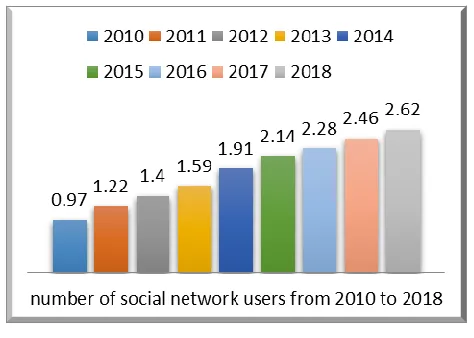
Figure 2 Trending Analysis Graph
In the Figure 2 representing the 2010-2018 trending social networks. Nowadays, the users of these social medias are growing fast. The graphical representation of trending analysis based on some test cases, management system and virtual reality [8].
The paper is arranged as follows, section two explains the various multimedia protocols used to process, section three explains the video data processing in mobile ad hoc network, section four details the comparative analysis and section five draws the conclusion and future enhancement.
2. RELATED WORK
The multimedia data are processes by using the well-known protocol called Multimedia Networking Protocol. There exist some more protocols that provision real time transportation flow over the internet. Some of the protocols of multimedia network are: RTSP, RTP and SIP which are the application layer protocols which supports multimedia transmission.
RTP- For real time data transport, this protocol is used in case of audio and video specifying the typical packet format of bringing audio and video over IP networks. The necessary information required to send streaming data are: Sequence Numbers, Timestamps, Source Identification, payload format for the encoded form of data. RTP-Sequence number, Sequence number field, Time Stamp and Source Identifier. Arrangement number field which is 16 bits long increments by one for each RTP packet sent, and might be used by Time stamp field. The 32 bits long Time stamp field reflects the first byte of sampling instant in the RTP data packet. Timestamp clock rate for audio is 8000Hz while for video is 90,000Hz. Synchronization source identifier is 32 bits long
which identifies the source of RTP stream and it is distinct for each stream in a RTP session. In case of packet loss, retransmission occur which forces receiver application to wait where large delays are experienced. TCP do not support multicast and it is larger than a UDP header (40bytes for TCP where 8bytes for UDP). It also does not contain the information required by the receiving application like timestamp and encoding information.
SIP- Session Initiation Protocol - Similar to HTTP it is a text-based transaction protocol which uses commands and responses. As it is a lightweight protocol it is likely to make calls over an IP network. Using UDP or TCP protocols of peer-to-peer application are transported and it is intended to found, terminate and modify stateful multimedia communication conferences/sessions, instant messaging. [11, 12].
3. VIDEO PROCESSING IN MANETS
Multimedia is focused with the association of computer-controlled text,graphics or images,animations, audio, video and any other media where all thes types of evidence can be stored, processed, transmitted and represented. The above mentioned are the foremost essentials of multimedia where text is the primary component.
Graphics are the digitalized illustration of non-text data. It comprises images, drawing etc. It can be combined with text information. Audios comprise several types of sounds like speech, music etc. It can be combined with animation medium. Animation is a medium that represents the sequence of still images at a rapid speed. So that it looks like the image is affecting quickly. Videos are the most commonly using and effective medium to present the information .
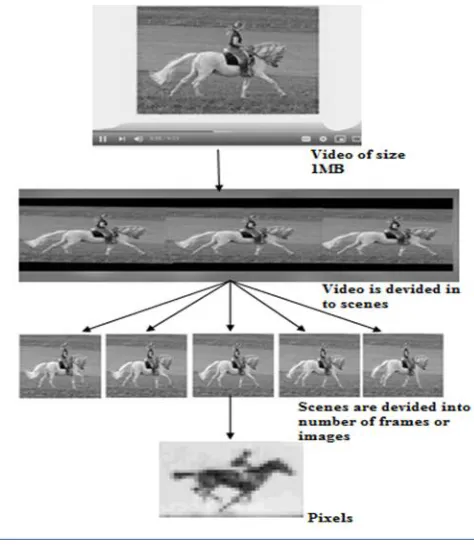
A video can be separated into numeral of scense. Scense are additionally separated in to frames. In video frame rate is the number of frames or images that can be expected per second. Frame rate are used to coordinating the audios, images and videos. Amount of frames are depend upon the frame rate. Frames are the configurations of pixels. Pixel are the smallest addressable,controllable element of a picture. The intensity of each pixel can be variable.
Let 'V' be the video of m*n pixels resolution
V= s1+s2...sn=∑ni=1si………. (i)
where s is the scene.
S= f1+f2+...fn=∑ni=1fi ………... (ii)
f be the frames
F=p1+p2+...pn= ∑ni=1pi ………(iii)
REVIEW ARTICLE
As we are applying on the dynamic network the vidoe may change based on the resolution.
The change of rate in the number of active entites in the network =∆
∆= ∆1 + ∆2 + ∆3 + ⋯ ∆n ∆1 = (n2 − n1)
∆2 = (n3 − n2)……… ∆n = (nn − 1 − nn)
The rate of change of data
∫ N =0m n1 + n2 + ⋯ ni ……… (iv)
∆= ∆1 + ∆2 + ∆3 + ⋯ ∆n
=(m2-m1)+(m3-m2)+...(mn-mn-1)
∆=dv
dt = ds1
dt + ds2
dt + ds3
dt + ⋯ dsn
dt dv
dt = ( df11
dt +
df12
dt +
df13
dt + ⋯
df1n dt ) + (df21
dt +
df22
dt +
df23
dt +
df2n dt )
+ ⋯ (dfn1
dt +
dfn2
dt +
dfn3
dt +
dfnm dt ) ∆= ∆V
∆= ∆V
= ∆s1 + ∆s2 + ⋯ ∆sn
=(∆f1 + ∆f2 + … … ∆fn)+ (∆f1 + ∆f2 … ∆fn)+... ∆f1 + ∆f2 +
⋯ ∆fnn)
Where,
The change of scene in video is represented by
∆V = ∆s1, ∆s2 … . ∆sn
The change of frames in scene is represented by
∆s = ∆f1, ∆f2 … ∆fn
The number of nodes as varies from time to time i.e., as we are dealing with dynamic network. The video quality may also change because of various parameters like between buffer capacity.
Rate of change in (network)nodes
α rate of change of video1 ……….. (v)
∆N α 1 ∆V
The equations (i), (ii), and (iii) represents the division of video to scenes and scenes to frames and that into pixels. And equation (iv) represnts the rate of change of data & equation
(v) reprents the equation of the rate of change of data.
The type of multimedia data may be anything but the data in the communication channel should always in the digitized format that is pixel to binary number where there will be no destruction in data and it is depicted in Figure 3.
Figure 3 Video Processing
In Mobile ad hoc networks, video transmission without congestion is very challenging issue. The influencing parameters pin mobile ad hoc networks like topology change, resource constraints, lack of fixed infrastructure deteriorates the performance of ad hoc network for multimedia.
Basically there are four different video processing models in MANETs such as Prediction Model, Network Friendly Model, Congestion Control Model and Bandwidth Estimation Model. The details of all these models are depicted here
3.1. Prediction Model
REVIEW ARTICLE
Prediction model is one of the classical model which basically works on probability. This model will not achieve better efficiency all the times, as it depends upon prediction. The Prediction model emphases on bandwidth variation & QoS problem. It defines an answer to the difficult of unexpected drop in bandwidth of a mobile network once any network worker transfers from “Strong Signal area (SSA) to Weak Signal Area (WSA)” & QoS problem in video transferring [15, 16].
Let ‘N’ be the network consisting number of nodes Let ‘B’ be the available bandwidth in the network Let ‘E’ be the Estimated Data rate of a Network
The rate of change of network infrastructure is directly proportional to the estimated data rate but it is in reverse proportional to the bandwidth availability in the network as shown in the equation (iv). The probability of estimated data rate can be represented as follows
𝐸 = 1/𝑀(𝑁) ……….. (iv)
where M (N) is the mobility of the network.
3.2. Network Friendly Model
The Network Friendly Mechanism is proposed to bring the system in under control by monitoring the data transfer rate frequently. It uses the bandwidth effectively. The network friendly model as the names itself indicates it foremost examine the data transmission phenomenon of the present video flowing services by TCP & demonstrate that they achieve data transmission at much advanced rates than the video-replay rate. Formerly, a new transmission mechanism for video flowing over TCP is proposed that controls the data transfer rate based on the network bottleneck level & the quantity of protected video data at the receiver [17] [18].
3.3. Congestion Control Model
In Congestion Control model takes packet loss and delay as metric to reduce congestion in video packets transmission. It also made a comparative study between TCP Stream and TCP NewReno for saving the network bandwidth. The Congestion control model is a hybrid model which combines the behaviour of loss based and delay based models. This model uses the delay & packet loss as the indices of the congestion [19].
3.4. Bandwidth Estimation Model
It is developed to strength the source node for preventing from bandwidth damage and provides better results in wireless network scenarios.
The bandwidth estimation model examines the difficult confronted by every bandwidth valuation procedure applied at the TCP Sender side. In this novel bandwidth
approximation scheme called as TIBET (Time Interval based Bandwidth estimation Technique) and is presented that can be applied within the TCP congestion resistor process, adapting only at the sender side of the construction. This method improves the TCP enactments above the links [20].
4. COMPARATIVE ANALYSIS
The event driven simulator network simulatoe-2 is used to compare the existing models. The complete comparative analysis is done based the simulation parameters as given in the below Table 1.
Parameter Value
Downlink Bandwidth 10Mhz
N 50
Antenna SISO
AP Transmission power 0.0212-0.0609 mW
802.11 CS Threshold 1.0 x RX Threshold
Antenna Omni Antenna
Propagation Type TwoRayGround
Time of simulation 500 seconds
Application Traffic for node FTP
Initial location of MN X:400 Y:960
Final Position of MN X:4900 Y:960
Table 1 Simulation Parameters
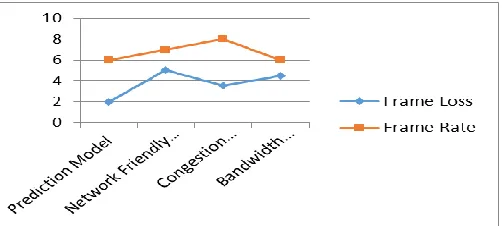
The various video processing mechanisms are evaluated based on frame loss, frame rate and packet loss. All the above mentioned models have taken bandwidth parameter to provide an effective video transmission over MANET.
REVIEW ARTICLE
The Figure 4 shows that, prediction model provides better results in terms of frame loss and having higher frame transfer rate compare to all other models.
Figure 5 Delay vs. Packet Loss for 5 Mbps Bandwidth
In the above Figure 5 is taken with different types of delay in packets transmission such as 5 ms, 10 ms, 15 ms and 20 ms. Whenever the delay gets increased, the packet loss also increased though the prediction model yields less loss ratio than the other models for video transmission.
Figure 6 Delay vs. Packet Loss for 10 Mbps Bandwidth
The above Figure 6 depicts by changing the Bandwidth. The same scenario is considered by changing the bandwidth from 5MBps to 10MBps and results have been taken. Prediction model proves the good results than the others.
5. CONCLUSION
Nowadays all the real time applications depends on multimedia data. So multimedia data plays a vital role. As we considered the various video processing models for the mobile ad hoc networks such as Prediction Model, Network Friendly Model, Congestion Control Model and Bandwidth Estimation Model for mobile ad hoc networks. After
evaluating the different model using the network simulators by changing the parameters it is evident that the Prediction model outperforms the other models by considering less frame loss, higher frame rate and less packet loss. By considering various TCP variants with prediction model gives better performance for multimedia data transfer.
REFERENCES
[1] Anees Ul Hassan, Jamil Hussain, Musarrat Hussain, Muhammad
Sadiq, Sungyoung Lee, (2017) “Sentiment Analysis of Social Networking Sites (SNS) Data using Machine Learning Approach for the Measurement of Depression”, IEEE xplore, Pages 138 - 140.
[2] Alireza Farasat, Geoffrey Gross, Rakesh Nagi, and Alexander G.
Nikolaev (2016), “Social Network Analysis With Data Fusion”, IEEE, Volume: 3 , Issue: 2, Page s: 88 – 99
[3] Stefan Stieglitza, Milad Mirbabaiea, Björn Rossa, Christoph
Neubergerb, “Social media analytics – Challenges in topic discovery, data collection, and data preparation”, Elsevier, 2017.
[4] Anton Ivaschenko, Anastasiya Khorina, Vladislav Isayko, Daniil
Krupin, Viktor Bolotsky, and Pavel Sitnikov (2018), “Modeling of User Behavior for Social Media Analysis”, IEEE, Pages: 1 - 4.
[5] Ravi vatrapu1, Raghava Rao Mukkamala, Abid Hussain, Benjamin
Flesch, (2016) “Social Set Analysis: A Set Theoretical Approach to Big Data Analytics”, IEEE, Vol. 4, Pages: 2542 – 2571
[6] Flora Amato, Vincenzo Moscato, Antonio Picariello and Giancarlo
Sperl, (2016) “Multimedia Social Network modeling: a proposal”, IEEE, 448 – 453
[7] Sun Danpeng ; Jiang Rui, “Research on Congestion Control
of Multimedia Data Stream in Network Transmission”, 2015 Seventh
International Conference on Measuring Technology and
Mechatronics Automation, Year: 2015, Page s: 856 – 859
[8] K M Archana Patel ; Richa Martoli (2016), “Congestion control
techniques in networking” International Conference on
Communication and Signal Processing (ICCSP), Year: 2016, Page s: 1831 – 1835
[9] Yuan Xinlei ; Li Shuping, (2015) “Multimedia Data Flow
Transmission Technology Research in the Network”, 8th International Conference on Intelligent Computation Technology and Automation (ICICTA), IEEE, Page s: 560 – 563
[10] Danyang Zhu ; Changqiao Xu ; Jiuren Qin ; Zan Zhou ; Jianfeng
Guan (2017), “Mobility-aware multimedia data transfer using
Multipath TCP in Vehicular Network”, 2017 13th International Wireless Communications and Mobile Computing Conference (IWCMC), Pages: 1041 – 1046
[11] Yuanlong Cao ; Changqiao Xu ; Jianfeng Guan ; Hongke Zhang
(2014), “TCP-friendly CMT-based multimedia distribution over
multi-homed wireless networks”, 2014 IEEE Wireless
Communications and Networking Conference (WCNC),
Page s: 3028 – 3033
[12] Joe, M. M., & Ramakrishnan, B. (2017). Novel authentication
procedures for preventing unauthorized access in social
networks. Peer-to-Peer Networking and Applications, 10(4), 833-843.
[13] Altunbey, F., & Alatas, B. (2015). Overlapping community detection
in social networks using parliamentary optimization
algorithm. International Journal of Computer Networks and Applications, 2(1), 12-19.
[14] Joe, M. M., & Ramakrishnan, D. B. (2014). A survey of various security issues in online social networks. International Journal of Computer Networks and Applications, 1(1), 11-14.
[15] Ozbay, Feyza Altunbey, and Bilal Alatas. "Discovery of
REVIEW ARTICLE
[16] Joe, M. M., Ramakrishnan, B., & Shaji, R. S. (2013). Prevention of losing user account by enhancing security module: A facebook case. Journal of emerging technologies in web intelligence, 5(3), 247-256.
[17] Joe, M. M., & Ramakrishan, B. (2014). Enhancing security module to
prevent data hacking in online social networks. Journal of Emerging Technologies in Web Intelligence, 6(2), 184-192.
[18] Joe, M. M., Shaji, R. S., & Dhanaseelan, F. R. (2012). Detection of M-worm to provide secure computing in social networks. Elixir International Journal–September-50, 10363-10365.
[19] Joe, M. M., Ramakrishnan, B., & Das, R. (2016). Designing a Novel
Two-Tier Authentication Algorithm for Web Service
Architecture. Journal of Telecommunication, Electronic and Computer Engineering (JTEC), 8(9), 67-75.
[20] Joe, M. M., Ramakrishnan, B., & Shaji, R. S. (2013). Modeling future
generation e-mail communication model for improving quality of service. Journal of emerging technologies in web intelligence, 5(4), 385-394
Authors
Gururaj H. L. completed his B.E and M. Tech degrees in computer science and engineering from Visvesvaraya Technological University, Belgaum, India in 2010 and 2013 respectively. Currently he is working as an Assistant Professor in the Department of Computer Science and Engineering at Vidyavardhaka College of Engineering, Mysuru, India. His areas of interest include congestion control algorithms, security issues in cloud computing and routing protocols for multi-hop wireless networks.