Original Research Article
An active surveillance of anaemia among pregnant women and its
association with obstetric history and sanitation in urban areas of
Kanpur, Uttar Pradesh
Firoza Bano, Anju Gahlot*
INTRODUCTION
Anaemia is recognised as a major public health problem throughout the world. According to World Health Organization (WHO), hemoglobin level below 11 g/dl is labeled as anemia during pregnancy and classified as mild (10.0-10.99 g/dl), moderate (7.0-9.9 g/dl), and severe (less than 7.0 g/dl) anemia. The same criteria are used for diagnosing anaemia in pregnancy.1 As per the World Bank data, in South Asian countries the prevalence of anaemia among the pregnant women averages 50%.2 According to another study, 56% of pregnant women in the developing countries are affected with anaemia whereas in developed regions, it has been reported to be only 18%.3,4 Worldwide it is estimated that about 20 percent of maternal death are caused by
anaemia, additionally anaemia is responsible partly for 50 percent of all maternal mortality.5
The National Family Health Survey-3 (NFHS-3) data suggests that anaemia is widely prevalent in all age groups and particularly high among the most vulnerable groups, among pregnant women estimated to be around 58 percent.6 A study carried out among 7 states by Nutrition Foundation of India (2006) had observed the overall prevalence of anemia among pregnant women found to be 84%.7 Low haemoglobin concentrations during pregnancy can be associated with an increased risk of maternal and perinatal mortality and low birth weight.8 In a study having ten year audit, nearly 15% maternal mortality was found owing to anaemia.9
ABSTRACT
Background: Anaemia is still one of the challenging issues in India in spite of various ongoing nutritional programmes. Very few data have been observed from the state Uttar Pradesh especially from urban areas regarding the status of anaemia during pregnancy. Objectives: To estimate the prevalence of anaemia among pregnant women and its association with the various socio-demographic determinants in urban areas of Kanpur.
Methods: Cross-sectional study having total participants of 207 pregnant women were selected by simple random sampling method and interviewed by pretested questionnaire followed by testing haemoglobin level in blood through Sahli’s haemoglobinometer and collected data were analysed using SPSS Version 21.0 and Microsoft Excel 2007.
Results: Out of 207 pregnant women 163 were estimated as anaemic.
Conclusions: A high prevalence of anaemia was observed which is 78.7%. Adolescent age group, lack of sanitation
and worm infestations were detected significant parameters contributing anaemia.
Keywords: Anaemia, Obstetric history, Pregnant women, Sanitation, Surveillance, Urban areas
Department ofCommunity Medicine, Rama Medical College, Kanpur, Uttar Pradesh, India
Received: 13 March 2019
Revised: 11 May 2019
Accepted: 13 May 2019
*Correspondence:
Dr. Anju Gahlot,
E-mail: [email protected]
Copyright: © the author(s), publisher and licensee Medip Academy. This is an open-access article distributed under the terms of the Creative Commons Attribution Non-Commercial License, which permits unrestricted non-commercial use, distribution, and reproduction in any medium, provided the original work is properly cited.
It adversely affects cognitive and motor development and cause fatigue and low productivity.10
There are evidences suggesting subsequent to maternal anaemia, babies suffering from anaemia may experience numerous deleterious effects like delayed psychomotor development, impaired performance and coordination of language and development of diseases like autism and asperger syndrome.11 Since the mortality ratios associated with maternal and neonatal health are invariably very high in Empowered Action Group (EAG) states including Uttar Pradesh, it has been paid a special attention in our primary health care system.
There should be an appropriate implementation and creating awareness regarding ongoing strategies like National Nutritional Anaemia Prophylaxis Program and
recently developed Community Obstetrics which
combines the obstetrical concerns with the concept of primary health care.12
Objectives
To estimate the prevalence of anaemia among pregnant women and its association with the various socio-demographic determinants in urban areas of Kanpur.
METHODS
Following approval from the ethical committee at Rama Medical College, Kanpur, the present cross- sectional study was conducted among 207 pregnant women selected through house to house survey conducted among the simple randomly selected families registered with urban field practice areas comprising of population about 34000, department of Community Medicine, Rama Medical College and Research Centre, Kanpur from April 2016 to March 2017.
Sample size
After the pilot study in the urban field practice areas, 17 pregnant women were found to be anaemic among 20, and thus 85% prevalence was estimated. The sample size was calculated using the following formula: (4pq) /L2, where, p represents the prevalence i.e., 85%.
q=100–p=100-85= 15
L is the allowable error (considered as 6% of the prevalence).
(4x85x15) / (85x6/100) = 200.
This 200 is considered as mimimum sample size in the study population. In the actual study, 207 pregnant women were selected.
Exclusion criteria
Exclusion criteria were pregnant women who were not present at the time of interview; those who were uncooperative.
The pregnant women were interviewed using pre structured, pretested interview schedule following a written consent. A demographic profile relating to their age, Obstetric history, use of sanitary privy and deworming within 6 months prior to conception were collected. Following this, hemoglobin estimation was done by Sahli’s acid haematin method on the spot.
Anaemia was classified as per WHO criteria. Haemoglobin below 11 g/dl is labelled as anaemia during pregnancy. Mildly and moderately anaemic pregnant mothers were given Iron supplements whereas severely anaemic pregnant women were referred to Rama Medical College Hospital, Mandhana, Kanpur for further management. The collected data was compiled and tabulated using Microsoft Excel 2007 and then analyzed using SPSS Version 21.0. Group comparisons were done by Chi-square test. P value less than 0.05 were considered significant.
RESULTS
Among 207 selected subjects, 163 pregnant women were found to be anaemic. The overall prevalence of anaemia among the study subjects were 78.7%. From the total of 207 selected pregnant women, 58 (28%), 90 (43.4%), 15 (7.2%) were with mild, moderate and severe anaemia, respectively (Table 1).
Table 1: Distribution of pregnant women according to grading of anaemia.
Grading of
anaemia Frequency %
Prevalence of anaemia
Normal 44 21.3
Mild anaemia 58
163
28.0
Moderate
anaemia 90 43.4
Severe anaemia 15 7.2
Total 207 78.7 78.7%
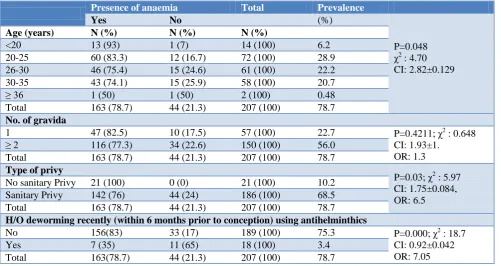
The estimated prevalence of anemia among adolescent study subjects were more than 90%. In addition to this, it is more likely to find anaemia among under 30 years (83+75/2=79%) than the respondents aged 30 or more years (74+50/2=62%) (p=0.048) (χ2=4.70) (95%CI: 2.82±0.129) (Table 2).
Table 2: Distribution of anaemic pregnant women according to various socio-demographic parameters.
Presence of anaemia Total Prevalence
Yes No (%)
P=0.048 χ2
: 4.70 CI: 2.82±0.129
Age (years) N (%) N (%) N (%)
<20 13 (93) 1 (7) 14 (100) 6.2
20-25 60 (83.3) 12 (16.7) 72 (100) 28.9
26-30 46 (75.4) 15 (24.6) 61 (100) 22.2
30-35 43 (74.1) 15 (25.9) 58 (100) 20.7
≥ 36 1 (50) 1 (50) 2 (100) 0.48
Total 163 (78.7) 44 (21.3) 207 (100) 78.7
No. of gravida
1 47 (82.5) 10 (17.5) 57 (100) 22.7 P=0.4211; χ2 : 0.648
CI: 1.93±1. OR: 1.3
≥ 2 116 (77.3) 34 (22.6) 150 (100) 56.0
Total 163 (78.7) 44 (21.3) 207 (100) 78.7
Type of privy
P=0.03; χ2 : 5.97 CI: 1.75±0.084, OR: 6.5
No sanitary Privy 21 (100) 0 (0) 21 (100) 10.2
Sanitary Privy 142 (76) 44 (24) 186 (100) 68.5
Total 163 (78.7) 44 (21.3) 207 (100) 78.7
H/O deworming recently (within 6 months prior to conception) using antihelminthics
No 156(83) 33 (17) 189 (100) 75.3 P=0.000; χ2 : 18.7
CI: 0.92±0.042 OR: 7.05
Yes 7 (35) 11 (65) 18 (100) 3.4
Total 163(78.7) 44 (21.3) 207 (100) 78.7
Anaemia was present in all respondents (100%) having no sanitary toilets or practicing open air defecation. On the other hand 142 (68%) respondents were found to be anaemic among those using sanitary privy (p=0.03) (χ2=5.9)(95%CI: 1.75±0.084) (OR=6.5) (Table 2).
Anaemia was found to be prevalent in 83% of pregnant women among those who have not taken antihelmintic drugs compared to 35% pregnant women were detected to have anaemia amongst those who have history of taking the said drugs within 6 months prior to conception (p=0.000) (χ2=18.7) (95%CI: 0.92±0.042) (OR=7.05) (Table 2).
DISCUSSION
This study revealed the overall prevalence of anaemia among pregnant women as 78.7% (Table 1). This result is found to be less than that of prevalence of anaemia during pregnancy in India, as per data of DLHS-3 (district level household and facility survey-3), 2005, which had been estimated as 87%.13 This high prevalence of anaemia is observed as similar to the earlier studies by Khan et al at rural communities attached with RHTC, Rama Medical College, Ghaziabad (80%), by Piyush et al at Index Medical College, Hospital (62.7%), by Singh et al at Dehradun (65.5%), by Suryanarayan et al at Karnataka (64%).14-18
“Indian Council of Medical Research (ICMR) Task Force Multicenter Study” revealed that the overall prevalence of anaemia among pregnant women from 16 districts was 84.9%.19
If we consider in terms of grading of anaemia, this study reveals that among 163 anaemic pregnant women only 58 (28%) were mildly anaemic, 90 (44%) moderately anaemic and only 15 (7%) were sufferred from severe anaemias. It was found that majority of the antenatal women were moderately anaemic (44%) (Table 1), similar to earlier studies.14,15
Another Indian study by Sharma et al reported that among 66 anaemic pregnant women, 40.92% had mild, 54.54% moderate, and 4.54% severe anaemia.20 Results of another study showed that, of 51 pregnant anaemic women, 9 (18%) were mildly, 30 (58%) moderately, 12 (34%) severely anaemic.21
With advancing age, the prevalence of anemia during pregnancy declines. In this study it has been observed that the estimated prevalence of anemia among adolescent study subjects were about 90%. In addition to this, it is more likely to find anaemia among under 30 years (80%) than the respondents aged 30 or more years (73%) (p=0.048) (95%CI: 2.82±0.129) (Table 2), similar to earlier studies indicating status of Hemoglobin deficit among the adolescent girls.14,15
addition to the nutritional needs during pregnancy. Therefore, teenage mothers are at increased risk to get anaemia. They have a greater nutritional requirement due to their own growth spurts.23,24
Teenage pregnancies are usually unplanned, and therefore these mothers may already have suboptimal experience regarding nutritional status prior to conception which leads to making them at an even higher risk for developing iron deficiency anemia.23
In this study, though the number of multigravida subjects were more than double to that of primigravida, primigravida subjects had slightly higher anaemic status (83%) compared to multigravida (77%), This parameter was found to be statistically insignificant as p=0.42, (95%CI: 1.93±1) (OR: 1.3) (Table 2). But the value of odd ratio indicates the likelihood of having anaemia among primigravida mothers are 1.3 times more than that of multigravida.
This result showed the similarity with the study conducted by Idowu et al, anaemia were more prevalent among primigravida (80%) than the multigravida (75%) but also statistically insignificant (p>0.05).25 Another study by Singh et al in 2015 also observed an insignificant association between anemia and gravid.26 In contrast to the other study conducted at Eastern Nepal by Manisha et al, where maternal anaemia in terms of gravidity and parity was set to be statistically significant (p<0.01) and study by Suryanarayana et al (p=0.032) and in 2017 (p=0.05).18,27,28
Regarding the use of privy among the study subjects to be correlated with anaemia, it had been observed that anaemia was present in all respondents (100%) having no sanitary toilets or practicing open air defecation although such type of study subjects were less in number i.e. only 21. On the other hand 142 (68%) respondents were found to be anaemic among those using sanitary privy. It is shown that this variable is statistically significant. (p=0.03) (95%CI: 1.75±0.084) (OR: 6.5) (Table 2). And the calculation of odd ratio adds the risk of getting anaemia among pregnant mothers still practicing open defecation is remarkably high i.e. 6.5 times higher than those using sanitary toilets. Another study conducted by Anuradha et al regarding Swachh Bharat Mission in rural areas of Tamil Nadu, advocates that nearly 33% respondents were still practicing open air defecation. And only 13% study subjects had the awareness about various disease transmission due to open air defecation.29
Anaemia was found to be prevalent in 83% of pregnant women those who denied the history of taking antihelmintic drugs within 6 months prior to conception. Conversely only 35% pregnant women were detected to have anaemia amongst those who have taken antihelminthic drugs within 6 months prior to conception (p=0.000) (95%CI: 0.92±0.042) (OR=7.05) (Table 2). Prior history of using antihelminthic drugs among such
study subjects were detected statistically highly significant and additionally, the strength of association also found to be very strong i.e. 7.5 times more chances to get anaemic in the absence of prior consumption of antihelminthic drugs.
The observational study in Nepal, compared women who had received anthelmintic treatment to those who did not, and found that treatment had significant beneficial effects on severe anaemia, birth weight and infant mortality.30 Evidence indicates that the increasing intensity of
hookworm infection is associated with lower
haemoglobin levels in pregnant women in poor countries.31
Helminthes mainly hookworm and flukes cause chronic blood loss and consequently iron loss from the body resulting in the development of anaemia. A hookworm burden of 40-160 worms is associated with iron deficiency anemia.32 Thus, overall it can be summarized in brief that in the present study among the four variables, only three like pregnancy during adolescent age group, not using sanitary privy and no history of deworming within 6 months prior to conception were found to be likelihood of contributing anaemia among pregnant women and were also statistically significant. The fourth variable, number of gravida was detected statistically insignificant as staus of anaemia declines with increasing number of gravida.
However, the high prevalence of anaemia at various places in India and other Asian countries indicates that it is a serious public-health issue that desperately needs attention.
Reduction of anaemia is an important component of women’s health. Age, type of privy used and worm infestations are the selected determinants that significantly contribute to the burden of anaemia in this study. There is relationship established between anaemia and gravid, that status of anaemia declines to a certain extent with advancing number of gravida but not remarkable and it is also statistically insignificant.
Recommendations
towards adolescent health, marriage at an appropriate age, improving socio-economic status, maintaining sanitation, hygiene, proper hand washing, avoidance of getting barefooted, nutrition education, behaviour change communication, awareness about the facilities and utilization provided by government of India like Swachh Bharat Abhiyan, by the active participation of our health workers team. We need improvement of the appropriate implementation of ongoing strategies. In addition to this, close monitoring and further evaluations must be addressed for the existing health programmes like National Iron Plus Initiative (NIPI) along with prophylactic deworming as well as Iron Fortification or Twin Fortifications targeting the nutritional determinants of anaemia and parasitic diseases especially among
adolescent age groups and during pregnancy.
Additionally the whole process must be supervised strictly through the arrival of the supplements and fortified products upto consumer level. Certainly, it would be more helpful for curbing this important challenging global health issue.
ACKNOWLEDGEMENTS
The authors are thankful to all participants for their co-operation and college authorities for giving permission and their helping attitude to conduct the study smoothly.
Funding: No funding sources Conflict of interest: None declared Ethical approval: Not required
REFERENCES
1. Gonmei Z, Toteja GS. Micronutrient profile of Indian population. New Delhi. Indian Council Med Res. 2018;148(5):511-21.
2. World Health Organization, Global Health
Observatory Data Repository/World Health
Statistics, 2016. Available at: https://data.world-bank.org/indicator/SH.PRG.ANEM, Accessed on 08 May 2019.
3. Sato APS, Fujimori E, Szarfarc SC, Borges ALV, Tsunechiro MA. Food consumption and iron intake of pregnant and reproductive aged women. Revista Latino-Americana de Enfermagem. 2010;18:247– 54.
4. orld Health rganization. Maternal Health and Safe Motherhood Programme. ( 1 2) . Low birth weight: a tabulation of available information 2nd ed. Geneva: Available at http://www.who.int/iris/ handle/10665/59205. Accessed on 08 May 2019.
5. Galloway R, Dusch E, Elderet L. omen’s
perception of iron deficiency and anaemia prevention and control in eight developing countries. Science Direct, Social Science & Medicine; August 2002.
6. National Family Health Survey (NFHS) -3, 2005-06. Available at https://www.dhsprogram.com/
pubs/pdf/FRIND3/FRIND3-Vol1%5BOct-17-2008%5D.pdf. Accessed on 08 May 2019.
7. Gautam VP, Bansal Y, Taneja OK, Saha R.
Prevalence of Anaemia Amongst Pregnant Women and its Socio-Demographic Associates in a Rural Area. Indian J Community Med. 2002;27(4):157. 8. Kozuki N, Lee AC, Katz J. Moderate to severe, but
not mild, maternal anemia is associated with increased risk of small-for-gestational-age outcomes. J Nutr. 2012;142:358–62.
9. Singla A, Rajaram S, Mehta S, Radhakrishnan G. A Ten Year Audit of Maternal Mortality:Millenium Development still a Distant Goal. Indian J Community Med. 2017;42:102-06.
10. Balarajan Y, Ramakrishnan U, Ozaltin E, Shankar AH, Subramanian SV. Anaemia in low-income and middle-income countries. Lancet. 2011;378:2123– 35.
11. Latif, A, Heinz P, Cook R. Iron Deficiency in Autism and Asperger Syndrome. Autism: Int J Res Pract. 2002;6:103-14.
12. K. Park. Preventive Med in Obstetrics, Paediatrics and Geriatrics. Park’s Textbook of Preventive and Social Med. 24th Ed, Jabalpur (M.P.), M/s Banarsidas Bhanot Publishers; 2017: 556.
13. District Level Household and Facility Survey (DLHS)-3, 2007-08. Available at http://rchiips.org/ pdf/INDIA_REPORT_DLHS-3.pdf. Accessed on 08 May 2019.
14. Khan MS, Srivastava A. The study of anemia & its related socio-demographic factors amongst pregnant women in rural community of Uttar Pradesh. J Evol Med Dent Sci. 2014;3:14-9.
15. Khan MS, Srivastava A. The Burden of Anaemia amongst Antenatal Women in the Rural Population of Northern India. Int J Sci Study. 2014;1(4):40-2. 16. Mahashabde P, Arora VK, Sharma S, Ahmed S,
Dabhi HM. Prevalence of anaemia and its socio demographic determinants in pregnant women:a cross-sectional study in tertiary health care setup in central India. National J Community Med. 2014;5:126.
17. Singh AB, Kandpal SD, Chandra R, Srivastava VK, Negi KS. Anaemia amongst pregnancy and lactating women in district. Indian J. Pre. Soc. Med. 2009;40:No.1.
18. Suryanarayana R, Chandrappa M, Santhuram AN, Shivaji RP, Rangappa SS. Prevalence of anemia among pregnant women in rural population of Kolar district, Karnataka, India. Int J Med Sci Public Health. 2016;5(3):454-8.
21. Shah AR, Patel ND, Shah MH. Hematological parameters in anemic pregnant women attending the antenatal clinic of rural teaching hospital, Innovative. J of Medical and Health Science 2012;2:70–3.
22. Dallman PR, Fomon SJ, Zlotkin S. Changing iron needs from birth through adolescence:Nutritional Anemia. Nestle Nutrition Series Nestec Ltd. Vevey/Raven Press New York, NY. 1992;30:29-38. 23. Dainty JR, Berry R, Lynch SR, Harvey LJ, Fairweather-Tait SJ. Estimation of dietary iron bioavailability from food iron intake and iron status. PLoS One. 2014;9:e111824.
24. De Jersey SJ, Nicholson JM, Callaway LK, Daniels LA. A prospective study of pregnancy weight gain in Australian women. Aust N Z J Obstet Gynaecol. 2012;52:545–51.
25. Idowu OA, Mafiana CF, Sotiloye D. Anaemia in pregnancy:A survey of pregnant women in Abeokuta, Nigeria. Afr Health Sci. 2005;5(4):295– 9.
26. Singh R, Singh AK, Gupta SC, Singh HK.
Correlates of anaemia in pregnant women. Indian J Community Health. 2015;27:351–5.
27. Maskey M, Jha N, Poudel S, Yadav D. Anemia in pregnancy and its associated factors:A study from Eastern Nepal. Nepal J Epidemiol. 2014;4(4):386-92.
28. Suryanarayana R, Chandrappa M, Santhuram AN, Sheela RS. Prospective study on prevalence of anemia of pregnant women and its outcome: A community based study. J Family Med Prim Care. 2017;6(4):739–43.
29. Anuradha R, Dutta R, Raja JD, Lawrence D, Timsi J, Sivaprakasam P. Role of Community in Swachh Bharat Mission: Their Knowledge, Attitude and Practices of Sanitary Latrine Usage in rural areas,
Tamil Nadu. Indian J Community Med
2017;42:107-10.
30. Christian P, Khatry SK, West KP. Antenatal anthelminthic treatment, birth weight, and infant survival in rural Nepal. Lancet. 2004;364:981–83. 31. Brooker S, Peter J, Hotez PJ, Donald AP, Bundy D.
Hookworm-Related Anaemia among Pregnant Women:A Systematic Review. PLOS Neglected Tropical Dis. 2008;2(9)e291.
32. Hotez PJ, Brooker S, Bethony JM, Bottazzi ME, Loukas A, Xiao S. Hookworm infection. N Eng J Med. 2004;351(8):799–841.
Cite this article as: Bano F, Gahlot A.An active surveillance of anaemia among pregnant women and its association with obstetric history and sanitation in urban areas of Kanpur, Uttar Pradesh. Int J