* To whom all correspondence should be addressed. E-mail: [email protected]
Study of the Relationships Between Tuber Nitrate and Some
Qualitative Traits of Potato Tuber (cv. Agria) by Statistical Analysis
Amir Ali Najm1, Farzad Paknejad1*, Ali Kashani1,
Mohammad Reza Ardakani1 and Mohammad Reza Haj Seyed Hadi2
1Department of Agronomy, Faculty of Agriculture and Natural Resource, Karaj Branch, Islamic Azad University, Karaj, Iran.
2Department of Agronomy, Faculty of Agriculture, Roudehen Branch, Islamic Azad University, Roudehen, Iran.
http://dx.doi.org/10.13005/bbra/2326
(Received: 11 May 2016; accepted: 16 July 2016)
Tuber nitrate is one of the major factors affecting the quality of potato. The present study was conducted to determine the relationships between tuber nitrate and some tuber characteristics (weight, specific gravity, tuber diameter, dry matter percentage of peel, total and peeled tuber, and amount of nitrate in peel, cortex and pith) in Agria potato tuber by using the statistical analyses of correlations, stepwise regression and path analysis. Peel, cortex and pith nitrate had significantly positive correlations with total tuber nitrate. While, tuber weight, specific gravity, tuber diameters, total and peeled tuber dry mater percentage had negative correlation with the total tuber nitrate. The specific gravity and pith nitrate had the most significant negative and positive correlation with total tuber nitrate, respectively. The results of stepwise regression showed that the pith nitrate, specific gravity and peel nitrate were the important characteristics of tuber nitrate. Path analysis showed that the pith nitrate and specific gravity had highest positive and negative direct effects on the total nitrate. So, in this experiment tuber specific gravity and, pith and peel nitrate had significant effect on the total nitrate and hence tuber quality.
Key words: Tuber nitrate; dry matter percentage; specific gravity; stepwise regression; path analysis; correlation coefficients.
Potato (Solanum tuberosum L.) is one of the major crops in the world and has a specific place in the human nutritional pyramid1. It is
consumed in different forms, depending on the variety of potato (such as cooked, french-fried, chipped, etc.)2. Agria is one of the most important
varieties. It is used in both the fresh market and the processing industry3.
Tuber quality is a critical issue and must be improved, but, the parameters of defining the best-quality potatoes are not clearly defined.
These parameters can by consider as the degree of excellence or acceptability by the consumers. So, this definition can be changed by consumers’ needs or the industrial process, where the potato is required1, 4, 5.Usually, the quality of potato depends
on its physical and chemical properties6, 7.
Although, tuber weight and size are the most important characteristics of consumer’s interest, while other factors such as; specific gravity and tuber dry matter have significant influence on the quality of potatoes used in the food processing industry8-11.
of tuber dry matter for tuber processing must be higher than 20%. Generally, the concentration of tuber dry matter has a positive effect on tuber storage. Dry matter percentage is different among tubers of growing on the same plant and throughout different parts of tuber as well. The amount of dry matter is usually highest in the cortex area and lowest in the pith area. There exists a positive relationship between the dry matter and specific gravity of tuber. Many researchers have demonstrated that the specific gravity can be a suitable measure for estimating tuber dry matter4, 8, 12-15.
The amount of nutrients present in tuber is a critical parameter for improving the quality of potato. Tubers include both valuable nutrients and poisonous substances. The nutritional quality of potato tubers can be controlled by establishing a balance between these nutritious and harmful compounds16,17. Tuber nitrate concentration is a
major concern for potato quality and its excessive amounts can be dangerous for human health. Although, nitrate itself is considered to be of low toxicity, its metabolites (such as nitrite, nitric oxide) and reaction products with secondary amines and amides are hazardous for human health and can lead to serious diseases such as cancer, Alzheimer’s disease, abortion and etc.18-20. Potato tuber is
classified among the crops with low nitrate concentration, but, if not controlled, it can be harmful when taken in large amounts. The concentration of nitrate in potato tubers oscillates among 40 -740 ppm of fresh matter, but the average of that must be less than 300 ppm of fresh matter21, 22. Total amount of nitrates depends on different
factors, such as the soil, weather conditions, potato cultivar, amount of the fertilizer used (especially, nitrogen fertilizer), tuber size and maturity and etc.18, 21. On the other hand, the amount of nitrates
is usually highest in the peel and cortex area and lowest in the pith area12.
Although tuber characteristics can be affected by production systems and environmental factors during the growth season, a change in one of these parameters increases or decreases the other one4, 5, 23. For example, some researchers have
mentioned a positive correlation between dry matter concentration and specific gravity, negative correlation between tuber nitrate content and specific gravity, negative relationship between
tuber nitrate and dry matter and, the effect of increased amounts of tuber dry matter and tuber weight on the increase in tuber size. SO, the evaluation of correct relationship between these parameters can be important for understand tuber quality12, 24-27. Simple correlation is one of the
methods of studying the relationship between the above-stated parameters. As, simple correlation is a simple technique, the path analysis is required to explain the precise relationship. Path coefficient analysis separates direct effects from the indirect effects of the causal components on the dependent component28.
A number of studies have been carried out using the simple correlation and path coefficient, but most of these investigations were focused on tuber yield, while relatively less attention has been paid to the factors affecting the quality of potato used in the processing industry28.
So, the purpose of present investigation was to determine the interrelationships among tuber nitrate and other quality-affecting parameters of market potatoes (Agria variety) by using simple correlation, stepwise regression and path analysis.
MATERIALS AND METHODS
Plant Materials
According to Kirkman et al. (2007), different size ranges of potato are acceptable in different regions of the world for potato chips processing. For example, 40-95 mm in most of the European countries and 45-105 mm in USA29. Also,
according to the instruction of the Manual of Fruit and Vegetable Organization of Tehran Municipality, the best tuber size for market tuber is 60-100 mm30. So, in this study, 50 kg Agria potatoes
tuber nitrate and total tuber dry matter percentage.
Fresh weight and tuber diameters
The fresh weight and diameters (small and large) of potato tubers were measured by Digital Scales and vernier caliper respectively.
Tuber specific gravity
Specific gravity of potato tubers was determined by using the following formula13
Specific gravity = weight in air/ (weight in air -weight in water)
Dry matter percentage
For calculating dry matter percentage of tuber peel, peeled tuber and whole tuber, fresh weights of the samples were recorded, separately. Then, the samples were dried in hot-air oven at 75 °C till they acquired constant weight and the dry matter percentage was calculated31.
Estimation of nitrate concentration
For estimating nitrate concentration of peel, cortex, pith and whole tuber, each sample was milled and nitrate concentration (No3- ions) of soap
was measured by Nitrate meter (Compact No3
-Meter; B-343, twin No3-, HORIBA, Ltd JAPAN). Statistical analyses
Correlation coefficients and stepwise multiple regression analysis were performed using SAS program (SAS Institute, Cary, N.C.; Version 9.1). The relative importance of direct and indirect effects of characters (remaining stepwise multivariate regression method), on the total tuber nitrate, was performed using Path program (Path-Coefficients analysis software, Mashhad College of Agriculture, written by Garcia De Moral edit by M.H. Mahdizadeh).
RESULTS AND DISCUSSION
Correlation coefficients
Correlation coefficients, computed between different pairs of characters, are presented in Table 1. Results have shown that the concentration of peel, cortex and pith nitrates had positive correlations with total tuber nitrate concentration. In this experiment, the maximum positive coloration between total tuber nitrate and parameters was obtained by pith nitrate (r = 0.78). So, total tuber nitrate concentration was affected by nitrate concentration of tuber parts and pith nitrate had the maximum effect on it. Although, usually maximum amounts of nitrate present in the
potato tuber are seen in peel, and the cortex area contains more nitrate than the pith area. But in most of tuber varieties, the pith contains more area ratio than the other parts. So, the pith area can exert different effects on the total nitrate than cortex and peel12, 18.
Specific gravity had negatively significant correlation with total tuber nitrate concentration (r = -0.71). In the same way, total tuber nitrate concentration had negative correlations with dry matter percentage (peeled and whole tuber). Also, the correlation between specific gravity and total tuber dry matter percentage was positive and significant (r = 0.78; Table 1). These results are in agreement with other researchers12, 24-26, 32, 33. Such relations can occur due to the
presence of tuber starch, which can be related to tuber nitrate content, specific gravity and tuber dry matter percentage. The starch is one of the main compounds of tuber dry matter with high specific gravity (1.65 g/cm3), and the usual
concentration of starch in tuber potatoes oscillates among 63-83.6% of dry matter. So, an increase in the amount of starch can lead to increase in tuber dry matter percentage and specific gravity12. On
the other hand, an increase in the amount of starch can lead to a decrease in tuber nitrate concentration12. These results are in agreement with
the studies of other researchers12, 24-26, 32, 33.
Tuber weight and diameters (large and small) had negatively significant correlation with total tuber nitrate (-0.59, -0.53 and -0.68, respectively). The small tubers usually are immature and the amount of nitrate concentration in such tubers is high. Furthermore, the peel area has high nitrate concentration and the ratio of peel in small tuber is higher than that of the large tuber. So, the amounts
Stepwise regression
T
able 1.
Calculation of correlation coef
ficient among the experimental potato traits.
Tuber Specific Large small T otal Peel Cortex Pith T otal tuber Peel Peeled tuber W eight gravity tuber tuber tuber nitrate nitrate nitrate dry matter d ry dry matter diameter diameter nitrate percentage matter percentage percentage Tuber weight 1 Specific gravity 0.61 1 0.0042**
Large tuber diameter
0.97 0.52 1 <.0001** 0 .0197**
small tuber diameter
0.95 0.67 0.95 1 <.0001** 0 .0013** <.0001** T
otal tuber nitrate
-0.59 -0.71 -0.53 -0.68 1 0.0063** 0.0004** 0 .0162** 0.001** Peel nitrate -0.28 -0.15 -0.26 -0.32 0.6 1 0.2376 ns 0.524 ns 0.2695 ns 0.1738 ns 0.005** Cortex nitrate -0.54 -0.6 -0.49 -0.59 0.58 0.39 1 0.0141** 0.0052** 0.0286* 0.0061** 0.0077** 0.0924 ns Pith nitrate -0.46 -0.31 -0.38 -0.5 0.78 0.66 0.43 1 0.0438* 0.19 ns 0.1031 ns 0.0256* <.0001** 0.0017** 0.0614 ns T
otal dry matter percentage
0.27 0.78 0.16 0.32 -0.53 -0.2 -0.41 -0.22 1 0.2572 ns <.0001* * 0.5123 ns 0.1665 ns 0.0165** 0.3915 ns 0.0753 ns 0.3418 ns
Peel dry matter percentage
0.03 0.66 -0.01 0.11 -0.4 -0.17 -0.21 -0.02 0.64 1 0.8952 ns 0.0015** 0.9622 ns 0.6423 ns 0.0816 ns 0.4771 ns 0.3843 ns 0.9417 ns0.0024**
Peeled tuber dry matter percentage
0.42 0.66 0.34 0.46 -0.56 -0.31 -0.39 -0.34 0.91 0.36 1 0.0646 ns 0.0015** 0.1435 ns 0.0416* 0.0108** 0.1787 ns 0.0848 ns 0.144 ns <0001** 0.1147 ns
tuber nitrate is as follows:
Y = 4506.385 + 0.42575 X1 - 4011.22 X2 + 0.05959 X3
Where X1 is pith nitrate concentration, X2 is specific gravity and X3 is the peel nitrate concentration
Path analysis
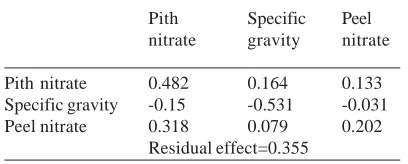
In this experiment, total tuber nitrate was considered as a dependent component and in order to get clear images of the effects of causal components (remaining stepwise multivariate regression method) on the dependent component, the correlation coefficients were partitioned into direct and indirect effects by path analysis (Table 3). Results of path analysis have shown that the specific gravity had highest negative direct effect (-0.531) on the total tuber nitrate concentration. Also, the lowest indirect effects on the total tuber nitrate concentration were observed with specific gravity (-0.181). Moreover, tuber pith and peel nitrate contributed positively towards total tuber nitrate through each other. In this experiment, peel nitrate had least significant positive and direct effect (0.202) on the total tuber nitrate concentration. Whereas, highest indirect effects on total tuber nitrate concentration was observed by peel nitrate (0.397; Table 3).
According to these results, increase of specific gravity with direct effect on total tuber nitrate and indirect effects on pith and peel nitrate can led to a decline in total tuber nitrate. On the other hand, increase of pith and peel nitrate can lead to decreased specific gravity and subsequently increase the total tuber nitrate. Other researchers have observed a negative relationship between nitrogen-containing compounds and specific gravity25, 32. These relations can be understand by
tuber starch concentration and relationship of that whit tuber nitrogen compounds and specific gravity which mentioned above12. Also, results about
peel nitrate are in agreement whit other researchers which have observed a positive effect of peeling on decreasing tuber nitrates for processing or cooking22.
CONCLUSIONS
It can be concluded from the present study that, pith nitrates are more effective on the total tuber nitrate than the cortex and peel nitrate. On the other hand, the effect of peel nitrates on the total tuber nitrates is stronger than the cortex nitrates. Also, specific gravity had highest direct effect on the total tuber nitrates. So, the specific gravity of tuber, pith nitrate and peel nitrate had major contributions to the total tuber nitrates. Hence, breeding of these traits can possibly lead to decreased amount of total tuber nitrate and improve tuber quality. According to the results of this experiment, in preparing potato tubers for processing or cooking or French-fries, peeling can decrease tuber nitrate level. Moreover, use tubers potatoes with high specific gravity can lead to low nitrate concentration and high dry matter contact and subsequently increase the quality of potato.
ACKNOWLEDGMENTS
The authors are gratefully acknowledge the Islamic Azad University (Roudehen and Karaj Branch), and Young Researchers Club of the Islamic Azad University, for their support to the part of present project.
Table 3. Path analysis of total tuber nitrates
Pith Specific Peel
nitrate gravity nitrate
Pith nitrate 0.482 0.164 0.133
Specific gravity -0.15 -0.531 -0.031
Peel nitrate 0.318 0.079 0.202
Residual effect=0.355
Underlined amounts show direct effects.
Table 2. Stepwise regression of tuber nitrate (dependent variable) and other traits (independent)
Added trait Stepwise regression stages
to model 1 2 3
Intercept 135.490 4415.119 4506.385
Pith nitrate 0.68151 0.54246 0.42575
Specific gravity -3930.21 -4011.22
Peel nitrate 0.05959
REFERENCES
1. Golmohammdi, A. and A.H. Afkari-Sayyah,
Long-Term Storage Effects on the Physical
Properties of the Potato. International Journal
of Food Properties, 2013. 16(1): p. 104-113.
2. Ellstrand, N.C., Dangerous liaisons?: when
cultivated plants mate with their wild
relatives2003, U.S.A: The Johns Hopklins
University Press.
3. Keiser, A., M. Häberli, and P. Stamp, Quality
deficiencies on potato (< i> Solanum tuberosum</i> L.) tubers caused by< i> Rhizoctonia solani</i>, wireworms (< i> Agriotes</i> ssp.) and slugs (< i> Deroceras reticulatum</i>,< i> Arion hortensis</i>) in
different farming systems. Field Crops Research,
2012. 128: p. 147-155.
4. Raj, D., Technological innovations in potato
processing2012, India. Delhi: Narendra
publishing house.
5. Seefeldt, H.F., E. Tønning, and A.K. Thybo,
Exploratory sensory profiling of three culinary preparations of potatoes (Solanum tuberosum
L.). Journal of the Science of Food and
Agriculture, 2011. 91(1): p. 104-112.
6. Booysen, L., A.T. Viljoen, and H.C. Schönfeldt,
A comparison of the eating quality of selected potato cultivars from two potato production
regions in South Africa. Journal of the Science
of Food and Agriculture 2012. doi:10.1002/
jsfa.5813.
7. Rytel, E., et al., Changes in glycoalkaloid and
nitrate contents in potatoes during French fries
processing. Journal of the Science of Food and
Agriculture, 2005. 85(5): p. 879-882.
8. Mosa, A.A., Effect of the Application of Humic
Substances on Yield, Quality, and Nutrient
Content of Potato Tubers in Egypt, in Sustainable
Potato Production: Global Case Studies, Z. He,
R. Larkin, and W. Honeycutt, Editors. 2012, Springer Science+Business Media B.V.: Netherlands. Dordrecht. p. 471-492.
9. Marshall, B., H. Holwerda, and P. Struik,
Synchronisation of tuber growth in potato (< i> Solanum tuberosum</i>): a statistical model.
Field Crops Research, 1993. 32(3): p. 343-357.
10. Ziadi, N., et al., Efficiency of controlled-release
urea for a potato production system in Quebec,
Canada. Agronomy Journal, 2011. 103(1): p.
60-66.
11. Burke, J., T. O’donavan, and P. Barry, Effect of
seed source, presprouting and desiccation date on the processing quality of potato tubers for
French fry production. Potato research, 2005.
48(1): p. 69-84.
12. Lisiñska, G. and W. Leszczyñski, Potato science
and technology1989, Essex, England: Elsevier
Applied Science.
13. Liu, Q., et al., Advanced analytical techniques to
evaluate the quality of potato and potato starch,
in Advances in Potato Chemistry and Technology,
J. Singh and L. Kaur, Editors. 2009, Elsevier Inc: USA. New York. p. 221-248.
14. Alvarez, M.D., W. Canet, and C. Fernandez,
Effect of modified starch concentration and freezing and thawing rates on properties of
mashed potatoes (cv. Kennebec). Journal of the
Science of Food and Agriculture, 2007. 87(6): p.
1108-1122.
15. Thybo, A.K., et al., Prediction of sensory texture
quality attributes of cooked potatoes by NMR-imaging (MRI) of raw potatoes in combination
with different image analysis methods. Journal
of food engineering, 2004. 61(1): p. 91-100.
16. Lachman, J., et al., Effect of peeling and three
cooking methods on the content of selected phytochemicals in potato tubers with various
colour of flesh. Food Chemistry, 2013. 138 p.
1189–1197.
17. Najm, A.A., et al., Effect of Integrated
Management of Nitrogen Fertilizer and Cattle Manure on the Leaf Chlorophyll, Yield, and Tuber Glycoalkaloids of Agria Potato.
Communications in Soil Science and Plant
Analysis, 2012. 43(6): p. 912-923.
18. Mondy, N.I. and R. Ponnawpalam, Effect of
Magnesium Fertilizers on Total Glycoalkaloids
and Nitrate N in Katahdin Tubers. Journal of
Food Science, 1985. 50(2): p. 535-536.
19. Anjana, S. Umar, and M. Iqbal, Factors
responsible for nitrate accumulation: A review,
in Sustainable Agriculture, E. Lichtfouse, et al.,
Editors. 2009, Springer Science+Business Media B.V.: Netherlands, Dordrecht. p. 533-549.
20. Speijers, G., et al., Evaluation of agronomic
practices for mitigation of natural toxins2010,
Brussels, Belgium: ILSI Europe a.i.s.b.l.
21. Ierna, A., Influence of harvest date on nitrate
contents of three potato varieties for off-season
production. Journal of Food Composition and
Analysis, 2009. 22(6): p. 551-555.
22. Pêksa, A., et al., Changes of glycoalkaloids and
nitrate contents in potatoes during chip
processing. Food Chemistry, 2006. 97(1): p.
151-156.
23. Najm, A.A., et al., Effects of conventional,
integrated and organic production systems on leaf chlorophyll, growth characteristics and tuber
yield of agria potato, in 9th Solanaceae
209.
24. Schippers, P., The relationship between specific
gravity and percentage dry matter in potato
tubers. American journal of potato research,
1976. 53(4): p. 111-122.
25. Belanger, G., et al., Nitrogen fertilization and
irrigation affects tuber characteristics of two
potato cultivars. American journal of potato
research, 2002. 79(4): p. 269-279.
26. Giletto, C., H. Echeverría, and V. Sadras,
Fertilización nitrogenada de cultivares de papa (Solanum tuberosum) en el sudeste bonaerense.
Ciencia del suelo, 2003. 21(2): p. 44-51.
27. Van der Zaag, D., Potatoes and Their Cultivations
in The Netherlands1992: Netherlands Potato
Consultative Institute and The Ministry of Agriculture and Fisheries.
28. Asghari-Zakaria, R., M. Fathi, and D.
Hasan-Panah, Sequential path analysis of yield
components in potato. Potato research, 2007.
49(4): p. 273-279.
29. Kirkman, M.A., Global Markets for Processed
Potato Products, in Potato biology and
biotechnology: advances and perspectives, D.
Vreugdenhil, et al., Editors. 2007, Elsevier: oxfoard, UK. p. 27-44.
30. Anonymous, instruction for the grading and
pricing of potato tubers2012, Tehran, IRAN:
Fruits and Vegetables Organization of Tehran Municipality (Department of hygiene and Quality Control). 1-10.
31. Kumar, P., et al., Effect of nitrogen rate on
growth, yield, economics and crisps quality of
Indian potato processing cultivars. Potato
Research, 2007. 50(2): p. 143-155.
32. Verma, S., T. Sharma, and K. Joshi, Relation
between specific gravity, starch and nitrogen
content of potato tubers. Potato research, 1975.
18(1): p. 120-122.
33. Torres, M.D.A. and W.C. Parreno, Thermal
Processing and Quality Optimization, in
Advances in Potato Chemistry and Technology,
J. Singh and L. Kaur, Editors. 2009, Elsevier Inc: USA. New York. p. 163-219.
34. Sinden, S., L. Sanford, and R. Webb, Genetic
and environmental control of potato
glycoalkaloids. American journal of potato