Holocene Climate Variability (HOLIVAR)
An ESF scientific programme
The European Science Foundation acts as a catalyst for the development of science by bringing together leading scientists and funding agencies to debate, plan and
The HOLIVAR programme seeks to bring together European scientists interested in climate variability over the last 11,500 years (the Holocene period). The scientists,
principally include palaeoclimatologists, climate historians and climate modellers. The over-arching research
questions of the programme concern how and why climate has varied naturally on different time-scales (annual to centennial) during the Holocene and how an understanding of past variability can be used to improve the performance of climate models. Although HOLIVAR is a free-standing programme it is also a contribution to the PAGES/CLIVAR intersection, a joint project sponsored by the International Geosphere Biosphere Programme (PAGES) and the World Climate Research Programme (CLIVAR).
Evidence for Holocene climate variability comes from several sources. Instrumental and documentary data are available for the recent past but natural archives of climate information, such as tree rings and peat bogs, are needed to extend the time-scales further into the past. However, the reconstruction of climate history from these proxy records depends upon a thorough understanding of all the processes involved in their formation and
preservation, and to provide regional scale climate reconstructions it is necessary to combine the data from the different archives, a process that demands accurate dating and the use of multi-proxy databases.
The HOLIVAR community is particularly interested in Holocene climate modelling, how the models can be further improved and how in turn they can be used to understand past climate change. A key issue is specifying the external climate forcings to be used in the models and the extent to which proxy methods can be used to identify past variability in forcings. Improved time-series of solar irradiance is especially needed.
Data–model comparisons for the entire Holocene will not be possible for many years. However, progress can be made by focussing on time periods within the Holocene of known rapid change using models of intermediate complexity (EMICs) and on the last millennium in particular using fully coupled atmosphere-ocean general circulation models (AOGCMs).
Introduction
The ESF HOLIVAR programme seeks to bring together European scientists interested in climate variability over the Holocene period, broadly the last 11,500 years of earth history. The scientists involved in the programme include palaeoclimatologists, palynologists, palaeolimnologists, glaciologists, geochemists, oceanographers, climate historians, archaeologists and climate modellers. The over-arching research questions are:
.
how and why has climate varied natural-ly on different time-scales (annual, centennial and millennial) over the Holocene period?.
how can an understanding of past varia-bility improve the performance of cli-mate models, leading to an improved prediction of future climate change?.
how can climate models help to explainpast climate change?
.
how has climate variability and the nature of human society interacted during the Holocene?Although these are questions relevant for the world as a whole, the HOLIVAR programme focuses mainly on research in Europe, and is allied closely to the aims and objectives of the Past Global Changes (PAGES) PEP-III project
(http://www.pages-igbp.org/) that is concerned with climate change along a pole to pole transect through Europe and Africa.
Scientific rationale
There is increasing evidence that green-house-gas forcing is becoming one of the dominant, though not the only process driving global warming. Consequently, future climate change will be the result of interactions between the effects of hu-man-induced changes and the effects of natural variability. There is therefore an urgent need to understand these interac-tions, to document and identify the cha-racteristics of natural climate variability and to improve the performance of clima-te models that seek to predict future climate change.
Natural variability, whether associated with mechanisms external or internal to the earth system, is expressed on inter-annual, decadal, and century time-scales. Data for only the most recent part of the historical record can be derived from instrumental measurements and, therefore, there is a need to extend the instrumental record backwards in time using docu-mentary records and proxy records con-tained in naturally occurring archives such as lake and marine sediments, peat bogs, tree rings, speleothems and ice cores (Figure 1, cover page).
Instrumental and documentary climate records
Continuous instrumental records of temperature, precipitation and other climate-related variables are available for the last one to two centuries. They are insufficiently long to capture centennial-scale variability but, especially after homogenisation, are of fundamental value in providing verification for model re-sults and as a means of calibration for proxy records.
Documentary sources cover a longer period, though they tend to be disconti-nuous in time and space, and are often difficult to quantify. They are particularly valuable, however, as sources of infor-mation on extreme events, such as floods, droughts and severe frosts.
Extending instrumental records using proxies from natural archives Natural archives such as tree rings, spe-leothems (cave stalagmites), lake and marine sediments, peat bogs, and glacier records preserve environmental respon-ses to climate change.
Some are annually banded (Figure 3) allowing calendar ages to be derived, others have no in-built seasonal or annual structures but can be dated, albeit with less precision, using radiometric methods such as radiocarbon dating. In this case radiocarbon years can be converted into calendar years using a tree-ring based calibration or 14C wiggle-matching.
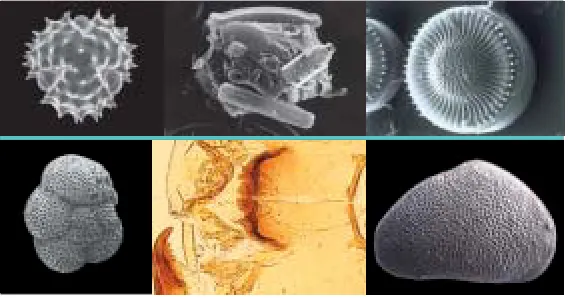
The climatic information in these archi-ves is stored in the form of physical, chemical and biological properties refer-red to as proxy climate indicators or climate proxies (Figure 4). Each of the major archives contains a range of climate proxies (e.g. stable isotopes, diatoms), and some proxies occur in more than one type of archive. The exact relationship
Figure 3: Annually banded archives: (from left to right) tree rings of Huon pine from Tasmania (E Cook); varves from Lake Holzmaar, Germany (B Zolitschka); speleothems from Rana, Norway (J Kihle); coral from Papua New Guinea (S Tudhope); ice from GISP2, Greenland (A Gow) Functions
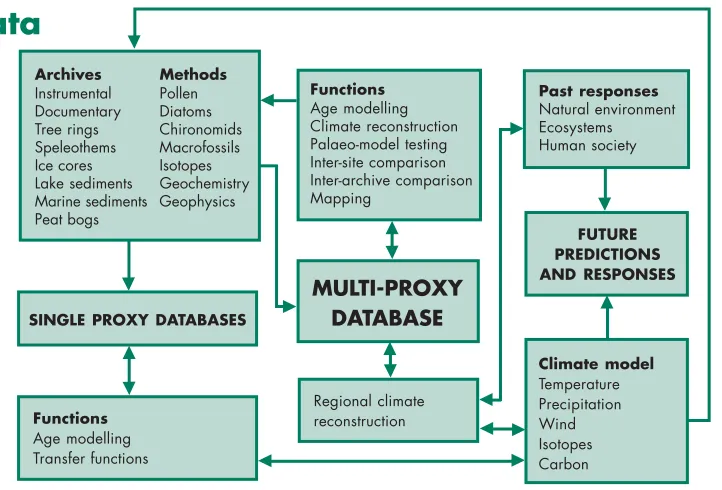
Age modelling Climate reconstruction Palaeo-model testing Inter-site comparison Inter-archive comparison Mapping
Past responses Natural environment Ecosystems Human society
FUTURE PREDICTIONS AND RESPONSES
SINGLE PROXY DATABASES
MULTI-PROXY DATABASE
Functions Age modelling Transfer functions
Regional climate reconstruction
Climate model Temperature Precipitation Wind Isotopes Carbon
Figure 2: Processes of data collection, storage, analysis, and their use in climate modelling.
Data
Model
Archives Methods
Instrumental Pollen
Documentary Diatoms
Tree rings Chironomids
Speleothems Macrofossils
Ice cores Isotopes
Lake sediments Geochemistry
the accuracy and precision of dating techniques and to increase the robustness of the age models that are used in making independent comparisons between data from different sites. Institutionally combi-ning data requires scientists to be willing to contribute data to common databases using a harmonised approach that allows database queries across data types to be processed swiftly and efficiently. HOLI-VAR stresses the need to develop a cen-tral, multi-proxy data system of this type to bring proxy climate data together and ultimately to enable regional climate reconstruction through the Holocene.
Holocene climate modelling
The earth’s climate is a system of immense complexity, incorporating numerous sources, sinks and transports of material and energy, with complex feedbacks operating between different parts of the system. Changes in the climate system over time can be simulated using models of varying types and complexity. These include comprehensive coupled atmos-phere-ocean general circulation models (AOGCMs), earth system models of intermediate complexity (EMICs) and more simple energy balance models (EBMs). AOGCMs have the advantage of high spatial resolution and include representations of many key processes in the system but the disadvantage that long time-scale simulations are expensive and slow to run. However, simulations of the last 250-500 years are becoming availa-ble and the HOLIVAR community has a special interest in data-model compari-sons over this time period that spans the intersection between instrumental, docu-mentary and proxy record availability and that covers a known period of relatively rapid climate change from the “Little Ice Age” to the recent period of warming. The less complex EMICs have the ad-vantage of speed and allow experiments and sensitivity testing to be carried out over longer time periods on centennial to millennial time-scales (Figure 5). HOLIVAR will in particular encourage
Figure 4: Microfossils used as climate proxies: (clockwise from top left): pollen (Aster linosyris) (H Halbritter); testate amoeba (Difflugia bacillariarum) (D Charman); diatom (Cyclostephanos tholiformis) (C Sayer); ostracod (Sarscypridopsis aculeata) (R Jones); chironomid (Heterotrissocladius subpilosus) (S Brooks); foraminifera (Neogloboquadrina pachyderma) (UCL)
between climate proxies and climatic variables such as temperature, rainfall, or wind can be indirect and complex. Re-construction of climate history from proxy records therefore depends on a thorough understanding of the processes governing the formation of the proxy climate signals, their incorporation into the archive, and the preservation of their integrity over time.
Climate proxies can be calibrated by developing transfer functions which describe the relationship between a cli-mate proxy and clicli-mate across the mo-dern-day environmental gradient and are validated by comparing their recent record with historical climate data. Be-cause each climate proxy has its own particular strengths and weaknesses, the reliability of climate reconstructions can be further improved by integrating data from different proxies and across archi-ves. Consequently, one of the aims of HOLIVAR is to encourage this multi-proxy, multi-archive approach (Figure 1).
Combining data to provide regional scale climate reconstruction
Figure 5: Annual mean surface temperature anomaly for the 8.2K event simulated by an EMIC (from Renssen, H,H Goosse, T Fichefet, and J M Campin, Geophysical Research Letters 28, 2001)
simulations of events that are well known from palaeoclimatic data.
Understanding climate forcing in the Holocene
Climate models, whether GCMs or EMICs can be used to perform control runs that simulate the inherent variability in the climate system or forced runs that simulate the response of the system to changes in external forcings. External forcings, in turn, may be either natural, e.g., changes in insolation from orbital variations, solar activity or volcanic aerosols (Figure 6) or anthropogenic e.g. changes in land cover, greenhouse gases or sulphate aerosols.
Whilst the timing and magnitude of some of the these forcings are reasonably understood over the very recent period (last 100 years) uncertainty increases with age and currently limits the usefulness of expensive GCM
simulations over periods longer than the last few centuries. For Holocene simulations improved time-series of solar irradiance variations are especially needed. The extent to which such information can be provided from the record of cosmogenic isotopes (such as
10Be and 14C) in natural archives is a key
issue for the HOLIVAR community.
Figure 6: (A) Northern Hemisphere temperature forcing over the past 1000 years attributable to documented volcanic eruptions (blue), solar variability (magenta, green and orange), anthropogenic greenhouse-gas emissions (red) and air pollution (brown), as calculated with an energy-balance climate model.
(B) Comparison of the combined temperature effect of these four natural and anthropogenic climate-forcing mechanisms (blue) with the instrumental temperature record (black; AD 1860-1993) and an integrated Northern Hemisphere temperature reconstruction based on natural archives with annual resolution and age control (red; AD 1005-1993) (from Crowley, T J, Science 289, 2000)
Comparing model output with palaeoclimate data
One of the key objectives of HOLIVAR is to encourage the comparison between model simulations and palaeoclimate data, using data to test and improve model performance on the one hand, while using model experiments to investigate the causes of past climate variability on the other hand. Data-model comparisons are not straightforward, however, because the characteristics of model output and palaeodata are very different, especially with respect to scale and uncertainty. Proxy records integrate climatic information only locally over space, but often over longer time periods (seasons to decades, or more), as if climate history has passed through a low-pass filter. They also respond to non-climatic drivers, making their climatic interpretation imprecise. In contrast, numerical models simulate climate at larger spatial scales, not resolving variations at scales near to or less than their resolution (typically hundreds of kilometers). Matching the two approaches consequently requires the use of scaling techniques. In the inverse approach, climate is reconstructed from the proxy data, usually with some spatial aggregation to a scale appropriate for comparison with the climate model simulation, whereas the forward
180 90W 0 90E 180
60N
30N
EQ
30S
60S
180 90W 0 90E 180
60S 30S
EQ 30N 60N
–10 –5 –2 –1 –0.5 0 0.5 1 2 5 10
–2 –1 –0.5 –0.5 0 0 0 0 0 0 0 0 0.5 2 10.5 –0.5 0 0.50 0 0 –0.5 –1 –2 –1 –1 –0.5 0 0 –2 –10 –5 –5 –2 –0.5 –1 0 –1 1.0 0.5 0.0 -0.5 0.4 0.2 0.0 -0.2 -0.4
1000 1200 1400 1600 1800 2000
All Be10 sm11 2.0 Mn (sm11) Jones.inst sm11 Vol.hl.alb 2.0 Sol.Be10 2.0 Sol.C14.Brd 2.0 Sol.C14.Stv 2.0 GHG 2.0 Trop Aer 2.0
Temperature Variations (
°
C)
Temperature Variations (
°
C)
A
B
Figure 7: Glacier length (in km) for Nigardsbreen as a function of time (in kyr BP) showing a phase of rapid expansion and high variability during the mid-Holocene. Length of records are generated using a process-based glacier model coupled to the climate model ECBilt, which is driven by orbital forcing (from Weber, S L, and J Oerlemans, The Holocene, 2003)
approach involves the comparison of actual proxy data with simulated proxy time series generated by process-based or empirical models that are driven by climate model output that has been downscaled to the proxy site (Figure 7). HOLIVAR seeks to encourage the development of both approaches. The inverse approach can be facilitated by harmonising and combining proxy data at the regional scale using multi-proxy data systems for sharing and manipulating data, and forward modelling has major future potential as it allows the exploration of the processes that lie behind the climate-proxy relationship.
Data–model comparisons for the entire Holocene will not be possible for some years as an extended period of time is needed for data compilation and synthe-sis to take place. However, progress can be made by focussing jointly on time periods within the Holocene of known rapid change and for which data are available, such as the 8.2 ky BP cooling event, the period of aridification in low latitudes in the mid Holocene, the Sub-boreal/Sub-atlantic transition (about 2750 BP), and the last millennium.
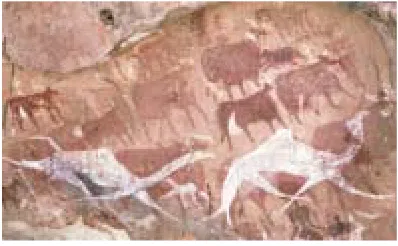
Figure 8: Multi-phase rock art from the Ennedi, NE Chad. Rock paintings of domesticated cattle in a currently arid region illustrating humid conditions during the early and middle Holocene. Late Holocene drier conditions are indicated by superposed camel drawings less than 200 years old. (S Kroepelin, Heinrich-Barth-Institute, Cologne)
Climate-human society interactions in the Holocene
Studies of past climate-human society interaction can contribute strongly to debates on the collapse of past civilisa-tions and, although the nature of human society is today very different, they can provide useful insights into how humans might respond to climate change in the future (Figure 8). There are many exam-ples throughout the world of rapid popu-lation expansion and decline during the latter part of the Holocene, and in most cases the role of climate, directly or indi-rectly, has been a central topic of debate. Explanations for civilisation collapse often range from the purely deterministic with climate as the main driver to those that favour human-induced over-exploi-tation of resources, environmental degra-dation or the development of dysfunctional societies, irrespective of climatic influen-ces. Of key importance in these debates is the availability and quality of the palaeo-environmental data needed to assess the relationships between environ-mental and societal change.
Consequently HOLIVAR seeks to encou-rage the palaeoclimate research commu-nity to improve further our understanding of climate variability and its impacts across archaeologically important re-gions, and to engage in these debates with historians and archaeologists.
Nigardsbreen
Ky BP
km
16 14 12 10 8 6 4 2 0
Activities
Open Science Meetings
The HOLIVAR programme began in 2001 with an international conference co-sponsored by IGBP-PAGES in Aix-en-Provence on Past Climate Variability through Europe and Africa. The procee-dings of this meeting will be published in 2003 by Kluwer. The programme will end in 2005 with a second international meeting on Holocene climate variability: data, models and impacts. scheduled for September 2005 in London.
Workshops
HOLIVAR has scheduled a series of annual workshops as follows:
.
Combining proxies, April 2002 in Lammi (Finland); organised by Matti Saarnisto and Antti Ojala.
Data-model comparisons, June 2002 in Louvain-la-Neuve (Belgium); organised by Hans Renssen and Tim Osborn.
Holocene dating, chronologies, and age modelling, April 2003 in Utrecht (The Netherlands); organised by André Lotter.
Database meeting, scheduled for 2003/4.
Holocene climate forcing, scheduled for 2004.
Climate-human society interactions during the Holocene, scheduled for 2005Training courses
Training courses that include all the HOLIVAR themes and that stress and exemplify the need to integrate climate change science are planned. The course title is Quantitative Holocene climate reconstruction and data-model compari-sons. They will be offered both in 2003 and 2004 and are designed to bring together students with both modelling and data interests. The first course will take place in London, 23rd June – 4th July
2003.
External links
HOLIVAR is concerned with scientific issues identified as being of international importance for climate change studies by the PEPIII research community in IGBP-PAGES. It is also a contribution to The PAGES/CLIVAR Intersection which is a shared research agenda between WCRP and IGBP.
Funding
ESF scientific programmes are principally financed by the Foundation’s Member Organisations on an à la carte basis. HOLIVAR is supported by:
Österreichische Akademie der Wissenschaften, Austria; Fonds zur Förderung der wissenschaftlichen Forschung, Austria; Fonds National de la Recherche Scientifique, Belgium; Fonds voor Wetenschappelijk Onderzoek -Vlaanderen, Belgium; Suomen Akatemia/ Finlands Akademi, Finland; Centre National de la Recherche Scientifique, France; Deutsche
HOLIVAR Steering Committee
March 2003
© European Science Foundation
Rick Battarbee (Chair)
Environmental Change Research Centre
Department of Geography University College London
26 Bedford Way London WC1H 0AP United Kingdom
Tel: +44 20 7679 7582 Fax: +44 20 7679 7565 Email: [email protected]
Jürg Beer
EAWAG
Ueberlandstrasse 133 Postfach 611 8600 Dübendorf Switzerland
Tel: +41 1 823 5111 Fax: +41 1 823 5210 Email: [email protected]
André Berger
Institut d’Astronomie et de Géophysique G. Lemaître Université Catholique de Louvain
2 Chemin du Cyclotron 1348 Louvain-la-Neuve Belgium
Tel: +32 10 473303 Fax: +32 10 474722 Email: [email protected]
Keith Briffa
Climatic Research Unit University of East Anglia
Norwich NR4 7TJ United Kingdom
Tel: +44 1603 593 909 Fax: +44 1603 507 784 Email: [email protected]
Françoise Gasse
CEREGE
Europôle Méditerranéen de l’Arbois
BP 80
13545 Aix-en-Provence cedex 04 France
Tel: +33 4 42 97 15 70 Fax: +33 4 42 97 15 95 Email: [email protected]
Eystein Jansen
Bjerknes Centre for Climate Research University of Bergen
Allégaten 55 5007 Bergen Norway
Tel: +47 55 583 491 Fax: +47 55 584 330
Email: [email protected]
Ingemar Renberg
Department of Ecology and Environmental Science Umeå University
901 87 Umeå Sweden
Tel: +46 90 786 6029 Fax: +46 90 786 6705
Email: [email protected]
Matti Saarnisto
Geological Survey of Finland
Betonimiehenkuja 4 PO Box 96 02151 Espoo Finland
Tel: +358 20 550 2184 Fax: +358 205 5012 Email: [email protected]
Christoph Spötl
Institute of Geology and Paleontology University of Innsbruck
Innrain 52 6020 Innsbruck Austria
Tel: +43 512 507 5593 Fax: +43 512 507 2914
Email: [email protected]
Bas van Geel
Faculty of Science University of Amsterdam
PO Box 94062 1090 GB Amsterdam The Netherlands
Tel: +31 20 525 7664 Fax: +31 20 525 7832 Email: [email protected]
Dirk Verschuren
Department of Biology Ghent University
Ledeganckstraat 35 9000 Ghent Belgium
Tel: +32 9 264 5262 Fax: +32 9 264 5343
Email: [email protected]
Bernd Zolitschka
Institute of Geography University of Bremen
Celsiusstrasse FVG-M 28359 Bremen Germany
Tel: +49 421 218 2158 Fax: +49 421 218 9658 Email: [email protected]
Figure 1 (cover):
Naturally occurring archives of palaeoclimatic proxy record (clockwise from top left): Raised bog profile, Bargerveen, the Netherlands (B van Geel); Lochnagar, Scotland (M Hughes); Quelccaya ice cap, Peru (L Thompson); Crag Cave, Ireland (A Baker); Pinus sylvestris (K Briffa); Ocean Drilling Program’s drillship JOIDES Resolution, (ODP)
For the latest information on this
programme consult the HOLIVAR
home page: www.esf.org/holivar
Svenje Mehlert ESF Scientific Secretary
Joanne Dalton Goetz ESF Administrative Assistant
European Science Foundation
1 quai Lezay-Marnésia 67080 Strasbourg cedex France
www.esf.org
Tel: +33 (0)3 88 76 71 22 Fax: +33 (0)3 88 37 05 32 E-mail: [email protected]
IREG Strasbourg - Dépôt légal: mars 2003 - N
°