The European Science Foundation (ESF) acts as a catalyst for the development of science by bringing together leading scientists and funding agencies to debate, plan and implement pan-European scientific and science policy initiatives. It is also responsible for the management of COST (European Cooperation in the field of Scientific and Technical Research).
ESF is the European association of 78 major national funding agencies devoted to scientific research in 30 countries. It represents all scientific disciplines: physical and engineering sciences, life, earth and environmental sciences, medical sciences, humanities and social sciences. The Foundation assists its Member Organisations in two main ways. It brings scientists together in its Scientific Forward Looks, Exploratory Workshops, Programmes, Networks, EUROCORES, and ESF Research Conferences, to work on topics of common concern including Research Infrastructures. It also conducts the joint studies of issues of strategic importance in European science policy and manages, on behalf of its Member Organisations, grant schemes, such as EURYI (European Young Investigator Awards).
It maintains close relations with other scientific institutions within and outside Europe. By its activities, the ESF adds value by cooperation and coordination across national frontiers and endeavours, offers expert scientific advice on strategic issues, and provides the European forum for science.
Copyright: European Science Foundation
Reproduction with appropriate acknowledgements, is authorised, except for commercial uses. E-copies can be downloaded from: www.esf.org
Social Sciences in Europe
An ESF Standing Committee for the Social Sciences Report
Contents
Foreword 3
Introduction 4
Case Studies 7
1. Social inclusion 7
2. Promoting European growth 8
3. Making the most of imperfect knowledge 9
4. Beliefs in government 10
5. Politics of prostitution 11
6. European Social Survey (ESS) 12
7. Organised crime 13
8. Health technology 14
Facts and figures 16
Foreword
T
he socialsciences are a diverse group of disciplines. Some such as sociology and economics are long-established and have methodology and results whose power cannot be disputed. In other areas, such as
behaviour vary subtly and cannot be translated simply.
Social science is constantly developing new ways of thinking about the world. Some of its methodology is highly quantitative while some is qualitative but still rigorous. Social scientists are being trained in increasing numbers in Europe and are needed by employers in the public, private and non-profit sectors.
Governments and companies have long valued economists and statisticians as important advisers but are now employing a wider range of social scientists with knowledge in areas such as health differences, gender, education and ethnic diversity.
The European Science Foundation promotes the social sciences actively. We run a variety of research programmes and European collaborative research projects in the social sciences. Our social science networks cover a wide range of topics including urbanisation, econometric modelling, European political elites, gender, family structure and the ageing population, migration and globalisation. We also hold many research workshops and conferences designed to identify important emerging problems in the social sciences and build the scientific networks needed to research them. Our aim is to add a new dimension to the social sciences in Europe and to add value to the existing impressive social science research programmes of our Member Organisations and nations.
I hope you enjoy this publication. We would welcome your response, which can be submitted electronically at [email protected].
Professor Chris Whelan
Chair of the Standing Committee for the Social Sciences, European Science Foundation fields of interdisciplinary research where they
overlap with other areas of science and with the arts and humanities, the social sciences are newer but equally solid in their methodology, their devotion to data and their ability to produce valuable findings.
We hope that this document will show a wide audience a little of what the social sciences have to offer. Because of Europe’s terrific cultural, political and economic diversity, the social sciences are the key to understanding many of the continent’s most difficult questions, such as its need for more economic growth and the falling perceived legitimacy of its politicians. At the same time, as one of the case studies in this pages shows, social science can use well-established methods to investigate such issues as unequal information about holidays. This is not at first sight a matter of life and death, but tourism is the mainstay of many European economies and a source of well-being for many Europeans.
4
Introduction
Europe is a continent of 730 million people. They live in a wide variety of societies with many systems of government, varying economic patterns, different divisions between the public and private sector – and dozens of languages. They are the biggest population bloc in the developed world, well ahead of the United States with 288 million people and Japan with 127 million.
Social science is the group of disciplines and methods which helps us to understand these people and the societies in which they live.
Such understanding is essential to Europe’s future economic success. Innovation, economic growth and job creation all happen in a social and policy context which social science exists to explain and assist. In addition, social science helps to illuminate key concerns for the future of European societies. How do children learn in school? Why do people commit crime, and what might make them stop? Do high taxes discourage enterprise? What are the social, political and economic effects of ageing populations?
European societies are so diverse that they provide a natural laboratory for social science. Within a few thousand kilometres, researchers can find a wide variety of family structures, education and healthcare systems, religious beliefs and employment practices to study. They can hear hundreds of languages and meet people from all races.
Nor is Europe merely an arena for social science research. Social science provides the research findings we need to promote social cohesion within European societies and within Europe as a whole. It is of particular relevance to the European Union in its current era of accomplished and planned expansion.
At the same time, the social sciences form part of science in general. Many of the key challenges which Europe faces involve new knowledge. Like the rest of the planet, climate change affects Europe
and the people who live there. It is a key policy concern for national governments and for the European Union. Likewise, although most European countries are not experiencing rapid population growth, their populations are changing dramatically as their age structure and ethnicity alter.
New knowledge is also producing fresh challenges for Europe. European companies are world leaders in pharmaceuticals, information and communications technology, aerospace and other established high-technology industries. They are taking a strong position in nanotechnology, biotechnology and other possible future technologies.
The acceptability of such innovations across Europe is complex, because of the continent’s broad range of religions, cultures and political structures. Social science is the key to understanding the complex ways in which people react to innovation, and the business processes involved in turning new discoveries into profitable products.
Ariane flight 160. 2003 © ESA/CNES/Ariane-photo Service Optique Video CSG
Management is itself one of the most vigorous areas of social science. Enterprise across Europe takes many forms and is also distinct in style from business in Asia, North America and other parts of the world. Research can help improve skills at all levels in business organisations and make them more competitive and innovative, a vital role at a time of rapid change in the business climate.
In addition to helping us to make the most of these opportunities, social science is the key to understanding many of the risks and uncertainties of modern life. In recent decades, social science has vastly increased its understanding of risk and how people appreciate it. Social science provides ways of thinking about the origins of crime and political violence and approaches to minimising them. At the same time, it allows the human dimension of environmental risks such as flooding and pollution, and of the risks of new technology such as that arising from our knowledge of the human genome, to be researched.
The social sciences are a rich and varied group of disciplines. Some such as economics have been studied for as long as physics or chemistry and have produced considerable bodies of knowledge and techniques of broad application. The European Union started out life as the European Economic Union and as the launch of the Euro shows, economic integration is still at the heart of its concerns. Good economic understanding is the key to success in this enterprise.
Other social sciences such as the study of risk are newer and as a result, are ascending a steeper learning curve. Some such as psychology are close to laboratory science while others, such as politics, are closely related to cultural concerns.
These subjects have in common a commitment to the proper use of data and methodology. But while the methods used by physicists or mathematicians vary little from country to country, the social sciences emerge from the societies of which they form part.
In the modern era, social scientists study contemporary issues such as the comparative success of different economies and the different health patterns and life expectancies of citizens across Europe and the world.
Their findings help inform national, local and European policies which promote health and welfare as well as business and economic success. For example, much has been written about the critical state of many inner cities, an issue which has been the subject of much social science research. But social sciences such as economics, demography and business studies are also interacting with other sciences such as agronomy and environmental science to illuminate the severe problems of depopulation and economic failure that are affecting many rural areas across Europe.
Research such as this is only possible if the right trained people are available to carry it out and if the data, methodology and funding they need are in place. European countries have long been enthusiastic collectors of economic and demographic data, including censuses. In recent years they have added more systematic data on employment, family structure, education and other key social issues. They have also developed methods for the analysis of this data.
Perhaps most importantly, the social science agencies of Europe have begun collecting data systematically across the continent. The European
6
Social Survey, described in these pages, was initiated by the ESF and is a major development in this field. New consistent and high-quality data will allow social scientists to raise and unify the standards to which they work. More importantly, a unified knowledge base for Europe is an essential part of the continent’s intellectual infrastructure. Its role in allowing Europe to think about itself, its people and its societies as a whole is no less vital in its way than the transport links and telecommunications networks of the new Europe.
The social scientists in Europe’s universities and research institutions produce outputs such as journal articles and books which can be shown to be of high quality by world standards. They also form part of a community of social scientists working in government departments, public and private sector business and the non-profit sector, all of which rely on social scientists produced through education, training and personal development in European higher education.
And like other scientists, they seek increasingly to engage the public in their work by communicating it to the widest possible audience.
As this publication proves, European social scientists are also becoming increasingly aware that their research is of more than scholarly and even practical interest. Social science is a mirror that people, and the societies they live in, can hold up to themselves to gain a fascinating idea of their present shape and of the options for their future development.
Case studies
1. Social inclusion
European nations are increasingly committed to the social inclusion of as many of their citizens as possible. But it is impossible for a country to develop inclusive social policies without good data on topics such as incomes, family structure, health, and education.
Social scientists are now starting to extend their thinking on social inclusion across Europe. But they are finding that the task is far from simple.
A project carried out for the Belgian government by a team led by Tony Atkinson of the University of Oxford in the UK found that even defining an unacceptably low income is surprisingly difficult. One definition is an income that totals 60 per cent of the median in a specific country. Such an individual will not be rich anywhere. But in a country with a completely state-funded health system, they will be better-off than in a country where people have to pay for healthcare.
Finding out about people who live in poverty inherently involves dealing with groups such as the homeless, travellers and recent immigrants who may be hard to reach, including illegal immigrants who may be reluctant to answer questions.
The researchers found that social inclusion is a subtle concept. To be included in society, a person has to have enough money and other resources, such as education, to be able to join in its activities. But such involvement varies widely from place to place. In the Netherlands, 20 per cent of adults speak to their neighbours on most days, but in Italy, half do. So even the answers to a simple question about how often people do this need careful interpretation. By contrast, about 60 per cent of Danes belong to some sort of club or organisation but only a fifth of Italians. In the same way, people in some countries and cultures eat in restaurants together as a basic means of social interaction, while in other countries they invite people into their homes.
This means that finding out who is socially included and excluded, and the income levels that might be required to support inclusion, calls for detailed knowledge of different countries. Getting a consistent picture of social exclusion across Europe will mean interpreting answers to a range of questions in each country.
The project recommended a number of comparatively basic and robust measures of poverty (see box), as well as some more detailed measures such as overcrowded housing and financial inability to obtain medical treatment. Its conclusions will form part of European and national-level thinking on poverty and exclusion.
Indicators of exclusion
.
Risk of financial poverty as measured by income of 50 and 60 per cent of national median.
Income inequality.
Proportion of 18-24 year olds with only lower secondary education and not now studying.
Overall unemployment.
Long-term unemployment.
Proportion of population in jobless households.
Proportion of population dying before age 65, or the ratio of those in top and bottom income groups saying they are in bad or very bad health8
2. Promoting
European growth
The European Union was originally known – at least to English speakers – as the “Common Market.” But achieving a true market of 456 million people and 25 countries is a daunting task.
The European Commission asked a group of social scientists chaired by André Sapir of the Free University in Brussels, Belgium, to look more closely at economic integration across the EU. Their report looked only at the 15-state EU and was delivered just before the arrival of ten new member states in 2004.
They found that although the 15 states were economically stable, their economic growth was unsatisfactory – a key consideration given the competition from the United States and Asia.
Part of the problem, they found, lay in the assumptions behind the EU. Many of its structures date from the era of large corporations, lifetime employment, mass production and the accompanying economies of scale, and the steady spread of established technologies across the continent, might well not work in the information age, which is characterised by networks involving a wide variety of organisations. This calls for more flexible and mobile labour, a wider variety of sources of finance, more higher education, training and retraining, and more research and development.
This means that big, old, established organisations such as universities, banks and government ministries are wrongly configured to produce economic growth. In the postwar era, secondary education was the basic requirement for growth. Now this role has been taken by higher education. The US was found to be outspending Europe on public funds for higher education and exceeding European private spending on higher education massively.
The group found that in 2000, only 24 per cent of the 25-64 year olds in the EU 15 had tertiary education, while in the US the total was 37 per
cent. The EU was spending 1.4 per cent of GDP on tertiary education to the US’s 3 per cent.
The team – eight in number, with seven based in European universities and other institutions and one in the US – also found that US firms are creating more jobs and using immigrant labour more effectively in high technology.
Their research confirmed many beliefs about areas in which Europe needs to strengthen reform and uncovered problems which could not have been identified without the methods of social science.
Mobilising European money
Sapir and his colleagues found that although newspapers often write about the EU’s budget, it is hard to find in any coherent form.
Most of the money spent by Brussels, they found, was collected from national treasuries out of national taxation. There are no Europe-wide taxes that rise and fall as European spending changes. And over half the money goes to agriculture, an industry whose importance is in steady decline. In any case, they point out, today’s enlarged EU is an area of such huge variety, in terms of population, ecology and climate, that a single policy for agriculture is becoming steadily less feasible. Case studies – Promoting European growth
3. Making the
most of imperfect
knowledge
Many readers of this report take part in the European Southern Migration – the annual holiday trek from the continent’s dark northern reaches to its sun-facing south. To social scientists in Cyprus, a favoured destination for such temporary migrants, these lucky travellers open up possibilities for research.
When you plan a holiday, you are the potential victim of asymmetrical information. The hotel owner knows how good their hotel is, but you do not. There are ways round this, and one of the best is to use a well-informed intermediary. There might be a hotel rating system, or you might trust a travel agent in your home country.
Sofronis Clerides, Paris Nearchou and Panos Pashardes of the University of Cyprus studied such intermediaries. They are not unique to tourism. Some are profit-making companies such as travel agents. Others are non-profit, such as the consumer rights bodies found in many countries. Others are state-run. Most governments fund an organisation to inspect restaurants and close down those with unacceptable food safety practices. In the case of tourism, there are two main types of intermediary, private-sector and government, which produce potentially conflicting information.
The scientists compared holidays offered by two major UK tour operators to nine countries, spread geographically from Turkey and Egypt to the Canary Islands in the Atlantic. They found that one operator is especially likely to upgrade hotels in its catalogue by comparison with the ratings applied by the national tourism body, while the other has a more pronounced tendency to downgrade them. In general, using mainland Spain, the biggest destination, as a benchmark, national hotel rating agencies are likely to be too generous to their hotels in Turkey, and less generous in Cyprus and the Balearics.
The authors suggest that these national differences may reflect different policies for the development of tourism, a significant and growing part of the economy of all these nations. Countries which are less generous in giving a hotel four rather than three stars, for example, may want to move towards smaller numbers of better-paying tourists, while those that prefer large numbers of less demanding customers might be more inclined to rate their hotels generously. There is growing awareness of the social disruption and environmental damage which uncontrolled mass tourism can involve. The EU is allowed to spend 1.27 per cent of the
area’s GDP. If it became possible to redistribute this cash, it would be feasible to have a restructuring fund for agriculture and other declining industries alongside money to help low-income EU nations catch up with the richer ones and a fund for encouraging economic growth. This would spend some money on research, training and education and some on infrastructure.
Sunbathers on a popular Turkish beach. © Torleif Svensson/Corbis
10
into tourism might do well to provide better information to potential visitors.
One problem, they say, is that there is too little profit in hotel ratings to make it worth setting up a free-standing ratings business. The tour operators rate hotels as part of their overall business. But the growth of the web has seen online ratings systems spring up, such as eopinions.com, so there could be an electronic way of achieving this.
4. Beliefs in
government
Europe is for the most part a continent of democracies. Despite setbacks in the former Soviet Union and the tragedies that attended the breakup of the former Yugoslavia, most European nations have stable governments chosen in honest elections.
But this success is not matched by public support for the political processes that have made it possible. Participation in elections has been on a downward track in Europe and the US and loyalty to old mass movements has been eroded by new social structures and new employment patterns.
A European Science Foundation project led by Max Kaase in Mannheim, Germany and Kenneth Newton in Essex, UK, looked at beliefs in government across Europe. They found that an increasing percentage of the population lives in a fluid way and does not feel an attachment to the organisations and societies which have produced the major political parties we now see. This insight also suggests that people’s disinclination to vote has much in common with their reluctance to go to church.
At the moment, the researchers found, many voters do not believe that politicians have real power, which means that voting is inherently a waste. More adventurous means of involving people in democracy might focus on new institutions with visible effects. They point to local planning cells
(Planungszellen) in Germany as a form of participatory organisation which could be seen to have results.
But although people have less faith in politicians, the processes that elect them and take major policy decisions have been getting more open and transparent throughout Europe for some decades. More officials are elected, there are referenda on major issues, there has been decentralisation, and access to the political class has become less embroiled in elitism. In particular, many countries have had open government legislation that has made political processes and decisions more visible.
But by contrast, Kaase, Newton and their colleagues caution that the growth of the powers of the European Union, and of subnational political regions, also threatens to attack the legitimacy of national parliaments. Perhaps even more of a threat comes from network politics in which decisions are taken by electronically-connected elites in structures which vary from issue to issue.
In the past, poorer people would vote for left-wing parties which promised more state spending, and the richer voters supported parties of the right that might cut their taxes. But the loss in faith in old-style political parties has been accompanied by an increase in “value voting.“
Value voting expresses the voter’s wider world view rather than articulating some concept of their narrow economic interest. It is seen at its Case studies – Beliefs in government
most successful in the emergence of green parties. Kaase and Newton point out that there is no reason for the old parties not to build green issues into their policies. In fact, established parties are often surprisingly successful at incorporating new demands. But value voters, who tend to be in more affluent societies and are typically young, find new and “purer“ parties worth supporting even when they are small, have inexperienced leaders, and in many cases do not offer a full range of policy options in their manifestos.
At the same time, they say, “unconventional participation,“ seen in the animal rights movement amongst others, has now become a firm part of the political scene in many countries. The participants can be involved at a number of levels from illegal violence to a consumer boycott.
5. Politics of
prostitution
Societies throughout history have struggled with the existence of an industry that supplies sexual pleasure. Joyce Outshoorn of Leiden University in the Netherlands has coordinated a European project on the way in which this age-old problem is developing in an era of HIV/Aids, feminism, globalisation, and mass democracy.
She and social scientist colleagues from Europe, North America and Australia looked at the issue from a number of angles. Governments wish to safeguard public order and health: feminists wish to abolish prostitution or regulate it.
They analysed debates and legislative changes concerned with prostitution in over a dozen countries and put them into a systematic analytical framework. They found that despite debates about the right size and shape of the state, this is one area in which government agencies charged with
looking after women’s interests are genuinely valuable. In most western European nations – as well as Canada and Australia – prostitution became a political issue at some point between the 1960s and the 1990s. At that point, prostitution was often reclassified as something to be regulated rather than criminalised, as part of a general liberalisation of social values. Often prostitution ceased to be a crime but profiting from it remained one.
Although these debates coincided in time with the emergence of feminism, they were often influenced more by the general feeling that the state should not interfere with the lives of its citizens, or was a social problem because of its possible consequences for public health and order. It was rarely regarded as being a women’s issue in its own right.
Later debates, they found, have had a higher orientation towards gender, with the issue being more often viewed as one about women. However, this change does not always benefit the feminist standpoint. Instead, it can embody views of women encouraging immorality in men.
The latest round of debates about prostitution have involved feminist groups more deeply and has led to reforms such as in Austria, where prostitutes have been brought within the state employment tax system.
It emerges that women’s policy agencies, where they existed, had a key role in prostitution debates. Such agencies tend to have a leadership with a
12
definite commitment to feminism. They are often very close to politically powerful allies and have a strong effect on policy outcomes. The result, says Outshoorn, is a powerful case for what she calls “state feminism.”
European nations have all taken their own route through the prostitution debates of recent decades.
In Italy, brothels were banned in 1958. Various attempts by politicians to reopen them have come up against powerful opposition from women’s groups, the Catholic church, and the left. In Spain, prostitution was banned under Franco and it was not until the 1990s that the harsh laws against it were replaced. In France, debate about prostitution, which was illegal, was sparked by a police crackdown in Lyon and then became national. By contrast, the discussion in the United States has been heavily dominated by child protection concerns, involving both boys and girls.
The Survey was set up on the initiative of social scientists themselves and is managed from City University in London. It completed its first full cycle of research in 2003 and the second was under way at the time of writing in 2004. The intention is to collect data on a two-year cycle.
The first round of the ESS has generated data from 22 participating countries. It asked a central core of questions on topics such as people’s political beliefs and allegiances, their well-being or social exclusion, their religion, feelings of identity and possible experience of discrimination, their media use and level of trust in social institutions, their involvement in social organisations, their opinions on immigration and asylum, their values, and their socio-demographic status and household circumstances. This data will build up into a time series showing changes in key aspects of the social structure of European nations.
In addition, the Survey asks changing questions over time on more topical issues.
Case studies – ESS
Lutheran great church of Finland. © Danny Lehman/Corbis
6. European Social
Survey (ESS)
Most European nations started to collect systematic data on their citizens in the 18th and 19th centuries. They regarded such information as an essential part of becoming a nation, allowing governments to plan everything from education systems to armies. It also had significant commercial uses. Life insurers cannot stay in business if they do not know how long people are likely to live.
Today most countries collect a wide variety of information on their populations. It feeds government policy thinking, business decisions, and social science research.
The Survey has been designed to give social scientists across Europe access to data which will drive high-quality research, although its results are also likely to interest policy-makers, business and other audiences.
Achieving proper quality data has involved the Survey in ensuring that the population of each country is sampled in a representative manner. In addition, the questionnaire itself, which is originally written in English, has been translated with care so that concepts do not lose or change their meaning. Quality assurance is built into its design and into the interpretation of its findings.
7. Organised crime
It is generally believed that international organised crime makes significant profits from the traffic in human beings. But is it true?
The International Centre for Migration Policy Development in Vienna, Austria has done research on this problem in response to a request from the Budapest Group, an intergovernmental organisation concerned with illegal and informal migration.
Its research, led by Jonas Widgren, showed that the problem has two halves. Its more repugnant aspect is trafficking, in which people are taken from country to country to be exploited, typically in an extreme fashion. More acceptable to many, but still illegal, is people smuggling, in which people pay criminal organisations to get into a foreign country, often as economic migrants.
Both of these activities make use of the international networks which organised crime commands and which can be used to transport anything from drugs to stolen antiquities.
The Austrian group found that in some regions, up to half of the illegal migration which occurs involves organised crime. These migrants often travel long distances by routes which are varied to avoid problems with the authorities. Migrants often pay large sums for such journeys and in some cases are provided with expensive extras such as legal assistance if they are caught. Some are provided with documents and some even attend The changing concerns of social science are
reflected in the ESS’s “rotating modules” which vary from round to round of the Survey. In the first, questions were asked about citizenship, involvement and democracy, and about immigration.
The intention of the first set of questions was to probe declining citizen engagement in public life and the loss of trust in social institutions. In the second, the focus was on people’s perceptions of the scale and impact of immigration, and of discrimination against immigrants.
In the second round, the questions are concerned with family, work and well-being: health and care seeking: and economic morality. The first was mainly concerned with the interaction between household structures and working lives. The second probed cross-Europe variations in the way health services are provided and interact with cultural expectations. And the third sought to look at people’s attitudes to dishonesty by business organisations – and their own role in dishonest practices, for example in dealings with government. Here and throughout the Survey, anonymity is a key to success!
More about the ESS may be found at www.europeansocialsurvey.org
14
mandatory training courses before being smuggled. This increases their dependency upon the smugglers and reduces the chances of the smugglers being revealed.
It turns out that this trade is profitable, and much safer than drug smuggling because the penalties for being caught are much lower.
True organised crime involves a number of specialist trades, including document production, intelligence about border crossings, and transport in small steps across the migrant’s journey. It also extracts profit in a number of ways. If people are being trafficked for exploitation in a rich country, organised criminals will stop the flow once there are too many such people for new ones to be profitable. When this happens, they switch to smuggling voluntary, paying customers instead.
What can be done about people smuggling? There are a great many physical routes for smuggling and a huge number of organisations involved. Many have their own specialist markets, for example the transport of people from a specific country.
The Austrian researchers found that the focus ought to be placed on uncovering the high-level criminals behind people smuggling, as catching individual smugglers would solve only a tiny part of the problem. In the same way, trafficked people are useful manpower for other criminal activities, and closing these activities down would reduce the attractiveness of people trafficking itself.
At the same time, people smuggling and trafficking require apparently legal front organisations through which to perform their business. Travel agents and shipping companies are obvious examples. Language schools and other colleges are another favourite as they provide a plausible destination for travellers. Closing these businesses down would make people smuggling and trafficking less simple. It would also deprive organised crime gangs of profitable, legal businesses. Many criminals like to own such businesses, in their own right and to launder money from crime.
8. Health technology
Are we seeing the emergence of more ‘informed patients’? How do people inform themselves about health problems and treatments generally? What about the risks and benefits of highly-publicised treatments such as Hormone Replacement Therapy (HRT) and Viagra? Where do people get medical information and advice on possible treatments? How significant is the Internet for those seeking medical information? How do patients and practitioners assess the risks and benefits? How do practitioners respond to patients who have sought information for themselves? Do they regard them as a nuisance or praise their initiative?
In the UK, the Economic and Social Research Council and the Medical Research Council have set up the Innovative Health Technologies programme to look at the way in which new possibilities for medical treatment and health are used in society.
As part of the programme, Dr Flis Henwood of Brighton University looked at the way patients inform themselves about illnesses and treatments.
It turns out that patients have access to a wide variety of information sources but despite the availability of such information, health care practitioners retain an authoritative position.
Informal networks of friends, colleagues and neighbours are an important source of health information for women, in particular.
The mass media, especially TV and newspapers, are another important source of health information, but their reliability is often questioned by health care practitioners.
New technologies, including both the world wide web and services such as NHS Direct, part of the UK National Health Service which provides telephone and online health advice, are increasingly important. But they seem to be used to supplement, rather than substitute for, more traditional sources of information.
Efficient use of the Internet is hampered by users’ poor information literacy skills. Sometimes they cannot understand the information they find online.
Health Care Professionals appear to have ambivalent views about ‘informed patients’. It seems that men are less concerned with the risks of Viagra than women are with the risks of HRT.
Women place a good deal of trust in their doctors when deciding whether or not to take HRT, only looking for alternative sources of information and advice when something goes wrong.
Health experts all over the world would like people – even sick people – to spend less time in hospital. New technology that would allow them to care for themselves, or be cared for by their families, is part of the answer. But social science has a vital role in how it is used.
Most of the Innovative Health Technologies programme’s work is on big policy issues such as cloning, xenotransplantation and genetics. But one of its first projects has been on a smaller scale. It involved carrying out research on children who are very ill but are supported at home rather than in hospital. There are over 6,000 children in this group in the UK alone. They are dependent upon ventilators, dialysis machines, feeding pumps and other advanced equipment.
Doctors in operating theatre. © Warren Morgan/Corbis
Most families manage to deliver this support. But they need help when things go wrong. For example, if the carer becomes ill themselves, or if they become overtired by having to provide non-stop care, some backup is needed.
The research, led by Janet Heaton of the University of York, UK, suggested that manufacturers of health equipment could help by making it more reliable and making it less likely to give inaccurate error warnings.
16
Facts and figures
How big are the
social sciences in
Europe?
This is an impossible question to answer, but there is no doubt that the numbers are impressive, whether one chooses to count people or money.
Eurostat, the European Union’s statistical agency, gathers data on European universities. It found that in 2002, there were 16.4 million students in the present 25 member nations of the EU. Of these, exactly one third, or 5.5 million, were studying the social sciences including business and law. In the 15 pre-2004 member states there were 13.2 million students. Of these, 31 per cent were studying the social sciences as defined by Eurostat, which adds up to 4.1 million students of these subjects. To these should be added students of these subjects in non-EU Europe, including Norway, Russia and Switzerland.
Eurostat also finds that the social sciences are good at attracting women students. They make up 56 per cent of those studying these subjects in the EU 25, or 54 per cent in the EU 15.
This means that millions of Europeans have the professional skills of the social scientist, and the number is growing all the time in line with the general growth of tertiary education in Europe. Many of these people work in professions such as social care, management or the law which make use of their education and training.
Numerous studies have shown the richness of European social sciences research in specific countries. Research carried out by the ESF shows that Germany has 3,312 professors and 13,095 academic staff in total working in the social sciences, which means that 16 per cent of the country’s professors are in this field.
In financial terms, Germany spent €51.5 million on the social sciences in 2002, a rise of 15 per cent
from 2001. The figure rises to €95.5 million if psychology is added. This is less than a quarter of spending on biomedicine, an expensive laboratory science.
It is generally true that social scientists require less cash than other researchers. But in Finland, the ESF found, the Academy of Finland puts more money into the social sciences than into engineering, €24 million against €16 million. The social sciences take up 14 per cent of the Academy’s research spending. Of this, sociology uses up 26 per cent with most of the rest accounted for by psychology, education, business and political science in that order. Smaller sums go into such areas as statistics, law and communications.
In 2003, the United Kingdom’s Commission on the Social Sciences reported at length on the “nature, scale and financial support of the social sciences in Britain.” Its inquiry found that in the area defined by the UK Higher Education Statistics Agency as “administrative, business and social studies,” 17,455 staff were at work in 2000/01. Of these, 2,895 were research-only staff while the rest did both research and teaching. The fields covered by this definition include librarianship, media and communications and catering. In addition, there were 5,590 academics in the field of education, of whom 565 were research-only. In both of these fields, most researchers were men but women were increasing as a percentage of the total.
The report concluded that the UK had about 25,000 academic social scientists and 6,800 further research students, technicians and research staff in the area. But in practice, they added, the number is much greater because of the part-time contribution of professionals working in the social sciences, whose input is highly valued in many of these fields.
Another group, who are even simpler to count, are social scientists working in government. The UK government has a chief social scientist, a chief economist and a national statistician who head its work in these fields. In 2002, the UK government was employing 850 research officers in the social sciences, 963 statisticians, 700 psychologists and 859 economists. Demand was growing so fast that
there were also 100 vacancies for economists. The UK’s devolved administrations also employ large numbers of social scientists and many public servants with an education in the social sciences are employed in other areas of work.
The Commission found that these professions are being fed by a large student base, totalling 375,000 first-degree students. Of these, 147,000 were studying business and management and another 133,000 social studies, with 78,000 in education and 18,000 in geography. At a postgraduate level, 2,700 doctoral degrees in the social sciences were awarded in 2001 by British universities, 1,500 of them to UK nationals.
The Commission concluded that UK universities have a turnover of about £2.8 billion (€4 billion) for their teaching and research in the social sciences. This spending is feeding skilled staff to some of the most successful firms in the British economy as well as to government and the non-profit sector.
It is worth speculating on the possible extrapolation of these figures to a European scale.
The UK accounts for 59 million of the 380 million inhabitants of the EU15. Add to these 12 million inhabitants of Norway and Switzerland, and the UK makes up 15 per cent of the comparatively homogeneous population of western Europe.
This would imply that this area spends some €27 billion a year on the social sciences and that perhaps 18,000 doctorates per year are being awarded in these subjects. To this should be added a smaller but still substantial total for social sciences in the EU accession states and the non-member states.
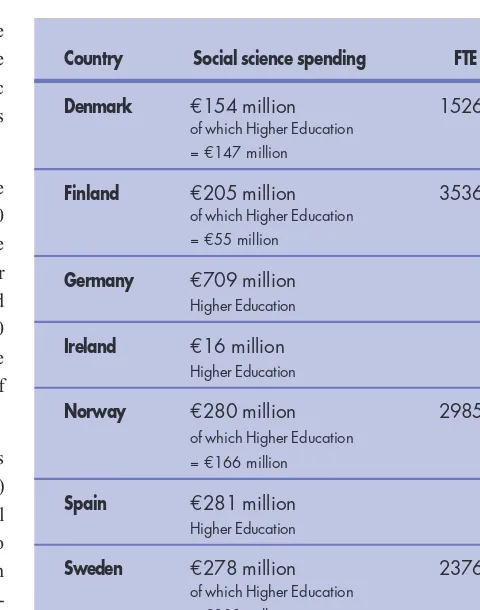
Another source of information is the data supplied by some countries to the Organisation for Economic Cooperation and Development (OECD) on their research effort. It shows that Denmark, Sweden, and Norway had a total of 6,900 full time equivalent researchers in 2001. Total social science spending for these three countries was equivalent to €733 million, most of it the higher education sector. The table also gives the spending figures, but not the numbers of people, for Spain, Germany and Ireland.
Country Social science spending FTE Denmark €154 million 1526
of which Higher Education = €147 million
Finland €205 million 3536 of which Higher Education
= €55 million
Germany €709 million Higher Education
Ireland €16 million Higher Education
Norway €280 million 2985 of which Higher Education
= €166 million
Spain €281 million Higher Education
Sweden €278 million 2376 of which Higher Education
= €200 million
18
ESF Member
Organisations
with an
interest in the
social
sciences
Austria
Fonds zur Förderung der wissenschaftlichen Forschung in Österreich
Austrian Science Fund
• www.fwf.ac.at
Österreichische Akademie der Wissenschaften
Austrian Academy of Sciences
• www.oeaw.ac.at
Belgium
Fonds National de la Recherche Scientifique National Fund for Scientific Research
• www.fnrs.be
Fonds voor Wetenschappelijk Onderzoek-Vlaanderen Fund for Scientific Research -Flanders
• www.fwo.be
Bulgaria
Bulgarian Academy of Sciences
• www.bas.bg
National Science Fund of Bulgaria
• www.minedu.government. bg/nsfb/nsfbnach.html
Croatia
Hrvatska akademija znanosti i umjetnosti
Croatian Academy of Sciences and Arts
• www.hazu.hr
Cyprus
Cyprus Research Promotion Foundation
• www.research.org.cy
Czech Republic
Akademie ved Ceské republiky Academy of Sciences
of the Czech Republic
• www.cas.cz
Grantová agentura Ceské republiky
Czech Science Foundation
• www.gacr.cz
Denmark
Det Kongelige Danske Videnskabernes Selskab Royal Danish Academy of Sciences and Letters
• www.royalacademy.dk
Grundforskningsfonden Danish National Research Foundation
• www.dg.dk
Statens Samfundsvidenskabelige Forskningsråd
Social Science Research Council
• www.forsk.dk/ssf
Estonia
Eesti Teaduste Akadeemia Estonian Academy of Sciences
• www.akadeemia.ee
Eesti Teadusfond
Estonian Science Foundation
• www.etf.ee
ESF Member Organisations with an interest in the social sciences
The ESF currently has 78 Member Organisations in 30 countries.
ˇ
Finland
Suomen Akatemia/Finlands Akademi
Academy of Finland
• www.aka.fi
Suomen Tiedeakatemiain Valtuuskunta/Delegationen för Vetenskapsakademierna i Finland Delegation of the Finnish Academies of Science and Letters
• www.helsinki.fi/science/deleg
France
Centre National de la Recherche Scientifique National Centre for Scientific Research
• www.cnrs.fr
Institut National de la Recherche Agronomique National Institute for Agronomic Research
• www.inra.fr
Germany
Deutsche Forschungsgemeinschaft German Research Foundation
• www.dfg.de
Hermann von Helmholtz-Gemeinschaft Deutscher Forschungszentren
The Hermann von Helmholtz Association of National Research Centres
• www.helmholtz.de
Max-Planck-Gesellschaft Max Planck Society
• www.mpg.de
Union der deutschen Akademien der Wissenschaften
Union of the German Academies
• www.akademieunion.de
Greece
Foundation for Research and Technology - Hellas
• www.forth.gr
National Hellenic Research Foundation
• www.eie.gr
Hungary
Magyar Tudományos Akadémia Hungarian Academy of Sciences
• www.mta.hu
Országos Tudományos Kutatási Alapprogramok
Hungarian Scientific Research Fund
• www.otka.hu
Iceland
The Icelandic Centre for Research
• www.rannis.is
Ireland
Am Chomhairle um Thaighde sna Dána agus sna
hEolaíochtaí Sóisialta Irish Research Council for Humanities and Social Sciences
• www.irchss.ie
Royal Irish Academy
• www.ria.ie
Italy
Consiglio Nazionale delle Ricerche
National Research Council
• www.cnr.it
Lithuania
Lithuanian State Science and Studies Foundation
• www.vmsfondas.lt
Luxembourg
Fonds National de la Recherche
National Research Fund
• www.fnr.lu
Netherlands
Koninklijke Nederlandse Akademie van Wetenschappen Royal Netherlands Academy of Arts and Sciences
• www.knaw.nl
Nederlandse Organisatie voor Wetenschappelijk Onderzoek Netherlands Organisation for Scientific Research
• www.nwo.nl
Norway
Det Norske Videnskaps-Akademi
Norwegian Academy of Science and Letters
• www.dnva.no
Norges Forskningsråd Research Council of Norway
• www.forskningsradet.no
Poland
Polska Akademia Nauk Polish Academy of Sciences
• www.pan.pl
Portugal
Academia das Ciências de Lisboa
Lisbon Academy of Sciences
Gabinete de Relações
Internacionais da Ciência e do Ensino Superior
Office for International Relations in Science and Higher Education
• www.iccti.mct.pt
Romania
Consiliul National al Cercetarii Stiintifice din Invatamantul Superior
National University Research Council
20
Slovak Republic
Slovenská Akadémia Vied Slovak Academy of Sciences
• www.sav.sk
Slovenia
Slovenska Akademija Znanosti in Umetnosti
Slovenian Academy of Sciences and Arts
• www.sazu.si
Slovenska Znanstvena Fundacija
Slovenian Science Foundation
• www.ustanova-szf.si
Spain
Consejo Superior de Investigaciones Científicas Council for Scientific Research
• www.csic.es
Oficina de Ciencia y Tecnología Comisión Interministerial de Ciencia Y Tecnología Interministerial Commission for Science and Technology
• www.cicyt.es
Sweden
Forskningsrådet för arbetsliv och socialvetenskap
Swedish Council for Working Life and Social Research
• www.fas.forskning.se
Vetenskapsrådet
Swedish Research Council
• www.vr.se
Switzerland
Rat der schweizerischen wissenschaftlichen Akademien Council of the Swiss Scientific Academies
• www.cass.ch
Schweizerischer Nationalfonds zur Förderung der
wissenschaftlichen Forschung Swiss National Science Foundation
• www.snf.ch
Turkey
Türkiye Bilimsel ve Teknik Arastırma Kurumu
The Scientific and Technical Research Council of Turkey
• www.tubitak.gov.tr
United Kingdom
The British Academy
• www.britac.ac.uk
Economic and Social Research Council
• www.esrc.ac.uk
This publication was written by Martin Ince, a UK freelance journalist, [email protected]. He wishes to thank Professor Chris Whelan, Dr Henk Stronkhorst, and other staff of ESF, for their work on the project.
ESF Member Organisations with an interest in the social sciences
IREG Strasbourg - Dépôt légal: février 2005 - N
°
d’ordre - 050334
National organisations are spending more on the social sciences, and they are growing in importance within the European Union's Framework programmes for research. They are also certain to be a major part of the work of the planned European Research Council. As Europe becomes more integrated, the social sciences that observe Europe's fast-changing societies are changing as well, with new data and methods.
This European Science Foundation publication explains the importance of the social sciences within European research, their value to policy-making and business and economic life,
European Science Foundation
1 quai Lezay-Marnésia
.
BP 90015.
67080 Strasbourg cedex.
FranceTel: +33 (0)3 88 76 71 00
.
Fax: +33 (0)3 88 37 05 32www.esf.org