ISSN (Online): 2409-4285 www.IJCSSE.org Page: 266-275
Text Mining Preprocessing In Times of Python vs MVCS
Jhonathan Quillo-Espino1, Rosa María Romero-González2 and Francisco Javier Paulin-Martinez3
1, 2, 3 Faculty of Informatics, Autonomous University of Querétaro, Santiago de Querétaro, Querétaro 76230, México
1[email protected], 2[email protected], 3[email protected]
ABSTRACT
This investigation illustrates in a clear and understandable manner the preprocessing execution of text mining, through two programming languages: Microsoft Visual C Sharp (MVCS) and Python. It pretends to demonstrate the usefulness of each analyzed method, mentioning which one is more efficient. The main purpose is to show the advantages and disadvantages of natural language preprocessing tools in Python, versus a personalized programming, specifically for text mining preprocesses in Microsoft Visual C Sharp.
Keywords: PNLTK, Preprocesses, Python, Text-Mining, Visual- C-Sharp.
1. INTRODUCTION
By nature, the human being constantly looks for continuous innovation; he pretends to build methods that allow him to improve his environment and to achieve an easier and more pleasant life. Information Technologies are only one of the many areas where advances are clearly noticeable. The invention of the computer and artificial intelligence are clear examples of technological progress in its full development. Currently, researchers have focused on trying to make computer systems understand and interpret natural human language. Nowadays, private and public technology companies, as well as educational, financial and many other companies store and generate huge amounts of information; either tangibly on paper or digital in text documents. Here is where Text Mining (TM) plays an important role in textual analysis. [1] also define TM as the combination of different techniques including natural language processing (NLP), to automatically discover patterns and subtract information derived from large volumes of textual databases. For their part, [2] assure that TM is a useful tool for a new knowledgeable generation and it can be applied in any research area where the analysis of data texts is required. TM is useful to analyze unstructured texts and to try to structure them. At the same time [3] proposed the main TM elements. Fig. 1. Shows the general TM process.
Text collection
Preprocesses
Stemming Tokenization
Stop Words
Processes Spell checker
Fig. 1. General TM process. [3]
The preprocesses are crucial part for the TM development, since they are in charge of making the first contact with disorganized information and perform the process of cleaning it in such way that it can move onto the next TM stage. It is quite simple because the data and texts contain elements that are none functional such as numbers, symbols, etcetera and they must be eliminated for the TM process. The essence that allows textual database analysis in an efficient way is the information processing through preprocesses, since they perform basic activities of the NLP such as the elimination of inconsistencies and unnecessary or irrelevant information for the analysis.
When the databases have been filtered, formats, characters, spelling symbols, and others are eliminated contributing to the use of the information in an efficient and direct way.
1.1 Spelling Corrector (SC).
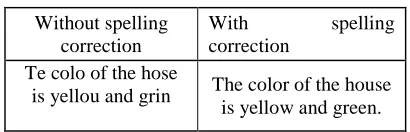
Table 1: SC example
Without spelling correction
With spelling
correction Te colo of the hose
is yellou and grin The color of the house is yellow and green.
It is observed on the left side of Table1 a sentence without spelling corrections, on the right side there is a sentence with the spelling amendment applied. As a result, the stemming (ST) process is done promptly.
1.2 Tokenization
Is the process that allows separating or decomposing a text in independent elements. [4], [5] suggested that the main purpose of tokenization is to explore the words in a sentence. The result of tokenizing a sentence is to aid each element called token to be analyzed separately and at the same time to be eliminated fast. Table 2 shows a basic example of tokenization.
Table 2: Tokenization example
Without tokenization Tokenization The children play in
the corner park
The’, ‘children’, ‘play’, ‘in’, ‘the’,
‘corner’, ‘park’
It is observed on the left side of Table 2 a sentence without tokenization and on the right side the tokens are delimited through single quotes and a comma becoming independent elements.
1.4 Stemming (ST)
For their part, [2], [6] explained that the main idea is to take any existing word to the textual database to its root. Subsequently, [7] emphasized that two types of stemming exist, one is flexible and the other one derivational, being the last one highly used by the Porter [8] and Snowball algorithm [9] (for the Spanish language). Table 3 shows a clear example of ST taking words to their roots through the ST preprocess using Snowball algorithm.
Table 3: ST example
Word without ST Word with ST Presentar presenta
presente present present present
It is observed on the left side of Table 3 a set of 3 words without the ST process, on the right side the words are already transformed onto their root by the ST.
1.3 Stop Words (SW)
As [10], [11] assured, SW consists in the elimination of common terms without semantics that do not add relevant information for MT. Therefore, [12] propose that the removal of the SW word list helps the efficiency of preprocess without altering the words. The word list is clearly defined. Table 4 shows an example of a list of words contained in SW. A set of words in Spanish that do not provide significant value for the text analysis are shown.
Table 4: Example list of ST
['de', 'la', 'que', 'el', 'en', 'y', 'a', 'los', 'del', 'se', 'las', 'por', 'un', 'para', 'con', 'no', 'una', 'su', 'al', 'lo', 'como', 'más', 'pero', 'sus', 'le', 'ya', 'o', 'este',
'sí', 'porque', 'esta', 'entre', 'cuando', 'muy', 'sin', 'sobre', 'también', 'me', 'hasta', 'hay', 'donde',
'quien', 'desde'
1.4 Python with natural language tool kit (PNLTK)
Python with natural language package tools. Python is a recent powerful programming language that allows complex tasks in a simple way. [13] It can use preloaded libraries to perform tasks automatically and quickly. According to [14] Python is a language for learning real world programming. In addition, [15] affirm that Python is the most appropriate language for learning programming; since it has powerful tools that reflect the way people think, therefore; they will be able to implement their code.
1.4.1 Advantages
among others. As [18] assured Python is easy to use, it offers a better structure and a stronger support for heavier programs. It also has fewer errors than in C, making it a convenient and efficient program. It is an interpreter that saves you time during its execution since it does not require linkage or compilation. It is easy to install and it is an object oriented interpreter. It allows to type programs in a compact way, subsequently; it is shorter compared to developments in C, it stands out from other programs because it allows to add modules to the interpreter.
1.4.2 Disadvantages
No mistakes should be made when calling libraries, otherwise they will not work. It can be somewhat difficult to install additional complements that grant the library function. Libraries can take up a significant amount of space on the network, therefore; it is necessary to download and install them locally in order for it to work efficiently. Some programmers impose their own programing style, for instance; programming syntax of another language, for example C++, which could complicate the union with another program if it is not developed correctly.
In such way, [13] conclude that in spite of the PLN advances, one of the NTLK limitations is not to be able to make common sense reasoning and it is necessary to wait until Technology Science can solve such problems in the future.
1.5 Microsoft Visual C Sharp (MVCS)
MVCS is an object oriented language programming developed by Microsoft in 1998. Its syntax comes from the C and C++, using the object model of the NET platform.
1.5.1 Advantages
It is a very competitive language because of its high international use and its effortless adequacy in both installation and finding implementations that can be personalized with any application that is being developed. It also counts with an efficient, solid and modern interface. It uses an interface that permits to find and analyze in real time the syntax code and identifying immediately the mistakes. It can be integrated into any Microsoft application such as Office among others. This allows users to personalize their work environment, (identification of the labor environment, IDLE). It has the capacity to develop software components that allow the use in distributed environments. Being similar to C and C++, its migration by developers will be easily done. It helps the portability of the source code.
1.7.1 Disadvantages
Some complements need to be programmed and developed to adapt to the required needs. There are some existing developments that can be similar to PNLTK, however; they are limited since the programmers have a tendency for new language programming for their variety, simplicity and even for the ease to manipulate the program development. It is not multiplatform; it only works natively with Windows and Mac Os, but with limitations.
2. DEVELOPMENT
To be able to make a comparison, the MT preprocess programming in MT was necessary, while for PNLTK it was necessary to make adjustments to the Spanish language code.
2.1 MVCS and PNLTK Preprocess
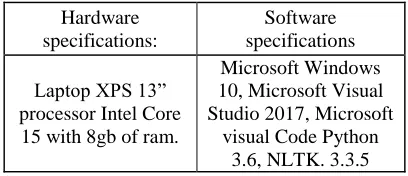
MVCS is a precise and very useful language programming that allows the operation of different types of programs. It is a perfect IDLE for any development, it also allows to load extensions faster. Besides, the code debugging is simple and fast. In order to perform the MT processes, it was necessary to use the following libraries: System, System Collection, Generic, System Component Model, System Data, System drawing, System linq, System Text, System Threadings Tasks, System Windows Forms, System Reflection, System IO, System Text Regular Expressions. Python was downloaded and installed from the official website. Subsequently, it was necessary the installation of Numpy extension in order to aid with the management of mathematic functions. In addition, the NLTK library was installed, this one includes a group of libraries in charge of the PLN, assisting in making easier the linguistic sources previously installed. Table 5 shows the technical specifications of hardware and software that have been used to carry out this investigation.
Table 5: Hardware and software specifications
Hardware specifications:
Software specifications Laptop XPS 13”
processor Intel Core 15 with 8gb of ram.
Microsoft Windows 10, Microsoft Visual Studio 2017, Microsoft
2.2 File reading
To be able to open a text file in MVSC it was necessary to create a form using the openfiledialog.openfile method. In such way the open and close buttons are displayed allowing you to open the explorer form to browse the required file. After selecting, the result of the file opened is sent in a resulting variable. If the Dialog result method is correct, a class streamreader result is sent. It will be the same as the variable read, and the result will be show in Richtextbox, where it is seen as the desire file text using a total of 40 code lines to be able to program.
Fig. 2 shows the process diagram used to open the text file in MVCS for further analysis. This is the normal process to open a file, so this one can be analyzed by the MT preprocesses.
Star
No
Correct file?
Conclude Yes Open a File
Read File
Analize or
not? Yes Analysis
No
Fig. 2. Process diagram used to open the text file in MVCS Proposed beam former.
2.3 Spell Checker (SC)
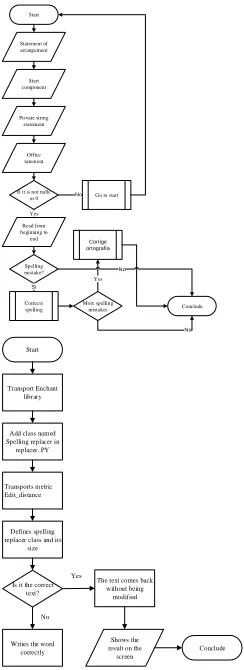
[3] state that preprocesses are carried out efficiently using a spell checker as the first preprocess. The SC is a very useful tool achieving two main functions, the first one is to eliminate and correct spelling mistakes, while the second one helps to diminish the ST preprocess timing. In order for the SC to work in MVCS it was necessary to use the implicit tools in Microsoft Office. Streamreader class was used, this one allows reading the text files saving the results in a variable denominated read.
Subsequently, the SC denominated as component Check spelling was initiated, creating an app variable and saving them in a string. As long as the value is different to null, the SC will be executed. Afterwards through a conditional, words with spelling mistakes are found, they are pointed out and possible options are shown. If no
spelling mistakes are found, another conditional takes you to the end of the text and asks you if you want to save changes. Finally, the results are sent to the textbox. Here a total of 75 code lines were used. In PNLTK a total of 7 code lines were used for its execution. Fig 3 shows the spell check process diagram with MVCS. And Fig 4 shows the spell check process diagram with PNTLK.
No Spelling
mistake? Start
Conclude Si
Corrige ortografía Statement of arrangement
If it is not nulle or 0 Start component Private string
statement Office tatement
Read from beginning to end Yes
Corrects spelling
Go to start No
More spelling mistakes
Yes No
Start
Transport Enchant library
Add class named Spelling replacer in replacer. PY
Transports metric Edit_distance
Defines spelling replacer class and its
size
Is it the correct text?
The text comes back without being
modified
Writes the word correctly
Shows the result on the
screen
Conclude Yes
No
Fig. 3. Spell check process diagram MVCS. Fig. 4 Spell check process diagram PNLTK
On Fig 3 we can see the process diagram correcting spelling mistakes used with MVCS provided by Microsoft Office. Fig 4 shows the process diagram to perform spell check with PNLTK. Enchanted library and Edit Distance metric are used to find the closest word in meaning to make the correction according to the previous definition with a minimum and a maximum distance until the closest word in meaning is found and suggests the correct alternative.
2.4 Tokenization
independently and transform them into tokens. To carry out tokenization in MVCS it was necessary a private class declaration called separate string. It was affirmed an arrangement called W which contains the Splitswords method, this one consists in creating a Substrins arrangement dividing the words by delimiters (blank spaces). The array resize function was used changing the number of unidimensional elements to a new specific size.
This is the easiest way to separate and convert a string into a sub-string or independent element. A total of 20 code lines for tokenization were used, while for PNLTK only 6 code lines were used. Fig 5 shows the Tokenization process diagram of a text in MVSC. Fig 6 shows the Tokenization process diagram of a text in PNLTK.
Yes There are blank
spaces Start
Read text
from beginning to end
Conclude No
It shows the result on the scrren Look for blank
spaces
Go to the end of the word and skip a line
Start
Define Spanish Tokenizer
Obtain data from Spanish library
Choose spacing type, period, blank,
line
Show text tokenization
Conclude
Fig. 5. Tokenization process diagram of a text MVCS. Fig. 6. Tokenization process diagram of a text PNLTK.
2.5 Stemming (ST)
It consists in eliminating the suffixes of the words and taking them to their root. Fig 7 shows the ST diagram; its objective is to eliminate suffixes of the word to take them to their root without affecting the meaning of it using the Snowball algorithm as an external module. A class called Class 1 was added as an independent module and it was declared a public String called execution. A public class called Spanish was declared, it contains the Snowball algorithm code as an object-method that encloses the different lexicographical rules to eliminate the suffixes of the words and take them to their root. It needs to be mentioned that more than 100 algorithm Snowball code lines were used coming from Porter algorithm. Therefore, it was an adaptation for the
elaboration of this investigation. 10 code lines were used for PNLTK.
Fig 8 shows the ST diagram in PNLTK. The Snowball algorithm is a class that allows eliminating the suffix of the Spanish words to transform them to their root avoiding losing their meaning.
Are there any suffixes?
Start
Read text from beginning to
end
Conclude Search suffixes
No
Uses algorithmSnow ball andeliminates suffixes
Yes
Shows result on the screen
Start
From nltk. Stem import snowball
stemmer
Choose the desired
language=Spanish
Conclude Text stemming
Show the result on the screen
Fig. 7. ST diagram in MVCS. Fig. 8 St diagram in PNLTK.
2.7 Stop words (SW)
Yes Were words
found? Start
Read text from the beginning to
the end
Conclude No Search for words in the list
Word elimination
Shows result on the screen
Start
Reads the text to analyze
Are there any words?
Delete words Shows results on the screen
Detener No Yes
Import ntlk. corpus
Chooses
language=Spanish
Searches for words in the Spanish
method
Fig. 9. SW diagram with MVCS. Fig. 10 SW diagram in PNLTK
2.7 Evaluation criteria among languages
The evaluation criteria allows similar characteristics to detonate among MVCS and PNLTK. Table 6 shows the comparison among MVCS and PNLTK for the MT processes.
Table 6: Evaluation criteria among languages Margin specifications
Comparison categories
MVCS PNLTK
Available documentation
Yes, online books
(limited)
Yes
online/forums/ books. There is a
need for the definition of data types.
Yes No, Python
automatically finds out the data types.
Compilation to execute
Yes No, it does not
require
compilation be executed
Execution per modules
Yes Yes
Portability Yes, Windows and McOs can only be used
in an
operating system already developed. It can cause problems in the libraries being used if it is about migrating to another platform
Yes,
multi-platform (Windows/Mac Os/Linux)
Sturdiness Yes, when it is used in the correct environment it can be sturdy and efficient. Limited (it will depend of
in the
development model applied).
Yes, it allows to handle large volumes of data without problems. Yes, it allows multiple processes to be executed, depending on the hardware.
Licence type Yes, it is free, however; it can also have significant cost in the market.
No. Tipo gratuito
sin costo,
software libre.
Popularity Little.
From its beginnings it was
successful. However, it has been declining.
A lot
Python is one of the most popular programming languages and at the same time with tendency to be one of the most used today for its simplicity, speed and easiness to learn how to use
it. Being
Object oriented
Yes Yes
Connectivity with databases
Yes Yes
Flexibility Yes, limited to the knowledge
of the
programmer.
Yes, limited.
Performance Yes, efficient if it was well programmed.
Yes, not
compiling reduces runtimes.
Scalability Yes, limited. Yes, wide. Learning Yes, slow. Yes, fast. Consistency
and ambiguity
The data and variables with which it will work should be defined without errors. If it is not defined correctly, the data size may cause errors when the code compilation is generated.
For the
programming of this task, the variables and types of data to be used in the customization
of the
algorithms in c Sharp had to be defined.
Python being a
newer and
different language allows the use of different variables and data and is suitable for the different sizes of data that are being used. Therefore, there could be errors when executing the code and not because of the definition or the size of the data being used.
The PNLTK
language tools were preset and defined to work regardless of the size or amount of data used.
The PNLTK kit instructions are simple to generate text analysis.
Data types and structure
Yes. The definition of data is in a traditional way using algorithms that allow operations to be carried out to achieve the required analysis of texts, causing more time for the analysis of the
development of the source code in the data structure.
Python automatically detects variable data types and structures, therefore; it causes less time consumption in setting data types.
Modularity The algorithms were developed independently, but depending
on the
previous one
PNTLK performs it automatically just by giving you the instruction, so it is generated automatically and quickly.
Ease of entry and exit
The data is opened through a standard library such as UNIX which allows free access to files through basic instructions. Therefore, it is efficient and
easy to
perform.
Python uses a standard library to open any type of file, in this case it is a text file.
Efficiency and performanc e
The
performance is efficient since it was custom development to carry out the
preprocesses of the MT
3. RESULTS
After executing the MT processes in both programming languages, the results are presented below:
3.1 Analyzed Words
In this investigation the preprocesses of TM were performed for the analysis of a set of words for each programming language. For MVCS the results obtained were a total of 14216 characters, forming a total of 2366 words. For PNLTK the results obtained from the analysis were a total of 2363 words. There was a variation of 3 characters in PNLTK because some characters were recognized as words.
3.2 Tokenization
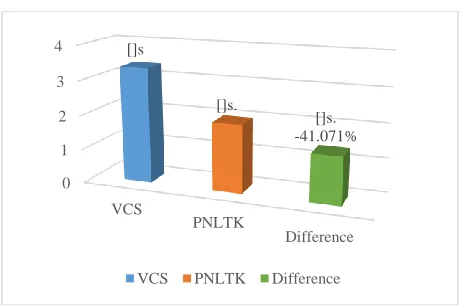
Fig 12 shows the results of the comparison of execution time for the tokenization of a text.
Fig. 12. Execution time for tokenization
In Fig 12 we can see that the tokenization execution time in MVCS was 3.36s, while in the PNLTK it was 1.98s, demonstrating that Python was faster at 41.071% because the code is not compiled for execution.
3.3 ST
The Fig13 shows the execution times for ST
Fig. 13. Execution time for ST
It can be seen in Fig 13, that the execution time of ST in MVCS was 4.3s, while for PNLTK it was 2.5s, being less by 1.8s, equivalent to 41.86% of the total time, because there is no need to compile the code. Because the library used with the Snowball algorithm was previously trained, speed execution was achieved.
3.4 SW
The Fig 14 shows the comparison between MVCS and PNTK.
Fig. 14. Execution time SW
It is observed in Fig 14 that MVCS took 1.08s execution time, while for PNLTK 0.09s, equivalent to 16.66% less runtime in PNLTK because the library was previously trained.
3.5 Totals
The Fig 15 shows the total seconds of execution time of the preprocesses.
Fig. 15. Summary of preprocess execution
0 1 2 3 4
VCS
PNLTK
Difference []s
[]s.
[]s. -41.071%
VCS PNLTK Difference
0 2 4
6 []s.
[]s. []s.
-41.86%
VCS PNLTK Difference
0 0.5 1
1.5 []s
[]s
[]s -16.66%
VCS PNLTK Diference
[]s []s []s
[]s
[]s []s []s
[]s
[]s []s []s
[]s
-[] -[] -[] -[]
0 2 4 6 8 10
Tokenizacion Stemming Stop Words Summary
The total execution time in MVCS was 8.74s, while for PNLTK it was 5.38s, equivalent to -38.44%. PNLTK was 38.44% more efficient in the execution preprocesses.
4. CONCLUSIONS
MVCS allows you to use more tools belonging to Microsoft Office. In addition, it is in the Spanish language and in many other languages. We can take advantage of the fact that the tools are installed in Windows operating system, therefore; you can take more advantage of them. The spell check uses dictionaries that have already been improved in most existing Microsoft Office languages and a word comparison is made. The tokenization can be done by skipping lines, by blank spaces, or by commas, it depends on how it is needed according to the requirements.
All preprocesses were able to be programmed without any problem since MVCS is a very solid program and allows to create and use important libraries that help in code development. It is important to observe that MVCS allows to program or adapt any necessary code.
Most PNLTK language tools were made for the English language, however; some of them allow to be adapted to the Spanish language. It allows to make the correction of each of the words using the enchant library. Besides performing the combination of edit distance and apply the replacement method to change the necessary word or letter so the correct combination of letters forms a word. PNLTK tools allow tokenization in a quick way, being able to choose how to delimit the tokens either by comma, skipping lines, etc. ST and SW are previously entered libraries that make the execution take place immediately, almost instantly. In addition, Python is a friendly language that makes development efficient and simple. The benefits of using Python tools are an important advantage that was developed in order to meet the objective of analyzing large amounts of data volumes. In addition, they were previously trained which brings the benefit of speed execution in each of the processes. Other tools are included such as word classification and statistical tools that allow you to evaluate large volumes of data in an effective way.
Without a doubt PNLTK proves to be superior for its benefits of use and speed for the execution of the code. The programming instructions are simple, it is not necessary to be a professional programmer to execute them and consequently, the learning methods are simple.
REFERENCES
[1] A. K. Choudhary., P. I. Oluikpe., J.A. Harding, & P. M. Carrillo. The needs and benefits of text mining applications on post-project reviews. (2009). Computers in industry. (60)9, pp. 728-740. Obtenido el 24 de
febrero de 2019 desde
https://doi.org/10.1016/j.compind.2009.05.006 http://www.sciencedirect.com/science/article/pii/S01663 6150900102X
[2] R. A. Saravanan., & M. R. Babu. Text mining techniques and its applications: a survey. International Journal of Computer Science and Technology. (2017). 8(3), pp.33-34. ISSN: 0976-8491. Obtenido el día 26 de
febrero de 2019 desde
http://www.ijcst.com/vol8/8.3/ver1/7-r-annamalai-saravanan.pdf
[3] J. Quillo-Espino., R. M. Romero-González., & A. Lara-Guevara. Advantages of using a spell checker in text mining pre-processes. (2018). Journal of Computer and Communications. (6)11, pp.43-54. DOI: 10.4236/jcc.2018.611004 Obtenido el 25 de noviembre
de 2018 desde
https://www.scirp.org/journal/PaperInformation.aspx?Pa perID=88461
[4] S. Kannan. & V. Gurusamy. Preprocessing techniques for text mining. (2015). Conference paper, obtenido el 19 de febrero de 2019 desde https://www.researchgate.net/publication/273127322_Pr eprocessing_Techniques_for_Text_Mining
[5] M. Allahyari, S. Pouriyeh., M. Assefi., S. Safaei., E. D., Trippe., J. B. Guitierrez., & K. Kochut. A brief survey of text mining, classification, clustering and extraction techniques. (2017). In Proceedings of KDD Bigdas, obtenido el 13 de mayo de 2019 desde https://arxiv.org/pdf/1707.02919.pdf
[6] A. Hotto. A brief survey of text mining. Journal for Computational Linguistics and Language Technology. (2005). LVD Forum (20), pp. 19-62, obtenido el 30 de
marzo de 2019 desde
https://www.researchgate.net/publication/215514577_A _Brief_Survey_of_Text_Mining
[7] K. L. Sumanthy., & M. Chidambaran. Text mining: concepts, applications, tools and issues- an overview. (2013). 80(4), p. 30. DOI: 10.5120/13851-1685, obtenido el 22 de febrero de 2019 desde http://citeseerx.ist.psu.edu/viewdoc/download?doi=10.1. 1.403.2426&rep=rep1&type=pdf
[8] Porter, M. F. (1980), An algorithm for suffix stripping, Program, 14(3) pp 130−137. Obtenido el 26 de abril de
2019 desde
https://tartarus.org/martin/PorterStemmer/index.html [9] Porter, M. F., Miles, P., Aksyonoff, A., Bartunov,O.
[10]P. V. Baradad., & A-M. Mugabushaka. Corpus specific stop words to improve the textual analysis in scientometrics. (2015). ISSI, obtenido el 15 de abril de
2019 desde
https://pdfs.semanticscholar.org/618d/a4f6d5cd329d3bc 498d9457f575cbdfaf53d.pdf
[11]V. Gupta., & G. S. Lehal. A survey of text mining techniques and applications. (2009). Journal of emerging technologies in web intelligence. (1)1, pp.60-76, obtenido el 23 de marzo de 2019 desde http://learnpunjabi.org/pdf/gslehal-pap18.pdf
[12]A. S. Nayak., A. P. Kanive., N. Chandavekar. & R. Balasubramani. Survey on pre-processing techniques for text mining. (2016). International journal of engineering and computer science. 5(6). pp. 16875-16879. ISSN: 2319-7242, obtenido el 18 de abril de 2019 desde https://www.researchgate.net/publication/319716444_S
urvey_on_Pre-Processing_Techniques_for_Text_Mining
[13]S. Bird., E. Loper., & E. Klein. Natural Language processing with python. (2009). O’ Reilly Media Inc. 17(3), p.33. ISBN: 978-0-596-51649-9, obtenido el 24
de abril de 2019 desde
http://www.datascienceassn.org/sites/default/files/Natur al%20Language%20Processing%20with%20Python.pdf [14]K. R. Srinath., Python. The fastest growing programming language. (2017). International Research Journal of Engineering and Technology. 04(12), pp.354-357, obtenido el 25 de abril de 2019 desde
https://www.irjet.net/archives/V4/i12/IRJET-V4I1266.pdf
[15]A. Bogdanchikov., M. Zhaparov., & R. Suliyev. Python to learn programming. (2013). Journal of physics. doi:10.1088/1742-6596/423/1/012027, obtenido el 28 de
abril de 2019 desde
https://www.researchgate.net/publication/258800484_P ython_to_learn_programming
[16]Fuente de consulta para nltk obtenido el 21 de abril de 2019 desde https://stackoverflow.com/
[17]Fuente de consulta para Python obtenida el 22 de abril de 2019 desde https://www.python.org/
![Fig. 1. General TM process. [3]](https://thumb-us.123doks.com/thumbv2/123dok_us/1325485.1640671/1.612.322.558.213.370/fig-general-tm-process.webp)