Semantic Web based Personalized eLearning
H. Srimathi
Department of Computer Applications SRM University,
Kattankulathur, Chennai 603 203, Tamil Nadu, India
ABSTRACT
eLearnering benefits the society when the content are prepared with interactive communication and customized navigation based on learners profile. The research question posed in this study is whether it is feasible and beneficial to separate the learning objects (LOs) and the learning sequence based on learner model. With this separation, the customized courses should be pedagogically appropriate and effective for the learner. Dynamic learner profile in eLearning systems is used to adapt expected learning resources and guide a learner through them. Customized sequencing and navigation in the information resources can be achieved with ease using semantic Web technology. Our research describes the study related to the investigation of personalized eLearning framework based upon dynamic learner profile using Sharable Content Object Reference Model (SCORM) and Instructional principles in semantic Web.
General Terms
Learning Objects, Adaptive Hypermedia, Learning Management System, SCORM
Keywords
Personalized sequencing, Dynamic Learner Profile, Instructional Design
1.
INTRODUCTION
Technology is an agent of change, and major technological innovations can result in entire paradigm shifts. There have been many technological enhancements in the last 30 years, during which the desktop computer and the Internet have been developed. The technological advancements throughout the 20th century are identified such as film, radio, audiotape, broadcast television, videotape, programmed learning machines, etc., [9]. Though there are few evidences on the transformation of teaching learning process based on these technological advancements, the impact has been minimal. The face to face discussion and paper resources still dominate the public education [7]. The audio-visual media is not treated as art of teaching learning process, though they are developed and used in few cases [22,23]. Similarly, the computer network known as the Internet is changed the way people communicate and do business. However, the effectiveness of eLearning is not perceived by the learning community, and it is utilized for just-in-time reference [5]. This is mainly because of the minimal considerations on psychological reactions, technological skills, and the independent learning ability while developing the learning content [14].
The strengths of multimedia software and Web technology are not utilized fully. Most of the current eLearning offerings deliver the same static content to all the learners, irrespective of their prior knowledge and experience. This kind of
cognitive overload problem may be addressed by recording the educational experiences towards the characteristics of each individual learner. Personalized eLearning systems should have a strong emphasis on learner empowerment, wherein the learner plays an active role on gaining the subject knowledge. The choice of „developing personalized eLearning‟ with learner centric LOs is governed by considering the aspects such as:
The great demand for eLearning has increased, since it supports „just-in-time‟ learning that can be accessed quickly, widely and cost-effectively by people regardless of where they are, which in turn warrants research on increasing its effectiveness [18].
The technological enhancements expand the possibility of using interactive multimedia course materials which promotes higher-order learning, reasoning skills, problem-solving skills and knowledge acquisition insisted on pedagogical approach [15].
eLearning standards ensures consistency, particularly SCORM integrates a collection of eLearning resources, wherein the content and the pedagogic approach (learner preference) is to be taken care of by the course author [21]
.
Ontology based semantic Web technologies are promising solutions to give an explicit definition of conceptualization on a specified domain and assembly of LOs with personalized functionality [4, 11].
The existing eLearning systems are focusing three different viewpoints [16] of eLearning such as pedagogical viewpoint (learner oriented educational theories), pragmatic viewpoint (practical solutions to use LO by teachers and instructional designers) and technological viewpoint (building and sequencing LO). The success of eLearning course materials based on instructional design principle has been studied [2, 10, 13, 15, 20]
and insisted a learner centric guideline of creating learning content. The dynamic updating of learner profile based on learner performance is suggested [3,8] to adapting learning sequence. The lack of formal semantics inherent in XML to achieve semantic interoperability is addressed and suggestion is made on ontology based conceptualization [10,17,19]
. The choice of SCORM is highlighted [6,12] for implementing reusable, interoperable, and sequencing navigation of LO. However, there are very limited studies which integrate all the three different viewpoints. Our research addresses the lacunae present in the existing scenario with the need of an integrated approach.
2.
RESEARCH BACKGROUND
eLearning to adapt individual learner preferences. In particular, our study examines how eLearning with instructional design principles, learning technology standards, adaptive hypermedia and semantic Web have influenced personalization. The evolution of SCORM complement Learning Management System (LMS) was developed as part of our study.
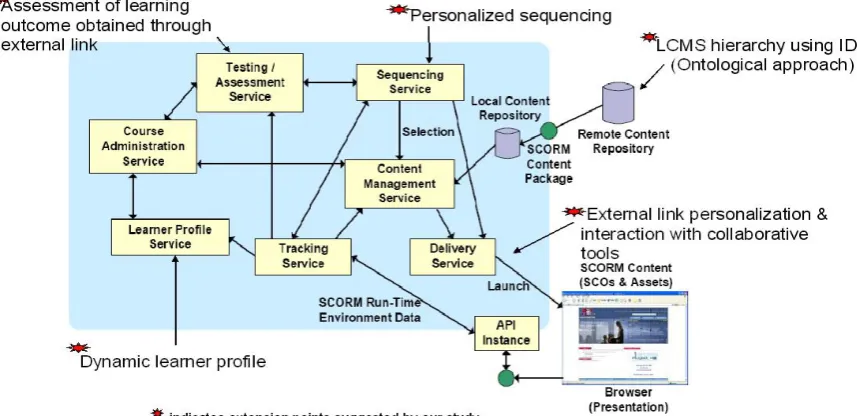
SCORM is now the de facto standard for eLearning systems and has been used successfully around the world [24]. SCORM is also a software model that helps software teams incorporate multiple, interacting community standards (data structure, communication protocols, metadata, distribution formats, etc.). However, SCORM makes no commitment on learner preference and content portability [1]. Hence, we suggest a solution whose aim is to provide SCORM courses with adaptation and pedagogical approach on content creation. Our study has extended SCORM-compliant architecture [22] to incorporate instructional design and personalization as given in Fig. 1. Some of the suggested extension points are further discussed.
Fig 1. Extended SCORM
3.
LCMS hierarchy using ID
We advocate the use of ontology to explicitly specify the Learning content Management System (LCMS) design hierarchy, LO and the relations between them with the help of ID principles. The lack of pedagogical approaches at the level of eLearning standards about LO necessitated the use of ID and semantic Web. Through the combination of ontology and their inference mechanism, we are able to model, represent and better organize all the knowledge that is required to process information-intensive tasks of activity based learning. The conceptual mapping of ID is carried out using the ontology tool Protégé and represented in the form of ontology class. The component represented is mapped on different
4. LEARNER PROFILE DATA MODEL
There have been attempts to standardize a leaner profile. The data model described in SCORM includes IEEE LOM metadata and AICC CMI (Computer Managed Instruction) student model. IEEE LOM educational metadata can be used for describing the scope of „learning resource‟ class. AICC describes the student model with a limited number of attributes. Some of the other most widely used learner profile models are IEEE PAPI and IMS LIP. These standards have been developed from different points of view. The PAPI standard reflects ideas from intelligent tutoring systems wherein the performance information is considered as the most important information about a learner. Our study has proposed dynamic learner profile by integrating the existing models and extended to suit our requirements. The defined learner model personalizes and aggregates the best fit LOs in conjunction with the PAPI standards. The learner model comprises static and dynamic learner profile. Static profiles are not altered during the interaction. Dynamic profiles are
updated based on individual learning performance through self-check exercises, and other form of tests. The challenge is to find out the learning outcome and record the performance of learning through collaborative environment and external resources.
5.
PERSONALIZED SEQUENCING
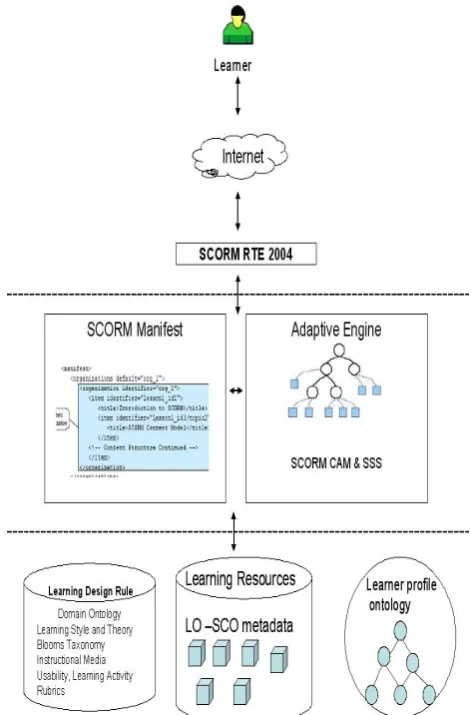
The personalized adaptation of learning is carried out to support individual learners by referring to the value stored in the learner model. The learner profile is referred on request and the required content aggregation is formed using adaptation engine. The key stages in creating personalized eLearning sequencing are modeling the learner, choosing an appropriate learning approach, selecting appropriate contents and activities to perform learning and finally populating these concepts with customized LOs. The sequence of the LOs during the execution of the workflow is determined with the help of domain model. This necessitated a well formed cooperation between the modules. The layered architecture, supporting adaptive content aggregation and sequencing, is presented in Fig. 2. This enables the adaptive hypermedia service to deliver personalized eLearning courses. The learner profile contains a model of the learner with respect to learning preferences, performance etc. The learning resource model represents the collection of LOs which may be selected to a particular learner. The learning resources may be rendered in a variety of ways, e.g. text documents, slides, animation, simulation, interactive file, etc. A mechanism that enables the personalized course structures to be described in terms of concepts is proposed. This abstraction enables the adaptive hypermedia service to populate the concept with an appropriate piece of learning content at runtime. For example, if the learner prefers interactive content, then a kinesthetic piece of content may be delivered over a non-interactive visual piece of content. The domain model is responsible for describing the possible combinations of learning concepts that may be assembled to fulfill a learner‟s personal learning goals. The content sequencing is then generated according to the order suggested for the specific learner domain level. The LO metadata is used for such semantic querying.Fig. 2: Adaptive eLearning architecture
6.
RESULTS
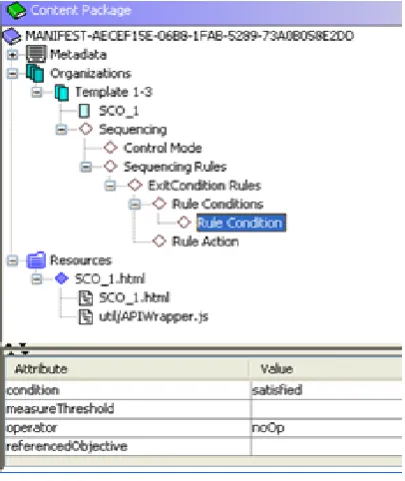
Our study has implemented a problem based learning activity as a viable means of learner centered eLearning. The advent of ID has eased the design of learner centric LO creation. The system consists of the LMS for processing basic data, learner profile, and the LCMS for managing and storing SCOs. The important steps in implementation are LO creation with the help of authoring tools and personalized LO aggregation through Reload Editor. The sequencing rule option is given in Fig. 3. A sample implementation of conditional statements in “C Programming” for a behavioral learner in Reload editor is given in Fig. 4.
Fig. 3: Sequencing options in Reload Editor
Fig. 4: Aggregation of LO in Reload Editor
As a part of the evaluation of the personalized course, the effectiveness of the course was assessed by examining the performance of the learners in the examination. The effectiveness of the personalized course is examined by comparing it to non-adaptive courses and online courses with minimum navigation facility.
The E-Model-1 courses are organized based on learner preference model with link hiding adaptation technique for additional resources. E-Model-2 is developed with listing all
scores obtained at the end of the learning are recorded (Table 1) and analyzed with Tukey‟s HSD (honestly significance difference) mean variation for the session “Conditional statement” in “C Programming” (Table 2).
Table 1. Online Quiz score of each model
Table 2.Tukey’s HSD mean variation
Population Tukey‟s HSD (q)
Group A Vs Group B 6.8033
Group B Vs Group C 6.4254
Group A Vs Group C 15.4965
The study clearly indicated that all the three comparisons are statistically significant. Group A which has studied the E-Model-1 with personalized links scored high, better than Group B and is best among the three. Group B scored moderate on study and the learning of Group C is not encouraging. The result was accepted meaning that the user adaptation provided by our research significantly allowed increase in user performance.
The principal implication ensures that the personalized sequencing enhances the learning outcome and reduces the cognitive overload. The functionality of updating learner profile is done through monitoring learner‟s navigation and performance. The study has recommended the architectural revision needed on newer versions of SCORM by incorporating pedagogical approach, extending the existing learner model, learner preference in LO sequencing and implementation of ontology based semantic Web service approach.
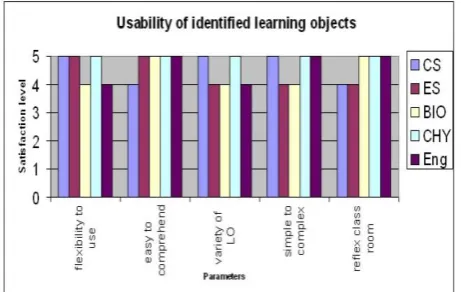
Fig. 5. The study on usability of identified LOs
7.
CONCLUSION
In our work, we have observed that the ontology based LO integrated with the learner profiles generates better results in an eLearning system. Our study was carried out in a closed system wherein LOs are created and consumed within the organization. The recommended external learning resources by the course developer or teacher are added as additional resources. The system is studied for promoting formal education with the reflex of class room teaching. From an educational point of view, our research makes it possible for the SCORM learning environment to deliver reusable learning materials that are preferable to both teachers and learners.
Considering the rural and urban ratio of population in India, and also the acute shortage of skilled teachers in rural areas, the implementation of research helps in promoting effective education through eLearning and reduces the current dropout rates in higher education
8.
REFERENCES
[1] Abdullah, Nor Aniza, Bailey, Christopher Davis, and Hugh (2004), “Augumenting SCORM manifests with adaptive links”, Proceedings of the Fifteenth ACM Conf. on Hypertext, pp. 183 – 184.
[2] Akpinar Y. and Simsek H. (2005), “Development of a learning content management system based on interactive learning object approach”, 6th Int. Conf. on Information Technology Based Higher Education and Training, ITHET, pp. T3A5-T3A15.
[3] Brusilovsky. P, (1996), “Methods and Techniques of Adaptive Hypermedia”, User Modeling and User-Adapted Interaction, 6(2-3), pp 87-129.
[4] Devedzic, V (2004), “Web Intelligence and Artificial Intelligence in Education”, Educational Technology & Society, 7(4), pp. 29-39.
[5] Hasibuan, Z.A. and Harry, B.S. (2005), “The Use of E-Learning : Case Study Student Centered E-E-Learning Environment”, IEEE Int. Conf. on Advanced Learning Technologies (ICALT), pp. 1026-1030.
[6] Heiyanthuduwage S.R, and Karunaratne. D.D (2006), “A Learner Oriented Ontology of Metadata to improve Effectiveness of Learning Management Systems”, Third Int. Conf. on eLearning for Knowledge-Based Society, http://www.elearningap.com/eLAP2006/Proceeding/p42.1 -6-fin-12.pdf.
[7] Johnson, W. L., Rickel, J. and Lester, J. C. (2000), “Animated Pedagogical Agents: Face-to-Face Interaction in Interactive Learning Environments”, Int. Journal of Artificial Intelligence in Education, 11, pp. 47-78.
[8] Knight, C., Gasevic, D., and Richards,G., (2005), “Ontologies to integrate learning design and learning content”, Journal on Interactive Media in Education, http://www-jime.open.ac.uk/2005/07/knight-2005-07.pdf
[9] Montazemi, A.R. (2006), “The Effect of Video Presentation in a CBT Environment”, Educational Technology and Society, 9 (4), pp. 123-138.
[10]Norhayati, A. M. and Siew, P. H. (2004), “Malaysian Perspective: Designing Interactive Multimedia Learning Environment for Moral Values Education”, Educational Technology & Society, 7 (4), pp 143-152.
[11]Pasin. M. (2005), “Semantic Learning Narratives An Investigation of the Usage of Semantic Web Technologies to Support Learning”, Knowledge Media Institute, Tech Report, http://kmi.open.ac.uk/publications /techreport/
[12]Paulo Gomes, Bruno Antunes, Luis, and Rdorigues (2006), “Using Ontologies for elearning Personalization”, 3rd E-Learning Conference, http://www.formare.pt/documentos/art_using ontologies for_elearning_personalization.pdf.
[13]Raghavan Rengarajan, (2001), “LCMS and LMS, Taking advantage of Tight Integration”, http://www.e-learn.cz/soubory/lcmsand_lms.pdf.
[14]Rodríguez, A.M. and Verdejo Maíllo, M.F. (2004), “Modeling educational Content: The Cognitive Approach of the PALO Language”, Educational Technology and Society, 7 (3), pp. 124-137.
[15]Ronchetti, M., and Saini, P. (2004). Knowledge Management in an E-learning System, Proceedings of 4th IEEE Int. Conf. on Advanced Learning Technologies IEEE Computer Society, pp. 365-369.
[16]Rossano, V., Joy, M. Roscelli, T., and Sutinen, E (2005), “A Taxonomy for Definitions and Applications of LOs: A Meta-analysis of ICALT papers”, Educational Technology & Society, 8(4), pp. 148-160.
[17]Rumetshofer, H., and Wob, W. (2003), “XML-based Adaptation Framework for Psychological-driven E-Learning Systems”, Educational Technology & Society, 6(4), pp. 18-29.
[18]Sarfo, F.K. (2007), “The views of educational practitioners in Ghana on ICT use and Instructional Design practice for promoting quality education”, IEEE Int. Conf. on Advanced Learning Technology (ICALT), pp. 775-779.
[19]Stojanovic, Lj. Staab, S., and Studer R (2001), “eLearning based on the semantic web”, Proceedings of WWWnet Conference, http://www.aifb.uni-karsruhe.de/~sst/Research/
Conference on Advanced Learning Technologies, pp. 443-444.
[21]Su, J.-M., Tseng, S.-S., Wang, W., Weng, J.-F., Yang J. T. D. and Tsai W.-N, (2006), “Learning Portfolio Analysis and Mining for SCORM Compliant Environment”, Educational Technology and Society, 9 (1), pp. 262-275.
[22]CCfE, “Commonwealth Consortium for Education”,,http://www.commonwealtheducation.org
[23]Gyan Dharshan, “Video program telecast by IGNOU”, http://www.ignou.ac.in/gyan_sch .html.