Original Research Article
Maternal co-relates of anaemia among children aged 1-3 years of age
in a rural area of Meerut
Tanveer Bano, Abhishek Agarwal*, Sunil Kumar Garg, Harivansh Chopra,
Seema Jain, Ganesh Singh
INTRODUCTION
Nutritional anaemia especially iron deficiency anaemia is one of the major public health problem affecting both
developed and developing nations with major
consequences for human health as well as socio economic development.1 It has been defined by WHO as “a condition in which the number of red blood cells or their oxygen carrying capacity is insufficient to meet physiologic needs, which vary by age, sex, altitude, smoking and pregnancy status”.2
In 2004, globally 2, 73,000 deaths were attributed to anaemia, with 97% deaths occurring in low and middle
income countries.3 According to World Health
Organization, 2011 report 29% of the World’s population is suffering from low haemoglobin levels with a highest prevalence of 42.2% among preschool children followed by 38% among pregnant women.3. In India, as per National Family Health Survey, 2014–2015 about 58.4% under 5 children were found to be anaemic and the prevalence is much higher among under 3 with more than 79% children have haemoglobin levels below 11 gm%.4
ABSTRACT
Background: Iron deficiency anaemia constitutes more than half of the anaemia burden among the under 5 children. In addition to socio-demographic factors, the maternal factors plays an important role in determining childhood anaemia. The objective of the study was to determine the prevalence of anaemia among 1-3 year old children and to find their association with maternal factors.
Methods: The present cross sectional study was conducted in a sub centre village under Machhra CHC. Sample size was calculated as 182 by taking the prevalence of anaemia as 79% with 7.5% relative precision and 95% confidence interval. From the list of 404 children obtained from MCTS data, 200 children were selected randomly. Detailed information regarding socio demographic factors and maternal factors was obtained on a pre tested and pre designed questionnaire. Hemoglobin levels were estimated using haemo check rapid diagnostic kit. The data was collected and analyzed on epi info 3.7.2 using appropriate statistical tests.
Results: Out of 200 children 77.5% of them were suffering from mild to severe anaemia. Among all the maternal factors studied maternal education, iron folic acid consumption during pregnancy, birth order of the index case and history of exclusive breast feeding were found to be significantly associated with prevalence of anaemia among the children.
Conclusions: The present study revealed a high prevalence of anaemia in children and maternal factors plays an important role in determining the disease.
Keywords: Anaemia, Maternal factors, Rural area, Children 1-3 years age
Department of Community Medicine, LLRM Medical College, Meerut, Uttar Pradesh, India
Received: 17 May 2018
Revised: 26 June 2018
Accepted: 27 June 2018
*Correspondence:
Dr. Abhishek Agarwal,
E-mail: [email protected]
Copyright: © the author(s), publisher and licensee Medip Academy. This is an open-access article distributed under the terms of the Creative Commons Attribution Non-Commercial License, which permits unrestricted non-commercial use, distribution, and reproduction in any medium, provided the original work is properly cited.
Pre-school children and pregnant women are the worst hit section of the society accounting for major burden of morbidity and mortality. Pre School Children if suffer from anaemia in early stages of life, have a high incidence to develop delayed psychomotor development, impaired scholastic performance, impaired coordination of language and motor skills and increased morbidity from infectious diseases.5
A child is made prone to develop iron deficiency anaemia in future right from the maternal practices adopted by mother from her ante natal period. Maternal factors such as iron and folic acid consumption during pregnancy, exclusive breast feeding, her education levels, the space between two children and the order of birth plays an important role in determining the children’s vulnerability to develop anaemia.
Thus this study has been undertaken with the objective of:
To find the prevalence of anaemia among 1-3 year old children in a selected rural area of Meerut.
To find the association between the various maternal factors and the prevalence of anaemia among the children of 1-3 years of age.
METHODS
A community based cross sectional study was carried out among children of age 1-3 years in a sub centre village of PHC Amarpur of Machhra block, the field practice area of LLRM, Medical College, Meerut, selected by multistage simple random sampling.
A sample of 182 children was estimated by taking the prevalence of anaemia among 1-3 year old children as 79%, with 7.5% precision and 95% confidence interval.6 The sample size was rounded off to 200. A list of all children obtained from MCTS data available from the Block level CHC, from which 200 children were selected randomly (lottery method).
The data regarding the socio demographic factors and maternal factors was obtained by house to house visit on
a pretested and predesigned questionnaire by a single observer. Haemoglobin levels were estimated using haemo check rapid kit using paper chromatography method and the children were divided according to WHO, grades of anaemia given below.7
Table 1: WHO Grading of anaemia.
Grade Hb concentration (g/dl)
Mild anaemia 10–10.9 gm/dl
Moderate anaemia 7–9.9 gm/dl
Severe anaemia <7 gm/dl
The information thus obtained was compiled on MS excel 2013, evaluated using epi info software 3.7.2 and results were analyzed using appropriate statistical tests.
RESULTS
Out of 200 children studied, 77.5% (155) children were found to be anaemic (Figure 1). The prevalence was found to be comparatively higher among females (79%) than males (76%). A higher prevalence of anaemia seen in the age group 24 months to 35 months where 78.4% children were anaemic compared to 76.8% children of age 12 months to 23 months. Though no significant association was seen of age and sex with anaemia (Table 2).
Figure 1: Distribution of anaemia in 1-3 year old children (%).
Table 2: Age and sex wise distribution of study subjects.
Factors Anaemia Total (%) X2, df, p value
Yes (%) No (%)
Sex Male 70 (76) 22 (24) 92 (100) X
2
=0.195, df=1, p=0.659
Female 85 (79) 23 (21) 108 (100)
Age 12–23 Months 86 (76.8) 26 (23.2) 112 (100) X
2
=0.745, df=1, p=0.785
24–35 Months 69 (78.4) 19 (21.6) 88 (100)
Maternal factors
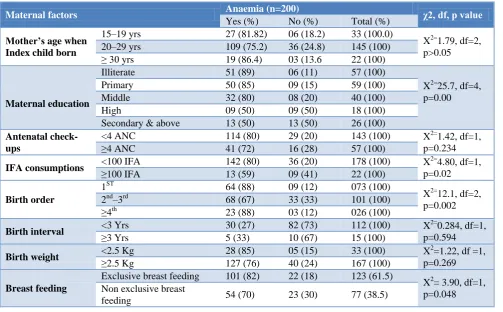
In the present study 200 children’s mother were interviewed and the association of various maternal
factors with anaemia in children is shown in Table 3. A significantly high prevalence of anaemia was seen with number of iron folic acid consumed by mother during
22.5
30.5
39
8
NO ANEMIA MILD ANEMIA
index case pregnancy, birth order of the child, exclusive breast feeding and mother’s education level.
A direct association was seen with iron and folic acid tablets consumed during pregnancy, with a higher prevalence of anaemia (90%) was seen among the children whose mother had not consumed at-least 100 tablets in full course of pregnancy of the index case (Table 3).
Children who were not exclusively breast fed for 4 to 6 months were found to be having a significantly higher prevalence of anaemia (82%) compared to children who were exclusively breast fed (70%) (Table 3).
A twin peak of high prevalence was seen with the birth order, with higher prevalence of anaemia was seen among children with order either 1st (88%) or 4th or more (88%) compared to children born 2nd or 3rd (67%) (Table 2).
Table 3: Association between maternal factors and prevalence of anaemia.
Maternal factors Anaemia (n=200) χ2, df, p value
Yes (%) No (%) Total (%)
Mother’s age when Index child born
15–19 yrs 27 (81.82) 06 (18.2) 33 (100.0)
X2=1.79, df=2, p>0.05
20–29 yrs 109 (75.2) 36 (24.8) 145 (100)
≥ 30 yrs 19 (86.4) 03 (13.6 22 (100)
Maternal education
Illiterate 51 (89) 06 (11) 57 (100)
X2=25.7, df=4, p=0.00
Primary 50 (85) 09 (15) 59 (100)
Middle 32 (80) 08 (20) 40 (100)
High 09 (50) 09 (50) 18 (100)
Secondary & above 13 (50) 13 (50) 26 (100)
Antenatal check-ups
<4 ANC 114 (80) 29 (20) 143 (100) X2=1.42, df=1,
p=0.234
≥4 ANC 41 (72) 16 (28) 57 (100)
IFA consumptions <100 IFA 142 (80) 36 (20) 178 (100) X
2=
4.80, df=1, p=0.02
≥100 IFA 13 (59) 09 (41) 22 (100)
Birth order
1ST 64 (88) 09 (12) 073 (100)
X2=12.1, df=2, p=0.002
2nd–3rd 68 (67) 33 (33) 101 (100)
≥4th
23 (88) 03 (12) 026 (100)
Birth interval <3 Yrs 30 (27) 82 (73) 112 (100) X
2=
0.284, df=1, p=0.594
≥3 Yrs 5 (33) 10 (67) 15 (100)
Birth weight <2.5 Kg 28 (85) 05 (15) 33 (100) X
2
=1.22, df =1, p=0.269
≥2.5 Kg 127 (76) 40 (24) 167 (100)
Breast feeding
Exclusive breast feeding 101 (82) 22 (18) 123 (61.5)
X2= 3.90, df=1, p=0.048 Non exclusive breast
feeding 54 (70) 23 (30) 77 (38.5)
Table 4: Multiple logistic regression analysis.
Term Odds ratio 95% CI Coefficient Standard error P value
Maternal education
Illiterate
3.18 1.26–8.02 1.16 0.47 <0.05
Literate
IFA
consumption
≥100 tablets
18.21 6.21–53.40 2.90 0.55 <0.01
<100 tablets
Birth order
1st
1.34 0.82–2.21 0.29 025 <0.05
2nd–3rd 4 or more
Breast feeding
Exclusive for 6 months
1.95 0.99–3.83 0.67 0.34 >0.05
Not exclusive breast feeding
Mother’s education level was found to be directly associated with the haemoglobin levels of the children with increasing literacy was associated with increase in haemoglobin levels (Table 3).
On multivariate multiple logistic regression analysis, the following factors: mother’s education, Iron and folic acid tablet consumption by mother during pregnancy and birth order were found to be statistically significant (p<0.05), while association of exclusive breast feeding with prevalence of anaemia was not found to be statistically significant (p>0.05). However the factors, iron folic acid consumption by mother during pregnancy was strongly associated with anaemia (p<0.01) (Table 4).
DISCUSSION
The prevalence of anaemia found in this study was 77.5% which is similar to national average of 79% (NFHS 3).6 and state average of 81% (CAB report, 2014).8 Similar findings were seen in the study conducted by Alarappa et al, Parischa et al and Venkatesh et al where the prevalence were 81%, 75.3% and 81.2%.9-11
In the present study, the prevalence was found to be higher among the females, similar to findings by Jain et al and Awasthi et al while as per National Family Health Survey 3, almost equal prevalence of anaemia was seen in both sexes.12,13
Maternal education has been found to play an important role in determining the anaemia status in children with a significant association of education levels with prevalence of anaemia. The findings are similar to NFHS 3 (2004-05), Singh et al, Ray et al and Mishra et al who reported increase in prevalence with decreasing maternal education levels.6,14-16 While the studies by Jain et al and Alarappa et al revealed no significant association.12,17
Birth order was found to be significantly associated with anaemia with an increasing prevalence of anaemia was seen in the studies by Deeksha et al, Singh et al, Ray et al, Mishra et al and National Family Health Survey 3 where no significant association was seen by Jain et al.6,12,14-16
Exclusive Breast feeding for 4 to 6 months prevents the child from recurrent infections and reduces the child from developing anaemia, this study also reveals similar outcome which is quite similar to study by Lordes et al and Derr et al.19,20
A child born to anaemic mother has more chances to have anaemia in early stages of life, to combat this iron and folic acid supplementations are given to antenatal mothers. A significant association with this iron supplementation was depicted in this study.
CONCLUSION
The present study shows a high prevalence of anaemia among the children aged 1-3 years residing in rural parts of the country. A significant association of the prevalence of anaemia was seen with maternal factors like Iron and folic acid tablet consumption during pregnancy of index
case, Mother’s education level, birth order of the child and breast feeding practices by mother.
Recommendations
This study thus recommends there is need to increase the awareness of the masses and peripheral workers about the importance of iron supplementation, exclusive breast feeding and adopting family practice methods to control births as well as to have proper spacing between two children.
This study further recommends there is a need for strengthening the health infrastructure with capacity building of the workers.
ACKNOWLEDGEMENTS
The corresponding author acknowledges the effort of Medical Officer In-charge of CHC Machhra and the ASHA workers of the village for their support in field work and last but not the least the support of the parents of the children.
Funding: No funding sources Conflict of interest: None declared
Ethical approval: The study was approved by the Institutional Ethics Committee
REFERENCES
1. World Health Organization; Worldwide prevalence of anaemia; 1993–2005, WHO Global Database, Geneva Switzerland; 2008: 1-2
2. Anaemia: World Health Organization, Available at: http://www.who.int/topics/anaemia/en. Accessed on 11 May 2018.
3. World Health Organization; The Global Prevalence of Anaemia in 2011; Geneva; WHO; 2015.
4. Indian Institute of Population Sciences (IIPS); India fact sheet, National Family Health Survey 4, 2015– 16, Ministry of Health and Family Welfare. Available at: http://rchiips.org/NFHS/pdf/NFHS4/ India.pdf. Accessed on 11 May 2018.
5. National Iron Plus Initiative; Guidelines for control of Iron Deficiency anaemia: National Iron Plus initiative; National Health Mission, Ministry of Health & Family Welfare; 2013.
6. Ministry of health and Family Welfare; Nutrition in India; National Family Health Survey 2005–07; Indian Institute of Population Sciences; Mumbai; 2009.
7. WHO; Hemoglobin concentrations for the diagnosis of anaemia and assessment of severity, Geneva, WHO; 2011.
8. Clinical Anthropometry Biochemistry report–Uttar
Pradesh (2014) Available at: http://www.
children of West Bengal, India; Ann Hum Biol. 2010;37(2):231-42.
10. Parischa S, Black J, Muthayya S. Determinants of anaemia among young children in Rural, Indian Pediatrics. 2010;126(1):140–9.
11. Venkatesh G, Talawar S, Shah B; Clinical Profile of Anaemia in Children; IOSR-JDMS. 2013;10(5):65-9.
12. Jain S. Anaemia in children: early iron
supplementation. Indian J Pediatrics. 2000;67(1):19-21.
13. Awasthi S, Das R, Verma T, Vir S. Anaemia and Undernutrition Among Preschool Children in Uttar Pradesh, India. India Pediatrics. 2003;40; 985–90. 14. Singh R, Patra S. Extent of anaemia among
pre-school children in EAG states, India: A challenge to
policy makers; 2014; Hildwani Publishing
cooperation, 2014.
15. Ray S, Chandra J, Bhattacharjee J, Sharma S, Agarwala A. Determinants of nutritional anaemia in children less than five years age; Indian J Contemporary Pediatr. 2016;2(3):403-8.
16. Mishra N, Kumar S, Parveen K. Essential
determinants of Anaemia among children of Uttar Pradesh (India): Evidence from National Family
Health Surveys. Indian J Community Health. 2016;28(3):254-9.
17. Arlappa N, Balakrishna N, Laxmaiah A. Prevalence of anaemia among rural preschool children of Maharashtra. Indian Journal of Community Health. 2012;24(1):4-8.
18. Kapur D, Sharma S, Agarwal K; Iron Status of children aged 9-36 months in an urban slum Integrated Child Development Services Project in Delhi, 2002; Indian Pediatr. 2002;39;136-44. 19. Lourdes J. Influence of breastfeeding type and
maternal anaemia on hemoglobin concentration in
6-month-old infants; J Pediatr (Rio J).
2010;86(1):65-72.
20. Derr J, Guerrero M, Alteye M, Gallegos H. Risk of Infant Anaemia Is Associated with Exclusive Breast-Feeding and Maternal Anaemia in a Mexican
Cohort. J Nut American Society Nutr.
2006;136(2):452-8.