Original Research Article
Prevalence of risk factors for non-communicable diseases among adult
population in district Amritsar of Punjab
Kanwal Preet Kaur Gill*, Priyanka Devgun, Shyam Lal Mahajan, Harpreet Kaur
INTRODUCTION
The burden of chronic non-communicable diseases (NCDs) is rising rapidly all over the world. About 63% of all annual deaths globally are contributed by non-communicable diseases and it is expected that it will increase to 73% by 2020.1 Most of these deaths occur in low income and middle income countries leading to significant social, economic and health consequences. In India too, prevalence of non-communicable diseases is very high. In cities like Channai and Delhi, six out of ten
adults are either diabetic or prediabetic.2 The rise of NCDs is driven primarily by four major risk factors i.e. tobacco use, physical inactivity, the harmful use of alcohol and unhealthy diets. Tobacco accounts for 7.2 million deaths every year. This figure is inclusive of mortality arising from the effects of exposure to second-hand smoke. Also, 6 million deaths annually can be attributed to insufficient physical activity. More than half of the 3.3 million annual deaths attributable to alcohol use are from NCDs, including cancer.3 So, NCDs can be prevented through effective interventions that tackle these
ABSTRACT
Background: The burden of chronic non-communicable diseases (NCDs) is rising rapidly all over the world. World
Health Organization recommends surveillance of risk factors in different countries so that appropriate intervention is implemented to cut down the morbidity and mortality from NCDs. Hence, the presented study was planned with the objective of assessing the prevalence of common modifiable risk factors for NCDs in district Amritsar of Punjab.
Methods: The study was conducted in Urban Health Training Centre of Sri Guru Ram Das Institute of Medical
Sciences and Research, Amritsar. Sample size of 400 was calculated by adopting WHO Stepwise approach to surveillance guidelines. Behavioural risk factors, physical measurements and biochemical measurements were studied. Data was collected, compiled and analyzed by using SPSS 19.0 for windows evaluation version.
Results: Majority of study subjects (98.75%) were taking inadequate vegetable and fruit servings irrespective of their
age, gender, place of residence and educational status. The prevalence of physical exercise was also very low with only 86 (21.5%) of study subjects doing minimum recommended physical exercise. Among men, 27% of them were drinking alcohol, but among women, there was only one. Prevalence of smoking was very low (1.5%). Nearly one third (30.7%) of study subjects were overweight, 13.3% were obese, 35.3% were hyperglycemic and 36.7% were hypertensive. The prevalence of all these risk factors was found to be higher in higher age group.
Conclusions: Low physical activity coupled with poor fruits and vegetables intake and alcohol consumption along with high prevalence of obesity, diabetes and hypertension is worrisome and needs to be addressed effectively.
Keywords: Risk factor, Non-communicable, Diseases, Population
Department of Community Medicine, Sri Guru Ram Das Institute of Medical Sciences and Research (SGRDIMSAR), Amritsar, Punjab, India
Received: 16 March 2018
Accepted: 27 April 2018
Accepted: 28 April 2018
*Correspondence:
Dr. Kanwal Preet Kaur Gill, E-mail: [email protected]
Copyright: © the author(s), publisher and licensee Medip Academy. This is an open-access article distributed under
the terms of the Creative Commons Attribution Non-Commercial License, which permits unrestricted non-commercial use, distribution, and reproduction in any medium, provided the original work is properly cited.
shared risk factors like tobacco use, unhealthy diet, physical inactivity and harmful use of alcohol. According to World Health Organization if major risk factors for NCDs are eliminated, three quarter of heart diseases, stroke and type 2 diabetes would be prevented.4 Therefore surveillance of risk factors is recommended in different countries so that appropriate intervention is implemented to cut down the deaths from NCDs. Hence, the presented study was planned with the objective of assessing common modifiable risk factors for NCDs in district Amritsar of Punjab.
METHODS
The study was conducted in Urban Health Training Centre of Sri Guru Ram Das Institute of Medical Sciences and Research, Amritsar from January 2017 to March 2017. The Centre is being run by Department of Community Medicine. The attendants of the children coming for vaccination ranging from 24 years of age to 64 years were enrolled in the study. Sample size of 400 was calculated by adopting WHO Stepwise approach to surveillance guidelines.5
Inclusion and exclusion criteria
Adults in the age group of 24 to 64 years who were willing to participate were considered eligible for the study. The purpose of study was explained to them and verbal consent was taken. But those who were too sick to give valid answers or who were not willing to participate were excluded from the study.
Each study subject was subjected to interview (Behaviour risk factor), physical measurements and biochemical measurements.
Behaviour risk factors: It included ever use of alcohol, current smoking/ smokeless tobacco (daily or less than that), low physical activity (less than 150 minutes of exercise per week) and less than five servings of fruits and vegetables with one serving equal to 80gms translated into different units of standard cups depending on the fruit and vegetable.5 A smoker is a person who at the time of study smokes any tobacco product either daily or occasionally.6
Physical measurements: It included overweight
(BMI 25-29.9 kg/m2), obesity (BMI ≥30 kg/m2)7 and hypertension (blood pressure ≥140/90 mm of hg or on medication).8
Biochemical measurements: Random blood sugar
≥180 mg/dl or on medication was considered as diabetic.
Weight was measured using digital weighing machine with 0.01 kg accuracy. It was standardized periodically
with standard weights. Height was measured by using a stadiometer. Data was collected, compiled and analyzed by using SPSS windows evaluation version 19.0. Pilot testing was done before starting the study and required changes were made.
RESULTS
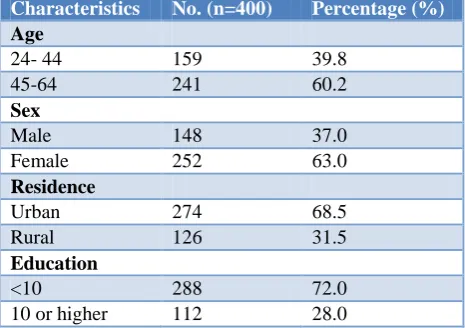
It was observed that 60.2% of study subjects were in the age group of 45- 64 years and rests were in age group of 24-44 years. Also 63% of study subjects were females. Large majority (68.5%) of study subjects were residing in urban areas. Literacy level of study subjects showed that only 28% of them had studied up to matriculation or higher (Table 1).
Table 1: Selected socio-demographic characteristics of study subjects.
Characteristics No. (n=400) Percentage (%)
Age
24- 44 159 39.8
45-64 241 60.2
Sex
Male 148 37.0
Female 252 63.0
Residence
Urban 274 68.5
Rural 126 31.5
Education
<10 288 72.0
10 or higher 112 28.0
Table 2: Life style risk factors for NCDs in relation to age, sex, residence and education.
Characteristics
Inadequate fruits/vegetables serving per day
Crude *OR (CI)
Low physical exercise
Crude *OR (CI)
Alcohol intake
Crude *OR (CI)
Smoking
Crude OR (CI)
Age
24-44 (159) 155 (97.5)
0.16 (0.02-1.5) 112 (70.4) 0.5 (0.3-0.7) 20 (12.6) 1.6 (0.8-3.0) 06(12.6) 20.5 (1.2-365.6)
45-64 (241) 240 (99.6) 202 (83.8) 20 (8.3) 00 (0)
Sex
Male (148) 145 (98.0)
0.6 (0.08-4.16) 116 (78.4) 0.9 (0.6-1.6) 39 (27.0) 89 (12.2-662.0) 06 (4.05) 23.0n (1.3-411.9)
Female (252) 250 (99.2) 198(78.6) 01 (0.4) 00 (0)
Residence
Urban (274) 271 (98.9)
0.9 (0.15 -5.58) 223 (81.3) 1.7 (1.0-2.7) 06 (2.2) 0.06 (0.02-0.14) 02 (0.7) 0.22(0.04-1.24)
Rural (126) 124 (98.4) 91 (73.4) 34 (27.0) 04 (3.2)
Education
<10 yrs (288) 286 (98.5)
3.9 (0.6-23.9) 214 (74.3) 0.35 (0.2-0.7) 31 (10.8) 1.4 (0.6-3.0) 06 (2.1) 5.2 (0.3-92.7)
10/ >10 yrs (112) 109 (97.2) 100 (89.3) 09 (08.0) 00 (0)
* OR- Odds ratio, CI - Confidence interval.
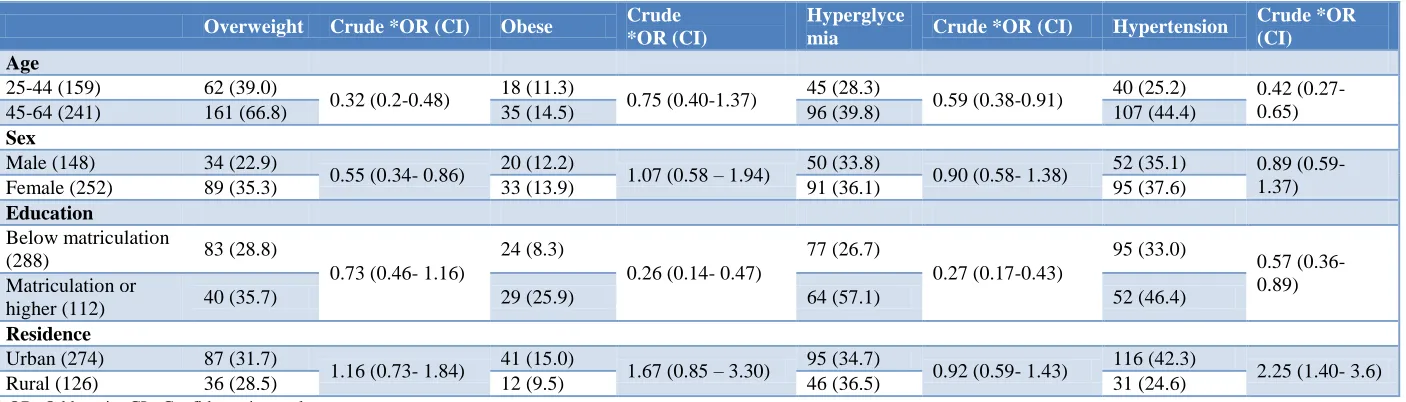
Table 3: Physical and biochemical risk factors (overweight, obesity, diabetes and hypertension) for NCDs in relation to age, sex, residence and education.
Overweight Crude *OR (CI) Obese Crude
*OR (CI)
Hyperglyce
mia Crude *OR (CI) Hypertension
Crude *OR (CI) Age
25-44 (159) 62 (39.0)
0.32 (0.2-0.48) 18 (11.3) 0.75 (0.40-1.37) 45 (28.3) 0.59 (0.38-0.91) 40 (25.2) 0.42 (0.27- 0.65)
45-64 (241) 161 (66.8) 35 (14.5) 96 (39.8) 107 (44.4)
Sex
Male (148) 34 (22.9)
0.55 (0.34- 0.86) 20 (12.2) 1.07 (0.58 – 1.94) 50 (33.8) 0.90 (0.58- 1.38) 52 (35.1) 0.89 (0.59- 1.37)
Female (252) 89 (35.3) 33 (13.9) 91 (36.1) 95 (37.6)
Education
Below matriculation
(288) 83 (28.8)
0.73 (0.46- 1.16)
24 (8.3)
0.26 (0.14- 0.47)
77 (26.7)
0.27 (0.17-0.43)
95 (33.0)
0.57 (0.36- 0.89) Matriculation or
higher (112) 40 (35.7) 29 (25.9) 64 (57.1) 52 (46.4)
Residence
Urban (274) 87 (31.7)
1.16 (0.73- 1.84) 41 (15.0) 1.67 (0.85 – 3.30) 95 (34.7) 0.92 (0.59- 1.43) 116 (42.3) 2.25 (1.40- 3.6)
Rural (126) 36 (28.5) 12 (9.5) 46 (36.5) 31 (24.6)
Table 3 depicted physical measurements and biochemical risk factors. It was observed that 123 (30.7%) study subjects were overweight, 53 (13.3%) were obese, 141 (35.3%) were hyperglycemic and 147 (36.7%) were hypertensive. The prevalence of all these risk factors was found to be higher in higher age group. In the age group of 25-44 years only 39% were obese and 11.3% were overweight but these figures rose in the age group of 45- 64 years to 66.8% and 14.5% for overweight (OR-0.32, CI=0.2-0.48) and obesity (0.75 (0.40-1.37) respectively. Similarly in the age group of 25-44 years, 28.3% were suffering from hyperglycemia and 25.2% were hypertensive, but with the advancement of age to 45-64 years, the prevalence of hyperglycemia and hypertension increased to 39.8% (OR-0.59, CI=0.38-0.91) and 44.4% (OR-0.42, CI=0.27- 0.65) respectively. Among all the study subjects, females had higher probability of being overweight in comparison to males (OR-0.55 CI=0.34- 0.86). There was no significant difference among men and women in relation to diabetes and hypertension. It was also depicted that the prevalence of risk factors i.e. obesity, diabetes and hypertension, was higher among study subjects who had studied higher than matriculation and who were residing in urban areas and the difference was statistically significant. The prevalence of hypertension was higher among urban residents (OR-2.25, CI-1.40 to 3.6) (Table 3).
DISCUSSION
In the present study, it was observed that 39.8% study subjects were in the age group of 24-44 years while rests (60. 2%) were in the age group of 45-64 years. Also, 63% of study subjects were females. Large majority (68.5%) of study subjects were residing in urban areas. Literacy level of study subjects showed that only 28% of them had studied up to matriculation or higher.
Though in Punjab, availability of food is not a problem, in the current study it was observed that majority of study subjects were taking inadequate vegetable and fruit servings irrespective of their age, gender, residence and education status. Similar findings were observed in another study conducted in Tamil Nadu which indicates that habit of fruits and vegetables consumption needs to be inculcated.9 Similar observations were depicted regarding exercise which is one of the important factors for non-communicable diseases. Only 21% of study subjects were doing minimum recommended physical exercise and there was no difference among men and women. In age group 24-44 years, 29.6% study subjects are doing adequate exercise whereas the number decreased to 16.2% for the age group 45-64 years (OR-0.5, CI=0.3-0.7) though the prevalence of NCDs increases with age. The percentage of study subjects doing adequate physical exercise was found to be less in rural areas (19%) in comparison to urban areas (22.6%) (OR-1.7, CI=1.0-2.7). Similar findings were observed in a state wide study conducted in Punjab.10 Regarding alcohol intake, 20% (40) study subjects were taking
alcohol and only one among them was female. Percentage of study subjects taking alcohol decreased with age, but the difference was not statistically significant. Prevalence of drinking alcohol was found to be lower in urban areas but education had no significant impact on drinking alcohol. Prevalence of smoking was found to be very less among study subjects. These findings are similar to another study conducted in Gujarat.11
It was observed that 30.7% study subjects were overweight and 13.5% were obese. In the age group of 25-44 years, only 39% were obese and 11.3% were overweight but these figures rose to 66.8% and 14.5% for overweight and obesity respectively in the age group of 45-64 years. In a study conducted in Punjab it was observed that 29.3% study subjects were overweight and 18% were obese.12 These findings are in consistent with the current study. Females among study subjects had higher probability of being overweight in comparison to males and the difference was statistically significant (0.55 (0.34-0.86). Also, the prevalence of overweight and obesity was higher among urban residents than their rural counterparts but the difference was not statistically significant (OR-1.67, CI=0.85–3.30). Prevalence of obesity and overweight in the current study is though comparable to other studied conducted in Punjab, it is very high in comparison to studies conducted in South India states.13,10
In the current study, 35.2% were found to be diabetic and 36.7% were hypertensive. In the age group of 25-44 years, 28.3% were diabetic and 25.2% were hypertensive, but with the advancement of age to 45-64 years, the prevalence of diabetes and hypertension increased to 39.8% and 44.4% respectively. The prevalence of diabetes and hypertension was also higher among those who had studied up to matriculation or higher which might be because of life style differences and economic conditions. Prevalence of hypertension was also found to be higher in urban areas (42.3%) than their counterparts in rural areas (24.6%). These findings are in congruence with other studies, indicating that effective measures need to be adopted.14,9
CONCLUSION
In the present study, low physical activity coupled with poor fruits and vegetables intake was observed which poses threat to health and wellbeing of individuals. At the same time, alcohol consumption along with high prevalence of obesity, diabetes and hypertension is worrisome and needs to be addressed effectively by public health professionals.
Funding: No funding sources Conflict of interest: None declared
REFERENCES
1. World Health Organization Regional Office for Europe. Summary Report- Noncommunicable diseases risk factors survey in Georgia 2006-2007. 2007. Available at: http://www.who.int/fctc/ reporting/party_reports/georgia_annex1_ncd_risk_f actors_survey_2006_2007.pdf. Accessed on 02 March 2018.
2. Deepa M, Grace M, Binukumar B, Pradeepa R, Roopa S, Khan HM, et al. Surveillance Research Group. High burden of prediabetes and diabetes in three large cities in South Asia: The Center for cardio-metabolic Risk Reduction in South Asia (CARRS) Study. Diabetes Res Clin Pract. 2015;110(2):172-82.
3. GBD 2015 Risk Factors Collaborators. Global, regional, and national comparative risk assessment of 79 behavioural, environmental and occupational, and metabolic risks or clusters of risks, 1990–2015: a systematic analysis for the Global Burden of
Disease Study 2015. Lancet.
2016;388(10053):1659-172.
4. World Health Organization. 10 Facts on NCDs. Available at: http://www.who.int/features/factfiles/ noncommunicable_diseases/facts/en/index9.html. Accessed on 9 Jan 2018.
5. World Health Organization. STEPwise approach to surveillance (STEPS). Available at: http://www. who.int/chp/steps/en/. Accessed on 10 Jan 2018. 6. WHO Regional Office for Europe. Reducing
Burden of Preventable Non-communicable Diseases. World Health Organization Regional Office for Europe 2007.
7. World Health Organization. Obesity: preventing and managing the global epidemic. Report of a WHO consultation (TRS894). Geneva: World Health Organization (WHO); 2000.
8. World Health Organization. Prevention of Cardiovascular Disease. Guidelines for assessment and management of cardiovascular risk. Geneva: Switzerland; 2007. Available at: http://www.who.int/cardiovascular_diseases/publica tions/Prevention_of_Cardiovascular_Disease/en/. Accessed on 12 Dec 2017.
9. Oommen AM, Abraham VJ, George K, Jose VJ. Prevalence of risk factors for non-communicable diseases in rural & urban Tamil Nadu. Indian J Med Res. 2016;144(3):460–71.
10. Thakur JS, Jeet G, Pal A, Singh S, Singh A, Deepti SS, et al. Profile of Risk Factors for Non-Communicable Diseases in Punjab, Northern India: Results of a State-Wide STEPS Survey. PLoS ONE. 2016;11(7):e0157705.
11. Bhagyalaxmi A, Atul T, Shikha J. Prevalence of Risk Factors of Non-communicable Diseases in a District of Gujarat, India. J Health Popul Nutr. 2013;31(1):78-85.
12. Kaur G, Singh SP and Singh AP. Prevalence of Overweight and Obesity in Urban and Rural Women of Punjab. Hum Bio Rev. 2013;2(4):306-13.
13. Junapudi SS, Rao BB. A comparative study of cardiovascular disease risk factors among urban and rural population South Indian city. Int J Community Med Public Health. 2017;4(12):4623-9.
14. Shah B, Mathur P. Surveillance of cardiovascular disease risk factors in India: The need & scope. Indian J Med Res. 2010;132(5):634–42.
Cite this article as: Gill KPK, Devgun P, Mahajan