ENHANCING EDUCATION IN SCIENCE BASED ON INFORMATION TECHNOLOGY APPLICATION
Erofeeva G.V., Sklyarova Е.А., Chernov I.P.
National Research Tomsk Polytechnic University, Tomsk, e-mail: [email protected]
The article regards the fundamentalization of scientifi c education exemplifi ed by developing and using interac-tive teaching systems in physics for technical students. The system is designed for practical classes and students’ individual work in a physics course according to the course syllabus. The results of the system piloting in the process of study indicate that the students’ knowledge has improved.
Keywords: fundamentalization, information technology, teaching system, test items, assessment
Challenges faced by higher technical edu-cation in Russia are connected with decreasing interest in it, eliminating the examination in physics from obligatory disciplines, problems with the graduating students’ employment be-cause of weakly developing economy and cri-sis directly infl uence on the secondary school education and, as a result, students’ ability to learn science and mathematics.
Maintaining and enhancing education in science and mathematics directly related to the fundamentalization of professional education (developing high professional competences of a technical university graduate) requires sys-tematic changes in the process of teaching sci-ence and mathematical disciplines.
These changes, as well as enhancing edu-cation in science and mathematics with
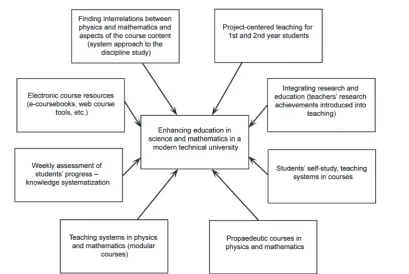
interre-lations found between physics and mathemat-ics, creates the basis and conditions for the fundamentalization of professional education, which enables the specialist to be quickly re-trained and study new technologies and pro-duction processes at a high level of effi ciency. This makes it possible to effectively develop such characteristics of a professional as a high level of professional awareness, professional adaptability and mobility, capability of self-education and self-development throughout their life, fl exibility in thinking, etc. Besides, enhancing the education is impossible without introducing information technology into the educational process and resources for students’ self-study [1-7]. An up-to-date model of en-hancing education in science and mathematics is presented in Fig.1
Methods
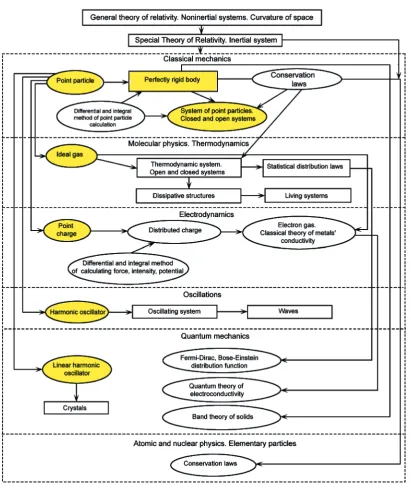
The fundamentalization of education in science is impossible unless the interrelations between physics, mathematics and special disciplines, as well as within the course of physics, are taken into account [8]. Models in physics undergo transformation and transfer from one section of the course to another. If the system of interrelations between models within the course of physics is not presented to the student, it is almost impossible to fi nd them without the teacher’s help. The analysis
of interrelations within the course of physics as well as awareness that postulates of the Special Theory of Relativity change for those of classi-cal physics if the object velocity is much lower than that of light in the vacuum allows for ap-plying the theoretical and deductive method rather than historic and inductive one (Fig. 2). The use of IT also makes it possible to ap-ply the productive method (problem solving), personality-centered approach (various learn-ing trajectories), and developmental teachlearn-ing methods.
For the purpose of enhancing the edu-cational process in the course of physics and fundamentalization of scientifi c education, an interactive physics courseware based on Macintosh and IBM PC computers has been developed in National Research Tomsk Poly-technic University. The courseware is de-signed for practical lessons, independent, in-dividual students’ work and distance teaching and learning. Nowadays there are four parts of the courseware which has been completely developed, tested and introduced in the teach-ing process. These parts are devoted to the fol-lowing units: «Mechanics. Molecular Physics. Thermodynamics». (part I), «Electricity. Elec-tromagnetism». (part II), «Oscillations. Wave Optics». (part III), «Nuclear Physics. Quantum Physics Accidence». (part IV). The courseware has been tested at lessons with full-time and part-time students of different faculties for 10 years (more than 10 thousand class hours).
Course sections:
1. Point Particle Kinematics. 2. Kinematics of Rigid Body. 3. Dynamics of Rigid Bodies. 4. Conservation Laws.
5. Special Theory of Relativity. 6. Ideal Gas Laws.
7. The First Law of Thermodynamics. Thermal Capacity. Entropy. Thermal Engines.
8. Coulomb’s Law. Electric-fi eld Intensity. Gauss Theorem.
9. Movement of Charge in the Electric Field. Potential. Intensity and Potential Rela-tion. Electric Capacity.
10. Direct Current Laws.
11. Electromagnetism. Ampere Force. Lor-entz Force. Motion of Charged Particles.
12. Biot-Savart-Laplace Law and its Ap-plication to the Calculation of Magnetic Induc-tion and Intensity of Magnetic Fields. Material Magnetism.
13. Hall Effect. Electromagnetic Induction Law. Maxwell Equations.
14. Mechanical Oscillations and Waves. 15. Electromagnetic Oscillations and Waves. 16. Geometric Optics.
17. Interference. 18. Diffraction. 19. Polarization. 20. Thermal Emission.
21. Photoeffect. Compton Effect.
22. Hydrogen Atom according to Bohr. Linear Spectrum.
23. Quantum Physics Accidence. Particles’ Wave Properties.
24. Schrödinger Equation. Particle in the Potential Well.
25. Physics of Atomic Nucleus and Particles.
Methodological support of the system [9]:
1. Theoretical section structured to be the necessary minimum and consisting of:
a) interrelations of physical values and laws with those studied at previous classes and interdisciplinary relations with other courses within the curriculum;
b) up-to-date achievements in the relevant
fi eld of science.
2. Feedback or communication to organize a dialogue between the student and the computer.
3. Non-standard test items of various types to measure students’ type I and II knowledge – productive activity.
4. Solved problems (typical ones, to de-velop the ability to build problem solving al-gorithms and remember the relations in theory and a corresponding individual version of the problem to be solved independently).
5. Solved integrated problems (non-stand-ard, original ones) to develop the ability to think creatively.
6. Progress check tasks with a wide range of skills development, including type III and VI knowledge (writing tasks relevant to the course section) – productive activity.
7. A variety of studying trajectories corre-sponding to the student’s present profi ciency level, intentions and opportunities.
8. Rating scale to assess the students’ learn-ing results at any stage of the class.
9. Facilities for modeling and simulating phenomena studied and performing simple ex-periments as well as video presentations.
10. Historic background (interesting didac-tic stories about scientists and their discover-ies) and supporting illustrative material.
11. Reference material – a table of deriva-tive values, integrals, trigonometric functions, constants, etc.
12. Comfortable conditions for studying and communication with the student.
13. Necessary conditions for self-study and individual work.
Experiment
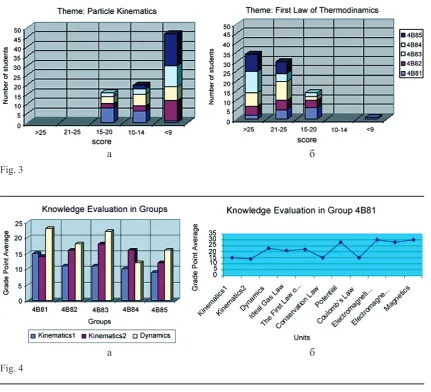
Interactive physics courseware was pilot-ed in the computer lab of the Department of General Physics, Physico-Technical Institute of Tomsk Polytechnic University during 2000-2010. The piloting of the system involved over 800 people. The courseware allows for the analysis of changes in the students’ learn-ing curve from the fi rst lesson (Fig. 3а) to the subsequent ones (Fig. 3b). The result of the
analysis performed in 5 groups of students at the Faculty of Machine Building reveals the rise of the learning curve which displays itself as an increase in the number of students who got high scores for the lesson (Fig. 4а,b)). Fig. 4а shows the results of testing different groups of students over three themes. Fig. 4b demon-strates the increase of the grade point average during the physics course study, which
con-fi rms the learning curve rise.
а б
Fig. 3
а б
Fig. 4
Conclusions
Advantages of the interactive courseware: 1. The courseware allows for teaching and simultaneous assessment of knowledge of many students.
2. Due to the software and scientifi c-methodological support of the courseware all types of knowledge assessment are possible: progress assessment, achievement testing, re-sidual knowledge assessment as well as fi nal examination.
3. Teacher receives an assessment protocol (of a lesson or examination) with the analysis of results of the unit learning.
4. Originality of the test item bank devel-oped by a creative team provokes interest of the test-takers in the process of studies and the testing.
6. The courseware allows for teaching and assessment of knowledge in any other disci-pline if the test questions bank is replaced.
References
1. Nirmalakhandan N. Computerized adaptive tutorials to improve and assess problem-solving skills // Computers & Edu-cation. – 2007. – Vol. 49, Issue 4. – Р. 1321-1329.
2. Lilley M., Barker T., Britton C. The development and evaluation of a software prototype for computer-adaptive testing // Computers & Education. – 2004. – Vol. 43. – Р. 109-123.
3. Mason B.J., Patry M., Bernstein D.J. An examination of the equivalence between non-adaptive computer-based and traditional testing // Journal of Educational Computing Rese-arch. – 2001. – Vol. 24. – Р. 29–39.
4. Van Horn R. Computer adaptive tests and computer-based tests // Phi Delta Kappan. – 2003. – №84 (567). – Р. 630–631.
5. Gwo-Jen Hwang A conceptual map model for develop-ing intelligent tutordevelop-ing systems // Computers & Education. – 2003. – Vol. 40, Issue 3. – Р. 217-235.
6. Wood D. Comments on «Learning with ICT: New per-spectives on help seeking and information searching» // Comput-ers and Education. – 2009. – Vol. 53. – Р. 1048–1051.
7. Tian Jeff. Software Quality Engineering: Testing, Qual-ity Assurance, and Quantifi able Improvement // J. Tian. – Hobo-ken : John Wiley & Sons, Inc. – 2005. – 412 p.
8. Efremova N.A., Rudkovskaya V.F., Sklyarova E.A. The importance of fundamental approach to studying physics at uni-versity // European journal of natural history. – 2007. – №2. – Р. 120-122.