Original Research Article
Prevalence of asthmatic respiratory complications among the rural
community of Tangail area in Bangladesh
Md. Imam Hossain
1*, Masum Parvez
1, Fatama Tous Zohora
1,
Md. Shariful Islam
1, Luthfunnesa Bari
2INTRODUCTION
There is no clear, universally acceptable definition of asthma because of the absence of any gold standard for asthma.1 It is a chronic inflammatory disorder of the airways characterized by recurrent episodes of wheezing, breathlessness, chest tightness, and cough, particularly at night or in the early morning (National Asthma Education and Prevention Program, 2007).2 A variety of expert
groups defined asthma. All definitions have their central criteria as a physiologic phenomenon: reversible bronchospasm or increased airway responsiveness.3 Over the last 40 years, there has been a sharp increase in the global prevalence, morbidity, mortality and economic burden associated with asthma. An estimate suggests that, approximately 300 million people worldwide currently have asthma, and its prevalence increases by 50% every decade.4 Prevalence are high (>10%) in developed
ABSTRACT
Background: Asthmatic respiratory complications appear to be a notable public health consequence and associated with mortality, morbidity and economic burden worldwide. Globally several epidemiological studies have been conducted to assess the prevalence of asthmatic respiratory complications. As far our knowledge very few population based study have been conducted in Bangladesh to assess the magnitude of asthmatic respiratory complications focusing the rural community. Therefore the study was undertaken to assess the prevalence of asthma and related respiratory complications in the rural community of Tangail area in Bangladesh.
Methods: This human population based cross-sectional survey study was conducted during the period of August to December 2016 on some villagers of Tangail area in Bangladesh using a pre-standardized questionnaires called "IUATLD -1984 bronchial symptoms questionnaires", designed by the International Union Against Tuberculosis and Lung Diseases (IUATLD). The demographic data of the study subjects were collected by interviewing the subjects and the data were analyzed using SPSS software.
Results: The results demonstrated that a substantial proportion of study subjects showed the main characteristic symptoms of asthma i.e., wheeze last 12 months is about 18.27%, shortness of breath (SOB) without strenuous work were 21.84%, nocturnal SOB 14.70%, morning cough 13.26%, nocturnal cough 17.25% and morning phlegm 10.37%. Overall 9.69% of the subjects were found to be asthmatic. Female study subjects showed more asthmatic complications than male subjects and in the higher aged group asthmatic symptoms were more prevalent.
Conclusions: Among the study subjects, asthmatic complications were found to be substantial. Further clinical study is necessary to confirm the findings.
Keywords: Asthma, IUATLD, Bangladesh, Public health
1
Department of Biotechnology and Genetic Engineering, 2Departmentof Food Technology and Nutritional Science, Mawlana Bhashani Science and Technology University, Tangail, Bangladesh
Received: 19 February 2018
Accepted: 09 March 2018
*Correspondence:
Dr. Md. Imam Hossain, E-mail: [email protected]
Copyright: © the author(s), publisher and licensee Medip Academy. This is an open-access article distributed under the terms of the Creative Commons Attribution Non-Commercial License, which permits unrestricted non-commercial use, distribution, and reproduction in any medium, provided the original work is properly cited.
countries and rates are increasing in developing regions as they become more westernized. The most striking increases are seen among children although the disease is also on the increase in the elderly. Worldwide, approximately 180,000 deaths annually are attributable to asthma.5 In developing regions (Africa, Central and South America, Asia, and the Pacific), asthma prevalence continues to rise sharply with increasing urbanization and westernization.4 In Asia, increased prevalence is likely to be particularly dramatic in India and China. In India the overall prevalence of asthma is 2.38%.6 In Bangladesh asthma appears to be a substantial public health problem. In an estimate it has shown that 7 million people including 4 million children in Bangladesh suffering from asthma related symptoms and the prevalence of asthma is 6.9%.7
To assess the prevalence of asthma different questionnaires are available. The International Union against Tuberculosis and Lung Diseases (IUATLD) sponsored the development of a standard questionnaire to be used in prevalence studies of asthma in adults. The validity and reproducibility of this questionnaire were found to be satisfactory in several studies.8,9 It was used in the European Community Respiratory Health Survey (ECRHS), a multicenter 2-stage prevalence study supported by the European Commission.
Several epidemiological studies have been conducted worldwide to assess the prevalence of asthma.10-14 Some research group focused on clinical parameters of asthma and some groups focused on asthmatic symptoms. Very few population based study have been conducted to determine the magnitude of asthma problem in Bangladesh. As far our knowledge very few studies have been conducted to assess the symptoms based prevalence of asthma especially in rural community in Bangladesh. Thus, the study was aimed to determine the prevalence of asthma and asthma related respiratory complications in the rural community of Tangail area in Bangladesh.
METHODS
Ethical consideration
For the study, Institutional permission was taken from the Department of Biotechnology and Genetic Engineering of Mawlana Bhashani Science and Technology University, Bangladesh.
Study areas and study subjects
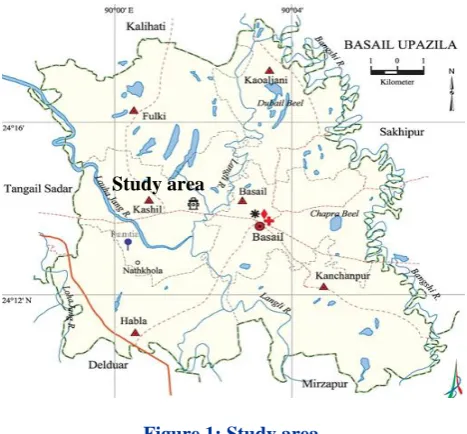
This was cross-sectional prevalence study which quantifies the distribution of asthma and asthmatic respiratory complications among rural community of Bathuly-sadi village of Basail upazila of Tangail district in Bangladesh (Figure 1) during the period of August to December 2016. All the study populations were between age ranges 15-60. Each study individuals have given their written consent and have their freedom to withdraw
themselves at any time from the study. The subjects who participated in this study gave their written approval and all sorts of confidentialities and rights of the study subjects were stringently maintained.
Figure 1: Study area.
Source: en.banglapedia.org/index.php?title=Basail_Upazila
Preparation of questionnaires
The International Union against Tuberculosis and Lung Diseases (IUATLD) sponsored the development of a standard questionnaire to be used in prevalence studies of asthma in adults (IUATLD -1984 bronchial symptoms questionnaires). The validity and reproducibility of this questionnaire were found to be satisfactory in several studies.15,16 It was used in the European Community Respiratory Health Survey (ECRHS), a multicenter 2-stage prevalence study supported by the European Commission.17 The questionnaire was translated in Bengali with the help of a University English teacher and the medical terms were checked with the help of a clinical doctor. The questionnaire contains 14 separate questions and the questions were easily understandable. Rather the study individual had the opportunity to discuss with ensure trained team member anytime during answering the questions.
Data collection
For data collection, door to door visit was conducted by some trained members of the research team. The members described the objective of the research and requested the individuals to participate the research spontaneously. Some public-representatives also helped the research team to convince the villagers to participate the survey. The villagers, who were convinced, were supplied with the questionnaires and requested to fill up the form. The team member collected the data in case of the villagers who did not have any formal education. Moreover the trained members of the research team explained any technical term to each individual. The team
members stayed for couple of days in the village for data collection. The BMI and Blood pressure of the study subjects were measure as described in our another study.18
Exclusion criteria
Rural people having known hepatitis B positive, prescription of hepatotoxic and anti-hypertensive drugs, malaria, kalazar, and hepatic, renal or cardiac diseases were excluded from this study.
Statistical analysis
Statistical analyses for the study were performed using the Statistical Packages for Social Sciences (SPSS Statistics for Windows, Version 21.0. Armonk, NY: IBM Corp.) Software. The mean age, sex, BMI of the study subjects were assessed by Chi-square test. The prevalence of symptoms was counted with frequency and chi-square tests. Graphical representations of the results were done with Microsoft Excel program.
RESULTS
General characteristics of the study subjects
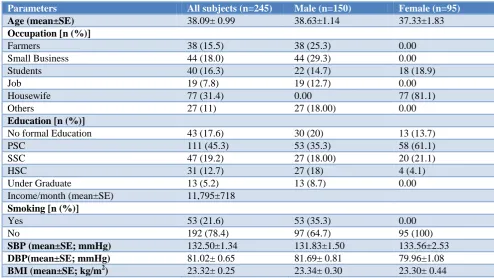
Table 1 shows the general characteristics of the study subjects of Bathuli-Sadi village of Bashail Upazila of Tangail district. Of the total 245 study subjects, 150 were male and 95 were female. The average age (Mean±SE) of the study subjects were 38.09±0.99 years. The average ages of male were 38.63±1.14 years and the average age of female were 37.33±1.83 years respectively. Occupationally maximum male study subjects were engaged in small business (29.3%) and farming (25.3%), some were students and the remaining portions were engaged in job and others (rickshaw-puller, driver, electrician, mechanics etc). Among the females 81.1% were housewives and remaining were students (18.9%). We also collected data for smoking of the study subjects and found that 35.3% male subjects were smoker. No female study subjects were found to be smoker because generally Bangladeshi women do not habited to smoke. Maximum portion of the study subjects completed their primary level education (45.3%). Gross family income of the study individuals were 11,795 taka. The mean BMI of the study subjects in the study area were 23.32± 0.25.
Table 1: General characteristics of the study subjects.
Parameters All subjects (n=245) Male (n=150) Female (n=95)
Age (mean±SE) 38.09± 0.99 38.63±1.14 37.33±1.83
Occupation [n (%)]
Farmers 38 (15.5) 38 (25.3) 0.00
Small Business 44 (18.0) 44 (29.3) 0.00
Students 40 (16.3) 22 (14.7) 18 (18.9)
Job 19 (7.8) 19 (12.7) 0.00
Housewife 77 (31.4) 0.00 77 (81.1)
Others 27 (11) 27 (18.00) 0.00
Education [n (%)]
No formal Education 43 (17.6) 30 (20) 13 (13.7)
PSC 111 (45.3) 53 (35.3) 58 (61.1)
SSC 47 (19.2) 27 (18.00) 20 (21.1)
HSC 31 (12.7) 27 (18) 4 (4.1)
Under Graduate 13 (5.2) 13 (8.7) 0.00
Income/month (mean±SE) 11,795±718
Smoking [n (%)]
Yes 53 (21.6) 53 (35.3) 0.00
No 192 (78.4) 97 (64.7) 95 (100)
SBP (mean±SE; mmHg) 132.50±1.34 131.83±1.50 133.56±2.53
DBP(mean±SE; mmHg) 81.02± 0.65 81.69± 0.81 79.96±1.08
BMI (mean±SE; kg/m2) 23.32± 0.25 23.34± 0.30 23.30± 0.44
Data were presented as mean ±SE, BMI: Body Mass Index; DBP: Diastolic Blood Pressure; SBP: Systolic Blood Pressure.
Prevalence of asthma symptoms among the study subjects
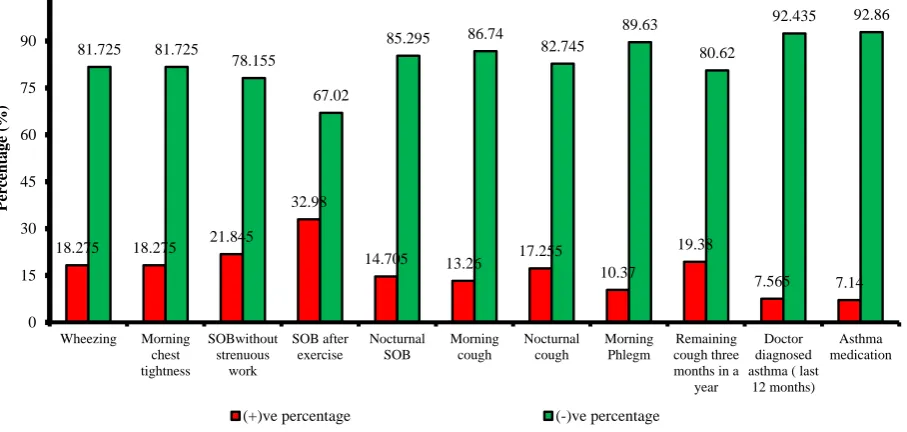
The result showed that a substantial proportion of study subjects show the main characteristic symptoms of asthma (wheeze last 12 months) which is about 18.27%.
by clinical doctors or by quacks. Among which 7.14% subjects routinely takes asthma medications. The study
results are summarized in Figure 2.
Figure 2: Prevalence of asthma symptoms, attacks and medication use among rural community in the 12 months preceding the survey.
Table 2: Prevalence of asthma symptoms among male and female study subjects in last twelve months.
Questions Female (n=95) Male (n=150
Wheezing 25.07 15.30
Morning chest tightness 21.50 15.89
Shortness of breath (SOB) without strenuous work 24.14 21.50
SOB after exercise 36.72 31.70
Nocturnal SOB 17.93 13.60
Morning cough 17.93 17.00
Nocturnal cough 10.71 10.79
Morning phlegm 11.64 15.30
Remaining cough three months in a year 19.72 19.29
Doctor diagnosed asthma 7.14 7.90
Asthma medication 7.14 7.39
Prevalence of asthma symptoms among male and female study subjects in last twelve months
Results in Table 2 indicated that, female study individuals were more prone to have asthmatic respiratory complications than the male study subjects. For wheezing the prevalence was 15.30% in male and 25.07% were in female. 21.50% female shows morning chest tightness where 15.89% male showed the symptoms. 24.14% female subjects showed shortness of breathe without any strenuous work where the prevalence of these symptoms in male was 21.50%. 17.93% female subjects showed nocturnal SOB which was also higher than the male subjects. 17.93% female study subjects have morning cough where its prevalence in male were 17.00%.
Breathing condition of the study subjects
The study subjects were asked about their breathing condition. The results (Figure 3A) indicated that maximum portion of the study subjects (52.3%) never or rarely feel trouble in breathing, 36.30% shows regular trouble with breathing but is complete recoverable and in case of 11.4% subjects their breathing never quite right. Figure 3B showed the response of the study subjects in response to dust. They were asked about their response when they are in dusty part of the house or with animals (for instance dogs, cats or horses) or near feathers (including pillows, quilt and eiderdowns). The results indicated that 23.6% study subjects showed the symptoms of cough, nasal fluid and phlegm, 19.8% chest 18.275 18.275 21.845
32.98
14.705 13.26 17.255
10.37
19.38
7.565 7.14 81.725 81.725
78.155
67.02
85.295 86.74 82.745 89.63
80.62
92.435 92.86
0 15 30 45 60 75 90 105
Wheezing Morning chest tightness
SOBwithout strenuous
work
SOB after exercise
Nocturnal SOB
Morning cough
Nocturnal cough
Morning Phlegm
Remaining cough three months in a
year
Doctor diagnosed asthma ( last
12 months) Asthma medication
Perc
entag
e
(%
)
tightness, 17.3% shows shortness of breath and 9.30% showed skin rash or itching.
Figure 3A: Breathing condition of the study subjects.
Figure 3B: Response of the study subjects in response to dust.
Major asthma definitions among different age groups among the study subjects
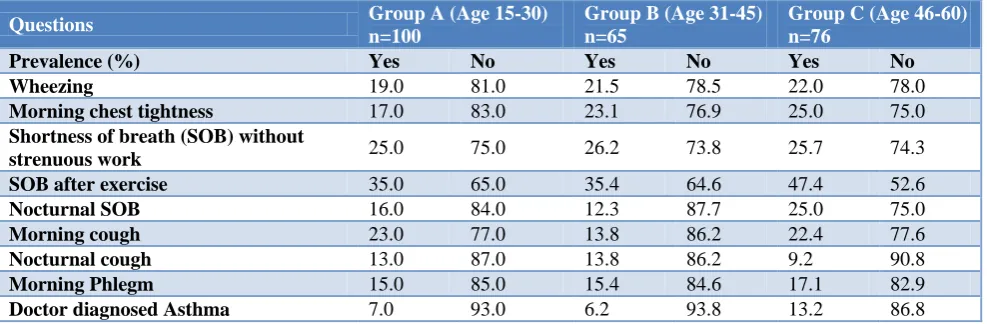
To assess the prevalence of asthma in different age groups, the study subjects were divided into 3 groups- age 15-30 in group A, age 31-45 in group B and age 46-60 in group C. Different asthmatic respiratory complications among 3 groups are represented in Table 3. The result indicated that group C (age 46-60) showed highest prevalence of asthmatic respiratory complications and group A (age 15-30) showed the lowest prevalence of asthmatic respiratory complications.
Prevalence of asthma among study subjects
Asthma is characterized by four major symptoms include episodes of recurrent wheezing, shortness of breath, chest tightness, and coughing.19,5 Symptoms are usually worse at night and in the early morning or in response to exercise or cold air.20 Taking these signature features of asthma, the proportion of asthmatic and non-asthmatic proportion among the study subjects were computed and the results showed that 9.69% of the subjects were asthmatic and remaining 90.31% were non-asthmatic (Figure 4).
Table 3: Major asthma definitions among different age groups among the study subjects.
Questions Group A (Age 15-30) n=100
Group B (Age 31-45) n=65
Group C (Age 46-60) n=76
Prevalence (%) Yes No Yes No Yes No
Wheezing 19.0 81.0 21.5 78.5 22.0 78.0
Morning chest tightness 17.0 83.0 23.1 76.9 25.0 75.0
Shortness of breath (SOB) without
strenuous work 25.0 75.0 26.2 73.8 25.7 74.3
SOB after exercise 35.0 65.0 35.4 64.6 47.4 52.6
Nocturnal SOB 16.0 84.0 12.3 87.7 25.0 75.0
Morning cough 23.0 77.0 13.8 86.2 22.4 77.6
Nocturnal cough 13.0 87.0 13.8 86.2 9.2 90.8
Morning Phlegm 15.0 85.0 15.4 84.6 17.1 82.9
Doctor diagnosed Asthma 7.0 93.0 6.2 93.8 13.2 86.8
Figure 4: Proportion of asthmatic and non-asthmatic study subjects.
DISCUSSION
In Bangladesh, asthma appears to be a substantial public health problem. Asthma is governed by genetic and environmental factors, known as clinically and pathologically heterogeneous.21 Very few symptoms based systematic surveys have been conducted so far in Bangladesh. Hassan et al found that, among total population of 6161 in Dhaka city the prevalence of asthma were 6.8%.22 In another study Hassan et al observed that, among 5642 Bangladeshi people the asthma prevalence were 6.9%. This population based
52.3 (%) 36.3 (%)
11.4 (%)
Never or rare trouble in breating
Regular trouble with breathing but completely recoverable
Breathing never quite right
9.3 17.3
23.6 19.8
0 5 10 15 20 25
Skin rash and itching (%) Shortness of breath(%) Cough, nasal fluid and phlegms
(%)
Chest tightness(%)
9.69 (%)
90.31 (%)
study confirms that the prevalence of asthma symptoms is very high among rural community in Bangladesh.7 Obel et al reported that, the mean age of respondents was 36.7 years, and the prevalence of asthma were 6.9% where present study reveals the asthmatic prevalence was 9.6% (Figure 4).21 Moreover, the study subjects showed wheezing complication (about 18.27%) which is the main symptom of bronchial asthma. The prevalence of other featured asthma definitions were: morning chest tightness (18.27%), shortness of breath (SOB) without strenuous work were 21.84%, attack of SOB after exercise last 12 months 32.98%, nocturnal SOB 14.70%, morning cough 13.26%, nocturnal cough 17.25%, morning phlegm 10.37% (Figure 2). However the results of our study differ from other symptom based epidemiological survey. This may be due to the multi-factorial nature of asthma where genetic variation, geographic localization, environmental pollution, dietary behavior, socioeconomic status and other factors contribute asthmatic complications.23-26 Another contributory considerations are the variations of study methodology and different questionnaire utilized for survey. Some study also conducted on clinical and pathophysiological determination of asthma. All the symptoms may not be generalized for all study subjects who are positive for the individual symptoms but these all together implies that a substantial proportion of our study subject are in greater asthma risk. Recent studies reported that the prevalence of asthma was highest among non-Hispanic blacks, women, and persons with less than a high school education and in rural parts of the state (south and northwest Georgia).27
Asthmatic prevalence, asthma mortality and asthmatic respiratory complications vary with age. In a nationwide survey conducted in Britain, Strachan et al reported that, with increasing age, morbidity related to wheezing declined to a greater extent than annual period prevalence.28 In our study, to assess the prevalence of asthma in different age groups, the study subjects were divided into 3 groups (age 15-30 in group A, age 31-45 in group B and age 46-60 in group C). The result indicated that relatively more aged group showed more prevalence of asthmatic respiratory complications than lower aged group (Table 3). Sex may have effect on prevalence of asthmatic symptoms. The results of the study indicated that females are more susceptible to developed asthmatic respiratory complications than in male (Table 2). Among several strengths one notable strength of our survey is that, the study was conducted with a pre standardized questionnaires called IUATLD bronchial symptoms. Several research groups validated these questionnaires and the sensitivity and specificity of the questionnaires found to be justified.
In spite of several strengths, there were some limitations of this study that warranted further discussion. Asthma is a multi-factorial disease. Genetic variations, socio-economic status, age, sex, occupation, smoking, eating behavior, racial variations etc. are key contributory for
asthma. Another limitation is that, the numbers of study subjects were very limited. However new study has been designed to address these limitations. Our study was a symptoms based prevalence study. Clinical study may also be designed to confirm the results.
ACKNOWLEDGEMENTS
The authors are grateful to all of the study subjects who participated in this survey research.
Funding: No funding sources Conflict of interest: None declared
Ethical approval: The study was approved by the Institutional Ethics Committee
REFERENCES
1. Toren C. Making history: the significance of childhood cognition for a comparative anthropology of mind. Man. 1993;1:461-78.
2. http://www.pediatricsconsultantlive.com/allergy/upd ate-2007-national-asthma education-and-prevention-program-guidelines-treatment-asthma-children. Accessed on 13 February 2018.
3. Weiss RB, Donehower RC, Wiernik PH, Ohnuma T, Gralla RJ, Trump DL, et al. Hypersensitivity reactions from taxol. Journal of Clinical Oncology. 1990;8(7):1263-8.
4. Masoli M, Fabian D, Holt S, Beasley R. The global burden of asthma: executive summary of the GINA Dissemination Committee report. Allergy. 2004;59(5):469-78.
5. Braman SS. The global burden of asthma. Chest. 2006;130(1):4S-12S.
6. Aggarwal AN, Chaudhry K, Chhabra SK, D Souza GA, Gupta D, Jindal SK, et al. Prevalence and risk factors for bronchial asthma in Indian adults: a multicentre study. Indian J Chest Dis Allied Sci. 2006;48(1):13.
7. Hassan RM, Kabir ARML, Mahmud AM et al. Self-reported asthma symptoms in children and adults in Bangladesh: findings of theNational Asthma Prevalence Study. Int J Epidemiol. 2002;31:483–8. 8. Tennant SK, Szuster FS. Nationwide monitoring
and surveillance question development: Asthma. Public Health Information Development Unit, the University of Adelaide; 2003.
9. Becklake MR. International Union Against Tuberculosis and Lung Disease (IUATLD): initiatives in non-tuberculous lung disease. Tubercle Lung Dis. 1995;76(6):493-504.
10. Alavinezhad A, Boskabady MH. The prevalence of asthma and related symptoms in Middle East countries. The Clin Resp J. 2017;00:1-13.
12. Zedan M, SettinA, Farag M, Ezz-Elregal M, Osman E, Fouda A. Prevalence of bronchial asthma among Egyptian school children. Egypt J Bronch. 2009;3(2):124–30.
13. Steppuhn H, Kuhnert R, Scheidt-Nave C. 12-month prevalence of asthma among adults in Germany. Journal of Health Monitoring. 2017;2(3):34-42. 14. Zaman K, Takeuchi H, Yunus M, El Arifeen S,
Chowdhury HR, Baqui AH, et al. Asthma in rural Bangladeshi children. The Indian J Pediatrics. 2007;74(6):539-43.
15. Burney PG, Laitinen LA, Perdrizet S, Huckauf H, Tattersfield AE, Chinn S, et al. Validity and repeatability of the IUATLD (1984) Bronchial Symptoms Questionnaire: an international comparison. Eur Resp J. 1989;2(10):940-5.
16. Burney PG, Chinn S, Britton JR, Tattersfield AE, Papacosta AO. What symptoms predict the bronchial response to histamine? Evaluation in a community survey of the bronchial symptoms questionnaire (1984) of the International Union Against Tuberculosis and Lung Disease. Int J Epidemiol. 1989;18(1):165-73.
17. European Commission, Directorate General XII. Protocol for the European Community Respiratory Health Survey. Luxembourg: Office for Official Publications; 1993.
18. Hossain MI, Islam MS, Hasan MR, Akter M, Khoka MSH. Fasting blood glucose level and its association with sex, body mass index and blood pressure: a cross sectional study on a Bangladeshi public university students. Int J Community Med Public Health. 2017;4:2663-9.
19. Mincheva R, Ekerljung L, Bjerg A, Axelsson M, Popov TA, Lundbäck B, et al. Frequent cough in unsatisfactory controlled asthma–results from the population-based West Sweden Asthma study. Respiratory Res. 2014;15(1):79.
20. Kaplan AG, Balter MS, Bell AD, Kim H, McIvor RA. Diagnosis of asthma in adults. CMAJ : Canadian Med Assoc J. 2009;181(10):E210-20.
21. Obel KB, Ntumba KJ, Kalambayi KP, Zalagile AP, Munogolo KZ. Prevalence and determinants of asthma in adults in Kinshasa. PloS one. 2017;12(5):e0176875.
22. Haque ME, Ahmad MM, Habib GM, Kabir MH. Prevalence of Asthma in highly polluted Dhaka city and low Polluted Coastal area of Bangladesh. Indian J Allergy Asthma Immunol. 2005;19(2):85-92. 23. Ahmadi KR, Goldstein DB. Multifactorial diseases:
asthma genetics point the way. Current Biol. 2002;12(20):R702-4.
24. Bijanzadeh M, Mahesh PA, Ramachandra NB. An understanding of the genetic basis of asthma. The Indian J Med Res. 2011;134(2):149-61.
25. Basagaña X, Sunyer J, Kogevinas M, Zock JP, Duran-Tauleria E, Jarvis D, et al. Socioeconomic Status and Asthma Prevalence in Young Adults: The European Community Respiratory Health Survey. Am J Epidemiol. 2004;160(2):178–88. 26. Marder D, Targonski P, Orris P, Persky V,
Addington W. Effect of racial and socioeconomic factors on asthma mortality in Chicago. Chest. 1992;101(6):426s-9s.
27. Ebell M, Marchello C, O'Connor J. The burden and social determinants of asthma for adults in the state of Georgia. J Ga Public Health Assoc. 2017;6(4):426–34.
28. Strachan DP, Anderson HR, Limb ES, O'Neill A, Wells N. A national survey of asthma prevalence, severity, and treatment in Great Britain. Arch Disease Childhood. 1994;70(3):174-8.