Volume 3 Issue 8 ǁ November 2018.
www.ijahss.com
The Usability Evaluation of a Digital Book Application for
Elementary School Students
Dalal Alfageh Dr. Fatih Demir
Northern Illinois University, Northern Illinois University
Abstract: Over the past few decades, digital technologies have dramatically altered the learning tools available to students and teachers. myON is considered one of the key reading intervention programs that have contributed significantly in improving elementary school students’ reading ability.The goal of this study is to understand how elementary school students acquired and utilized the digital book libraries through usability research. This involved understanding how the students use myON to find key information about a book and their experiences when interacting with myON website.
The research results show that 97% of success in task completion indicated that the website was effective whichenables participants to complete their tasks successfully. The overall satisfactionscore was above the average, indicating that the majority of the participants were satisfied with using the website. The common consensus among the participants was that myON was appropriate for enabling students to read different books online.
Keywords: Usability Testing, Reading Program, Elementary School,User Interaction
I. Introduction
The internet has become widespread in its use among students for academic purposes. In the recent years, it became easier for students to use the Internet as aresearch tool, as opposed to the early years, when it was used mainly for scientific research and military purposes [1]. Moreover, the internet has grown at a tremendous rate to become a common communication tool that everyone relies on for various types of information[2]. However, the rapid rate of growth and ease of access of the Internet has a negative side, which is the lack of regulation of the information that is published on the internet. Additionally, anyone can publish this information, which can lead to biased and unreliable information being passed on to internet visitors [3].
Usability Evaluation emphases on how users can acquire and utilize a product to attain their goals. It can also be used to state to how contented operators are through that route. To bring together this statistics, specialists use a variation of approaches that collect response from users about a current location or strategies linked to a different location. This paper seeks to explore the various ways to enhance usability to consumers of the products.
1.1 Background
Over the past few decades, digital technologies have dramatically altered the learning tools available to students and teachers. Studies indicate that the number of applications and devices available for presenting digital book libraries has increased exponentially since 2007 [4].
The development of the digital reading programs was aimed at accommodating the varying abilities of students. This is an important aspect of successful reading programs. Today’s elementary classrooms have children with diverse abilities including some who know how to read upon entering the 1st grade and those who do not have the basic pre-reading skills. Some students may have learning disabilities while in some, English may not be their first language. Digital reading programs have personalized reading, whichrecognizes this variation and ensures that all the students have resources that suit their ability level [5].
II. Advantagesof the digital book library
Digital book libraries are beneficial in developing the early reading skills of children. In addition, it gives students with visual impairments or language-based disabilities access to reading materials. The ease of reading is achieved using the text-to-speech feature. For some students, synchronized highlighting of texts helps to draw their attention to words [4]. The digital technology reading tools provide practice opportunities and individualized feedback, which help improve reading skills.
Digital reading programs and the contribution of myON
Technology and interactive media have continued to shape the way in which children are learning [2]. Simple applications available in digital platforms such as using text-to-speech features and using the internet for collaborative learning activities have the capacity to greatly improve the learning of many young children. myON is considered as one of the key reading intervention programs that have contributed significantly in improving elementary school students reading ability. myON helps the users to identify the current Zone of Proximal Development (ZPD) and it suggests the right books for the elementary school students for independent reading. Further, myON is helpful in increasing comprehension and reading skills as well as motivating the students through extrinsic rewards [5].
2.1 Usability Evaluation of myON
Usability tests are used to evaluate how the students can access and use digital libraries to improve their reading. When using myON, students have to first take the Lexile Placement Exam and Interest Inventory at the beginning. The program then determines the lexile score for reading and recommends the most suitable books tailored to meet the student’s interest and proficiency [8].
myON can also provide valuable data on the number of books opened and read, a number of minutes read, quizzes taken and projected reading growth. myON has a plan for literacy tools to improve student achievement and growth in reading. The usability tests will, therefore, be important in evaluating how elementary school students can locate a book and find information about a book using myON. Further, it will be useful in assessing the experience of students when interacting with myON website.
myON designs and provides quality digital books with multimedia supports, daily news articles, real-time assessments, and active reading tools to students. The purpose of this project is to establish an understanding regarding the usage and compliance of myON by students. Moreover, the usability testing of myONwas evaluated the users’ effectiveness, efficiency, and satisfaction of the website, that were provided important information on how to improve the website. Also, this is important for teachers and the administration to come up with instructional decisions that facilitate the growth of student’s learning.
The main goals and objectivity of the usability test areto evaluate how effectively students find the key information about a book, to analyze how efficiently students using myON to find a book to read andto assess the students’ experience when interacting with myON website.
The usability study was designed to determineusers’interaction in three aspects based on usability theory that include efficiency, effectiveness, and subjective satisfaction. The usability data was collected through a set of tasks that were given to the user to gather data on whether users can successfully find a book. Additionally, users were given a post- task questionnaire and a SUS survey to provided quantitative data on the users’ satisfaction[9]. Therefore, ausability test was set out to identify user concerns, and to recommend a rationale for the design as well as providing an improved redesign, which was user friendly.The key questions that were developed to guide the evaluationinclude:
1. How effectively do participants complete predefined tasks on myON? 2. How efficiently do participants complete the predefined tasks on myON? 3. What is the satisfaction level of the users with the myON?
4. What is the difference in effectiveness and efficiency rates between the experienced and non-experienced myON users?
III. Method
It is vital to stress that the research was qualitative and quantitative in nature. The research was designed deploying a mixed method to understand the user'seffectiveness, efficiency, and satisfaction with myON website, and to provide further improvement with the myON website if necessary.
This method was adopted based on the assumption that the interview is acknowledged as one of the best methods of getting first class data that has no interferences [10].They were then asked post-test questions in order to provide qualitative feedback on the subject, finally, the users also conducted SUS survey, and a semi-structured interview, that lasted around 5 minutes each, in order to providequantitative data on the users’ satisfaction.
3.1 Pre-Defined Tasks
Task 1: I want you to discover the MyON website before we start and tell me about this website.
Task 2: I want you to login to MyON using your username (Dalal) and password (12…).
Task 3: You are now on the MyON page, search for “Big Dinosaurs” book to read.
Task 4: You need to read, “ What if there were No Bees” and rate the book. How would you do this?
Task 5: You need to read “Space Leftover” book and share your thoughts about the book. How would you do this?
Task 6: Search for a 3rd book to read under the “Because I Like Seasons and Weather”.
Task 7: whether “Once Upon a Time” book is in the Teacher Recommend for you to read.
Task 8: You need to open a new book from books recently opened. How would you do this?
Task 9: You need to know how much time you spent reading. How would you do this?
Task 10: You need to read “Motion” book and take a quiz. How would you do this?
IV. Results
In order to answer the research questions and get enough information and data to reach a conclusion, the study was given to 10 students they are willing to take theusability testing and survey. Seven male and three females participants were recruited for the study. There were 5 students familiar with myON, and other 5 students were novicewith myON website. Four participants were from 4th grade, andsix participants were from 5th grade. Six participants were aged 11-12 years, and four participants were aged 9-10 years.
1.1 Effectiveness – Task Completion Success Rates
The rate of success in carrying out tasks using a website determines the effectiveness of a website. As shown in Table 1 below, there were 10 participants with each participant involved in 10 tasks. Therefore, there were approximately 10 tasks, in general, to be completed by the participants. 9 out of the 10 tasks were completed effectively, resulting in a 97% task success rate. The 97% completion rate of the tasks indicates that the website was effective in enabling the participants to complete their tasks. However, the average time to complete all the tasks for participants with experience was 100%, and the average time to complete all the tasks for participants without experience was 94%. It can be noted that three participants without experience were not able to complete task 6 which required them to search for the 3rd book to read under the Because I like Seasons and Weather. It was observed that even some of the participants who had experience on how to use myON found it challenging to complete the task at the beginning. All the other tasks except task 6 experienced a 100% completion rate.
Tasks
Participant with experience Participant without experience
P1 P2 P3 P4 P5
Mean Total Score
P6 P7 P8 P9 P10
Mean Total Score
Task 1
1 1 1 1 1 5 1 1 1 1 1 5
Task 2
1 1 1 1 1 5 1 1 1 1 1 5
Task 3
Task 4 1 1 1 1 1
5 1 1 1 1 1 5
Task 5
1 1 1 1 1 5 1 1 1 1 1 5
Task 6
1 1 1 1 1 5 0 0 0 1 1 2
Task 7
1 1 1 1 1 5 1 1 1 1 1 5
Task 8
1 1 1 1 1 5 1 1 1 1 1 5
Task 9
1 1 1 1 1 5 1 1 1 1 1 5
Task 10
1 1 1 1 1 5 1 1 1 1 1 5
Mean Completion
Rate (%) 100 100 100 100 100 100 90 90 90 100 100 94
Note: 1 indicates success; 0 indicates failure
Table 1: Effectiveness rates
2.1 Efficiency – Task Completion Time
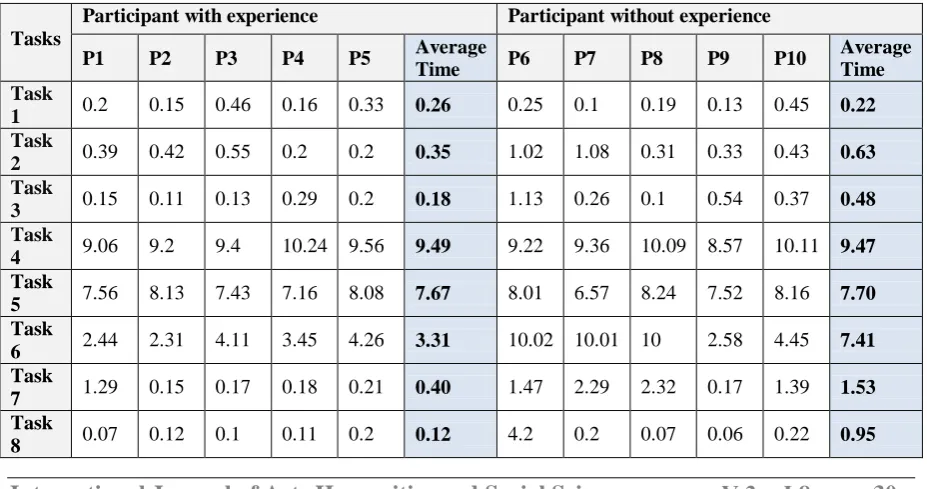
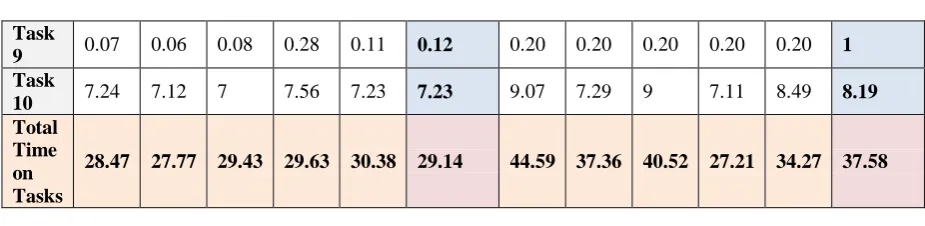
The efficiency of a website is determined by the amount of time taken to complete a given task. As shown in Table 2 the average time to complete all the tasks for participants with experience was29 minutes and 14 seconds, and the average time to complete all the tasks for participants without experience was 37 minutes and 58seconds. Further, it can be observed that the time period between the longest and the shortest task for participants with experience was 7 minutes and 45 seconds, and the time period between the longest and the shortest task for participants without experience was 7 minutes and 45 seconds. The average time is taken to complete each task ranged between 24 seconds to 8 minutes and 09 seconds. From table 2 below, participant 9 was the fastest in completed all the tasks while participant 6 was the slowest, registering a time of 44 minutes and 59 seconds. From this, it can be concluded that participant 9 was more efficient in using the website. All the participants were completed task 8 below 1-minute and participant 6 was completed the taskin 4 minutes and 20 seconds. Finally, task 6 was fairly difficult for 3 participants due to the fact they take a long time to complete the task, but the rest of the participants were able to complete the task below the average time of 7 minutes and 41 seconds.
Tasks
Participant with experience Participant without experience
P1 P2 P3 P4 P5 Average
Time P6 P7 P8 P9 P10
Average Time
Task
1 0.2 0.15 0.46 0.16 0.33 0.26 0.25 0.1 0.19 0.13 0.45 0.22 Task
2 0.39 0.42 0.55 0.2 0.2 0.35 1.02 1.08 0.31 0.33 0.43 0.63 Task
3 0.15 0.11 0.13 0.29 0.2 0.18 1.13 0.26 0.1 0.54 0.37 0.48 Task
4 9.06 9.2 9.4 10.24 9.56 9.49 9.22 9.36 10.09 8.57 10.11 9.47
Task
5 7.56 8.13 7.43 7.16 8.08 7.67 8.01 6.57 8.24 7.52 8.16 7.70 Task
6 2.44 2.31 4.11 3.45 4.26 3.31 10.02 10.01 10 2.58 4.45 7.41 Task
7 1.29 0.15 0.17 0.18 0.21 0.40 1.47 2.29 2.32 0.17 1.39 1.53 Task
Task
9 0.07 0.06 0.08 0.28 0.11 0.12 0.20 0.20 0.20 0.20 0.20 1 Task
10 7.24 7.12 7 7.56 7.23 7.23 9.07 7.29 9 7.11 8.49 8.19 Total
Time on Tasks
28.47 27.77 29.43 29.63 30.38 29.14 44.59 37.36 40.52 27.21 34.27 37.58
Table 2: Efficiency rates
3.1 The difference in experienced and non-experienced users in terms of effectiveness and efficiency
3.1.1 Effectiveness
The difference in effectiveness between the two participants groups was based onthe success rates of completing tasks using myON. The experienced users were effective in using myON, with all the participants having 100% completion rate. On the other hand, the non-experienced users demonstrated 94% completion rate of the tasks.
Despite the failure of a few of the non-experienced users (3 users) to effectively complete their tasks, the high completion rate in the two groups illustrates that the application was effective in enabling the participants to complete tasks.
3.1.2 Efficiency
The efficiency was determined by the amount of time taken to complete a given task. The difference between the two participant groups was observed in the average time taken to complete all the tasks. The average time used by the experienced users was 29 minutes and 14 seconds, while the non-experienced users took 37 minutes and 58 seconds.
However, the two groups of participants had a similarity in the time period between the longest and the shortest task at 7 minutes and 45 seconds.
4.1 User Satisfaction Survey Results
For this usability test, we obtained the user satisfaction using the standard SUS survey. The outcome of the survey indicated that the mean SUS score for this usability test was 77.3 which is higher than 68. The overall SUS score was above average, this score indicates that the majority of the participants were satisfied with the website in enabling them to complete their tasks.
5.1 Interview Results
In order to get more information and data from the participants to test the website. Post-test questions were conducted to understand the user's experiences, how they felt about the website and to certain aspects not covered in the tasks questions. All the participants agreed that the website was fun, easy and good for kids to read the different book online. 6 out of 10 participants found that task number 6 was the most difficult task, which 3 of them failure to complete it. However, 4 participants found that task number 3 was the easiest task and that because the navigation was clear and easy to use. One of the participants claimed that “I don’t know why… when I used the search engine to search for a book to read, it does not come first”, and because of that most of participants took a long time tried to found a book.
V. Discussion
It can be observed that some of the tasks were more confusing for the participants and as such, some of the participants were not able to successfullycomplete their tasks. For instance, in task 6 three participants were unable to complete this task and they felt the website was not clearly designed. The participants have to click on Library navigation, this takes them to the library page, and the students have to scroll down of the page to see the Because I Like navigation that hasa drop down menu. Even some of the students who have experience using myON found the task difficult in the beginning, but then they completed it. We recommend to redesign one of the search engines in the website and replace it with a drop down menu, as to ensure that all the key features are visible at the top of the page so that users do not have a problem navigating through pages.
having to scroll down the page in order to get to the scroll down menu, we will ensure that all the key features are visible at the top of the page to facilitate ease of navigation through pages.
A total of ten participants have a split-attention effectin the search enginewhen they completed the tasks, and that happened when the users had to split their attention between multiple navigations that have the same link information. In order to avoid the split-attention effect, it is recommended to redesignand change one of them to a drop down menu.That way the students can search and trace all the books contained in the database so that users do not face any problem in getting the books that they need.
Moreover, some participants suggested that if the timer starts when the users start reading the book,they can know how much time was spent during reading a book.
The difference in effectiveness rates with the experienced and non-experienced users is also determined. The participants with previous experience with myON completed all the tasks successfully where participants without any previous experience with my on completed 94% of the tasks successfully. Although 94% of success is considerably high in user experience research, very first time users should gain more experience with the myOn to increase the success rates. As it is mentioned above some of the reasons to failure are design problems, navigation issues and mislabeling.
In addition, the efficiency rates shown that the experienced users are completed the tasks spending less timethan non-experienced users, which indicated that non-experienced users need more assistance to discover the site structure and efficiently use the website.
The overall SUS score was above average, this score indicates that the majority of the participants were satisfied with the website in enabling them to complete their tasks. However, given that the score was not perfect, it illustrates the need for modifications on the website, which are captured in the recommendations. The results from this survey also indicated that the overall learnability was 57.5, indicating that the participants were not fully conversant with how to use the website. The majority of the participants still required guidance on how to use the website.
VI. Conclusion
myON is a digital book library that is designed to meet the interests of every individual learner. Also, itprovides the necessary information that teachers and parents need to monitor and evaluate student progress in reading. Therefore, a usability evaluation for the website is very important to determine the usability of the web services.
This research project has evaluated the effectiveness, efficiency, and satisfaction of students using myON website by applying the task test with a think aloud protocol, system usability scale satisfaction survey, semi structured interview, and the observation by the researchers.
The efficiency scores show that the average time to complete all the tasks for participants with experience was 29 minutes and 14 seconds, and the average time to complete all the tasks for participants without experience was 37 minutes and 58 seconds with a failure. The split-attention effect in the search engine was the main factor that effected the users to complete the tasks successfully, and that happened when the users had to split their attention between multiple navigations that have the same link information.
Moreover, the effectiveness rate of a website indicated that the average time to complete all the tasks for participants with experience was 100%, and the average time to complete all the tasks for participants without experience was 94%. It can be noted that three participants without experience were not able to complete task 6 which required them to search for the 3rd book to read under the “Because I like Seasons and Weather”. It was observed that even some of the participants who had experience on how to use myON found it challenging to complete the task at the beginning. All the other tasks except task 6 experienced a 100% completion rate.
On the other hand, the overall SUS score for this usability test was 77.3, which is above the average of 68. This score indicates that the majority of the participants were satisfied with the website in enabling them to complete their tasks.
The fact that there was a common consensus among the participants that myON was fun, easy, and appropriate for students to read different books online. Also, when wecompared the usability testing between two groupswedid notfind any differences in efficiency, effectiveness, and satisfaction rates because all the participant'sscores were close to each other regardless of their previous experience with the myON.
References
[1] N, Syed. (2017). Internet-Users and Internet Non-Users Attitude towards Research: A Comparative Study on Post-Graduate Students. Journal of Education and Practice.8(1), 1-9.
[2] Radich, J. (2013). Technology and interactive media as tools in early childhood programs serving children from birth through age 8. Every Child, 19(4), 1-15.
[3] McDowell, M., Lytle, M.,&Rafail, J.(2016). Guidelines for Publishing Information Online. Retrieved from https://www.us-cert.gov/ncas/tips/ST05-013
[4] Biancarosa, G., & Griffiths, G. G. (2012). Technology tools to support reading in the digital age. The Future of Children,22(2),139-160.
[5] Brekhus, T. (2011). Building Proficiency Through Personalized Reading: Capstone Digital’s myON reader. Retrieved from
https://about.myon.com/sites/default/files/attached/Building-Proficiency-through-Personalized-Reading.pdf
[6] Demir, F., Ahmad, S., Calyam, P., Jiang, D., Huang R.,&Jahnke, J. (2017). A next-generation augmented reality platform for mass casualty incidents (MCI). Journal of Usability Studies, 12(4), 193-214.
[7] Demir, F., Karakaya, M., &Tosun, H. (2012). Research methods in usability and interaction design: Evaluations and case studies (2nd ed.). Germany: Lambert Academic Publishing.
[8] MyON, (2018). MyON. Retrieved from https://about.myon.com/what-is-myon
[9] Brook, J. (1986). SUS-A quick and dirty usability scale.Retrieved fromhttps://hell.meiert.org/core/pdf/sus.pdf