Original Research Article
Assessment of nutritional status in chronic obstructive airways disease
patients in a tertiary care hospital at Himachal Pradesh, India:
a cross sectional study
Balbir Singh
1, Pramod Shridhar
1*, Kamaljit Singh
2, Rajesh Garg
3,
Herleen Pabla
4, Ena Sharma
5INTRODUCTION
Chronic obstructive pulmonary disease (COPD) is an important and growing cause of morbidity and mortality worldwide. The WHO Global Burden of Disease Project estimated that COPD was the fifth leading cause of death worldwide in 2001 and will be the third leading cause by 2020. The growing burden of COPD is partly due to the
ageing of the world's population and partly to the continued use of tobacco, which is the most important risk factor for this disease. The reported prevalence of COPD is highly variable ranging from 0.2% in Japan to 37% in the United States. According to the 12-site Burden of Obstructive Lung Disease (BOLD) study, the average prevalence of COPD is 10.1%, with wide variations.1 The estimated burden of COPD in India is about 15 million cases. These figures may however
ABSTRACT
Background: Chronic obstructive pulmonary disease (COPD) is a major cause of morbidity and mortatlity worldwide. Malnourishment in COPD patients is very common and is a prognostic factor in its treatment. The present study has been conducted to assess nutritional status in COPD patients and its correlation with severity of disease.
Methods: This institutional based analytical cross sectional study was conducted in the Department of Pulmonary Medicine at tertiary care hospital in Himachal Pradesh (India) from 1 Dec 2017 to 31st May 2018. A total of 52 COPD participants attending the pulmonary Medicine OPD and fulfilling the inclusion criteria were enrolled.
Results: All participants reported being smoker since long with the mean years of smoking since 31 years and about 13.6 cigarettes being smoked per day. 22 (42%) of the participants were undernourished as per BMI criteria But when compared with MUAC criteria, a large number 38 (73%) came out to be undernourished. haemoglobin and cholesterol levels were less in patients with severe diseases than mild and moderate category (76.9%).
Conclusions: The malnourishment and severity of the disease has direct correlation. More the severity of COPD, more is the malnourishment. Biochemical parameters, although not deranged significantly in any group, but more on the lower side in patients with severe COPD. There is a need for regular nutritional assessment of every COPD patient and recommendation of supplementary food for them.
Keywords: COPD, Malnourishment, Body mass index, Mid-arm upper circumference, Anthropometry
1
Department of Respiratory Medicine, MM Medical College, Kumharhatti, Solan, Himachal Pradesh, India Department of Community Medicine, 2Dr YSP Government Medical College, Nahan, Himachal Pradesh, 3Kalpana Chalwa Government Medical College, Karnal, Haryana, 4Government Medical College and Hospital, Sector 32, Chandigarh,India
5
Department of Periodontics, MM Dental College, Mullana, Ambala, Haryana, India
Received: 17 June 2019
Accepted: 19 July 2019
*Correspondence:
Dr. Pramod Shridhar,
E-mail: [email protected]
Copyright: © the author(s), publisher and licensee Medip Academy. This is an open-access article distributed under the terms of the Creative Commons Attribution Non-Commercial License, which permits unrestricted non-commercial use, distribution, and reproduction in any medium, provided the original work is properly cited.
underestimate the true burden since questionnaire based prevalence rates tend to underestimate the true spirometry-based prevalence of COPD.2
Nutritional status disorders pose a serious problem, which concerns about 1/5 of the COPD population. Body mass index <20 is shown to be a predictive factor for hospitalization in COPD.3 Patients with COPD often lose weight and, depending on the population studied and the indicator used to determine the nutritional status, between 19-60% of patients are classified as malnourished.4 The reasons of loss of weight, and fat mass are unambiguous.
Enhanced metabolic rate and decreased caloric
consumption among patients may play an important role in it. Other critical factors are tissue hypoxia, release of systemic inflammatory mediators, oxidative stress, drugs, and sedentary life. The occurrence of malnutrition is lethal to COPD patients, leading to respiratory failure due to decreased respiratory muscle strength, and decreased immunity.5,6 Malnutrition directly affects both the respiratory muscles and the lung parenchyma, thereby contributing to worsening of the underlying disease.7 Previous studies had documented increased COPD-related mortality rates in underweight and normal-weight patients than in overweight and even obese patients.8
The high prevalence of weight loss, muscle and fat mass wasting in COPD patients suggests that effective nutritional screening must be implemented to detect and treat nutritional problems, to minimize COPD-related medical care costs, to improve the patients’ health and to ameliorate their quality of life. Therefore the present study will be conducted to assess nutritional status in COPD patients and its correlation with severity of disease.
METHODS
Study area: Maharishi Markendeshwar Medical College and Hospital, Kumharhatti, Solan (HP).
Study population: Patients of COPD attending to Pulmonary Medicine OPD of MMCH, Solan.
Study period: 1 December 2017 to 31 May 2018.
Study design: Institutional based analytical cross sectional, interventional study.
Study size and sample
A total of 52 COPD participants attending the pulmonary Medicine OPD (including patients who were admitted later) of MMMCH, Solan were enrolled in the study.
Study tools and techniques
Participants were classified according to smoking status.
Current smokers: who have smoked regularly with 1 month prior to examination.
Non-smokers: who have never smoked and subjects occasionally have smoked.
Ex-smokers: who have stopped more than 1 month prior to examination.
Smoking index was defined as number of cigarettes smoked multiplied by duration smoked in years. Pack years was calculated from the average number of cigarettes smoked per day in a year. One pack year was calculated as smoking of 20 cigarettes per day for one year.
All patients underwent the Spirometry test with a trained technician. The participants were instructed not to use bronchodilator on the day of pulmonary function assessment. All patients were investigated in a sitting position. The highest values from at least three technically acceptable Spirometic manoeuvres were taken to calculate Forced Vital Capacity (FVC) and Forced Expiratory Volume in First Second (FEV1).
Measurements of body composition were used to assess nutritional status in COPD patients and its correlation with severity of disease. Nutritional status was assessed
by anthropometric and biochemical indices. In
Anthropometric indices, body weight was taken nearest to 0.1 kg with participants standing barefoot and in light clothing. Height was measured by anthropometric rod in bare or stocking feet. Mid upper arm circumference (MUAC) was measured on the left side to the nearest 0.1 cm with a non-stretchable tape midway between Olecranon and Acromion. Body Mass Index (BMI) which was defined as weight (kg) divided by the square of height (meters). Criteria for under nutrition considered were BMI less than 18.5 kg/m2.9 Similarly MUAC measurement of less than 24 cm was taken as cut off for labelling as under nutrition.10
In addition, to calculate biochemical indices, blood samples were analyzed for haemoglobin, albumin, total protein and cholesterol. Normal ranges accepted for these parameters biochemistry were-Haemoglobin: 12-16 g/dl, Albumin: 3.5-5.3 g/l, total protein: 6.4-8.3 g/l and cholesterol: 150-200 mg/dl.
A pre tested semi-structured questionnaire was designed to collect the information from participants. The Principal Investigator had asked the questions, observed the findings and documented the response in the proforma. The questionnaire was piloted among the few participant groups before finalization.
Statistical analysis
The data collected was entered in an Excel spread sheet. Chi-square test, proportions, percentages mean and other appropriate statistical tests were applied to analyse the data to identify important relationships between variables and determine the level of significance. P<0.05 will be considered as significant.
Inclusion criteria
All clinically diagnosed COPD patients by a pulmonary specialist as per Indian COPD guidelines were subjected to spirometry test. Post brochodilator FEV1/FVC<0.7 was used as the criteria of COPD guidelines and the severity of disease was determined as mild when post bronchodilator FEV1 (% predicted) was ≥ 80, moderate when 50-79 and severe when <50.2
Exclusion criteria
Patients with history of recent surgery (major) and trauma (major) or with concomitant disease that might alter nutritional status (heart disease, cirrhosis, diabetes, thyroid disorders, pregnancy, malignancy, chronic renal failure) were excluded from the study.
Ethical clearance
The study project was approved by the Institutional Ethics Committee (IEC), Maharishi Markendeshwar Medical College and Hospital, Kumharhatti, Solan (HP). The confidentiality has been maintained and the information thus obtained has not been used for any other purpose except for academic purposes.
RESULTS
A total of 52 participants were enrolled for the study, out of which 81% were males. All of them were from rural background. This might be due to the location of the hospital in a remote village area where maximum patients came from rural areas. The mean age observed was 60.1 years. Majority of the participants were farmers and labourers (96%). The education level of respondents was very low with only 11% of respondents were having education level metric and above (Table 1).
When enquired about the smoking history, all participants reported being smoker since long with the mean years of smoking since 31 years and about 13.6 cigarettes being smoked per day (Table 2).
Table 1:Socio-demographic profile of the respondents.
Characteristic Number %
Gender
Male 42 80.7
Female 10 19.3
Total 52 100
Residence
Urban 0 0
Rural 52 100
Total 52 100
Occupation
Farmer 32 61.5
Labour 18 34.6
Retired 1 2
Unemployed 1 2
Total 52 100
Marital status
Married 52 100
Unmarried 0 0
Total 52 100
Education
Illiterate 10 19.3
Primary 36 69.2
Matric 5 9.5
Graduate 1 2.0
Total 52 100
Religion
Hindu 52 100
Others (Sikh, Muslim,
Christian) 0 0
Total 52 100
History of Smoking
Smokers 52 100
Non smokers 0 0
Total 52 0
Table 2:Exposure to smoke (n=52).
Smoking details Average±SD
Average number of cigarettes smoked/day
13.6±5.1
Average number of years smoked 31±10.7
Smoking Index
Mild 457.1±205.3
Moderate 325.0±106
Severe 417.3±185.2
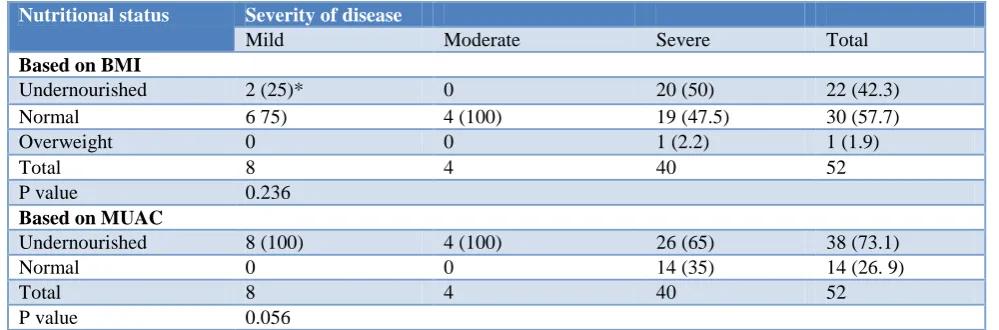
When the anthropometric results were co-related with the severity of the disease, it was observed that BMI was lowest in those participants who were having severe disease (77%). This means that as the severity of the
disease increased, the BMI tends to decrease in those patients. In case of MUAC, again 77% participants were having low MUAC findings as compared to those with moderate disease (Table 4).
Table 3:Relation between under nutrition and severity of disease.
Nutritional status Severity of disease
Mild Moderate Severe Total
Based on BMI
Undernourished 2 (25)* 0 20 (50) 22 (42.3)
Normal 6 75) 4 (100) 19 (47.5) 30 (57.7)
Overweight 0 0 1 (2.2) 1 (1.9)
Total 8 4 40 52
P value 0.236
Based on MUAC
Undernourished 8 (100) 4 (100) 26 (65) 38 (73.1)
Normal 0 0 14 (35) 14 (26. 9)
Total 8 4 40 52
P value 0.056
*Figures in parenthesis are proportions.
Table 4:Correlation between anthropometry and severity of disease.
Anthropometric measurement Severity of disease
Mild Moderate Severe Total P value
Number of patients 8 4 40 52
BMI (Mean±SD) 20.2±4.2 21.6±2.7 19.0±4.1 19.4±4.6 0.396
MUAC (Mean±SD) 21.0±0.8 23.0±0 21.6±5.7 21.6±5.0 0.766
Table 5:Biochemical indicators and severity of disease.
Biochemical indicator Severity of disease
Mild Moderate Severe Total P value
Number of patients 8 4 40 52
Haemoglobin (Mean±SD) 14.0±1.2 15.0±0 13.6±1.6 13.7±1.5 0.193
Total Protein (Mean±SD) 6.8±0.5 7.3±0.3 6.9±0.9 6.9±0.8 0.600
Albumin (Mean±SD) 3.5±0.4 3.9±0.3 3.8±0.6 3.8±0.5 0.346
Cholesterol (Mean±SD) 174.8±18.9 158.0±9.9 155.0±32.7 158.0±30.1 0.247
Table 5 depicts the biochemical changes according to the severity of disease. Haemoglobin and cholesterol level seems not be deranged in the study participants but haemoglobin and cholesterol levels were less in patients with severe diseases than mild and moderate category (76.9%).total protein and albumin levels were within normal limits irrespective of severity of the disease.
DISCUSSION
The COPD seems to more in farmers and labourers as none of the patient enrolled in the study was from professional or service sector. Maximum of the respondents were either illiterate or educated up to primary level. All of the respondents were heavy smokers. Malnutrition was observed in about half of the patients. Pirabbasi et al reported malnutrition was more
prevalent (52.4%) in the subjects with severe stages of COPD as compared to mild and moderate COPD stages (26.2%).11 Similar findings were observed by Ahmedi et al that the mean BMI of the severe group was significantly lower than the controls.12
in all groups of patients with different level of severity but in severe COPD group this was observed to be on lower side indicating potential biochemical derangements in this group.
CONCLUSION
The malnourishment and severity of the disease has direct correlation. Education and occupation seems to have important role to play in the etiology and severity of the disease. More the severity of COPD, more is the malnourishment. Biochemical parameters, although not deranged significantly in any group, but more on the lower side in patients with severe COPD.
Recommendations
There is a need for regular nutritional assessment of every COPD patient both in out-patient and indoor patient department. Nutritional counselling by a dietician in a tertiary care setting and by the physician in single set up should be a regular and mandatory feature of COPD management. Nutritional counselling of the patient and their attendants should be conducted during treatment. If possible, provision of supplementary food for the COPD patients could be thought for on the similar lines as that of tuberculosis patients.
Funding: No funding sources Conflict of interest: None declared
Ethical approval: The study was approved by the Institutional Ethics Committee
REFERENCES
1. Buist AS, McBurnie MA, Vollmer WM, Gillespie S, Burnie P, Mannino DM, et al. International variation in the prevalence of COPD (the BOLD Study): a population-based prevalence study. Lancet. 2007;1:370(9589).
2. Gupta D, Agarwal R, Aggarwal AN, Maturu VN, Dhooria S, Prasad KT, et al. Guidelines for diagnosis and management of chronic obstructive
pulmonary disease: Joint ICS/NCCP (I)
recommendations. Lung India. 2013;30(3):228-67. 3. Yuceege MB, Salman SO, Duru S, Saygıdeğer Y,
Sonmez Z, Ardıç S. The evaluation of nutrition in male COPD patients using subjective global assesment and mini nutritional assesment. Int J Internal Med. 2013;2(1):1-5.
4. Hunter AM, Carey MA, Larsh HW. The nutritional
status of patients with chronic obstructive
pulmonary disease. Am Rev Respir dis.
1981;124(4):376-81.
5. Schols AM, Fredrix EW, Soeters PB, Westerterp KR, Wouters EF. Resting energy expenditure in patients with chronic obstructive pulmonary disease. Am J Clin Nutr. 1991;54(6):983-7.
6. Goldstein S, Askanazi J, Weissman C, Thomashow
B, Kinney JM. Energy expenditure in patients with chronic obstructive pulmonary disease. Chest. 1987;91(2):222-4.
7. Sinde F, Gronberg AM, Engstrom CP, Rossander-
Hulthen L, Larsson S. Individual dietary
intervention in patients with COPD during multidisciplinary rehabilitation. Respir Med. 2002;96(5):330-6.
8. Gray-Donald K, Gibbons L, Shapiro SH, Macklem PT, Martin JG. Nutritional status and mortality in chronic obstructive pulmonary disease. Am J Respir Crit Care Med. 1996;153(3):961-6.
9. WHO: Technical Report Series no. 916. Geneva; 2003.
10. Tang AM, Chung M, Dong K, Wanke C, Bahwere A, Bose K, et al. Determining a global mid upper arm circumference cutoff to assess underweight in adults (men and non-pregnant women). Food and Nutrition Technical Assistance; 2017: 42.
11. Pirabbasi E, Najafiyan M, Cheraghi M, Shahar S, Manaf ZA, Rajab N, et al. Factors of Nutritional Status of Male Chronic Obstructive Pulmonary
Disease Patients. Int Scholarly Res Notices, 2012. Available at: https://www.hindawi.com/journals
/isrn/2012/782626/. Accessed 27 August 2017. 12. Ahmadi A, Haghighat N, Hakimrabet M, Tolide-ie
H. Nutritional Evaluation in Chronic Obstructive Pulmonary Disease Patients. Pak J Biol Sci. 2012;15(10):501-5.
13. Fernandes AC, Bezerra OM de PA. Nutrition
therapy for chronic obstructive pulmonary disease and related nutritional complications. J Bras Pneumol 2006;32(5):461-71.
14. Park SK, Richardson CR, Holleman RG, Larson JL.
Frailty in people with COPD, using the National Health and Nutrition Evaluation Survey dataset (2003–2006). Heart & Lung J Acute Critical Care. 2013;1:42(3):163-70.
Cite this article as: Singh B, Shridhar P, Singh K, Garg R, Pabla H, Sharma E.Assessment of nutritional status in chronic obstructive airways disease patients in a tertiary care hospital at Himachal Pradesh, India: a cross sectional study. Int J