http://www.ijcmph.com pISSN 2394-6032 | eISSN 2394-6040
Original Research Article
Incidence, nature and causality assessment of cutaneous adverse
reactions to cosmetics: a pilot study
Fatma Al Mulla
1, Sathvik Belagodu Sridhar
1*, Atiqulla Shariff
1, Ghada Abu Al Hassan
2INTRODUCTION
For many decades, cosmetics are one of the commonly used products on a regular basis for enhancement of physical appearance.1 According to Federal Food, Drug, and Cosmetic Act (FD & C Act) pastes, soaps, cleansing shampoos, perfumes, lipsticks, skin moisturizers, perfumes, baby care products, lipsticks, nail polishes, makeup removers, eye and facial makeup preparations, cleansing shampoos, hair colors, permanent waves,
deodorants and hair dyes etc. are categorized under cosmetics.2
Despite of its safety and tolerability, adverse reactions (ARs) to cosmetics are common & underreported. 3 Women are at higher risk of acquiring allergic reactions to cosmetic ingredients than men, due to greater product usage rate.4-6 The reported incidence rate of cosmetics related ARs vary from 8 to 26%.7,8 Dermatological system or skin is one of the most commonly affected
organ systems due to ARs. 9 The most common cutaneous
ABSTRACT
Background: Adverse reactions (ARs) are one of the most important causes of morbidity, hospitalization and increased healthcare cost. ARs to cosmetics are often underreported. The aim of our study was to assess the incidence, nature, causality and the outcome of ARs to cosmetics.
Methods: This was a prospective observational study conducted in a dermatology outpatient clinic of a secondary care hospital of UAE. All the patients with suspected AR to cosmetics and reporting to dermatology clinic were included. The required data were collected from patient case files, patients and their caretakers. The Colipa causality scale was used to assess the causality of reported ARs.
Results: The incidence of cutaneous ARs to cosmetics was 1.58%. Shampoo was the most common [7 (16.6%)] type
of cosmetic suspected to cause AR, followed by face cream [6 (14.2%)]. The most common cutaneous AR to cosmetics observed in our study was rash and pruritus [13 (30.9%)] followed by itching [10 (23.8%)]. The majority of the cutaneous ARs in our study were on scalp, face and lower limbs each contributing about 21.4%. Causality assessment reveals that 16 (38%) of the cutaneous ARs were very likely type, while 25 (60%) of ARs were of not clearly attributable to use of cosmetic/s.
Conclusions: Good number of the adverse reactions documented were mild in nature. Majority of the adverse reactions were not clearly attributable type. The results of this study can form a basis for creating awareness regarding the most common cosmetics associated with ARs. The study fosters the role of initiating cosmetovigilance activities.
Keywords: Cutaneous adverse reactions, Cosmetics, Cosmetic allergy, Cosmetovigilance
1
Department of Clinical Pharmacy and Pharmacology, RAK College of Pharmaceutical Sciences (RAKCOPS), RAK
Medical and Health Sciences University (RAKMHSU), Ras Al-Khaimah, UAE
2
Dermatologist, Department of Dermatology, Umm al Quwain, UAE
Received: 03 April 2019
Revised: 20 April 2019
Accepted: 22 April 2019
*Correspondence:
Dr. Sathvik Belagodu Sridhar, E-mail: [email protected]
Copyright: © the author(s), publisher and licensee Medip Academy. This is an open-access article distributed under the terms of the Creative Commons Attribution Non-Commercial License, which permits unrestricted non-commercial use, distribution, and reproduction in any medium, provided the original work is properly cited.
reactions reported for skin and hair care cosmetics include allergic contact dermatitis, urticaria, cheilitis, angioedema, acne, itching, photo contact or photo allergic reaction, even deaths have been reported for certain skin or hair care products.7,8,10
ARs or any untoward reaction can occur due to application of a wide variety of branded and non-branded cosmetic products available in the market and can also partly occur due to the lack of appropriate information regarding the safe usage practices of the cosmetics.11,12 Majority of the time, the allergic reaction occurs due to the presence of allergens in the cosmetics.13
In developed countries, there are different systems do exist for reporting ARs to cosmetics.14 There is a good number of studies conducted in the western world with respect to the monitoring and reporting of ARs related to use of cosmetics. However, there are limited numbers of published literature in this regard within the Middle East or South Asian countries. Saudi Arabia and the UAE are home to the world’s highest consumption rates of cosmetics. The UAE market is the second biggest Gulf market where cosmetics sales were around $331.3 million in 2014.3
Cosmetovigilance can play a vital role in alerting the healthcare providers regarding different cutaneous ARs to cosmetics. This type of monitoring and evaluation programs helps in creating awareness or educating the general public regarding appropriate usage of cosmetics and thus protecting the patients from the possible harmful ARs.15,16 Thus this pilot study makes an attempt to determine the incidence, nature, causality and outcome of cutaneous ARs to cosmetics.
METHODS
The current study was a prospective observational study carried out at a dermatology outpatient clinic at Umm AL Quwain hospital, UAE for eight months (November 2015 to June 2016). The required data for the study was collected after obtaining both institutional and regional research and ethics committee approval.
Patients of all the age groups, either visiting or referred to the outpatient clinic with suspected cutaneous ARs after using any type of cosmetics were included in the study. While patients who presented to the dermatology clinic with repeated AR to the same cosmetic or patients who were unable to give a complete medication history or if the cutaneous ARs are not well associated with the cosmetic usage were not included.
For all the patients satisfying inclusion criteria, the required data were collected from the patient case files/prescriptions, treating dermatologists, patients and their caretakers. This information was obtained through/in the presence of the treating dermatologist and
was entered in a cosmetic adverse reaction reporting and documentation form designed for the study.
Various details such as demographic information, history of AR, type of reaction, date of onset, history of cosmetic usage before the development of reaction, treatment given to the patients to manage AR and other relevant information were recorded. The causality assessment of cosmetic related AR was done using Colipa causality assessment scale.17
Once the data collection is over the data was summated and was entered into the Microsoft-excel sheet and the data was analyzed using the Statistical Package for the Social Sciences (SPSS) version 24.0. The categorical data were presented in the form of frequency and percentage.
RESULTS
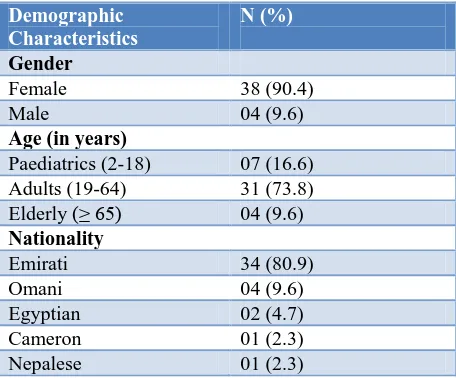
Over a period of eight months a total of 42 cutaneous ARs to cosmetics were reported. Majority [31 (73.8%)] of the study population were adults. Higher incidence of ARs was documented in females 38 (90.4%). The majority (80.9%) of the study population were Emiratis (Table 1). Twenty-two patients (52.3%) amongst 42 who experienced cutaneous ARs to cosmetics had a previous history of allergy to different medications.
The total number of patients experienced ARs to cosmetics were 42 out of 2652 patients who visited the study site during the study period. Hence the incidence rate of dermatological ARs to cosmetics was 1.58% [42/2652×100].
Table 1: Demographic characteristics of study patients (n=42).
Demographic Characteristics
N (%)
Gender
Female 38 (90.4)
Male 04 (9.6)
Age (in years)
Paediatrics (2-18) 07 (16.6)
Adults (19-64) 31 (73.8)
Elderly (≥ 65) 04 (9.6)
Nationality
Emirati 34 (80.9)
Omani 04 (9.6)
Egyptian 02 (4.7)
Cameron 01 (2.3)
Nepalese 01 (2.3)
Table 2: Cosmetics implicated in cutaneous adverse reactions (n=42).
Type of cosmetic product N (%)
Hair dye 03 (7.1)
Face cream 06 (14.2)
Baby skin cream 04 (9.5)
Baby oil 02 (4.7)
Shampoo 07 (16.6)
Soap 05 (11.9)
Body spray 01(2.38)
Peeling cream 01 (2.38)
Massage oil 02 (4.7)
Hair straightener 01 (2.38)
Skin care products 04 (9.5)
Hair remover wax 02 (4.7)
Hand care products 03 (7.1)
Perfume 01 (2.38)
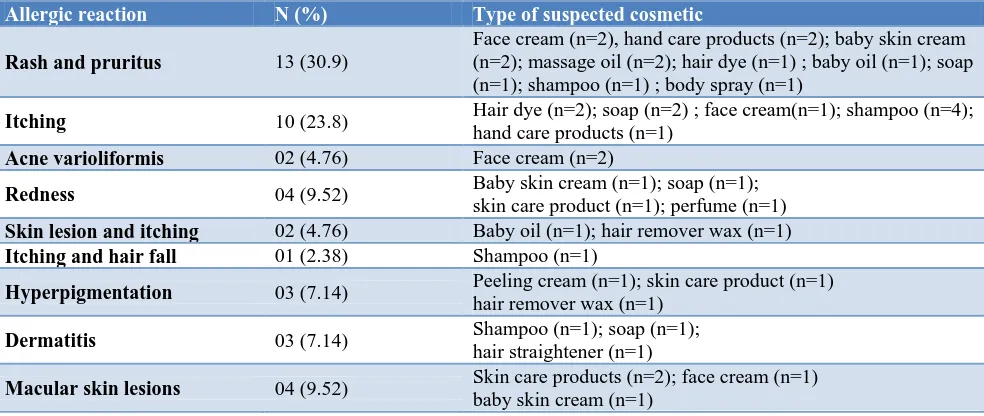
The most common cutaneous ARs to cosmetic were rash and pruritus [13 (30.9%)] followed by itching [10 (23.8%)] (Table 3). Majority of the cutaneous ARs to cosmetics were on “scalp”, “face” and on “lower limbs” each contributing for 9 (21.4%) of ARs, followed by “upper arm” [7 (16.6%)].
The causality assessment using Colipa scale reveals that the majority [25 (60%)] of the cutaneous ARs were categorized to be “not clearly attributable” to use of cosmetics followed by 16 (38%) were “very likely” and one was “excluded”.
In majority [34 (81%)] of the cases the suspected cosmetic was withdrawn. The good percentage [31 (73.8%)] of the ARs were treated symptomatically and 40 (95%) of ARs were recovered (Table 4).
Table 3: Types of cutaneous adverse reaction and associated cosmetic product (n=42).
Allergic reaction N (%) Type of suspected cosmetic
Rash and pruritus 13 (30.9)
Face cream (n=2), hand care products (n=2); baby skin cream (n=2); massage oil (n=2); hair dye (n=1) ; baby oil (n=1); soap (n=1); shampoo (n=1) ; body spray (n=1)
Itching 10 (23.8) Hair dye (n=2); soap (n=2) ; face cream(n=1); shampoo (n=4);
hand care products (n=1)
Acne varioliformis 02 (4.76) Face cream (n=2)
Redness 04 (9.52) Baby skin cream (n=1); soap (n=1);
skin care product (n=1); perfume (n=1)
Skin lesion and itching 02 (4.76) Baby oil (n=1); hair remover wax (n=1)
Itching and hair fall 01 (2.38) Shampoo (n=1)
Hyperpigmentation 03 (7.14) Peeling cream (n=1); skin care product (n=1)
hair remover wax (n=1)
Dermatitis 03 (7.14) Shampoo (n=1); soap (n=1);
hair straightener (n=1)
Macular skin lesions 04 (9.52) Skin care products (n=2); face cream (n=1)
baby skin cream (n=1)
Table 4: Management and outcome of cutaneous adverse reactions to cosmetics (n=42).
Management and outcome N (%)
Fate of suspected cosmetic
Cosmetic withdrawn 34 (81)
No change with suspected cosmetic 08 (19)
Treatment of ARs
Specific 09 (21.4)
Symptomatic 31 (73.8)
No treatment 02 (4.7)
Outcome of cutaneous ARs
Recovered 40 (95)
Unknown 02 (5)
DISCUSSION
There are limited published studies that reported the overall incidence of ARs to cosmetics. The incidence of
products.18 While a study conducted by Dhavalshankh et
alreported 72% cutaneous ARs secondary to use of hair
dye. 19 Whereas an epidemiological study conducted in the UK reports the incidence to be 23% in women and 13.8% in men.20 Findings of these studies are inconsistent with an incidence of ARs to cosmetics in our study.18,19 This vast difference in incidence of ARs to cosmetics could be because of the difference in the study design, sample size, and type of study population included. Such as in a study conducted by Lindberg et al, investigators included around 1075 patients attending the patch test clinics, it means patients referred to these clinics have had at least one episode of AR to cosmetic in the past. In addition, this study included patients from four different patch test clinics in Sweden; in contrast, our study was a single center observational study.18
Higher incidence of ARs documented in females in our study. Similar findings were observed in other studies which reported incidence rate of 23.8% to 74.9% in the female population. 4,18,20-22 The high incidence of ARs to cosmetics in females could be due to more frequent use of cosmetics and skincare products by women compared to men and may also due to higher skin sensitivity. In addition, high level of concern about their skin may result in more number of dermatology clinic visits by female compared to males.
A good number of our study population had experienced at least one episode of cutaneous AR to cosmetics in the past and hence were at higher risk of development of ARs to cosmetics compared to those who do not have a previous allergic history. This observation is consistent with a study conducted in Sweden, where individuals who were positive for patch test reactions, had more frequent skin reactions to cosmetics compared to those who were having a negative response to patch test.18 Our observations are also consistent with Willis et al study where individuals with sensitive skin (who had a history of previous allergy) suffered more cosmetic induced skin discomfort compared to those with non-sensitive skin.4
Shampoo was the most common type of cosmetic suspected to cause AR in our study population, followed by face cream and soap. In contrast, a survey based study conducted by Dhavalshank et al reported ARs only to use of hair dye.19 This can suggest that cosmetic implicated in causing ARs always depends on the type of study population (such as gender, male or female, different age groups like pediatric, adults or geriatrics) and their choice of cosmetic use. On the other hand, the study conducted in North America reported fragrances, preservatives, lanolin and lanolin derivatives as the most common causative agents.23 In another study conducted in Sweden, the top-ranking product category suspected to cause ARs were moisturizers followed by hair care products and nail products. 24 In a retrospective study, females attributed most common ARs to soap, facial creams, deodorant, shampoo and eye shadow, whereas males reported ARs to soap, aftershave, deodorant and shower foam. 25
Sportiello et al reported facial care products, followed by body care products, perfumes and eye care products as the causative cosmetics in their study.26 Similarly, soap, shampoo and deodorants were the causative agents in the study published by Huf et al.27
The most common cutaneous AR to cosmetics observed in our study were rash with pruritis and itching. Itching was the most common skin discomfort experienced by female population in a study conducted by Willis et al.
that resembles the observations of our study. 20
Eczematous reactions with redness, scaling and itching were the most common cutaneous ARs to cosmetics in an interview based study conducted in a Danish population.21 ARs to cosmetics, most commonly occur either due to type–I hypersensitivity reactions (IgE–
mediated hypersensitivity reactions) or type–IV
hypersensitivity reactions (cell mediated hypersensitivity reactions). Hence the type cutaneous reaction is based on type of hypersensitivity reaction.12
The majority of the cutaneous ARs in our study were on scalp, face and lower limbs. This is because hair dye, shampoo and soap were the most common cosmetics used by our study population. This observation is consistent with many studies. A study conducted by Dhavalshank et al, involved volunteers using hair dye and hair dye dermatitis on scalp were the most common site of AR.19
In a study conducted in North America, dermatologists identified allergic contact dermatitis on the face, eye and upper arm where the causative agents were skin care products, hair preparations and facial makeup products. 23 In a retrospective study conducted by Groot et al, most reactions were localized on the face, followed by hands and the axillae.25 Sportiello et al reported face, including periorbital and perioral area, forehead, ocular mucous membrane and lips, followed by the entire body as the sites of AR to cosmetics in their study population.26
Limited number of published studies have assessed the causality of ARs to cosmetics, this could be due to lack of a standard scale that assess the causality of ARs to cosmetics unlike for assessment of causality of adverse reactions to drugs, we have standard internationally recognized, scales such as WHO causality assessment scale and Naranjo’s algorithm. The main strength of our study was causality assessment of reported ARs. We used Colipa scale to assess the causality of reported ARs to cosmetics in our population.17 A comparative study reported higher sensitivity and specificity compared to other causality assessment scales such as post launch monitoring (PLM).28
Suspected cosmetic was withdrawn in majority of the cases in our study. Similar observations were reported in
a study conducted by Groot et al.,where the majority of
this was the first prospective study, which documented the different cosmetics contributing for allergic reactions in the local population. In addition, the pharmacist was involved in monitoring of the ARs. The data obtained from this pilot study highlights the importance of initiating cosmetovigilance activity in UAE and also necessitates initiating a local cosmetovigilance program in near future.
The main limitation of our study that, it was of short duration, which limited the number of reported ARs cosmetics. In addition, there were limited numbers of studies available related to ARs to cosmetics, to compare our results with other studies. Our study was a single center study; hence the findings of the study cannot be generalized to UAE population. Most of the ARs reported to dermatology outpatient department were mild in nature and if any ARs, which were serious in nature might have been treated at emergency and inpatient department. In addition, the ARs to cosmetics were not confirmed by evidences such as prick test as performed in few studies or we could not relate it to the specific ingredient present in the cosmetic product.
CONCLUSION
The most commonly associated cosmetic with cutaneous allergic reaction was shampoo. Rash with pruritus and itching were the most commonly documented ARs to cosmetics. The majority of the reactions were not clearly attributable typed. The results of this study will help in creating awareness regarding the most common cosmetics associated with ARs. The study fosters the role of initiating cosmetovigilance activity.
ACKNOWLEDGEMENTS
Our sincere thanks to Dr. Padma GM Rao, Dean, RAKCOPS for all the support and cooperation. Our heartfelt thanks to Dr. Gurumadhva Rao, President of RAKMHSU for all the support, encouragement, and motivation. We thank Medical Director of Umm AL Quwain Hospital and the doctors and staff of Dermatology Department for their kind help and cooperation during the study period.
Funding: No funding sources Conflict of interest: None declared
Ethical approval: The study was approved by the Institutional Ethics Committee
REFERENCES
1. Nigam P. Adverse reactions to cosmetics and
methods of testing. Indian J Dermatol Venereol Leprol. 2009;75(1):10.
2. De Groot AC, White IR. Cosmetics and skin care products. In: RycroftR JG, MenneT, Frosch PJ, Benezra C, eds. Textbook of Contact Dermatitis. Berlin: Springer-Verlag; 1992: 467–468.
3. Khawaja M. Saudi, UAE top world cosmetics
markets. Arabian Gazette. 2012. Available at: http://www.arabiangazette.com/saudi-uae-top-world-cosmetics-markets/. Accessed on May 21, 2018.
4. Willis CM, Shaw S, De Lacharrière O, Baverel M, Reiche L, Jourdain R, et al. Sensitive skin: an
epidemiological study. Br J Dermatol.
2001;145(2):258-63.
5. Thyssen JP, Linneberg A, Menne T, Nielsen NH,
Johansen JD. The prevalence and morbidity of sensitization to fragrance mix I in the general population. Br J Dermatol. 2009;161:95-101.
6. Wolf R, Wolf D, Tüzün B, Tüzün Y. Cosmetics and
contact dermatitis. Dermatol Therapy. 2001;14:181-7.
7. De Groot AC, Beverdam E, Ayong C, Coenraads P,
Nater J. The role of contact allergy in the spectrum of adverse effects caused by cosmetics and toiletries. Contact Dermatitis. 1988;19(3):195-201.
8. Digiovanni C, Arcoraci V, Gambardella L, Sautebin
L. Cosmetovigilance survey: Are cosmetics
considered safe by consumers? Pharmacological Res. 2006;53(1):16-21.
9. Lee A, Thomson J. Drug-induced skin reactions. In:
Lee A, editor. Adverse Drug Reactions. 2nd ed. London, UK: Pharmaceutical Press; 2006: 126-155.
10. Alani J, Davis M, Yiannias J. Allergy to Cosmetics.
Dermatitis. 2013;24(6):283-90.
11. Andrew S. Adverse reactions to cosmetic
ingredients. Dermatologic Clin. 2000;18(4):685-98. 12. Peiser M, Tralau T, Heidler J, Api AM, Arts JH, Basketter DA, et al. Allergic contact dermatitis: epidemiology, molecular mechanisms, in vitro methods and regulatory aspects: Current knowledge assembled at an international workshop in BfR,
Germany. Cellular Molecular Life Sci.
2012;69(5):763-81.
13. Olasode OA. Chemical hair relaxation and adverse outcomes among Negroid women in South West Nigeria. J Pak Assoc Dermatol. 2009;19:203-7.
14. Sautebin LA. Cosmetovigilance survey in Europe.
Pharmacol Res. 2007;55(5):455-60.
15. Edwards IR. The accelerating need for
pharmacovigilance. J R Coll Physicians Lond. 2000;34(1):48-51.
16. Chung MS, Haung WS, Chang YC, Chen YS, Lee
MS, Huang SC, et al. A review of quality surveillance projects on cosmetics in Taiwan. J Food Drug Analysis. 2014;22(4):399-406.
17. Causality Assessment of Undesirable Effects
Caused by Cosmetic Products. Accessed from : https://ec.europa.eu/docsroom/documents/13251/att achments/2/translations/.../native. Accessed on April 18, 2018.
18. Lindberg M, Tammela M, Boström Å, Fischer T,
Swedish Patch Test Clinics. Acta Dermato-Venereologica. 2004;84(4):291-5.
19. Dhavalshankh A, Dhavalshankh G.
Cosmetovigilance: the study of prevalence & vigilance of adverse cutaneous reactions in hair dye users. Int J Biol Med Res. 2012;3(2):1704–7. 20. Kasemsarn P, Kulthanan K, Tuchinda P, Dhana N,
Jongjarearnprasert K. Cutaneous reactions to
non-steroidal anti-inflammatory drugs. J Drugs
Dermatol. 2011;10(10):1160-7.
21. Sosted H, Hesse U, Menne T, Andersen K, Johansen
J. Contact dermatitis to hair dyes in a Danish adult population: an interview-based study. Br J Dermatol. 2005;153(1):132-5.
22. Warshaw E, Buchholz H, Belsito D, Maibach H,
Fowler J, Rietschel R, et al. Allergic patch test reactions associated with cosmetics: Retrospective analysis of cross-sectional data from the North American Contact Dermatitis Group, 2001-2004. J American Acad Dermatol. 2009;60(1):23-38.
23. Eiermann H, Larsen W, Maibach H, Taylor J,
Maibach H, Adams R et al. Prospective study of cosmetic reactions: 1977-1980. J American Acad Dermatol. 1982;6(5):909-17.
24. Berne B, Bostrom Å, Grahnen A, Tammela M.
Adverse effects of cosmetics and toiletries reported
to the Swedish Medical Products Agency 1989-1994. Contact Dermatitis. 1996;34(5):359-62.
25. Groot AC, Nater JP, Lender R, Rijcken B. Adverse
effects of cosmetics and toiletries: a retrospective study in the general population. Int J Cosmet Sci. 1987;9(6):255-9.
26. Sportiello L, Cammarota S, de Portu S, Sautebin L.
Notification of undesirable effects of cosmetics and toiletries. Pharmacol Res. 2009;59(2):101-6.
27. Huf G, Rito PN, Presgrave RF, Bôas MHSV.
Adverse reactions to cosmetic products and the Notification System in Health Surveillance: a survey. Rev Bras Epidemiol. 2013;16(4):1017-20.
28. Zweers PG, Gilmour NJ, Hepburn PA, Gerritsen
RF, Van Puijenbroek EP. Causality method in cosmetovigilance; comparison of colipa and PLM
versus global introspection. Regul Toxicol
Pharmacol. 2012;63(3):409-17.
Cite this article as: AlMulla F, Sridhar SB, Shariff A, Al Hassan GA. Incidence, nature and causality assessment of cutaneous adverse reactions to