63
The Effect of Impurity of Inert Atmosphere on Synthesis
of Nanostructure TiAl (γ) Alloy by Mechanical Alloying
Process
F. Abbasi Nargesi
*, R. Azari Khosroshahi, N. Parvini Ahmadi
Matrials Engineering Faculty, Sahand University of Technology, Tabriz, I. R. Iran
(*) Corresponding author: [email protected]
(Received:05 Feb. 2012 and Accepted: 20 June 2012)
Abstract:
In this research, the high-energy planetary mill was
employed to produce nanocrystalline Ti-50Al(γ)(at%)
powders. Initial
powders were mechanically alloyed in 99.9999% and 90% purities of
Argon and also Air
atmosphere with alloying times up to 50h. The effect of impurity of Argon atmosphere on the microstructure and
the rate of phase transformation of Ti-50Al were investigated during mechanical alloying and after annealing
at 1000°c. The results showed that the formation of nanostructure TiAl(
γ) phase had directly related to the
impurities of atmosphere in vials. The impurity of the atmosphere could delay the rate of amoprphization during
mechanical alloying and decrease the rate of mechanical alloying process beside some unwanted phases which
were produced in powder mixture. The powder particles produced in the high purity Argon atmosphere seemed
to be finer than those
in the atmosphere. The X-ray patterns, SEM analysis, changes in grain size and DTA test
were studied during mechanical alloying and after annealing.
Keywords:
Titanium Alumindes, Mechanical Alloying, Nanostructure, Atmosphere, Impurity.
1. INTRODUCTION
TiAl based alloys are considered as promising
structural materials for high temperature aerospace
and automotive applications. This is essentially due
to some attractive properties such as low density,
high specific strength, high specific stiffness and
high temperature strength retention [1-4].
However, two major drawbacks remain: brittleness
and poor formability at low temperature [4-6].
Many attempts have been made during recent
decades to overcome these obstacles; one of them
is grain refinement (to nanometer-sized grains).
Mechanical alloying has been used to refine the
grain size and synthesize non-equilibrium structures
[6-8].
The mechanical alloying process is a solid state
powder process where the powder particles are
subjected to high energetic impact by the balls
in vial. As the powder particles in the vial are
continuously impacted by the balls, cold welding
between particles and fracturing of the particles
repeatedly take place during the ball milling process
[9-12].
For the alloying process, several control parameters
have to be considered, namely, environment in the
vial, ball to powder weight ratio and process control
agent.
64
Abbasi Nargesi ,
et al.
The aim of the present work is to study the effect of
Argon atmosphere purity on the microstructure of
Ti-50Al alloy during mechanical alloying and after
annealing at 1000°C for 10min at vacuum furnace.
2. EXPERIMENTAL PROCEDURE
Titanium and aluminum of more than 99.5% purity
and particle size 100-150μm were used as starting
powders to reach Ti-50Al(at%) (γ). The powders
weighed in a glove box with argon atmosphere. The
FP4 planetary mill with two tempered steel bowels
with steel balls was employed in this research. The
capacity of each vial was 250ml. The diameters of
balls were 15 and 20 mm. The vials were designed
to allow pumping and subsequent filling by an
inert gas. Argon atmosphere with 99.9999% and
90% purities and also air atmosphere were studied
in this research. The final gas pressure in the vial
was kept to be 0.1 Mpa. Methanol was used as a
process control agent (PCA). The ball-to-powder
weight ratio and speed of rotation of supporting
disk were 15:1 and 450 rpm, respectively. The
maximum alloying time accumulated was 50h. To
avoid temperature increase, periods of 0.5h were
alternated with an equal rest time. After alloying
time (5 , 10 , 15 , 20 , 30 , 50h), the powders were
withdrawn from the vials for analysis (XRD).
XRD measurements were performed by
Bruker-D8-Advanced, using Cu-K
αradiation at 30kv and
20 mA. Analyses of the powder morphology and
particle size measurements were achieved by Cam
Scan MV-2300 SEM with EDS analyzer at an
accelerating voltage of 25Kv.
The crystallite size and lattice strain of the powder
particles were determined using the X-ray peak
broadening techniques (Scherrer and
Williamson-Hall formulas):
Θ
=
cos
9
.
0
B
d
λ
(1)
Θ
+
=
Θ
0
.
9
sin
cos
λ
η
d
B
(2)
d is the crystallite size, λ is the wavelength of
the X-radiation used , B is the peak width at half
the maximum intensity,
q
Bragg angle and η is
the strain. Some samples were examined after
mechanical treatment by differential thermal
analysis (DTA) L62 HDSC. This test performed
in argon atmosphere. Annealing of samples was
executed by Alcatel CFA-222 vacuum furnace.
3. RESULTS AND DISCUSSION
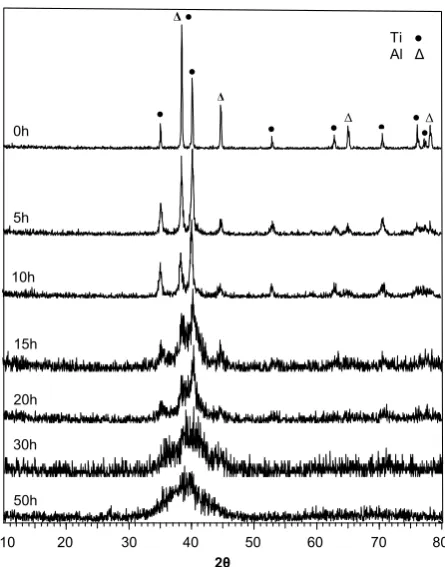
XRD patterns of Ti-50Al (at%) powder blends
that mechanically alloyed in high purity Argon
(99.9999%) atmosphere for several alloying times
are shown in Figure 1.
mA. Analyses of the powder morphology and particle size measurements were achieved by Cam Scan MV-2300 SEM with EDS analyzer at an accelerating voltage of 25Kv.
The crystallite size and lattice strain of the powder particles were determined using the X-ray peak broadening techniques (Scherrer and Williamson-Hall formulas):
cos 9 . 0 B
d (1)
0.9 sin
cos
d
B (2)
d is the crystallite size, λ is the wavelength of the X-radiation
used , B is the peak width at half the maximum intensity, Ө
Bragg angle and η is the strain. Some samples were examined
after mechanical treatment by differential thermal analysis (DTA) L62 HDSC. This test performed in argon atmosphere. Annealing of samples was executed by Alcatel CFA-222 vacuum furnace.
III. RESULTS AND DISCUSSION
XRD patterns of Ti-50Al (at%) powder blends that mechanically alloyed in high purity Argon (99.9999%)
atmosphere for several alloying times are shown in Fig. 1.
The XRD patterns showed that the diffraction intensities drastically decreased and broadened after 5h milling time. The diffraction peaks corresponding to the Al, disappeared at an
early time, indicating the solution of Al in Ti lattice. In Fig. 1,
the metastable solid solution of Al in Ti phase and a little
metastable solid solution of Ti in Al were formed after 10h
milling.
Al is diffused faster in Ti lattice in comparison to Ti in Al lattice [16-18].
The diffraction intensities of Ti is gradually decreased with
increasing the time of milling and observation of shifts in the diffraction angles of Ti to higher angles indicated the formation of a solid solution of Al in Ti and shrinkage of lattice
parameters of Ti. The lattice parameters of the -Ti after M.A
for 10h are approximately a=0.255nm and c=0.467nm whereas those before M.A are approximately a=0.258nm and c=0.470nm so that about 2% volume shrinkage has occurred
which was due to the diffusion of Al into Ti lattice that
promotes the Ti(Al) solid solution.
During mechanical alloying in high purity of Argon
atmosphere, the oxide or nitrogen compounds were not seen in
powder mixture.
Moreover, the diffraction peaks around 2θ=40º can not be separated after an alloying time of 30h.
The formation of an amorphous-like phase or very fine
particles has been strongly enhanced with increasing the
milling time. Amorphization during MA, as a result of
increasing the free energy of system. The continuous decrease in grain size (and consequent increase in grain boundary area) and a lattice expansion would also contribute to the increase in free energy of the system [16, 17].
The amorphous phase and very fine particle was completely formed after 50h milling.
SEM images of Ti-50Al powders that mechanically alloyed at several alloying times in high purity Argon are shown in Fig.
2θ
10 20 30 40 50 60 70 80
0h
15h 5h
10h
20h
50h 30h
Ti ●
Al ∆
Δ ● ● ● Δ
● ● Δ●
●Δ ●
Fig. 1. X-ray diffraction patterns of Ti-50Al (at%) elemental powder, mechanically alloyed at several alloying times in high purity Argon atmosphere (99.9999%).
Fig. 2. SEM micrographs of Ti-50Al powder blends that mechanically alloyed after (a)10h (b)20h (c)30 and (d)50h in high purity Argon Atmosphere.
Figure 1:
X-ray diffraction patterns of Ti-50Al (at%)
elemental powder, mechanically alloyed at several
alloying times in high purity Argon atmosphere
(99.9999%).
The XRD patterns showed that the diffraction
intensities drastically decreased and broadened
after 5h milling time. The diffraction peaks
corresponding to the Al, disappeared at an early
time, indicating the solution of Al in Ti lattice. In
Figure 1, the metastable solid solution of Al in Ti
q
65
International Journal of Nanoscience and Nanotechnology
phase and a little metastable solid solution of Ti in
Al were formed after 10h milling.
Al is diffused faster in Ti lattice in comparison to Ti
in Al lattice [16-18].
The diffraction intensities of Ti is gradually
decreased with increasing the time of milling and
observation of shifts in the diffraction angles of
Ti to higher angles indicated the formation of a
solid solution of Al in Ti and shrinkage of lattice
parameters of Ti. The lattice parameters of the
a
-Ti
after M.A for 10h are approximately a=0.255nm
and c=0.467nm whereas those before M.A are
approximately a=0.258nm and c=0.470nm so that
about 2% volume shrinkage has occurred which
was due to the diffusion of Al into Ti lattice that
promotes the Ti(Al) solid solution.
During mechanical alloying in high purity of Argon
atmosphere, the oxide or nitrogen compounds were
not seen in powder mixture.
Moreover, the diffraction peaks around 2θ=40º can
not be separated after an alloying time of 30h.
2
mA. Analyses of the powder morphology and particle size measurements were achieved by Cam Scan MV-2300 SEM with EDS analyzer at an accelerating voltage of 25Kv.
The crystallite size and lattice strain of the powder particles were determined using the X-ray peak broadening techniques (Scherrer and Williamson-Hall formulas):
cos 9 . 0
B
d (1)
0.9 sin
cos
d
B (2) d is the crystallite size, λ is the wavelength of the X-radiation used , B is the peak width at half the maximum intensity, Ө
Bragg angle and η is the strain. Some samples were examined after mechanical treatment by differential thermal analysis (DTA) L62 HDSC. This test performed in argon atmosphere. Annealing of samples was executed by Alcatel CFA-222 vacuum furnace.
III. RESULTS AND DISCUSSION
XRD patterns of Ti-50Al (at%) powder blends that mechanically alloyed in high purity Argon (99.9999%)
atmosphere for several alloying times are shown in Fig. 1.
The XRD patterns showed that the diffraction intensities drastically decreased and broadened after 5h milling time. The diffraction peaks corresponding to the Al, disappeared at an
early time, indicating the solution of Al in Ti lattice. In Fig. 1,
the metastable solid solution of Al in Ti phase and a little metastable solid solution of Ti in Al were formed after 10h milling.
Al is diffused faster in Ti lattice in comparison to Ti in Al
lattice [16-18].
The diffraction intensities of Ti is gradually decreased with increasing the time of milling and observation of shifts in the diffraction angles of Ti to higher angles indicated the formation of a solid solution of Al in Ti and shrinkage of lattice parameters of Ti. The lattice parameters of the -Ti after M.A for 10h are approximately a=0.255nm and c=0.467nm whereas those before M.A are approximately a=0.258nm and c=0.470nm so that about 2% volume shrinkage has occurred
which was due to the diffusion of Al into Ti lattice that
promotes the Ti(Al) solid solution.
During mechanical alloying in high purity of Argon atmosphere, the oxide or nitrogen compounds were not seen in powder mixture.
Moreover, the diffraction peaks around 2θ=40º can not be
separated after an alloying time of 30h.
The formation of an amorphous-like phase or very fine particles has been strongly enhanced with increasing the
milling time. Amorphization during MA, as a result of increasing the free energy of system. The continuous decrease in grain size (and consequent increase in grain boundary area) and a lattice expansion would also contribute to the increase in free energy of the system [16, 17].
The amorphous phase and very fine particle was completely formed after 50h milling.
SEM images of Ti-50Al powders that mechanically alloyed at several alloying times in high purity Argon are shown in Fig.
2θ
10 20 30 40 50 60 70 80
0h
15h 5h
10h
20h
50h 30h
Ti ● Al ∆
Δ ●
● ●
Δ
● ● Δ●
●Δ
●
Fig. 1. X-ray diffraction patterns of Ti-50Al (at%) elemental powder, mechanically alloyed at several alloying times in high purity Argon atmosphere (99.9999%).
Fig. 2. SEM micrographs of Ti-50Al powder blends that mechanically alloyed after (a)10h (b)20h (c)30 and (d)50h in high purity Argon Atmosphere.
Figure 2: SEM micrographs of Ti-50Al powder blends
that mechanically alloyed after (a)10h (b)20h (c)30 and
(d)50h in high purity Argon Atmosphere.
The formation of an amorphous-like phase or very
fine particles has been strongly enhanced with
increasing the milling time. Amorphization during
MA, as a result of increasing the free energy of
system. The continuous decrease in grain size (and
consequent increase in grain boundary area) and
a lattice expansion would also contribute to the
increase in free energy of the system [16, 17].
The amorphous phase and very fine particle was
completely formed after 50h milling.
SEM images of Ti-50Al powders that mechanically
alloyed at several alloying times in high purity
Argon are shown in Figure 2.
2.
These images indicated that with increasing the alloying time, the particle size of the powder were decreased and the homogenous and very fine particles were achieved after 50h alloying time.
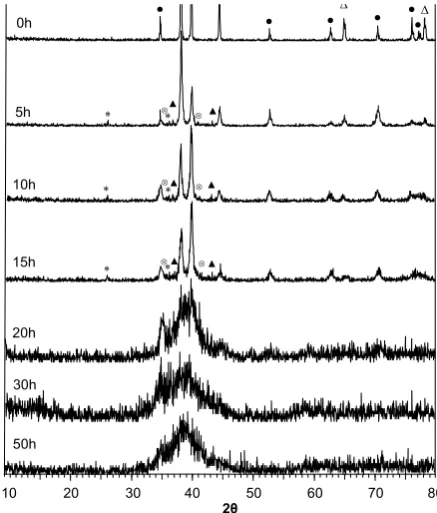
XRD patterns of Ti-50Alpowder blends that mechanically alloyed for several alloying times in 90% purity of Argon and air atmosphere are shown in Figs. 3 and 4 respectively.
When the purity of atmosphere decreased to 90%, some
compositions such as TiO2, Al2O3 and TiH2 were appeared in
X-ray patterns. When air atmosphere was used in the vials, the
contaminations such as TiN, Ti2AlN, TiO2, Al2O3, TiH2 were
seen in XRD patterns. In this case, we couldn’t see an entire broad peak that indicated a complete amorphous phase after 50h alloying time.
By comparing these XRD patterns, it seemed that the time to reach a complete amorphous phase was decreased with increasing the impurity of atmosphere of vials.
It suggests that contaminative phases such as oxides and nitrides can delay the rate of mechanical alloying process.
In mechanical alloying method, the cold welding and fracturing process enables powder particles to be always in
contact with each other with atomically clean surfaces and with minimized diffusion distance. During alloying when contaminations were produced, these compounds can place between the fine particles and delay the diffusion mechanism of
the process.
The grain size of Titanium as a function of milling time for three employed atmosphere are shown in Fig. 5.
It seems that the grain sizes of powders in samples with high
purity of Argon are a little smaller than those in other atmospheres.
Fig. 6 compared the SEM images of the powders, mechanically alloyed for 50h in three different atmospheres.
SEM images, confirmed the results of Fig. 5. The powder particles produced in the high purity Argon atmosphere seems to be finer than those in the atmosphere which have impurities. The elemental powders might react better in a high purity atmosphere than in other atmospheres.
Finally, with annealing the last productions of process in vacuum furnace for 10min at 1000°c, the final phases were formed. In sample that mechanically alloyed in high purity Argon, the TiAl(γ) phase with very high purity and 50nm average grain size was produced (Fig. 7). This phase was our
0h
15h 5h
10h
20h
50h 30h
Δ ● ● ● Δ ●
● Δ●
●Δ ●
2θ
10 20 30 40 50 60 70 80
Ti ●
Al ∆
Tio2 Al2O3 ▲ TiH2
▲ ▲
▲ ▲
▲ ▲
Fig. 3. X-ray diffraction patterns of Ti-50Al elemental powder, mechanically alloyed at several alloying times in 90% purity of Argon atmosphere.
0h
15h 5h
10h
20h
50h 30h
Ti ● Al ∆
Tio2 Al2O3 ▲ TiN ◊
Ti2AlN ◘ TiH2 Δ
● ● ● Δ ●
● Δ●
●Δ ●
2θ
10 20 30 40 50 60 70 80
▲ ▲
▲ ▲
◊
▲ ◊▲
◘
◘
Fig. 4. X-ray diffraction patterns of Ti-50Al elemental powder, mechanically alloyed at several alloying times in Air atmosphere.
0 50 100 150 200 250 300 350 400 450 500
0 10 20 30 40 50 60
Milling Time (h)
Cr
ys
tal
lit
e S
iz
e (
nm
) 99.9999%Ar
Air Atmosphere 90%Ar
Fig. 5. The average grain size of productions of M.A process as a function of milling time for three atmospheres.
Figure 3: X-ray diffraction patterns of Ti-50Al
elemental powder, mechanically alloyed at several
alloying times in 90% purity of Argon atmosphere.
66
Abbasi Nargesi ,
et al.
ideal phase corresponding to Ti-Al binary diagram.
SEM image
of this sample is
also
shown in Fig. 8.
For the samples which mechanically alloyed in 90% purity
of Argon and air atmosphere, the final phase after annealing
contain TiAl(
γ
) and other phases such as Ti
3Al(
2) and other
contaminations such as TiO
2, Al
2O
3(Figs. 9 and 10).
When the impurity of atmosphere was increased, the
γ
phase
content was reduced, the intensity of
γ
peaks were lowered and
other contaminations were increased in the final powder
mixture. Some phases such as TiH
2, TiN were disappeared after
annealing in vacuum furnace.
Fig. 11 compared the results of DTA test for samples that
mechanically alloyed in high purity argon and air atmosphere
after 50h alloying times.
The result of DTA test on the sample which mechanically
alloyed in high purity Argon atmosphere showed an exothermic
peak around 450ºc.
This temperature concern to crystallization of an amorphous TiAl to crystalline TiAl(
γ
) phase but for other sample that
mechanically alloyed in Air atmosphere, besides of this
exothermic peak, the peaks around 570 ºc which concern to
Ti
3Al(
2) and other peaks concern to other contaminations
such as TiO
2, Al
2O
3were revealed.
IV.
C
ONCLUSION
- When a very high purity
of
Argon atmosphere were used in
vials, the time to formation of amorphous phase was
decreased
and only
γ
phase was produced
which has no contamination
after annealing.
- Increasing the impurity content of atmosphere, delayed the
time to formation of an amorphous phase in Ti-50Al system.
- With increasing the impurity of atmosphere, the content of
contaminative phases and compounds were accelerated during
mechanical alloying of Ti-50Al powder mixture.
- Powder particles synthesized in the high purity Argon
atmosphere seems to be finer than those in the atmosphere
which had impurities.
- The impurity of atmosphere changed the final phases of
Ti-50Al after annealing and reduced the efficiency of
γ
-TiAl
Fig. 6. SEM micrographs of Ti-50Al powders mechanically alloyed after 50h in (a)high
purity Argon atmosphere(99.9999%) (b)90% Argon atmosphere (c)Air atmosphere.
2
θ
10
20
30
40
50
60
70
80
50h (1000ºC)
TiAl(
γ
)
In
te
ns
ity
Fig. 7. XRD diffraction pattern of Ti-50Al
which mechanically alloyed in high
purity Argon atmosphere after annealed at 1000ºc for 10min at vacuum furnace.
2
θ
10
20
30
40
50
60
70
80
50h (1000ºC)
TiAl(
γ
)
TiO2
Al2O3
�
� �
In
te
ns
ity
Fig. 9. XRD diffraction pattern of Ti-50Al
which mechanically alloyed in 90% purity
Argon atmosphere after annealed at 1000ºc for 10min at vacuum furnace.
Fig. 8. SEM micrographs of last mechanically alloyed
Ti-50Al
sample in high purity Argon atmosphere, after annealed at 1000ºc for
10min at vacuum oven.
4
ideal phase corresponding to Ti-Al binary diagram.
SEM image
of this sample is
also
shown in Fig. 8.
For the samples which mechanically alloyed in 90% purity
of Argon and air atmosphere, the final phase after annealing
contain TiAl(
γ
) and other phases such as Ti
3Al(
2) and other
contaminations such as TiO
2, Al
2O
3(Figs. 9 and 10).
When the impurity of atmosphere was increased, the
γ
phase
content was reduced, the intensity of
γ
peaks were lowered and
other contaminations were increased in the final powder
mixture. Some phases such as TiH
2, TiN were disappeared after
annealing in vacuum furnace.
Fig. 11 compared the results of DTA test for samples that
mechanically alloyed in high purity argon and air atmosphere
after 50h alloying times.
The result of DTA test on the sample which mechanically
alloyed in high purity Argon atmosphere showed an exothermic
peak around 450ºc.
This temperature concern to crystallization of an amorphous TiAl to crystalline TiAl(
γ
) phase but for other sample that
mechanically alloyed in Air atmosphere, besides of this
exothermic peak, the peaks around 570 ºc which concern to
Ti
3Al(
2) and other peaks concern to other contaminations
such as TiO
2, Al
2O
3were revealed.
IV.
C
ONCLUSION
- When a very high purity
of
Argon atmosphere were used in
vials, the time to formation of amorphous phase was
decreased
and only
γ
phase was produced
which has no contamination
after annealing.
- Increasing the impurity content of atmosphere, delayed the
time to formation of an amorphous phase in Ti-50Al system.
- With increasing the impurity of atmosphere, the content of
contaminative phases and compounds were accelerated during
mechanical alloying of Ti-50Al powder mixture.
- Powder particles synthesized in the high purity Argon
atmosphere seems to be finer than those in the atmosphere
which had impurities.
- The impurity of atmosphere changed the final phases of
Ti-50Al after annealing and reduced the efficiency of
γ
-TiAl
Fig. 6. SEM micrographs of Ti-50Al powders mechanically alloyed after 50h in (a)high
purity Argon atmosphere(99.9999%) (b)90% Argon atmosphere (c)Air atmosphere.
2
θ
10
20
30
40
50
60
70
80
50h (1000ºC)
TiAl(
γ
)
In
te
ns
ity
Fig. 7. XRD diffraction pattern of Ti-50Al
which mechanically alloyed in high
purity Argon atmosphere after annealed at 1000ºc for 10min at vacuum furnace.
2
θ
10
20
30
40
50
60
70
80
50h (1000ºC)
TiAl(
γ
)
TiO
2
Al
2O
3�
� �
In
te
ns
ity
Fig. 9. XRD diffraction pattern of Ti-50Al
which mechanically alloyed in 90% purity
Argon atmosphere after annealed at 1000ºc for 10min at vacuum furnace.
Fig. 8. SEM micrographs of last mechanically alloyed
Ti-50Al
sample in high purity Argon atmosphere, after annealed at 1000ºc for
10min at vacuum oven.
4
ideal phase corresponding to Ti-Al binary diagram.
SEM image
of this sample is
also
shown in Fig. 8.
For the samples which mechanically alloyed in 90% purity
of Argon and air atmosphere, the final phase after annealing
contain TiAl(
γ
) and other phases such as Ti
3Al(
2) and other
contaminations such as TiO
2, Al
2O
3(Figs. 9 and 10).
When the impurity of atmosphere was increased, the
γ
phase
content was reduced, the intensity of
γ
peaks were lowered and
other contaminations were increased in the final powder
mixture. Some phases such as TiH
2, TiN were disappeared after
annealing in vacuum furnace.
Fig. 11 compared the results of DTA test for samples that
mechanically alloyed in high purity argon and air atmosphere
after 50h alloying times.
The result of DTA test on the sample which mechanically
alloyed in high purity Argon atmosphere showed an exothermic
peak around 450ºc.
This temperature concern to crystallization of an amorphous TiAl to crystalline TiAl(
γ
) phase but for other sample that
mechanically alloyed in Air atmosphere, besides of this
exothermic peak, the peaks around 570 ºc which concern to
Ti
3Al(
2) and other peaks concern to other contaminations
such as TiO
2, Al
2O
3were revealed.
IV.
C
ONCLUSION- When a very high purity
of
Argon atmosphere were used in
vials, the time to formation of amorphous phase was
decreased
and only
γ
phase was produced
which has no contamination
after annealing.
- Increasing the impurity content of atmosphere, delayed the
time to formation of an amorphous phase in Ti-50Al system.
- With increasing the impurity of atmosphere, the content of
contaminative phases and compounds were accelerated during
mechanical alloying of Ti-50Al powder mixture.
- Powder particles synthesized in the high purity Argon
atmosphere seems to be finer than those in the atmosphere
which had impurities.
- The impurity of atmosphere changed the final phases of
Ti-50Al after annealing and reduced the efficiency of
γ
-TiAl
Fig. 6. SEM micrographs of Ti-50Al powders mechanically alloyed after 50h in (a)high purity Argon atmosphere(99.9999%) (b)90% Argon atmosphere (c)Air atmosphere.
2θ
10 20 30 40 50 60 70 80
50h (1000ºC)
TiAl(γ)
In
te
ns
ity
Fig. 7. XRD diffraction pattern of Ti-50Alwhich mechanically alloyed in high purity Argon atmosphere after annealed at 1000ºc for 10min at vacuum furnace.
2θ
10 20 30 40 50 60 70 80
50h (1000ºC)
TiAl(γ)
TiO2 Al2O3 �
� � In te ns ity
Fig. 9. XRD diffraction pattern of Ti-50Alwhich mechanically alloyed in 90% purity Argon atmosphere after annealed at 1000ºc for 10min at vacuum furnace.
Fig. 8. SEM micrographs of last mechanically alloyedTi-50Al sample in high purity Argon atmosphere, after annealed at 1000ºc for
10min at vacuum oven.
3
2.
These images indicated that with increasing the alloying time, the particle size of the powder were decreased and the homogenous and very fine particles were achieved after 50h alloying time.
XRD patterns of Ti-50Alpowder blends that mechanically
alloyed for several alloying times in 90% purity of Argon and air atmosphere are shown in Figs. 3 and 4 respectively.
When the purity of atmosphere decreased to 90%, some
compositions such as TiO2, Al2O3 and TiH2 were appeared in X-ray patterns. When air atmosphere was used in the vials, the
contaminations such as TiN, Ti2AlN, TiO2, Al2O3, TiH2 were
seen in XRD patterns. In this case, we couldn’t see an entire broad peak that indicated a complete amorphous phase after 50h alloying time.
By comparing these XRD patterns, it seemed that the time to
reach a complete amorphous phase was decreased with increasing the impurity of atmosphere of vials.
It suggests that contaminative phases such as oxides and nitrides can delay the rate of mechanical alloying process.
In mechanical alloying method, the cold welding and fracturing process enables powder particles to be always in
contact with each other with atomically clean surfaces and with minimized diffusion distance. During alloying when contaminations were produced, these compounds can place between the fine particles and delay the diffusion mechanism of
the process.
The grain size of Titanium as a function of milling time for three employed atmosphere are shown in Fig. 5.
It seems that the grain sizes of powders in samples with high
purity of Argon are a little smaller than those in other
atmospheres.
Fig. 6 compared the SEM images of the powders, mechanically alloyed for 50h in three different atmospheres.
SEM images, confirmed the results of Fig. 5. The powder particles produced in the high purity Argon atmosphere seems to be finer than those in the atmosphere which have impurities. The elemental powders might react better in a high purity atmosphere than in other atmospheres.
Finally, with annealing the last productions of process in vacuum furnace for 10min at 1000°c, the final phases were formed. In sample that mechanically alloyed in high purity
Argon, the TiAl(γ) phase with very high purity and 50nm
average grain size was produced (Fig. 7). This phase was our
0h 15h 5h 10h 20h 50h 30h Δ ● ● ● Δ ● ● Δ● ●Δ ● 2θ
10 20 30 40 50 60 70 80
Ti ● Al ∆ Tio2 Al2O3 ▲ TiH2
▲ ▲ ▲ ▲ ▲ ▲
Fig. 3. X-ray diffraction patterns of Ti-50Al elemental powder, mechanically alloyed at several alloying times in 90% purity of Argon atmosphere.
0h 15h 5h 10h 20h 50h 30h
Ti ● Al ∆
Tio2 Al2O3 ▲ TiN ◊
Ti2AlN ◘ TiH2 Δ ● ● ● Δ ● ● Δ● ●Δ ● 2θ
10 20 30 40 50 60 70 80
▲ ▲ ▲ ▲ ◊ ▲ ◊▲ ◘ ◘
Fig. 4. X-ray diffraction patterns of Ti-50Al elemental powder, mechanically alloyed at several alloying times in Air atmosphere.
0 50 100 150 200 250 300 350 400 450 500
0 10 20 30 40 50 60
Milling Time (h)
Cr ys tal lit e S iz e ( nm
) 99.9999%Ar
Air Atmosphere 90%Ar
Fig. 5. The average grain size of productions of M.A process as a function of milling time for three atmospheres.
3
2.
These images indicated that with increasing the alloying
time, the particle size of the powder were decreased and the
homogenous and very fine particles were achieved after 50h
alloying time.
XRD patterns of Ti-50Al
powder blends that mechanically
alloyed for several alloying times in 90% purity of Argon and
air atmosphere are shown in Figs. 3 and 4 respectively.
When the purity of atmosphere decreased to 90%,
some
compositions
such as TiO
2, Al
2O
3and TiH
2were appeared in
X-ray patterns. When air atmosphere was used in the vials, the
contaminations such as TiN, Ti
2AlN, TiO
2, Al
2O
3, TiH
2were
seen in XRD patterns. In this case, we couldn’t see an entire
broad peak that indicated a complete amorphous phase after
50h alloying time.
By
comparing these XRD patterns, it seemed that the time to
reach a complete amorphous phase was decreased with
increasing the impurity of atmosphere of vials.
It suggests that contaminative phases such as oxides and
nitrides can delay the rate of mechanical alloying process.
In mechanical alloying method, the cold welding and
fracturing process enables powder particles to be always in
contact with each other with atomically clean surfaces and with
minimized diffusion distance. During alloying when
contaminations were produced, these compounds can place
between the fine particles and delay the diffusion mechanism of
the process.
The grain size of Titanium as a function of milling time for
three employed atmosphere are shown in Fig. 5.
It
seems that
the grain sizes of powders in samples with high
purity of Argon are a little smaller than
those
in other
atmospheres.
Fig. 6 compared the SEM images of the powders,
mechanically alloyed for 50h in three different atmospheres.
SEM images, confirmed the results of Fig. 5. The powder
particles produced in the high purity Argon atmosphere seems
to be finer than those in the atmosphere which have impurities.
The elemental powders might react better in a high purity
atmosphere than in other atmospheres.
Finally, with annealing the last productions of process in
vacuum furnace for 10min at 1000°c, the final phases were
formed. In sample that mechanically alloyed in high purity
Argon, the TiAl(
γ
) phase with very high purity and 50nm
average grain size was produced (Fig. 7).
This phase was our
0h 15h 5h 10h 20h 50h 30h Δ ● ● ● Δ ● ● Δ● ●Δ ● 2θ10 20 30 40 50 60 70 80
Ti ● Al ∆ Tio2 Al2O3 ▲ TiH2
▲ ▲ ▲ ▲ ▲ ▲
Fig. 3. X-ray diffraction patterns of Ti-50Al elemental powder, mechanically alloyed at several alloying times in 90% purity of Argon atmosphere.
0h 15h 5h 10h 20h 50h 30h
Ti ● Al ∆ Tio2 Al2O3 ▲ TiN ◊ Ti2AlN ◘ TiH2
Δ ● ● ● Δ ● ● Δ● ●Δ ● 2θ
10 20 30 40 50 60 70 80
▲ ▲ ▲ ▲ ◊ ▲ ◊▲ ◘ ◘
Fig. 4. X-ray diffraction patterns of Ti-50Al elemental powder, mechanically alloyed at several alloying times in Air atmosphere.
0 50 100 150 200 250 300 350 400 450 500
0 10 20 30 40 50 60
Milling Time (h)
Cr ys tal lit e S iz e ( nm
) 99.9999%Ar
Air Atmosphere 90%Ar
Fig. 5. The average grain size of productions of M.A process as a function of milling time for three atmospheres.
Figure 4: X-ray diffraction patterns of Ti-50Al
elemental powder, mechanically alloyed at several
alloying times in Air atmosphere.
Figure 5: The average grain size of productions of
M.A process as a function of milling time for three
atmospheres.
Figure 6: SEM micrographs of Ti-50Al powders
mechanically alloyed after 50h in (a)high purity Argon
atmosphere(99.9999%) (b)90% Argon atmosphere (c)
67
International Journal of Nanoscience and Nanotechnology
alloying time.
By comparing these XRD patterns, it seemed that
the time to reach a complete amorphous phase
was decreased with increasing the impurity of
atmosphere of vials.
It suggests that contaminative phases such as
oxides and nitrides can delay the rate of mechanical
alloying process.
In mechanical alloying method, the cold welding
and fracturing process enables powder particles to
be always in contact with each other with atomically
clean surfaces and with minimized diffusion
distance. During alloying when contaminations
were produced, these compounds can place between
the fine particles and delay the diffusion mechanism
of the process.
ideal phase corresponding to Ti-Al binary diagram.
SEM image
of this sample is
also
shown in Fig. 8.
For the samples which mechanically alloyed in 90% purity
of Argon and air atmosphere, the final phase after annealing
contain TiAl(γ) and other phases such as Ti
3Al(
2) and other
contaminations such as TiO
2, Al
2O
3(Figs. 9 and 10).
When the impurity of atmosphere was increased, the γ phase
content was reduced, the intensity of γ peaks were lowered and
other contaminations were increased in the final powder
mixture. Some phases such as TiH
2, TiN were disappeared after
annealing in vacuum furnace.
Fig. 11 compared the results of DTA test for samples that
mechanically alloyed in high purity argon and air atmosphere
after 50h alloying times.
The result of DTA test on the sample which mechanically
alloyed in high purity Argon atmosphere showed an exothermic
peak around 450ºc.
This temperature concern to crystallization of an amorphous TiAl to crystalline TiAl(
γ) phase but for other sample that
mechanically alloyed in Air atmosphere, besides of this
exothermic peak, the peaks around 570 ºc which concern to
Ti
3Al(
2) and other peaks concern to other contaminations
such as TiO
2, Al
2O
3were revealed.
IV.
C
ONCLUSION- When a very high purity
of
Argon atmosphere were used in
vials, the time to formation of amorphous phase was
decreased
and only γ phase was produced
which has no contamination
after annealing.
- Increasing the impurity content of atmosphere, delayed the
time to formation of an amorphous phase in Ti-50Al system.
- With increasing the impurity of atmosphere, the content of
contaminative phases and compounds were accelerated during
mechanical alloying of Ti-50Al powder mixture.
- Powder particles synthesized in the high purity Argon
atmosphere seems to be finer than those in the atmosphere
which had impurities.
- The impurity of atmosphere changed the final phases of
Ti-50Al after annealing and reduced the efficiency of γ-TiAl
Fig. 6. SEM micrographs of Ti-50Al powders mechanically alloyed after 50h in (a)highpurity Argon atmosphere(99.9999%) (b)90% Argon atmosphere (c)Air atmosphere.
2θ
10 20 30 40 50 60 70 80
50h (1000ºC)
TiAl(γ)
In
te
ns
ity
Fig. 7. XRD diffraction pattern of Ti-50Alwhich mechanically alloyed in high
purity Argon atmosphere after annealed at 1000ºc for 10min at vacuum furnace.
2θ
10 20 30 40 50 60 70 80
50h (1000ºC)
TiAl(γ)
TiO2
Al2O3 �
�
�
In
te
ns
ity
Fig. 9. XRD diffraction pattern of Ti-50Alwhich mechanically alloyed in 90% purity
Argon atmosphere after annealed at 1000ºc for 10min at vacuum furnace.
Fig. 8. SEM micrographs of last mechanically alloyedTi-50Al
sample in high purity Argon atmosphere, after annealed at 1000ºc for 10min at vacuum oven.
4
ideal phase corresponding to Ti-Al binary diagram.
SEM image
of this sample is
also
shown in Fig. 8.
For the samples which mechanically alloyed in 90% purity
of Argon and air atmosphere, the final phase after annealing
contain TiAl(
γ
) and other phases such as Ti
3Al(
2
) and other
contaminations such as TiO
2, Al
2O
3(Figs. 9 and 10).
When the impurity of atmosphere was increased, the
γ
phase
content was reduced, the intensity of
γ
peaks were lowered and
other contaminations were increased in the final powder
mixture. Some phases such as TiH
2, TiN were disappeared after
annealing in vacuum furnace.
Fig. 11 compared the results of DTA test for samples that
mechanically alloyed in high purity argon and air atmosphere
after 50h alloying times.
The result of DTA test on the sample which mechanically
alloyed in high purity Argon atmosphere showed an exothermic
peak around 450ºc.
This temperature concern to crystallization of an amorphous TiAl to crystalline TiAl(
γ
) phase but for other sample that
mechanically alloyed in Air atmosphere, besides of this
exothermic peak, the peaks around 570 ºc which concern to
Ti
3Al(
2) and other peaks concern to other contaminations
such as TiO
2, Al
2O
3were revealed.
IV.
C
ONCLUSION- When a very high purity
of
Argon atmosphere were used in
vials, the time to formation of amorphous phase was
decreased
and only
γ
phase was produced
which has no contamination
after annealing.
- Increasing the impurity content of atmosphere, delayed the
time to formation of an amorphous phase in Ti-50Al system.
- With increasing the impurity of atmosphere, the content of
contaminative phases and compounds were accelerated during
mechanical alloying of Ti-50Al powder mixture.
- Powder particles synthesized in the high purity Argon
atmosphere seems to be finer than those in the atmosphere
which had impurities.
- The impurity of atmosphere changed the final phases of
Ti-50Al after annealing and reduced the efficiency of
γ
-TiAl
Fig. 6. SEM micrographs of Ti-50Al powders mechanically alloyed after 50h in (a)high purity Argon atmosphere(99.9999%) (b)90% Argon atmosphere (c)Air atmosphere.
2θ
10 20 30 40 50 60 70 80
50h (1000ºC)
TiAl(γ)
In
te
ns
ity
Fig. 7. XRD diffraction pattern of Ti-50Alwhich mechanically alloyed in high
purity Argon atmosphere after annealed at 1000ºc for 10min at vacuum furnace.
2θ
10 20 30 40 50 60 70 80
50h (1000ºC)
TiAl(γ)
TiO2 Al2O3 �
�
�
In
te
ns
ity
Fig. 9. XRD diffraction pattern of Ti-50Alwhich mechanically alloyed in 90% purity
Argon atmosphere after annealed at 1000ºc for 10min at vacuum furnace.
Fig. 8. SEM micrographs of last mechanically alloyedTi-50Al
sample in high purity Argon atmosphere, after annealed at 1000ºc for 10min at vacuum oven.
Figure 8: SEM micrographs of last mechanically
alloyed Ti-50Al sample in high purity Argon
atmosphere, after annealed at 1000ºc for 10min at
vacuum oven.
Figure 7: XRD diffraction pattern of Ti-50Al which mechanically alloyed in high purity Argon
atmosphere after annealed at 1000ºc for 10min at vacuum furnace.
Figure 9:
XRD diffraction pattern of Ti-50Al which mechanically alloyed in 90% purity Argon
atmosphere after annealed at 1000ºc for 10min at vacuum furnace.
4ideal phase corresponding to Ti-Al binary diagram. SEM image
of this sample is also shown in Fig. 8.
For the samples which mechanically alloyed in 90% purity of Argon and air atmosphere, the final phase after annealing
contain TiAl(γ) and other phases such as Ti3Al(2) and other
contaminations such as TiO2, Al2O3 (Figs. 9 and 10).
When the impurity of atmosphere was increased, the γ phase
content was reduced, the intensity of γ peaks were lowered and
other contaminations were increased in the final powder
mixture. Some phases such as TiH2, TiN were disappeared after
annealing in vacuum furnace.
Fig. 11 compared the results of DTA test for samples that mechanically alloyed in high purity argon and air atmosphere after 50h alloying times.
The result of DTA test on the sample which mechanically alloyed in high purity Argon atmosphere showed an exothermic peak around 450ºc.
This temperature concern to crystallization of an amorphous TiAl to crystalline TiAl(γ) phase but for other sample that
mechanically alloyed in Air atmosphere, besides of this exothermic peak, the peaks around 570 ºc which concern to
Ti3Al(2) and other peaks concern to other contaminations
such as TiO2, Al2O3 were revealed.
IV. CONCLUSION
- When a very high purity of Argon atmosphere were used in
vials, the time to formation of amorphous phase was decreased
and only γ phase was produced which has no contamination
after annealing.
- Increasing the impurity content of atmosphere, delayed the time to formation of an amorphous phase in Ti-50Al system.
- With increasing the impurity of atmosphere, the content of contaminative phases and compounds were accelerated during mechanical alloying of Ti-50Al powder mixture.
- Powder particles synthesized in the high purity Argon atmosphere seems to be finer than those in the atmosphere which had impurities.
- The impurity of atmosphere changed the final phases of
Ti-50Al after annealing and reduced the efficiency of γ-TiAl
Fig. 6. SEM micrographs of Ti-50Al powders mechanically alloyed after 50h in (a)high purity Argon atmosphere(99.9999%) (b)90% Argon atmosphere (c)Air atmosphere.
2θ
10 20 30 40 50 60 70 80
50h (1000ºC)
TiAl(γ)
In
te
ns
ity
Fig. 7. XRD diffraction pattern of Ti-50Alwhich mechanically alloyed in high purity Argon atmosphere after annealed at 1000ºc for 10min at vacuum furnace.
2θ
10 20 30 40 50 60 70 80
50h (1000ºC)
TiAl(γ) TiO2 Al2O3 �
�
�
In
te
ns
ity
Fig. 9. XRD diffraction pattern of Ti-50Alwhich mechanically alloyed in 90% purity Argon atmosphere after annealed at 1000ºc for 10min at vacuum furnace.
Fig. 8. SEM micrographs of last mechanically alloyedTi-50Al sample in high purity Argon atmosphere, after annealed at 1000ºc for
68
Abbasi Nargesi ,
et al.
The grain size of Titanium as a function of milling
time for three employed atmosphere are shown in
Figure 5.
It seems that the grain sizes of powders in samples
with high purity of Argon are a little smaller than
those in other atmospheres.
Figure 6 compared the SEM images of the powders,
mechanically alloyed for 50h in three different
atmospheres.
SEM images, confirmed the results of Figure 5.
The powder particles produced in the high purity
Argon atmosphere seems to be finer than those
in the atmosphere which have impurities. The
elemental powders might react better in a high
5
production.
R
EFERENCES[1] K. B. Gerasimov, S. V. Pavlov, “Metastable Ti-Al Phases Obtained by Mechanical Alloying”, Journal of Alloys and Compounds, vol. 242, (1996), 136-141.
[2] K. R. Cardoso, C. A. D. Rodrigues, “Processing of Aluminium Alloys Containing Titanium addition by Mechanical Alloying” , Materials Science and Engineering A, vol. 375, (2004), 1202-1208.
[3] Z. M. Sun, H. Hashimoto, “Fabrication of TiAl alloys by MA-PDS process and mechanical properties”, Intermetallics, vol. 11, (2003), 826-831.
[4] K. Uenishi, T. Marsobara, “Nanostructured Titanium-Aluminides and Their Composites Formed by Combustion Synthesis of Mechanically Alloyed Powders”, Scripta Materialia, vol. 44, (2001), 2094-2099. [5] P. Bhattacharya, P. Bellon, R. S. Averback, “Nanocrystalline TiAl
powder Synthesized by high-energy ball milling: effects of milling parameters on yield and contamination”, Journal of Alloys and Compounds, vol. 368, (2004), 187-190.
[6] K. Uenishi, T. Marsobara, “Nanostructured Titanium-Aluminides and Their Composites Formed by Combustion Synthesis of Mechanically Alloyed Powders”, Scripta Materialia, vol. 44, (2001), 2094-2099. [7] L. Lu, M. O. Lai and F. H. Froes,“The Mechanical Alloying of Titanium
Aluminides”, JOM, vol. 54, (2002), 62-70.
[8] S. H. Kim, H. H. Chung, “Effect of B on the Microstructure and Mechanical Properties of Mechanically milled TiAl Alloys”,
Metallurgical and Materials TransactionA, vol. 20A, (1998), 2273-2280.
[9] E. Szewczak, J. Paszula, A. V. Lenov and H. Matyja, “Explosive Consolidation of Mechanically Alloyed Ti-Al Alloys”, Materials Science and Engineering A, vol. 226-228, (1997), 115-119.
[10] F. H. Froes, C. Suryanarayana, K. Russel and C. G. Li, “Synthesis of Intermetallics by Mechanical Alloying”, Materials Science and Engineering A, vol. 192-193, (1995), 612-623.
[11] Hiroshi Kimura, “Syntheses, consolidation and charactersics of Nano-Intermetallics”, Sci Rep., vol. 42, (1996), 245279.
[12] M. Bermudez, F. J. Carrion, P. Iglesias, “Influence of milling conditions on the wear resistance of mechanically alloyed aluminum”, Wear, vol. 258, (2005), 906-910.
[13] M. Sherif El-Eskandarany, “Mechanical Alloying for Fabrication of Advanced Engineering Materials”, William Andrew Publication, USA, (2001).
[14] K. Wang, T. D. Shen, J. T. Wang, “Effect of atmosphere on further milling mechanically alloyed Ni60Ti40 amorphous powders”, Journal of Materials Science letters, vol. 11, (1992), 1170-1175.
[15] Akito Takasaki,Yoshio Furuya, “Mechanical Alloying of The Ti-Al System in Atmosphere of Hydrogen and Argon”, Nanostructured Materials, vol.11, (1999), 1209-1212.
[16] C. Suryanarayana, “Mechanical Alloying and Milling”, Progress in Materials Science, vol.46, (2001), 100-140.
[17] L. Lu, M. O. Lai, “Mechanical Alloying”, Kluwer Academic Publishers, Boston, (1998).
[18] Y. Mishin, Chr. Herzig, “Diffusion in the Ti-Al system”, Acta Materials, vol. 48, (2000), 591-600.
2θ
10 20 30 40 50 60 70 80
50h (1000ºC)
TiAl(γ) TiO2
Al2O3 �
Ti3Al(2)
�
�
In
te
nsi
ty
Fig. 10. XRD diffraction pattern of Ti-50Alwhich mechanically alloyed in Air atmosphere after annealing at 1000ºc for 10min at vacuum furnace.
Fig. 11. The curve of DTA test for two different atmosphere samples.
production.
R
EFERENCES
[1]
K. B. Gerasimov, S. V. Pavlov, “Metastable Ti-Al Phases Obtained by
Mechanical Alloying”,
Journal of Alloys and Compounds
, vol. 242,
(1996), 136-141.
[2]
K. R. Cardoso, C. A. D. Rodrigues, “Processing of Aluminium Alloys
Containing Titanium addition by Mechanical Alloying” ,
Materials
Science and Engineering A
, vol. 375, (2004), 1202-1208.
[3]
Z. M. Sun, H. Hashimoto, “Fabrication of TiAl alloys by MA-PDS
process and mechanical properties”,
Intermetallics
, vol. 11, (2003),
826-831.
[4]
K. Uenishi, T. Marsobara, “Nanostructured Titanium-Aluminides and
Their Composites Formed by Combustion Synthesis of Mechanically
Alloyed Powders”,
Scripta Materialia
, vol. 44, (2001), 2094-2099.
[5]
P. Bhattacharya, P. Bellon, R. S. Averback, “Nanocrystalline TiAl
powder Synthesized by high-energy ball milling: effects of milling
parameters on yield and contamination”,
Journal of Alloys and
Compounds
, vol. 368, (2004), 187-190.
[6]
K. Uenishi, T. Marsobara, “Nanostructured Titanium-Aluminides and
Their Composites Formed by Combustion Synthesis of Mechanically
Alloyed Powders”,
Scripta Materialia
, vol. 44, (2001), 2094-2099.
[7]
L. Lu, M. O. Lai and F. H. Froes
,
“The Mechanical Alloying of Titanium
Aluminides”,
JOM
, vol. 54, (2002), 62-70.
[8]
S. H. Kim, H. H. Chung, “Effect of B on the Microstructure and
Mechanical Properties of Mechanically milled TiAl Alloys”,
Metallurgical and Materials TransactionA
, vol. 20A, (1998),
2273-2280.
[9]
E. Szewczak, J. Paszula, A. V. Lenov and H. Matyja, “Explosive
Consolidation of Mechanically Alloyed Ti-Al Alloys”,
Materials Science
and Engineering A
, vol. 226-228, (1997), 115-119.
[10]
F. H. Froes, C. Suryanarayana, K. Russel and C. G. Li, “Synthesis of
Intermetallics by Mechanical Alloying”,
Materials Science and
Engineering A
, vol. 192-193, (1995), 612-623.
[11]
Hiroshi Kimura, “Syntheses, consolidation and charactersics of
Nano-Intermetallics”,
Sci Rep.
, vol. 42, (1996), 245279.
[12]
M. Bermudez, F. J. Carrion, P. Iglesias, “Influence of milling conditions
on the wear resistance of mechanically alloyed aluminum”,
Wear
, vol.
258, (2005), 906-910.
[13]
M. Sherif El-Eskandarany, “Mechanical Alloying for Fabrication of
Advanced Engineering Materials”, William Andrew Publication, USA,
(2001).
[14]
K. Wang, T. D. Shen, J. T. Wang, “Effect of atmosphere on further
milling mechanically alloyed Ni
60Ti
40amorphous powders”,
Journal of
Materials Science letters
, vol. 11, (1992), 1170-1175.
[15]
Akito Takasaki,Yoshio Furuya, “Mechanical Alloying of The Ti-Al
System in Atmosphere of Hydrogen and Argon”,
Nanostructured
Materials
, vol.11, (1999), 1209-1212.
[16]
C. Suryanarayana, “Mechanical Alloying and Milling”,
Progress in
Materials Science
, vol.46, (2001), 100-140.
[17]
L. Lu, M. O. Lai, “Mechanical Alloying”, Kluwer Academic Publishers,
Boston, (1998).
[18]
Y. Mishin, Chr. Herzig, “Diffusion in the Ti-Al system”,
Acta Materials
,
vol. 48, (2000), 591-600.
2θ
10 20 30 40 50 60 70 80
50h (1000ºC)
TiAl(γ)
TiO2 Al2O3 � Ti3Al(2)
�
�
In
te
nsi
ty