Original Research Article
Sedentary behaviour and their association with academic performance
among high school students in South Tamil Nadu
Madhumitha Manohar
1*, Sureshbalan Kumarasamy Uma
1, Judith Rajendran
2INTRODUCTION
Sedentary behaviour has received considerable public and media attention in the recent times. Sedentary behaviour is defined as any waking behaviour characterized by an energy expenditure ≤1.5 METs while in a sitting, reclining or lying posture.1,2 Sedentary behaviours have increased among young people partly due to technological development of attractive home-based
entertainment devices and high levels of sitting at school, with or without computer screens.3 So, during leisure time most of the adolescents sit and play video and computer games. Girls also use the computer for diverse reasons like social contact and shopping.4,5 Television is the most common entertainment device which is available in most homes and widely used by young people.6 However computer (internet)is the most valued media among young people because of its wide variety of its use
ABSTRACT
Background: Sedentary behaviour refers to activities that require very low energy expenditure where sitting or lying is the dominant posture. It is reported that children spend approximately 80% of their day in sedentary behaviours. It is an important risk factor for physical, psychological and socio-emotional health among school children. Epidemiological studies have shown that spending excessive time in sedentary behaviors have a negative impact on academic performance. The objectives of this study were to study the proportion of sedentary behaviours among high school students. To find out whether any association exist between sedentary behaviors with academic performance.
Methods: A cross sectional study conducted from July to September, 2018 among high school students in a government school, Kanyakumari district. 213 students from class 9th and 10th standard participated in our study. Permission was obtained from school authorities after explaining the purpose of study. Data was collected using a pre tested questionnaire. Study variables included internet usage, watching television, duration of sleep, physical activity and academic performance. Data was entered in MS-Excel, analyzed for proportions, chi-square using SPSS version 16.0.
Results: 61% watched TV more than 2 hours a day. 59.6% of the students spend >2 hours a day for internet browsing. 60% of the students spend <30 minutes a day for doing exercise. 45% of the students reported sleeping for 8 to 10 hours. Internet browsing and watching TV have shown significant association with academic performance.
Conclusions: Sedentary behaviours are on the rise among school children. Multi component school-based interventions are necessary to minimize sedentary behaviours among school children.
Keywords: Academic performance, School children, Sedentary behaviour
1Department of Community Medicine, Kanyakumari Govt. Medical College, Kanyakumari District, Tamil Nadu, India 2Department of Community Medicine, Dr. S. M. C. S. I. Medical College, Thiruvananthapuram, Kerala, India
Received: 12 September 2019
Revised: 18 October 2019
Accepted: 19 October 2019
*Correspondence:
Dr. Madhumitha Manohar,
E-mail: [email protected]
Copyright: © the author(s), publisher and licensee Medip Academy. This is an open-access article distributed under the terms of the Creative Commons Attribution Non-Commercial License, which permits unrestricted non-commercial use, distribution, and reproduction in any medium, provided the original work is properly cited.
including e-mail, social networking, playing games, watching movies and searching information.7
Recent research has shown that high levels of sedentary behaviour in young people have a negative impact on their health. High levels of sedentary behaviour have contributed to the increase in chronic diseases such as obesity, type 2 diabetes and heart problems among adolescents.8,9 Shaping the attitude of children and promotion of a healthy lifestyle, including constructive behavior is essential in the formative years of life.10 Hence this study is undertaken to find out the proportion of sedentary behaviours among high school students and whether any association exist between sedentary behaviors with academic performance.
METHODS
A cross sectional study conducted from June to August 2019 among high school students in a government school, Kanyakumari district. 213 students from classes 9th and 10th standard participated in our study. Permission was obtained from school authorities after explaining the
purpose of study. Data was collected using a self-administered, pretested questionnaire. Study variables included internet usage, watching television, duration of sleep, physical activity and academic performance. Academic performance was assessed from the average of their term and monthly exams. Score more than 70% was considered satisfactory and less than 70% as not satisfactory.
Data analysis
Data was entered in MS-excel, analyzed for proportions, chi-square using SPSS version 16.0.
RESULTS
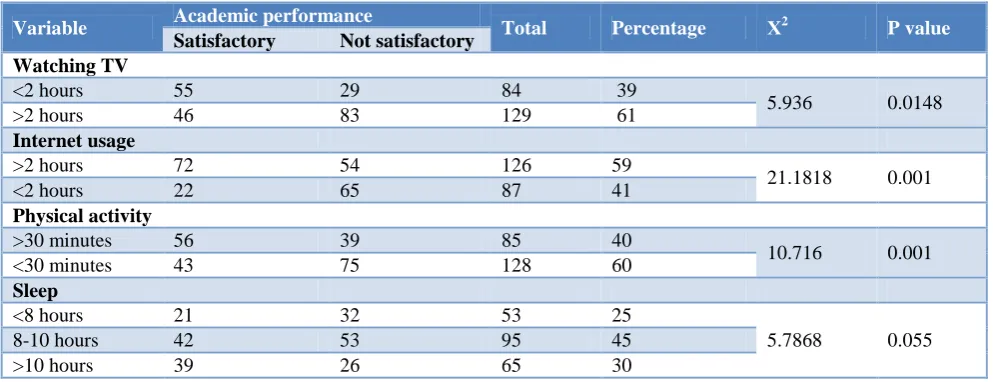
61% of the students were watching television for more than 2 hours a day. 59% of the students reported to use internet for more than 2 hours a day. 60% of the students spend <30 minutes a day for doing physical activity. 45% of the students reported to sleep for 8 to 10 hours a day. 25% of the students had inadequate sleep for less than 8 hours a day.
Table 1: Association between sedentary lifestyle and academic performance.
Variable Academic performance Total Percentage Χ2 P value
Satisfactory Not satisfactory
Watching TV
<2 hours 55 29 84 39
5.936 0.0148
>2 hours 46 83 129 61
Internet usage
>2 hours 72 54 126 59
21.1818 0.001
<2 hours 22 65 87 41
Physical activity
>30 minutes 56 39 85 40
10.716 0.001
<30 minutes 43 75 128 60
Sleep
<8 hours 21 32 53 25
5.7868 0.055
8-10 hours 42 53 95 45
>10 hours 39 26 65 30
Watching television had a significant association with academic performance (p<0.05). Internet usage and physical activity had a highly significant association with academic performance (p=0.001).
DISCUSSION
Television and academic performance
In our study 61% reported watching television for more than 2 hours a day which is comparable to a study done by Syed Noor-Amin in Kashmir in 2012 among 15-17 years students reported that 63.93% were found to watch TV for more than 2 hours a day and it indicates that low TV viewer adolescents exhibit a higher scholastic
achievement than the heavy TV viewer group of adolescents.11
Further, there are few studies that found a positive influence of overall viewing time (including non-educational programs) on non-educational achievement. Study conducted by Singh et al in Mumbai showed that all the observed academic skills improved with both overall televisions watching time and watching of educational content particularly the observed reading, mathematics and writing skills.12
Study done by Kumar et al among students of class IX to XII in Pune found that here is no significant association between the number of hours of watching television per day and academic performance as measured by marks in examinations.13
Our study also showed a highly significant association between television watching and academic performance (p<0.01).
Internet usage and academic performance
Information and communication technology have been proven one of the greatest innovations in teaching and learning. It helps students to broaden their academic knowledge and research by accessing to the information world. Even though there are multiple benefits linked with Internet use, there has been a growing concern regarding the risk associated with Internet overuse. It is reported that Internet has a significant diminution on student academic performance.14
59.6% of the students reported to use internet for more than 2 hours a day. Studies have found out that academic outcome of students who spent most of their time interacting in social media are positive as they were able to share and generate ideas and concepts related to their studies. They also use these sites for having fun as these social media sites are helpful in their academic work Mensah and Nizam concluded in their study that social media platforms has a significant impact on students’ academic performance in Malaysia tertiary institutions.15,16 According to the study of Owusu-Acheaw et al, it was revealed that use of social media had affected the academic performance of their respondents negatively Their study further revealed that most of their respondents use social media sites to chat rather than for academic purpose.17 A study on impact of social media on academic performance of class X students conducted by state council of educational research and training in Nagaland, 2017 found 62% of the students were using internet similar to our study (59%) Most of them reported using social media through their mobile phone mostly at night with browsing time ranging from 3 hours or more and it has negative effect as it lowers the concentration on their studies. Our study also showed a highly significant association between internet usage hours and academic performance (p<0.001).
Physical activity and academic performance
The impact of exercise on children's cognition implies a link to academic performance. Population studies provide evidence that inactivity and excess weight are associated with poor academic achievement. Time devoted to physical activity at school does not harm academic performance and may actually improve it. Small benefits have been detected with 20 minutes per day of vigorous physical activity.18
In our study only 40% of the students were involved in physical activity more than half an hour a day. Studies done by Balaji et al in Chennai 2018 revealed insufficient physical activity was more among 16-17 years (70.8%) compared to 13-15 years (57.5%) and found significant association between academic performance and insufficient physical activity.19 A systematic review of the literature (reporting a total of 50 unique studies) by Sarah et al in Atlanda (USA) demonstrated a positive relationship between physical activity and academic performance.20
Erin et al reviewed a total of 125 published articles and majority of conclusions show a positive effect of physical activity and academic achievement.21
Role of sleep in academic performance
Sleep deprivation can impact various aspects of the mind and body, such as mood, energy, memory, efficiency, and importantly the ability to learn. Students ideally should get 8-9 hours of sleep a night. Recent studies have shown that adequate sleep is essential to feeling awake and alert, maintaining good health and working at peak performance and getting enough sleep is vital to academic success.
In the student-age population, studies have found that factors such as self-reported shortened sleep time, erratic sleep/wake schedules, late bed and rise times, and poor sleep quality have been found to be negatively associated with school performance for adolescents from middle school through college. Thus, there is ample evidence to indicate that the lack of adequate night time sleep can lead to disturbances in brain function, which in turn, can lead to poor academic performance.22
Mari Hysing Allison G. Harvey assessed the association between sleep duration and academic performance in 16-19-year‐ old adolescents using registry based academic grades demonstrated significant relationship between sleep problems and poor academic performance.23
Bugueno et al studied 322 students of the first and second year of high school students at Santiago de Chile and found a significant association between sleep and academic scores and concluded that bad sleep quality influences academic performance in these students.25 But our study did not show any significant association between academic performance and duration of sleep.
CONCLUSION
This study shows that there is a significant association between some sedentary behaviors with academic performance. Statistically analyzing, Internet browsing (p value=0.001) and watching TV (p=0.018) and physical activity (p<0.001) were found to have significant association with academic performance.
Recommendations
Parents should be encouraged to incorporate age appropriate educational TV into their children s lives for stimulating children’s cognitive development.
Internet is playing great role in today’s changing education by providing innumerable resources and services. However, the use of internet has dark side also, therefore self-regulation is also important criteria while using internet in education.
Interventional strategies such as school and community health education programs and imparting life skills training and provision of staff training can be useful.
After-school programs that allow time for both academic enrichment and vigorous physical activity would meet the need of many families for a safe, constructive environment for children while parents are working. Integrating physical activity into classroom instruction has great promise, if adopted by educators at a dose adequate to affect achievement, and offers an alternative or complementary approach to ensure adequate physical activity.
Prevention of sedentary behaviours starts at home, where the socio-cultural environment begins to form the character and personality of the child. Education and awareness among parents are of paramount importance so that the child transforms into a healthy adolescent and a healthy adult.
ACKNOWLEDGEMENTS
We would like to thank all the participants of the study. Authors also acknowledge the great help received from the scholars whose articles cited and included in the references of this manuscript. The authors are also grateful to authors/editors/publishers of all those articles, journals and books from where the literature for this article has been reviewed and discussed.
Funding: No funding sources Conflict of interest: None declared Ethical approval: Not required
REFERENCES
1. Chowdhury Sedentary Behaviour Research Network Letter to the editor: standardized use of the terms “sedentary” and “sedentary behaviours.” Appl Physio Nutr Metab. 2012;37:540-2.
2. Tremblay MS, Aubert S, Barnes JD, Saunders TJ, Carson V, Latimer-Cheung AE, et al. SBRN Terminology consensus project participants. Sedentary behavior research network (SBRN) - terminology consensus project process and outcome. Int J Behav Nutr Phys Act. 2017;14:75.
3. Hallai PC, Andersen LB, Bull FC, Guthoid R, Haskell W, et al. For the Lancet Physical Activity Series Working Group. Global physical activity levels: surveillance progress, pitfalls, and prospects. The Lancet. 2012;380:247-57.
4. Appel M. Are heavy users of computer games and social media more computer literate? Computers Educat. 2012;59:1339-49.
5. Shaw LH, Gant LM. Users divided? Exploring the gender gap in Internet use. Cyperpsychol Behav. 2002;5:517-27.
6. American Academy of Pediatrics Committee on Public Education. American Academy of Pediatrics: Children, adolescents, and television. Pediatrics. 2001;107:423-6.
7. Strasburger VC. Children, adolescents, and the media. Curr Probl Pediatr Adolesc Health Care. 2004;54-113.
8. Edwardson CL, Gorely T, Davies MJ, Gray LJ, Khunti K, Wilmot EG, et al. Association of sedentary behaviour with metabolic syndrome: a meta-analysis. PloS One. 2012;7(4):e34916.
9. Haines L, Wan KC, Lynn R, Barrett TG, Shield JP. Rising incidence of type 2 diabetes in children in the UK. Diabetes care. 2007;30(5):1097-101.
10. Tsering D, Pal R, Dasgupta A. Substance use among adolescent high school students in India: a survey of knowledge, attitude, and opinion. J Pharma Bioallied Sci. 2010;2(2):137-40.
11. Noor-Ul-Amin S. Impact of television watching on academic achievement of adolescents with special reference to their socioeconomic status. Stand J Educ. 2013;1:14-20.
12. Singh A, Gaurav S. Television exposure and academic skills of children: New findings from India. J Comm Tec Human Behavior. 2013;1:1-24. 13. Kumar RS, Das RC, Prabhu HR, Bhat PS, Prakash J,
Seema P, et al. Interaction of media, sexual activity and academic achievement in adolescents. Med J Armed Forc India. 2013;69(2):138-43.
districts of Kashmir Valley. Int J Comp Sci Eng Open Access Res. 2018;6:3.
15. Amin Z, Mansoor A, Hussain SR, Hashmat F. Impact of social media of student’s academic performance. Int J Business Manag Invent. 2016;5(4):22-9.
16. Mensah SO, Nizam I. The impact of social media on students’ academic performance-A case of Malaysia Tertiary Institution. Int J Edu Learn Train. 2016;1(1):14-21.
17. Owusu-Acheaw M, Larson A. Use of social media and its impact on academic performance of tertiary institution students: a study of students of Koforidua Polytechnic, Ghana. J Edu Pract. 2015;6(6):94-101. 18. Davis CL, Pollock NK. Does physical activity
enhance cognitio and academic achievement in children? a review. Available at: https://www. medscape.org/viewarticle/764365. Accessed on 1st September 2019.
19. Balaji SM, Karthik RC, Durga R, Harinie S, Ezhilvanan M. Intensity of physical activity among school going adolescents in Chennai, South India. Int J Community Med Public Health. 2018;5(5):2094-8.
20. Rasberry CN, Lee SM, Robin L, Laris BA, Russell LA, Coyle KK, et al. The association between school-based physical activity, including physical education, and academic performance: a systematic review of the literature. Prevent Med. 2011;52:S10-20.
21. Howie EK, Pate RR. Physical activity and academic achievement in children: a historical perspective. J Sport Health Sci. 2012;1(3):160-9.
22. College students: getting enough sleep is vital to academic success. American academy of sleep medicine Updated, 2017. Available at: https://aasm.org/college-students-getting-enough-sleep-is-vital-to-academic-success/. Accessed on 2nd September 2019.
23. Hysing M, Harvey AG, Linton SJ, Askeland KG, Sivertsen B. Sleep and academic performance in later adolescence: results from a large population‐ based study. J Sleep Res. 2016;25(3):318-24. 24. Brigham and Women's Hospital. "Irregular sleeping
patterns linked to poorer academic performance in college students: Timing of sleep found to be as important as number of hours slept." ScienceDaily. ScienceDaily, 2017. Available at: https://www. sciencedaily.com/releases/2017/06/170612094045.h tm.
25. Bugueno M, Curihual C, Olivares P, Wallace J, Lopez-Alegria F, Rivera-Lopez G, et al. Quality of sleep and academic performance in high school students. Revista Medica de Chile. 2017;145(9):1106-14.