R E S E A R C H
Open Access
Network reconstruction via density
sampling
Tiziano Squartini
1*, Giulio Cimini
1,2, Andrea Gabrielli
1,2and Diego Garlaschelli
3*Correspondence: [email protected] 1IMT School for Advanced Studies Lucca, Piazza S.Francesco 19, 55100 Lucca, Italy
Full list of author information is available at the end of the article
Abstract
Reconstructing weighted networks from partial information is necessary in many important circumstances, e.g. for a correct estimation of systemic risk. It has been shown that, in order to achieve an accurate reconstruction, it is crucial to reliably replicate the empirical degree sequence, which is however unknown in many realistic situations. More recently, it has been found that the knowledge of the degree sequence can be replaced by the knowledge of the strength sequence, which is typically accessible, complemented by that of the total number of links, thus considerably relaxing the observational requirements. Here we further relax these requirements and devise a procedure valid when even the the total number of links is unavailable. We assume that, apart from the heterogeneity induced by the degree sequence itself, the network is homogeneous, so that its (global) link density can be estimated by sampling subsets of nodes with representative density. We show that the best way of sampling nodes is the random selection scheme, any other procedure being biased towards unrealistically large, or small, link densities. We then introduce our core technique for reconstructing both the topology and the link weights of the unknown network in detail. When tested on real economic and financial data sets, our method achieves a remarkable accuracy and is very robust with respect to the sampled subsets, thus representing a reliable practical tool whenever the available topological information is restricted to small portions of nodes.
PACS numbers: 89.75.Hc; 89.65.Gh; 02.50.Tt
Introduction
Reconstructing a weighted, directed network means providing an algorithm to estimate the presence and the weight of all links in the network, making optimal use of the avail-able information (Wells 2004; Upper 2011; Mastromatteo et al. 2012; Baral and Fique 2012; Drehmann and Tarashev 2013; Hałaj and Kok 2013; Anand et al. 2014; Montagna and Lux 2014; Peltonen et al. 2015; Cimini et al. 2015b). Since several networks are in general compatible with the known information, the output of such a procedure cannot identify a unique network but rather an ensemble of possible ones. This leads to a (large) set of candidate networks to be sampled with a certain probability, where the latter has to be specified in such a way that the resulting ensemble average is as close as possible to the empirical, unknown network. Maximum-entropy is a powerful method to construct
probability distributions that realise a certain set of constraints on average. Treating the available pieces of information as empirical constraints in the maximum-entropy pro-cedure ensures that the statistical inference carried out via the resulting distribution is maximally unbiased.
In many situations, e.g. for economic, interbank or other financial networks, the strength sequence (i.e. the list of strengths of all nodes) is known while there is little or no information available about the topology (i.e. the binary structure) of the net-work. Exploiting the strength sequence as the only constraint of the maximum entropy procedure leads to an unrealistic ensemble where the likely networks are (almost) com-pletely connected (Mastrandrea et al. 2014). This occurs because, when replicating the empirical strengths in absence of topological information, the method tends to dis-tribute non-zero link weights as evenly as possible (i.e. between all pairs of nodes). When such unrealistically dense networks are used as proxies to measure, e.g. the level of systemic risk in a financial network, the resulting estimates are completely unreliable. By contrast, it has been shown that, if the degree sequence is known in addition to the strength sequence, the network reconstruction procedure improves tremendously and achieves a remarkable accuracy, as a result of a much more faith-ful replication of the topology (Mastrandrea et al. 2014; Cimini et al. 2015a). Notice that, if the link weights are specified by the matrix W, whose entry wij ≥ 0
repre-sents the weight of the directed link from nodeito nodej, the topology is specified by the binary adjacency matrixAwhose entry aij = 1 ifwij is strictly positive and zero otherwise.
Although complete information on the degree sequence is rarely available, this kind of information can be retrieved from the strength sequence, provided that the latter is complemented with some kind of topological information: in (Musmeci et al. 2013) this information consists of the degree sequence of only a subsetIof nodes,{ki}i∈I, while in
(Cimini et al. 2015b) the information used is the total number of links,L, of the network. In this paper we face the problem of reconstructing weighted, directed networks, for which the only information available is represented by the set of out-strengths
souti = j(=i)wij and in-strengths sini =
j(=i)wji (i.e. the total rows and columns
sums of the adjacency matrix) as well as the link density of a subset I of nodes, i.e.
cI = nI(nLII−1), with LI = i∈I
j(=i)∈Iaij being the observed number of internal
links to the subset I. By doing so, we do not require information which is either too detailed (as the degree sequence of even a small subset of nodes) or simply unacces-sible (as the total number of links). However, the information encoded into the link density of the chosen subset must be representative of the global one, in order to accu-rately reconstruct a given network: for this reason, we also propose a recipe about how properly sampling the nodes set of our network. As we will show, the random-nodes sampling scheme provides the best way to draw representative subsets out of the whole nodes set.
The rest of the paper is organized as follows. In “Methods” section we illustrate the two steps characterizing our reconstruction method and provide measures to test the effec-tiveness of the algorithm; in “Results” section we apply our method to two real networks, an economic one and a financial one, and in “Conclusions” section we discuss the results.
Methods
Inferring the topological structure
In order to reconstruct the topological structure of a networkW, whenever the nodes strengths{souti }Ni=1and{sini }Ni=1and the total number of linksLare known, one can follow the algorithm proposed in (Cimini et al. 2015b), which prescribes to solve the equation
L= L (1)
withL = ij(=i)aij,L = i
j(=i)pij andpij = (zsouti sinj )/(1+zsouti sinj ), in order
to estimate the unknown parameterzand quantify the probabilitypijthat a directed link
fromitojexists. However, a global (yet very simple) piece of information asLmay be not always available. In these cases, an algorithm resorting upon local information has to be employed. In this paper we propose an algorithm to infer the unknown parameterz
whenever the information of only a subsetIof nodes is accessible. Notice that a possi-ble solution to this propossi-blem has already been provided in (Musmeci et al. 2013), where the supposedly known piece of information is represented by the degree sequence of the nodes inI, i.e.{ki}i∈I, an hypothesis leading to the equation
i∈I
kouti +kiin= i∈I
kiout + kiin (2)
(withkouti = j(=i)∈Vpijandkini =
j(=i)∈VpjiandV indicating the whole nodes
set). However, the knowledge of the number of neighbors of even a small subset of nodes may be unavailable as well. For this reason, here we make use of a simpler, more easily accessible, information and suppose to know only the link density within the subsetI. Our recipe thus reads
cI= cI (3)
wherecI=LI/[nI(nI−1)],nI= |I|is the number of nodes constituting the subsetI,LI=
i∈I
j(=i)∈Iaijis the observed number of links within it andLI =
i∈I
j(=i)∈Ipijis
the expected value ofLI.
Remarkably, Eq. (3) can be easily extended to infer the structure of a different subset (sayI), provided that the link density of the latter could be guessed from the known value
cI. As an example, let us assume the existence of a linear proportionality between the two
valuescIandcI: in this case, the equation to be solved would be
cI=fcI. (4)
More explicitly, such a condition translates into the equation
cI= f
nI(nI−1)
i∈I
j(=i)∈I
zIsout i sinj
1+zIsouti sinj
(5)
which shows that the observed quantity tuning the parameterzIiscI·nI(nI−1), i.e. the
The valuef =1 corresponds to the assumption that the network is homogeneous. This is equivalent to requiring that any two different subsets have exactly the same link density and that, in turn, any subset provides a representative value of the global network density. As we will show in what follows, a random sampling of the set of nodes indeed ensures that this assumption is verified with high accuracy, for the networks considered here.
Inferring the weighted structure
Beside reconstructing a network topological features, the approach proposed in (Cimini et al. 2015b) satisfactorily reproduces also its weighted structure. This approach is based on the degree-corrected gravity model prescription, which reads
wij=
⎧ ⎨ ⎩
0 with probability 1−pij,
sout i sinj
Wpij with probabilitypij
(6)
leading to the expectationswij =souti sinj /Wand ensuring thatsouti = souti =
jwij,∀i
andsini = sini =jwji, ∀i(i.e. that the in-strength and out-strength sequences are, on average, reproduced) as long asallentries are summed over.
However, in many real-world networks self-loops are either absent or explicitly excluded: this implies that either the diagonal terms of the adjacency matrix are equal to zero or that our sums should run overj=i. This causes the expectations coming from the degree-corrected gravity model to need an extra-term to restore the correct value. More explicitly,
souti = j(=i)
wij =
souti (W−sini )
W =s
out
i −
souti sini
W , (7)
sini = j(=i)
wji =
sini (W−souti )
W =s
in i −
souti sini
W (8)
and the missing term to be added up to our expectations is precisely the diagonal term, i.e.wii.
Here we provide a solution to the problem above, by redistributing the diagonal term wiiacross theN−1 entries of theith row and theN−1 entries of theith column. In order
to implement it, a procedure inspired to the iterative proportional fitting (IPF) algorithm (Bishop et al. 2007) can be devised. More specifically, redistributing the diagonal terms across the corresponding rows and columns amounts to redistribute the strengths of the following matrix on the entries equal to 1. Notice that we need to explicitly distinguish the strengths along rows and columns, since the generic weightwijneeds a correction
affecting bothiandj.
0 1 1 1 . . . s out 1 sin1
W
1 0 1 1 . . . sout2 sin2
W
1 1 0 1 . . . s out 3 sin3
W
1 1 1 0 . . . sout4 sin4
W
..
. ... ... ... . .. ...
sout1 sin1 W
sout2 sin2 W
sout3 sin3 W
sout4 sin4 W . . .
In order to achieve the aforementioned redistribution, one can compute the iterations of the IPF algorithm
⎧ ⎪ ⎪ ⎨ ⎪ ⎪ ⎩
w(n)ij = souti sini
W
w(ijn−1)
k(=i)w(ikn−1)
w(nij+1) = s
out j sinj
W
w(ijn)
k(=j)w(kjn)
(10)
upon setting the matrix defined byw(0)ij = 1, ∀i = jas the initial configuration. As a consequence, we need to correct our probabilistic recipe as
wij=
⎧ ⎨ ⎩
0 with probability 1−pij,
sout i sinj
W +w
(∞) ij
1
pij with probabilitypij.
(11)
For all practical purposes, a small number of iterations is often enough to achieve a satisfactory degree of accuracy. Here we explicitly report the analytical functional form of the first three IPF algorithm iterations only:
w(1)ij = s out i sini
W
1
N−1
;
w(2)ij = s out i sini
W
soutj sinj
l(=j)soutl sinl
; (12)
w(3)ij = s out i sini
W
soutj sinj
l(=j)soutl sinl
⎡ ⎢
⎣ 1
k(=i) s
out k sink
m(=k)sout m sinm
⎤ ⎥ ⎦.
A pseudo-code summarizing the two main steps of our algorithm (i.e. Eqs. (3) and (11)) is provided in Appendix 1.
Testing our reconstruction algorithm
An algorithm aiming at reconstructing the topological structure of a network is an exam-ple of a binary classificator which tries to infer whether each link is present or not. In order to test the performance of our reconstruction method we, thus, consider four indicators: the number oftrue positives, true negatives, false positivesand false negatives. In net-work terms, the expectation value of such indices readsTP =ij(=i)aijpij,TN =
i
j(=i)(1−aij)(1−pij),FP =i
j(=i)(1−aij)pijandFN =i
j(=i)aij(1−pij).
However, the information provided by these indicators is often condensed into four alter-native indices. The first one is calledsensitivity(ortrue positive rate),TPR = TPL, and quantifies the percentage of 1s that are correctly recovered by our method. The second index is thespecificity(ortrue negative rate),SPC = N(NTN−1)−L, and quantifies the per-centage of 0s that are correctly recovered by our method. The third index is theprecision
(orpositive predicted value),PPV = TPL, and measures the performance of our method in correctly placing the 1s with respect to the total number of predicted 1s. The fourth index is theaccuracy,ACC = TPN(N+−TN1), and quantifies the overall performance of our method in correctly placing both the 1s and the 0s.
To test the effectiveness of the weighted reconstruction, instead, we use the cosine similarity measure which estimates the distance between the observed weights{wij}Ni,j=1
the corresponding matrices as vectors of real numbers and measuring their overlap. In formulas,
θ = ||W· W
W|| ||W|| (13)
withθ = −1 indicating maximum dissimilarity,θ =0 indicating absence of correlations andθ =1 indicating perfect overlap.
Results
World Trade Web
The first network we have analyzed is the World Trade Web (WTW), i.e. the net-work whose nodes are the world countries and whose links represent the trade volumes between them: in other words,wijquantifies the volume of export fromitoj. We remand the reader to (Gleditsch 2002) for more details on the dataset. For the sake of illus-tration, we show detailed results for the snapshot of the WTW in year 2000. We have however analyzed other temporal snapshots as well and found comparable results (see Appendix 2).
Table 1 sums up the results of our analysis when the nodes subsetIis chosen at ran-dom. We see that the performance of our algorithm is not affected by the cardinality ofI
upon which the estimation ofzis carried on, providing remarkably good results for all the chosen values. In particular, our method is overall very accurate, being able to correctly recover the 80% of 1s and the 73% of 0s, a result to be compared with the performance of a perfect classifier, for whichTPR = SPC =1, and with that of a random classifier, for whichTPR =1− SPC =c(cbeing the link density of the whole network). The high accuracy of our reconstruction method is also witnessed by the low rate of false positives of our algorithm, due to the accurate estimation of the actual link density. As discussed in (Squartini et al. 2016), overestimating the link density would have increased the expected
TPR(a method predicting a complete network is characterized byTPR =1), at the price of increasing the rate of false positives as well, thus decreasing the predictive power of the method itself.
Our method performs well also in reproducing the weighted structure of the WTW: upon adding the correction term up to the third iteration of the IPF algorithm, the largest
expected in-strength (readingsini,corr =j(=i)
soutj sini
W +w
(3) ji
,∀i) accounts for the 95%
of the observed value. On the other hand, the non-corrected valuesini =j(=i)
sout j sini
W
accounts for the 82% only. Better results are obtained for the out-strength sequence: the corrected value for the node characterized by the maximum out-strength amounts at the 99% of the corresponding observed value (the non-corrected value accounts for the 88%). Overall, we obtain a valueθWTW 0.712 for all the considered cardinalitiesnI,
indi-cating a satisfactorily high level of similarity between our weights prediction and their observed values.
e-MID interbank network
The second network we have tested our method upon is the electronic Market for Inter-bank Deposits (e-MID), i.e. the network whose nodes are Inter-banks and whose generic link
Table 1 summarizes the results of our analysis on e-MID in the year 1999 only (again, similar results hold for the other years in our data set - see Appendix). As for the WTW, the performance of our algorithm is not affected bynIproviding again very good results
for the whole range of values of the subsets cardinality. In particular, our method is again very accurate, being able to correctly recover the64% of 1s and the86% of 0s. Even if the predictive power of our method is lower than for the WTW case, the accuracy values are comparable, amounting at80%.
Our method performs also very well in reproducing the e-MID weighted structure: the correction term coming from the IPF algorithm and calculated for the maximum souti,corr =j(=i)
sout i sinj
W +w
(3) ij
, ∀iaccounts for the 99% of the observed value. On the
other hand, the usual valuesouti = j(=i)
souti sinj
W
accounts for the 88% only. A
com-parable result is obtained for the in-strength sequence: the corrected value for the node characterized by the maximum in-strength still amounts at the 99% of the corresponding observed value (the non-corrected value accounts for the 96%).
The value θe-MID 0.82 indicates that, on average, a very high level of similarity
between observed and predicted weights is again obtained, confirming the degree-corrected gravity model as a good predictor of the links weights.
Random-nodes sampling scheme
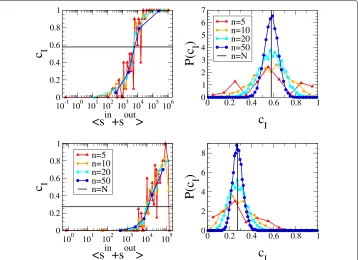
The sampling-based reconstruction algorithm we have proposed in the present paper rests upon the homogeneity assumption, according to which any subset of nodes picked at random provides a representative value of the density of the whole network. Table 2 collects the estimations of the link density, averaged over all sampled subsets of a given cardinality: remarkably, the obtained values are accurate even for low cardinalities. In order to assess the magnitude of fluctuations, we have also explicitly computed the empir-ical probability distributions of the link density estimates, obtained by random sampling our nodes subsets. These distributions are shown in Fig. 1 (right panels). Naturally, the smaller the cardinality of the considered nodes subsets, the more spaced the values of the observable link density and the less smooth the corresponding probability distribution. These findings suggests that our homogeneity assumption is indeed verified, provided that nodes are sampled according to the random selection scheme (Genois et al. 2015).
Fig. 1Left panels: scatter plots of the link densitycIversus the internal total strengthstotI of the subsetI.
Nodes characterized by large values of the total strength tend to form densely-connected groups, while nodes characterized by small values of the total strength tend, on the contrary, to form loosely-connected groups.Right panels: empirical probability distributions of the link densitycI, when nodes belonging toIare
chosen randomly. Each distribution is peaked around the density value of the whole network.Toppanels refer to the WTW,bottompanels to e-MID
severely overestimate the overall network density), nor towards the “periphery” portion of nodes (which would lead to severely underestimate the overall network density). Inter-estingly, in a recent paper comparing several network sampling techniques was found that the least biased sampling scheme for estimating a given network density is precisely the random-nodes one (Blagus et al. 2016).
Conclusions
The present contribution proposes a recipe to reconstruct a network from a very lim-ited amount of information. In particular, we address the problem of inferring the binary and the weighted structure of a given network from the knowledge of the nodes strengths and the link density of only a subset of nodes. As we have shown in the paper, the best sampling scheme is the random-nodes selection scheme which ensures that an accurate estimation of the whole network density can indeed be achieved. On the contrary, select-ing nodes on the basis of more informative structural properties (as the degree, or the strength) could bias the estimation of the connectance towards unrealistically too large, or too small, values. The role played by the available piece of topological information is fundamental not only to achieve an accurate reconstruction of the purely binary structure but also of the weighted structure, as evident upon inspecting Table 1.
different random subsets (even with different cardinality) are characterized by very sim-ilar densities, in turn implying that the whole network density can be estimated (with a high degree of accuracy) by considering a subset randomly drawn from the whole set of nodes. However, the proposed algorithm can be also used to reconstruct networks with a modular structure, upon tuning the link densities of the different modules via Eq. (4): examples are provided by interbank networks structured into jurisdictions, the latter playing the role of the subsets to be reconstructed.
Appendix 1
A pseudo-code summarizing the main steps of the reconstruction algorithm presented in the paper follows.
Algorithm 1:Network reconstruction via density sampling
Input: in- and out-strengths{sini }Ni=1,{souti }Ni=1and link density of a subsetI,
cI = nI(nLII−1).
begin
solve the equationcI= cIin order to determinez:
cI=
1
nI(nI−1)
i∈I
j(=i)∈I
zsouti sinj
1+zsouti sinj ;
definepij= zs
out i sinj
1+zsout i sinj
;
form=1. . .Mdo fori<jdo
calculate the correction to the gravity-like estimation
w(3)ij = s out i sini
W
soutj sinj
l(=j)soutl sinl
⎡ ⎢
⎣ 1
k(=i) s
out k s
in k
m(=k)soutm sinm ⎤ ⎥ ⎦;
connectiandjwith a weight drawn from the following Bernoulli distribution
wij=
⎧ ⎨ ⎩
0, 1−pij,
sout i sinj
W +w
(3) ij
1 pij, pij.
end end
verify the goodness of the achieved reconstruction by calculating the ensemble average of indicators likeTPR,SPC,PPV,ACCandθ;
end
Appendix 2
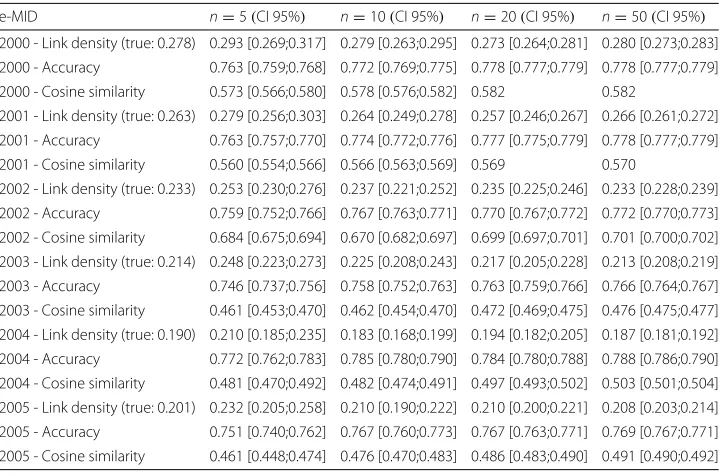
Additional years have been analysed for both the WTW and e-MID (see Tables 3 and 4).
Table 3Statistical indicators used to evaluate the performance of our sampled-based reconstruction
method, for different cardinalitiesnof the known subsetI. Results are shown together with the 95%
confidence intervals (not shown whenever their difference affects the significant digits beyond the third one)
WTW n=5(CI 95%) n=10(CI 95%) n=20(CI 95%) n=50(CI 95%)
1950 - Link density (true: 0.402) 0.401 [0.375;0.426] 0.402 [0.387;0.416] 0.401 [0.393;0.409] 0.400 [0.396;0.403] 1950 - Accuracy 0.736 [0.731;0.741] 0.747 [0.746;0.749] 0.751 0.752
1950 - Cosine similarity 0.460 [0.458;0.462] 0.463 0.463 0.463
1960 - Link density (true: 0.383) 0.329 [0.305;0.352] 0.343 [0.330;0.357] 0.346 [0.338;0.355] 0.348 [0.344;0.353] 1960 - Accuracy 0.737 [0.734;0.741] 0.746 0.749 [0.748;0.750] 0.751
1960 - Cosine similarity 0.586 0.591 0.591 0.591
1970 - Link density (true: 0.460) 0.464 [0.436;0.492] 0.478 [0.462;0.496] 0.461 [0.451;0.471] 0.464 [0.458;0.469] 1970 - Accuracy 0.695 [0.691;0.699] 0.704 [0.702;0.706] 0.709 0.709
1970 - Cosine similarity 0.669 0.669 0.669 0.669
1980 - Link density (true: 0.468) 0.484 [0.458;0.510] 0.470 [0.455;0.485] 0.471 [0.461;0.481] 0.463 [0.458;0.469] 1980 - Accuracy 0.719 [0.715;0.723] 0.731 [0.730;0.733] 0.734 [0.733;0.735] 0.736
1980 - Cosine similarity 0.732 0.732 0.732 0.732
1990 - Link density (true: 0.505) 0.495 [0.467;0.522] 0.516 [0.500;0.532] 0.506 [0.497;0.515] 0.507 [0.503;0.512] 1990 - Accuracy 0.731 [0.726;0.736] 0.743 [0.741;0.745] 0.748 0.749
1990 - Cosine similarity 0.751 0.751 0.751 0.751
The considered cardinalitiesn=5, 10, 20, 50 correspond to percentages ranging from2% to25% of the total number of nodes. The true link densities calculated on the entire networks for the various periods are shown in brackets for reference
Table 4Statistical indicators used to evaluate the performance of our sampled-based reconstruction
method, for different cardinalitiesnof the known subsetI. Results are shown together with the 95%
confidence intervals (not shown whenever their difference affects the significant digits beyond the third one)
e-MID n=5(CI 95%) n=10(CI 95%) n=20(CI 95%) n=50(CI 95%)
2000 - Link density (true: 0.278) 0.293 [0.269;0.317] 0.279 [0.263;0.295] 0.273 [0.264;0.281] 0.280 [0.273;0.283]
2000 - Accuracy 0.763 [0.759;0.768] 0.772 [0.769;0.775] 0.778 [0.777;0.779] 0.778 [0.777;0.779] 2000 - Cosine similarity 0.573 [0.566;0.580] 0.578 [0.576;0.582] 0.582 0.582
2001 - Link density (true: 0.263) 0.279 [0.256;0.303] 0.264 [0.249;0.278] 0.257 [0.246;0.267] 0.266 [0.261;0.272] 2001 - Accuracy 0.763 [0.757;0.770] 0.774 [0.772;0.776] 0.777 [0.775;0.779] 0.778 [0.777;0.779]
2001 - Cosine similarity 0.560 [0.554;0.566] 0.566 [0.563;0.569] 0.569 0.570
2002 - Link density (true: 0.233) 0.253 [0.230;0.276] 0.237 [0.221;0.252] 0.235 [0.225;0.246] 0.233 [0.228;0.239] 2002 - Accuracy 0.759 [0.752;0.766] 0.767 [0.763;0.771] 0.770 [0.767;0.772] 0.772 [0.770;0.773] 2002 - Cosine similarity 0.684 [0.675;0.694] 0.670 [0.682;0.697] 0.699 [0.697;0.701] 0.701 [0.700;0.702] 2003 - Link density (true: 0.214) 0.248 [0.223;0.273] 0.225 [0.208;0.243] 0.217 [0.205;0.228] 0.213 [0.208;0.219]
2003 - Accuracy 0.746 [0.737;0.756] 0.758 [0.752;0.763] 0.763 [0.759;0.766] 0.766 [0.764;0.767] 2003 - Cosine similarity 0.461 [0.453;0.470] 0.462 [0.454;0.470] 0.472 [0.469;0.475] 0.476 [0.475;0.477] 2004 - Link density (true: 0.190) 0.210 [0.185;0.235] 0.183 [0.168;0.199] 0.194 [0.182;0.205] 0.187 [0.181;0.192] 2004 - Accuracy 0.772 [0.762;0.783] 0.785 [0.780;0.790] 0.784 [0.780;0.788] 0.788 [0.786;0.790]
2004 - Cosine similarity 0.481 [0.470;0.492] 0.482 [0.474;0.491] 0.497 [0.493;0.502] 0.503 [0.501;0.504] 2005 - Link density (true: 0.201) 0.232 [0.205;0.258] 0.210 [0.190;0.222] 0.210 [0.200;0.221] 0.208 [0.203;0.214] 2005 - Accuracy 0.751 [0.740;0.762] 0.767 [0.760;0.773] 0.767 [0.763;0.771] 0.769 [0.767;0.771] 2005 - Cosine similarity 0.461 [0.448;0.474] 0.476 [0.470;0.483] 0.486 [0.483;0.490] 0.491 [0.490;0.492]
Acknowledgments
This work was supported by the EU projects CoeGSS (grant num. 676547), Multiplex (grant num. 317532), Shakermaker (grant num. 687941), SoBigData (grant num. 654024), GrowthCom (grant num. 611272) and the FET projects SIMPOL (grant num. 610704) and DOLFINS (grant num. 640772). AG acknowledges the CNR Strategic Project CRISISLAB funded by Italian Government. DG acknowledges support from the Econophysics foundation (Stichting Econophysics, Leiden, the Netherlands).
Authors’ contributions
TS, GC, AG and DG participated in the design of the analysis. TS and GC performed the statistical analysis. All authors wrote, read and approved the final manuscript.
Competing interests
The authors declare that they have no competing interests.
Author details
1IMT School for Advanced Studies Lucca, Piazza S.Francesco 19, 55100 Lucca, Italy.2Istituto dei Sistemi Complessi (ISC)
-CNR, UoS Sapienza, Dipartimento di Fisica, Universitá “Sapienza”, Piazzale Aldo Moro 5, 00185 Rome, Italy.
3Instituut-Lorentz for Theoretical Physics, Leiden Institute of Physics, University of Leiden, Niels Bohrweg 2, 2333 CA
Leiden, The Netherlands.
Received: 20 October 2016 Accepted: 11 January 2017
References
Anand K, Craig B, von Peter G (2014) Filling in the blanks: Network structure and interbank contagion. Quant Finance 15:625–636
Baral P, Fique JP (2012) Estimation of bilateral exposures - a copula approach. Mimeo. http://www.cirano.qc.ca/ conferences/public/pdf/networks2012/02-BARAL-FIQUE-Estimation_of_Bilateral_Exposures-A_Copula_Approach. pdf
Bishop YM, Fienberg SE, Holland PW (2007) Discrete Multivariate Analysis: Theory and Practice. Springer-Verlag, New York Blagus N, Subelj L, Bajec M (2016) Empirical comparison of network sampling techniques. arxiv:1506.02449. https://arxiv.
org/pdf/1506.02449v2.pdf
Cimini G, Squartini T, Gabrielli A, Garlaschelli D (2015a) Estimating topological properties of weighted networks from limited information. Phys Rev E 92:040802. doi:10.1103/PhysRevE.92.040802
Cimini G, Squartini T, Garlaschelli D, Gabrielli A (2015b) Systemic risk analysis on reconstructed economic and financial networks. Sci Rep 5:15758. doi:10.1038/srep15758
De Masi G, Iori G, Caldarelli G (2006) Fitness model for the italian interbank money market. Phys Rev E 74:066112. doi:10.1103/PhysRevE.74.066112
Drehmann M, Tarashev N (2013) Measuring the systemic importance of interconnected banks. J Financ Intermediation 22(4):586–607. doi:10.1016/j.jfi.2013.08.001
Fagiolo G, Reyes J, Schiavo S (2010) The evolution of the world trade web: a weighted-network analysis. J Evol Econ 20(4):479–514. doi:10.1007/s00191-009-0160-x
Genois M, Vestergaard C, Cattuto C, Barrat A (2015) Compensating for population sampling in simulations of epidemic spread on temporal contact networks. Nat Commun 6(8860)
Gleditsch KS (2002) Expanded trade and gdp data. J Confl Resol 46(5):712–724
Hałaj G, Kok C (2013) Assessing interbank contagion using simulated networks. Comput Manag Sci 10(2):157–186. doi:10.1007/s10287-013-0168-4
Iori G, Jafarey S, Padilla FG (2006) Systemic risk on the interbank market. J Econ Behav Organ 61(4):525–542. doi:10.1016/j.jebo.2004.07.018
Mastrandrea R, Squartini T, Fagiolo G, Garlaschelli D (2014) Enhanced reconstruction of weighted networks from strengths and degrees. New J Phys 16(4):043022
Mastromatteo I, Zarinelli E, Marsili M (2012) Reconstruction of financial networks for robust estimation of systemic risk. J Stat Mech Theory Exp 03:03011. doi:10.1088/1742-5468/2012/03/P03011
Montagna M, Lux T (2014) Contagion risk in the interbank market: A probabilistic approach to cope with incomplete structural information. Kiel working papers, Kiel Institute for the World Economy. https://www.ifw-members.ifw-kiel. de/publications/1937-contagion-risk-in-the-interbank-market-a-probabilistic-approach-to-cope-with-incomplete-structural-information/1937_KWP.pdf
Musmeci N, Battiston S, Caldarelli G, Puliga M, Gabrielli A (2013) Bootstrapping topological properties and systemic risk of complex networks using the fitness model. J Stat Phys 151(3):720–734. doi:10.1007/s10955-013-0720-1
Peltonen TA, Rancan M, Sarlin P (2015) Interconnectedness of the banking sector as a vulnerability to crises. Working Paper 1866, ECB European Central Bank. http://www.ecb.europa.eu/pub/pdf/scpwps/ecbwp1866.en.pdf Squartini T, Caldarelli G, Cimini G (2016) Stock markets reconstruction via entropy maximization driven by fitness and
density. arXiv:1606.07684. https://arxiv.org/pdf/1606.07684v1.pdf
Upper C (2011) Simulation methods to assess the danger of contagion in interbank markets. J Financ Stability 7(3):111–125. doi:10.1016/j.jfs.2010.12.001