R E S E A R C H
Open Access
Quorums-based Replication of Multimedia
Objects in Distributed Systems
Tadateru Ohkawara
1*, Ailixier Aikebaier
3, Tomoya Enokido
2and Makoto Takizawa
1*Correspondence:
[email protected] 1Department of Computer and
Information Science, Seikei University, 3-3-1 Kichijoji-kitamachi, Musashino-shi, Tokyo 180-8633, Japan
Full list of author information is available at the end of the article
Abstract
Background: Multimedia objects like music and movies are distributed to peers through downloading and caching in peer-to-peer (P2P) overlay networks. In this paper, we consider multimedia objects which are characterized in terms of not only data structure but also quality of service (QoS) like frame rate and number of colours. For example, there are a pair of replicasoiandojof a fully coloured movie objecto. Here, a content of a replicaoiis changed by adding a subobject but another replicaoj is not changed. On the other hand, the colour of the replicaojis changed with monochromatic one but not in the replicaoi. This means, the replicaoiis newer than the replicaojwith respect to the content but is older thanojwith respect to QoS. Thus, replicas of a multimedia object are partially ordered in terms of newness of not only content but also QoS parameters.
Methods: In traditional quorum-based (QB) protocols, replicas are totally ordered just in terms of newness of content. We discuss a multimedia quorum-based (MQB) protocol to synchronize multiple replicas to make consistent on the basis of the newness-precedent relation of replicas. Here, the replicas are ordered in vectors of version counters of content and QoS parameters. Every replica in a quorum is not updated for QoS operations to reduce the communication overhead. We evaluate the MQB protocol in terms of communication overhead and show the communication overhead can be reduced in the MQB protocol compared with the traditional QB protocol.
Conclusions: We discussed the multimedia quorum-based (MQB) protocol to keep
replicas of a multimedia object mutually consistent. We evaluated the MQB protocol in terms of the total volume of data transmitted among the replicas. Then, we showed the total amount of data transmitted can be reduced in the MQB protocol compared with the traditional quorum-based (QB) protocol.
Background
In scalable distributed systems like cloud computing systems [1] and peer-to-peer (P2P) overlay networks [2] systems, resource objects like databases and files are replicated and distributed to multiple server computers in order to increase the performance, relia-bility, and availability. In P2P overlay networks, objects, especially multimedia objects like movies are in nature autonomously distributed through peer-to-peer communi-cation. There are many discussions on how to maintain the mutual consistency of multiple replicas like the two-phase locking (2PL) [3], read-one-write-all (ROWA) [4],
and quorum-based (QB) [5] protocols. In the 2PL protocol, all the replicas are first locked before they are read and write. On the other hand, only one replica is locked for read while every replica is locked for write in the ROWA protocol. In the QB protocol, subsets of the replicas for read and write operations are referred to asread quorum Qrandwrite
quo-rum Qw, respectively. Every pair of read and write quorums include at least one common
replica. Only if every replica in a quorum could be locked, a transaction can manipulate the replicas in the quorum. In Cassandra [6], the synchronization scheme based on the quorum concept [4] is adopted.
Various types of objects including multimedia objects are distributed in P2P overlay networks. Multimedia objects are characterized in terms of quality of service (QoS) like frame rate and number of colours in addition to the contents. Thus, not only the content but also QoS parameters of an object are manipulated. For example, suppose there are three replicaso1,o2, ando3of a fully-coloured movie objectoin a quorumQ. A scene subobject is added to the replicao2. On the other hand, the colour of another replicao3 is changed with monochromatic one. The replicao2is newer than the replicao3in terms of the content while the replicao3 is newer than the replicao2in terms of number of colours. Thus, replicas are partially ordered in terms ofnewnessof not only content but also QoS parameters in a quorum. The partially orderingnewness-precedentrelation among replicas of a multimedia object is defined in the paper [7]. On the other hand, replicas of a file object are totally ordered just in terms of newness of content in the tradi-tional QB protocol. Here, there is no newest replica in the quorumQ. Acompletequorum includes a newest replica. A newest replica should be a monochromatic replica with the scenesubobjects in the quorumQ. The replicaso2ando3can be made the newest one by degrading colours and adding thescenesubobjects, respectively. Thus, even if a quorum is not complete, some replicaoimight be made the newest by applying operations with data
held in other replicasoiin the quorum. An incomplete quorum which can be complete
is referred to ascompletable. The replicaQiscompletable. We discuss how to obtain the newest replica in an incomplete butcompletablequorum. In the traditional QB protocol, every quorum is complete. However, multimedia quorums can be completable.
We propose a multimedia quorum-based (MQB) protocol in this paper. Here, each replica of a multimedia object holds the vector of counters, where there is one counter for each of the content and QoS parameters. If a transaction issues a read operationop, the transaction selects the newest replicaoiin a quorumQop. If not found, one replicaoi
is selected and is made newest by obtaining operations and data which are not performed on the replicaoithrough communicating with other replicas. Then, the transaction reads
the replicaoiin the quorumQop. The content and QoS parameters of every replica are
updated to be the newest. Here, computation and communication resources are con-sumed to update every replica in the quorumQop. In order to reduce the computation
and communication overheads, every quorum is tried to becompletable, that is, only the counter vector of every replica is updated in the quorumQopbut all the replicas
them-selves are not updated. We evaluate the MQB protocol compared with the QB protocol and show the communication overhead in the MQB protocol can be reduced with the QB protocol.
we evaluate the MQB protocol compared with the QB protocol in terms of communica-tion overheads.
Method
Partially Ordering Relations of Multimedia Replicas
Multimedia objects
A multimedia objectois characterized in terms of not only content parametero.cbut also quality of service (QoS) parameterso.Q. A contento.cshows data structure, i.e. thepart _ of structure of subobjects. QoSo.Qis specified in a tuple of QoS parametersq1, ..., ql
(l ≥ 0). Frame rate and resolution are examples of QoS parameters. Thus, each replica oiof an objectois specified in a pair of the contentoi.cand QoS parametersoi.Q. It is
noted a traditional replicaoilike a text object is just specified in terms of a contentoi.c.
The contentoi.cin a replicaoiis manipulated in acontentoperation like delete-subobject
while QoS parameters.oi.Qis manipulated in aQoSoperation like change-colour.
In a QoS parameterframe rate(fr), 40[fps] is richer than 20[fps]. Thus, for a pair of valuesxandyof a QoS parameterqk,yisricherthanx(x → y) (yispoorerthanx) iff
yincludes more volume of data thanx. For example, 20→40[fps]. Letc1andc2 be a pair of contents of an objecto. A content parameterc2isricherthan a contentc1(c1is poorerthanc2) (c1 → c2) ifc1is a component ofc2. A valuexcan be obtained by just removing some data from a valueyifx → y. However, if y → x, the valuex cannot be obtained without adding any data to the valuey. For example, a fully coloured movie object can be degraded to a monochromatic one by just removing the colour data. How-ever, we have to add colour data to a monochromatic object in order to change with a coloured one.
A scheme of an objectois written in a tuplep0, p1, ..., plwhere the first parameter
p0stands for a content parametero.cand thekth parameterpkindicates a QoS parameter
o.qk(k= 1, ..., l).o.pishows a parameterpiof an objecto(i= 0, 1, ...,l).
Newness-precedent relation
LetObe a set{o1, ...,on}of replicas of an objecto(n≥1)in the system. Here, the content
parameteroj.cof a replicaojisnewerthan the contentoi.cof another replicaoi(oi.c≺oj.c)
iff (if and only if ) the content parameteroj.cis updated, e.g. some subobject is deleted
butoi.cis not updated. A contentoi.c precedesa contentoj.c(oi.c oj.c)iffoi.c ≺ oj.c
oroi.c =oj.c. A QoS parameteroj.qkof a replicaojisnewerthanoi.qk (oi.qk ≺oj.qk)iff
the parameterqkis changed in the replicaoi but is not in the replicaoj. For example, a
monochromatic replicaojis obtained by changing the QoS parametercl(colour) of a fully
coloured replicaoi. Here, the QoS parameteroj.clis newer thanoi.cl(oi.cl≺oj.cl). A QoS
parameteroi.qk precedes oj.qk with respect to newness(oi.qk oj.qk)iffoi.qk ≺oj.qk or
oi.qk=oj.qk.
Replicas in the replica setOare partially ordered in the newness-precedent relation (⊆ O2). A replicao
iprecedesa replicaojwith respect to newness (oi oj) iffoi.coj.c
andoi.qk oj.qk for every QoS parameterqk (k=0, 1, ..., l). A replicaoiisequivalent
with a replica oj (oi ≡ oj) iffoi.c = oj.cand oi.qk = oj.qk for every QoS parameter
qk. A replicaoi is newer than another replicaoj (oi ≺ oj) iff oi oj butoi ≡ oj. A
replicaoiisuncomparablewith a replicaoj(oi |oj)iff neitheroi ojnorojoi. In the
ordered, i.e. for every pair of replicasoi andoj in the replica setO, either oi ≡ oj or
oj≺oi, that is,oi oj. On the other hand, replicas of a multimedia objectoare partially
ordered in the newness-precedent relation. For example, the content parameteroj.cof
a replicaojis newer than the contentoi.c(oi.c ≺ oj.c)while some QoS parameteroi.qk
is newer thanoj.qk (oj.qk ≺ oi.qk). Here, a pair of replicasoi andoj are uncomparable
(oi|oj).
Newest replica in a quorum
In terms of the newness precedent relation, we define the least upper bound (lub) and greatest lower bound (glb) of replicas. oi ∪ oj shows a least upper bound (lub)
of a pair of replicas oi andoj, which is a replicaok such that oi ok and oj ok
and there is no replica oh such that oi oh ok and oj oh ok. oi ∩oj
indi-cates a greatest lower bound (glb) of replicas oi and oj, which is a replica ok such
that ok oj and ok oj and there is no replica oh such that ok oh oi
and ok oh oj. Let Q be a quorum of replicas o1, ..., on. ∪Q indicates the lub
o1∪ ... ∪on of every replica in the set Q, i.e. top replica of the set Q, which shows
the newest replica in the quorum Q. A replicaoi ismaximal iff there is no replicaoj
in the quorumQsuch thatoi oj. MaxQ shows a subset of maximal replicas in the
quorum Q. A quorum Q is referred to as completeiff the lub ∪Q exists in the quo-rumQ. Here, a quorumQis referred to ascompleteiff there is a top replica∪Qin the quorumQ.
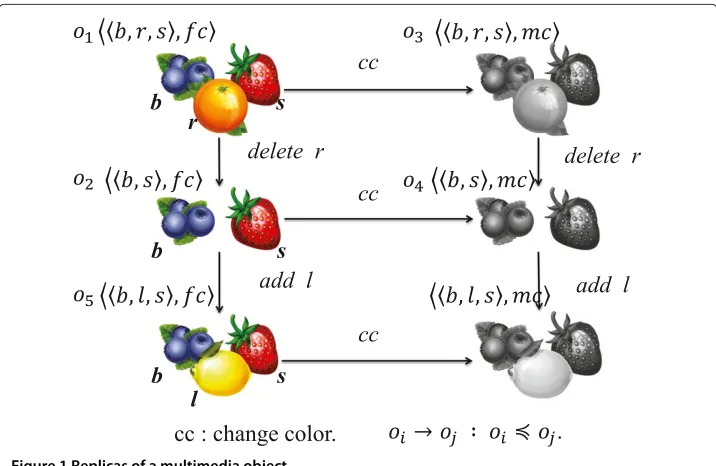
Figure 1 shows a quorumQof five replicaso1, o2, o3, o4, ando5of a multimedia object o,Q={o1, o2, o3, o4, o5}. Each replicaoihas a content parameter (c) and QoS parameter
colour(cl), i.e.oi=c, cl. Here, a directed edgeoi → oj shows the newness-precedent
relationoi oj. A replicao1is composed of three fully coloured subobjects, blueberry b, oranger, and strawberrys. The content parametercisb, r, s,o1=b, r, s, fully− colour(fc). Suppose initiallyo1≡o2≡o3≡o4≡o5.
1 In a content operationdelete, a subobject r is removed in the replicaso2ando5.
Here,o2≡o5=b, s, fc. For a pair of the replicaso2ando5, the content
parameterso2.cando5.care newer thano1.c(o1.co2.c)ando1.co5.cwhile the
QoS parameterso2.clareo5.clare the same aso1.cl,o1.cl=o2.cl. Hence, the replica o1precedes the replicao2(o1o2)ando1o5. Similarly,{o3, o4} o2and{o3, o4} o5.{o1, o3, o4} o5.
2 Next, a pair of the replicaso3ando4are changed by degrading with monochromatic
(mc) ones by a down-colour (dc) operation;o3≡o4=b, r, s, mc. Here, the QoS
parameterscl of the replicaso1ando2are newer thano1.cl(o1.clo3.cl)and o1.clo4.clwhileo3.c=o4.c=o1.c= b, r, s. The replicao1precedes the replica o3(o1o3)ando1o3. Similarly,o1o4. Here, a pair of the replicaso2ando3are
uncomparable(o2|o3). Similarly,o5|o3, o2|o4,ando5|o4.
3 Then, the subobject oranger is deleted in the replicao4;o4=b, s, mc. Here, o2∪o3=o4.
4 A lemon subobjectl is added to the replicao5. Here,o5=b, l, s, fc. Here, there is
no lubo4∪o5in the quorumQ. A pair of the replicaso4ando5are maximal and the
replicao1is a bottom of the quorumQ, i.e.o1=o2∩o3as shown in Figure 2. There
is no top replica∪Qin the quorumQ. The lubo4 ∪ o5shows the newest replica for
the replicas in the quorumQ. By changing the colour cl of the replicao5intomc or
deleting the oranger from the replicao4, a top replicab, s, mc(=o4∪o5) can
be obtained.
In Figure 2, the vertical axis shows the newness of the content parameterc. The content c=b, r, sis changed with the contentb, s, i.e.b, r, s b, s. Hence,o1.c(=b, r, s) includes a larger volume of data thano2.c(=b, s), i.e.o1.c ⊇ o2.c. The horizontal axis indicates the newness of the QoS parametercl. The QoS parameterclis changed from fctomc, i.e.fcmc. The QoS parametero1.cl(=fc)includes more volume of data than o2.cl(=mc). Thus,b, s → b, r, sandmc→fc. A replicaojis richer than a replica
oi(oi → oj) iffoi.c → oj.candoi.qk → oj.qk for every QoS parameterqk. This means,
the replicaoican be obtained by deleting data and degrading the richer replicaojto a less
QoS one.
In the QB protocol [9], there is at least one newest replicaoiin areadquorumQr.A
transaction reads the newest replica oi in the quorum Qr.A transaction writes every
replica in awritequorum Qw. Then, every replica in the quorumQw gets the newest.
In the QB protocol, each replica has the version counter. The version counter of every replica in a write quorumQwis incremented so that the version counter of each replica
in the quorumQwshows the maximum value in the replica setO. Hence, the write
quo-rumQwincludes at least one newest replica whose version counter is the maximum. A
replica whose version counter is the maximum is the newest. Every replica is required to be complete in the QB protocol.
For a pair of valuesxandy,max(x, y) is defined to be the valuexifyx. Here,max(x, y) =max(y, x).max(x, y) =⊥ifx|y. Theupgradeoperationoi+ojon a pair of replicasoiand
oja replicaohsuch thatoh.c=max(oi.c,oj.c)andoh.qk=max(oi.qk,oj.qk)for every QoS
parameterqk.+Qshowso1+...+onfor a quorumQ(={o1, ...,on}).+Qshows a replica
owhich may not be in a quorumQbut which can be the top replica∪Q. Here, letmcbe
max{oi.c |oi ∈Q}andmqk be max{oi.qk | oi ∈ Q}in a quorumQ. A replicaoican be upgraded to an lub of a quorum Q if the content parameteroi.cand every QoS parameter
oi.qk could be changed tomcandmqk, respectively. In order to reduce the overhead to upgrade a replica, one of the maximal replicas is taken. For example, a maximal replica oi with the smallest number of parameters to be changed is taken. Then, the maximal
replicaoiis upgraded. A quorumQis referred to ascompletableiff+Qis∪Q. That is,
some replicaoican be upgraded to the top replica∪Q. The quorumQshown in Figure 1 is
incomplete but completable since one of the maximal replicaso5ando6can be upgraded.
Types of operations
Letopbe an operation supported by an objecto, i.e. read or write operation.LetQop(⊆O)
be a quorum for an operationop. Here, there might not be the newest, i.e. top replica in the quorumQop. That is, the lub∪Qopis not in the quorumQop. Even if there is no top
replica in the quorumQop, there is some maximal replicaoiin the quorumQop.
There are two types of write operations by which replicas are changed:
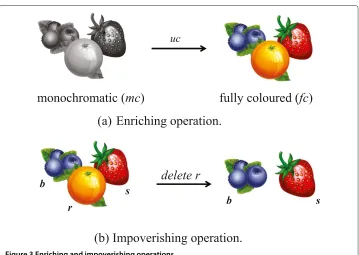
1 Enriching (E ) type. 2 Impoverishing (I ) type.
Suppose a valuexis changed with another valueyof a content or QoS parameter in an operationop. Here, the valuexprecedes the valuey, i.e.yis newer thanx(x y). Ifop is an enriching type of operation,yis richer thanx(x→y). Otherwise,y→x. A richer replicaoi can be easily changed into a poorer replica because data in the replica is just
removed without using additional data not in the replicaoi. On the other hand, we need
additional data which is not in a replicaoito change a poorer replicaoiin order to a richer
one. Thus, in an enriching operation, some volume of data is added to a replicaoi, i.e.
Figure 3 Enriching and impoverishing operations.
required to increase the frame rate. Thus, it is easier to perform the impoverishing type of write operation than the enriching type on a replica.
Suppose there are a pair of monochromatic replicasoiandojof a multimedia objecto,
which are composed of a blueberryb, oranger, and strawberryssubobjects. A pair of the replicasoiandojare equivalent,oi ≡ ojwhereoi.c= oj.c= b, r, sandoi.cl =oj.cl=
mc. Then, a transactionT1deletes an orange subobjectrin the replicaoi. The top, i.e.
newest replica is the replicaoiwhileojis obsolete. Sincedeleteis an impoverishing write
operation, the replicaojcan be made a newest one by just deleting the subobjectr. On the
other hand, suppose a transactionT2changes the colour (cl) parameter of the replicaoi
to be fully coloured in anup-colour(uc) operation. Theucoperation is an enriching one. In order to change the replicaoj, data to make the replicaojfully coloured has to be sent
to the replicaojsince the replicaojdoes not have the data whileoihas the data. Even if
the operationucwhich is applied to the replicaoiis obtained to the replicaoj, the replica
ojcannot be changed without obtaining the colour data from the newest replicaoi.
In the QB protocol,Qopi∩Qopj=φfor every pair of quorumsQopiandQopjof conflict-ing operationsopiandopj. The quorum-based protocol for abstract types of operations
on objects is discussed in the paper [5].
Multimedia Quorum-Based (MQB) Protocol
Counter vectors
LetQbe a quorum of replicaso1, ..., on(n ≥ 1)of a multimedia objecto. Each replica
oi is characterized in terms of the contentoi.cand QoS parametersoi.q1, ..., oi.ql (i=
1, ..., n). Here, a tuple of parametersp0, p1, ..., pl is a scheme of a replicaoi. Here,
the objectoiis written as a tuplev0, v1, ..., vl (l ≥ 1) of values, wherev0shows the contentcandvkstands for a value of a QoS parameterqk fork =1, ..., l. A vectoroi.V
Initially,oi.V =0, 0, ..., 0. Each time an elementoi.qkis changed(k =0, 1, ..., l), the
counteroi.vckis incremented so that the counteroi.vckis the maximum in the quorumQ.
Suppose a countervckis incremented since a parameteroi.pk is changed in a replicaoi
by performing an operationopon the replicaoi (k ∈ {0, 1, ..., l}). First, the maximum
counter valuevis taken in a set{oi.vck |oi∈Qop}of the counter values of the quorumQop.
In the quorumQop, the maximum valuevof the countervckis incremented by one,v=v
+ 1. Then,oi.vck=von every replicaoiin the quorumQop. The value of thekth parameter
oi.qkof a replicaoiis the newest if the countervckis maximum in the quorumQop.
Let us consider a quorumQof five replicaso1, o2, o3, o4ando5shown in Figure 1, Q = {o1, o2, o3, o4, o5}. Initially, every replica is equivalent in the quorum Q, i.e. o1≡o2≡o3≡o4≡o5. Each replicaoihas one QoS parameter colour (cl) and a vector
oi.V =oi.vc0, oi.vc1(i= 1, ..., 5). In each vectoroi.V,oi.vc0is a counter for the content parameter oi.c (= oi.v0) and oi.vc1 is a counter for the QoS parameter cl (number of colours)oi.cl(=oi.v1). In every replicaoi, initiallyoi.V=0, 0whereoiis composed of
three fully coloured subobjectss,g, anda, i.e.oi=s, g, a, fl.
1 First, the fully coloured replicaso2ando5are updated by changing the colour
parame-tercl with the monochromatic one,o2=o5=s,g, a, mc. The countervc1is
incre-mented by one. Here,o2.V =o5.V=0, 1since the second parametercl is changed.
2 Next, a pair of replicaso3ando4are obtained by deleting an orange subobjectr, i.e. o3.V=o4.V=1, 0whereo3=o4=s, g, fcsince the first contentv0is changed.
3 Then, the orange subobjectr is deleted in the replicao4,o4=s, g, mc.
Here,o4.V=1, 1. Here,o1o2o4whereo1.V≤o2.Vando2.V≤o4.V.
4 Then, the fully coloured lemon subobjectl is added
to the replicao5,o5=b, l, s, fc. The counter vectoro5.Vis changed with2, 0.
Here, a pair of the replicas o2 and o3 are uncomparable (o2 | o3) where a pair of the vectors o2.V = 1, 0 and o3.V = 0, 1 are not comparable. o1 o3 since o1.V < o3.V. o3 o4and o3 o5 where o3.V ≤ o4.V ando3.V ≤ o5.V, o4 | o5 sinceo4.V =1, 1ando5.V =2, 0. Figure 4 shows the vectoroi.V of each replica
oi (i= 1, ..., 5). Here, a directed edge oi → oj shows the newness-precedent relation
oi oj. Here, there is no top replica in the quorumQ. Here, max(o4.vc0, o5.vc0) = 2 and max(o4.vc1, o5.vc1) = 1. Hence, if the colour parametero5.clof the replicao5is changed with monochromatic one mc, the replicao5 gets the top replica b, l, s,mc. Here, the countero5.vc0is incremented by one,o5.V =2, 1. In another way, the replica o4 can be the newest replica b, l, s, mc by adding a monochromatic lemonl to the replicao4.
Write operations
Suppose a transactionT issues a write operationopto change thekth parameterpk of
a replicaoi (0 ≤ k ≤ l). A transactionT first locks a replicaoiin theopmode before
performing an operation opon the replicaoi. Here, a lock mode op1 is referred to as conflictwith a lock modeop2if an operationop1conflicts with an operationop2. If the replicaoiis already locked in a mode conflicting with the operationop, the transactionT
has to wait.
[Write procedure]
1 First, the transactionT locks every replicaoiwith anop mode in the quorumQop. If
every replicaoicould not be locked, the transactionT waits.
2 If successfully locked, the transactionT writes the k th elementoi.vkof every replica
oiand collects the vectoroi.Vfrom every replicaoiin the quorumQop.
3 vc=max (o1.vck, ...,on.vck) and the transactionT changesoi.vckwithvc + 1 in
every replicaoiof the quorumQop.
The version countervck of every replica in the quorumQopis changed with the
max-imum valuevc. In order to reduce the computation and communication overheads, the parameteroi.pkof every replicaoiis not always changed while the counter is updated:
1 If the operationop is an enriching type, the parameteroi.qkof every replicaoiis
updated in the quorumQop.
2 Ifop is an impoverishing type, the parameteroi.qkof only the top replicaoiis updated.
We consider the replicas of the objectoshown in Figure 5. Suppose a transactionT1 adds a lemon subobjectlto the replicas. The operationaddis an enriching type of write operation. SupposeQadd is a quorum{o1, o2, o3}of the replicas for theaddoperation. Here,o1=b, r, s, fc,o2=b, s,fc, ando3=b, r, s, mc. A pair of the replicas o2ando3are maximal,MaxQadd ={o2, o3} ⊆ Qadd. Here, max(o1.c, o2.c, o3.c) =b, s
(=o2.c=o3.c) and max(o1.cl, o2.cl, o3.cl) =mc. Here, the replicao2can be the top replica b, s, mcby upgrading the replicao2, o2= +Qadd. Then, the lemon subobjectlis
added to the replicao2. Here,o2=b, l, s, mc. A pair of the other replicaso1ando3are changed so thato1≡o2ando3≡o2. That is, the colour parameterclof the replicao1is changed with monochromatic onemc, the orange subobjectris deleted, and the lemonl is added to the replicao1. The orangeris deleted and the lemonlis added to the replica o3. Then, a pair of the replicaso2ando3get equivalent with the replicao1(o2≡o3≡o1= b, s, mc).
Next, suppose a transactionT2 deletes a subobjectb. Here, suppose there are three replicaso1, o2, ando3shown in Figure 2. One maximal replicao2is taken and upgraded tob, s, mc. Then,bis removed. Here,o2=s, mc. Since thedeleteoperation is an impoverishing one, the other replicaso1ando2are not updated and the delete operation is logged ino1ando2.
Read operations
Next, suppose a transaction T issues a operationopto replicas of an objectoto read the parameter pk (k = 0, 1, ..., l). The transaction T has to read the kth parameter
oi.pk of the newest replicasoi in the quorum Qop. In order to read the newest replica
oi, the transactionT has to read the version counteroj.vck from every replicaoi in the
quorumQop:
[Read procedure]
1 First, the transactionT locks every replica with an op mode in the quorumQop. If
every replica could not be locked, the transactionT waits.
2 If every replica could be successfully locked, the transactionT collects the vector oi.Vfrom every replicaoiin the quorumQop.
3 If there is a replicaoisuch thatoj.V ≤oi.Vfor every replicaojin the quorumQop,
the replicaoiis the top of the replicas in the quorumQop, i.e.oi=∪Qopand is the
newest in the quorumQop. The transactionT reads the replicaoiand change the
counteroi.vckin every replica in the quorumQop.
4 If there is no top replica in the quorumQop, the transactionT has to upgrade one
maximal replicaoiinQop, i.e.oi= +Qopwhich is the top∪Qopof the quorumQop.
The transactionT reads the k th elementoi.vkof the replicaoiand changes the
counteroj.vckwithoi.vchin every replica inQop.
Upgrade of a maximal replica
If a top replica is not in the quorumQop, the transactionT has to obtain a top replica
from the replicas in the quorumQopin the read procedure. We discuss how to upgrade a
maximal replicaoito the top replica, i.e.oi= +Qopby using the vectors of the replicas. A
replicaoiis referred to assatisfya counter vectorV=vc0, vc1, ...,vcliffoi.vck=vckfor
k= 0, 1, ...,l.
First, one maximal replicaoiis selected in the quorumQopas follows:
[Selection of a maximal replica]
1 The transactionT obtains a vectorV = vc0,vc1, ...,vclwherevck=
max({oi.vck |oi∈Qop}) fork =0, 1, ...,lfrom the collection of the vectors collected
2 A replicaoiwhich satisfies the vectorV =vc0, vc1, ...,vcl, i.e.oi.vck=vckfor
everyk =0, 1, ...,l, shows the top replica∪Qop. If the replicaoiis found, the
transactionT reads the replicaoi.
3 Otherwise, the transactionT selects a replicaoiwhere| {vck|oi.vck=vckfork =
0, 1, ..., l} |is the maximal in the quorumQop. That is, a maximal replicaoiis
selected so that the overhead to change the replica can be reduced.
The replicaoifound at step 3 is not the top in the quorumQop. Here, a parameterpk
of a replicaoiis current ifoi.vck is maximum. Otherwise, the parameterpk is obsolete.
Hence, the transactionTupdates the parameters of the replicaoias follows:
[Upgrade of a maximal replica]
1 For each obsolete parameterpk, the transactionT finds a replicaojwhereoj.pkis
current in the quorumQopwhich satisfiesoi.vck <vck.
2 The transactionT updates each obsolete parameteroi.pkwith the current one
oj.pkby using the replicaoj.
3 The vectoroi.Vis updated asoi.V =V.
At step 1, the replica oj found by the transaction T has the newest value of each
obsolete parameter pk of the replica oi. The value of the parameter oi.pk has to be
enriched to the parameter value oj.pk. If the parameter value oi.pk is richer than
oj.pk, i.e. oj.pk → oi.pk, the QoS parameter of the replica oi can be impoverished
just by deleting some data in the replica oi without using additional data.
Other-wise, the parameter pk of the replicaoi has to be enriched, i.e. we need further data
which is not in the replica oi to enrich the value of the QoS parameter pk. Hence,
the content oi.v0 of the replica oi is required to be the same as the replica oj, i.e.
oi.v0=oj.v0.
The elementsoi.v0, oi.v1, ..., oi.vl of every replicaoi in the quorum Qop (⊆ O) are
changed with the newest ones. In addition, the vector oi.V of every replica oi in the
quorumQop has to be changed to be larger than every replica in the replica set O. In
every read operation op’, every replica in the quorum Qop is changed with a replica
equivalent with the top replica. It is sure at least one top replica of the replica set O is included in the quorumQop. However, the overhead to change every replica in
the quorum Qop is increased. Suppose one top replica is read by the operation op
and other replicas in the quorumQop are not changed. Hence, the quorumQop may
not include the top replica. Here, the content and QoS parameters of every replica in the quorum Qop can be changed since they are just overwritten. However, the
max-imum vector value obtained by all the replicas in the quorum Qop may not be the
maximum in the replica setO. Suppose Qop ={o1, o2, o3}andQop ={o3, o4}. Here, suppose the replicao1 is the top replica. A transactionT1reads the top replica o1 in a read operationop’ but does not change the other replicaso2 ando3. Then, another transaction T2 writes the replicas o3 and o4 in a write-type operation op. Here, the vectors of replicas o3 ando4 are not the newest while the vector of the replicao1 is the newest.
[Completable quorum]
• In a read operationop, only the vectoroi.Vof every replicaoiexcept the top replica
is changed but the contentoi.v0and QoS parametersoi.Qof the replicaoiare not
changed.
In a write operationop, the vectorV which shows the top replica in the replica setO can be obtained in the quorumQop. In the example of the quorumsQop andQop, the
vectors of the replicaso1, o2, ando3are updated while the content and QoS parameters of the replicaso2ando3are not updated by the transactionT1. Then, the transactionT2 overwrites every replica in the quorumQop. Here, the vectoro3.Vof the replicao3is the newest sinceo3.Vis updated by the transactionT1. Hence, the vector of the replicao3is incremented and then the vectoro4.Vof the replicao4is changed witho3.V.
Evaluation
We would like to evaluate the multimedia quorum-based (MQB) protocol compared with the traditional quorum-based (QB) protocol in terms of communication overhead. In the MQB protocol, if a transaction issues a read operation, every replica in a read quorum Qr is not updated while the vector of every replica is updated. We show how much the
communication overhead to update every replica in the quorumQr can be reduced in
the MQB protocol.
Suppose there arenreplicas,o1, ..., on(n ≥ 1) of an objecto. Suppose there are two
types of operations, read (r) and write (w).QrandQwshow a pair of read and write
quo-rums, respectively.nrshows the number|Qr|of replicas in the quorumQrandnw= |Qw|.
Letfr andfw be a pair of probability that a replica is included in the quorumsQr and
Qw, respectively. We assume each quorum is randomly constructed. That is,fr = nr/n
andfw= nw/n. According to the quorum properties,fr+fw >1 andfw >0.5. Letf be
fr+fw−1. Here,f shows probability that a replica is included in both the quorumsQr
andQw.f >0.
In the QB protocol, a transactionT first issues a lock request to every replica in a quo-rumQopto perform an operationop∈ {r, w}. If every replica is successfully locked in the
quorumQop, the transactionT issues an operationopto replicas inQop. First, suppose
the transactionT issues a writeopto every replica in the write quorumQwand updates
the version counter of every replica. Here, totally 4·nw( = 4·n·fr) messages are
trans-mitted. In order to write replicas, data is sent to every replica in the write quorumQw.
Letdbe the size of the update data, e.g. the size of a replica. The expected volume of data transmitted isn·fw·d.
On the other hand, the transaction T issues a read operationopto one replica and receives a value of the replica in the read quorumQr. Then, the transactionTsends the
newest value to every other replica and updates the version vector of every replica in the QB protocol. The totally 4·nrmessages are transmitted between the transactionTand the
replicas. In the QB protocol, the newest value of the replicas in the quorumQris read into
the transactionTand is transmitted to every other replica which is in the quorumQrbut
not in the quorumQw. Hence, the expected volume of data transmitted isn·fr·(1−fw)·d.
In the MQB protocol, the transactionT reads the top replica and updates the ver-sion counter of every replica in the read quorumQr. However, the other replicas are not
0 0.1 0.2 0.3 0.4 0.5 0.6 0.7
0 0.1 0.2 0.3 0.4 0.5 0.6 0.7 0.8 0.9 1
data ratio
/( ). /( ).
Figure 6 Transmission data volume (fw= 0.6,f= 0.1).
messages are transmitted for read and write in the MQB protocol, respectively, as well as the QB protocol. The volume of data transmitted to write the replicas is n·fw·d
in the traditional QB protocol and the MQB protocol. Here, let α be the ratio of the number of write operations to the total number of operations issued by transactions (0 ≤α ≤ 1). “α = 0” means every request isreadand “α = 1” shows every request is write. In the QB protocol, the expected volumeSQof data transmitted in each transaction
isα·n·fw·d+(1−α)·n·(1−fw)·fr·d. The expected volumeSMof data transmitted in
0 0.1 0.2 0.3 0.4 0.5 0.6 0.7 0.8 0.9
0 0.1 0.2 0.3 0.4 0.5 0.6 0.7 0.8 0.9 1
data ratio
. .
Figure 8 Transmission data volume (MQB).
the MQB protocol isα·n·fw·d+(1−α)·dsince no data is transmitted to every other
replica inreadthan the top replica in the quorumQr.
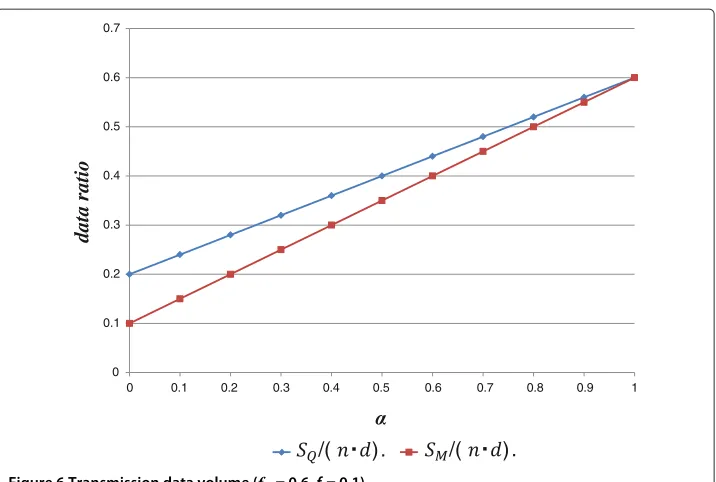
Figures 6 and 7 show the ratiosSQ/(n·d)andSM/(n·d)for the write ratioα. Here, we
assume there are ten replicas,n= 10. In Figure 6,fw= 0.6, andf = 0.1. In Figure 7,fw=
0.8 andf = 0.1.SQ =SM forα = 1. As shown in Figures 6 and 7, the total amount of
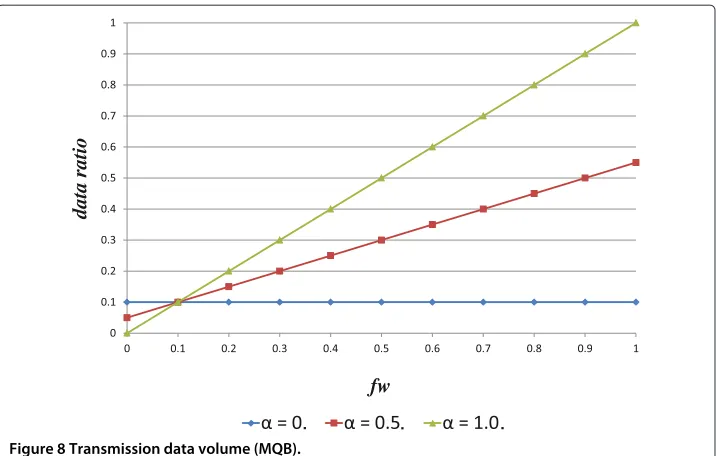
data transmitted can be reduced in the MQB protocol compared with the QB protocol. In Figure 8, the ratioSM/ (d·n) is shown for the write probabilityfw. Here,fwshould be lager
than 0.5 from the quorum constraint (fw>0.5). The lagerfwandαare, the lager amount
of data is transmitted. In order to reduce the communication overhead, the write quorum
Figure 10 Transmission data volume (QB) (fw= 0.8,f= 0.1).
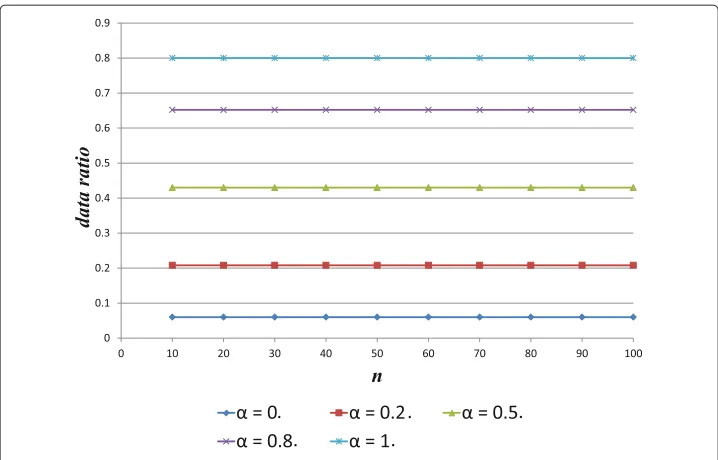
should be smallest. In Figure 9, the data ratioSM/ (d·n) for the numbernof replicas is
shown wherefw= 0.8. Figure 10 shows the data ratioSQ/ (d·n) for the numbernof the
replicas. The communication overhead of the MQB protocol is increased in complexity O(n) since the ratio to the numbernof the replicas is almostO(1).
Conclusions
In this paper, we discussed the multimedia quorum-based (MQB) protocol to keep repli-cas of a multimedia object mutually consistent.A multimedia object is characterized in content and QoS parameters. Replicas are partially ordered in the newness-precedent relationin terms of not only content parameter but also QoS parameters. If a replica oi has a larger vector value than another replica oj, the replica i.e. oi.V > oj.V, oi is
newer thanoj. A replicaoi and the vectoroi.V are updated each time the replicaoi is
manipulated. In order to increase the performance to read replicas, only the counter vec-tor of each replica is updated in a quorum while the content and QoS parameters of the replica are not updated. We evaluated the MQB protocol in terms of the total volume of data transmitted among the replicas. We showed the total amount of data transmit-ted can be reduced in the MQB protocol compared with the traditional quorum-based (QB) protocol.
Competing interests
The authors declare that they have no competing interests.
Author’s contribution
Tadateru Ohkawara carried out the MQB protocol studies, participated in designing, implementing, and evaluating the MQB protocol and drafted the manuscript. Ailixer Aikebaier and Tomoya Enokido participated in the design of the algorithm used in the MQB protocol. Makoto Takizawa conceived of the study, and participated in its design and coordination and helped to draft the manuscript. All authors read and approved the final manuscript.
Acknowledgements
Author details
1Department of Computer and Information Science, Seikei University, 3-3-1 Kichijoji-kitamachi, Musashino-shi, Tokyo
180-8633, Japan.2Faculty Of Business Administration, Rissho University, 4-2-16 Oosaki, Shinagawa-ku, Tokyo 141-8602, Japan.3New Generation Network Laboratory, NICT, 4-2-1 Nukui-Kitamachi, Koganei, Tokyo 184-8795, Japan.
Received: 17 October 2011 Accepted: 7 March 2012 Published: 10 May 2012
References
1. Hofmann P, Woods D (2010) Cloud Computing: The Limits of Public Clouds for Business Applications. Journal of IEEE Internet Computing 14: 90–93 ISBN 1089–7801
2. Schollmeier R (2001) A Definition of Peer-to-Peer Networking for the Classification of Peer-to-Peer Architectures and Applications. In Proc. of the First International Conference on Peer-to-Peer Computing. Linkoping, Sweden, p 101 3. Gray J (1978) Notes on Database Operating Systems. Lecture Notes in Computer Science, vol 60. Springer Verlag 4. Helal A, Bhargava B (1995) Performance Evaluation of the Quorum Consensus Replication Method. In Proc. of the
Internation Computer Performance and Dependability Symposium (IPDS’95). Erlangen, Germany, pp 165-172 5. Stoica I, Morris R, Karger D, Frans Kaashoek M, Balakrishnan H (2001) Chord: A Scalable Peer-to-peer Lookup Service
for Internet Applications. In Proc. of ACM the 2001 Conference on Applications, Technologies, Architectures, and Protocols for Computer Communications (SIGCOMM ’01). San Diego, califonia, USA, pp 149–160
6. Lakshman A, Malik P (2010) Cassandra: A Decentralized Structured Storage System. ACM SIGOPS Operating Systems Review 44(26): 35–40
7. Ohkawara T, Aikebaier A, Enokido T, Takizawa M (2011) Quorums-based Replication of Multimedia Objects in Distributed Systems. In Proc. of the International Conference on Network-Based Information Systems, NBiS2011, CD-ROM. Tirana, Albania
8. Enokido T, Higaki H, Takizawa M (1998) Group Protocol for Distributed Replicated Objects. In Proc. of the 27th International Conference on Parallel Processing (ICPP-98). Minneapolis, Minnesota, USA, pp 570–577
9. Tanaka K, Takizawa M (2001) Quorum-Based Locking Protocol for Replicas in Object-Based Systems. In Proc. of IEEE the 5th International Symposium or Autonomous Decentralized Systems. Dallas, Texas, USA, pp 196–203
doi:10.1186/2192-1962-2-11
Cite this article as:Ohkawaraet al.:Quorums-based Replication of Multimedia Objects in Distributed Systems. Human-centric Computing and Information Sciences20122:11.
Submit your manuscript to a
journal and benefi t from:
7 Convenient online submission
7 Rigorous peer review
7 Immediate publication on acceptance
7 Open access: articles freely available online
7 High visibility within the fi eld
7 Retaining the copyright to your article