Heuristics for spatial finding using
iterative mobile crowdsourcing
Seng W. Loke
*Background
Crowdsourcing, or crowd computing, is an important powerful approach to problem-solving and critical information gathering, harnessing the power of the crowd, and crea-tively combining machine and human computations [1–3]. Crowdsourcing can be used to do tasks that either no machine alone can do or where involving humans is better (e.g., CrowdDB [4]). Mobile crowdsourcing, i.e. crowdsourcing to mobile users, presents significant new opportunities and challenges, with enormous possibilities for human computations and tasks with spatial and temporal properties [5–12].
One important class of crowdsourcing applications is where information and tasks to be crowdsourced have spatiotemporal properties and are advantageously done by mobile device users (e.g., crowdsourcing for carpark spaces, locations of crowds, maps of areas, transport demand, emergency needs, photos/video at different locations of a parade, location of flora and fauna), different from general tasks that can be crowdsourced such as language translation or copy-editing. Such crowdsourcing may be done over extended periods of time and data centralised for analytics, or can be done in an ad-hoc real-time on-demand manner (e.g., issuing crowdsourced queries to assess a situation in the vicin-ity within the next few minutes). Real-time crowdsourcing of queries can be useful, even
Abstract
Crowdsourcing has become a popular method for involving humans in socially-aware computational processes. This paper proposes and investigates algorithms for find-ing regions of interest usfind-ing mobile crowdsourcfind-ing. The algorithms are iterative, usfind-ing cycles of crowd-querying and feedback till specified targets are found, each time adjusting the query according to the feedback using heuristics. We describe three (computationally simple) heuristics, incorporated into crowdsourcing algorithms, to reducing the costs (the number of questions required) and increasing the efficiency (or reducing the number of rounds required) in using such crowdsourcing: (i) using additional questions in each round in the expectation of failures, (ii) using neighbour-hood associations in the case where regions of interest are clustered, and (iii) model-ling regions of interest via spatial point processes. We demonstrate the improved performance of using these heuristics using a range of stylised scenarios. Our research suggests that finding in the city is not as difficult as it can be, especially for phenomena that exhibit some degree of clustering.
Keywords: Mobile crowdsourcing, Spatial finding, Heuristics
Open Access
© 2016 Loke et al. This article is distributed under the terms of the Creative Commons Attribution 4.0 International License (http:// creativecommons.org/licenses/by/4.0/), which permits unrestricted use, distribution, and reproduction in any medium, provided you give appropriate credit to the original author(s) and the source, provide a link to the Creative Commons license, and indicate if changes were made.
RESEARCH
with prior information available (e.g., there is a database of historical traffic or car park-ing availability for a given area) obtained from some source (e.g., either from stationary sensors or previous crowdsourcing efforts or other means) in order to obtain up-to-date information that can complement or update prior information, especially in the case where information can easily deviate from history (e.g., car parking), or historical data are too coarse-grained (e.g., the database only has average car park availability for a large area over days), or without any prior information, where the queries are to obtain new information about regions in the area, in a just-in-time on-demand manner. Real-time responsiveness in crowdsourcing is a challenge but methods have been explored mak-ing it a real possibility. For example, Bernstein has done interestmak-ing work in preparmak-ing crowds via additional incentives in order to achieve real-time performance [13].
Crowdsourcing involves incentives, and hence, costs, such as monetary costs for pay-ments for answers as well as efficiency costs, e.g., in terms of time taken to achieve an adequate response. Algorithms where humans are viewed as data processors have been explored for finding the maximum [14], filtering [15] and for finding a subset of items with a given property among a given unstructured collection [16], taking into considera-tion the need to optimise cost and efficiency at the same time.
In this paper, we propose and investigate iterative crowdsourcing processes, based on work from [17], to find regions of particular interest (e.g., regions satisfying particular properties) from among a collection of regions, with all such regions within a given fixed size area, as typically seen in the context of mobile crowdsourcing, where the human con-tributors (or workers) for crowdsourced tasks/queries are people within the area with mobile devices, so that queries or jobs posed to them (and their answers) have spatial properties. We also have in mind real-time crowdsourcing where results are intended for the here-and-now, rather than obtained over a long period of time, but our work does not deal specifically with strict real-time constraints.
In particular, we consider cases where association between regions can be exploited to reduce the costs and increase efficiency in crowdsourcing. Often, information about a region provides clues about information of its neighbouring regions: a region that is crowded might be adjacent to another crowded region or a polluted region might be adjacent to another polluted region, even if this is not always the case. We argue that this is the case for a number of real-world phenomena including car parking, 3G/4G band-width, crowded areas, and noise pollution. So, for example, if one wants to use crowd-sourced queries to find regions where there are car parks available, regions where there is currently high 3G/4G bandwidth, regions which are crowded, and regions with noise pollution above some threshold, then neighbourhood or proximity associations can be exploited.
using spatial point processes in "Experiments" section. We then review related work in "Related work" section and conclude in "Conclusion" section.
The spatial finding problem
The spatial finding problem is a simple variation of the problem first proposed in [17]. The basic version of the original problem is as follows: given a (large) set of items, a predicate, and a number k, use humans to find k items from the given set that satisfy a given predicate. An example of an instance of this problem is given as follows: “Consider a data set I of images, from which we want to find 10 images that satisfy a predicate or flter f, e.g., whether it is a photo of a cat. We consider each image, and ask humans the question, e.g., ‘does this image show a cat?’ Suppose on average that 20 % of the photos are of cats. For the purposes of this example, we assume that humans do not make mis-takes while answering questions.” A solution to the above problem might be sequential (to ask about one image at a time) and stop whenever 10 images are found; this algo-rithm is cost-optimal asking only as many questions as needed, but could take a long time (requiring many rounds of questioning)—the cost and latency depends on which images are picked. Another solution is to consider asking about all images in parallel; this is fast (requiring only one round of questioning), but is costly since one needs to pay for all the questions asked. A third possible solution which is between the first and second solution in terms of the cost-latency tradeoff is to ask (10−x) questions at the
current round of questioning, if we already found x cat images so far.
This original version does not deal with spatial properties of items as we do in this paper. We define below a spatial version of the above problem and while we explore the above solution ideas, we consider spatial heuristics for picking items to ask about. The general notion of cost-latency tradeoffs, however, also applies here.
Our Problem Assume a a large area R partitioned into n regions {r1,. . .rn}. The problem is to find a set S⊆R of at least k≤n regions, each of which evaluates to true for a given
predicate F representing some criteria, i.e. F(r)=TRUE, for each r∈S. We also want
to solve this problem with the lowest cost (assuming we need to pay to get a question about a region answered) and in a most efficient way (the number of rounds of questions required).
For example, we want to find at least k regions with available car parking spaces, and can divide a large area into a set of regions, about which we can then ask the crowd about, but each time we ask the crowd about a region, we assume that we incur a cost. Another example is to find a not-so-crowded cafe and can issue a query to find at least
k regions with a not-so-crowded cafe, answers being given by people near or within the region. A third example is to find a high bandwidth (WiFi, 4G or otherwise) region.
There are two factors to deal with in any solution to the problem. One is the cost, where we assume that each time a query is issued to find out about a region, a cost φ is
incurred (which includes the cost of issuing the query as well as incentives paid for an answer to the query) so that if we ask about k regions, we incur a total cost of k.·φ. The
While we do not prescribe the mechanism used by users to issue queries to other users, we assume that some cost is incurred per query issued (or per answer about a region obtained). We assume, for simplicity, here that each query issued is always answered, and answered accurately and truthfully. The cost could be measured in differ-ent forms, e.g., to the query issuer, the cost could be a monetary incdiffer-entive to a user pro-viding an answer about a query (about a region). This means that a general mechanism to ask everyone could incur a high cost if everyone actually answers, as we discuss below.
A crowdsourcing solution
An initial solution to the above problem is to simply adapt the solutions from [16], which was initially developed to find particular items from a database of items: assuming that each region is an item requiring a binary answer YES or NO (TRUE or FALSE), we have the algorithm below which is to find particular regions from a collection of regions. Note that YES/NO questions are very easy for users to respond to (but of course, tend to pro-vide less information than more general responses).
Given a set of regions R and α which denotes the fraction of regions (we call posi-tive regions) of R where F evaluates to TRUE (and the rest of the regions, F evaluates to
FALSE, and we assume that α >0), and assuming that we are finding k positive regions
from R, where there are at least k regions that can satisfy F, i.e., k ≤ |R| ·α, we have
Algorithm 1.
While we have not found enough regions and while there are still regions from R that are not yet observed, we iteratively choose a subset of regions to observe, and this sub-set is according to choose Candidates (k,D,R\O), a version of which is shown in
Depending on how we choose the candidates, three solutions are possible:
1 It has been shown from [16] that a way to minimise total cost is to ask about one region at a time (say, in any order) and stopping whenever k regions are found sat-isfying the criteria, so that we never ask more questions than required or get more than k positive answers; only in the worst case, this scheme can lead to |R| rounds. 2 A more expensive solution but very efficient (requiring one round) is to ask |R|
ques-tions about all the regions in parallel. This could be done, for example, by posting a query like ‘where can I find a parking spot?’ on a wide-audience medium, such as a (mobile accessible) Website say, and anyone or everyone in any region can answer the question; in effect, we are asking about all regions at the same time. Since we assume that a query about any region is always answered, the cost is then |R| ·φ. Now, suppose we want a solution that can achieve a cost less than |R| ·φ. To find k positive regions, note that a method to do this might be to issue |R| queries and then wait for a certain fixed period of time for k positive responses and paying for all the first K ≥k answers obtained on a first-come first-serve basis1—however, this has already incurred costs in issuing the |R| queries and also paying for what may be largely K−k negative answers; to avoid such costs, we want to select regions to ask about (reducing the cost of issuing queries) and focus search queries to where there is a higher likelihood of getting a posi-tive response. For each query issued on a region, the first answer obtained could be used and paid for, or it could be obtained via taking a majority vote of the first z answers (where z is the number of answers that can be paid for from the budget φ).
3 A third solution which aims to minimise cost and maximise efficiency at the same time is as follows, which will be the main focus in the rest of this paper. In each round, we ask no more questions than that required if all the answers were positive. More precisely, in round i, if ki <k regions have already been found where F evalu-ates to TRUE, in parallel, we ask questions about a further k−ki regions which we have not asked the crowd about previously. It can be seen that this solution never asks more questions than required in this case, and hence, minimises cost, but at the same time, would provide a means to finish in fewer rounds than solution (1). More precisely, chooseCandidates(k,D,R\O) is as in Algorithm 2.
This algorithm is essentially that in [16] but tailored to spatial finding, where it was shown that the total number of questions it requires is comparable to solution (1), when both are operating on the same input.
A key feature of the algorithm is how chooseCandidates(·) actually selects the regions to ask about. In contrast to Algorithm 2 which, in each round, randomly selects a region to ask about (which we call the random spatial crowdsourcing), the algorithm we propose later will use a neighbourhood association heuristic to select regions to ask about which will be called associative spatial crowdsourcing. We first discuss the performance of two versions of random spatial crowdsourcing below, one without a heuristic as above and another with a heuristic that embraces failure.
Analysis of spatial crowdsourcing via solution (3) In the worst case, the total cost is |R| ·φ
with the largest number of rounds |R|. The best case total cost is k·φ with the least
number of rounds being 1.
Let us consider the average case. We describe the typical case of the algorithm via a
success factor0< σ ≤1, where we assume that in each round, the fraction of queries
answered positively with F evaluating to TRUE is σ. In random spatial crowdsourcing,
we would have σ =α, where α, as given earlier, is the proportion of regions in R where F evaluates to TRUE, since our choice of regions to ask about in each round is random.
The algorithm uses k queries in round 1, k−⌈k·σ⌉ queries in round 2, given
an expected ⌈k·σ⌉ successes from round 1, (k−⌈k·σ⌉)−⌈(k−⌈k·σ⌉)·σ⌉
queries in round 3, given ⌈(k−⌈k·σ⌉)·σ⌉ successes from round 2,
(k−⌈k·σ⌉)−⌈(k−⌈k·σ⌉)·σ⌉−⌈((k−⌈k·σ⌉)−⌈(k−⌈k·σ⌉)·σ⌉)·σ⌉ queries in
round 4 and so on. In general, let Q(k) denote the total number of queries used to find k
positive regions using the algorithm. Then, Q is given by:
The reason for this is that with a success rate of σ, to find n positive regions, we first
use n queries to find ⌈n·σ⌉ successes, and then to find the remaining n−⌈n·σ⌉ positive
regions, we use Q(n−⌈n·σ⌉) questions.
Thus, to look for k positive regions, the total cost of the algorithm is Cost(k)=φ·Q(k) .
The number of rounds taken by the algorithm is T(k), where the function T is as given by the following:
We will use the following lemma later. (The Appendix contains proofs of all lemmas and theorems.)
Lemma 1 The function Tis monotonically increasing, i.e. for any m, T(n)≥T(m) for alln≥m.
Intuitively, a larger σ can improve performance both of the cost and number of rounds
of the algorithm. But α is assumed fixed, and so, we introduce heuristics to increase the
success rate of queries in each round.
Q(0)=0
Q(n)=n+Q(n−⌈n·σ⌉)
T(0)=0
A heuristic that embraces failure: redundant questioning
We set σ =α which means that we use the proportion of regions in R where F
evalu-ates to TRUE as an estimate of the success factor. Now, since each query only has an α
chance of success, we can improve performance by having more queries in each round as also noted in 17]: we will have γ times more, where 1≤γ ≤1/α. Note that if γ =1
means zero redundancy as in the solution above in "A crowdsourcing solution" section. That is, we can obtain k regions faster by having γ ·(k−ki) queries in the next round i+1, where ki is the number of regions found to be TRUE so far, up to and
includ-ing round i. In round i+1, by asking more queries, the number of successes is then ⌈(number of queries)·α⌉ = ⌈(γ·(k−ki))·α⌉.
This slight variation to solution (3) above is given by the definition of chooseCandidates(·) in Algorithm 3.
We call this random spatial crowdsourcing with redundancy (RSC-R), when γ >1, and random spatial crowdsourcing with no redundancy (RSC-NR) when γ =1 (the algorithm
given earlier). In general, let Q′γ(k) denote the total number of queries used to find k
positive regions using this algorithm. Then, Q′γ is given by:
To find n positive regions, RSC-R starts with ⌈γ ·n⌉ queries, finding ⌈⌈γ ·n⌉ ·σ⌉ positive regions, and then to find the remaining (n−⌈⌈γ ·n⌉ ·σ⌉) regions, it uses Qγ′(n−⌈⌈γ ·n⌉ ·σ⌉) queries.
Lemma 2 Given γ, the function Q′γ is monotonically increasing, i.e. for any m,
Qγ′(n)≥Q′γ(m) for alln≥m.
Thus, to look for k positive regions, the total cost of the algorithm RSC-R is Costγ′(k)=φ·Q′γ(k).
For a givenγ ≥1, and a given requirementk, the number of rounds isTγ′(k), whereTγ′ is given by the function:
We also have the following relationship between the number of rounds taken by RSC-R (denoted by T′) and the number of rounds taken by RSC-NR (denoted T).
Q′γ(0)=0
Qγ′(n)= ⌈γ ·n⌉ +Qγ′(n−⌈⌈γ ·n⌉ ·σ⌉)
Tγ′(0)=0
Theorem 1 For any 1
σ ≥γ ≥1 and a given non-negative integer n, we have
Tγ′(n)≤T(n).
And the following relationship between the cost of RSC-R (denoted byCost′) and the cost taken by RSC-NR (denotedCost).
Theorem 2 For any 1
σ ≥γ ≥1 and a given non-negative integer n, we have Qγ′(n)≤ ⌈γ⌉ ·Q(n), i.e. Costγ′(n)≤ ⌈γ⌉ ·Cost(n).
Theorem 1 means that RSC-R can result in fewer rounds than RSC-NR, but according to Theorem 2, it is no worse than a factor of ⌈γ⌉ in terms of costs.
We conducted experiments with this technique of posing more queries (with the expec-tation ofσ =α proportion of successes) in each round to see how it helps the performance and how much extra costs it incurs.
Experiments
Typical run
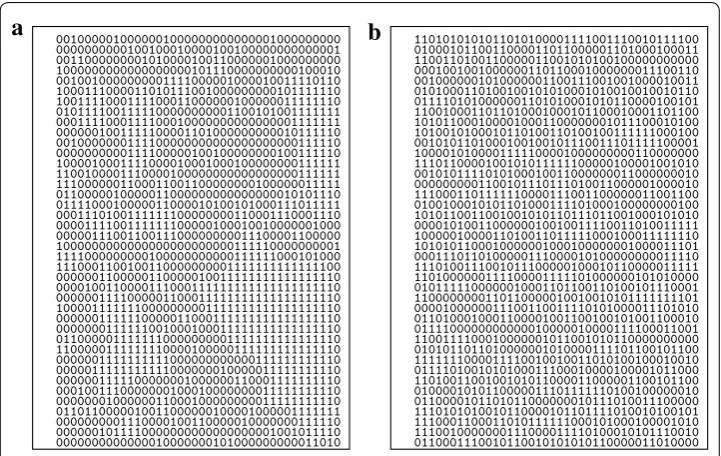
In comparing RSC-NR and RSC-R, we use the area illustrated in Fig. 1a, where the ‘1’s represent regions where F evaluates to TRUE and the ‘0’s represent regions where F
evaluates to FALSE, with σ =α=0.2075. In a run with k=20, and the total number of regions is 1600 (40 × 40 grid), Fig. 1b shows the observed regions as a result of run-ning RSC-NR which completed in nine rounds with 73 questions (73 regions observed). The execution proceeded as follows in this run, showing the number of questions asked in each round, and the number of ‘1’ regions found from asking those questions in that round: 1010001001000000000001001000001000000110 0000000100100100000000001111001000000000 0010000000000000000000010000000000100001 0011000000000000110001000100000000000000 0010000101100000001011100010110010000010 0000000000000000100100000001100000000010 0000001000010000000000000010100000011010 0101000110100011000100001001001000000100 0001000001100000100100000001010000000100 1010001011000000000001000100101100000100 0100110000000011011001101000000110110001 0000000000000101000000000000000100000100 0010100001001000000001000100000100010000 0000000000000000010000001000000001010000 0100000101100000100000011000001100100100 0000100001000101100010000010100100000000 0000000000000010010000010000000000000000 0000001000100001010000100000001000110101 0000001000000000000000000010000010000100 0100000010100001010101000000010100000010 0000100001100000000001001011100100000010 1000000000000000000000000101001001000001 0100000001000010000001000000000010000000 0100000100011000000000001001010010100000 1100001000000000001100100001000001100000 1000000010000010000000001100000110000000 0110010010000100100001000001000000001001 1101010000000001000001100001010100000000 0000100111000100100100000000000000000000 1010010000010100000000011000100000110000 0000100000000110000110000100001000010010 0100100110000001101010010010001000000101 0001000100000100000100000000000101000000 0000001100000000000000100001000100010100 0001000000000000100000000100000011000001 1000000100011000000101001001000001001000 0000000001100000000010000000010111000000 0001100110010001101000001101000000010100 0010000001001010001000010000100001001000 1010000000100010001010000000000100000001
a
0 00 1 0 0 01
0 0 0 10 0
1
0 0 0
1 1
0
1 0 1 1
1 00
0 0 0 1
0 0
0
0 0
0 1 00
0
0 1 0
0 0 1 0 0 1 0 0 0 0 1
1 0 0 0
0
0 0
0 0
1 1
0 10 00
0
b
20 qns in round 0, found:6 14 qns in round 1, found:4 10 qns in round 2, found:3 7 qns in round 3, found:0 7 qns in round 4, found:1 6 qns in round 5, found:1 5 qns in round 6, found:2 3 qns in round 7, found:2 1 qns in round 8, found:1
In a run from RSC-R with γ =2.41, we get:
49 qns in round 0, found:9 27 qns in round 1, found:6 13 qns in round 2, found:1 10 qns in round 3, found:1 8 qns in round 4, found:3
It can be seen that asking more (redundant) questions each round results in a larger number of ‘1’s found resulting in a faster convergence, in five rounds, instead of nine rounds as in RSC-NR. But the total number of questions asked is 107 questions instead of 73. In an extreme case, in a run from RSC-R with γ =4.82, only one round is enough but with 97 questions asked.
Comparing RSC‑NR and RSC‑R
We compare the performance of RSC-NR and RSC-R using different values of k =20 and different kinds of distributions of positive regions, but with the total number of regions being 1600 (40 × 40 grid). Below, we give the average number of rounds and average number of question asked over 1000 runs. Note that RSC-NR is the case of RSC-R with γ =1.
With σ=α=0.315625 (i.e., 31.5625 % of positive regions represented as ‘1’s), we gen-erated a scenario similar to that in Fig. 1a but with more 1s. Setting k=20, and averag-ing over 1000 runs, the results for 31.5625 % are shown in Fig. 2b, where the horizontal axis is labelled with different values of γ. Similar experiments were carried out with dif-ferent values of α on 40 × 40 scenarios with randomly distributed positive regions, but
with varying percentages of positive regions, with results shown in Fig. 2a, c–f. We make the following observations:
• It can be seen that even for all values of α tested, using additional questions in each round can substantially reduce the number of rounds even to 1, without substantially increasing the number of questions asked, since convergence is quick. For example, averaging over 1000 runs, with α=0.40125 in Fig. 2a, with γ =1.246, we use a total of four rounds on average with 50 questions on average, compared to using seven rounds on average and 49 questions on average with γ =1 (or no redundant ques-tions), and with γ =2.492, only 1 round is used on average, with 53 questions used on average.
69–12, and 100–12), with only a small increase in the number of questions asked on average.
• In all cases of α tested, for a large enough γ, on average, asking 11 % more questions in total can lead to a reduction to only 1 round required.
In summary, the above results show that additional questions in each round lead to faster convergence towards the required number of positive regions (i.e., taking fewer rounds), though asking more questions in earlier rounds. And the faster convergence offsets the larger number of questions asked in earlier rounds so that, overall, only a
small percentage increase in the total number of questions is required, i.e. there is only a relatively small price to pay for faster results.
Discussion
The results show that if we ask 1< γ ≤ α1 more questions (the additional questions are
so-called redundant questions) than the minimum required in each round, we can sig-nificantly reduce the number of rounds, and because we reduce the number of rounds, we end up asking only a small number of additional questions than we needed to in total, compared to no redundancy. We see that this result holds for a large range of scenarios. However, it must be noted that the gains are greater only when α is small
and large enough γ, and the value of γ relies on some prior knowledge (or estimate) of α, which might be difficult to obtain in practice; using too small a γ does not result in much improvements in efficiency but using too large a γ wastes questions. The result of average 1 round in Fig. 2a–f are all obtained with γ having the value approximately
1
α, as each of the k·
1
α questions randomly chooses a region with
1
α chance of being
positive.
RSC-R above fails to take into account the clustering of positive regions. For example, Fig. 3a, b have similar results, as shown in Table 1. We examine a heuristic that takes advantage of such clustering in the next section.
0010000010000001000000000000001000000000 0000000000100100010000100100000000000001 0011000000001010000100110000001000000000 1000000000000000000101110000000000100010 0010010000000001111000001000010011110110 1000111000011010111001000000000101111110 1001111000111100011000000100000011111110 0101111001111100000000001100101001111111 0001111000111100010000000000000001111111 0000001001111100001101000000000010111110 0010000000111100000000000000000000111110 0000000000111100000100100000000100111110 1000010001111000010001000100000000111111 1100100001110000100000000000000000111111 1110000001100011001100000000100000011111 0110000010000011000000000000000010101110 0111100010000011000010100101000111011111 0001110100111111100000000110001110001110 0000111100111111100000100010010000001000 0000011100110011100000000011100001100000 1000000000000000000000000111110000000001 1111000000000100000000000111111000101000 1110001100100110000000001111111111111100 0000001100000110000010011111111111111110 0000100110000111000111111111111111111110 0000001111000001100011111111111111111110 1000011111110000000001111111111111111110 0000001111110000011000111111111111111110 0000000111111001000100011111111111111110 0110000011111110000000001111111111111110 1100000111111110000100000111111111111110 0000001111111111000000000000111111111110 0000011111111111000000010000011111111110 0000001111100000001000000110001111111110 0001001110000000100010000000011111111110 0000000100000011000100000000011111111110 0110110000010011000000100001000001111111 0000000001110000100110000010000000111110 0000001011110000000000000000001001011110 0000000000000010000000101000000000011010
a
1101010101011010100001111001110010111100 0100010110011000011011000001101000100011 1100110100110000011001010100100000000000 0001001001000000110110001000000011100110 0010000001010000001100111001001000010011 0101000110100100101010001010010010010110 0111101010000001101010001010110000100101 1100100011011010001000101100010001101100 1010110001000010001100000001011100010100 1010010100010110100110100100111111000100 0010101101000100100101110011101111100001 1000010100001111100001000000000110000000 1110110000100101011111100000100001001010 0010101111010100010011000000011000000010 0000000001100101110111010011000001000010 1110001101111110000111001100000011001100 0100100010101101000111101000100000000100 1010110011001001010110111011001000101010 0000101001100000010010011110011010011111 1000001000011010011011111000100011111110 1010101100010000001000100000001000011101 0001110110100000111000010100000000011110 1110100111001011100000100010110000011111 1101000000111100001111101000000101010000 0101111100000010001101100110100101110001 1100000000110110000010010010101111111101 0000100000011100110011110101000011101010 0110100010001100001001100100101001100010 0111100000000000010000010000111100011001 1100111100010000001011001010110000000000 0101011011010000001010000111101100101100 1111111000011110010010011010100100010010 0111101001010100011100010000100001011000 1101001100100101011000011000001100101100 0100001010110000011101111110100100000010 0110000101101011000000010111010011100000 1110101010010110000101101111010010100101 1110001100011010111111000101000100001010 1110010000000111000011110100010101110010 0110001110010110010101010110000011010000b
Fig. 3 Two regions with roughly 40 % of positive regions but different in the amount of clustering. a Region with α =0.40125 but more clustering. b Region with α = 0.418125 but less clustering
Table 1 Results for α=0.418125 (α=0.40125) with less clustering (more clustering), averaged over 1000 runs
γ 1 (1) 1.196 (1.246) 2.392 (2.492)
Avg. no. of questions 47 (49) 48 (50) 52 (53)
A heuristic for spatial finding: neighbourhood associations
In the case where we know nothing about the unobserved regions, any selection is as good as any other. The solutions have not so far considered the case where know-ing somethknow-ing about a region tells us somethknow-ing about another region. For example, we assume initially no information, i.e. F(r)=TRUE with probability α (and F(r)=FALSE
with probability 1−α). The value of α may be estimated from some initial density
meas-ure if there is some a priori information, but here, we take α to be the true proportion of
regions in R that satisfy F. Hence, the success factor σ has been approximated via α in the
experiments above.
It can be seen from the definitions of Q, Q′, T and T′ above and their monotonically
increasing properties that if σ was to increase, we can reduce the number of questions
and the number of rounds. In this section and the next section, we consider heuristics that can improve the success factor in each round of querying.
Given direct observation of a region, then F(r) must evaluate to true or false, but with-out direct observation of a region, we can only compute the probability of F(r) being true or false in some way. Note that we say we observe a region whenever we ask the crowd a question about it.
To estimate Pr(F(r)=TRUE) given that r has not been observed, we introduce the
neighbourhood association factor δ (>0) which represents the informational relationship
between neighbouring regions, where knowing something certain about a region q tells us something about its neighbouring region, i.e., if r and p are two neighbouring regions, then if we observed that F(q)=TRUE, but have not observed r, then, we set:
where δ is chosen so that 0≤α·(1+δ)≤1, and also, if we directly observed that
F(q)=FALSE, using Baye’s rule:
For example, if α is 0.5 and δ is 0.1, then Pr(F(r)=TRUE|F(q)=TRUE)=0.55>0.5 .
In other words, as we observe more regions, given the association among regions, we might be able to do better than randomly selecting a set of regions to ask about in each round; we can select regions with a higher probability of evaluating F to TRUE based on such association information. Also, if a region should be false with probability 1−α, on
observing that its neighbour is TRUE, its probability of being FALSE is reduced.
More precisely, let N be a function that returns the immediate neighbours of a region, i.e. N(r)⊆R is the set of regions sharing a boundary with r defined in some way. N(r) would have eight members at most if R is divided into a grid of rectangular regions (including diagonally adjacent regions).
Pr(F(r)=TRUE|F(q)=TRUE)=α·(1+δ)
Pr(F(r)=FALSE|F(q)=TRUE)=1−α·(1+δ)
Pr(F(r)=TRUE|F(q)=FALSE)
=Pr(F(r)=TRUE)· Pr(F(q)=FALSE|F(r)=TRUE)
Pr(F(q)=FALSE)
=α·1−α·(1+δ) 1−α
From the point of view of the unobserved region r, it is possible that multiple neigh-bouring regions have been observed, and so, we need to combine the influence from multiple observed neighbours.
For example, for a given region, if one of its neighbours q1 is found that F(q1)=FALSE
and another two neighbours q2 and q3 are such that F(q2)=F(q3)=TRUE, then by
Bayes’ rule (where H =α·(1−α·(1+δ))·(α·(1+δ))·(α·(1+δ)):
Given a region r, and that we observed some subset of the neighbours of r, say
(A∪B)⊆N(r), where A are neighbours where F evaluated to FALSE and B are
neigh-bours where F evaluated to TRUE, then using obs(N(r)) to denote the observed neigh-bours of r, by a Bayesian approach of combining information, we have what we call the
neighbourhood formula, where H′=α·(1−α·(1+δ))|A|·(α·(1+δ))|B|:
Note that the above is merely a heuristic for estimating the probability of a region sat-isfying F; our guess could turn out completely wrong upon observation, i.e. given cur-rent observations obs, we estimate that Pr(F(r)=TRUE|obs) >0.5 but we later may
observe that F(r)=FALSE. Also, for simplicity, we have taken a Markov-inspired
assumption in that we compute the probability based only on observed regions in the neighbourhood of r, and do not consider any influence from regions beyond the neigh-bourhood, i.e., using obs (R) to denote observed regions in the entire area R:
Pr(F(r)=TRUE|obs(N(r)) )=Pr(F(r)=TRUE|obs(R)).
If we are using solution (3), in each round i, for simplicity, we compute probabilities only for regions not yet observed, with the aim of choosing the k−ki regions most likely
to evaluate F to TRUE, and we use only observed information. For example, an unob-served region r that has no observed neighbours will have Pr(F(r)=TRUE)=α even if
all its unobserved neighbours q have estimated Pr(F(q)=TRUE|obs) > α given some
observations obs.
In the previous random spatial crowdsourcing algorithm, in SpatialCrowdsourcing (k, F, R) given above, chooseCandidates(c,R\O) chooses c candidates from R\O in a random
way, and in the associative spatial crowdsourcing algorithm, chooseCandidates(c,R\O ) chooses c candidates from R\O by selecting the c regions with the highest probability
of F evaluating to TRUE, i.e., for each region r∈R\O, we compute the probability of F(r)=TRUE using the neighbourhood formula above and select c regions with the
Pr(F(r)=TRUE|(F(q1)=FALSE∧F(q2)=TRUE∧F(q3)=TRUE))
= H
H+(1−α)·1−α·1−α·(1+δ)1−α ·α·1−α·(1+δ)1−α ·α·1−α·(1+δ)1−α
Pr
F(r)=TRUE |
p∈A(F(p)=FALSE) ∧
q∈B(F(q)=TRUE) ∧ (A∪B)=obs(N(r))
= H
′
H′+(1−α)·(1−α·1−α·(1+δ) 1−α )|
A|·(α·1−α·(1+δ) 1−α )|
highest probabilities according to the formula, randomly selecting among equal prob-ability regions.
This slight variation to solution (3) above using neighbourhood association is given by this definition of chooseCandidates(·) in Algorithm 4.
Experiments with randomly generated area maps
We study the effect that the extent of clustering has with the use of this heuristic as k
varies and as δ is varied. In the first set of experiments, we generate area maps with α set
to values within the range [0.15, 0.20] and clustering introduced so that where whenever there are three ‘1’s surrounding a region, the region will be a ‘1’ (otherwise the region is either ‘1’ or ‘0’ with equal probability).
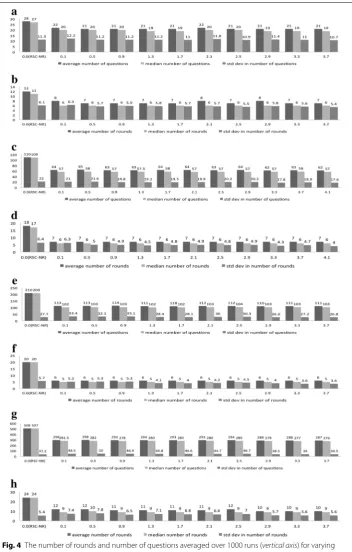
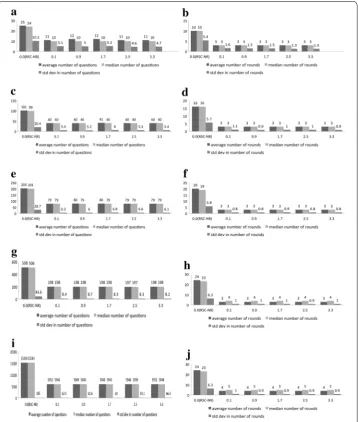
Figure 4 shows the results of associative spatial crowdsourcing compared with ran-dom spatial crowdsourcing (RSC-NR) as k is varied for a range of δ values—the number
of questions used and the number of rounds used are averages over 1000 runs with the same region map. It can be seen that with even small δ(=0.1), associative spatial
crowd-sourcing yields, on average, both a significant reduction in both the number of questions used (up to 30–40 %) and the number of rounds required to find the k positive regions (as low as a third or half of the number of rounds required with RSC-NR). The reduc-tions are proportionately larger with larger k. Larger values of δ(>0.1) do not seem to
yield much improvement.
Note, however, that with little clustering, associative spatial crowdsourcing provides little to nor advantage, and can even do slightly worse in case it assumed clustering when there wasn’t any. However, as we show in the following examples, contiguous and clus-tered regions (fortunately) occur in a range of real-world scenarios. Below, we use maps sourced from real-world applications as a starting point representing the current state of the world from which we want to find regions of interest.
Experiments on finding parking
Fig. 4 The number of rounds and number of questions averaged over 1000 runs (vertical axis) for varying δ (horizontal axis) for different values of k while maintaining a similar α. a Average, median and std. dev. for number of questions with k= 5 and α = 0.175 as δ varies. b Average, median and std. dev. for number of
there are parking spaces in a region of size 37 by 37 m, and for simplicity, answers are binary, YES or NO, and we assume truthfulness in answers given.
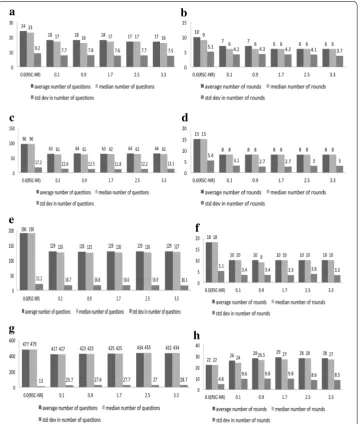
Figure 6 shows the average over 1000 runs of results (number of questions and num-ber of rounds) with two values of k (5 and 40). The median and standard deviation are included to indicate there is a fair amount of variability between runs. With k = 5 in Fig. 6a, b, we see that with large enough δ (e.g., 1.7), i.e., using a strong association
between neighbouring positive regions), the algorithm can effectively zoom in on posi-tive regions faster than a random approach (RSC-NR, i.e., δ=0), resulting, on average,
with both 40 % reduction in the number of rounds and 25 % reduction in the number of questions used at the same time, i.e., it is not a trading off rounds with questions but reduction in both. However, with the standard deviation of sometimes over 40 % of the average rounds and questions, there is substantial variability among runs so that gains can be small. A similar result is observed for k = 40, 100 in Fig. 6c–h with proportion-ate reductions in the number of rounds and questions, on average. The type of clustering observed in the parking map made it susceptible to gains using our neighbourhood asso-ciation heuristic. As before, gains can be obtained just with δ=0.1, with little
improve-ments for δ >0.1.
Experiments on finding crowds
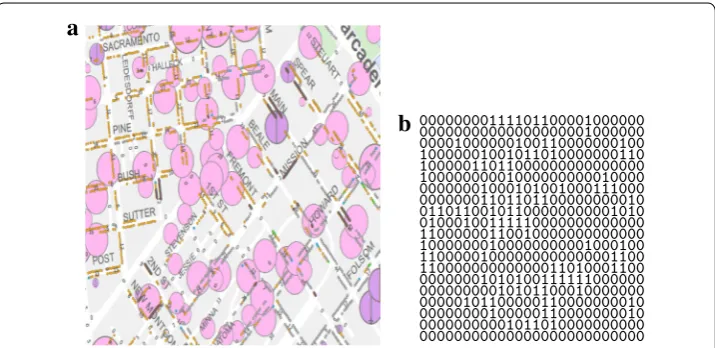
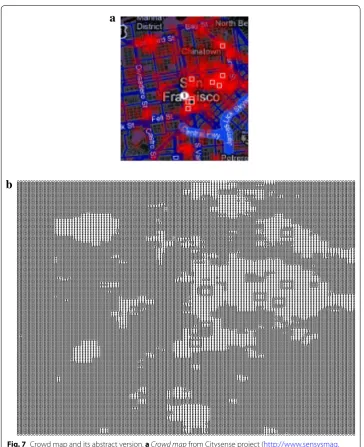
In this experiment, we are simulating the use of crowdsourcing to find where the crowds are in a city or urban setting. We use a crowd map obtained from the MIT Citysense project,2 abstracted into 126 × 148 regions, each region corresponding to roughly
28.5 × 28.5m in size. Figure 7 illustrates the map we use that, we assume here, repre-sents the current real state of the urban area, and the problem is then, given this state of the world, to find k = 5, 40, 100 or 3000 regions where there are crowds, using
2 http://www.sensysmag.com/spatialsustain/citysense-app-aims-to-connect-tribes.html.
a
00000000111101100001000000 00000000000000000001000000 00001000000100110000000100 10000001001011010000000110 10000011011000000000000000 10000000001000000000010000 00000001000101001000111000 00000001101101100000000010 01101100101100000000001010 01000100111110000000000000 11000000110010000000000000 10000000100000000001000100 11000001000000000000001100 11000000000000011010001100 00000001010100111111000000 00000000010101100010000000 00000101100000110000000010 00000000100000110000000010 00000000001011010000000000 00000000000000000000000000
b
crowdsourcing. Again, for simplicity, we assume binary answers to a query on each region: is there a crowd here or not?
Figure 8 shows our results when finding k = 5, 20, 40, 100 and 3000 crowded regions. Similar to the previous case study, our results show a considerable reduction (up to 70 %) in the number of rounds required and up to 60 % reduction in the number of questions required, on average, with k = 5, 100 and 3000. This is due to the clustering in the crowd map, which is to a higher degree than in the parking map. These results show
that neighbourhood association can be extremely useful in knowing which regions to ask about when looking for crowded regions—neighbouring regions tend to be crowded.
Experiments on finding coverage/bandwidth
In this experiment, we simulate finding regions where there is coverage (or adequate bandwidth) for 3G/4G networking. The assumed current coverage/bandwidth map is taken from OpenSignal as illustrated in Fig. 9. We want to find k = 5, 20, 40, 100 or 1000 regions where there is coverage, using crowdsourcing. We have 103 × 77 regions, each
a
000000000000000000000000000000000000000000000000000000000000000000000000111111100000000000001111000000000000000000000000000000 000000000000000000000000000000000000000000000000000000000000000001111111111111011100000000001111000000000000000000000000000000 000000000000000000000000000000000000000000000000000000000000000001111111111111111100000001110000000000000000000000000000000000 000000000000000000000000000000000000000000000000000000000000000001111111111111111100000000000000000000000000000000000000000000 000000000000000000000000000000000000000000000000000000000000000001111111111111110000000000000000000000000000000000000000000000 000000000000000000000000000000000000000000000000000000000000001111111111111000000011111111110000000000000000000000000000000000 000000000000000000000000000000000000000000000000000000000000001111111111111000000001011111110011000000000000000000000000000000 000000000000000000000000000000000000000000000000000000000000001101111111111000000011011111110010000000000000000000000000000000 000000000000000000000000000000000000000000000000000000000000000001111000111111111101000001110010001000001000000000000000000000 000000000000000000000000000000000000000000000000000000000000000001110000011111111111100011110000011000001000000000000000000000 000000000000000000000000000000000000000000000000000000000000000001110100010111111111110001110000000000000000000000000000000000 000000000000000000000000000000000000000000000000000000000000000000000000000111111101100000000000000000000000000000000000000000 000000000000000000000000000000000000000000000000000000000000000000000000000111111111111000000000000000000000000000000000000000 000000000000000000000000000000000000000000000000000001100000000000000000000111111111111000000000000000000000000000000000000000 000000000000000000000000000000000000000000000000011111000000000000000000000111111111111000000000000000000000000000000000000000 000000000000000000000000000000000000000000000000000000010000000000000000111111111111111110000000000000000000000000000000000000 000000000000000000000000000000000000000000000000000000010000000000000000111111111111111110000000000000000000000000000000000000 000000000000000000000000000000000000000000000000000000010000000000000000111111111111111110000000000000000000000000000000000000 000000000000000000000000001000000000000000000000000000000000000000000000000111111111100000000000000000000000000000000000000000 000000000000000000000000111111111110000000000000000000000000000000000000000000111100110000000000111000000000000000000000000000 000000000000000000000000111111111110000000000000000000000000000000000000000111111110001000000000111000000000000000000000000000 000000000000000000000111111111111111000000000000000000000000000000000000000000011100000000000011111000000000000000000000000000 000000000000001111111111111111111111110000000000000010000000000000000000000000000000000000101111111111000000000000000000000000 000000000000001111111111111111111111110000000000000010000000000000000000000000000000000001111111111111000000000000000000000000 000000000000001111111111111111111111110000000000000001000000000000000000000000000000000001111111111111000000000000000000000000 000000000000001111111111111111111111110000000000000000000000000000000000000000000000000000001111111111111000000000000000000000 000000000000001111111111111111111111110000000000000000000000000000000000000000000000000000001111111111111100000000000000000000 000000000000001111111111111111111111110000000000000000000000000000000000000000000000000000001111111000011100000000000000000000 000000000000001111111111111111111111100000000000000000000000000000000000000000000000000001101111110000011111100000000000000000 000000000000001111111111111111111111100000000000000011100000000000000000000000011100000001101111110111011111110000000000000000 000000000000001111111111111111111111110000000000000011100000000000000000000000000100000001111111110111011111100000000000000000 000000000000000111111111111111111111000000000000000001100000000000000000000000000000000000001111110111011111101100000000000000 000000000000000000000111111111111110000000000000101111100010000001110000000000010000000000001111110000011111111110000000000000 000000000000000000000111111111111110000000000000111111100010111101110000000000000000000000000111111111111111111110000000000000 000000000000000000000011111111111110000000000000111111100010110011111000000000010000000000001111111111111111111110000000000000 000000000000000000000000111111100100000000000000000001111100000100110100000000000000000001110011010000011111111111110000000000 000000000000000000000000000011100000000000000000000000111100011110110000000000000000000001111001001000011111111111110000000000 000000000000000000000000000011100000000000000000000000111100011111110000000000000000000001110101000000111111111111110000000000 000000000000000000000000000000000000000000000000000100110000001100010100000000000000000000001000000000011111111111110000000000 000000000000000000000000000000000000000000000000000011100000000000000000000000000000000000000000000000011111111111111111100011 000000000000000000000000000000000000000000000000000011100000000001110000000000000000000000000000000000011111111111111111111111 000000000000000000000000000000000000000000000000000011100000000001100000000000000010000000000000000000011111111111111111111111 000000000000000000000000000000000000000000000000000011000000000000000110110000011100000000000000000000000011110000100101111111 000000000000000000000000000000000000110000000000000011000000000000000111111000011100000000000000000000000011110000100100111111 000000000000001000000000000000000001110000000000000011000000000000000010111000011100000000000000000000000011110000110000111111 000000000000001000000000000000000000000000000000000011000000000000000110000000011111100000000110110000000000000000000000000111 000000000000001000000000000000000000001000000000000001000000000001111111000000011111111101111111111000000000000000000000000111 000000000000001000000000000000000000001110000000000001000000000001000011000000111111111111111111111000000000000000000000000111 000000000000000000000000000000000000000000000000000001000000000001111111000000011111111111111111111100000000000000000000000000 000000000000000000000000000000000000000000000000000000000000000001111111111011111111111111111111111111111100001000000000000000 000000000000000000000000000000000000000000000000000000000000000001111111111111111111111111111111111111111100000000000000000000 000000000000000000000000000000000000000000000000000000000000000001111111111111111111111111111111111111111100000000000000000000 000000000000000000000000000000000000000000000000000000000000000001111111111111111111111111111111111111111111110000000000000000 000000000000000000000000000000000000000000000000000000000000011000111111111111111111111111110000111111111111111000000000000000 000000000000000000000000000000000000000000000000000000000000001000111111111111111111100001110011111111111111110000000000000000 000000000000000000000000000000000000000000000000000000000000001110111111111111111111100000110111111111111111111100000000000000 000000000000000110010000000000000000000000000000000000000000111111111111110111111111100000000111111111111111111110000000000000 000000000000000011100000000000000000000000000000000000000001111111111000111111111111100000001111111111111111111110000000000000 000000000000000000000000000000000000000000000000000000000001011110111111111111111111100000001111110000011111111110000000000000 000000000000000000000000000000011111110000000000000000000000000000111111110000111111111111111111110111011111100011110000000000 000000000000000000000000000000000011110000000000000000000000000001111111111100111111111111111111110111011111100011110000000000 000000000000000000000000000000011111110000000000000000000000000001110000011110111111111111111111110111011111100011110000000000 000000000000000000000000000000000000000000000000000000000000000001100000011110111111111111111111110000011111111111110000000000 000000000000000000000000000000000000000000000000000000000000000001100111011110111111111111111111111111111111111111110000000000 000000000000000000000000000000000010000000000000000000000000000001100111011111111111111111111111111111111111111111111000000000 000000000000000000000000000000000000000000000000000000000000000001100111011111111111111100000111111111111111111111110100000000 000000000000000000000000000000000000000000000000000000000000000001110000011111111111111101110111111111111111111111110111111111 000000000000001000000000000000000000001000000111000000000000000011111111111111111111111101110111111111111111111111111111111111 000000000000000000000000000000000000001000000111000000000000000001111111111111111111111101110110000011111111111111111111111111 000000000000000000100000000000000000001111111111111000000000000011111111111111111111111100000110111011111111111111111111111111 000000000000000000000000000000000000001111111111111000000000000011111111111110111111111111111110111011111111111111111111111111 000000000000000000000000000000000000001111111000111000000000001101111111111110111111111111111110111011111111111111111111111111 000000000000000000000000000000000000001111111000000000000000000111111111111110011111111111111110000011111111111111111101111111 000000000000000000000000000000000000001111000000000000000000000001111111111000000011111110001110000111111111111111100000011111 000000000000000000000000000000000000001111010001000000000000000001111111111000000011111110011111111111111111111111000000001111 000000000000000000000000000000000000001111110010000000000000000001111111110000000011111110000111111111111111111110000111000110 000000000000000000000000000000000001110110100000000000000000001111111111000000000000000000000000111111111111111100000000000000 000000000000000000000000000000000001110110111000000000000000000001111111000000000000000000000000111111111111111100000000000000 000000000000000000000000000000000001110110000000000000000000000000011111000000000000000000000000111111111111111100000000000000 000000000000000000000000000000000000011110000000000000000000000000011111100000000000000000000000000111000111100000000000000000 000000000000000000000000000000000000011110000000000000000000000000001111111100000000000000000000100111000011000000000000000000 000000000000000000000000000000000000011110000000000000000000000000001111111100000000000000000000000111100000000000000000000000 000000000000000000000000000000000000001110000000000000000000000000000000011100000000000000000000110001101000000000000000000000 000000000000000000000000000000000000001110000000000000000000000000000111011100000000000000000000111001000000000000000000000000 000000000000000000000000000000000000001010000000000000000000000000100111011100000000000000100000111010000000000000000000000000 000000000000000000000000000000000000001110000000000000000000000000000000011100000000000000110001011000000000000000000000000000 000000000000000000000000000000000000000000000000000000000000001101100000011111100100010000000000000000111111000000000000000000 000000000000000000000000000000000000000000000000000000000000001101100000011111111100011110000000000000011111100000000000000000 000000000000000000000000000000000000000000000000000000000000001101100000011111111100001100000000000100011111000000000000000000 000000000000000000000000000000000000000000000000000000000000001100000000011111111111111100000000000000011110001100000000000000 010000000000000000000000000000000000000000000000000000000000001110000000111111111111111100000000000000111110111100000000000000 000000000000000000000000000000000000000000000000000000000000001111111111111111111111111110000000000000111101111100000000000000 000000000000000000000000000000000000000000000000000000000000001100000111111111111111111110000000000000111101110000000000000000 000000000000000000000000111111000000000000000000000000000001111101110111111111111111111110000000000000000011100000000000000000 000000000000000000000000111111000000000000000000000000000011111101110111111111111111111110000000000000000011100000000000000000 000000000000000000000000111111000000000000000000000000000011111101110111111111111111111110000000000000000001000000000000000000 000000000000000000000011111111100000000000000000000000000011111100000111111111000001100000000000000000000000000000000000000000 000000000000000000000111111111100000000000000000000010000011111111111111111111100000001000000000000000000000000000000000000000 000000000000000000000111111111100000000000000000000000100011111111111111111111000000011100000000000000000000000000000000000000 000000000000000000000111111111100000000000000000000000000011111111110000000000000000001110000000000000000000000000000000000000 000000000000000000000111111111100000000000000000110000000001111110000000000000000000001110000000000000000000000000000000000000 000000000000000000000111111111100000000000000000111000000001111110000000000000000000001110110000000000000000000000000000000000 000000000000000000000111111111100000000000000000011000000001111110000000000000000000001111110000000000000000000000000000000000 000000000000000000000111111100000000000000000000000000000000000000000000000000000000000000000000000000000000000000000000000000 000000000000000000001111111100000000000000000010000000000000000000000000000000000000000000000000000000000000000000000000000000 000000000000000000000011111100000000000000000100000000000000000000000000000000000000000000000000000000000000000000000000000000 000000000000000000000000000000000000000000000000000000000000000000000000000000000000000000000000000000000000000000000000000000 000000000000000000000000000000000000000000000000000000000000000001110000000000000000000000000000000000000000000000000000000000 000000000000000000000000000000000000000000000110000000000000000001110000000000000000000000000000000000000000000000000000000000 000000000000000000000000000000000000000000000000000000000000000000110000000000000000000000000000000000000000000000000000000000 000000000000000000000000000000000000000000000000000000000000000000000000000000000000000000000000000000000000000000000000000000 000000000000000000000000000000000000000000000000000000000000000000000000000000000000000000000000000000000000000000000000000000 000000000000000000000000000000000000000000000000000000000000000000000000000000000000000000000000000000000000000000000000000000 000000000000000000000000000000000000000000000000000000000000000000000000000000000011000000000000000000000000000000000000000000 000000000000000100000000000000000000000000000000000000000000000000000000000000000011110000000000000000000000000000000000000000 000000000000000100000000000000000000000000000000000000000000000000000000000000000011110000000000000000000000000000000000000000 000000000000000100000000000000000000000000000000000000000000000000000000000000000001100000000000000000000000000000000000000000 000000000000000000000000000000000000000000000000000000000000000000000000000000000000000000000000000000000000000000000000000000 000000000000000000000000000000000000000000000000000000000000000000000000000000000000000000000000000000000000000000000000000000 000000000000000000000000000000000000000000000000000000000000000000000000000000000000000000000000000000000000000000000000000000 000000000000000000000000000000000000000000000011000000000001110000000000000000000000000000000000000000000000000000000000000000 000000000000000000000000000000000000000000000111000000000011111000000000000000000000000000000000000000000000000000000000000000 000000000000000000000000000000000000000000000111000000001011110010000000000000000000000000000000000000000000000000000000000000 000000000000000000000000000000000000000000001001000000001011111110000000000000000000000000000000000000000000000000000000000000 000000000000000000000000000000000000000000111000000000001011111110000000000000000000000000000000000000000000000000000000000000 000000000000000000000000000000000000000000111100000000001011111110000000000000000000000000000000000000000000000000000000000000 000000000000000000000000000000000000000000111000000000001001111010000000000000000000000000000000000000000000000000000000000000 000000000000000000000000000000000000000000000111000000000000000000000000000000011100000000000000000000000000000000000000000000 000000000000000000000000000000000000000000000111000000000000000000000000000000011100000000000000000000000000000000000000000000 000000000000000000000000000000000000000000000111000000000000000000000000000000001100000000000000000000000000000000000000000000 000000000000000000000000000000000000000000000000000000001000011111111000000000000000000000000000000000000000000000000000000000 000000000000000000000000000000000000000000000000000000001111111111111110000000000000000000000000000000000000000000000000000000 000000000000000000000000000000000000000000011000000000001111111111111111000000000000000000000000000000000000000000000000000000 000000000000000000000000000000000000000000000000000000001111111111111111000000000000000000000000000000000000000000000000000000 000000000000000000000000000000000000000000000000000000000011111111111111000000000000000000000000000000000000000000000000000000 000000000000000000000000000000000000000000000000000000000011111111111111000000000000000000000000000000000000000000000000000000 000000000000000000000000000000000000000000000000000000000111111111111111000000000000000000000000000000000000000000000000000000 000000000000000000000000000000000000000000000000000000001111111111111111000000000000000000000000000000000000000000000000000000 000000000000000000000000000000000000000000000000000000001111111111111111000000000000000000000000000000000000000000000000000000 000000000000000000000000000000000000000000000000000000000111111111111111000000000000000000000000000000000000000000000000000000 000000000000000000000000000000000000000000000000000000000000001111111110000000000000000000000000000000000000000000000000000000 000000000000000000000000000000000000000000000000000000000000001111111100000000000000000000000000000000000000000000000000000000 000000000000000000000000000000000000000000000000000000000000001111111110000000000000000000000000000000000000000000000000000000 000000000000000000000000000000000000000000000000000000000000000111111110000000000000000000001000000000000000000000000000000000 000000000000000000000000000000011100000000000000000000000000001110000100000000000000000000001111000000000000000000000000000000 000000000000000000000000000000011100000000000000000000000000001110000100000000000000000000001111100000000000000000000000000000 000000000000000000000000000000011100000000000000000000000000000110000110000000000000000000001111100000000000000000000000000000 000000000000000000000000000000000000000000000000000000000000000000000000000000000000000000001100100010000000000000000000000000b
region corresponding to roughly 100 by 100 m in size. Each query will determine if each such region has 3G/4G coverage or adequate bandwidth.
Similar to the previous two experiments, from Fig. 10, a significant reduction (up to 60 %) in the number of rounds required can be achieved and 40–50 % reductions in the number of questions required are observed, with all values of k used.
A heuristic based on spatial point processes
To go beyond simple immediate neighbourhood influences, we explore an alternative heuristic for choosing potential regions to query about, i.e. to guess the location of posi-tive regions (labelled ‘1’s) within an area, based on modelling the distribution of posiposi-tive regions using spatial point processes [18].
Suppose that an area R has been divided into I disjoint subareas R1,R2,. . .RI, i.e. each
Ri has a set of regions. At time t, for a subarea Ri, positive regions are assumed to be
distributed according to a Poisson process with intensity i(t) (where intensity here is
defined to be the average number of positive regions per unit area, or the potential of an event to appear at any location). The expected number of positive regions in area Ri
is given by i(t)· |Ri|, where |Ri| denotes the size of (or the number of regions in) Ri, and
the positive regions in Ri are assumed distributed uniformly within Ri.
Now, for p>1, suppose that after round (p−1), we have observed Np regions r1,. . .,rNp (some of which are observed to be positive and some negative). We would
a
0000000000000000000000000000000000000000000000000000000000000000000000000000000000000000000000000000000 0000000000000000000000000000000000000000000000000000000000000000000000000000000000000000000000000000000 0000000000000000000000000000000000000000000000000000000000000000000000000000000000000000000000000000000 0000000000000000000000000000000000000000000000000000000000000000000000000000000000000000000000000000000 0000000000000000000000000000000000000000000000000000000000000000000000000000000000000000000000000000000 1000011110001000000000000000000000000000000110110111100000000000000010000000000000000110000000000000010 1100000111100000000000000000000000000000001100110001100000001100000010000000000000000110000000000000100 0111000111110000000000000000000000000000010001100001100000001000000100010000000000000000000000000000100 0011100011110000000000000000000000000001100011000001100000010000000100000000001100000000000000000001100 0000110111001000000000000000000000000011000011000001100000100000001000000000000000000000000000000000000 0000011111001110000000000000000000011000000110000001100000100000011000000000000000000000000000000000000 0000011101100111000000000000000001100000001100000001100000000000010000000000000000001000000000000100000 0000011000110011100000000000000100000000011000000001100000000000000000000000000000011000000000000000000 0000111000011011110000000000000000000000011000000001000000000000100000000000000000011000000000000000000 0001111100001111111000000001000000000000110000000011000000000000100000000000000000010000000000000000010 0011000000000111111000000000000000000001100000000010000000000000000000000000000000110000000000000000010 0110000000000011111100000000000000000001000000000100000000000000000000000000000000100000000000000000010 1100000000000000001111000000000000000011000000000000000000000000000000000000000001100000000000000000110 1000000000000000000011100000000000000110000000000000000000000000000000000000000001000000000000000001110 0000000000000001100001110000000000001100000000000000000000000000000000010000000001000000000000000011100 0000000000000011111000111100000000011100000000000000000000000000000000000000000001000000000000000011000 0000000000000110111100111100000000011000000000000000000000000000000000000000000000000000000000000110000 0000000000000000000110111100000010110000000000000000000000100000000000000000000000000000000000000110000 0000000000000000000011111111001101110000000000000000000000110000000000000000000000000000000000001100000 0000000000000000000001111001101001100000000000000000000000011000000000000000000000000000000000001000010 0000000000000000000000110000110111000000000000000000000110000110000000000000000000000000000000011000110 0000000000000000000000000000011111000000000000000000000110000011000000000000001000000000000000011000010 0000000000000000000000000000011110000000000010000000000010000000000000000000011000000000000000010000000 0000000000000000000000000011111100000000000000000000000010000000000000000000110000000000000000110100000 0000000000000000000000000001111110000000000000000000000000000000001000000001100000000000000001110110010 0000000000000000000000000000101110000000000000000000000000000100000000000001100000000000000001110000010 0000000000000000000000000001000110000000000000110000000000000000000000110111000000000000000001111000010 0000000000000000000000000011110111000000000000100000000000000000000001101110000000000000000001010111100 0000000000000000000000000111110011000000000000000000000000000000000011011000000000000000000011000011100 0000000000000000000000011111100001010000000000000000000010000000000010110000000000000000000110000111000 0000000000000000000000001111100001100000000000000000000010000000000110000000000000000000000110001100000 0000000000000000000000001111100001100000000000000000000000000000000000000000000000000000001100001100010 0000000000100000000000111111110001100000000000000000000000000000000001000000000000000000011001101100010 0000000000000000000000111000111101100000001000000000010000000000000000000000000000000000011001111100100 0000000000011110000000110000001111110000010000000000000000000000000000000000000000000000110011011110000 0000000000001111000000110000000011111000010000000000000000000000011100000000000000000000110010001111000 0000000000000001100001110000000001111100010000000011000000000000010000000000000000000001100010010011100 0000000000000000011001100000000000000111110000000010000000000000010000000000000000000001000100000010010 0000000000000000001001100000000000000011110000011100000000000000110000000000000000000011001101011110010 0000000000000000000011000000000000001111011101111000000000000000110000000000000000000110011011111111110 0000000000000000000011000000000000000110000111100000000000000000110000000000000000000110011001111100100 0000000000000000000110000000000000000000000011110000000000000001110000000000000000001100110000111111010 0000000000000000000100100000000000000000000010011000000000000000000000000000000000001100100000111111110 0000000000000000001100110000000000000000000110001110000000000000000000000000000000011001100011111011110 0000000000000000011100110000000000000000001110000111100000110000000000000000000000011001111111111010010 0000000000000001111000010000000000000000011100000111111100100000000000000000000000011011111111111110000 0000000000000011110000011000000000000000110000000111011110100000000000000000000000011110111111111100000 0000000000000001110000011000000000000001100000000011011111100010000000000000000000110110111111111100000 0000000000000011100000001100000000000011000000000110000111100100000000000000000001111100111111111110000 0000000000000111000000000100000000000010000000000110000011111100000000000000000001101000011111111011110 0000000000001111000000000100000000000010000000000100000011111110000000000000000011111001111111111111110 0000000000111110000000000000000000000010000000001100000111110001100000000000110011011000011111111111110 0000000001111000000000000000000000000010000000001100000111110000111000000000011110110110011111111111110 0000000111100000000000000000000000000010000000001000001111100000001110000000001110100111111111111111110 0000001110000000000000000001000100000010000000011000001111000000000011100000111101100101111111111111110 0010111100000000000000000001001100000110000000010000011000000000000000110000111011101101111111111111110 0011110000000000000000000001111000001100000000100000010000000000000000001100001111111111111111111111110 0111000000000000000000000000110000001000000001100000000000000000000000000111011111111111111111111110000 1000000000000000000000000000010000011000000001100000100000000000000000000000111111111111111111111111010 1000001000000000000000000000110000011000000001000000100000000000000000000001001111111111111111111111110 0000000000000000000000000001100000110000000011000000100000000000000000000011001111111111111111111011110 0000000100000000000000000011000000110000000010000000100000000000000000000010011111111111111111111101110 0000000000100000000000000010000001100000000000000001100000000000000000000011110111111111111111111111110 0000000000000000000000000000000001100000000000000001000000000000000000000000000111011111111111111111110 0000000000000000000000000000000001000000001100000111000000000000000000000000001110011111111111111111110 0000000000000000000000000000000000000000001000000000000000000000000000000000000111111111111111111111110 0000000000000000000000000000000000000000000000000000000000000000000000000000000000000000000000000000000 0000000000000000000000000000000000000000000000000000000000000000000000000000000000000000000000000000000 0000000000000000000000000000000000000000000000000000000000000000000000000000000000000000000000000000000 0000000000000000000000000000000000000000000000000000000000000000000000000000000000000000000000000000000 0000000000000000000000000000000000000000000000000000000000000000000000000000000000000000000000000000000 0000000000000000000000000000000000000000000000000000000000000000000000000000000000000000000000000000000b
like to obtain the intensity at any region r∈R, as an estimate of the probability of the
region r being positive. To obtain an estimate of the intensity at any r∈R, taking into
consideration contributions of both observed positive and negative regions, we use the Nadaraya-Watson kernel weighted average, with bandwidth h:
ˆ
h(r)=
Np
i=1(Kh(r,ri)·F(ri))
Np
i=1Kh(r,ri)