S T U D Y P R O T O C O L
Open Access
A double blind randomized controlled trial
comparing primary suture closure with mesh
augmented closure to reduce incisional hernia
incidence
Jeroen Nieuwenhuizen
1, Hasan H Eker
2, Lucas Timmermans
2*, Wim CJ Hop
3, Gert-Jan Kleinrensink
4,
Johannes Jeekel
4, Johan F Lange
2and PRIMA Trialist Group
Abstract
Background:Incisional hernia is the most frequently seen long term complication after laparotomy causing much morbidity and even mortality. The overall incidence remains 11-20%, despite studies attempting to optimize closing techniques. Two patient groups, patients with abdominal aortic aneurysm and obese patients, have a risk for incisional hernia after laparotomy of more than 30%. These patients might benefit from mesh augmented midline closure as a means to reduce incisional hernia incidence.
Methods/design:ThePRImaryMesh Closure ofAbdominal Midline Wound (PRIMA) trial is a double-blinded international multicenter randomized controlled trial comparing running slowly absorbable suture closure with the same closure augmented with a sublay or onlay mesh. Primary endpoint will be incisional hernia incidence 2 years postoperatively. Secondary outcomes will be postoperative complications, pain, quality of life and cost effectiveness. A total of 460 patients will be included in three arms of the study and randomized between running suture closure, onlay mesh closure or sublay mesh closure. Follow-up will be at 1, 3, 12 and 24 months with ultrasound imaging performed at 6 and 24 months to objectify the presence of incisional hernia. Patients, investigators and radiologists will be blinded throughout the whole follow up.
Disccusion:The use of prosthetic mesh has proven effective and safe in incisional hernia surgery however its use in a prophylactic manner has yet to be properly investigated. The PRIMA trial will provide level 1b evidence whether mesh augmented midline abdominal closure reduces incisional hernia incidence in high risk groups.
Trial registration:Clinical trial.gov NCT00761475.
Background
Incisional hernia (IH) is the most frequently seen long term complication in surgery causing much morbidity and even mortality in patients [1-4]. Despite studies on the optimal closing technique for laparotomies, the risk for IH after midline incision remains about 11-20% [5,6]. In the Netherlands alone about 4000 IH operations are per-formed each year. Incisional hernia surgery is, in fact, a re-operation to relieve symptoms caused by this com-mon complication and the results of repair are often disappointing [7,8].
Patient-related risk factors for incisional hernia after a laparotomy, like obesity, steroid use, malnutrition, smoking, abdominal aortic aneurysm (AAA), and connective tissue disorders are known [7,9-13]. Despite this knowledge a sufficient method for prevention, has not been developed yet. Most research in the field of incisional hernia surgery has been performed to prevent recurrence after repair. The closure technique of midline incisions has grosso modo remained unchanged since many decades and pri-marily consists of suturing the linea alba. Interest in pre-vention of incisional hernias with the aid of synthetic mesh is growing and small, yet promising studies have now been published [14-25].
* Correspondence:[email protected]
2Department of Surgery, Erasmus MC, Rotterdam, The Netherlands
Full list of author information is available at the end of the article
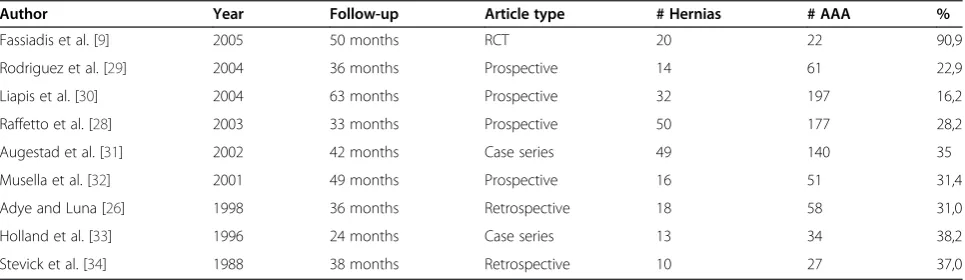
One specific group of high-risk patients are patients with an AAA. Aortic aneurysm is considered to be related to a type of connective tissue disorder. The connective tissue in these patients is thought to be compromised, playing an important role in the pathogenesis of an aneurysmal distension of the aorta. Healing of the midline fascia after laparotomy may be compromised due to for-mation of collagen with insufficient strength. Sutures can tear through the fascia and defects can develop in the ab-dominal wall. The relationship between aortic aneurysm and other abdominal wall hernias, like inguinal hernias, has been reported [26-28]. Retrospective and prospective studies have shown an average risk for incisional hernia after AAA repair of about 30% (Table 1) [9,26,28-34].
Another high risk group is the group of obese patients [5]. Patients with a BMI of 30 or more have a high risk of developing an incisional hernia after midline incision, with an incidence of 22% after 12 months [5,13]. Most recent lit-erature is showing us that even a BMI of more than 27 gives a 20% risk for developing an incisional hernia after midline laparotomy [35]. Considering only 50% of incisional hernia will be clinically evident in the first 12 months, the total incidence is likely to be above 30%. It is known from the study of Burger et al. that an extensive follow up time of up to 10 years is needed to evaluate outcome in hernia surgery [7]. A tailored approach might be necessary, since hernia formation is multifactorial. Thus, the above mentioned high-risk group of patients with obesity and aneurysmal disease can benefit most from prevention.
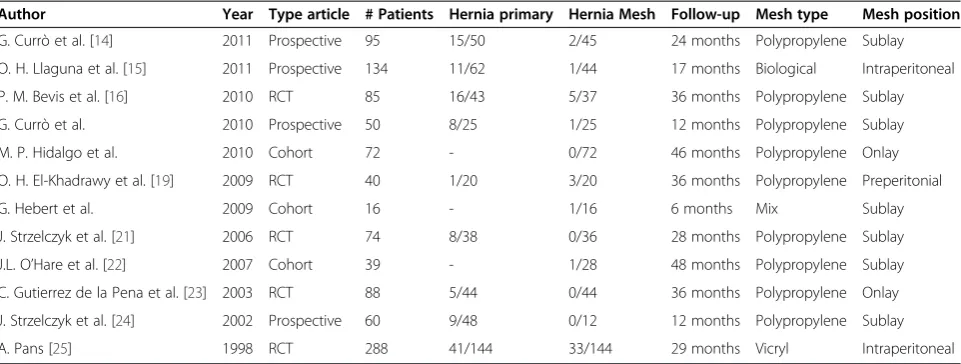
Some small studies have been performed to evaluate the effect and safety of primary laparotomy wound clos-ure with the aid of prosthetic mesh (Table 2) [14-25]. These studies show a very low risk for incisional hernia and a low infection rate, even when used in contami-nated area’s, as seen in colostomy surgery. However, no high quality and adequately powered randomized con-trolled trial has been performed to evaluate the impact of prophylactic mesh augmentation for prevention of
incisional hernia in high risk patients. This is the reason
that the PRImary Mesh Closure of Abdominal Midline
Wound (PRIMA) trial is being conducted.
Objective
The objective of this study is to evaluate the effectiveness of incisional hernia prevention in patients after laparot-omy for aortic aneurysm and in obese patients with a BMI of more than 27. A double blind randomized controlled trial will compare the commonly used technique of run-ning suture to closure with the aid of a prosthetic mesh.
The primary outcome measure will be incisional hernia occurrence 2 years postoperatively.
Secondary outcome measures will cover relevant postoperative complications, post-operative pain and quality of life.
Methods/design
Trial design
The trial is a double blinded randomized controlled inter-national multi centre trial comparing traditional closure with running slowly absorbable suture to closure with the aid of prosthetic mesh. A total of 11 centers have agreed to participate in the trial which are located in three different countries (The Netherlands, Germany and Austria). A total number of 460 patients will be included. Patients will be randomized in three groups per-operatively to either re-ceive primary closure, or mesh supported closure either in a sublay or onlay position. Patients will be kept unaware of the procedure until the endpoint of the trial was assessed. Outpatient clinic controls will be done by surgeons or sur-gical residents blinded for the procedure. Results will be stratificated by center and operation indication.
Participants
Patients meeting the inclusion criteria scheduled for elective laparotomy will be asked to participate in the
Table 1 Publications concerning risk for incisional hernia after aortic aneurysm repair with midline incision with a minimum of 2 years follow-up
Author Year Follow-up Article type # Hernias # AAA %
Fassiadis et al. [9] 2005 50 months RCT 20 22 90,9
Rodriguez et al. [29] 2004 36 months Prospective 14 61 22,9
Liapis et al. [30] 2004 63 months Prospective 32 197 16,2
Raffetto et al. [28] 2003 33 months Prospective 50 177 28,2
Augestad et al. [31] 2002 42 months Case series 49 140 35
Musella et al. [32] 2001 49 months Prospective 16 51 31,4
Adye and Luna [26] 1998 36 months Retrospective 18 58 31,0
Holland et al. [33] 1996 24 months Case series 13 34 38,2
study. After ample information has been given, patients will be asked for informed consent.
Inclusion criteria
Every elective midline laparotomy for patients with Abdominal Aortic Aneurysm AND/OR patients with a BMI of more than 27a.
Signed informed consent
Exclusion criteria
Age < 18 years
Inclusion in other trials with interference of the primary endpoint
Life expectancy less than 24 months (as estimated by the treating physician)
Pregnant women
Immune suppression therapy within 2 weeks before surgery
Bovine allergy
Registration and randomization procedure
Patients who are scheduled for operation and who have given informed consent will be registered by contacting the trial coordinator using the telephone or using the on-line inclusion randomization system. Included patient are registrated in an online data base (designed and managed by HOVON data center, Rotterdam, the Netherlands) called TOP (Trial Online Process; see http://www.prima-trial.nl). The patient name code, date of birth, name of caller, name of responsible physician, sex and eligible cri-teria will be registered. Every participating institution has its own login code.
Randomisation will take place at the end of the sched-uled operation before closing the abdomen in the oper-ating room by contacting the trial coordinator using the
telephone or using the online inclusion randomization system. The patient will stay in the randomization group on an intention to treat principle.
Intervention
Patients will be randomized for three different closing techniques (1A: primary suture closure of the midline fascia, 2B onlay mesh supported closure and 3C sublay mesh supported closure). Both mesh techniques are exten-sively used in incisional hernia surgery. However, a pow-ered randomized comparison of these two techniques has not been performed. Infection rates in these trials seem low, even in the presence of open bowel [36-41]. Because the study population will not be operated for an incisional hernia, which necessitates extended dissection of the ab-dominal wall in a previously operated area, infection rates are expected to be lower than the rates mentioned in the literature. Intra-peritoneal placement has not been consid-ered given the high risk for adhesions between viscera and mesh [42].
The mesh will be fixed to the fascia structures with fibrin sealant (Tissucol DUO 500 2,0 ml (Baxter Deutschland GmbH, Unterschließheim, Germany) in order to avoid su-tures subcutaneously, to prevent the production of seroma and to simplify the procedure [43]. Nowadays fibrin seal-ants are occasionally used in inguinal hernia surgery [44-46]. The mesh will be fixed adequately with fibrin sealant to the ventral part of linea alba and posterior rectus sheath. The Optilene Mesh LP, 6 × 35 cm, B. Braun Aesculap AG, Tuttlingen, Germany, will be used as it was shown to have an optimal fixation with fibrin sealant and to provide good tensile strength [47].
Only the first operations of each center will be super-vised by one of the PRIMA trial research fellows. If dur-ing operation an incisional hernia was discovered the patient was excluded from the trial, as the interest of this study was incisional hernia prevention, not repair.
Table 2 Publications concerning incisional hernia prevention with the aid of prosthetic mesh
Author Year Type article # Patients Hernia primary Hernia Mesh Follow-up Mesh type Mesh position
G. Currò et al. [14] 2011 Prospective 95 15/50 2/45 24 months Polypropylene Sublay
O. H. Llaguna et al. [15] 2011 Prospective 134 11/62 1/44 17 months Biological Intraperitoneal
P. M. Bevis et al. [16] 2010 RCT 85 16/43 5/37 36 months Polypropylene Sublay
G. Currò et al. 2010 Prospective 50 8/25 1/25 12 months Polypropylene Sublay
M. P. Hidalgo et al. 2010 Cohort 72 - 0/72 46 months Polypropylene Onlay
O. H. El-Khadrawy et al. [19] 2009 RCT 40 1/20 3/20 36 months Polypropylene Preperitonial
G. Hebert et al. 2009 Cohort 16 - 1/16 6 months Mix Sublay
J. Strzelczyk et al. [21] 2006 RCT 74 8/38 0/36 28 months Polypropylene Sublay
J.L. O’Hare et al. [22] 2007 Cohort 39 - 1/28 48 months Polypropylene Sublay
C. Gutierrez de la Pena et al. [23] 2003 RCT 88 5/44 0/44 36 months Polypropylene Onlay
J. Strzelczyk et al. [24] 2002 Prospective 60 9/48 0/12 12 months Polypropylene Sublay
All centers were familiar with the 4:1 suture length to wound length ratio concept although not measured. As the focus of the trial was on the effect of primary mesh augmentation versus common day practice closure, no measurements of the suture closure were done.
Group A. Primary closure of the midline
The midline fascia will be closed in all three groups with a running slowly absorbable suture(MonoPlus, USP 1, Needle HRT48, 150 cm loop, B.Braun Aesculap, Tuttlingen, Germany).The ratio of suture length to wound length of 4:1 is recommended (but not measured). Subcutaneous tissue and skin are closed in a fashion preferred by the surgeon.
Mesh supported closure
Group B. Onlay mesh supported closure
First, the midline will be closed as indicated in group A. The Optilene Mesh LP will be positioned on the pri-mary closed midline fascia with an overlap of 3 cm at each side. The mesh will then be fixed with fibrin sealant (5 ml). The fibrin sealent will be applied on the entire surface of the mesh, and in one shot having permanent contact between the mesh and the tip of the joining piece. Immediately after application of the fibrin sealant, the mesh will be smoothed with the back of a forceps to get a good fixation of the mesh on the entire surface and especially on the suture line. If present, it is also possible to use spray fixation using the EASYSPRAY system,
Deutschland GmbH, Unterschließheim, Germany. When laparotomy is larger then 25 cm use 2 applicators of Tis-sucol (10 ml). Subcutaneous tissue and skin are closed in a fashion preferred by the surgeon.
Group C. Sublay mesh supported closure
A space will be created between both posterior rectus sheaths and the rectus muscle. Both posterior rectus sheath edges are sutured using a running slowly absorbable suture,
(Monoplus, USP1, Needle HRT48, 150 cm, B. Braun Aesculap AG, Tuttlingen, Germany). A suture length to wound length ratio of 4:1 was recommended (not mea-sured). The Optilene Mesh LP will then be placed be-tween the posterior rectus sheath and the rectus muscle with an overlap of 3 cm at each side and fixed with fibrin sealant (5 ml). The fibrin sealent will be ap-plied on the entire surface of the mesh, in one shot having permanent contact between the mesh and the tip of the joining piece. Immediately after application of the fi-brin sealant, the mesh will be smoothed with the back of a forceps to get a good fixation of the mesh on the entire sur-face and especially on the suture line. If present, it is also possible to use spray fixation using the EASYSPRAY system,
Deutschland GmbH, Unterschließheim, Germany. When laparotomy is >25 cm use 2 applicators of Tissucol (10 ml). The midline anterior rectus sheath will be closed using a
running slowly absorbable suture(Monoplus, USP1, Needle HRT48, 150 cm, B. Braun Aesculap AG, Tuttlingen, Germany), covering the mesh. A suture length to wound length ratio of 4:1 was recommended (not measured). Sub-cutaneous tissue and skin will be closed in a fashion pre-ferred by the surgeon.
Postoperative treatment:
Wound drainage will not be routinely applied. Seromas do not have to be punctured or drained, but can be left untreated to resolve spontaneously.
Implementation
Pre-operative data
Date of birth
Length and weight
Smoking history (current smoker ( Y or N )
Medical history (COPD, diabetes, cardiac disease)
Preoperative Radiotherapy or chemotherapy
Preoperative corticosteroids
Postoperative corticosteroids
Previous abdominal operations
Other abdominal hernias (inguinal, umbilical, epigastric hernias)
ASA class
Width of linea alba (when pre-operative C.T. imaging is available)
Size of aneurysm and location
Epidural catheter Operation data
Type of operation
Type and length of prosthesis
Volume of fibrin sealant applied
Length of incision
Blood loss
Operation time
Antibiotic prophylaxis
Suture material
Drains and location
Thrombosis prophylaxis
Pain medication
Complications (intestinal lesions, bleeding, other) Post-operative data
Blood transfusion
Postoperative ventilation and duration
Postoperative ileus and duration
Postoperative complications:
○Wound hematoma: accumulation of blood in the wound area, which warrants surgical exploration and intervention.
○Seroma subcutaneously ○Pulmonary infections ○Ventilation problems
○Re-intervention and difficulties caused by the mesh at re-entry
○Re-admission and indication
Ultrasound examination
At 6 and 24 months ultrasound imaging will be per-formed to examine the midline for any asymptomatic clinically not detectable incisional hernias. This will pro-vide valuable information about the onset of an inci-sional hernia. Size and location of all inciinci-sional hernias noted radiographically will be registered, as well as com-plaints presented by the patients. Endpoint of this study will be at 2 years follow up. At this follow-up the pres-ence of a hernia will be investigated by physical examin-ation and ultrasound imaging.
Outpatient follow-up
The follow-up schedule is displayed in Table 3. During visits the following information will be gathered.
Outpatient clinic visit at 1, 3, 12 and 24 months ○Incisional hernia
○Wound infection ○Seroma formation ○Other wound problems ○Inguinal hernia
Ultrasound at 6 and 24 months
VAS score at 1 month
VAS scores and Quality of Life forms preoperatively ( day of operation or the day before) and at 3, 12 and 24 months
Economical evaluation
Cost effectiveness will be calculated after 2 years. The direct costs, admissions, operation costs, costs of mate-rials and treatment of complications and incisional
hernias, will be calculated. Quality Adjusted Life Years will be calculated.
An incisional hernia correction costs Є3777,-. When
100 patients are operated with the aid of a mesh in-sertion we estimate to prevent 15 incisional hernias (=Є56.655,-). One hundred meshes cost approximately Є30.000,-. We would save Є26.655,- if all incisional her-nias are repaired. We did not include all extra costs as for example visits to the general practitioner, but these will be included in our final analysis.
Statistical analysis
Three comparisons will be made leading to pair-wise com-parison at alpha = 0.017 (=0.05/3) according to Bonferroni’s correction for multiple testing. Assuming a 30% rate of in-cisional hernia in group A, and about 10% in both groups B and C, for a power of 90% comparing group A versus group B and C, 92 patients are required in group A and 164 in groups B and C. Allowing for some dropouts, 100 will be included in the control group and 180 in each ex-perimental group.
It is expected that differences between groups B and C can only be demonstrated with a very large number. Therefore it was decided to set the objective to showing “non inferiority”for onlay (group C) versus sublay (group B). Setting the non-inferiority margin at 10%, the power to show non-inferiority regarding the incidence rate of inci-sional hernia will be greater than 80%.
For the comparison of both experimental groups with the control group, Kaplan-Meier curves will be con-structed and the log-rank tests will be performed. These logrank tests will be done with stratification by center and operation indication.
For the comparison of both experimental groups B and C, the cumulative 2-years probability will be calcu-lated with the one-sided 98.3% confidence interval for the difference. Analysis will be done according to the intention-to-treat principle in comparing group A with groups B and C. For the comparison of groups B and C a per-protocol analysis will be the primary analysis.
Comparison of VAS and QOL scales between groups will be done using Repeated Measures Anova (SAS PROC
Table 3 Follow up schedule
Evaluation moments MOS SF-36 (1) EQ-5D (2) VAS score (3) Outpatient clinic Ultrasound
Pre-operative X X X
1 month X X
3 months X X X X X at 6 months
12 months X X X X
24 months X X X X X
(1) MOS SF-36: Questionnaire concerning quality of life (SF-36™Health Survey, Medical outcomes Trust, Boston, Massachusetts 02116, USA). (2) EQ-5D: Euro Qol Group quality of life questionnaire.
MIXED) with baseline value, age, gender, operation indica-tion and center as covariates.
The following putative risk factors regarding incisional hernia (smoking, infection, diabetes, corticosteroids) will be evaluated using Cox-regression.
Serious Adverse Event (SAE) reporting & Monitoring
A SAE will be reported to the Dutch Department for Human Research (Centrale Commissie Mensgebonden Onderzoek), Baxter and Braun within 24 hours.
Requirements for SAE reporting will be:
1. (Prolonged) Hospitalisation (difined as a longer stay in the hospital than normally expected caused by a postoperative complication)
2. (Re-)operation 3. Death
Once a year, data from each center will be monitored. In compliance with GCP guidelines, monitors will verify data collected on data collection forms against source documents. Source documents are defined as any ori-ginal records or data related to the trial or to subject treatment or medical history. Source documents include: original hospital, clinical, and office charts, laboratory notes, subject diaries or evaluation checklists, pharmacy records, recorded data from automated instruments, transcriptions (certified to be accurate after verification), magnetic media, or x-rays.
Ethics
Before centers could participate in this trial, approval was obtained from the local medical ethics committee (Medische Ethische Toetsings Commissie, Erasmus MC). Patients will be extensively informed about the research project and can only participate after giving informed con-sent. Patients will always be permitted to withdraw from the study without providing further reasons. This will have no consequences for further treatment. Data of these pa-tients will be evaluated in the final analysis. This trial was registered at Clinical trial.gov under NCT00761475.
History and current status
After Ethical approval was obtained the trial started cluding patients in the middle of 2009. Initially the in-take of patients was rather slow. This was attributed to the the low number of participating hospitals, the con-tinued increase of laparoscopy and endovascular treat-ment, and the inclusion criteria of BMI >30. After the publication of Seiler et al. the BMI inclusion criteria were lowered from 30 to 27 [35]. The BMI amendment and the inclusion of additional participating hospitals made it possible to include more patients per month. Currently the trial is in the final stage of the inclusion of
patients. It is estimated that the last patients will be seen in the outpatient clinic in the beginning of 2015. Around this time the final results will be subjected to peer-review for publication.
Discussion
Incisional hernia continues to be one of the most frequent complications after laparotomy. Up to this date no inter-vention strategy has led to a resolution to this problem. In high risk patients, with a risk for incisional hernia more than 30%, an alternative technique with lower incisional hernia incidence would be highly desirable.
In daily practice almost all midline laparotomies are closed with slowly absorbable running sutures. This technique seems ample for low risk patients. Despite the high incidence of incisional hernia, this technique is still used in high risk patients. These patients are known to have altered collagen synthesis in wound repair or in-creased abdominal wall stress, leading to insufficient re-pair of the midline after operation.
In incisional hernia surgery the use of prosthetic mesh has proven its effectiveness and safety. For this reason a RCT investigating the effectiveness and safety of aug-menting the closure of the midline with prosthetic mesh in high risk patients is being conducted. A high level of evidence will be obtained due to the design of the study, as it was a randomized, double blind, powered, multi-center study.
Conclusion
The PRIMA trial is a prospective international multicen-ter double blind randomized trial comparing primary su-ture closure of midline laparotomy to closure aided with a prosthetic mesh. This trial might provide the surgical society a technique to prevent incisional hernia in high risk patients.
Endnote a
The initial inclusion criteria featured patients with a BMI of 30 or higher. However as stated before, a study was published during the enrolment of this trial demon-strating that patients with a BMI 27 or more could also be included [35]. We amended our protocol to lower our inclusions criteria for BMI, from 30 to 27.
Appendix
Criteria for defining a Surgical Site Infection (SSI) [49]
Superficial Incisional SSI
Infection occurs within 30 days after the operation and
infection involves only skin or subcutaneous tissue of the incisionandat leastoneof the following:
2. Organisms isolated from an aseptically obtained culture of fluid or tissue from the superficial incision. 3. At least one of the following signs or symptoms of
infection: pain or tenderness, localized swelling, redness or heatandsuperficial incision is deliberately opened by surgeon,unlessincision is culture-negative. 4. Diagnosis of superficial incisional SSI by the
surgeon or attending physician.
5. Do not report the following conditions as SSI: 6. Stitch abscess (minimal inflammation and discharge
confined to the points of suture penetration). 7. Incisional SSI that extends into the fascial and
muscle layers (see deep incisional SSI).
Deep incisional SSI
Infection occurs within 30 days after the operation if no implant is left in place or within 1 year if implant is in place and the infection appears to be related to the oper-ationandinfection involves deep soft tissue (e.g., fascial and muscle tissue) of the incisionandat leastoneof the following:
1. Purulent drainage from the deep incision but not from the organ/space component of the surgical site. 2. A deep incision spontaneously dehisces or is
deliberately opened by a surgeon when the patient has at least one of the following signs or symptoms: fever (>38°C), localized pain, or tenderness, unless site is culture negative.
3. An abscess or other evidence of infection involving the deep incision is found on direct examination, during re-operation, or by histopathologic or radiological examination.
4. Diagnosis of a deep incisional SSI by a surgeon or attending physician.
Notes:
1. Report infection that involves both superficial and deep incision sites as deep incisional SSI.
2. Report an organ/space SSI that drains through the incision as a deep incisional SSI.
Organ/Space SSI
Infection occurs within 30 days after the operation if no implant is left in place or within 1 year if implant is in place and the infection appears to be related to the oper-ationand infection involves any part of the anatomy (e. g., organs or spaces), other than the incision, which was
opened or manipulated during an operationandat least
oneof the following:
1. Purulent drainage from drain that is placed through a stab wound into the organ/space.
2. Organisms isolated from an aseptically obtained culture of fluid or tissue in the organ space. 3. An abscess or other evidence of infection involving
the organ/space that is found on direct examination, during reoperation, or by histopathologic or radiologic examination.
4. Diagnosis of a deep organ/space SSI by a surgeon or attending physician.
Competing interests
This study was supported by B. Braun Aesculap GmbH, Tuttlingen, Germany and Baxter Deutschland GmbH, Unterschließheim, Germany. None of these sponsors were involved in the design, conduct or analysis of the study. Disclosure: The authors declare no other conflict of interest.
Authors’contributions
JN drafted the original protocol and wrote the protocol manuscript, HHE drafted following procotol amendments and was involged in patient inclusion and data gathering, LT drafted following procotol amendments and was involved in patient inclusion and data gathering, WCJH is the trial statistician and performed the power analysis and was responsible for the trial methodology, GJK was involved in writing of the first manuscript and all following amendments, JJis initiator and creator of the PRIMA trial and was involved in writing of the first manuscript and all following amendments, J. F. Lange is initiator and creator of the PRIMA trial and was involved in writing of the first manuscript and all following amendments, PRIMA Trialist group were all responsible for including patients, organizing and conducting follow-up. All authors read and approved the final manuscript.
Acknowledgements
PRIMA Trialist Group
C.W. Burger, Department of Gynecology, Erasmus MC, Rotterdam, The Netherlands
H.J. Verhagen, Department of Surgery, Erasmus MC, Rotterdam, The Netherlands
D. de Jong, Department of Gynecology, Erasmus MC, Rotterdam, The Netherlands
P.J. Klitsie, Department of Surgery, Erasmus MC, Rotterdam, The Netherlands E.G. Pierik, Department of Surgery, Isala Clinics, Zwolle, The Netherlands S.S. Lases Department of Surgery, Isala Klinieken, Zwolle, The Netherlands A.C. van der Ham Department of Surgery, Sint Franciscus Gasthuis, Rotterdam, The Netherlands
J.J. Harlaar Department of Surgery, Sint Franciscus Gasthuis, Rotterdam, The Netherlands
J.A. Charbon Department of Surgery, Maxima MC, Veldhoven, The Netherlands B. Leenders Department of Surgery, Maxima MC, Veldhoven, The Netherlands I. Dawson Department of Surgery, IJsseland ziekenhuis,Cappele aan de IJssel, The Netherlands
M. van den Berg Department of Surgery, Scheper ziekenhuis, Emmen, The Netherlands
N.J. Harlaar Department of Surgery, Scheper ziekenhuis, Emmen, The Netherlands
C.M Seiler Department of Surgery, Sinsheim Klinikum, Sinsheim, Germany M.W Buchler Department of Surgery, Universitätsklinikum Heidelberg, Heidelberg, Germany
M.K Diener Department of Surgery, Universitätsklinikum Heidelberg, Heidelberg, Germany
C. Schuhmacher Department of Surgery, Ludwig-Maximilians-Universität München, München, Germany
A.L Mihaljevic Department of Surgery, Ludwig-Maximilians-Universität München, München, Germany
J.R. Izbicki Department of Surgery Universitätsklinikum Hamburg-Eppendorf, Hamburg, Germany
A. Kutup Department of Surgery Universitätsklinikum Hamburg-Eppendorf, Hamburg, Germany
P. Neuhaus Department of Surgery, Universitätsmedizin Berlin: Charité, Berlin, Germany
M. Golling Department of Surgery, Diakonie-Klinikum Schwäbisch Hall, Schwäbisch Hall, Germany
D. Laux Department of Surgery, Diakonie-Klinikum Schwäbisch Hall, Schwäbisch Hall, Germany
R. Fortelny Department of Surgery, Allgemeines Krankenhaus der Stadt Wien, Vienna, Germany
C. May, Department of Surgery, Allgemeines Krankenhaus der Stadt Wien, Vienna, Germany
Author details
1Department of Surgery, LUMC, Leiden, The Netherlands.2Department of
Surgery, Erasmus MC, Rotterdam, The Netherlands.3Department of Epidemiology, Erasmus MC, Rotterdam, The Netherlands.4Department of
Neuroscience, Erasmus MC, Rotterdam, The Netherlands.
Received: 2 April 2013 Accepted: 26 September 2013 Published: 28 October 2013
References
1. Anthony T, Bergen PC, Kim LT, Henderson M, Fahey T, Rege RV, Turnage RH: Factors affecting recurrence following incisional herniorrhaphy. World J Surg2000,24:95–100. discussion 101.
2. Manninen MJ, Lavonius M, Perhoniemi VJ:Results of incisional hernia repair. A retrospective study of 172 unselected hernioplasties.Eur J Surg 1991,157:29–31.
3. Paul A, Korenkov M, Peters S, Kohler L, Fischer S, Troidl H:Unacceptable results of the Mayo procedure for repair of abdominal incisional hernias. Eur J Surg1998,164:361–367.
4. Read RC, Yoder G:Recent trends in the management of incisional herniation.Arch Surg1989,124:485–488.
5. Hoer J, Lawong G, Klinge U, Schumpelick V:[Factors influencing the development of incisional hernia. A retrospective study of 2,983 laparotomy patients over a period of 10 years] Einflussfaktoren der Narbenhernienentstehung. Retrospektive Untersuchung an 2.983 laparotomierten Patienten uber einen Zeitraum von 10 Jahren. Chirurg2002,73:474–480.
6. Mudge M, Hughes LE:Incisional hernia: a 10 year prospective study of incidence and attitudes.Br J Surg1985,72:70–71.
7. Burger JW, Luijendijk RW, Hop WC, Halm JA, Verdaasdonk EG, Jeekel J: Long-term follow-up of a randomized controlled trial of suture versus mesh repair of incisional hernia.Ann Surg2004,240:578–583. discussion 583–575.
8. Luijendijk RW, Hop WC, van den Tol MP, de Lange DC, Braaksma MM JNIJ, Boelhouwer RU, de Vries BC, Salu MK, Wereldsma JC,et al:A comparison of suture repair with mesh repair for incisional hernia. N Engl J Med2000,343:392–398.
9. Fassiadis N, Roidl M, Hennig M, South LM, Andrews SM:Randomized clinical trial of vertical or transverse laparotomy for abdominal aortic aneurysm repair.Br J Surg2005,92:1208–1211.
10. Langer C, Schaper A, Liersch T, Kulle B, Flosman M, Fuzesi L, Becker H: Prognosis factors in incisional hernia surgery: 25 years of experience. Hernia2005,9:16–21.
11. Sauerland S, Korenkov M, Kleinen T, Arndt M, Paul A:Obesity is a risk factor for recurrence after incisional hernia repair.Hernia2004,8:42–46. 12. Sorensen LT, Hemmingsen UB, Kirkeby LT, Kallehave F, Jorgensen LN:
Smoking is a risk factor for incisional hernia.Arch Surg2005,140:119–123. 13. Sugerman HJ, Kellum JM Jr, Reines HD, DeMaria EJ, Newsome HH, Lowry
JW:Greater risk of incisional hernia with morbidly obese than steroid-dependent patients and low recurrence with prefascial polypropylene mesh.Am J Surg1996,171:80–84.
14. Curro G, Centorrino T, Musolino C, Sarra G, Navarra G:Incisional hernia prophylaxis in morbidly obese patients undergoing biliopancreatic diversion.Obes Surg2011,21:1559–1563.
15. Llaguna OH, Avgerinos DV, Nagda P, Elfant D, Leitman IM, Goodman E: Does prophylactic biologic mesh placement protect against the development of incisional hernia in high-risk patients?World J Surg2011, 35:1651–1655.
16. Bevis PM, Windhaber RA, Lear PA, Poskitt KR, Earnshaw JJ, Mitchell DC: Randomized clinical trial of mesh versus sutured wound closure after open abdominal aortic aneurysm surgery.Br J Surg2010,97:1497–1502.
17. Curro G, Centorrino T, Low V, Sarra G, Navarra G:Long-term outcome with the prophylactic use of polypropylene mesh in morbidly obese patients undergoing biliopancreatic diversion.Obes Surg2012,22:279–282. 18. Hidalgo MP, Ferrero EH, Ortiz MA, Castillo JM, Hidalgo AG:Incisional hernia
in patients at risk: can it be prevented?Hernia2011,15:371–375. 19. El-Khadrawy OH, Moussa G, Mansour O, Hashish MS:Prophylactic
prosthetic reinforcement of midline abdominal incisions in high-risk patients.Hernia2009,13:267–274.
20. Herbert GS, Tausch TJ, Carter PL:Prophylactic mesh to prevent incisional hernia: a note of caution.Am J Surg2009,197:595–598. discussion 598. 21. Strzelczyk JM, Szymanski D, Nowicki ME, Wilczynski W, Gaszynski T,
Czupryniak L:Randomized clinical trial of postoperative hernia prophylaxis in open bariatric surgery.Br J Surg2006,93:1347–1350. 22. O’Hare JL, Ward J, Earnshaw JJ:Late results of mesh wound closure after
elective open aortic aneurysm repair.Eur J Vasc Endovasc Surg2007, 33:412–413.
23. Gutierrez de la Pena C, Medina Achirica C, Dominguez-Adame E, Medina Diez J:Primary closure of laparotomies with high risk of incisional hernia using prosthetic material: analysis of usefulness.Hernia2003,7:134–136. 24. Strzelczyk J, Czupryniak L, Loba J, Wasiak J:The use of polypropylene mesh
in midline incision closure following gastric by-pass surgery reduces the risk of postoperative hernia.Langenbecks Arch Surg2002,387:294–297. 25. Pans A, Elen P, Dewe W, Desaive C:Long-term results of polyglactin mesh
for the prevention of incisional hernias in obese patients.World J Surg 1998,22:479–482. discussion 482–473.
26. Adye B, Luna G:Incidence of abdominal wall hernia in aortic surgery. Am J Surg1998,175:400–402.
27. Pleumeekers HJ, De Gruijl A, Hofman A, Van Beek AJ, Hoes AW:Prevalence of aortic aneurysm in men with a history of inguinal hernia repair. Br J Surg1999,86:1155–1158.
28. Raffetto JD, Cheung Y, Fisher JB, Cantelmo NL, Watkins MT, Lamorte WW, Menzoian JO:Incision and abdominal wall hernias in patients with aneurysm or occlusive aortic disease.J Vasc Surg2003,37:1150–1154. 29. Rodriguez HE, Matsumura JS, Morasch MD, Greenberg RK, Pearce WH:
Abdominal wall hernias after open abdominal aortic aneurysm repair: prospective radiographic detection and clinical implications. Vasc Endovascular Surg2004,38:237–240.
30. Liapis CD, Dimitroulis DA, Kakisis JD, Nikolaou AN, Skandalakis P, Daskalopoulos M, Kostakis AG:Incidence of incisional hernias in patients operated on for aneurysm or occlusive disease.Am Surg2004,70:550–552.
31. Augestad KM, Wilsgaard T, Solberg S:[Incisional hernia after surgery for abdominal aortic aneurysm] Arrbrokk etter operasjon for abdominalt aortaaneurisme.Tidsskr Nor Laegeforen2002,122:22–24.
32. Musella M, Milone F, Chello M, Angelini P, Jovino R:Magnetic resonance imaging and abdominal wall hernias in aortic surgery.J Am Coll Surg 2001,193:392–395.
33. Holland AJ, Castleden WM, Norman PE, Stacey MC:Incisional hernias are more common in aneurysmal arterial disease.Eur J Vasc Endovasc Surg 1996,12:196–200.
34. Stevick CA, Long JB, Jamasbi B, Nash M:Ventral hernia following abdominal aortic reconstruction.Am Surg1988,54:287–289.
35. Israelsson LA, Jonsson T:Overweight and healing of midline incisions: the importance of suture technique.Eur J Surg1997,163:175–180.
36. Seiler CM, Bruckner T, Diener MK, Papyan A, Golcher H, Seidlmayer C, Franck A, Kieser M, Buchler MW, Knaebel HP:Interrupted or continuous slowly absorbable sutures for closure of primary elective midline abdominal incisions: a multicenter randomized trial (INSECT: ISRCTN24023541). Ann Surg2009,249:576–582.
37. Gogenur I, Mortensen J, Harvald T, Rosenberg J, Fischer A:Prevention of parastomal hernia by placement of a polypropylene mesh at the primary operation.DIS COLON RECTUM2006,49:1131–1135.
38. Janes A, Cengiz Y, Israelsson LA:Randomized clinical trial of the use of a prosthetic mesh to prevent parastomal hernia.BR J SURG2004, 91:280–282.
39. Janes A, Cengiz Y, Israelsson LA:Preventing parastomal hernia with a prosthetic mesh.Arch Surg2004,139:1356–1358.
40. Geisler DJ, Reilly JC, Vaughan SG, Glennon EJ, Kondylis PD:Safety and outcome of use of nonabsorbable mesh for repair of fascial defects in the presence of open bowel.Dis Colon Rectum2003,46:1118–1123. 41. Machairas A, Misiakos EP, Liakakos T, Karatzas G:Incisional hernioplasty
42. Afifi RY:A prospective study between two different techniques for the repair of a large recurrent ventral hernia: a double mesh intraperitoneal repair versus onlay mesh repair.Hernia2005,9:310–315.
43. Halm JA, De Wall LL, Steyerberg EW, Jeekel J, Lange JF:Intraperitoneal polypropylene mesh hernia repair complicates subsequent abdominal surgery.World J Surg2007,31:423–429.
44. Weinrach JC, Cronin ED, Smith BK, Collins DR Jr, Cohen BE:Preventing seroma in the latissimus dorsi flap donor site with fibrin sealant. Ann Plast Surg2004,53:12–16.
45. Lovisetto F, Zonta S, Rota E, Mazzilli M, Bardone M, Bottero L, Faillace G, Longoni M:Use of human fibrin glue (Tissucol) versus staples for mesh fixation in laparoscopic transabdominal preperitoneal hernioplasty: a prospective, randomized study.Ann Surg2007,245:222–231. 46. Hidalgo M, Castillo MJ, Eymar JL, Hidalgo A:Lichtenstein inguinal
hernioplasty: sutures versus glue.Hernia2005,9:242–244.
47. Fortelny RH, Petter-Puchner AH, Glaser KS, Redl H:Use of fibrin sealant (Tisseel/Tissucol) in hernia repair: a systematic review.Surg Endosc2012, 26:1803–1812.
48. Schug-Pass C, Lippert H, Kockerling F:Mesh fixation with fibrin glue (Tissucol/Tisseel) in hernia repair dependent on the mesh structure–is there an optimum fibrin-mesh combination?–investigations on a biomechanical model.Langenbecks Arch Surg2010,395:569–574. 49. Mangram AJ, Horan TC, Pearson ML, Silver LC, Jarvis WR:Guideline for
prevention of surgical site infection, 1999. Hospital infection control practices advisory committee.Infect Control Hosp Epidemiol1999, 20:250–278. quiz 279–280.
doi:10.1186/1471-2482-13-48
Cite this article as:Nieuwenhuizenet al.:A double blind randomized controlled trial comparing primary suture closure with mesh augmented closure to reduce incisional hernia incidence.BMC Surgery
201313:48.
Submit your next manuscript to BioMed Central and take full advantage of:
• Convenient online submission
• Thorough peer review
• No space constraints or color figure charges
• Immediate publication on acceptance
• Inclusion in PubMed, CAS, Scopus and Google Scholar
• Research which is freely available for redistribution