R E S E A R C H
Open Access
Medium-term health-related quality of life
in patients with pulmonary arterial
hypertension treated with goal-oriented
sequential combination therapy based on
exercise capacity
Akihiro Hirashiki
1,2*, Shiro Adachi
3, Naoki Okumura
3, Yoshihisa Nakano
1, Shigetake Shimokata
1, Atsuya Shimizu
2,
Hidenori Arai
2, Kenji Toba
2, Toyoaki Murohara
1and Takahisa Kondo
3Abstract
Background:Pulmonary arterial hypertension (PAH) remains a life-threatening condition, despite modern therapies. We prospectively investigated the therapeutic health-related quality of life (HRQOL) effects of goal-oriented
sequential combination therapy based on exercise capacity in patients newly diagnosed with PAH.
Methods:To examine the changes in HRQOL in PAH patients, we treated 30 patients newly diagnosed with PAH
with goal-oriented sequential combination therapy based on exercise capacity. We monitored exercise capacity by cardiopulmonary exercise testing and observed the benefit of using a peak VO2cut-off of 15 mL/kg/min to guide combination therapy. First-line treatment was an endothelin receptor antagonist (ERA); second-line treatment was the addition of a phosphodiesterase-5 inhibitor (PDE-5I). At baseline and at 3, 6, and 12 months, HRQOL was evaluated by using the eight-item Medical Outcomes Survey Short Form Health Survey.
Results:At 12 months, 100% of PAH patients were receiving an ERA, and 82% an ERA + PDE-5I. The mean physical
component summary (PCS) score was 33.5 at baseline, 41.2 at 3 months, 40.8 at 6 months, and 42.0 at 12 months, and the mean mental component summary (MCS) scores were 45.6, 47.0, 50.0, and 50.1, respectively. PCS score was significantly greater at 3 months than at baseline (P= 0.035). MCS score was comparable at 3 months and at baseline, but was significantly greater at 6 and 12 months than at baseline (P= 0.033,P= 0.028, respectively). Thus, PCS score improved soon after initiation of therapy, and MCS score improved later.
Conclusions:Together, these results suggest that goal-oriented sequential combination therapy based on exercise capacity improves HRQOL in patients with PAH.
Introduction
Pulmonary arterial hypertension (PAH) is a life-threatening condition that is associated with poor prognosis [1], despite the availability of many therapeutic options. For the treat-ment of PAH, 3 different molecular pathways can be tar-geted with 5 families of drugs: prostanoids, prostanoid
receptor agonists (i.e., selexipag), endothelin receptor antag-onists (ERAs), phosphodiesterase-5 inhibitors (PDE-5Is), and soluble guanylate cyclase stimulators [2]. Current treatment algorithms for PAH recommend early use of either an ERA or a PDE-5I as first-line treatment in patients with World Health Organization (WHO) func-tional class II or III PAH [3]. Compared with monotherapy, combination therapy improves exercise capacity and re-duces the risk of clinical worsening in PAH patients [3–6]. However, the optimum combination therapy remains con-troversial. There is increasing recognition of the value of
© The Author(s). 2019Open Access This article is distributed under the terms of the Creative Commons Attribution 4.0 International License (http://creativecommons.org/licenses/by/4.0/), which permits unrestricted use, distribution, and reproduction in any medium, provided you give appropriate credit to the original author(s) and the source, provide a link to the Creative Commons license, and indicate if changes were made. The Creative Commons Public Domain Dedication waiver (http://creativecommons.org/publicdomain/zero/1.0/) applies to the data made available in this article, unless otherwise stated. * Correspondence:[email protected]
1
Department of Cardiology, Nagoya University Graduate School of Medicine, Nagoya 466-8560, Japan
2Department of Cardiology, National Center for Geriatrics and Gerontology,
cardiopulmonary exercise testing (CPX) for guiding treat-ment in patients with pulmonary hypertension [5, 7–10]. The 2015 European Society of Cardiology and European Respiratory Society (ESC/ERS) guidelines for the diagnosis and treatment of pulmonary hypertension associate a cut-off value of peak VO2≥15 mL/min/kg with a better
prog-nosis [3].
There is also growing interest in the analysis of health-related quality of life (HRQOL) in patients with PAH [11,12]. PAH imposes a considerable strain on patients and families in terms of prognosis and treatment-related difficulties. The 36-item Medical Outcomes Study Short Form Health Surveys (SF-36) are general, non-disease-specific instruments for assessing QOL and are consid-ered useful for evaluating treatment efficacy in patients with pulmonary hypertension [13–15]. SF-36 correlates well with 6-min walking distance (6MWD) and WHO functional classification, but not with hemodynamic parameters [16]. Since the reliability and validity of the Japanese version of the SF-8 was confirmed in the gen-eral Japanese population [17], it has been used in several Japanese studies as a measure of HRQOL outcomes [18–20]. Using the Japanese version of the SF-8 allows us to compare HRQOL between patients with different diseases and to compare diseases with studies from other countries [21,22].
It has been suggested that HRQOL is associated with prognosis in patients with PAH [23]. However, little is known about the changes in QOL over time in newly di-agnosed PAH patients undergoing goal-oriented sequen-tial combination therapy. Here, we prospectively investigated the therapeutic HRQOL effects of goal-oriented sequential combination therapy based on exer-cise capacity in patients newly diagnosed with PAH.
Methods
Study design and population
This prospective study was conducted at Nagoya University Hospital, Japan, from October 2012 through March 2015. Eligible patients were 16 to 80 years old at study entry and had newly diagnosed PAH of WHO functional classes II to IV according to the ESC/ERC guideline criteria [3]. Patients
who had WHO functional class IV disease with
hemodynamic instability were immediately treated with intravenous epoprostenol, if needed.
Patients with any of the following conditions at enroll-ment were excluded: 1) pulmonary hypertension corre-sponding to group 2, 3, 4, or 5 in the classification or PAH with congenital heart disease; 2) pregnancy; 3) serum creatinine > 2.0 mg/dL; 4) history of serious chronic obstructive pulmonary disease or restrictive lung disease; 5) inability to walk without personal assistance; 6) currently receiving PAH-targeted therapy such as an ERA, a PDE-5I, or intravenous epoprostenol; 7) any
other condition that, by judgment of the physicians in charge, made enrollment inappropriate because of con-cerns for patient safety.
Informed consent
The study protocol was approved by the Ethics Review Board of Nagoya University School of Medicine (ap-proval no. 1157). After a physician-in-charge explained the study objectives, study protocol, possible adverse ef-fects of PAH-targeted drugs, measures for privacy pro-tection, and procedures for study withdrawal, all participants provided their written informed consent.
Study procedures and medical protocol
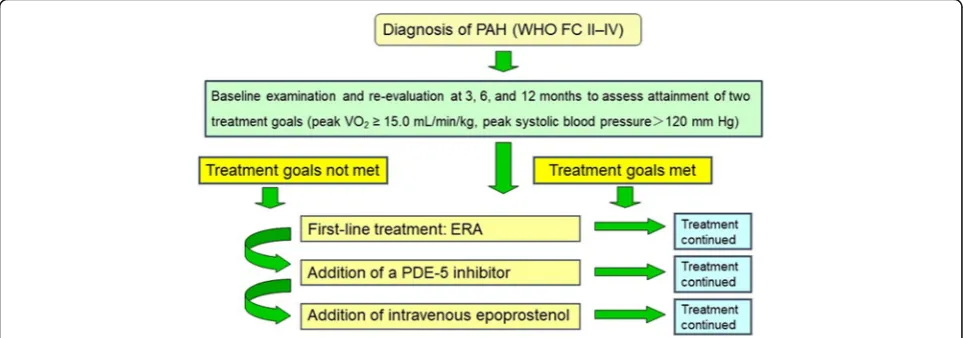
The treatment strategy for PAH in the study was per-formed a new treatment algorithm (Fig. 1). The treat-ment goal was peak VO2 > 15.0 mL/min/kg, which is
stated as providing a “better prognosis” in the 2015 ESC/ERS guidelines for the diagnosis and treatment of pulmonary hypertension [3], and peak SBP during exer-cise > 120 mmHg. Patients were considered clinically stable when both treatment goals were reached. First-line treatment was an ERA, either bosentan or ambrisentan. Second-line treatment was the addition of PDE-5I, either sildenafil or tadalafil, with intravenous epoprostenol if needed. All other drugs, including bera-prost, diuretics, digitalis, and anticoagulants, were per-mitted for use at the physician-in-charge’s discretion. Ultimately, physicians expert in treating PAH deter-mined the optimal pharmacological therapy for each pa-tient. All patients underwent cardiac catheterization at baseline and at 12 months, as well as CPX, laboratory measurement including brain natriuretic peptide (BNP), echocardiograms including tricuspid regurgitation pres-sure gradient (TRPG), and the completion of an HRQOL questionnaire at baseline and at 3, 6, and 12 months.
Dosing regimens
Bosentan was given at an initial dose of 62.5 mg twice daily for 4 weeks, and was titrated to 125 mg twice daily thereafter. Ambrisentan was started at 5 mg once daily for 4 weeks and gradually increased to 10 mg once daily thereafter in the absence of side effects and with ad-equate tolerability. Sildenafil was titrated to a maximum of 20 mg three times daily. Tadalafil was started and maintained at 40 mg once daily. Given the individual variability in responses, the choice of drug and dose to be used in each patient was left to the discretion of the treating physician. All drug regimens were adjusted as necessary to limit side effects. Patients were informed of all the available treatment options. Whenever combin-ation treatment was proposed, patients were informed of potential risks and side effects.
Questionnaire
The SF-8 survey was used for the QOL assessment. The SF-8 has one question for each health domain and was developed as an alternative to the SF-36 sur-vey (version 2) [21, 24], which is the most widely used patient-based health status survey. At baseline and at 3, 6, and 12 months, HRQOL was evaluated using the Japanese version of the SF-8 survey (stand-ard version, recall at 4 weeks). Each of the SF-8 sur-vey’s eight items represents one health profile dimension: general health perception, physical func-tioning, role functioning – physical, bodily pain, vital-ity, social functioning, mental health, and role functioning – emotional. The physical health nent summary score (PCS) and mental health compo-nent summary score (MCS) were measured using the Norm-Based Scoring method, which is based on a large-scale population study conducted in Japan [17]. Higher scores on these subscales indicate better HRQOL.
Exercise capacity
The 6MWD test is a measurement of the distance a per-son can walk in 6 min; in the present study, the 6MWD test was performed according to American Thoracic So-ciety criteria [25]. Each patient underwent CPX at a pro-gressively increasing work rate to maximal tolerance on a cycle ergometer. Oxygen and CO2 sensors were
cali-brated before each test by using gases with known O2,
N2, and CO2 concentrations. The flow sensor was also
calibrated before each test. All patients started at 10 W for a 3-min warm-up, followed by a 10-W/min ramp in-crement protocol. A 12-lead electrocardiogram was monitored continuously, and arm blood pressure was automatically measured every minute during exercise and throughout the recovery period. After achieving
peak workload, all patients pedaled at a load of 0 W for a cool-down period of at least 2 min to prevent excess venous pooling. Test termination criteria comprised pa-tient request, volitional fatigue, developed chest pain, ventricular tachycardia, suggestive ischemia (such as≥2 mm of horizontal or down-sloping ST segment depres-sion), second- or third-degree heart block, extreme hypertension, severe desaturation, and a drop in systolic blood pressure of ≥20 mmHg during exercise. A quali-fied exercise physiologist conducted each test under the supervision of a certified cardiologist. Respiratory gas-exchange variables, including VO2, CO2output (VCO2),
and minute ventilation (VE), were acquired continuously throughout CPX by using an Oxycon Pro ergospirom-eter (CareFusion Germany, H chberg, Germany), and the gas-exchange data were obtained breath-by-breath. Peak VO2and peak respiratory exchange ratio were
de-fined as the highest 30-s average values obtained during the final stage of CPX. The VE/VCO2 slope was
deter-mined by means of a linear-regression analysis of the VE and VCO2 values obtained up to the respiratory
com-pensation point during exercise.
Statistical analysis
All data are expressed as mean ± 1 standard deviation. To evaluate the effect of sequential combination ther-apy, we used repeated-measures analysis of variance to assess the change of parameters over time in all patients, excluding two who died during the study. The association between HRQOL scores and pulmon-ary vascular resistance (PVR) or plasma BNP concen-tration at baseline were analyzed by using Spearman’s correlation coefficient. All statistical analyses were performed in SPSS 17.0 v. software (SPSS, Chicago, IL, USA). A P value of < 0.05 was considered statisti-cally significant.
Results
Patient characteristics at baseline are shown in Table 1. The mean age of the 30 patients (8 male, 22 female) was 57 ± 16 years. Mean pulmonary arterial pressure at base-line was 46 ± 12 mmHg. The percentages of patients that received the different sequential combination therapies are shown in Table 2. Two patients died during the study, one due to right heart failure at 4 months, the other to cardiac sudden death at 7 months.
At baseline, no patients had received an ERA or PDE-5I; at 3 months, all patients were receiving an ERA; and at 6 months, 79% of patients were receiving both an ERA and a PDE-5I. At 12 months, all patients were still receiving an ERA, 82% were receiving both an ERA and a PDE-5I, and 1 patient (4%) was receiving intravenous epoprostenol. The changes in plasma BNP, TRPG, and 6MWD at base-line and at 3, 6, and 12 months are shown in Fig. 2.
Compared with baseline, BNP and TRPG were signifi-cantly reduced at 3 months, and were further reduced at 6 and 12 months. In contrast, 6MWD was significantly in-creased at 3 months, but was comparable at 3, 6, and 12 months. Compared with baseline, peak VO2was
signifi-cantly higher at 6 months. Mean pulmonary arterial pres-sure was significantly decreased from 45.6 mmHg at baseline to 37.7 mmHg at 12 months (P = 0.007). Mean PVR was significantly decreased from 10.1 Wood units at baseline to 5.6 Wood units at 12 months (P< 0.001).
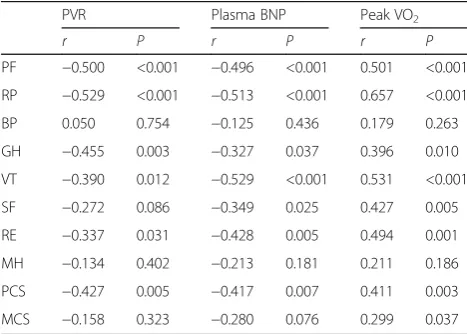
Changes in HRQOL score during the study period, as assessed by using the SF-8, are shown in Fig. 3. Treat-ment with sequential combination therapy significantly improved seven of the eight SF-8 domains except social functioning. Mean PCS scores were 33.5 at baseline, 41.2 at 3 months, 40.8 at 6 months, and 42.0 at 12 months, and mean MCS scores were 45.6, 47.0, 50.0, and 50.1, respectively (Fig. 4). The mean PCS score was signifi-cantly improved at 3 months compared with baseline (P = 0.003), but there were no significant differences in PCS score among 3, 6, and 12 months. In contrast, MCS was comparable at baseline and at 3 months (P = 0.47), but it was significantly improved at 6 and 12 months compared with baseline (P = 0.033 and P = 0.028, re-spectively). Furthermore, at baseline, PCS score was sig-nificantly correlated with PVR, plasma BNP, and peak VO2(r=−0.427,r=−0.417, andr= 0.411, respectively),
and MCS score was significantly correlated with peak VO2(r= 0.299; Table3). Significant negative correlations
with PVR, plasma BNP and peak VO2 were found for
five of the health profile dimensions (physical function-ing, role functioning – physical, general health percep-tion, vitality, and role functioning – emotional). Social functioning was significantly negatively correlated with plasma BNP and positively with peak VO2.
Discussion
This is the first study to show the therapeutic effect on HRQOL over time under sequential combination ther-apy in patients newly diagnosed with PAH. Our goal-oriented treatment used CPX to guide therapeutic deci-sions, because CPX is noninvasive and has prognostic importance [7, 26]. To date, most investigations of PAH have examined hemodynamic parameters or cardiac
Table 1Patient baseline characteristics
Age (years) 57 ± 16
Male,n(%) 8 (27)
BMI (kg/m2) 23.3 ± 4.8
WHO functional classification II/III/IV 5/15/10
Idiopathic/porto/CTD 13/6/11
Laboratory
BNP (pg/mL) * 391 (69–558)
Swan–Ganz data
RAP (mm Hg) 6.1 ± 4.2
Systolic PAP (mm Hg) 73.9 ± 20.2
Diastolic PAP (mm Hg) 28.9 ± 8.5
Mean PAP (mm Hg) 46 ± 12
PAWP (mm Hg) 9 ± 4.3
CO (L/min) 4.06 ± 1.42
CI (L/min/m2) 2.68 ± 0.93
PVR (Wood units) 11.3 ± 6.8
SvO2(%) 64.1 ± 8.9
Pulmonary Function Testing
FEV1% 76.9 ± 11.2
%VC 87.4 ± 19.8
%DLCO 61.2 ± 26.4
Cardiopulmonary Exercise Testing
Peak VO2(mL/min/kg) 12.1 ± 4.4
VE/VCO2slope 55.1 ± 20.3
Data are presented as mean ± SD or median (interquartile range)
BSABody surface area,BNPBrain natriuretic peptide,CICardiac index,CO
Cardiac output,CTDConnective tissue disease,DLCOCarbon monoxide lung
diffusing capacity,FEV1%Forced expiratory volume,PAPPulmonary arterial
pressure,PAWPPulmonary artery wedge pressure,PortoPortopulmonary hypertension,PVRPulmonary vascular resistance,RAPRight atrial pressure,
SvO2mixed venous oxygen saturation,UAUric acid,VCVital capacity,WHO
World Health Organization * Normal range for BNP, < 18.4 pg/mL
Table 2Pulmonary arterial hypertension-specific treatments used during the study
Medication Baseline 3 months 6 months 12 months
(n= 30) (n= 30) (n= 29) (n= 28)
ERA 0 30 (100%) 29 (100%) 28 (100%)
PDE-5I 0 2 (7%) 23 (79%) 23 (82%)
Epoprostenol i.v. 0 0 0 1 (4%)
ERAEndothelin receptor antagonist,PDE-5IPhosphodiesterase-5 inhibitor,i.v. Intravenous administration
function by means of cardiac catheterization at rest. However, these approaches are unsuitable for repeated assessment, and so they cannot be used to examine the efficacy of therapeutic regimens for the treatment of PAH. In addition, most patients with PAH become
breathless only during exercise, and resting
hemodynamic data are not enough to reflect dyspnea on effort in daily life or to predict prognosis. Indeed, QOL is associated with a prognostic marker in patients with PAH [23]. Therefore, we examined the efficacy of
goal-oriented sequential combination therapy based on exer-cise capacity for the treatment of PAH by using the SF-8 health survey to assess HRQOL. We found that in pa-tients newly diagnosed with PAH, HRQOL was gradually improved, which suggests that HRQOL assessment could provide useful information on the efficacy of therapeutic regimens for the treatment of PAH.
Previous studies have demonstrated that the HRQOL of PAH patients is severely reduced compared with that of healthy individuals [27]. PAH patients present with Fig. 2Parameter changes during the study period. BNP, brain natriuretic peptide; 6MWD, 6-min walking distance; TRPG, tricuspid regurgitation pressure gradient
reduced physical mobility, marked dyspnea, and in-creased difficulties in social interactions [12, 13]. In-deed, our results show that HRQOL was low at baseline; however, it was gradually improved by goal-oriented sequential combination therapy based on ex-ercise capacity. In addition, several of the health pro-file dimensions examined in the SF-8 health survey were significantly negatively correlated with both BNP and PVR, which are known to reflect PAH disease se-verity [28, 29]. Together, these results suggest that re-peated assessment of HRQOL can be used to evaluate not only the severity of symptoms in daily life, but
also therapeutic response, which is consistent with the findings of previous studies [30, 31].
The SF-8 health survey is a general, non-disease-specific QOL survey used to assess symptom severity [17]. The Japanese version of the SF-8 meets the stand-ard criteria for content and for construct and criterion validity, based on a national survey of 1000 Japanese citi-zens conducted in 2002 [17]. SF-8 is a short version of SF-36 that permits comparison of HRQOL between pa-tients with different diseases or comparison of health status between patients and the general population [17, 22,32]. Compared with the SF-36, the SF-8, in combin-ation with other questionnaires, is a more practical means of evaluating the actual condition of patients and their clinical responses because of its simplicity. In the present study, three health profile dimensions—role functioning – physical, role functioning – emotional, and mental health—were low at baseline, but were sig-nificantly improved at 6 months compared with 3 months. In addition, PCS improved before MCS. De-pression is common in patients with PAH, at 55% [33]. Similarly, 6MWD was also significantly improved. To-gether, these results suggest that exercise tolerance and QOL can be improved with goal-oriented sequential combination therapy based on exercise capacity, possibly via improving hemodynamic state by noninvasive assess-ment of BNP and TRPG. Thus, physical performance was gradually improved, followed by mental status. This suggests that improvements in physical status positively influence mental status during sequential combination therapy in the medium-term. We speculate that this is because when patients notice the improvements in phys-ical function brought about by the PAH-specific therapy, their confidence improves, which in turn brings about an improvement in their mental status.
In a previous study, patients with better baseline HRQOL had better long-term outcomes, as evidenced Fig. 4Changes in mean physical component summary (PCS) score and mental component summary (MCS) score during the study period
Table 3Correlation between SF-8 health profile dimensions and PVR, BNP, and Peak VO2at baseline
PVR Plasma BNP Peak VO2
r P r P r P
PF −0.500 <0.001 −0.496 <0.001 0.501 <0.001
RP −0.529 <0.001 −0.513 <0.001 0.657 <0.001
BP 0.050 0.754 −0.125 0.436 0.179 0.263
GH −0.455 0.003 −0.327 0.037 0.396 0.010
VT −0.390 0.012 −0.529 <0.001 0.531 <0.001
SF −0.272 0.086 −0.349 0.025 0.427 0.005
RE −0.337 0.031 −0.428 0.005 0.494 0.001
MH −0.134 0.402 −0.213 0.181 0.211 0.186
PCS −0.427 0.005 −0.417 0.007 0.411 0.003
MCS −0.158 0.323 −0.280 0.076 0.299 0.037
PVRPulmonary vascular resistance,BNPBrain natriuretic peptide Health-related quality of life was assessed by using the Medical Outcomes Study Short Form Health Survey (SF-8), which consists of eight items, each representing one health profile dimension:PFPhysical functioning;RPRole functioning–physical,BPBodily pain,GHGeneral health perception,VT
Vitality,SFSocial functioning,RERole functioning–emotional; andMHMental health. Physical component summary (PCS) and mental component summary (MCS) scores were compared with demographically adjusted United States norms and with historical controls
by a reduced risk of morbidity and mortality compared with patients whose PCS and MCS scores were less than the median baseline values [30]. In addition, PCS and MCS scores are both significantly associated with sur-vival [31]. These data suggest that a primarily noninva-sive treatment strategy and the use of combination therapy may yield acceptable results with regard to HRQOL in the majority of patients with PAH. The treat-ment strategy used included a period to check the side effects of each medication, and therapeutic decisions were based on physicians’experience as well as on prac-ticability and economic considerations. However, in clin-ical practice, we may need to comprehensively assess WHO functional class, 6MWD, and BNP response to therapy to decide whether additional therapy is required [34]. Therefore, further studies are needed to define the variables most useful for clinical decision-making as well as the treatment options that provide the best long-term results for patients with PAH.
The five patients who received only ERA improved to WHO-FC I or II and remained clinically stable without cardiac event; PDE-5Is were contraindicated in one of these patients because she was receiving amiodarone for the treatment of non-sustained ventricular tachycardia. The average peak VO2among the ERA-only patients
in-creased from 12.5 mL/kg/min at baseline to 17.4 mL/kg/ min at 12 months, and the mean pulmonary arterial pressure decreased from 42.5 mmHg at baseline to 27.7 mmHg at 12 months. We believe that in this subgroup of PAH patients, monotherapy was the appropriate choice for at least 12 months, so our CPX-guided goal-based treatment strategy might avoid excess medication and cost while still providing adequate intervention by enabling treatment to be tailored to the individual patient.
At the start of the study, beraprost had already been used in 37% of the subjects. This drug is the first chem-ically stable, orally active prostacyclin analog approved for the treatment of PAH [35,36], but its clinical effects subside after only half a year of use [37,38]. Beraprost is currently approved for the treatment of PAH in Japan and South Korea, but worldwide the evidence level for the effectiveness of beraprost is low. Because hemodynamic parameters at baseline did not differ sig-nificantly between PAH patients who received beraprost and those who did not (data not shown), we excluded it from the goal-oriented sequential combination therapy.
There are several limitations to our study. First, the study was performed in a small number of patients and had short follow-up periods. However, since the study population included only patients newly diagnosed with PAH, we believe that the results obtained from this study are important for the treatment of newly diag-nosed PAH. Second, we used the SF-8 survey instead of
the SF-36; the SF-8 may not be appropriate for individ-ual patient assessment and treatment decisions and may instead be better suited to population assessment [17, 21]. Also, we did not use PAH-specific HRQOL mea-sures such as the ERS or REVEAL risk assessment calcu-lators [34], which might produce different results compared with the SF-8. However, the SF-8 did detect a therapeutic effect of sequential combination therapy, which suggests that it can be used to monitor HRQOL in patients with PAH in the medium-term. Third, none of the patients underwent cardiac rehabilitation. Exercise training can have a positive impact on short-term func-tioning in certain patients with pulmonary hypertension [39]; therefore, if these patients had undergone cardiac rehabilitation, their exercise capacity might have been further improved.
Conclusions
In patients with PAH, the PCS score improved relatively soon after the initiation of PAH-specific therapy, followed later by the MCS score. Goal-oriented sequential combin-ation therapy based on exercise capacity might be useful for improving HRQOL in patients with PAH. HRQOL as-sessment provided useful information on the efficacy of this therapeutic regimen in patients with PAH.
Abbreviations
6MWD:6-min walking distance; BNP: Brain natriuretic peptide; CPX: Cardiopulmonary exercise testing; ERAs: Endothelin receptor antagonists; HRQOL: Health-related quality of life; MCS: Mental health component summary score; PAH: Pulmonary arterial hypertension; PCS: Physical health component summary score; PDE-5Is: Phosphodiesterase-5 inhibitors; PVR: Pulmonary vascular resistance; SF-8,−36: 8- and 36-item Medical Outcomes Study Short Form Health Surveys; TRPG: Tricuspid regurgitation pressure gradient; VE: Minute ventilation; WHO: World Health Organization
Acknowledgements
We express our sincere appreciation to all the patients, collaborating physicians, and other medical staff for their important contributions to the present study.
Authors’contributions
Author GL proposed this study and prepared the data collection, author ZY drafted the manuscript and performed the data analysis, author NL supervised the data collection and edited the manuscript, author JB contributed to the data analysis and edited the manuscript. All authors read and approved the final manuscript. AH contributed to the design, acquisition, analysis, and interpretation of the data, and revised the manuscript for important scientific content. SA, NO, and SS contributed to the acquisition, analysis, and interpretation of the data. AS, HA, KT, TM, and TK supervised the data collection and edited the manuscript.. All authors have read and approved the final manuscript.
Funding
This study was cofunded by the EuroQol Group and Peking University’s China Center for Health Economic Research.
Availability of data and materials
Ethics approval and consent to participate
All procedures performed in studies involving human participants were in accordance with the ethical standards of Nagoya Graduate School of Medicine University and with the 1964 Helsinki declaration and its later amendments or comparable ethical standards. A waiver of the informed consent was approved as this study did not provide any intervention to participants. Participants can withdraw at any time without any consequences.
Consent for publication
All authors have agreed to publish this study.
Competing interests
Akihiro Hirashiki used to belong to a department endowed by Actelion Pharmaceuticals Japan, Ltd. Both Takahisa Kondo, Naoki Okumura and Shiro Adachi belong to a department endowed by Actelion Pharmaceuticals Japan, Ltd.
Author details
1Department of Cardiology, Nagoya University Graduate School of Medicine,
Nagoya 466-8560, Japan.2Department of Cardiology, National Center for
Geriatrics and Gerontology, 7-430, Morioka-cho, Obu, Aichi, Morioka 474-8511, Japan.3Department of Advanced Medicine in Cardiopulmonary
Disease, Nagoya University Graduate School of Medicine, Nagoya 466-8560, Japan.
Received: 14 November 2018 Accepted: 10 June 2019
References
1. Thenappan T, Shah SJ, Rich S, Tian L, Archer SL, Gomberg-Maitland M. Survival in pulmonary arterial hypertension: a reappraisal of the NIH risk stratification equation. Eur Respir J. 2010;35(5):1079–87.
2. Hill NS, Cawley MJ, Heggen-Peay CL. New therapeutic paradigms and guidelines in the Management of Pulmonary Arterial Hypertension. J Manag Care Spec Pharm. 2016;22(3 Suppl A):S3–21.
3. Galie N, Humbert M, Vachiery JL, Gibbs S, Lang I, Torbicki A, et al. 2015 ESC/ ERS guidelines for the diagnosis and treatment of pulmonary hypertension: the joint task force for the diagnosis and treatment of pulmonary hypertension of the European Society of Cardiology (ESC) and the European Respiratory Society (ERS): endorsed by: Association for European Paediatric and Congenital Cardiology (AEPC), International Society for Heart and Lung Transplantation (ISHLT). Eur Respir J. 2015;46(4):903–75.
4. Zhu B, Wang L, Sun L, Cao R. Combination therapy improves exercise capacity and reduces risk of clinical worsening in patients with pulmonary arterial hypertension: a meta-analysis. J Cardiovasc Pharmacol. 2012;60(4):342–6.
5. Hoeper MM, Markevych I, Spiekerkoetter E, Welte T, Niedermeyer J. Goal-oriented treatment and combination therapy for pulmonary arterial hypertension. Eur Respir J. 2005;26(5):858–63.
6. Galie N, Barbera JA, Frost AE, Ghofrani HA, Hoeper MM, McLaughlin VV, et al. Initial use of Ambrisentan plus Tadalafil in pulmonary arterial hypertension. N Engl J Med. 2015;373(9):834–44.
7. Arena R, Lavie CJ, Milani RV, Myers J, Guazzi M. Cardiopulmonary exercise testing in patients with pulmonary arterial hypertension: an evidence-based review. J Heart Lung Transplant. 2010;29(2):159–73.
8. Triantafyllidi H, Kontsas K, Trivilou P, Orfanos SE, Lekakis J, Kremastinos D, et al. The importance of cardiopulmonary exercise testing in the diagnosis, prognosis and monitoring of patients with pulmonary arterial hypertension. Hell J Cardiol. 2010;51(3):245–9.
9. Hirashiki A, Adachi S, Nakano Y, Kamimura Y, Shimokata S, Takeshita K, et al. Circulatory power and ventilatory power over time under goal-oriented sequential combination therapy for pulmonary arterial hypertension. Pulm Circ. 2017;7(2):448–54.
10. Hirashiki A, Kondo T, Okumura T, Kamimura Y, Nakano Y, Fukaya K, et al. Cardiopulmonary exercise testing as a tool for diagnosing pulmonary hypertension in patients with dilated cardiomyopathy. Ann Noninvasive Electrocardiol. 2016;21(3):263–71.
11. Cenedese E, Speich R, Dorschner L, Ulrich S, Maggiorini M, Jenni R, et al. Measurement of quality of life in pulmonary hypertension and its significance. Eur Respir J. 2006;28(4):808–15.
12. Zlupko M, Harhay MO, Gallop R, Shin J, Archer-Chicko C, Patel R, et al. Evaluation of disease-specific health-related quality of life in patients with pulmonary arterial hypertension. Respir Med. 2008;102(10):1431–8. 13. Kukkonen M, Puhakka A, Halme M. Quality of life among pulmonary
hypertension patients in Finland. Eur Clin Respir J. 2016;3:26405. 14. Darocha S, Pietura R, Pietrasik A, Norwa J, Dobosiewicz A, Pilka M, et al.
Improvement in quality of life and hemodynamics in chronic
thromboembolic pulmonary hypertension treated with balloon pulmonary angioplasty. Circulation journal : official journal of the Japanese Circulation Society. 2017;81(4):552–7.
15. Urushibara T, Tanabe N, Suda R, Kato F, Kasai H, Takeuchi T, et al. Effects of surgical and medical treatment on quality of life for patients with chronic thromboembolic pulmonary hypertension. Circulation journal : official journal of the Japanese Circulation Society. 2015;79(12):2696–702. 16. Chua R, Keogh AM, Byth K, O'Loughlin A. Comparison and validation of
three measures of quality of life in patients with pulmonary hypertension. Intern Med J. 2006;36(11):705–10.
17. Fukuhara S, Suzukamo Y. Manual of the SF-8 Japanese version, (in Japanese). Kyoto:Institute for Health Outcomes and Process Evaluation Research.. 2004. 18. Shiozaki M, Hirai K, Dohke R, Morita T, Miyashita M, Sato K, et al. Measuring
the regret of bereaved family members regarding the decision to admit cancer patients to palliative care units. Psychooncology. 2008;17(9):926–31. 19. Shibata A, Oka K, Nakamura Y, Muraoka I. Recommended level of physical
activity and health-related quality of life among Japanese adults. Health Qual Life Outcomes. 2007;5:64.
20. Uramoto H, Kagami S, Iwashige A, Tsukada J. Evaluation of the quality of life between inpatients and outpatients receiving cancer chemotherapy in Japan. Anticancer Res. 2007;27(2):1127–32.
21. Ware JEKM, Dewey JE, Gandek B. How to score and interpret single-item health status measures: a manual for users of the SF-8 health survey. Lincoln, RIQualityMetric Incorporated; 2001.
22. Lefante JJ Jr, Harmon GN, Ashby KM, Barnard D, Webber LS. Use of the SF-8 to assess health-related quality of life for a chronically ill, low-income population participating in the Central Louisiana medication access program (CMAP). Quality of life research. an international journal of quality of life aspects of treatment, care and rehabilitation. 2005;14(3):665–73. 23. Fernandes CJ, Martins BC, Jardim CV, Ciconelli RM, Morinaga LK, Breda AP,
et al. Quality of life as a prognostic marker in pulmonary arterial hypertension. Health Qual Life Outcomes. 2014;12:130.
24. Tokuda Y, Okubo T, Ohde S, Jacobs J, Takahashi O, Omata F, et al. Assessing items on the SF-8 Japanese version for health-related quality of life: a psychometric analysis based on the nominal categories model of item response theory. Value in health: the journal of the International Society for Pharmacoeconomics and Outcomes Research. 2009;12(4):568–73. 25. Ross RM. ATS/ACCP statement on cardiopulmonary exercise testing. Am J
Respir Crit Care Med. 2003;167(10):1451 author reply.
26. Wensel R, Francis DP, Meyer FJ, Opitz CF, Bruch L, Halank M, et al. Incremental prognostic value of cardiopulmonary exercise testing and resting haemodynamics in pulmonary arterial hypertension. Int J Cardiol. 2013;167(4):1193–8.
27. Shafazand S, Goldstein MK, Doyle RL, Hlatky MA, Gould MK. Health-related quality of life in patients with pulmonary arterial hypertension. Chest. 2004; 126(5):1452–9.
28. Benza RL, Miller DP, Gomberg-Maitland M, Frantz RP, Foreman AJ, Coffey CS, et al. Predicting survival in pulmonary arterial hypertension: insights from the registry to evaluate early and long-term pulmonary arterial hypertension disease management (REVEAL). Circulation. 2010;122(2):164–72.
29. Benza RL, Gomberg-Maitland M, Miller DP, Frost A, Frantz RP, Foreman AJ, et al. The REVEAL registry risk score calculator in patients newly diagnosed with pulmonary arterial hypertension. Chest. 2012;141(2):354–62. 30. Mehta S, Sastry BKS, Souza R, Torbicki A, Ghofrani HA, Channick RN, et al.
Macitentan improves health-related quality of life for patients with pulmonary arterial hypertension: results from the randomized controlled SERAPHIN trial. Chest. 2017;151(1):106–18.
31. Mathai SC, Suber T, Khair RM, Kolb TM, Damico RL, Hassoun PM. Health-related quality of life and survival in pulmonary arterial hypertension. Ann Am Thorac Soc. 2016;13(1):31–9.
32. Kiyohara K, Itani Y, Kawamura T, Matsumoto Y, Takahashi Y. Changes in the SF-8 scores among healthy non-smoking school teachers after the enforcement of a smoke-free school policy: a comparison by passive smoke status. Health Qual Life Outcomes. 2010;8:44.
33. McCollister DH, Beutz M, McLaughlin V, Rumsfeld J, Masoudi FA, Tripputi M, et al. Depressive symptoms in pulmonary arterial hypertension: prevalence and association with functional status. Psychosomatics. 2010;51(4):339–e8. 34. Benza RL, Miller DP, Foreman AJ, Frost AE, Badesch DB, Benton WW, et al. Prognostic implications of serial risk score assessments in patients with pulmonary arterial hypertension: a registry to evaluate early and long-term pulmonary arterial hypertension disease management (REVEAL) analysis. J Heart Lung Transplant. 2015;34(3):356–61.
35. Okano Y, Yoshioka T, Shimouchi A, Satoh T, Kunieda T. Orally active prostacyclin analogue in primary pulmonary hypertension. Lancet. 1997; 349(9062):1365.
36. Nagaya N, Uematsu M, Okano Y, Satoh T, Kyotani S, Sakamaki F, et al. Effect of orally active prostacyclin analogue on survival of outpatients with primary pulmonary hypertension. J Am Coll Cardiol. 1999;34(4):1188–92. 37. Galie N, Manes A, Branzi A. Prostanoids for pulmonary arterial hypertension.
Am J Respir Med. 2003;2(2):123–37.
38. Barst RJ, McGoon M, McLaughlin V, Tapson V, Rich S, Rubin L, et al. Beraprost therapy for pulmonary arterial hypertension. J Am Coll Cardiol. 2003;41(12):2119–25.
39. Mereles D, Ehlken N, Kreuscher S, Ghofrani S, Hoeper MM, Halank M, et al. Exercise and respiratory training improve exercise capacity and quality of life in patients with severe chronic pulmonary hypertension. Circulation. 2006;114(14):1482–9.
Publisher’s Note