Venkatesaperumal et al. World Journal of Engineering Research and Technology
AUGMENT THE PERFORMANCE OF A SQUARE PYRAMID SOLAR
STILL USING FLY ASH PARTICLES
Prof. R. Venkatesaperumal*1, K. Syed Jafar2, V. Venkatesan3, S. Senthilnathan4 and R. Ezhilnilavan5
Department of Mechanical Engineering, Annamalai University, Chidhambaram, T N.
Article Received on 20/09/2019 Article Revised on 10/10/2019 Article Accepted on 31/10/2019
ABSTRACT
The conventional square pyramid solar still is tested with Fly ash
particles to utilize the maximum possible amount of solar energy
during noon time to increase the condensation rate. In this work,
various quantities (0.5kg, 1kg and 1.5kg) of fly ash particles are used
as a thermal energy storage material to receive and store the thermal
energy during noon time and also support the still to minimize the heat
loss through walls. The fly ash particles are effectively used in the pyramid solar still in order
to maintain the temperature difference between the absorber plate and water by absorbing the
additional quantity of solar energy during shiny hours. So, evaporation rate increases in the
pyramid solar still. The quantity of the fly ash particles in the basin will stimulate the productivity of the still and other parameters like water temperature‚ glass surface
temperature and vapour temperature etc. The experimental works have been conducted for
various quantity of water to find the optimum value and various quantity of fly ash used in
the basin of square pyramid solar still with the optimum quantity of water. Finally, the
performance of the pyramid solar still with fly ash particles is compared to the conventional
pyramid solar still under the same climate conditions. The solar productivity of the pyramid
solar still with 1.5kg of fly ash particles gives the best results among other quantities,
produces 30% more distilled water when compared with conventional pyramid solar
still(without fly ash particles).
World Journal of Engineering Research and Technology
WJERT
www.wjert.org
SJIF Impact Factor: 5.924*Corresponding Author
Prof. R.
Venkatesaperumal
Department of Mechanical
Engineering, Annamalai
University, Chidhambaram,
T N.
KEYWORDS: Square pyramid solar still; Fly ash particles; Condensation rate; thermal Energy storage material; Absorber plate; Evaporation rate; Still productivity; Glass surface
temperature; vapour temperature.
INTRODUCTION
The potable water is very much essential for human beings and all other animals and
increasing gradually with population growth and industrial revolution. So, Water purification
using solar energy is suitable and economical for drinking water production from saline or
waste water. Solar still is a device used for separation of pure water from waste water by
using solar distillation process. It is the low cost device used for providing clean drinking
water among all the devices. Generally, square pyramid solar still is made up of square
wooden box is enclosed by four triangular glass cover, in which black painted steel or copper
basin is kept inside with waste water to receive the solar thermal energy. It is well insulated
with appropriate material to minimize the heat loss through the sides and bottom of the solar
still to utilize the solar thermal energy effectively. The waste water in the basin is heated by
solar energy passing through the triangular transparent glass cover, vapour flows upward
from the hot water and condenses with inside surface of the triangular glass cover. The
purified water is collected in a measurable flask through a channel which is fitted along with
the lower edge of the transparent cover.
The conventional square pyramid solar still has a simple design and construction, low
maintenance cost and economical one, can be used in isolated area too. The average
production of a square pyramid solar still per square metre is limited to 3litres to 3.5 litres per
day. This low performance of the square pyramid solar still creates interest among the
scholars to improve the performance by novel method. The evaporation rate of saline water
from the basin depends on the rate of condensation on inside surface of triangular glass cover.
So, it is very important to avoid the heat accumulation between the basin and glass inner
surface for better productivity of the solar still. It is possible by absorbing excess amount of
heat energy during noon hours with help of thermal energy absorbing storage material. Many
investigators are attempted to improve the performance of solar still with help of energy
storage medium.
Kabeelet et al.[1] have constructed a pyramid solar still. They have used concave shaped basin, outer surface is covered by wick to increase the daily yield of simple pyramid solar
transfer in single basin square pyramid solar still. They have fixed a small DC fan inside solar
still to create constant turbulence in the flow of evaporated water vapour. Hassan et al.[3] have designed, constructed and conducted experiments in three similar square pyramids solar still
for the climatic condition of Damascus university, Syria. The pyramid solar stills have a basin
area of 0.25m2 and fabricated by 18gauge GI sheet. The bottom and side of wall of the basin are insulated with 5cm thick fibre glass enclosed by wooden frame of thickness 5cm. The
pyramidal glass cover is inclined to 45° with horizontal. For the investigation, three different
quantities of saline water were used such as 3litre, 6litre and 9litre respectively. They have
noted on hourly basis, the observations are ambient temperature, amount of distillate water,
solar radiation and wind velocity. Average daily yield found to be 3.924 l/m2 per day, 3.116 l/m2 per day and 2.408 l/m2 per day for 3litre, 6litre and 9litre of saline water in basin respectively. From the result, it is noted that the lower quantity of saline water leads to higher
productivity. Prakash et al.[4] tried a novel idea to increase the productivity of a square pyramid solar still using wick material in Tamilnadu, India. From the experiment, they have
established that yield increased by 17.68% when compared to simple pyramid solar still
without wick. The improved pyramid solar still is produced 4.82 l/m2 per day with average
still efficiency of 50.25%. A.Prakash et al.[5] fabricated and analyzednew pyramid wick-type solar still and conclude that wick type pyramid solar still 17.68% more than conventional
pyramid solar still. T. Arunkumar et al.[6] investigated the pyramid solar still with boosting mirror system to increase the yield. The efficiency of the still is increased by 15%.
R.Venkatesaperumal et al.[7] used fly ash material as thermal energy storage medium in a single basin and single slope solar still to enhance the still productivity and found that still
productivity increases around 70% while using 25kg of fly ash in the basin compared to
conventional still. M. sakthivel et al.[8] conducted many experiments in active solar still by using varying the depth of (6mm) black granite gravels as storage medium for different
quantity of waste water and improved the average still productivity per square metre nearly
0.9 litre per day for 30kg of water and 25 mm depth of black granite gravel. Hiteshpanchala
D.K. Patela et al.[9] conducted experiments in active solar still by sandstones and marble pieces inside the stills and generated 30% and 14% increment in potable water compared with
the still without storage materials. Mona et al.[10] used paraffin wax and paraffin oil as the energy storage medium in solar still and achieved 15% more productivity than passive solar
et al[13] used a mixture of sodium silicate, hydrochloric acid and graphite powder in the solar still and improved solar productivity by 49%. Madani and Zaki[14] have used rubber mate for the improvement of the still productivity. Abdel-RehimaZeinab and Lasheen Ashraf (15)
used black materials, glass, rubber, black gravels to improve the solar still productivity. The
cost ofthe pyramid solar still vary significantly with place and availability of things used for
construction. Thus, the pyramid shaped solar still seems to be more cost-effective as well as
productive than other design of solar still.
In this work, heat build-up between water and glass cover,extension of still productivity
during off sun shine hours are taken into main consideration. Various quantities of fly ash
particles are used as energy storage medium to receive and store the excess solar thermal
energy during noon time. So, rate of evaporation is also improved. Fly ash particles are
cheaply available compared with other thermal energy storage materials like nano particles,
PCM etc. So, it has been chosen for storing thermal energy during noon time and increases
the still productivity during off shining hours too.
EXPERIMENTAL SET UP
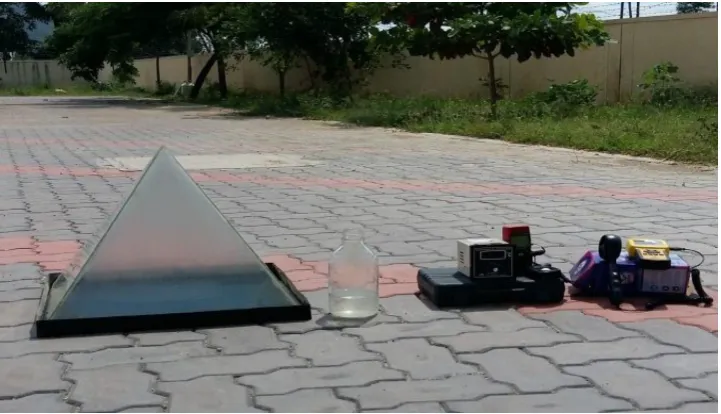
The conventional square pyramid solar still was constructed using 2mm iron sheet and has a
size 1mx1mx0.2m as shown in fig.1. The still is roofed by a four separate triangular glass
which has a thickness of 0.004m and inclined to 30° to the horizontal and pasted each other
by using polyurethane adhesive and opaque coating was given. The square basin is made up
of mild steel sheet which has a size of 0.7m x 0.7m x 0.15m and thickness is 0.002m. The
inner surface of the basin is coated with black colour to absorb the maximum solar energy.
The gap between bottom and side walls of the basin is filled with glass wool (thermal
Fig. 1: Photographic View of The Components of Pyramid Solar Still.
The experiments were carried out at Dharmapuri (13°5´2´´N, 80°16´12´´E), Tamil Nadu,
India. A Saline water storage tank is connected to square pyramid solar still through
thermally insulated supply port and a float valve. The float valve is used to maintain the
water level in the basin. A calibrated flask is used to collect the condensed water through
aluminium channel which is attached to lower end of the glass cover by using suitable
construction and one valve is placed at the bottom of the pyramid solar still to drain the saline
water. J-type thermocouples are connected to various parts of the pyramid solar still to
measure the temperatures of basin, water vapour, air space, glass inside, ambient
temperatures. The solar radiation is measured by using solarimeter with accuracy ±1W/m2.
FLY ASH PARTICLES
The development is much needed in thermal energy storage devices. The research for finding
the thermal energy storage material also plays a vital role in the solar still productivity. An
attempt has been made to construct an energy efficient square pyramid solar still with fly ash
particles which is used to absorb large amount of solar radiation during shiny hours. In this
study, coal fly ash was taken from the Mettur thermal power station, Tamil Nadu, India. The
overall chemical composition of the fly ash is tabulated in table-1 and few tests also carried
out in fly ash and the results are listed below.
Table 1: Chemical composition of FLY ASH.
Material SiO2 Al2O3 CaO MgO Fe2O3 Na2O K2O Others
Position [°2Theta] (Copper (Cu))
10 20 30 40 50 60 70 80
Counts
0 100 200 300 400 fly ash
Fig.2: XRD analysis.
EXPERIMENTAL RESULTS AND DISCUSSION
The experiments were conducted in conventional square pyramid solar still to find the
optimum depth of saline water in the basin and optimum time for maximum still productivity.
All temperatures are recorded between 9.30am to 6.30pm. Then the experiments were
conducted under the same climate conditions with various quantities of fly ash to find the
optimum quantity of fly ash for better still productivity.
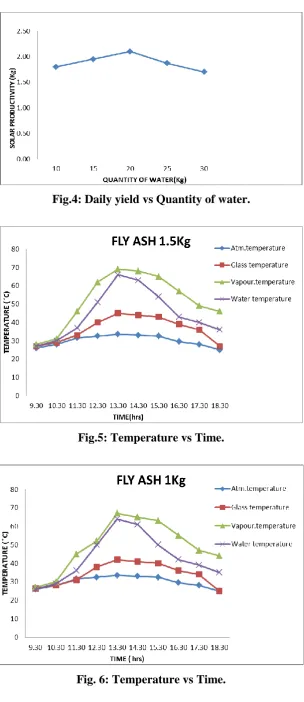
Fig.4: Daily yield vs Quantity of water.
Fig.5: Temperature vs Time.
Fig.7: Temperature vs Time.
Fig.8: Comparison of various quantities of fly ash with conventional pyramid still.
Initially, the experiments were conducted in conventional square pyramid solar still from
9.30am to 6.30pm during the month of May 2018 and found that the maximum solar intensity
was received at 1.30pm and minimum received at 6.30pm as shown in fig.3. In this study, the
experiments were conducted again in the square pyramid solar still to get the optimum value
of water quantity by varying the quantity of saline water from 10kg to 30kg in the basin and
found that the maximum still productivity is 2kg for 20kg of water in the basin and minimum
yield at 10kg of water as shown in fig 4. Fig 5 shows clearly that the variation of different
temperatures during day time for 1.5kg of fly ash from 9.30am to 6.30 pm. The maximum
water temperature is 66.5°C and maximum vapour temperature is 68.5 °C were observed at
1.30pm. The maximum ambient temperature is 31°C and maximum glass temperature is
temperatures with time for 1kg and 0.5kg of fly ash particles, the graph illustrates that all
temperatures are decreasing with reducing the quantity of fly ash in the basin. Fig.8 depicts
that maximum solar productivity occurs while using 1.5kg of fly ash in the basin and
minimum productivity occurs while using 0.5kg of fly ash. Fig.8 illustrates that yield
increases by increasing the fly ash quantity.
CONCLUSION
The square pyramid solar still was constructed, tested during day time and found that
maximum still productivity occurs at 1.30pm for 20kg of saline water while using 1.5kg of
fly ash in the basin. So, it can be concluded that the greater temperature difference
maintained between glass inner surface and water while using 1.5 kg of fly ash because of
maximum absorption of solar energy. This study describes that fly ash particles are acted as
good thermal energy storage medium effectively because it has low thermal conductivity and
high heat capacity. So, heat accumulation between water and glass cover is prevented to get
the maximum still productivity during day time. The Square pyramid with 1.5 kg of fly ash
particles produces 30 % more distilled water compared to conventional square pyramid still
without fly ash particles.
REFERENCES
1. Kabeel AE. Performance of solar still with a concave wick evaporation surface. Energy,
2009; 34: 1504–9.
2. Mahian O, Kianifar A. Mathematical modelling and experimental study of a solar
distillation system. ProcI MechE Part CJ Mech Eng Sci., 2011; 225: 1203–12.
3. Al-Hassan GA, Algarni SA. Exploring of water distillation by single solar still basins.
Am J Clim Change, 2013; 2: 57–61.
4. Prakash A, Jayprakash R, Kumar Sanjay. Experimental analysis of pyramid wicktype
solar still. Int J SciEng Res., 2016; 7(4): 1797–804.
5. A.Prakash, R.Jayaprakash, Sanjay Kumar (2016) experimental analysis of wick type
pyramid shape solar still International Journal of Scientific & Engineering Research,
April-2016; 7: 4.
6. T.Arunkumar, R. Jayaprakash, A. Prakash, P.U Suneesh, M. Karthik, Sanjay Kumar
(2010) Study of thermo physical properties and an improvement in production of distillate
yield in pyramid solar still with boosting mirror, Indian Journal of Science and
7. Venkatesaperumal.R, Syed jafar.K. ¨Study of thermal energy storage medium (Fly ash) on the performance of a solar still”, Elixir international journal, 2019; 135: 53678-53682.
8. Sakthivel.M, ShanmugasundaramM.¨Effect of energy storage medium (black granite gravel) on the performance of a solar still”. International journal of energy research, 2008.
DOI: 10.1002/er.1335
9. Panchal, Hitesh. ¨ Use of thermal energy storage materials for enhancement in distillate output of solar still”. Renewable and Sustainable Energy Reviews, 2016; 61: 86-96.
10.MonaMN, Mervat AAEK. ¨ Non- conventional solar stills with energy storage element”.
Journal of Desalination, 2002; 153: 71-80.
11.Bilal AA, Mousa SM, Omar O, Yaser E. ¨Experimentalevaluation of a single-Basin solar still using different absorbing materials”. Journal of Renewable Energy, 1998; 14:
307–310.
12.MonaMN, Mervat AAEK.¨ Non- conventional solar stills with charcoal particles as absorber medium”. Journal of Desalination, 2002; 153: 55-64.
13.P. Rajendra Prasad, Padma PujithaB, G. Venkata Rajeev and K. Vikky.¨ Energy efficient Solar Water Still”. International journal of chem tech research, 2011; 3: 1781-1787.
14.A.A. Madani, G.M. Zaki, ¨Yield of solar stills with porousbasins”, Appl. Energy, 1995;
52: 273–281.
15.S. Abdel Rehima Zeinab, Lasheen Ashraf, ¨ Improving the performance of solar desalination systems”, Renew. Energy, 2005; 30: 1955–1971.
16.Arjunan T V, Aybar H S, NedunchezhianN, Sakthivel M..¨ Effect of blue metal stones on the performance of conventional solar still”. Journal of Convergence Engineering
Technology, 2009; 1: 17-22.
17.Akashbilal A, Mohaen Mousa S, Ostaomar, Elavar Yaser.¨ Experimental evolution of a single basin solar still using different absorbing materials”. Renewable Energy, 1998; 14:
307-310.
18.Kalidasa Murugavel, SivakumarS, Riaz ashamed J, Chokalingam K N S K,
SridharK.¨Single basin double slope still with minimum basin depth and energy storing storingmaterials”. Applied Energy, 2010; 87: 514-523.
19.Panchal, Hitesh, Patel Sanjay.¨An extensive review on different design and climatic parameters to increase distillate output of solar still”. Renewable and Sustainable Energy
Reviews, 2017; 69: 750-758.
21.AsbikM, AnsariO, Bah A, ZariN, Mimet A, EI_Ghetany H.¨ Exergy analysis of solar
desalination still combined with heat storage system using phase change material desalination”. Desalination, 2016; 381: 26-37.
22.TianB, YangW, LuoL, WangJ, ZhangK, FanJ, WuJ, XingT.¨ Synergistic enhancement of
thermal conductivity for expanded graphite and carbon fiber in paraffin /EVA form stable phase change material”. Solar energy, 2016; 127: 48-55.
23.Tian, Yuan, Zhao, Chang-Ying.¨ A review of solar collectors and thermal energy storage in solar thermal applications”. App. Energy, 2013; 104: 538-553.
24.Kumarp, AslamM, SinghN, MittalS, BansalA, Jha M K, Sarma A K. ¨Characterization